ESP TOYOTA COROLLA HYBRID 2021 (in English) Repair Manual
[x] Cancel search | Manufacturer: TOYOTA, Model Year: 2021, Model line: COROLLA HYBRID, Model: TOYOTA COROLLA HYBRID 2021Pages: 584, PDF Size: 19.59 MB
Page 516 of 584
5168-2. Steps to take in an emergency
COROLLA HV_Upower switch was in before the
12-volt battery discharged, be
especially careful when recon-
necting the 12-volt battery.
■When replacing the 12-volt bat-
tery
●Use a 12-volt battery that con-
forms to European regulations.
●Use a 12-volt battery with the
same case size as the previous
12-volt battery and an equivalent
20 hour rate capacity (20HR) or
greater.
• If the sizes differ, the 12-volt bat-
tery cannot be pr operly secured.
• If the 20 hour rate capacity is low,
even if the time period where the
vehicle is not used is a short time,
the 12-volt battery may discharge
and the hybrid system may not be
able to start.
●For details, consu lt your Toyota
dealer.
WA R N I N G
■When removing the 12-volt
battery terminals
Always remove the negative (-)
terminal first. If the positive (+) ter-
minal contacts any metal in the
surrounding area when the posi-
tive (+) terminal is removed, a
spark may occur, l eading to a fire
in addition to electrical shocks
and death or serious injury.
■Avoiding 12-volt battery fires
or explosions
Observe the following precautions
to prevent accidentally igniting the
flammable gas that may be emit-
ted from the 12-volt battery:
●Make sure each jumper cable is
connected to the correct termi-
nal and that it is not unintention-
ally in contact with any other
than the intended terminal.
●Do not allow the other end of
the jumper cable connected to
the “+” terminal to come into
contact with any other parts or
metal surfaces in the area, such
as brackets or unpainted metal.
●Do not allow the + and - clamps
of the jumper cables to come
into contact with each other.
●Do not smoke, u se matches,
cigarette lighters or allow open
flame near the 1 2-volt battery.
■12-volt battery precautions
The 12-volt battery contains poi-
sonous and corrosive acidic elec-
trolyte, while related parts contain
lead and lead compounds.
Observe the following precautions
when handling the 12-volt battery:
●When working with the 12-volt
battery, always wear safety
glasses and take care not to
allow any battery fluids (acid) to
come into contact with skin,
clothing or the vehicle body.
●Do not lean over the 12-volt bat-
tery.
●In the event that battery fluid
comes into contact with the skin
or eyes, immediately wash the
affected area with water and
seek medical attention. Place a
wet sponge or cloth over the
affected area until medical
attention can be received.
●Always wash your hands after
handling the 12-volt battery sup-
port, terminals, and other bat-
tery-related parts.
●Do not allow children near the
12-volt battery.
Page 520 of 584
5208-2. Steps to take in an emergency
COROLLA HV_U
1Stop the hybrid system. Set
the parking brake and shift
the shift lever to P.
2 Remove the mud, snow or
sand from around the front
wheels.
3 Place wood, stones or some
other material under the front
wheels to help provide trac-
tion.
4 Restart the hybrid system.
5 Shift the shift lever to D or R
and release the parking
brake. Then, while exercising
caution, depress the acceler-
ator pedal.
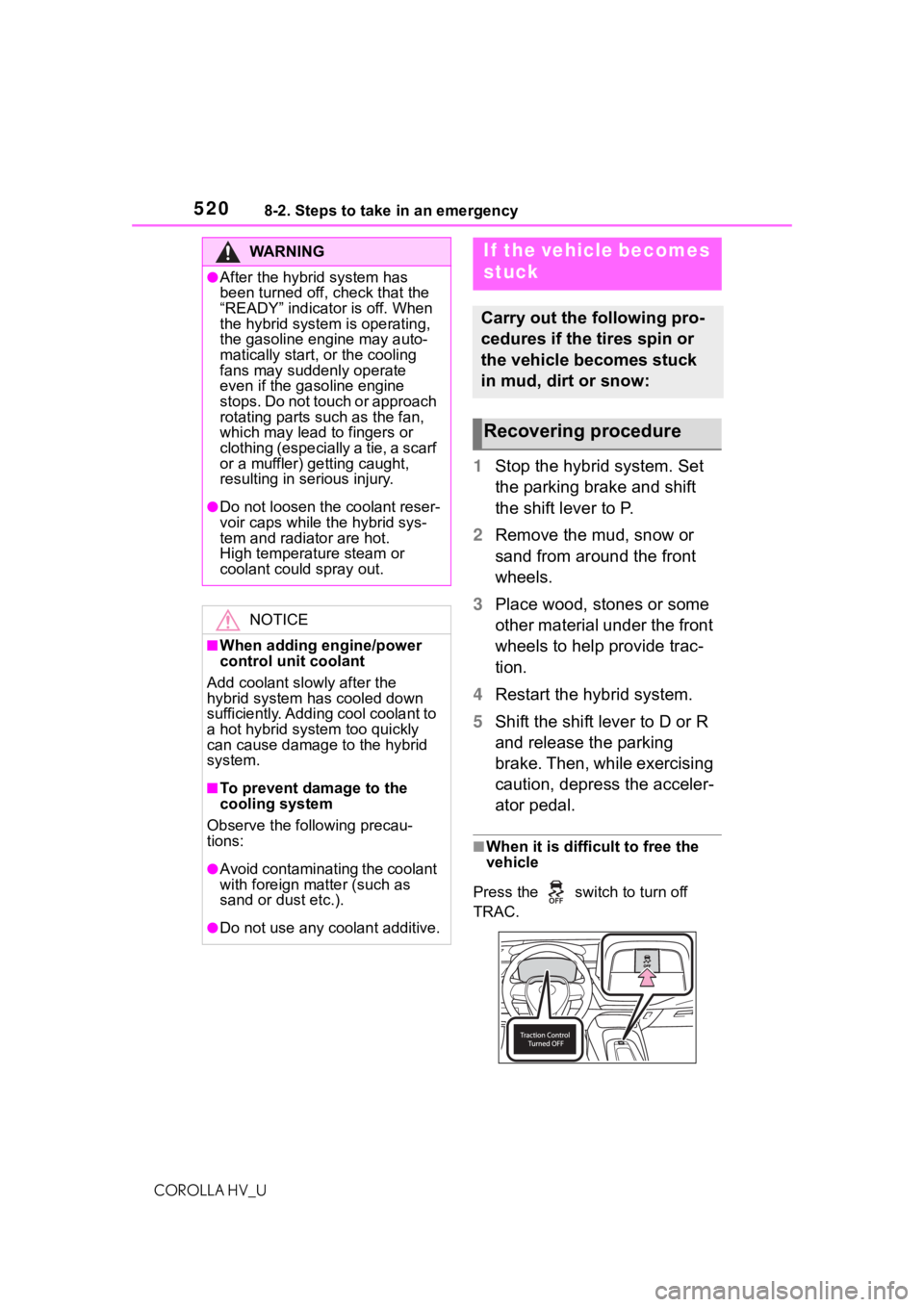
■When it is difficult to free the
vehicle
Press the switch to turn off
TRAC.
WA R N I N G
●After the hybrid system has
been turned off, check that the
“READY” indicator is off. When
the hybrid system is operating,
the gasoline en gine may auto-
matically start, o r the cooling
fans may suddenly operate
even if the gasoline engine
stops. Do not touch or approach
rotating parts such as the fan,
which may lead to fingers or
clothing (especially a tie, a scarf
or a muffler) getting caught,
resulting in serious injury.
●Do not loosen the coolant reser-
voir caps while the hybrid sys-
tem and radiator are hot.
High temperature steam or
coolant could spray out.
NOTICE
■When adding engine/power
control unit coolant
Add coolant slowly after the
hybrid system has cooled down
sufficiently. Adding cool coolant to
a hot hybrid system too quickly
can cause damage to the hybrid
system.
■To prevent damage to the
cooling system
Observe the following precau-
tions:
●Avoid contaminating the coolant
with foreign matter (such as
sand or dust etc.).
●Do not use any coolant additive.
If the vehicle becomes
stuck
Carry out the following pro-
cedures if the tires spin or
the vehicle becomes stuck
in mud, dirt or snow:
Recovering procedure
Page 537 of 584

5379-1. Specifications
COROLLA HV_U
9
Vehicle specifications
would wear one and a half (1 - 1/2)
times as well on the government
course as a tire graded 100.
The relative perfo rmance of tires
depends upon the actual conditions
of their use. Performance may differ
significantly from the norm due to
variations in driving habits, service
practices and differences in road
characteristics and climate.
■Traction AA, A, B, C
The traction grades, from high-
est to lowest, are AA, A, B and
C, and they represent the tire’s
ability to stop on wet pavement
as measured under controlled
conditions on specified govern-
ment test surfaces of asphalt
and concrete.
A tire marked C may have poor
traction performance.
Warning: The traction grade
assigned to this tire is based on
braking (straight ahead) traction
tests and does not include corner-
ing (turning) traction.
■Temperature A, B, C
The temperature grades are A (the highest), B, and C, repre-
senting the tire’s resistance to
the generation of heat and its
ability to dissipate heat when
tested under controlled condi-
tions on a specified indoor labo-
ratory test wheel.
Sustained high temperature can
cause the material
of the tire to
degenerate and reduce tire life, and
excessive temperature can lead to
sudden tire failure.
Grade C corresponds to a level of
performance which all passenger
car tires must meet under the Fed-
eral Motor Vehicle Safety Standard
No. 109.
Grades B and A represent higher
levels of performance on the labo-
ratory test wheel than the minimum
required by law.
Warning: The temperature grades
of a tire assume tha t it is properly
inflated and not overloaded.
Excessive speed, underinflation, or
excessive loading, either sepa-
rately or in combination, can cause
heat buildup and possible tire fail-
ure.
Glossary of tire terminology
Tire related termMeaning
Cold tire infl ation pressure
Tire pressure when the vehicle has been
parked for three hours or more, or has not
been driven more than 1 mile or 1.5 km
under that condition
Maximum inflation pressure
The maximum cold inf lated pressure to
which a tire may be inflated, shown on the
sidewall of the tire
Page 540 of 584
5409-1. Specifications
COROLLA HV_U
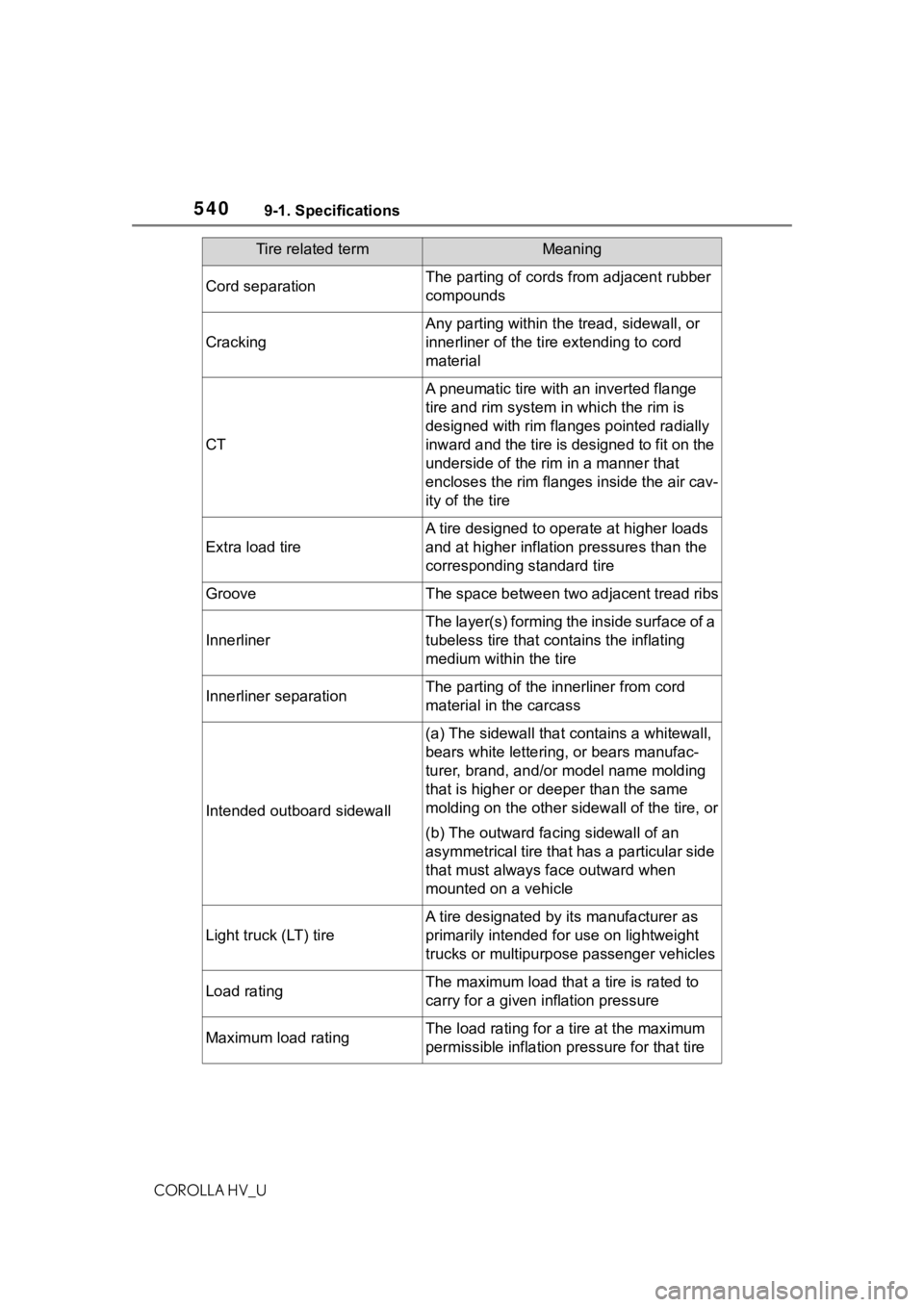
Cord separationThe parting of cords from adjacent rubber
compounds
Cracking
Any parting within the tread, sidewall, or
innerliner of the ti re extending to cord
material
CT
A pneumatic tire with an inverted flange
tire and rim system i n which the rim is
designed with rim flanges pointed radially
inward and the tire is designed to fit on the
underside of the rim in a manner that
encloses the rim flanges inside the air cav-
ity of the tire
Extra load tire
A tire designed to operate at higher loads
and at higher inflation pressures than the
corresponding standard tire
GrooveThe space between two adjacent tread ribs
Innerliner
The layer(s) forming th e inside surface of a
tubeless tire that contains the inflating
medium within the tire
Innerliner separationThe parting of the innerliner from cord
material in the carcass
Intended outboard sidewall
(a) The sidewall that contains a whitewall,
bears white lettering, or bears manufac-
turer, brand, and/or model name molding
that is higher or deeper than the same
molding on the other sidewall of the tire, or
(b) The outward facing sidewall of an
asymmetrical tire that has a particular side
that must always fa ce outward when
mounted on a vehicle
Light truck (LT) tire
A tire designated by i ts manufacturer as
primarily intended for use on lightweight
trucks or multipurpose passenger vehicles
Load ratingThe maximum load that a tire is rated to
carry for a given inflation pressure
Maximum load ratingThe load rating for a tire at the maximum
permissible inflation pressure for that tire
Tire related termMeaning
Page 541 of 584
5419-1. Specifications
COROLLA HV_U
9
Vehicle specifications
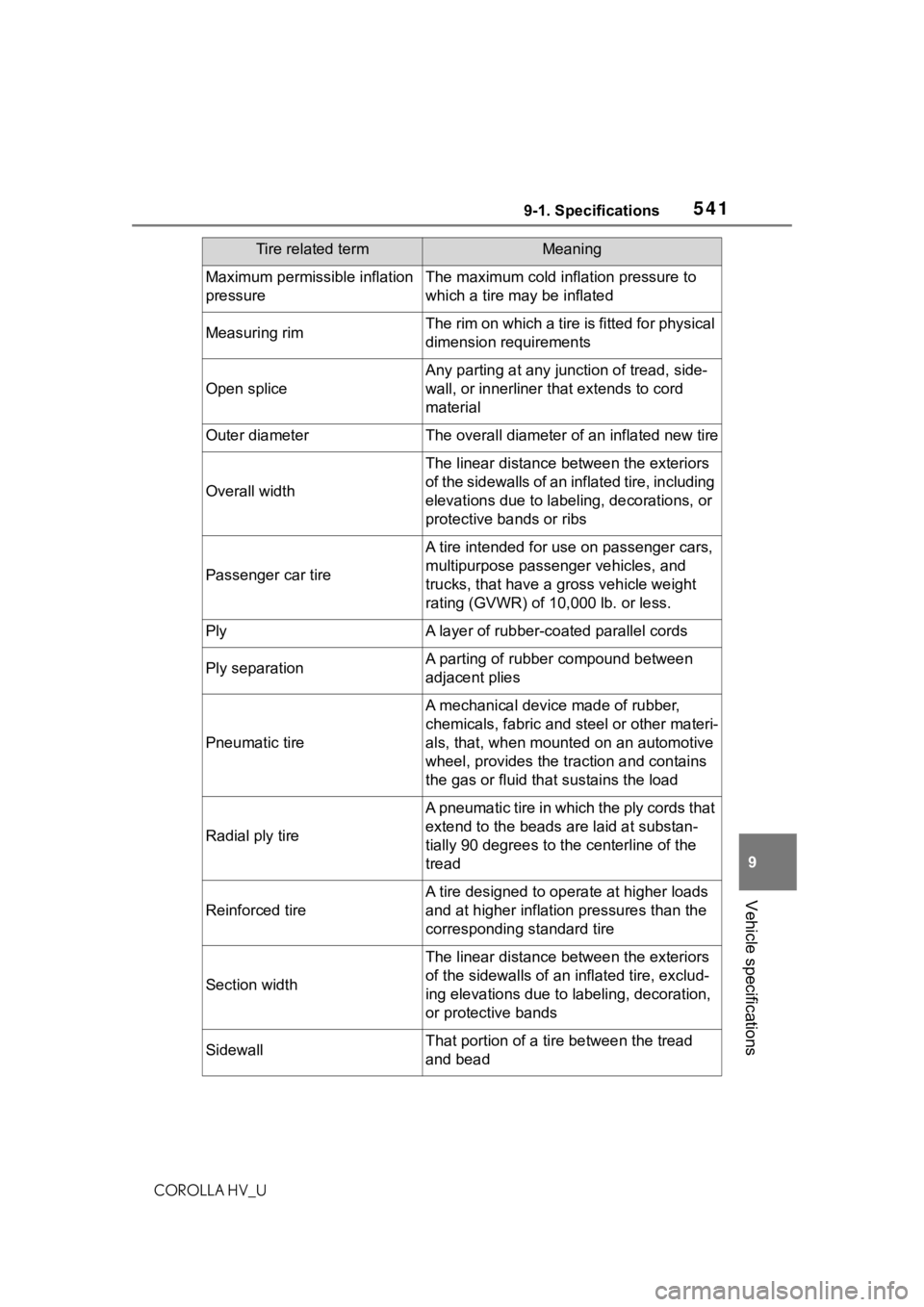
Maximum permissible inflation
pressureThe maximum cold inflation pressure to
which a tire may be inflated
Measuring rimThe rim on which a tire is fitted for physical
dimension requirements
Open splice
Any parting at any junct ion of tread, side-
wall, or innerliner that extends to cord
material
Outer diameterThe overall diameter of an inflated new tire
Overall width
The linear distance bet ween the exteriors
of the sidewalls of an inflated tire, including
elevations due to labe ling, decorations, or
protective bands or ribs
Passenger car tire
A tire intended for us e on passenger cars,
multipurpose passenger vehicles, and
trucks, that have a gross vehicle weight
rating (GVWR) of 10,000 lb. or less.
PlyA layer of rubber-coated parallel cords
Ply separationA parting of rubber compound between
adjacent plies
Pneumatic tire
A mechanical device made of rubber,
chemicals, fabric and steel or other materi-
als, that, when mount ed on an automotive
wheel, provides the tr action and contains
the gas or fluid that sustains the load
Radial ply tire
A pneumatic tire in which the ply cords that
extend to the beads are laid at substan-
tially 90 degrees to the centerline of the
tread
Reinforced tire
A tire designed to operate at higher loads
and at higher inflation pressures than the
corresponding standard tire
Section width
The linear distance bet ween the exteriors
of the sidewalls of an inflated tire, exclud-
ing elevations due to labeling, decoration,
or protective bands
SidewallThat portion of a ti re between the tread
and bead
Tire related termMeaning
Page 558 of 584

55810-1. For owners
COROLLA HV_U
Capteurs d'impact latéral (avant)
Coussin gonflable conducteur
Contact de boucle de ceinture de sécurité conducteur
Capteur de position du siège conducteur
Coussin gonflable de genoux du conducteur
Témoin d'avertissement SRS
Capteurs d'impact avant
Ensemble de capteurs de coussins gonflables
Votre véhicule est équipé de COUSSINS GONFLABLES INTELLI-
GENTS conçus selon les normes de sécurité américaines applica-
bles aux véhicules à moteur (FM VSS208). L'ensemble de capteurs
de coussins gonflables (ECU) régule le déploiement des coussins
gonflables sur la base des informa tions qu'il reçoit des capteurs,
etc., indiqués ci-dessus dans le schéma illustrant les composants du
système. Parmi ces informations figurent la gravité du choc et l'occu-
pation du véhicule par les pass agers. Le déploiement rapide des
coussins gonflables est obtenu au moyen d'une réaction chimique
dans les dispositifs pyrotechniques, qui produit un gaz inoffen sif per-
mettant d'amortir le mouvement des occupants.
WA R N I N G
■Précautions relatives aux
coussins gonflables SRS
Respectez les précautions suiva-
ntes concernant les coussins gon-
flables SRS.
Le non-respect de ces précau-
tions peut occasionner des bless-
ures graves, voire mortelles.
●Le conducteur et tous les pas-
sagers du véhicule doivent por-
ter correctement leur ceinture
de sécurité.
Les coussins gonflables SRS
sont des disposit ifs supplémen-
taires à utiliser avec les cein-
tures de sécurité.
Page 561 of 584
56110-1. For owners
COROLLA HV_U
10
For owners
WA R N I N G
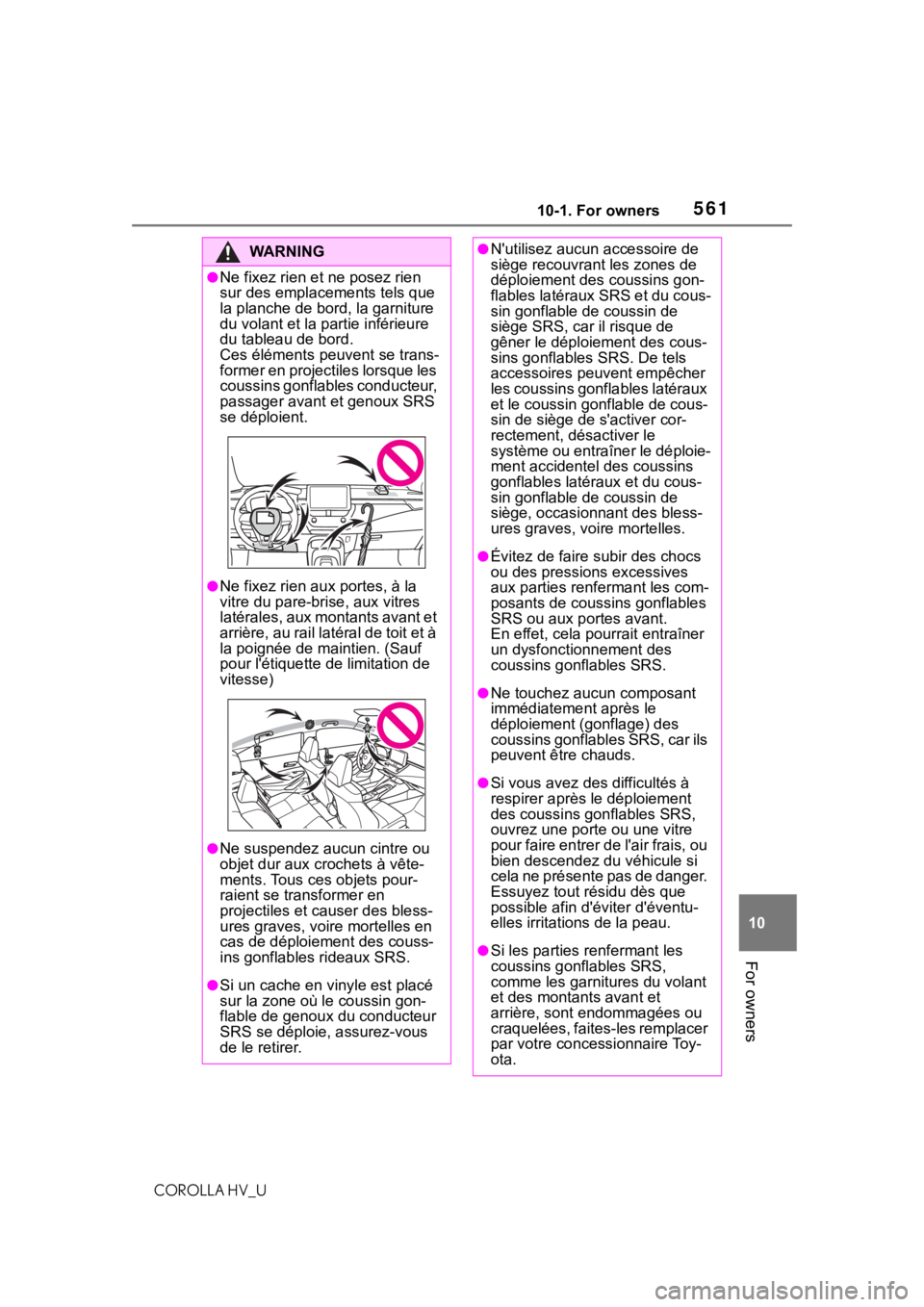
●Ne fixez rien et ne posez rien
sur des emplacements tels que
la planche de bord, la garniture
du volant et la partie inférieure
du tableau de bord.
Ces éléments peuvent se trans-
former en projectiles lorsque les
coussins gonflables conducteur,
passager avant et genoux SRS
se déploient.
●Ne fixez rien aux portes, à la
vitre du pare-brise, aux vitres
latérales, aux montants avant et
arrière, au rail latéral de toit et à
la poignée de maintien. (Sauf
pour l'étiquette d e limitation de
vitesse)
●Ne suspendez aucun cintre ou
objet dur aux crochets à vête-
ments. Tous ces objets pour-
raient se transformer en
projectiles et c auser des bless-
ures graves, voire mortelles en
cas de déploiement des couss-
ins gonflables rideaux SRS.
●Si un cache en vinyle est placé
sur la zone où le coussin gon-
flable de genoux du conducteur
SRS se déploie, assurez-vous
de le retirer.
●N'utilisez aucun a ccessoire de
siège recouvrant les zones de
déploiement des coussins gon-
flables latéraux SRS et du cous-
sin gonflable de coussin de
siège SRS, car il risque de
gêner le déploiement des cous-
sins gonflables SRS. De tels
accessoires peuvent empêcher
les coussins gonfl ables latéraux
et le coussin gonflable de cous-
sin de siège de s 'activer cor-
rectement, désactiver le
système ou entraîner le déploie-
ment accidentel des coussins
gonflables latéraux et du cous-
sin gonflable de coussin de
siège, occasionnant des bless-
ures graves, voire mortelles.
●Évitez de faire subir des chocs
ou des pressions excessives
aux parties renfermant les com-
posants de coussins gonflables
SRS ou aux portes avant.
En effet, cela pourrait entraîner
un dysfonctionnement des
coussins gonflables SRS.
●Ne touchez aucun composant
immédiatement après le
déploiement (gonflage) des
coussins gonflables SRS, car ils
peuvent être chauds.
●Si vous avez des difficultés à
respirer après le déploiement
des coussins gonflables SRS,
ouvrez une porte ou une vitre
pour faire entrer de l'air frais, ou
bien descendez du véhicule si
cela ne présente pas de danger.
Essuyez tout résidu dès que
possible afin d'éviter d'éventu-
elles irritations de la peau.
●Si les parties renfermant les
coussins gonflables SRS,
comme les garnitures du volant
et des montants avant et
arrière, sont endommagées ou
craquelées, faites-les remplacer
par votre concessionnaire Toy-
ota.