fuel cap TOYOTA COROLLA HYBRID 2021 Owners Manual (in English)
[x] Cancel search | Manufacturer: TOYOTA, Model Year: 2021, Model line: COROLLA HYBRID, Model: TOYOTA COROLLA HYBRID 2021Pages: 584, PDF Size: 19.59 MB
Page 3 of 584
3TABLE OF CONTENTS
COROLLA HV_U
1
2
3
4
5
6
7
8
9
10
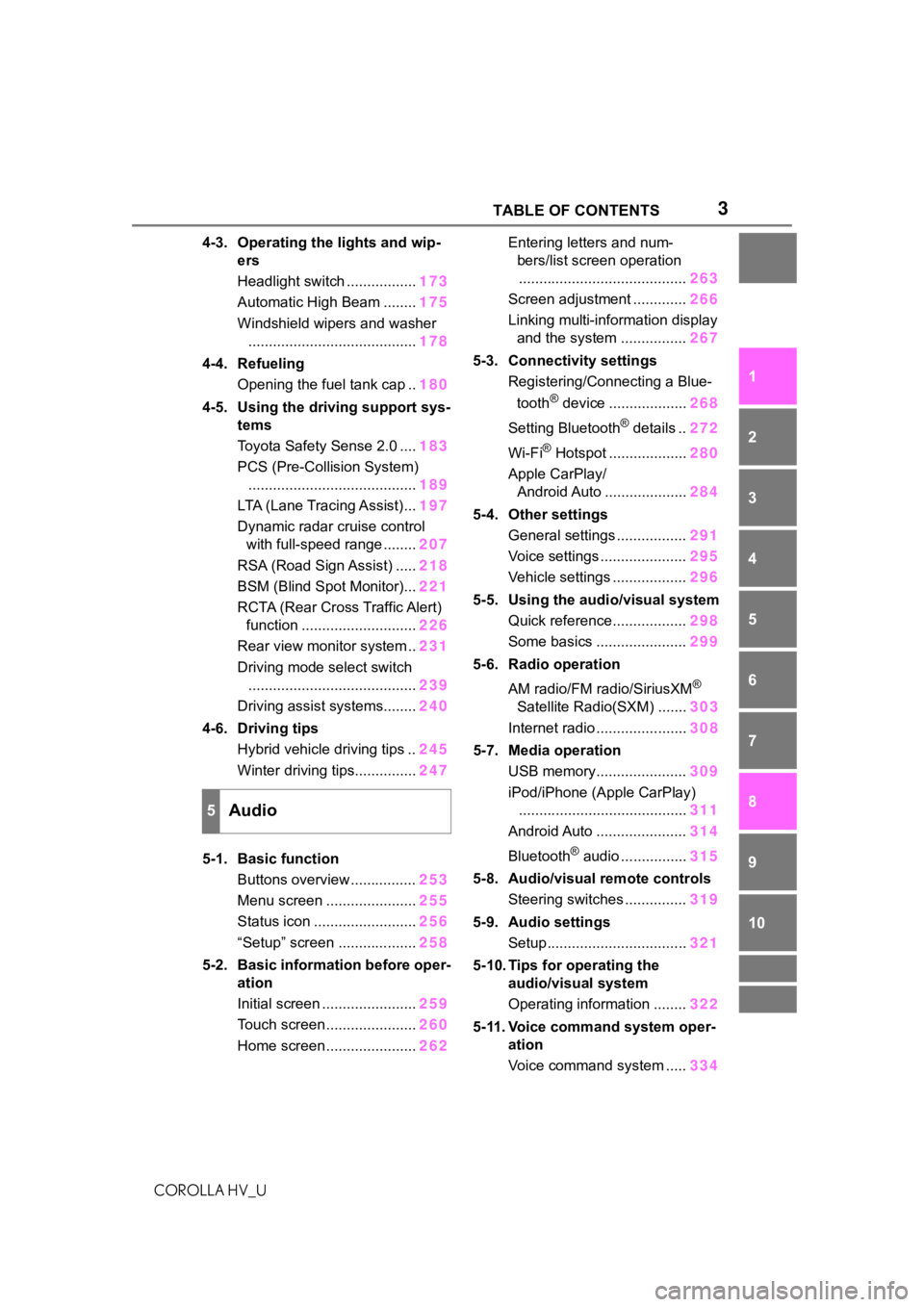
4-3. Operating the lights and wip- ers
Headlight switch ................. 173
Automatic High Beam ........ 175
Windshield wipers and washer ......................................... 178
4-4. Refueling Opening the fuel tank cap .. 180
4-5. Using the driving support sys- tems
Toyota Safety Sense 2.0 .... 183
PCS (Pre-Collision System) ......................................... 189
LTA (Lane Tracing Assist)... 197
Dynamic radar cruise control with full-speed range ........ 207
RSA (Road Sign Assist) ..... 218
BSM (Blind Spot Monitor)... 221
RCTA (Rear Cross Traffic Alert) function ............................ 226
Rear view monitor system .. 231
Driving mode select switch ......................................... 239
Driving assist systems........ 240
4-6. Driving tips Hybrid vehicle driving tips .. 245
Winter driving tips............... 247
5-1. Basic function Buttons overview ................ 253
Menu screen ...................... 255
Status icon ......................... 256
“Setup” screen ................... 258
5-2. Basic information before oper- ation
Initial screen ....................... 259
Touch screen ...................... 260
Home screen ...................... 262Entering letters and num-
bers/list screen operation......................................... 263
Screen adjustment ............. 266
Linking multi-information display and the system ................ 267
5-3. Connectivity settings Registering/Connecting a Blue-
tooth
® device ................... 268
Setting Bluetooth
® details .. 272
Wi-Fi
® Hotspot ................... 280
Apple CarPlay/ Android Auto .................... 284
5-4. Other settings General settings ................. 291
Voice settings ..................... 295
Vehicle settings .................. 296
5-5. Using the audio/visual system Quick reference.................. 298
Some basics ...................... 299
5-6. Radio operation
AM radio/FM radio/SiriusXM
®
Satellite Radio(SXM) ....... 303
Internet radio ...................... 308
5-7. Media operation USB memory...................... 309
iPod/iPhone (Apple CarPlay) ......................................... 311
Android Auto ...................... 314
Bluetooth
® audio ................ 315
5-8. Audio/visual remote controls Steering switches ............... 319
5-9. Audio settings Setup.................................. 321
5-10. Tips for operating the audio/visual system
Operating information ........ 322
5-11. Voice command system oper- ation
Voice command system ..... 334
5Audio
Page 14 of 584
14Pictorial index
COROLLA HV_U
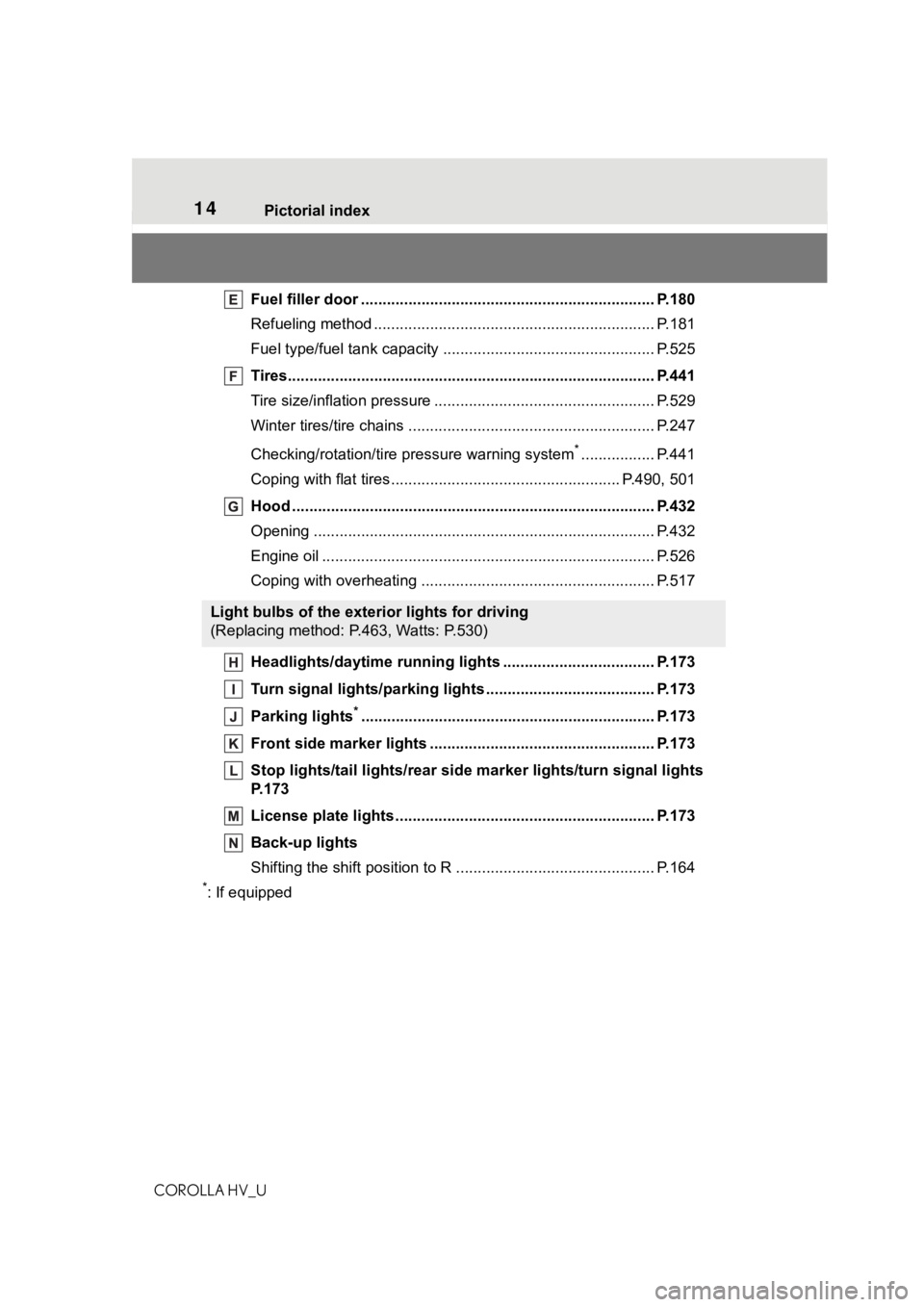
Fuel filler door ............................................... ..................... P.180
Refueling method ............................................... .................. P.181
Fuel type/fuel tan k capacity ................................... .............. P.525
Tires.......................................................... ........................... P.441
Tire size/inflation pressure ................................... ................ P.529
Winter tires/tire chains ....................................... .................. P.247
Checking/rotation/tire pressure warning system
*................. P.441
Coping with flat tires......................................... ............ P.490, 501
Hood ........................................................... ......................... P.432
Opening ............................................................................... P.432
Engine oil ..................................................... ........................ P.526
Coping with overheating ...................................................... P.517
Headlights/daytime running lights .............................. ..... P.173
Turn signal lights/parking lights .............................. ......... P.173
Parking lights
*............................................................... ..... P.173
Front side marker lights ....................................... ............. P.173
Stop lights/tail lights/rear side marker lights/turn signal lig hts
P. 1 7 3
License plate lights........................................... ................. P.173
Back-up lights
Shifting the shift position to R ............................... ............... P.164
*: If equipped
Light bulbs of the exterior lights for driving
(Replacing method: P.463, Watts: P.530)
Page 145 of 584
145
COROLLA HV_U
4
4
Driving
Driving
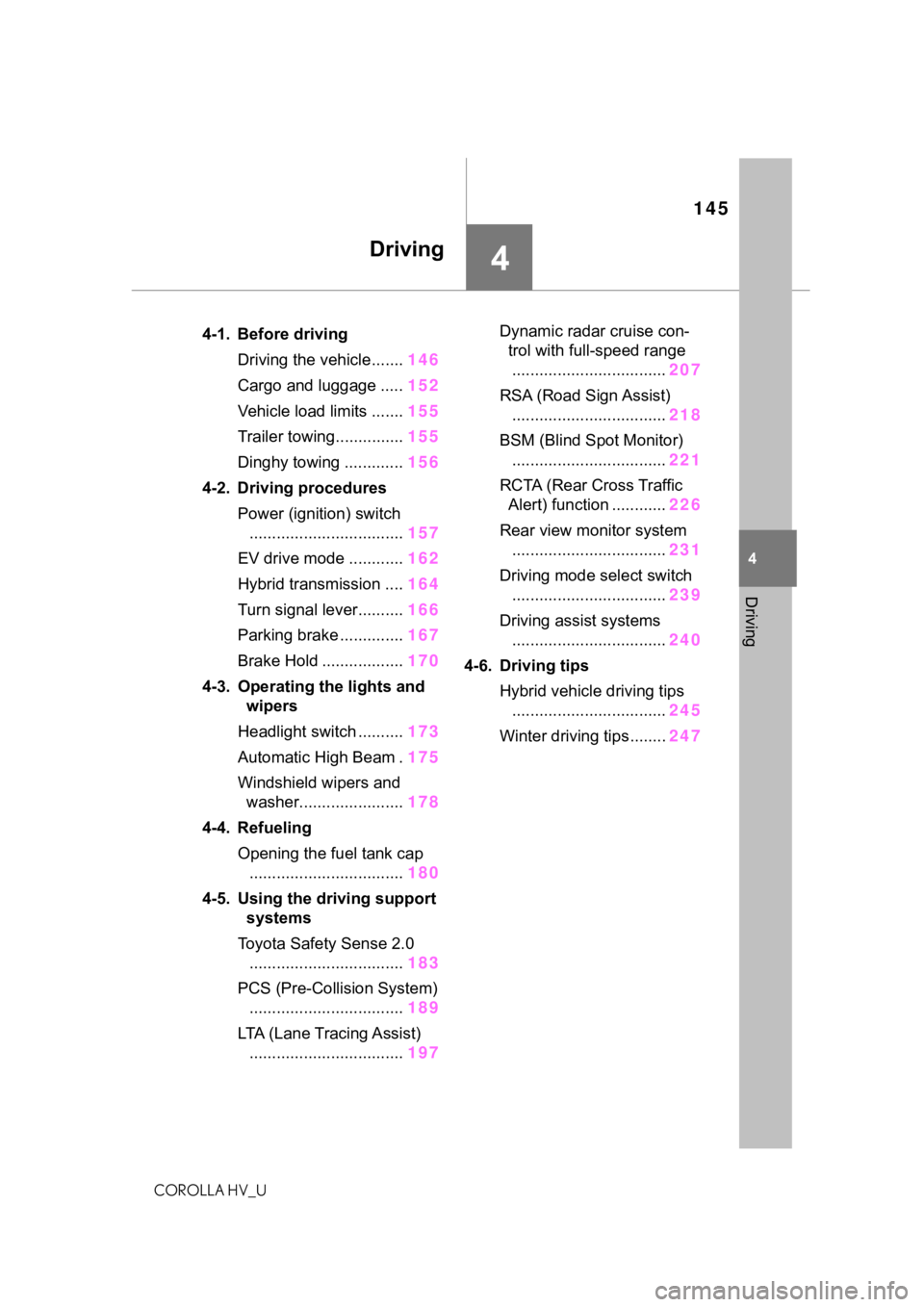
.4-1. Before drivingDriving the vehicle....... 146
Cargo and luggage ..... 152
Vehicle load limits ....... 155
Trailer towing............... 155
Dinghy towing ............. 156
4-2. Driving procedures Power (ignition) switch.................................. 157
EV drive mode ............ 162
Hybrid transmission .... 164
Turn signal lever.......... 166
Parking brake .............. 167
Brake Hold .................. 170
4-3. Operating the lights and wipers
Headlight switch .......... 173
Automatic High Beam . 175
Windshield wipers and washer....................... 178
4-4. Refueling Opening the fuel tank cap.................................. 180
4-5. Using the driving support
systems
Toyota Safety Sense 2.0 .................................. 183
PCS (Pre-Collision System) .................................. 189
LTA (Lane Tracing Assist) .................................. 197Dynamic radar cruise con-
trol with full-speed range.................................. 207
RSA (Road Sign Assist) .................................. 218
BSM (Blind Spot Monitor) .................................. 221
RCTA (Rear Cross Traffic Alert) function ............ 226
Rear view monitor system .................................. 231
Driving mode select switch .................................. 239
Driving assist systems .................................. 240
4-6. Driving tips Hybrid vehicle driving tips.................................. 245
Winter driving tips........ 247
Page 147 of 584
1474-1. Before driving
COROLLA HV_U
4
Driving
■Restraining the hybrid system
output (Brake Override System)
●When the accelerator and brake
pedals are depressed at the same
time, the hybrid system output
may be restrained.
●A warning messag e is displayed
on the multi-information display
while the system is operating.
■ECO Accelerator Guidance
( P.105)
Eco-friendly driving may be
achieved more easily by staying
within the zone of Eco acceleration.
Also, by staying w ithin the zone of
Eco acceleration, i t will be easier to
obtain a good Eco score.
●When starting off:
Gradually depress the accelerator
pedal to stay withi n the zone of Eco
acceleration and accelerate to the
desired speed. By refraining from
excessive acceleration, a good eco
start score will be obtained.
●When driving:
After accelerating to the desired
speed, release the accelerator
pedal and drive at a stable speed
while staying within the zone of Eco
acceleration. By staying within the
zone of Eco acceleration, a good
eco cruise score will be obtained.
●When stopping:
By starting to release the accelera-
tor pedal early before decelerating,
a good eco stop score will be
obtained.
■Restraining sudden start
(Drive-Start Control)
●When the following unusual oper-
ation is performed, the hybrid sys-
tem output may be restrained.
• When the shift lever is shifted from
R to D, D to R, N to R, P to D
*, or
P to R* (D includes B) with the
accelerator pedal depressed, a
warning message appears on the
multi-informatio n display. If a warning message is shown on the
multi-information d
isplay, read the
message and follow the instruc-
tion.
• When the accelerator pedal is depressed too much while the
vehicle is in reverse.
*: Depending on the situation, the
shift position may not be changed.
●While Drive-Start Control is being
activated, your v ehicle may have
trouble escaping from the mud or
fresh snow. In such case, deacti-
vate TRAC ( P.241) to cancel
Drive-Start Cont rol so that the
vehicle may become able to
escape from the mud or fresh
snow.
■Breaking in your new Toyota
To extend the life of the vehicle,
observing the following precautions
is recommended:
●For the first 186 miles (300 km):
Avoid sudden stops.
●For the first 621 miles (1000 km):
• Do not drive at extremely high speeds.
• Avoid sudden acceleration.
• Do not drive at a constant speed
for extended periods.
■Operating your v ehicle in a for-
eign country
Comply with the relevant vehicle
registration laws and confirm the
availability of the correct fuel.
( P.525)
WA R N I N G
Observe the following precau-
tions.
Failure to do so may result in
death or serious injury.
Page 180 of 584
1804-4. Refueling
COROLLA HV_U
4-4.Refueling
Turn the power switch off and
ensure that all the doors and
windows are closed.
Confirm the type of fuel.
■Fuel types
P. 5 3 1
■Fuel tank opening for unleaded
gasoline
To help prevent incorrect fueling,
your vehicle has a fuel tank opening
that only acco mmodates the spe-
cial nozzle on unleaded fuel pumps.
Opening the fuel tank
cap
The fuel tank of your vehicle
has a special structure,
which requires a reduction
in fuel tank pressure before
refueling. After the opener
switch has been pressed, it
will take several seconds
until the vehicle is ready for
refueling.
Before refueling the vehi-
cle
WA R N I N G
■When refueling the vehicle
Observe the following precautions
while refueling the vehicle. Failure
to do so may result in death or
serious injury.
●After exiting the vehicle and
before opening the fuel door,
touch an unpainted metal sur-
face to discharge any static
electricity. It is important to dis-
charge static electricity before
refueling because sparks result-
ing from static electricity can
cause fuel vapors to ignite while
refueling.
●Always hold the grips on the
fuel tank cap and turn it slowly
to remove it.
A whooshing sound may be
heard when the f uel tank cap is
loosened. Wait until the sound
cannot be heard before fully
removing the cap. In hot
weather, pressurized fuel may
spray out the filler neck and
cause injury.
●Do not allow anyone that has
not discharged static electricity
from their body to come close to
an open fuel tank.
●Do not inhale vaporized fuel.
Fuel contains substances that
are harmful if inhaled.
●Do not smoke while refueling
the vehicle.
Doing so may cause the fuel to
ignite and cause a fire.
●Do not return to the vehicle or
touch any person or object that
is statically charged.
This may cause static electricity
to build up, resulting in a possi-
ble ignition hazard.
■When refueling
Observe the following precautions
to prevent fuel overflowing from
the fuel tank:
●Securely insert the fuel nozzle
into the fuel filler neck.
●Stop filling the tank after the fuel
nozzle automatically clicks off.
Page 181 of 584
1814-4. Refueling
COROLLA HV_U
4
Driving
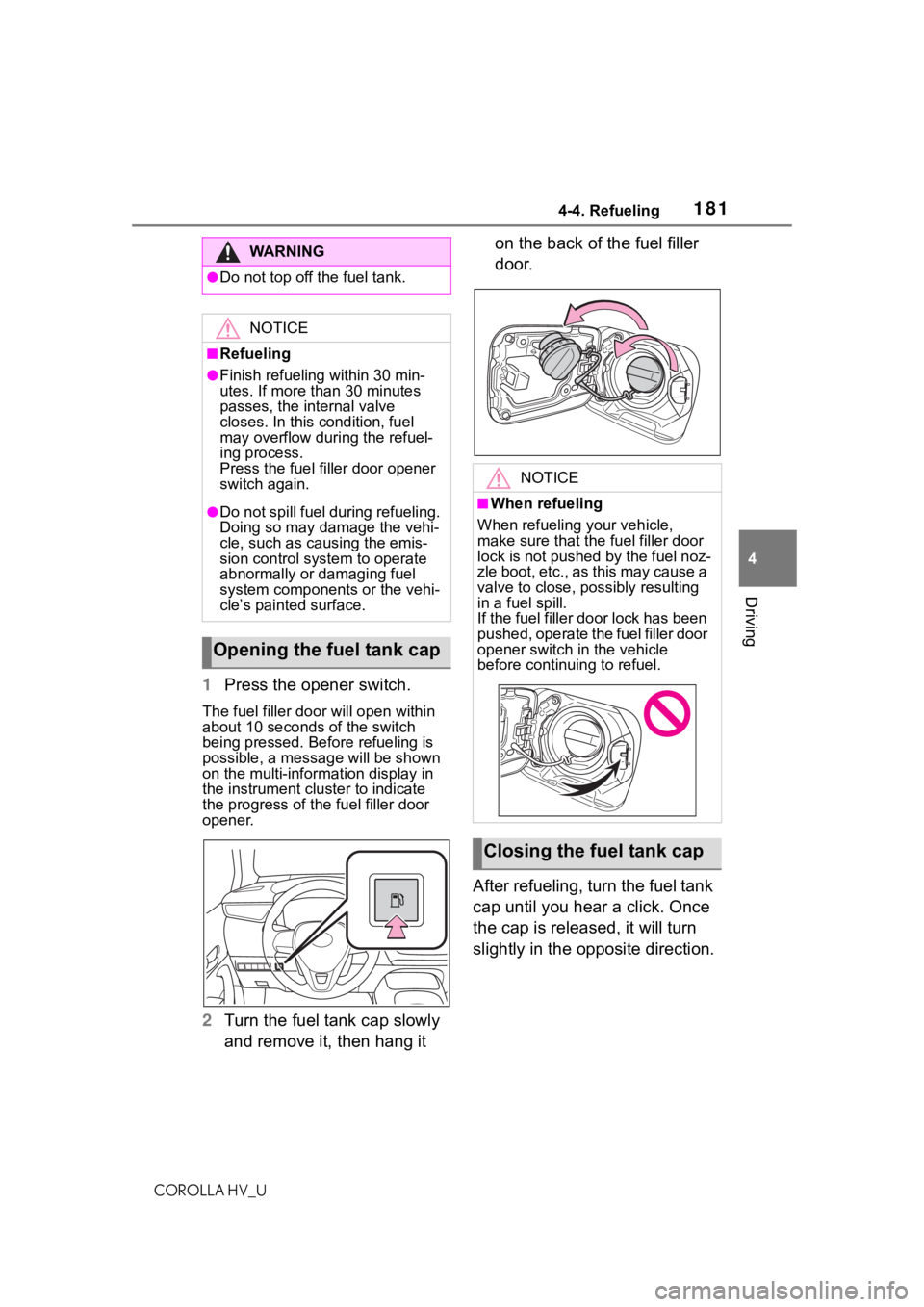
1 Press the opener switch.
The fuel filler doo r will open within
about 10 seconds of the switch
being pressed. Before refueling is
possible, a messa ge will be shown
on the multi-information display in
the instrument cluster to indicate
the progress of the fuel filler door
opener.
2 Turn the fuel tank cap slowly
and remove it, then hang it on the back of the fuel filler
door.
After refueling, turn the fuel tank
cap until you hear a click. Once
the cap is released, it will turn
slightly in the opposite direction.
WA R N I N G
●Do not top off the fuel tank.
NOTICE
■Refueling
●Finish refueling within 30 min-
utes. If more than 30 minutes
passes, the internal valve
closes. In this condition, fuel
may overflow during the refuel-
ing process.
Press the fuel filler door opener
switch again.
●Do not spill fuel during refueling.
Doing so may damage the vehi-
cle, such as causing the emis-
sion control system to operate
abnormally or damaging fuel
system components or the vehi-
cle’s painted surface.
Opening the fuel tank cap
NOTICE
■When refueling
When refueling your vehicle,
make sure that the fuel filler door
lock is not pushed by the fuel noz-
zle boot, etc., as this may cause a
valve to close, possibly resulting
in a fuel spill.
If the fuel filler door lock has been
pushed, operate the fuel filler door
opener switch in the vehicle
before continuing to refuel.
Closing the fuel tank cap
Page 182 of 584
1824-4. Refueling
COROLLA HV_U
WA R N I N G
■When replacing the fuel tank
cap
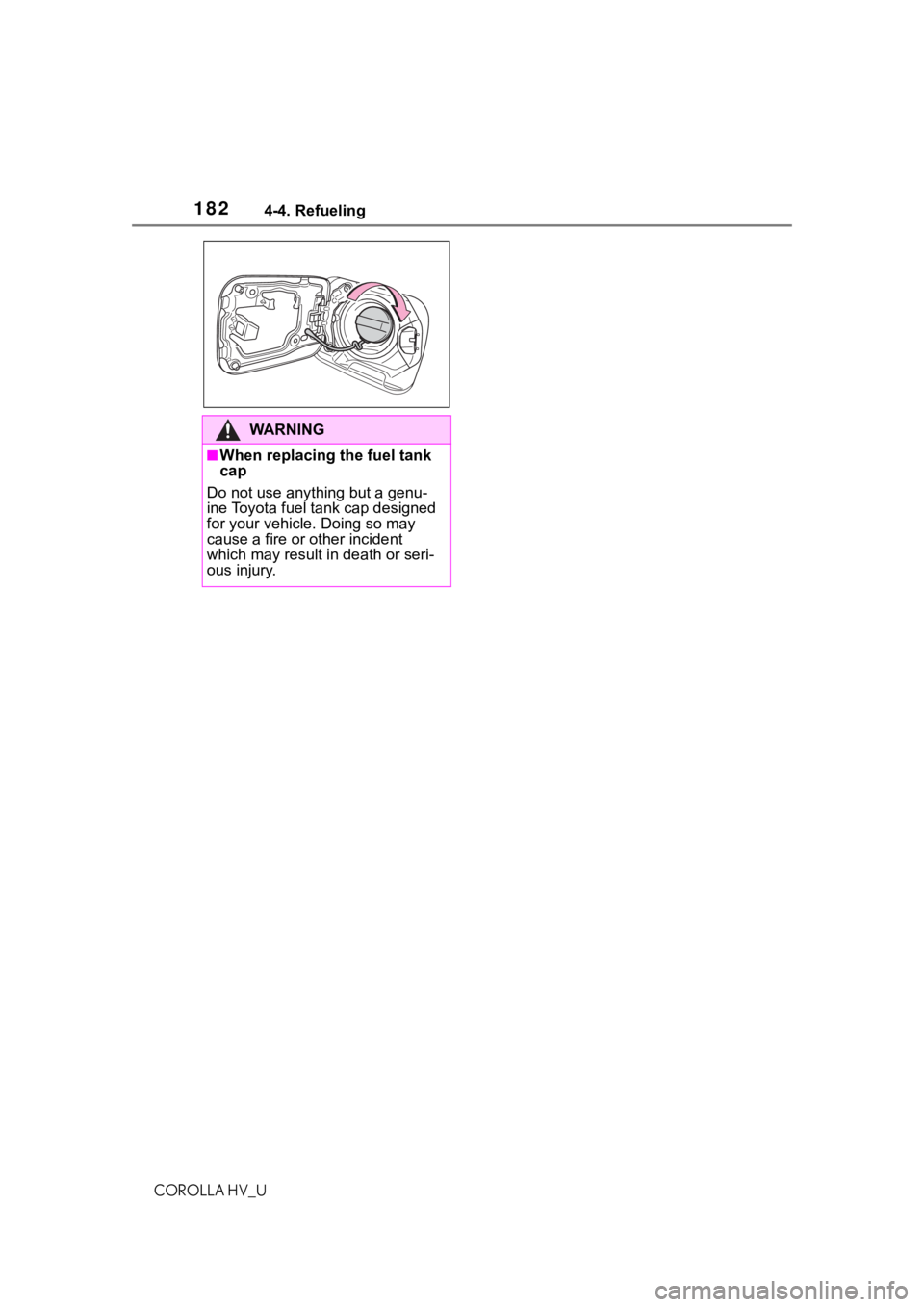
Do not use anything but a genu-
ine Toyota fuel tank cap designed
for your vehicle. Doing so may
cause a fire or other incident
which may result in death or seri-
ous injury.
Page 388 of 584

3886-1. Using the air conditioning system and defogger
COROLLA HV_UThe defoggers will
automatically
turn off after a while.
When the rear window and outside
rear view mirror defoggers switch is
on, the indicator illuminates on the
rear window and ou tside rear view
mirror defoggers switch.
■Eco air conditioning mode
The air conditioning is controlled
with low fuel consumption priori-
tized such as reducing fan
speed, etc.
Press the eco air conditioning
mode switch.
When the eco air conditioning
mode is on, the indicator illumi-
nates on the eco air conditioning
mode switch.
■When the outside temperature
exceeds 75°F (24°C) and the air
conditioning system is on
●In order to reduce the air condi-
tioning power consumption, the air
conditioning system may switch to
recirculated air mode automati-
cally. This may also reduce fuel
consumption.
●Recirculated air mode is selected
as a default mode when the power
switch is turned to ON.
●It is possible to switch to outside
air mode at any time by pressing
the outside air mode switch.
■Fogging up of the windows
●The windows will easily fog up
when the humidity in the vehicle is
high. Turning “A /C” on will dehu-
midify the air from the outlets and
defog the windshield effectively.
●If you turn “A/C” o ff, the windows
may fog up more easily.
●The windows may fog up if the
recirculated air mode is used.
■When driving on dusty roads
Close all windows. If dust thrown up
by the vehicle is still drawn into the
vehicle after closing the windows, it
is recommended that the air intake
mode be set to outside air mode and
the fan speed to a ny setting except
off.
■Outside/recirculated air mode
●Setting to the recirculated air
mode temporarily is recom-
mended in preventing dirty air
from entering the vehicle interior
and helping to c ool the vehicle
when the outside air temperature
is high.
●Outside/recirculated air mode may
automatically switch depending on
the temperature setting or the
inside temperature.
■Eco air conditioning mode
When Eco drive mode is selected
using the driving mode select
switch, eco air conditioning mode
turns on.
When a drive mode other than Eco
drive mode is sele cted, eco air con-
ditioning mode may turn off.
■Operation of the air condition-
ing system in Eco drive mode
●In Eco drive mode, the air condi-
tioning system is controlled as fol-
lows to prioritize fuel efficiency:
• Engine speed and compressor operation controlled to restrict
heating/cooling capacity
• Fan speed restri cted when auto-
matic mode is selected
●To improve air conditioning perfor-
mance, perform the following
operations:
• Turn off eco air conditioning mode ( P.388)
• Adjust the fan speed
• Turn off Eco drive mode ( P.239)
■When the outside temperature
falls to nearly 32°F (0°C)
The dehumidification function may
not operate even when “A/C” switch
Page 429 of 584
4297-2. Maintenance
COROLLA HV_U
7
Maintenance and care
The OBD system determines
that a problem exists some-
where in the emission control
system. Your vehicle may not
pass the I/M test and may need
to be repaired. Contact your
Toyota dealer to service the
vehicle.
When the 12-volt battery is
disconnected or discharged
Readiness codes that are set
during ordinary driving are erased.
Also, depending on your driving
habits, the readiness codes may
not be completely set.
When the fuel tank cap is
loose
The malfunction indicator lamp
comes on indicating a temporary
malfunction and your vehicle may
not pass the I/M test.
The error code in the OBD sys-
tem will not be cleared unless
the vehicle is driven 40 or more
times.
Contact your Toyota dealer to
prepare the vehicle for re-test-
ing.
Emission inspection
and mainte nance (I/M)
programs
Some states have vehicle
emission inspection pro-
grams which include OBD
(On Board Diagnostics)
checks. The OBD system
monitors the operation of
the emission control sys-
tem.
If the malfunc tion indica-
tor lamp comes on
Your vehicle may not pass
the I/M test in the follow-
ing situations:
When the malfunction
indicator lamp still
remains on after several
driving trips
If your vehicle does not
pass the I/M test
Page 451 of 584
4517-3. Do-it-yourself maintenance
COROLLA HV_U
7
Maintenance and care
Tire pressure gauge
1 Remove the tire valve cap.
2 Press the tip of the tire pres-
sure gauge onto the tire
valve.
3 Read the pressure using the
gauge gradations.
4 If the tire inflation pressure is
not at the recommended
level, adjust the pressure.
If you add too much air, press
the center of the valve to
deflate.
5 After completing the tire infla-
tion pressure measurement
and adjustment, apply soapy
water to the valve and check
for leakage.
6 Put the tire valve cap back
on.
■Tire inflation pressure check
interval
You should check tire inflation pres-
sure every two weeks, or at least
once a month. Do not forget to
check the spare.
■Effects of incorrect tire inflation
pressure
Driving with incorr ect tire inflation
pressure may result in the following:
●Reduced fuel economy
●Reduced driving comfort and poor
handling
●Reduced tire life due to wear
●Reduced safety
●Damage to the drive train
If a tire needs frequent inflating,
have it checked by your Toyota
dealer.
■Instructions for checking tire
inflation pressure
When checking tire inflation pres-
sure, observe the following:
●Check only when the tires are
cold.
If your vehicle has been parked for
at least 3 hours or has not been
driven for more than 1 mile or 1.5
km, you will get an accurate cold
tire inflation pressure reading.
●Always use a tire pressure gauge.
It is difficult to j udge if a tire is
properly inflated based only on its
appearance.
●It is normal for the tire inflation
pressure to be higher after driving
as heat is generated in the tire. Do
not reduce tire inflation pressure
after driving.
●Never exceed the vehicle capacity
weight.
Passengers and luggage weight
should be placed so that the vehi-
cle is balanced.
WA R N I N G
■Proper inflation is critical to
save tire performance
Keep your tires properly inflated.
If the tires are not properly
inflated, the following conditions
may occur which could lead to an
accident resulting in death or seri-
ous injury:
●Excessive wear
●Uneven wear
●Poor handling
●Possibility of blowouts resulting
from overheated tires
●Air leaking from between tire
and wheel
●Wheel deformation and/or tire
damage