tires TOYOTA COROLLA iM 2018 Owners Manual (in English)
[x] Cancel search | Manufacturer: TOYOTA, Model Year: 2018, Model line: COROLLA iM, Model: TOYOTA COROLLA iM 2018Pages: 36, PDF Size: 1.57 MB
Page 21 of 36

19
OVERVIEW
FEATURES & OPERATIONS
TOYOTA SAFETY SENSE
SAFETY & EMERGENCY FEATURESIf the vehicle is hit, the position and mounting angle of the camera
may change. Be sure to have the camera position and mounting angle
checked at your local Toyota dealer.
The camera is of water proof construction. Do not detach, disassemble
or modify it. Any of these activities may cause the system to malfunctio\
n.
If the temperature changes rapidly, such as pouring hot water on the
vehicle in cold temperatures, the system may not operate normally.
Do not hit the camera or expose it to strong impact as this may cause it\
s
position and mounting angle to change.
Do not rub the camera lens strongly. If the lens is scratched it cannot \
transmit a clear image.
Do not allow organic solvent, car wax, window cleaner or glass coat to
adhere to the camera. If contact is made with one of these substances
wipe it off as soon as possible.
When replacing tires on the vehicle, please consult your Toyota dealer. \
If
you replace the tires, the area displayed on the screen may change.
Do not use a high-pressure car-wash machine type wand to spray the
camera or camera area as this may cause serious damage to the rear
view camera. Using intensive bursts of water may result in the camera
malfunctioning.
NOTICE
The image on the screen is different from actual conditions. Depicted di\
stances
between objects and flat surfaces will differ from actual distance. If y\
ou back up
looking only at the screen monitor, you may hit an object, vehicle or pe\
rson.
Use your own eyes to confirm the vehicle’s surroundings, as the displ\
ayed image
may become faint or dark, and moving images will be distorted or not ent\
irely
visible when the outside temperature is low.
CAUTION
Page 29 of 36
27
OVERVIEW
FEATURES & OPERATIONS
TOYOTA SAFETY SENSE
SAFETY & EMERGENCY FEATURES
Seat belts
Tire Pressure Monitoring (warning) System (TPMS)
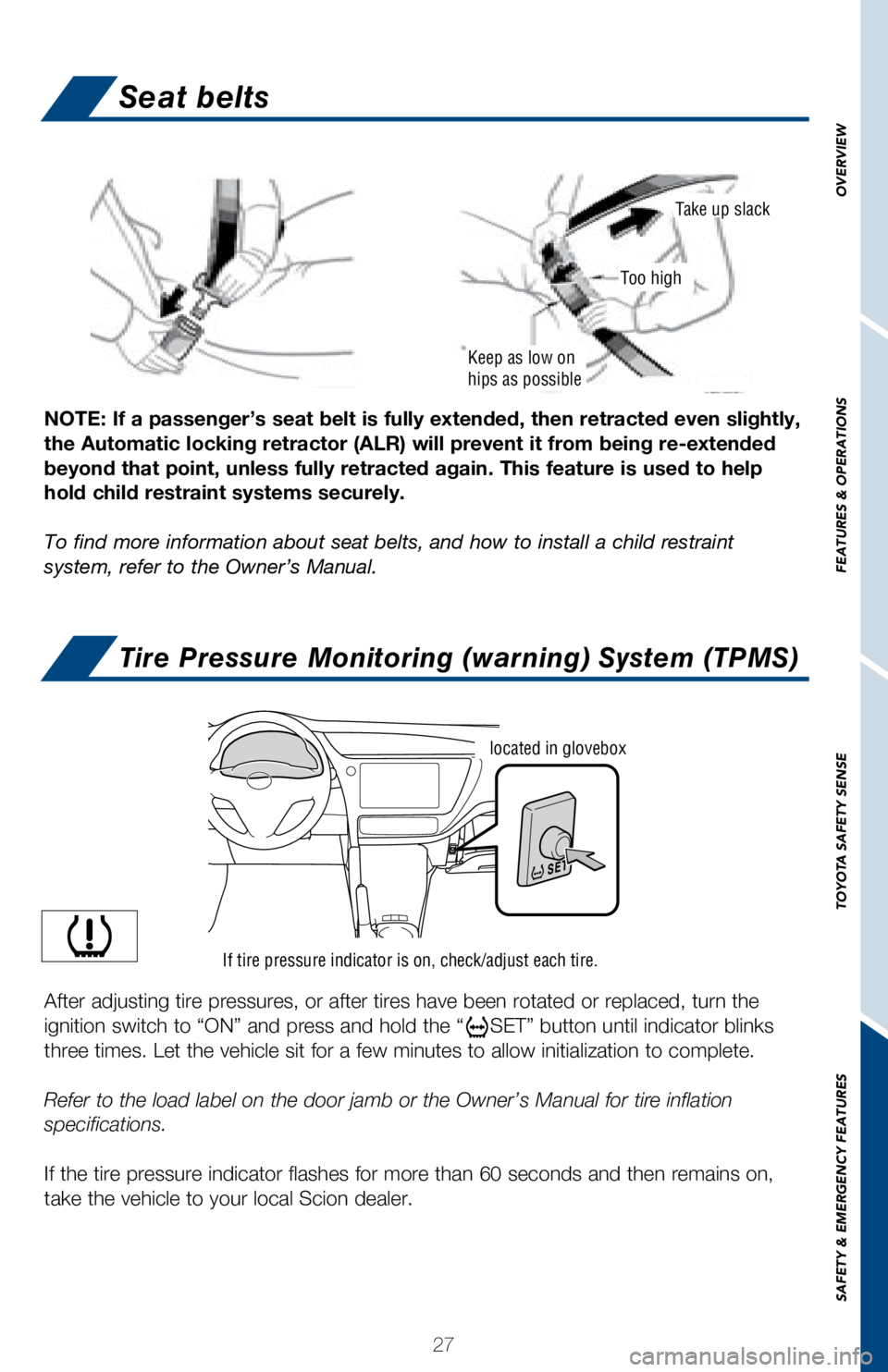
NOTE: If a passenger’s seat belt is fully extended, then retracted ev\
en slightly,
the Automatic locking retractor (ALR) will prevent it from being re-ex\
tended
beyond that point, unless fully retracted again. This feature is used to\
help
hold child restraint systems securely.
To find more information about seat belts, and how to install a child re\
straint
system, refer to the Owner’s Manual.
Keep as low on
hips as possible
Take up slack
Too high
If tire pressure indicator is on, check/adjust each tire.
located in glovebox
After adjusting tire pressures, or after tires have been rotated or repl\
aced, turn the
ignition switch to “ON” and press and hold the “
SET” button until indicator blinks
three times. Let the vehicle sit for a few minutes to allow initializati\
on to complete.
Refer to the load label on the door jamb or the Owner’s Manual for ti\
re inflation
specifications.
If the tire pressure indicator flashes for more than 60 seconds and then\
remains on,
take the vehicle to your local Scion dealer.
Page 31 of 36
 29
OVERVIEW
FEATURES & OPERATIONS
TOYOTA SAFETY SENSE
SAFETY & EMERGENCY FEATURES
Smart Stop Technology automatically reduces engine power when the accele\
rator and
brake pedals are pressed simultan")
29
OVERVIEW
FEATURES & OPERATIONS
TOYOTA SAFETY SENSE
SAFETY & EMERGENCY FEATURES
Smart Stop Technology automatically reduces engine power when the accele\
rator and
brake pedals are pressed simultaneously under certain conditions.
SST engages when the accelerator is depressed first and the brakes are a\
pplied firmly
for longer than one-half second at speeds greater than five miles per ho\
ur.
SST doesn’t engage if the brake pedal is depressed before the acceler\
ator pedal,
allowing vehicles to start on a steep hill and safely accelerate without\
rolling backward.
Star Safety System™
Your vehicle comes standard with the Star Safety SystemTM, which combines Anti-lock
Braking System (ABS), Brake Assist (BA), Electronic Brake-force Dist\
ribution (EBD),
Smart Stop Technology (SST), Traction Control (TRAC) and Vehicle Sta\
bility Control
(VSC).
Refer to the Owner’s Manual for more details and important informatio\
n on
limitations to these systems.
Toyota’s ABS sensors detect which wheels are locking up and limits wh\
eel lockup
by “pulsing” each wheel’s brakes independently. Pulsing release\
s brake pressure
repeatedly for fractions of a second. This helps the tires attain the tr\
action that current
road conditions will allow, helping you to stay in directional control. \
ANTI-LOCK BRAKE SYSTEM (ABS)
Brake Assist is designed to detect sudden or “panic” braking, and \
then add braking
pressure to help decrease the vehicle’s stopping distance. When there\
’s only a split
second to react, Brake Assist can add additional brake pressure more qui\
ckly than just
the driver alone can.
BRAKE ASSIST (BA)
Toyota’s ABS technology has Electronic Brake-force Distribution (EBD\
) to help maintain
control and balance when braking. Abrupt stops can cause a vehicle to ti\
lt forward,
reducing the braking power of the rear wheels. EBD responds to sudden st\
ops by
redistributing brake force to enhance the braking effectiveness of all f\
our wheels.
ELECTRONIC BRAKE FORCE DISTRIBUTION (EBD)
VSC helps prevent loss of traction during cornering by reducing engine p\
ower and
applying brake force to selected wheels.
Toyota’s VSC monitors steering angle and the direction your vehicle i\
s traveling. When
it senses that the front or rear wheels begin to lose traction, VSC redu\
ces engine power
and applies braking to selected wheels. This helps restore traction and \
vehicle control.
VEHICLE STABILITY CONTROL (VSC)
SMART STOP TECHNOLOGY (SST)