washer fluid TOYOTA GR86 2022 Owners Manual (in English)
[x] Cancel search | Manufacturer: TOYOTA, Model Year: 2022, Model line: GR86, Model: TOYOTA GR86 2022Pages: 582, PDF Size: 86.38 MB
Page 16 of 582
14Pictorial index
Parking brake .................................................................................P.151
Applying/releasing............................................................................P.151
Precautions for winter season..........................................................P.261
Warning lights ..................................................................................P.336
Headlight switch ...........................................................................P.153
Turn signal lever ............................................................................P.150
Headlights/front position lights/tail lights/daytime running lights ......P.153
Rear fog light....................................................................................P.159
Windshield wiper and washer switch ..........................................P.160
Usage...............................................................................................P.160
Adding washer fluid..........................................................................P.300
Headlight cleaners ...........................................................................P.160
Emergency flasher switch.............................................................P.326
Hood lock release lever .................................................................P.293
Tilt and telescopic steering lock release lever ............................P.122
Adjustment .......................................................................................P.122
Air conditioning system ................................................................P.264
Usage...............................................................................................P.264
Rear window defogger .....................................................................P.266
Audio system*2
*1: Vehicles with an automatic transmission
*2: Refer to “Multimedia owner’s manual”.
Page 22 of 582
20Pictorial index
Parking brake .................................................................................P.151
Applying/releasing............................................................................P.151
Precautions for winter season..........................................................P.261
Warning lights ..................................................................................P.336
Windshield wiper and washer switch ..........................................P.160
Usage...............................................................................................P.160
Adding washer fluid..........................................................................P.300
Headlight cleaners ...........................................................................P.160
Headlight switch ...........................................................................P.153
Turn signal lever ............................................................................P.150
Headlights/front position lights/tail lights/daytime running lights ......P.153
Rear fog light....................................................................................P.159
Emergency flasher switch.............................................................P.326
Hood lock release lever .................................................................P.293
Tilt and telescopic steering lock release lever ............................P.122
Adjustment .......................................................................................P.122
Air conditioning system ................................................................P.264
Usage...............................................................................................P.264
Rear window defogger .....................................................................P.266
Audio system*2
*1: Vehicles with an automatic transmission
*2: Refer to “Multimedia owner’s manual”.
Page 163 of 582
161
4
4-3. Operating the lights and wipers
Driving
■The windshield wiper and washer can be operated when
The engine switch is in ON.
■If no windshield washer fluid
sprays
Check that the washer nozzles are not
blocked if there is washer fluid in the
windshield washer fluid reservoir.
WA R N I N G
■Caution regarding the use of washer fluid
When it is cold, do not use the washer
fluid until the windshield becomes warm. The fluid may freeze on the
windshield and cause low visibility.
This may lead to an accident, result- ing in death or serious injury.
NOTICE
■When the washer fluid tank is
empty
Do not operate the switch continually
as the washer fluid pump may over-
heat.
■When a nozzle becomes blocked
In this case, contact any authorized Toyota retailer or Toyota authorized
repairer, or any reliable repairer.
Do not try to clear it with a pin or other object. The nozzle will be damaged.
Page 179 of 582
177
4
4-5. EyeSight
Driving
WA R N I N G
At night or in a tunnel when there is
a vehicle in front that does not have
its taillights on
Approaching a motorcycle, bicycle
or pedestrian at night
Ambient light is poor in the evening
or early morning.
A vehicle, motorcycle, bicycle or
pedestrian is outside the area illumi-
nated by the headlights.
Strong light is coming from the
front (for example, sunlight at dawn,
sunset or headlight beams, etc.).
The windshield has become
fogged, scratched or smeared, or
snow, dirt, dust or frost has adhered
to it, or it is otherwise affected. These
will reduce the stereo camera’s field
of view. Also, light is reflecting off the
dirt, etc.
Fluid has not been fully wiped off
the windshield during or after washer
use.
The target cannot be correctly rec-
ognized because the stereo camera’s
view is obstructed by water droplets
from rain or the window washer, or by
the wiper blades.
The stereo camera’s field of view is
obstructed.
The rear aspect of the vehicle in
front is low, small or irregular (the sys-
tem may recognize another part of the
vehicle as its rear and will determine
operation from that).
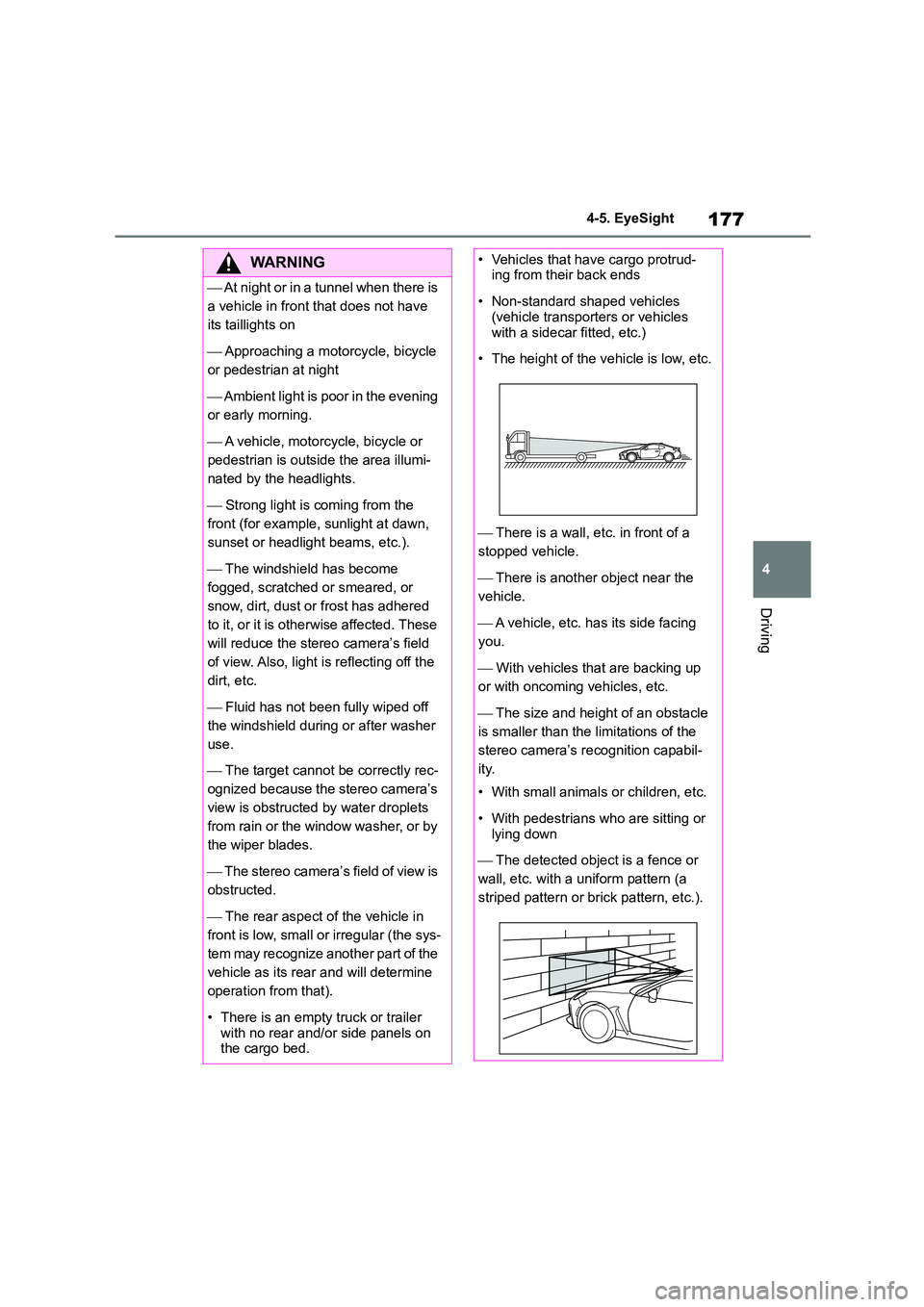
• There is an empty truck or trailer
with no rear and/or side panels on the cargo bed.
• Vehicles that have cargo protrud-ing from their back ends
• Non-standard shaped vehicles (vehicle transporters or vehicles
with a sidecar fitted, etc.)
• The height of the vehicle is low, etc.
There is a wall, etc. in front of a
stopped vehicle.
There is another object near the
vehicle.
A vehicle, etc. has its side facing
you.
With vehicles that are backing up
or with oncoming vehicles, etc.
The size and height of an obstacle
is smaller than the limitations of the
stereo camera’s recognition capabil-
ity.
• With small animals or children, etc.
• With pedestrians who are sitting or
lying down
The detected object is a fence or
wall, etc. with a uniform pattern (a
striped pattern or brick pattern, etc.).
Page 213 of 582

211
4
4-5. EyeSight
Driving
WA R N I N G
• Fluid has not been fully wiped off
the windshield during or after use of
the window washer.
• Obstacles cannot be correctly rec-
ognized due to water droplets from rain or the washer, or the wiper
blades obstructing the stereo cam-
era’s field of view.
• The stereo camera’s field of view is
obstructed.
• With low obstacles (low wall, crash
barrier, low vehicle, etc.)
• The size and height of an obstacle
is smaller than the limitations of the
stereo camera’s recognition capa- bility. (Small animals, children,
pedestrians who are sitting or lying
down, etc.)
• The rear portion nearest your vehi-
cle is too small or too close (such as a trailer or oncoming vehicle).
The system may not recognize the
part of that vehicle which is closest to you.
• There is a fence or wall, etc., with a uniform pattern (striped pattern,
brick, etc.) or with no pattern in
front.
• There is a wall or door made of glass or a mirror in front.
• An obstacle (another vehicle, motorcycle, bicycle, pedestrian,
animal or child, etc.) cuts in from
the side or jumps out suddenly.
• Your vehicle is immediately behind
an obstacle after changing lanes.
• On sharp curves, steep uphill
grades or steep downhill grades
●The system determines that steer-
ing operation by the driver is intended as evasive action.
●For your safety, do not test Pre-Col-lision Throttle Management on its
own. It may operate improperly and
cause an accident.
NOTICE
In the following situations, turn off Pre-Collision Throttle Management.
Otherwise Pre-Collision Throttle Man-
agement may activate unexpectedly.
●The vehicle is being towed.
●The vehicle is being loaded onto a
carrier.
●A chassis dynamometer, free-roll-
ers or similar equipment is being
used.
●A mechanic lifts up the vehicle,
starts the engine and allows the wheels to spin freely.
●Driving on a race track
Page 262 of 582

2604-7. Driving tips
4-7.Driving tips
Use fluids that are appropriate to
the prevailing out side tempera-
tures.
• Engine oil
• Engine coolant
• Washer fluid
Have a service technician
inspect the condition of the bat-
tery.
Have the vehicle fitted with four
snow tires or purchase a set of
tire chains for the rear tires.
Make sure to install 4 tires that are of
the specified size, and that all 4 tires
are the same size, same maker, same
brand and tread pattern. Also, make
sure to use tire chains that match the
size of the tires.
Winter driving tips
Carry out the necessary prepa-
rations and inspections before
driving the vehicle in winter.
Always drive the vehicle in a
manner appropriate to the pre-
vailing weather conditions.
Preparation for winter
WA R N I N G
■Driving with snow tires
Observe the following precautions to
reduce the risk of accidents.
Failure to do so may result in a loss of vehicle control and cause death or
serious injury.
●Use tires of the specified size, and that are the same size, same
maker, same brand and tread pat-
tern.
●Maintain the recommended level of
air pressure.
●Do not drive at speeds in excess of
the speed limit or the speed limit specified for the snow tires being
used.
●Use snow tires on a ll, not just some
wheels.
■Driving with tire chains
●When any of the tires are punc-
tured, you can seal the tire tempo- rarily. However, do not use the tire
chain on a sealed tire. If any of the
rear tires are punctured although it is required to use tire chains, con-
tact any authorized Toyota dealer or
repairer, or another duly qualified and equipped professional.
●Observe the following precautions to reduce the risk of accidents.
Failure to do so may result in the
vehicle being unable to be driven safely, and may cause death or
serious injury.
• Do not drive in excess of the speed limit specified for the tire chains
being used, or 30 km/h (19 mph),
whichever is lower.
• Avoid driving on bumpy road sur-
faces or over potholes.
• Avoid sudden acceleration, abrupt
steering, sudden braking and shift- ing operations that cause sudden
engine braking.
• Slow down sufficiently before enter- ing a curve to ensure that vehicle
control is maintained.
Page 293 of 582

291
6
6-3. Do-it-yourself maintenance
Maintenance and care
6-3.Do-it-yourself maintenance
Do-it-yourself ser vice
precautions
If you perform maintenance by
yourself, be sure to follow the
correct procedure as given in
these sections.
Maintenance
ItemsParts and tools
Battery condition
( P.298)
•Warm water
• Baking soda
•Grease
• Conventional
wrench (for termi-
nal clamp bolts)
• Distilled water
Engine coolant
level( P.297)
• “TOYOTA Genu-
ine 50/50
Pre-mixed Super
Long Life Coolant
BLUE” or a similar
high quality ethyl-
ene glycol-based
non-silicate,
non-amine,
non-nitrite and
non-borate cool-
ant with long-life
hybrid organic acid
technology.
• Funnel (used only
for adding coolant)
Engine oil level
( P.295)
• “Toyota Genuine
Motor Oil” or equiv-
alent
• Rag or paper towel
• Funnel (used only
for adding engine
oil)
Fuses ( P.319)
• Fuse with same
amperage rating
as original
Light bulbs
( P.321)
• Bulb with same
number and watt-
age rating as origi-
nal
• Phillips-head
screwdriver
• Flathead screw-
driver
Radiator and
condenser
( P.298)
Tire inflation
pressure
( P.312)
• Tire pressure
gauge
• Compressed air
source
Washer fluid
( P.300)
• Water or washer
fluid containing
antifreeze (for win-
ter use)
• Funnel (used only
for adding water or
washer fluid)
WA R N I N G
The engine compartment contains
many mechanisms and fluids that may move suddenly, become hot, or
become electrically energized. To
avoid death or serious injury, observe the following precautions.
ItemsParts and tools
Page 297 of 582

295
6
6-3. Do-it-yourself maintenance
Maintenance and care
Fuse boxes ( P.319)
Battery ( P.298)
Engine oil level dipstick ( P.295)
Engine oil filler cap ( P.295)
Washer fluid tank ( P.300)
Electric cooling fans
Condenser ( P.298)
Radiator ( P.298)
Engine coolant reservoir ( P. 2 9 7 )
For right-hand drive vehicles:
The battery is located on the opposite side of the engine compartment.
With the engine at operating tem-
perature and turned off, check the
oil level on the dipstick.
Engine compartment
Components
A
C
D
Checking and adding the
engine oil
Page 302 of 582
3006-3. Do-it-yourself maintenance
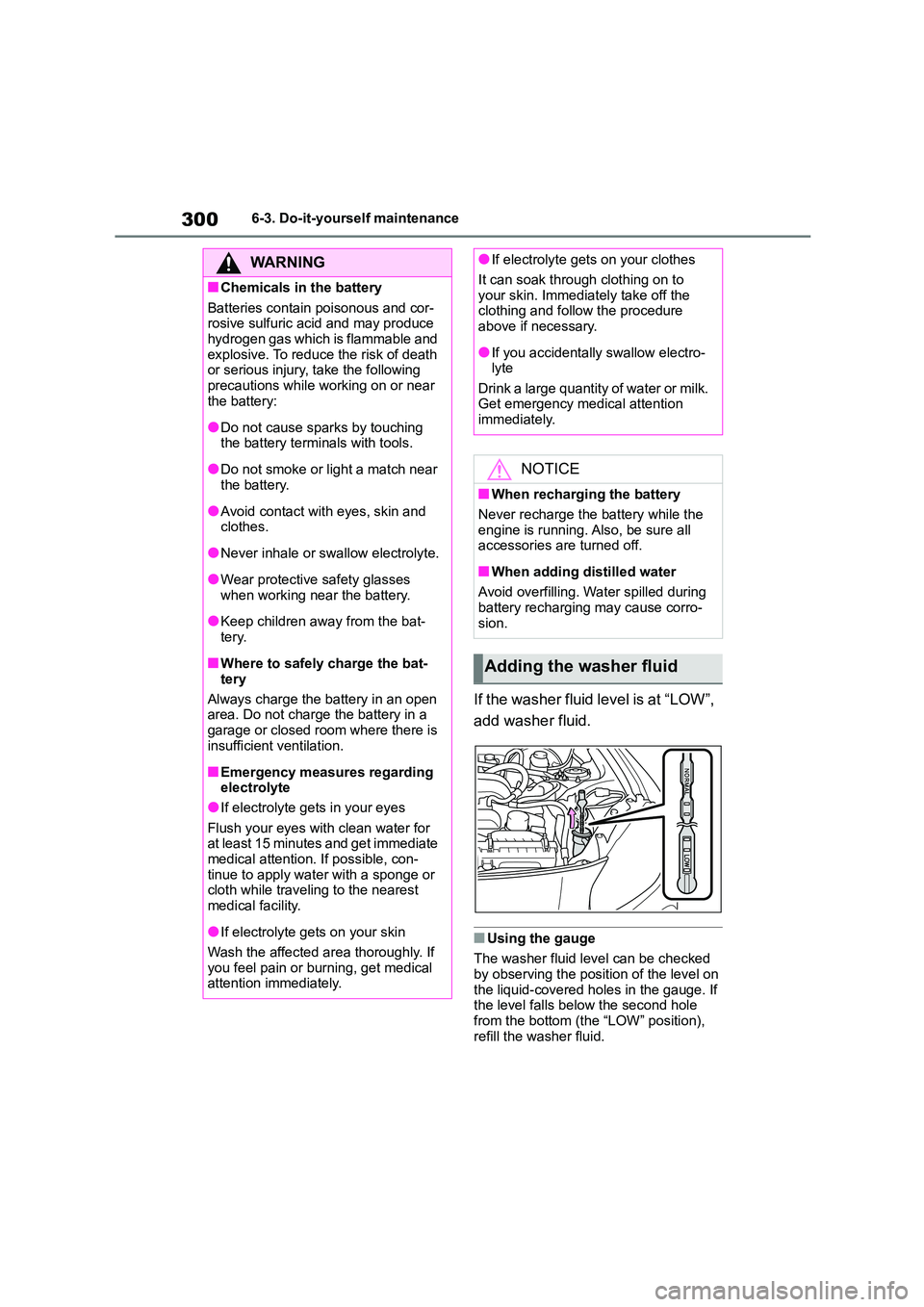
If the washer fluid level is at “LOW”,
add washer fluid.
■Using the gauge
The washer fluid level can be checked
by observing the position of the level on
the liquid-covered holes in the gauge. If the level falls below the second hole
from the bottom (the “LOW” position),
refill the washer fluid.
WA R N I N G
■Chemicals in the battery
Batteries contain poisonous and cor-
rosive sulfuric acid and may produce hydrogen gas which is flammable and
explosive. To reduce the risk of death
or serious injury, take the following precautions while working on or near
the battery:
●Do not cause sparks by touching the battery terminals with tools.
●Do not smoke or light a match near the battery.
●Avoid contact with eyes, skin and clothes.
●Never inhale or swallow electrolyte.
●Wear protective safety glasses
when working near the battery.
●Keep children away from the bat-
tery.
■Where to safely charge the bat-
tery
Always charge the battery in an open
area. Do not charge the battery in a
garage or closed room where there is insufficient ventilation.
■Emergency measures regarding electrolyte
●If electrolyte gets in your eyes
Flush your eyes with clean water for at least 15 minutes and get immediate
medical attention. If possible, con-
tinue to apply water with a sponge or cloth while traveling to the nearest
medical facility.
●If electrolyte gets on your skin
Wash the affected area thoroughly. If
you feel pain or burning, get medical attention immediately.
●If electrolyte gets on your clothes
It can soak through clothing on to
your skin. Immediately take off the
clothing and follow the procedure above if necessary.
●If you accidentally swallow electro-lyte
Drink a large quantity of water or milk.
Get emergency medical attention immediately.
NOTICE
■When recharging the battery
Never recharge the battery while the
engine is running. Also, be sure all accessories are turned off.
■When adding distilled water
Avoid overfilling. Water spilled during
battery recharging may cause corro-
sion.
Adding the washer fluid
Page 303 of 582

301
6
6-3. Do-it-yourself maintenance
Maintenance and care
Current fluid level
Check if the treadwear indicators
are showing on the tires. Also
check the tires for uneven wear,
such as excessive wear on one
side of the tread.
Check the spare tire condition and
pressure if not rotated.
New tread
Worn tread
Treadwear indicator
The location of treadwear indicators is
shown by a “TWI” or “ ” mark, etc.,
molded into the sidewall of each tire.
WA R N I N G
■When adding washer fluid
Do not add washer fluid when the
engine is hot or running as washer fluid contains alcohol and may catch
fire if spilled on the engine, etc.
NOTICE
■Do not use any fluid other than
washer fluid
Do not use soapy water or engine antifreeze instead of washer fluid.
Doing so may cause streaking on the
vehicle’s painted surfaces, as well as damaging the pump leading to prob-
lems of the washer fluid not spraying.
■Diluting washer fluid
Dilute washer fluid with water as nec-
essary.
Refer to the freezing temperatures listed on the label of the washer fluid
bottle.
A
Tires
Replace or rotate tires in
accordance with maintenance
schedules and treadwear.
Checking tires
A
C