slip TOYOTA GT86 2018 Owners Manual (in English)
[x] Cancel search | Manufacturer: TOYOTA, Model Year: 2018, Model line: GT86, Model: TOYOTA GT86 2018Pages: 532, PDF Size: 6.46 MB
Page 121 of 532

121
1-7. Safety information
1
Before driving
WARNING
■
SRS airbag precautions
●The SRS driver airbag deploys with considerable force, and can cause
death or serious injury especially if the driver is very close to the airbag.
The National Highway Traffic Safety Administration (“NHTSA”) advises:
Since the risk zone for the driver’s airbag is the first 2 - 3 in. (50 - 75 mm)
of inflation, placing yourself 10 in. (250 mm) from your driver airbag pro-
vides you with a clear margin of safety. This distance is measu red from the
center of the steering wheel to your breastbone. If you sit less than 10 in.
(250 mm) away now, you can change your driving position in seve ral
ways:
• Move your seat to the rear as far as you can while still reaching the pedals comfortably.
• Slightly recline the back of the seat. Although vehicle design s vary,
many drivers can achieve the 10 in. (250 mm) distance, even wit h the
driver seat all the way forward, simply by reclining the back o f the seat
somewhat. If reclining the back of your seat makes it hard to s ee the
road, raise yourself by using a firm, non-slippery cushion, or raise the
seat if your vehicle has that feature.
• If your steering wheel is adjustable, tilt it downward. This p oints the air-
bag toward your chest instead of your head and neck.
The seat should be adjusted as recommended by NHTSA above, whil e
still maintaining control of the foot pedals, steering wheel, a nd your view of
the instrument panel controls.
● The SRS front passenger airbag al so deploys with considerable force, and
can cause death or serious injury especially if the front passe nger is very
close to the airbag. The front passenger seat should be as far from the air-
bag as possible with the seatback adjusted, so the front passen ger sits
upright.
● Improperly seated and/or restrained infants and children can be killed or
seriously injured by a deploying airbag. An infant or child who is too small
to use a seat belt should be properly secured using a child res traint sys-
tem. Toyota strongly recommends that all infants and children be placed in
the rear seats of the vehicle and properly restrained. The rear seats are
safer for infants and children than the front passenger seat. ( P. 137)
Page 154 of 532
154 2-1. Driving procedures
Starting off on a steep uphillVehicles with an auto matic transmission
Make sure that the parking brake is set and shift the shift lever
to D.
Gently depress the accelerator pedal.
Release the parking brake.
Vehicles with a manual transmission With the parking brake firmly set and the clutch pedal fully
depressed, shift the shift lever to 1.
Lightly depress the accelerator pedal at the same time as
gradually releasing the clutch pedal.
Release the parking brake.
■ When starting off on an uphill
When enabled, the hill-start assist control can operate. ( P. 252)
■ Driving in the rain
●Drive carefully when it is raining, because visibility will be reduced, the
windows may become fogged-up, and the road will be slippery.
● Drive carefully when it starts to rain, because the road surfac e will be
especially slippery.
● Refrain from high speeds when driving on an expressway in the r ain,
because there may be a layer of water between the tires and the road
surface, preventing the steering and brakes from operating prop erly.
STEP 1
STEP 2
STEP 3
STEP 1
STEP 2
STEP 3
Page 159 of 532

159
2-1. Driving procedures
2
When driving
WARNING
■
When driving on slippery road surfaces
●Sudden braking, acceleration and steering may cause tire slippa ge and
reduce your ability to control the vehicle, resulting in an acc ident.
● Sudden acceleration, engine braking due to shifting, or changes in engine
speed could cause the vehicle to skid, resulting in an accident .
● After driving through a puddle, lightly depress the brake pedal to make
sure that the brakes are functioning properly. Wet brake pads m ay prevent
the brakes from functioning properly. If the brakes on only one side are wet
and not functioning properly, steering control may be affected, resulting in
an accident.
■ When shifting the shift lever
●On vehicles with an automatic transmission, be careful not to s hift the shift
lever with the accelerator pedal depressed. Shifting the shift lever to a
gear other than P or N may lead to unexpected rapid acceleratio n of the
vehicle that may cause an accident and result in death or serious injury.
● Do not place items in the shift lever's surrounding area. It may cause incor-
rect operation.
● If the shift boot is pulled out during cleaning, return it to i ts previous posi-
tion. If the shift boot is left pulled out, the shift lever may become difficult to
operate.
■ If you hear a squealing or scrap ing noise (brake pad wear limit indica-
tors)
Have your Toyota dealer check and replace the brake pads as soo n as pos-
sible.
Rotor damage may result if the pads are not replaced when needed.
It is dangerous to drive the vehicle when the wear limits of th e brake pads
and/or those of the brake discs are exceeded.
Page 180 of 532
180 2-1. Driving procedures
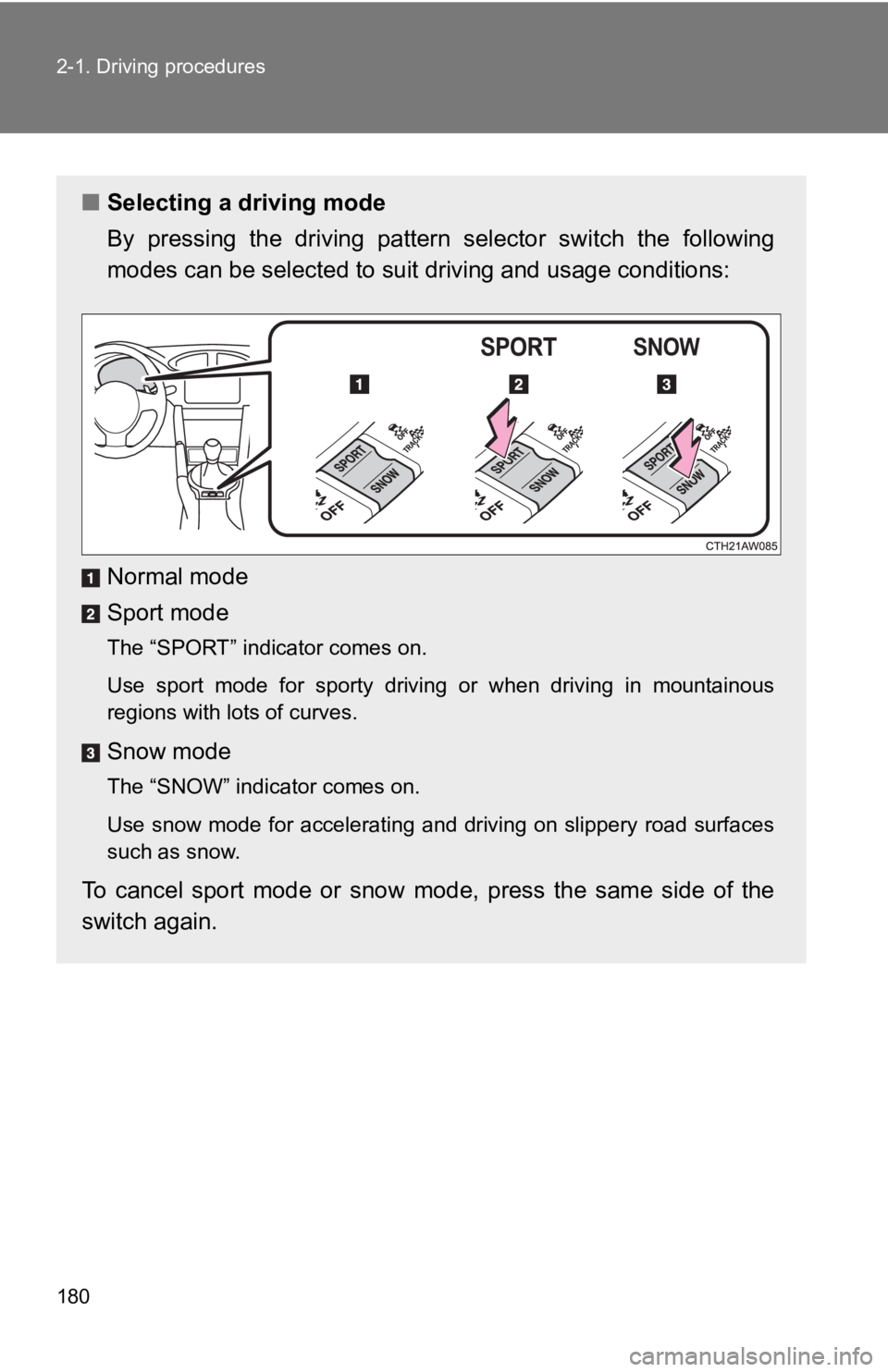
■Selecting a driving mode
By pressing the driving patter n selector switch the following
modes can be selected to suit driving and usage conditions:
Normal mode
Sport mode
The “SPORT” indicator comes on.
Use sport mode for sporty driving or when driving in mountainou s
regions with lots of curves.
Snow mode
The “SNOW” indicator comes on.
Use snow mode for accelerating and driving on slippery road surfaces
such as snow.
To cancel sport mode or snow mode, press the same side of the
switch again.
Page 182 of 532

182 2-1. Driving procedures
●When engine oil temperature is high and engine speed rises clos e
to the red zone.
■ When moving the shift lever out of P
If the shift lever is pushed sideways before the brake pedal is depressed,
shift lever operation may not be possible. Depress the brake pedal before
shifting the shift lever out of P.
■ Downshifting restrictions warning buzzer
If downshifting operations are performed at a vehicle speed by which down-
shifting is not possible (when downshifting will cause the engi ne speed to
enter the red zone), a buzzer will sound to warn the driver that downshifting
cannot be performed.
■ When driving with cruise control activated
Downshifting can be performed even when using cruise control. A fter down-
shifting, the set speed continues. ( P. 181, 183)
■ Sport mode
●In sport mode, lower gears are used and gears change at a highe r
engine speed.
● If sport mode is changed to while the shift lever is in the M p osition, the
“SPORT” indicator will come on but sport mode controls will not be car-
ried out. Shift the shift lever to the D position.
● Sport mode cannot be changed to when driving with cruise contro l acti-
vated.
■ Snow mode
To prevent slipping, 1
st gear cannot be selected when in snow mode.
■ Sport mode and snow mode automatic deactivation
In the following situations, the driving mode is automatically deactivated:
●When the engine is turned off after driving in sport mode or sn ow mode.
● When cruise control is activated while driving in sport mode.
■ If the shift lever cannot be shifted from P
P. 438
Page 183 of 532
183
2-1. Driving procedures
2
When driving
■
Automatic gear selection when the vehicle is stopped
When the vehicle is idling at high rpm in order to warm up, and the vehicle is
on a slippery road, the transmission may automatically shift to 2
nd gear for
stopping and starting off.
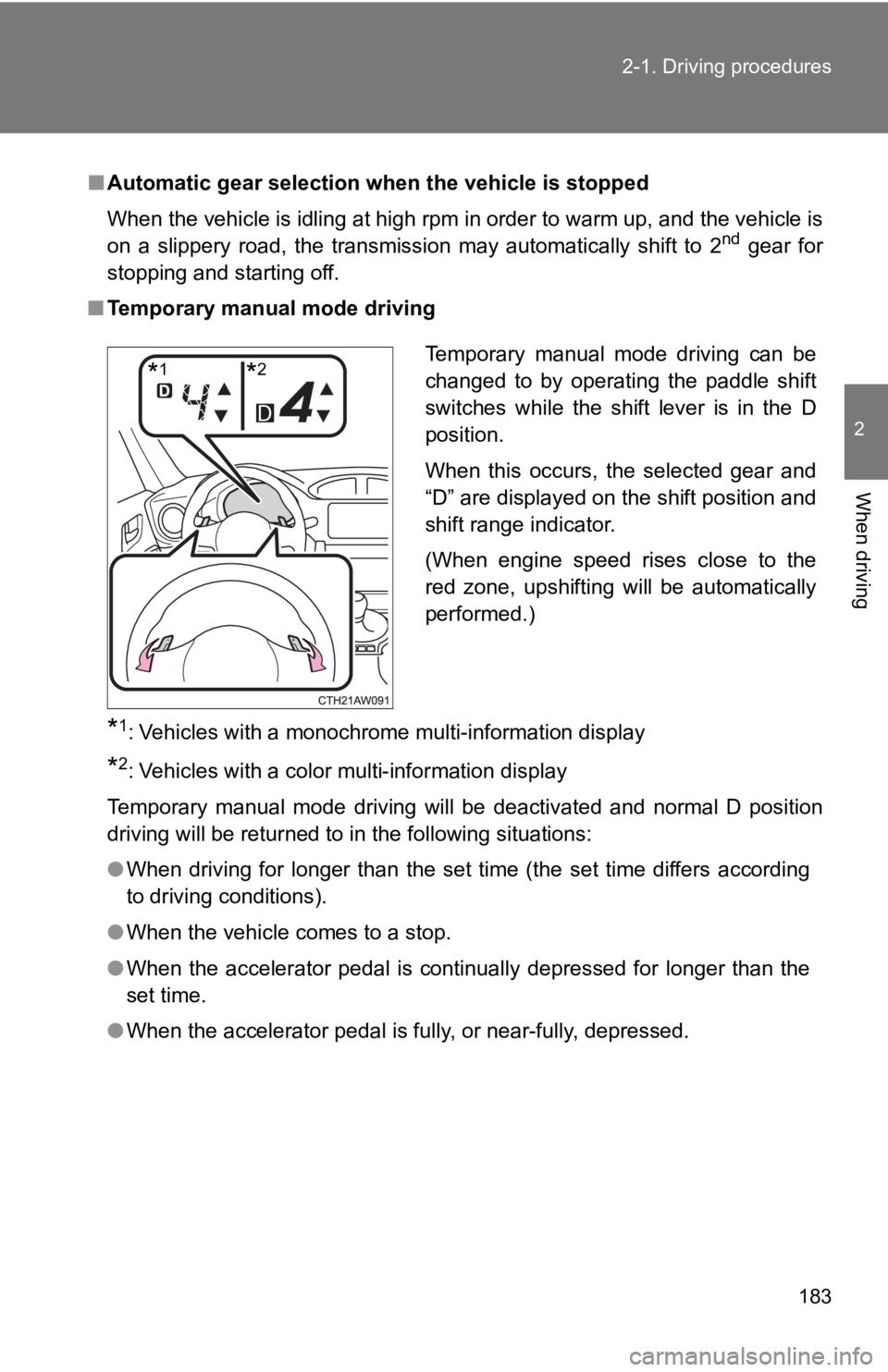
■ Temporary manual mode driving
*1: Vehicles with a monochrome multi-information display
*2: Vehicles with a color multi-information display
Temporary manual mode driving will be deactivated and normal D position
driving will be returned to in the following situations:
● When driving for longer than the set time (the set time differs according
to driving conditions).
● When the vehicle comes to a stop.
● When the accelerator pedal is continually depressed for longer than the
set time.
● When the accelerator pedal is fully, or near-fully, depressed.
Temporary manual mode driving can be
changed to by operating the paddle shift
switches while the shift lever is in the D
position.
When this occurs, the selected gear and
“D” are displayed on the shift position and
shift range indicator.
(When engine speed rises close to the
red zone, upshifting will be automatically
performed.)
*1*2
Page 184 of 532

184 2-1. Driving procedures
■AI-SHIFT
The AI-SHIFT automatically shifts the gear to the suitable posi tion according
to the driver performance and driving conditions.
The AI-SHIFT automatically operates when the shift lever is in the D posi-
tion. (Operating the paddle shift switches or shifting the shif t lever to the M
position cancels the function.)
WARNING
■ When driving on slippery road surfaces
Be careful of downshifting and sudden acceleration, as this cou ld result in
the vehicle skidding to the side or spinning.
■ To prevent incorrect operation
Do not attach items such as accessories to the paddle shift swi tches.
Doing so may unintentionally move the paddle shift switches.
Page 196 of 532
196 2-2. Instrument cluster
■Indicators
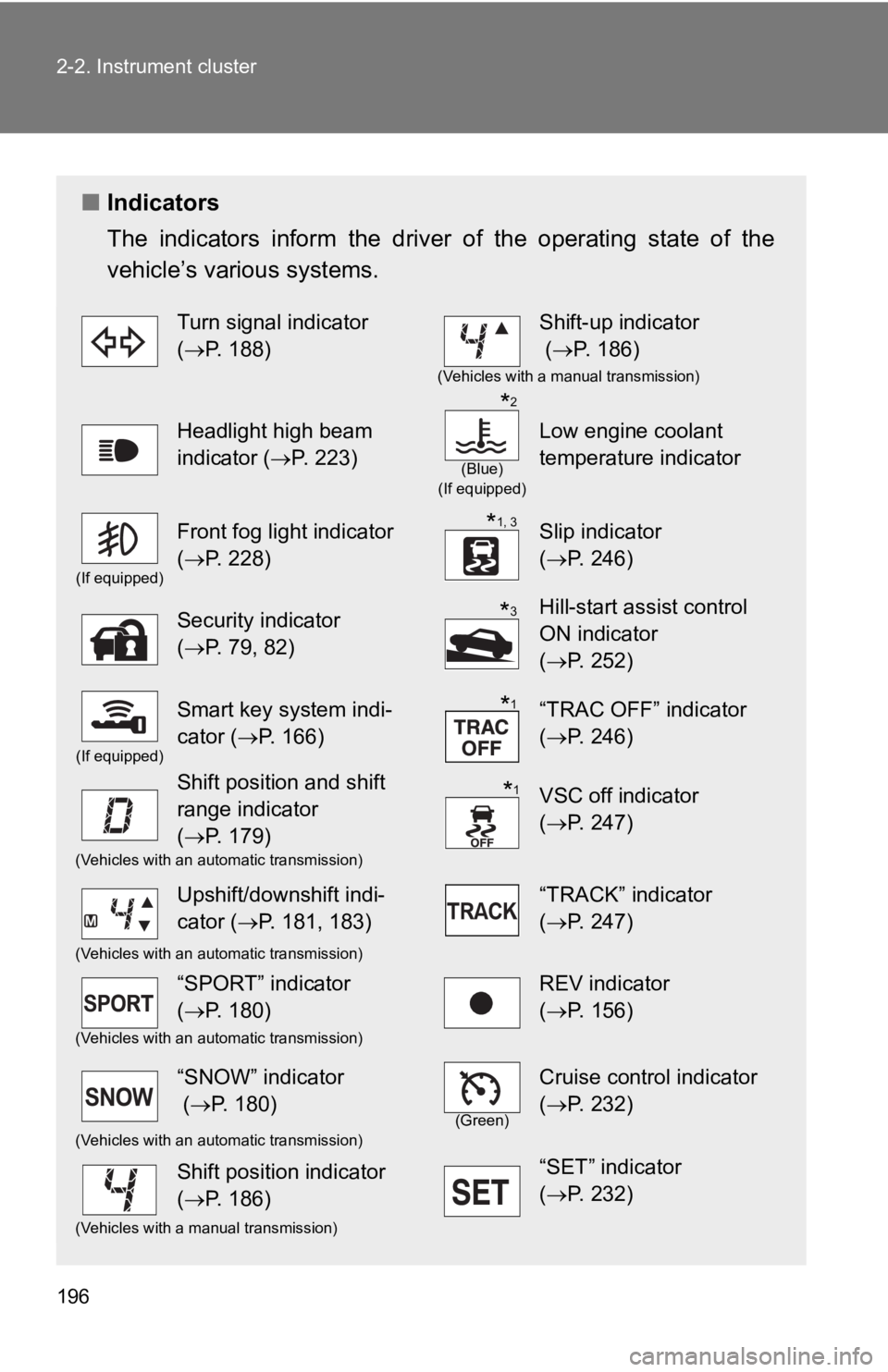
The indicators inform the driv er of the operating state of the
vehicle’s various systems.
Turn signal indicator
( P. 188)Shift-up indicator
( P. 186)
(Vehicles with a manual transmission)
Headlight high beam
indicator ( P. 223)
(Blue)
(If equipped)
Low engine coolant
temperature indicator
(If equipped)
Front fog light indicator
( P. 228)Slip indicator
(P. 246)
Security indicator
(P. 79, 82)Hill-start assist control
ON indicator
(P. 252)
(If equipped)
Smart key system indi-
cator ( P. 166)“TRAC OFF” indicator
(P. 246)
Shift position and shift
range indicator
(P. 179)VSC off indicator
(P. 247)
(Vehicles with an automatic transmission)
Upshift/downshift indi-
cator ( P. 181, 183)“TRACK” indicator
(P. 247)
(Vehicles with an automatic transmission)
“SPORT” indicator
(P. 180)REV indicator
(P. 156)
(Vehicles with an automatic transmission)
“SNOW” indicator
( P. 180)
(Green)
Cruise control indicator
(P. 232)
(Vehicles with an automatic transmission)
Shift position indicator
(P. 186)“SET” indicator
(P. 232)
(Vehicles with a manual transmission)
*2
*1, 3
*3
*1
*1
Page 236 of 532

236 2-4. Using other driving systems
WARNING
■To avoid operating the cruise control by mistake
Switch the cruise control off using the “ON-OFF” button when not in use.
■ Situations unsuitable for cruise control
Do not use cruise control in any of the following situations.
Doing so may result in loss of control and could cause an accident resulting
in death or serious injury.
●In heavy traffic
● On roads with sharp bends
● On winding roads
● On slippery roads, such as those covered with rain, ice or snow
● On steep hills
Vehicle speed may exceed the set speed when driving down a stee p hill.
● During emergency towing
Page 245 of 532
245
2-4. Using other driving systems
2
When driving
Driving assist systems
To help enhance driving safety and performance, the following sys-
tems operate automatically in response to various driving situations.
Be aware, however, that these systems are supplementary and
should not be relied upon too heavi ly when operating the vehicle.
■ABS (Anti-lock Brake System)
Helps to prevent wheel lock when the brakes are applied suddenl y, o r i f
the brakes are applied while driving on a slippery road surface
■ Brake assist
Generates an increased level of braking force after the brake pedal is
depressed when the system detects a panic stop situation
■VSC (Vehicle Stability Control)
Helps the driver to control skidding when swerving suddenly or turning
on slippery road surfaces
■ TRAC (Traction Control)
Helps to maintain drive power and prevent the drive wheels from spin-
ning when starting the vehicle or accelerating on slippery road s.
The TRAC system is also equipped with the brake LSD function.
■ Hill-start assist control
P. 252
■EPS (Electric Po wer Steering)
Employs an electric motor to reduce the amount of effort needed to turn
the steering wheel