fuel pressure TOYOTA HIGHLANDER 2020 Owners Manual (in English)
[x] Cancel search | Manufacturer: TOYOTA, Model Year: 2020, Model line: HIGHLANDER, Model: TOYOTA HIGHLANDER 2020Pages: 560, PDF Size: 14.42 MB
Page 1 of 560
1
2
3
4
5
6
7
8
9
9
HIGHLANDER_U
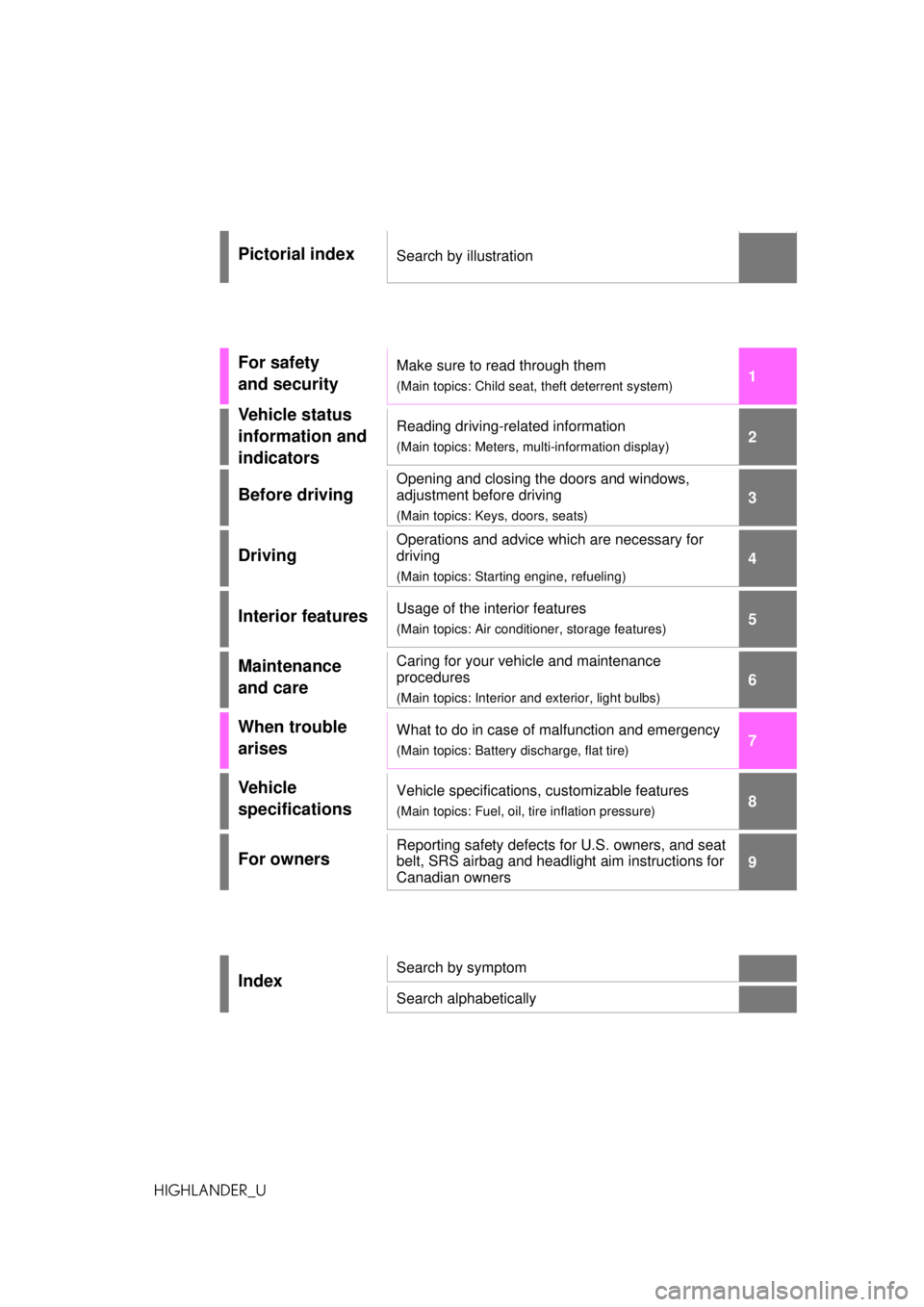
Pictorial indexSearch by illustration
For safety
and securityMake sure to read through them
(Main topics: Child seat, theft deterrent system)
Vehicle status
information and
indicatorsReading driving-related information
(Main topics: Meters, multi-information display)
Before driving
Opening and closing the doors and windows,
adjustment before driving
(Main topics: Keys, doors, seats)
Driving
Operations and advice which are necessary for
driving
(Main topics: Starting engine, refueling)
Interior featuresUsage of the interior features
(Main topics: Air conditioner, storage features)
Maintenance
and careCaring for your vehicle and maintenance
procedures
(Main topics: Interior and exterior, light bulbs)
When trouble
arisesWhat to do in case of malfunction and emergency
(Main topics: Battery discharge, flat tire)
Vehicle
specificationsVehicle specifications, customizable features
(Main topics: Fuel, oil, tire inflation pressure)
For ownersReporting safety defects for U.S. owners, and seat
belt, SRS airbag and headlight aim instructions for
Canadian owners
IndexSearch by symptom
Search alphabetically
Page 4 of 560
4TABLE OF CONTENTS
HIGHLANDER_U
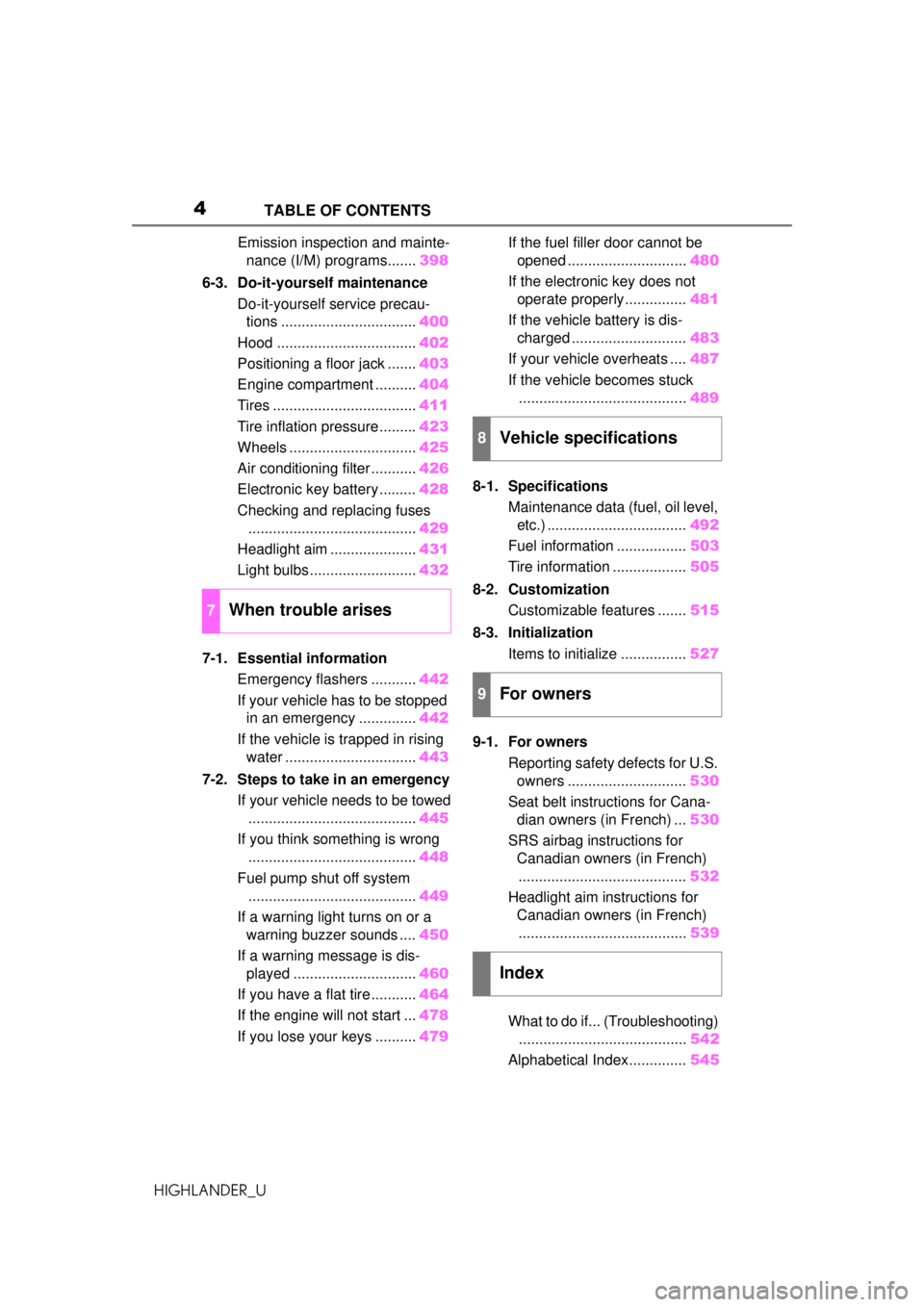
Emission inspection and mainte-nance (I/M) programs....... 398
6-3. Do-it-yourself maintenance Do-it-yourself service precau-tions ................................. 400
Hood .................................. 402
Positioning a floor jack ....... 403
Engine compartment .......... 404
Tires ................................... 411
Tire inflation pressure......... 423
Wheels ............................... 425
Air conditioning filter ........... 426
Electronic key battery ......... 428
Checking and replacing fuses ......................................... 429
Headlight aim ..................... 431
Light bulbs .......................... 432
7-1. Essential information Emergency flashers ........... 442
If your vehicle has to be stopped in an emergency .............. 442
If the vehicle is trapped in rising water ................................ 443
7-2. Steps to take in an emergency If your vehicle needs to be towed......................................... 445
If you think something is wrong ......................................... 448
Fuel pump shut off system ......................................... 449
If a warning light turns on or a warning buzzer sounds .... 450
If a warning message is dis- played .............................. 460
If you have a flat tire ........... 464
If the engine will not start ... 478
If you lose your keys .......... 479If the fuel filler door cannot be
opened ............................. 480
If the electronic key does not operate properly............... 481
If the vehicle battery is dis- charged ............................ 483
If your vehicle overheats .... 487
If the vehicle becomes stuck ......................................... 489
8-1. Specifications Maintenance data (fuel, oil level, etc.) .................................. 492
Fuel information ................. 503
Tire information .................. 505
8-2. Customization Customizable features ....... 515
8-3. Initialization Items to initialize ................ 527
9-1. For owners Reporting safety defects for U.S. owners ............................. 530
Seat belt instructions for Cana- dian owners (in French) ... 530
SRS airbag instructions for Canadian owners (in French)......................................... 532
Headlight aim instructions for Canadian owners (in French)
........ ................................. 53
9
What to do if... (Troubleshooting) ......................................... 542
Alphabetical Index.............. 545
7When trouble arises
8Vehicle specifications
9For owners
Index
Page 12 of 560
12Pictorial index
HIGHLANDER_U
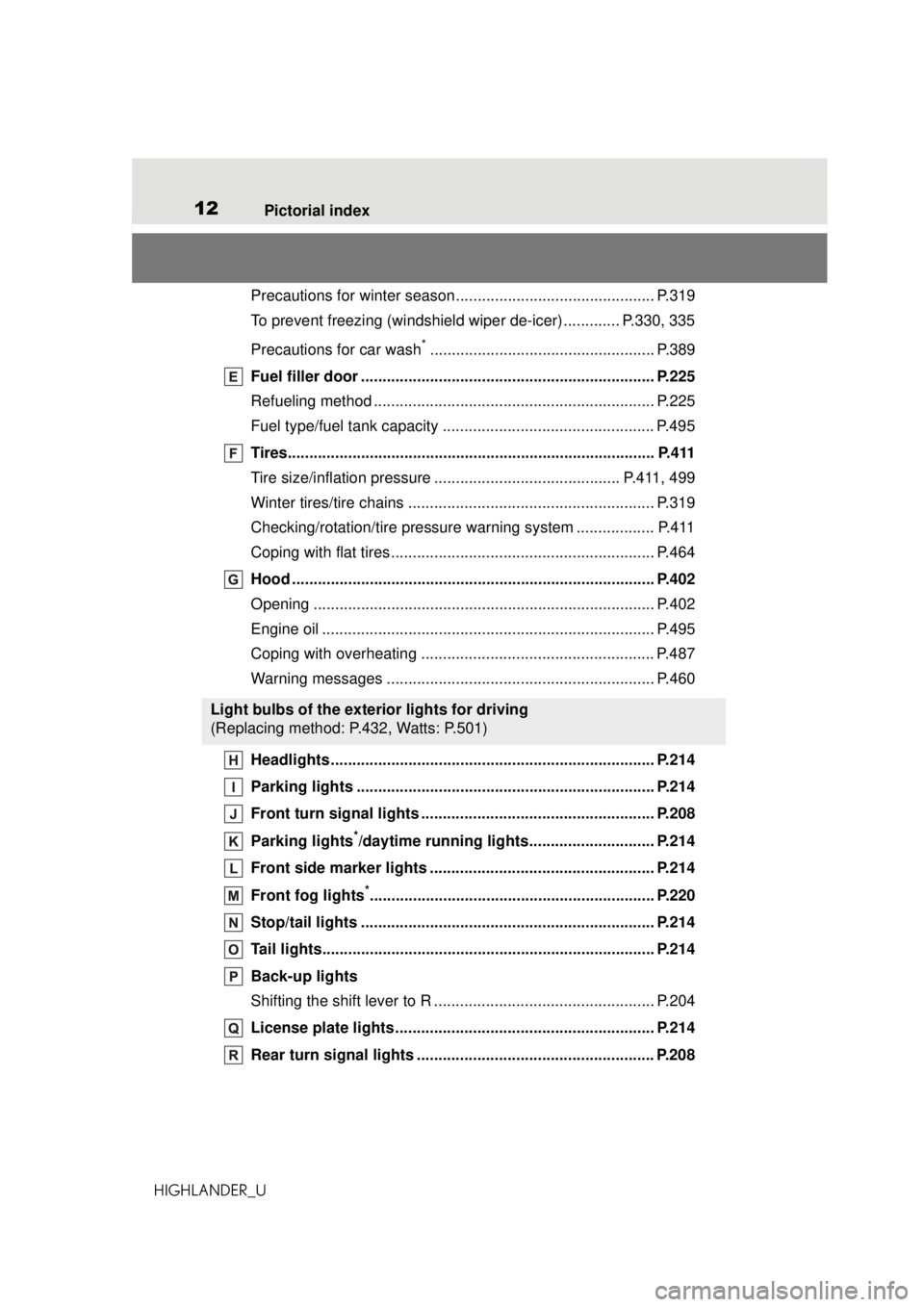
Precautions for winter season.... .......................................... P.319
To prevent freezing (windshield wiper de-icer) ............. P.330, 335
Precautions for car wash
*.................................................... P.389
Fuel filler door .................................................................... P.225
Refueling method ................................................................. P.225
Fuel type/fuel tank capacity ................................................. P.495
Tires..................................................................................... P.411
Tire size/inflation pressure ........................................... P.411, 499
Winter tires/tire chains ......................................................... P.319
Checking/rotation/tire pressure warning system .................. P.411
Coping with flat tires............................................................. P.464
Hood .................................................................................... P.402
Opening ............................................................................... P.402
Engine oil ............................................................................. P.495
Coping with overheating ...................................................... P.487
Warning messages .............................................................. P.460
Headlights........................................................................... P.214
Parking lights ..................................................................... P.214
Front turn signal lights ...................................................... P.208
Parking lights
*/daytime running lights............................. P.214
Front side marker lights .................................................... P.214
Front fog lights
*.................................................................. P.220
Stop/tail lights .................................................................... P.214
Tail lights............................................................................. P.214
Back-up lights
Shifting the shift lever to R ................................................... P.204
License plate lights............................................................ P.214
Rear turn signal lights ....................................................... P.208
Light bulbs of the exterior lights for driving
(Replacing method: P.432, Watts: P.501)
Page 75 of 560
752-1. Instrument cluster
HIGHLANDER_U
2
Vehicle status information and indicators
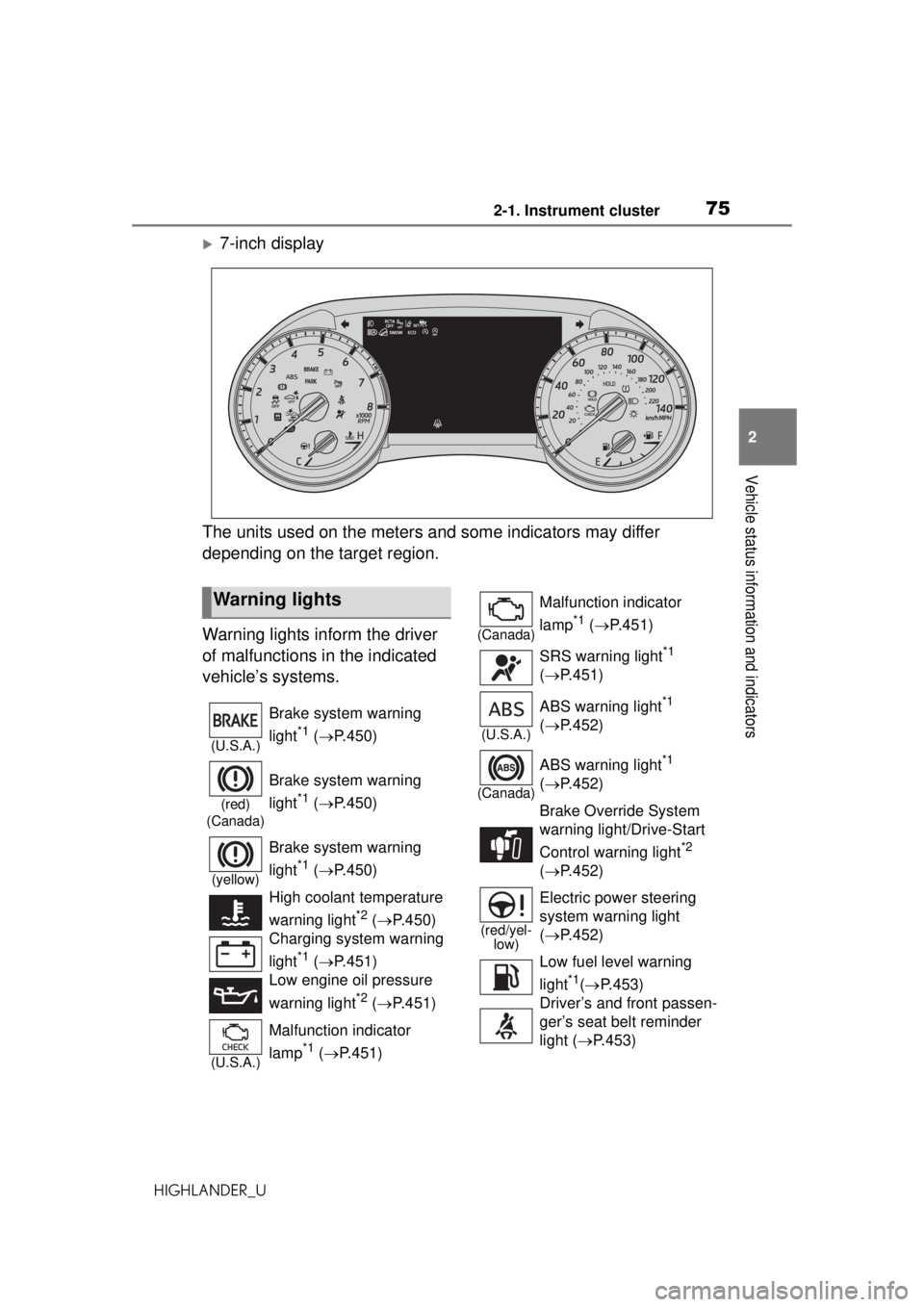
7-inch display
The units used on the meters and some indicators may differ
depending on the target region.
Warning lights inform the driver
of malfunctions in the indicated
vehicle’s systems.
Warning lights
(U.S.A.)
Brake system warning
light
*1 ( P.450)
(red)
(Canada)
Brake system warning
light
*1 ( P.450)
(yellow)
Brake system warning
light
*1 ( P.450)
High coolant temperature
warning light
*2 ( P.450)
Charging system warning
light
*1 ( P.451)
Low engine oil pressure
warning light
*2 ( P.451)
(U.S.A.)
Malfunction indicator
lamp
*1 ( P.451)
(Canada)
Malfunction indicator
lamp
*1 ( P.451)
SRS warning light
*1
( P.451)
(U.S.A.)
ABS warning light*1
( P.452)
(Canada)
ABS warning light*1
( P.452)
Brake Override System
warning light/Drive-Start
Control warning light
*2
( P.452)
(red/yel-
low)
Electric power steering
system warning light
( P.452)
Low fuel level warning
light
*1( P.453)
Driver’s and front passen-
ger’s seat belt reminder
light ( P.453)
Page 95 of 560
952-1. Instrument cluster
HIGHLANDER_U
2
Vehicle status information and indicators
When “Refuel” is displayed, the
remaining fuel amount is low and
the distance that can be driven with
the remaining fuel cannot be calcu-
lated.
Refuel immediately.
■Eco Driving Indicator
Eco Driving Indicator will not oper-
ate under the following conditions:
●The shift lever is in any position
other than D.
●The driving mode is set to sport
mode.
●The vehicle speed is approxi-
mately 80 mph (130 km/h) or
higher.
■Driving support system
information
Select to display the operational
status of the following systems:
LTA (Lane Tracing Assist)
( P.241)
RSA (Road Sign Assist) (if
equipped) ( P.251)
Dynamic radar cruise control
with full-speed range
( P.254)
■Navigation system-linked
display (if equipped)
Select to display the following
navigation system-linked infor-
mation:
Route guidance to destination
Compass display (head-
ing-up display)
■Route guidance to destination
display
When the route guidance to destina-
tion display is enabled on the
head-up display, it will not be dis-
played on the multi-information dis-
play. ( P.103)
Select to enable selection of an
audio source or track on the
meter using the meter control
switches.
This menu icon can be set to be
displayed/not displayed in .
■Tire pressure
P.414
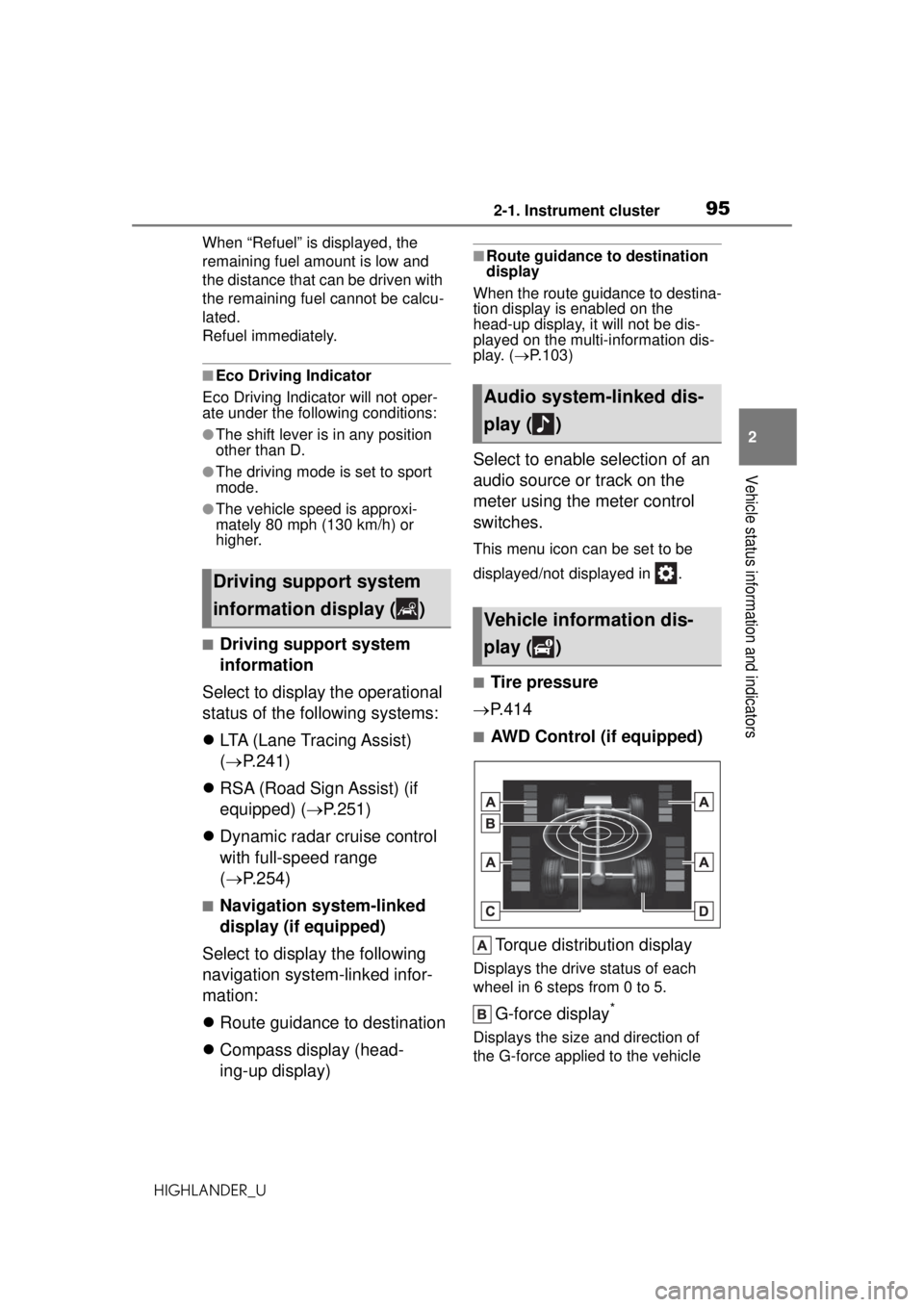
■AWD Control (if equipped)
Torque distribution display
Displays the drive status of each
wheel in 6 steps from 0 to 5.
G-force display*
Displays the size and direction of
the G-force applied to the vehicle
Driving support system
information display ( )
Audio system-linked dis-
play ( )
Vehicle information dis-
play ( )
Page 99 of 560

992-1. Instrument cluster
HIGHLANDER_U
2
Vehicle status information and indicators
dealer. ( P.420)
• “Change Wheel” (register tire pressure warning system sensor
ID codes)
Select to register the ID codes of
the tire pressure sensors to the tire
pressure warning system.
“Rear Seat Reminder”
( P. 1 1 7 )
Select to enable/disable the rear
seat reminder.
“Scheduled Maintenance”
( P.395)
Select to reset the scheduled main-
tenance information (maintenance
required message and distance
until maintenance necessary) after
all maintenance is performed.
“Oil Maintenance” ( P.404)
Select to reset the oil maintenance
information (maintenance required
message and distance until mainte-
nance necessary) after an oil
change is performed.
■ Meter settings
Press and hold to change
the settings of the following
items:
Language
Select to change the language dis-
played.
Units
Select to change the units of mea-
sure displayed.
Eco Driving Indicator Light
( P. 9 3 )
Select to enable/disable the Eco Driving Indicator Light.
Speedometer display (digital
speed)
Select to enable/disable the speed-
ometer display.
Gadget content
Select to turn the display of a gad-
get.
Fuel economy type
Select to change the average fuel
consumption display and an item to
be displayed as gadget.
Pop-up display
Select to enable/disable pop-up
displays for each relevant system.
Multi-information display off
Displays a blank screen.
Default setting
Select to reset the meter display
settings to the default setting.
■Vehicle functions and set-
tings that can be changed
P.515
■Background color of the indica-
tor/shift position display area
The background color of the indica-
tor/shift position display area is
changed according to the driving
mode as follows ( P.306):
●Eco drive mode: Blue
●Sport mode: Red
■Suspension of the settings dis-
play
●Some settings cannot be changed
while driving. When changing set-
tings, park the vehicle in a safe
place.
●If a warning message is displayed,
Page 398 of 560
3986-2. Maintenance
HIGHLANDER_U
The OBD system determines
that a problem exists some-
where in the emission control
system. Your vehicle may not
pass the I/M test and may need
to be repaired. Contact your
Toyota dealer to service the
vehicle.
When the battery is discon-
nected or discharged
Readiness codes that are set
during ordinary driving are erased.
Also, depending on your driving
habits, the readiness codes may
not be completely set.
When the fuel tank cap is
loose
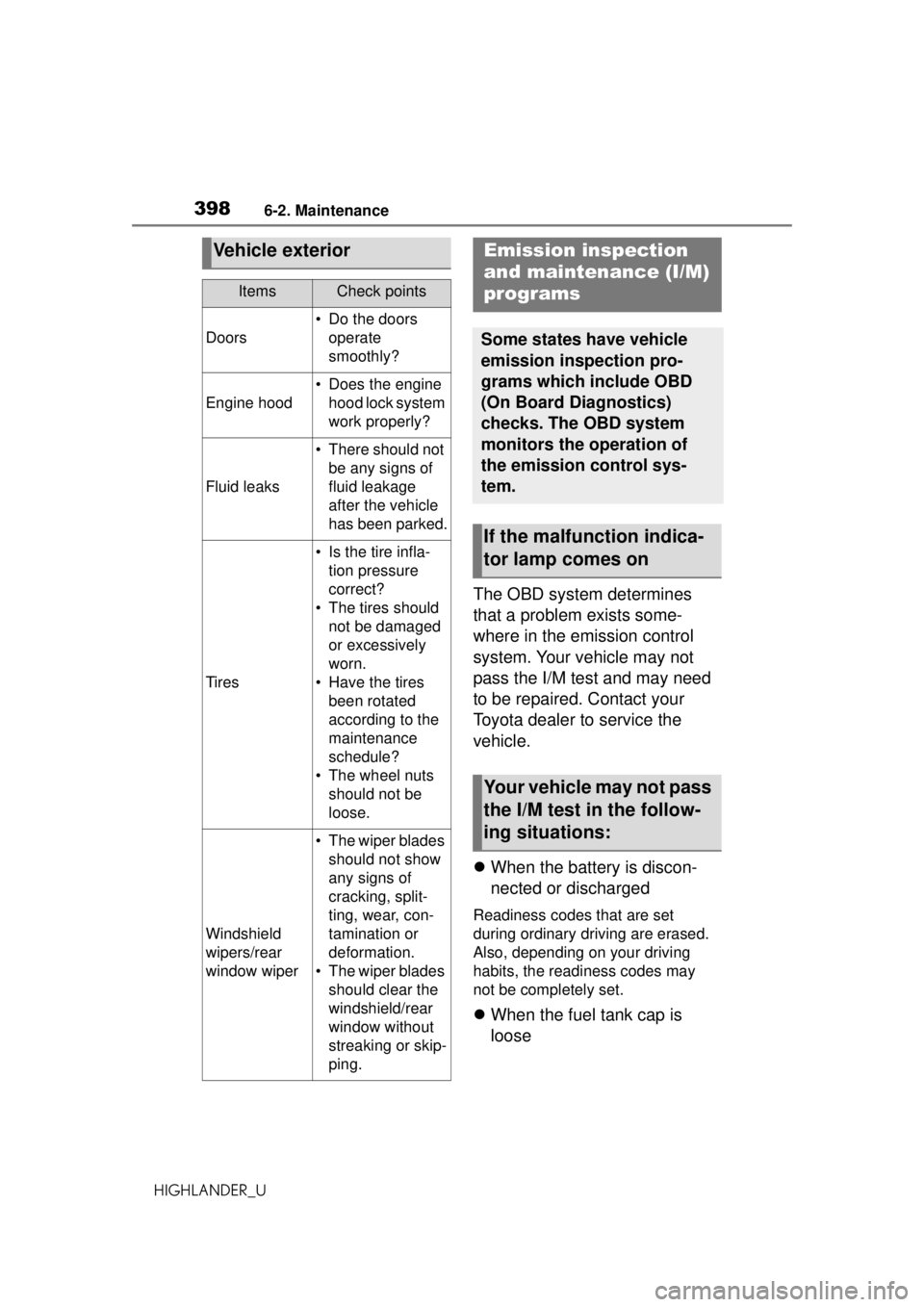
Vehicle exterior
ItemsCheck points
Doors
• Do the doors
operate
smoothly?
Engine hood
• Does the engine hood lock system
work properly?
Fluid leaks
• There should not be any signs of
fluid leakage
after the vehicle
has been parked.
Tires
• Is the tire infla-tion pressure
correct?
• The tires should not be damaged
or excessively
worn.
• Have the tires been rotated
according to the
maintenance
schedule?
• The wheel nuts should not be
loose.
Windshield
wipers/rear
window wiper
• The wiper blades should not show
any signs of
cracking, split-
ting, wear, con-
tamination or
deformation.
• The wiper blades should clear the
windshield/rear
window without
streaking or skip-
ping.
Emission inspection
and maintenance (I/M)
programs
Some states have vehicle
emission inspection pro-
grams which include OBD
(On Board Diagnostics)
checks. The OBD system
monitors the operation of
the emission control sys-
tem.
If the malfunction indica-
tor lamp comes on
Your vehicle may not pass
the I/M test in the follow-
ing situations:
Page 401 of 560
4016-3. Do-it-yourself maintenance
HIGHLANDER_U
6
Maintenance and care
Headlight aim
( P.431)• Phillips-head
screwdriver
Light bulbs
( P.432)
• Bulb with same
number and
wattage rating as
original
• Flathead screw- driver
• Wrench
Radiator and
condenser
( P.408)
Tire inflation
pressure
( P.423)• Tire pressure
gauge
• Compressed air source
Washer fluid
( P.410)
• Water or washer
fluid containing
antifreeze (for
winter use)
• Funnel (used only for adding
water or washer
fluid)
WARNING
The engine compartment contains
many mechanisms and fluids that
may move suddenly, become hot,
or become electrically energized.
To avoid death or serious injury,
observe the following precautions.
■When working on the engine
compartment
●Keep hands, clothing and tools
away from the moving fan and
engine drive belt.
ItemsParts and tools●Be careful not to touch the
engine, radiator, exhaust mani-
fold, etc. right after driving as
they may be hot. Oil and other
fluids may also be hot.
●Do not leave anything that may
burn easily, such as paper and
rags, in the engine compart-
ment.
●Do not smoke, cause sparks or
expose an open flame to fuel or
the battery. Fuel and battery
fumes are flammable.
●Be extremely cautious when
working on the battery. It con-
tains poisonous and corrosive
sulfuric acid.
■When working near the elec-
tric cooling fan or radiator
grille
Be sure the engine switch is off.
With the engine switch in ON, the
electric cooling fan may automati-
cally start to run if the air condi-
tioning is on and/or the coolant
temperature is high. ( P.408)
■Safety glasses
Wear safety glasses to prevent
flying or falling material, fluid
spray, etc. from getting in your
eyes.
NOTICE
■If you remove the air cleaner
filter
Driving with the air cleaner filter
removed may cause excessive
engine wear due to dirt in the air.
Page 423 of 560
4236-3. Do-it-yourself maintenance
HIGHLANDER_U
6
Maintenance and care
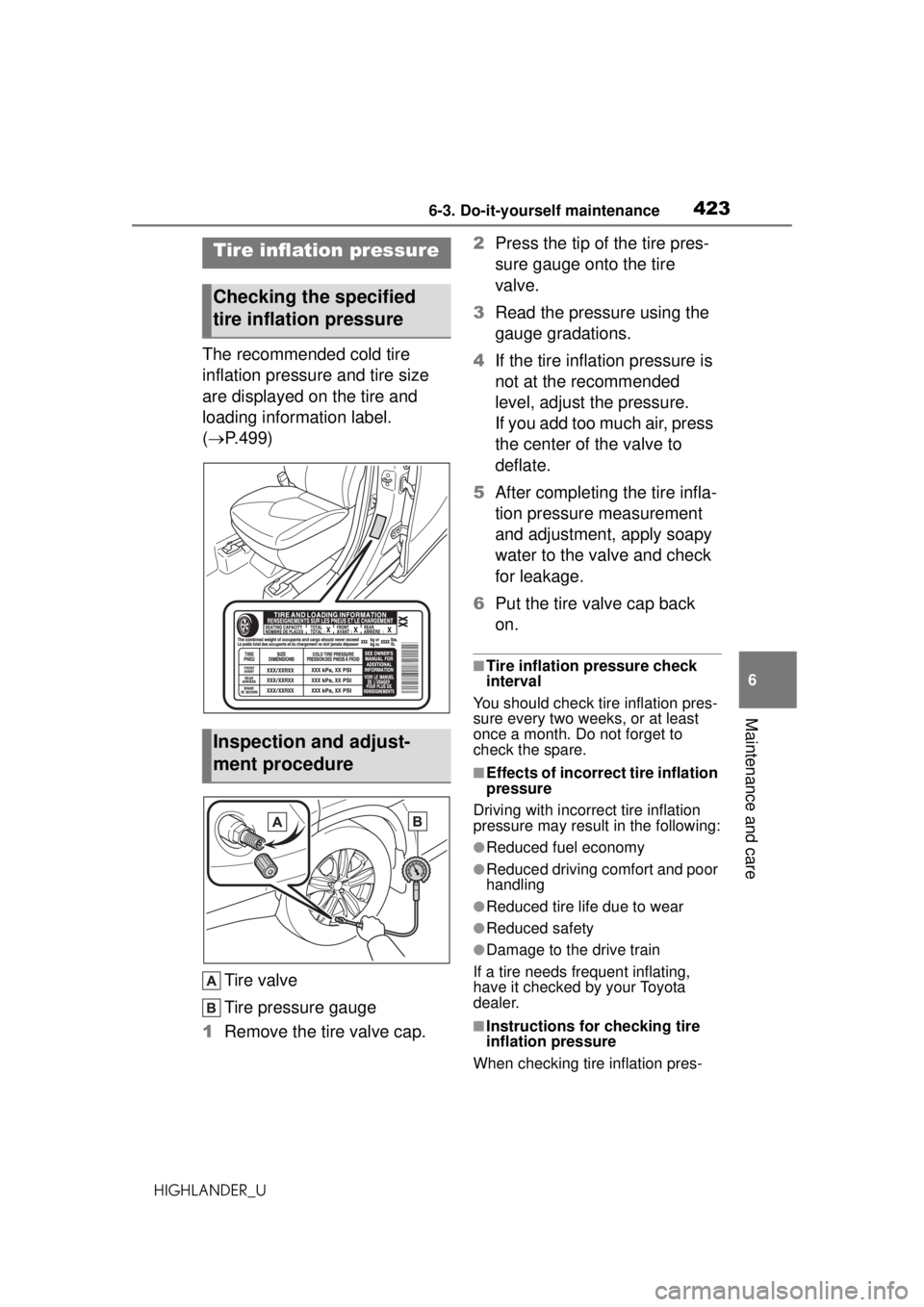
The recommended cold tire
inflation pressure and tire size
are displayed on the tire and
loading information label.
( P.499)
Tire valve
Tire pressure gauge
1 Remove the tire valve cap. 2
Press the tip of the tire pres-
sure gauge onto the tire
valve.
3 Read the pressure using the
gauge gradations.
4 If the tire inflation pressure is
not at the recommended
level, adjust the pressure.
If you add too much air, press
the center of the valve to
deflate.
5 After completing the tire infla-
tion pressure measurement
and adjustment, apply soapy
water to the valve and check
for leakage.
6 Put the tire valve cap back
on.
■Tire inflation pressure check
interval
You should check tire inflation pres-
sure every two weeks, or at least
once a month. Do not forget to
check the spare.
■Effects of incorrect tire inflation
pressure
Driving with incorrect tire inflation
pressure may result in the following:
●Reduced fuel economy
●Reduced driving comfort and poor
handling
●Reduced tire life due to wear
●Reduced safety
●Damage to the drive train
If a tire needs frequent inflating,
have it checked by your Toyota
dealer.
■Instructions for checking tire
inflation pressure
When checking tire inflation pres-
Tire inflation pressure
Checking the specified
tire inflation pressure
Inspection and adjust-
ment procedure
Page 459 of 560
4597-2. Steps to take in an emergency
HIGHLANDER_U
7
When trouble arises
WARNING
■When the electric power
steering system warning light
comes on
When the light comes on yellow,
the assist to the power steering is
restricted. When the light comes
on red, the assist to the power
steering is lost and handling oper-
ations of the steering wheel
become extremely heavy.
When steering wheel operations
are heavier than usual, grip the
steering wheel firmly and operate
it using more force than usual.
■If the tire pressure warning
light comes on
Be sure to observe the following
precautions.
Failure to do so could cause a
loss of vehicle control and result
in death or serious injury.
●Stop your vehicle in a safe place
as soon as possible. Adjust the
tire inflation pressure immedi-
ately.
●Vehicles with a compact spare
tire: If the tire pressure warning
light comes on even after tire
inflation pressure adjustment, it
is probable that you have a flat
tire. Check the tires. If a tire is
flat, change it with the spare tire
and have the flat tire repaired by
the nearest Toyota dealer.
●Avoid abrupt maneuvering and
braking.
If the vehicle tires deteriorate,
you could lose control of the
steering wheel or the brakes.
■If a blowout or sudden air
leakage should occur
The tire pressure warning system
may not activate immediately.
■Maintenance of the tires
Each tire, includ ing the spare (if
provided), should be checked
monthly when cold and inflated to
the inflation pressure recom-
mended by the vehicle manufac-
turer on the vehicle placard or tire
inflation pressure label (tire and
load information label). (If your
vehicle has tires of a different size
than the size indicated on the
vehicle placard or tire inflation
pressure label [tire and load infor-
mation label], you should deter-
mine the proper tire inflation
pressure for those tires.)
As an added safety feature, your
vehicle has been equipped with a
tire pressure monitoring system
(TPMS-tire pres sure warning sys-
tem) that illuminates a low tire
pressure telltale (tire pressure
warning light) when one or more
of your tires is significantly
under-inflated. Accordingly, when
the low tire pressure telltale (tire
pressure warning light) illumi-
nates, you should stop and check
your tires as soon as possible,
and inflate them to the proper
pressure. Driving on a signifi-
cantly under-inflated tire causes
the tire to overheat and can lead
to tire failure. Under-inflation also
reduces fuel efficiency and tire
tread life, and may affect the vehi-
cle’s handling and stopping ability.
Please note that the TPMS (tire
pressure warning system) is not a
substitute for proper tire mainte-
nance, and it is the driver’s
responsibility to maintain correct
tire pressure, even if under-infla-
tion has not reached the level to
trigger illumination of the TPMS
low tire pressure telltale (tire pres-
sure warning light).