radiator TOYOTA HIGHLANDER 2020 Owners Manual (in English)
[x] Cancel search | Manufacturer: TOYOTA, Model Year: 2020, Model line: HIGHLANDER, Model: TOYOTA HIGHLANDER 2020Pages: 560, PDF Size: 14.42 MB
Page 396 of 560
3966-2. Maintenance
HIGHLANDER_U
General maintenance
Listed below are the general
maintenance items that
should be performed at the
intervals specified in the
“Owner’s Warranty Informa-
tion Booklet” or “Owner’s
Manual Supplement/Sched-
uled Maintenance Guide”. It
is recommended that any
problem you notice should
be brought to the attention
of your Toyota dealer or
qualified service shop for
advice.
WARNING
■If the engine is running
Turn the engine off and ensure
that there is adequate ventilation
before performing maintenance
checks.
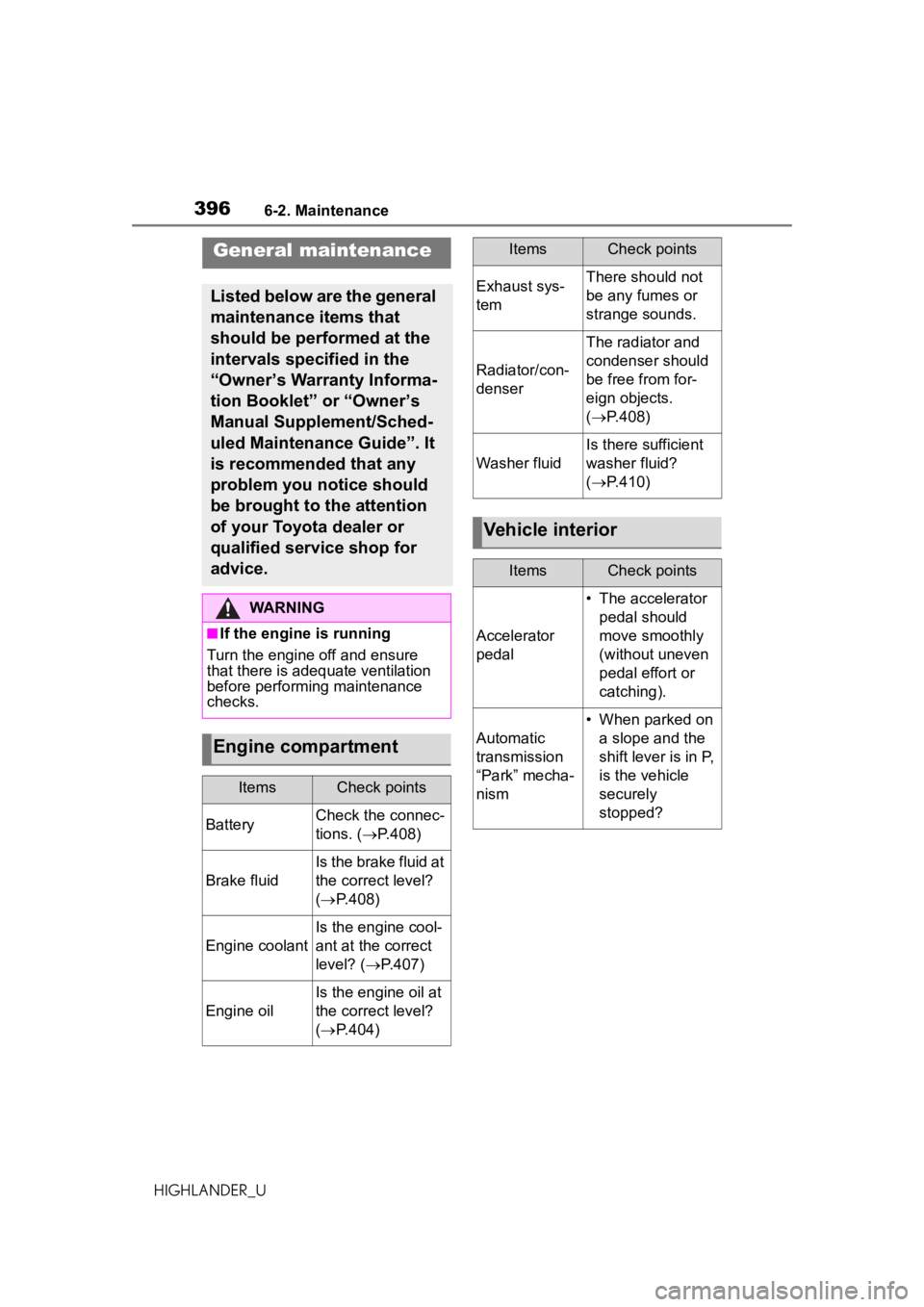
Engine compartment
ItemsCheck points
BatteryCheck the connec-
tions. ( P.408)
Brake fluid
Is the brake fluid at
the correct level?
( P.408)
Engine coolant
Is the engine cool-
ant at the correct
level? ( P.407)
Engine oil
Is the engine oil at
the correct level?
( P.404)
Exhaust sys-
temThere should not
be any fumes or
strange sounds.
Radiator/con-
denser
The radiator and
condenser should
be free from for-
eign objects.
( P.408)
Washer fluid
Is there sufficient
washer fluid?
( P.410)
Vehicle interior
ItemsCheck points
Accelerator
pedal
• The accelerator
pedal should
move smoothly
(without uneven
pedal effort or
catching).
Automatic
transmission
“Park” mecha-
nism
• When parked on a slope and the
shift lever is in P,
is the vehicle
securely
stopped?
ItemsCheck points
Page 401 of 560
4016-3. Do-it-yourself maintenance
HIGHLANDER_U
6
Maintenance and care
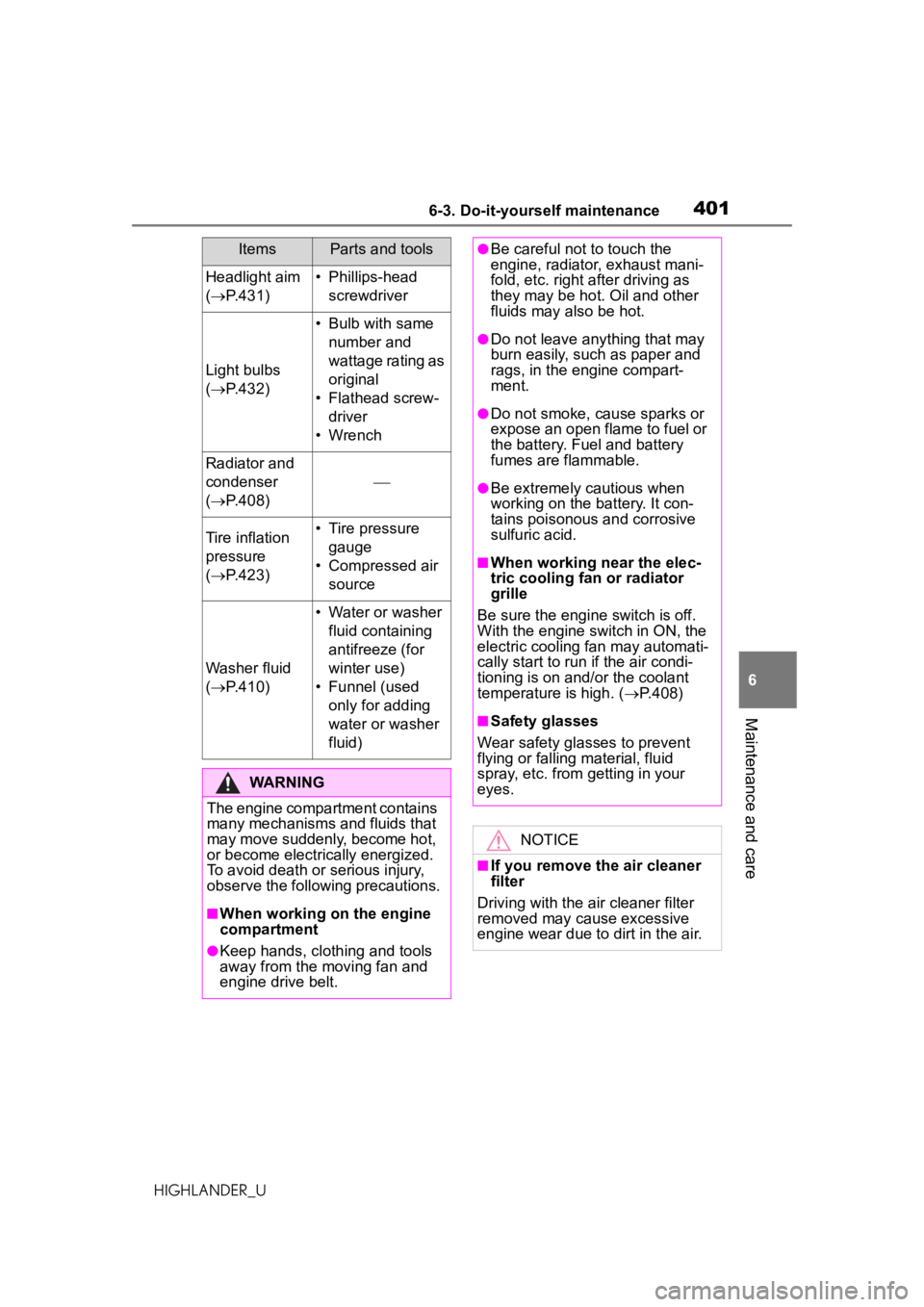
Headlight aim
( P.431)• Phillips-head
screwdriver
Light bulbs
( P.432)
• Bulb with same
number and
wattage rating as
original
• Flathead screw- driver
• Wrench
Radiator and
condenser
( P.408)
Tire inflation
pressure
( P.423)• Tire pressure
gauge
• Compressed air source
Washer fluid
( P.410)
• Water or washer
fluid containing
antifreeze (for
winter use)
• Funnel (used only for adding
water or washer
fluid)
WARNING
The engine compartment contains
many mechanisms and fluids that
may move suddenly, become hot,
or become electrically energized.
To avoid death or serious injury,
observe the following precautions.
■When working on the engine
compartment
●Keep hands, clothing and tools
away from the moving fan and
engine drive belt.
ItemsParts and tools●Be careful not to touch the
engine, radiator, exhaust mani-
fold, etc. right after driving as
they may be hot. Oil and other
fluids may also be hot.
●Do not leave anything that may
burn easily, such as paper and
rags, in the engine compart-
ment.
●Do not smoke, cause sparks or
expose an open flame to fuel or
the battery. Fuel and battery
fumes are flammable.
●Be extremely cautious when
working on the battery. It con-
tains poisonous and corrosive
sulfuric acid.
■When working near the elec-
tric cooling fan or radiator
grille
Be sure the engine switch is off.
With the engine switch in ON, the
electric cooling fan may automati-
cally start to run if the air condi-
tioning is on and/or the coolant
temperature is high. ( P.408)
■Safety glasses
Wear safety glasses to prevent
flying or falling material, fluid
spray, etc. from getting in your
eyes.
NOTICE
■If you remove the air cleaner
filter
Driving with the air cleaner filter
removed may cause excessive
engine wear due to dirt in the air.
Page 404 of 560
4046-3. Do-it-yourself maintenance
HIGHLANDER_U
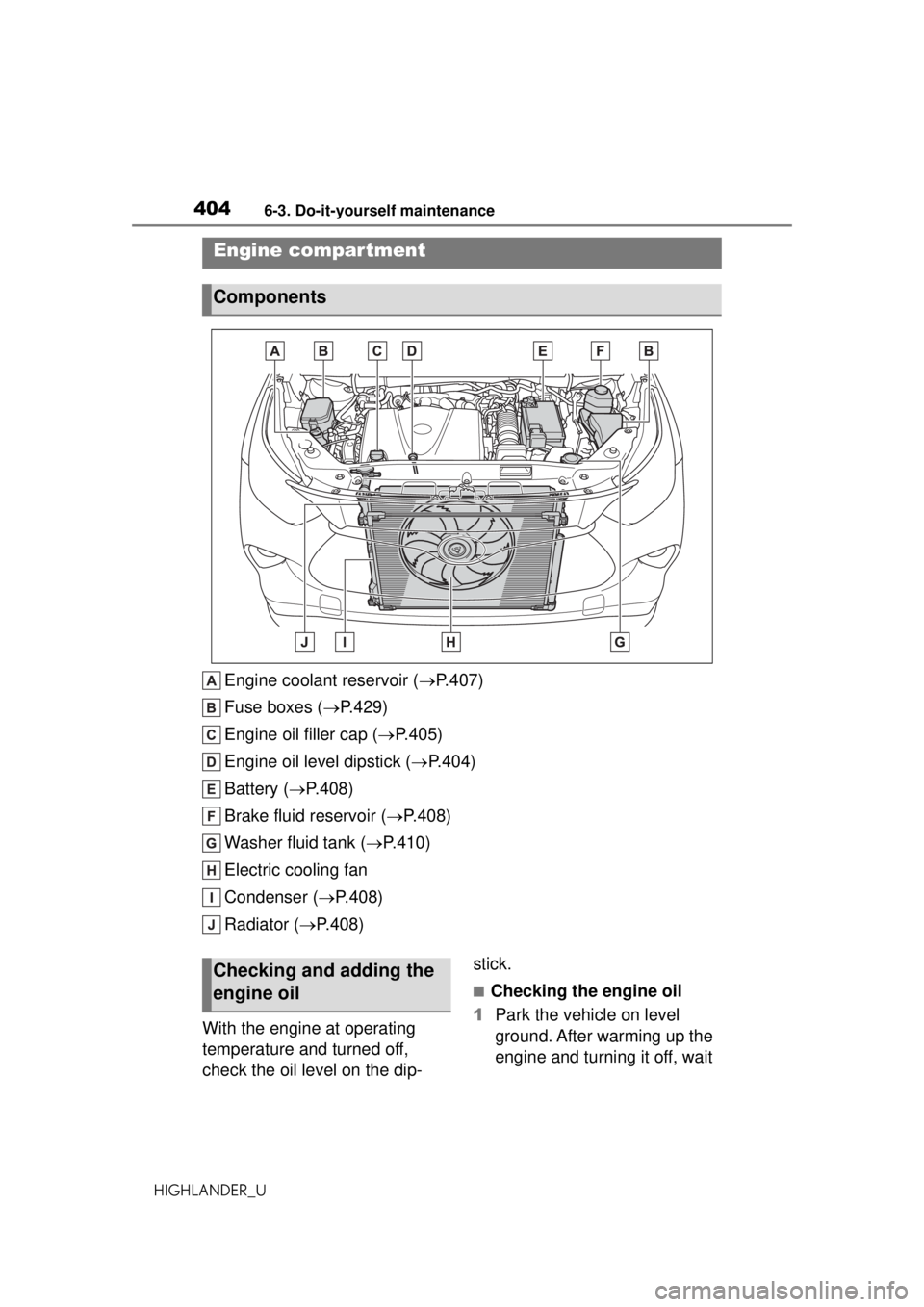
Engine coolant reservoir (P.407)
Fuse boxes ( P.429)
Engine oil filler cap ( P.405)
Engine oil level dipstick ( P.404)
Battery ( P.408)
Brake fluid reservoir ( P.408)
Washer fluid tank ( P.410)
Electric cooling fan
Condenser ( P.408)
Radiator ( P.408)
With the engine at operating
temperature and turned off,
check the oil level on the dip- stick.
■Checking the engine oil
1 Park the vehicle on level
ground. After warming up the
engine and turning it off, wait
Engine compar tment
Components
Checking and adding the
engine oil
Page 407 of 560
4076-3. Do-it-yourself maintenance
HIGHLANDER_U
6
Maintenance and care
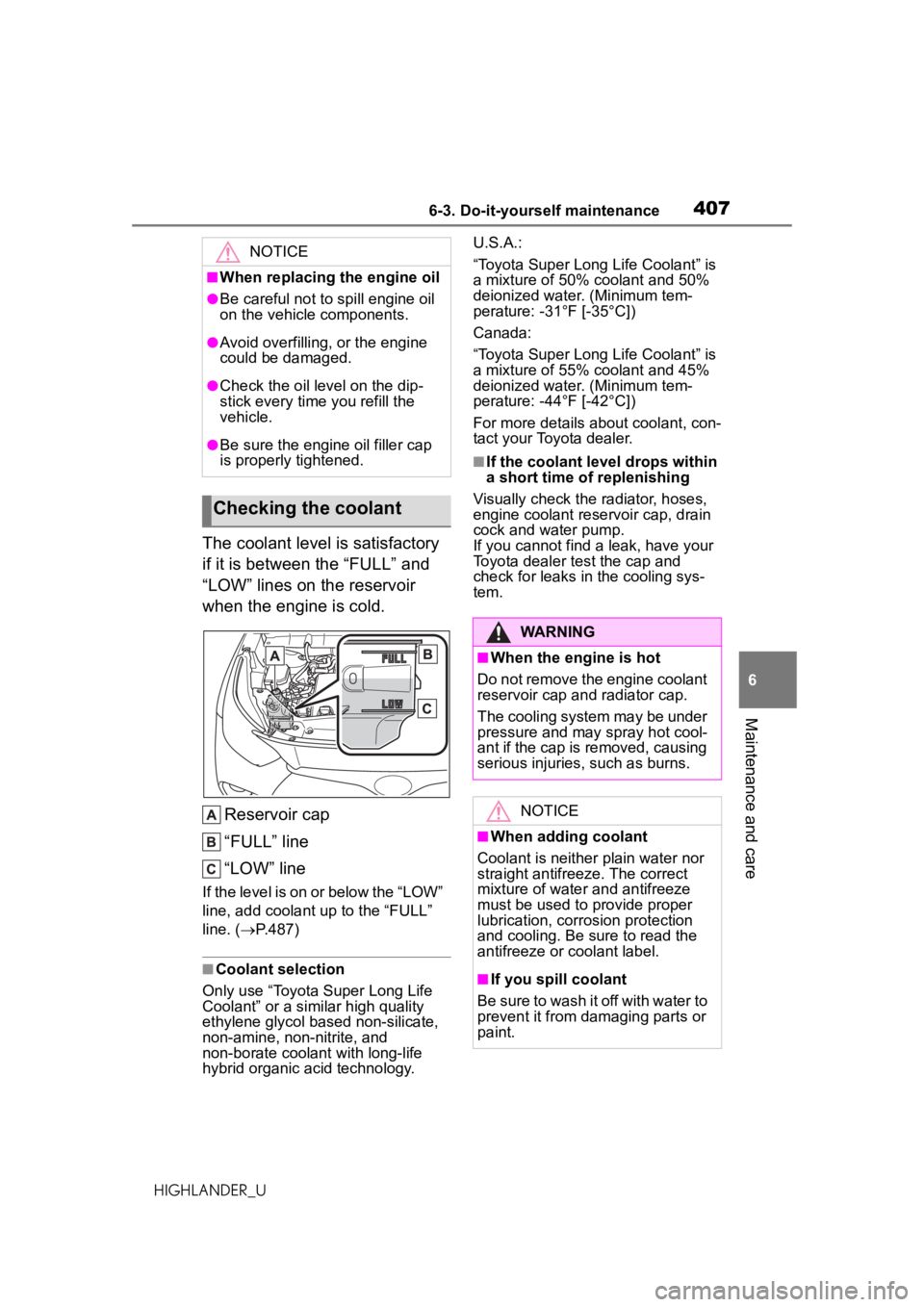
The coolant level is satisfactory
if it is between the “FULL” and
“LOW” lines on the reservoir
when the engine is cold. Reservoir cap
“FULL” line
“LOW” line
If the level is on or below the “LOW”
line, add coolant up to the “FULL”
line. ( P.487)
■Coolant selection
Only use “Toyota Super Long Life
Coolant” or a similar high quality
ethylene glycol based non-silicate,
non-amine, non-nitrite, and
non-borate coolant with long-life
hybrid organic acid technology. U.S.A.:
“Toyota Super Long Life Coolant” is
a mixture of 50% coolant and 50%
deionized water. (Minimum tem-
perature: -31°F [-35°C])
Canada:
“Toyota Super Long Life Coolant” is
a mixture of 55% coolant and 45%
deionized water. (Minimum tem-
perature: -44°F [-42°C])
For more details about coolant, con-
tact your Toyota dealer.
■If the coolant level drops within
a short time of replenishing
Visually check the radiator, hoses,
engine coolant reservoir cap, drain
cock and water pump.
If you cannot find a leak, have your
Toyota dealer test the cap and
check for leaks in the cooling sys-
tem.
NOTICE
■When replacing the engine oil
●Be careful not to spill engine oil
on the vehicle components.
●Avoid overfilling, or the engine
could be damaged.
●Check the oil level on the dip-
stick every time you refill the
vehicle.
●Be sure the engine oil filler cap
is properly tightened.
Checking the coolant
WARNING
■When the engine is hot
Do not remove the engine coolant
reservoir cap and radiator cap.
The cooling system may be under
pressure and may spray hot cool-
ant if the cap is removed, causing
serious injuries, such as burns.
NOTICE
■When adding coolant
Coolant is neither plain water nor
straight antifreeze. The correct
mixture of water and antifreeze
must be used to provide proper
lubrication, corrosion protection
and cooling. Be sure to read the
antifreeze or coolant label.
■If you spill coolant
Be sure to wash it off with water to
prevent it from damaging parts or
paint.
Page 408 of 560
4086-3. Do-it-yourself maintenance
HIGHLANDER_U
Check the radiator and con-
denser and clear away any for-
eign objects. If either of the
above parts is extremely dirty or
you are not sure of their condi-
tion, have your vehicle
inspected by your Toyota dealer.
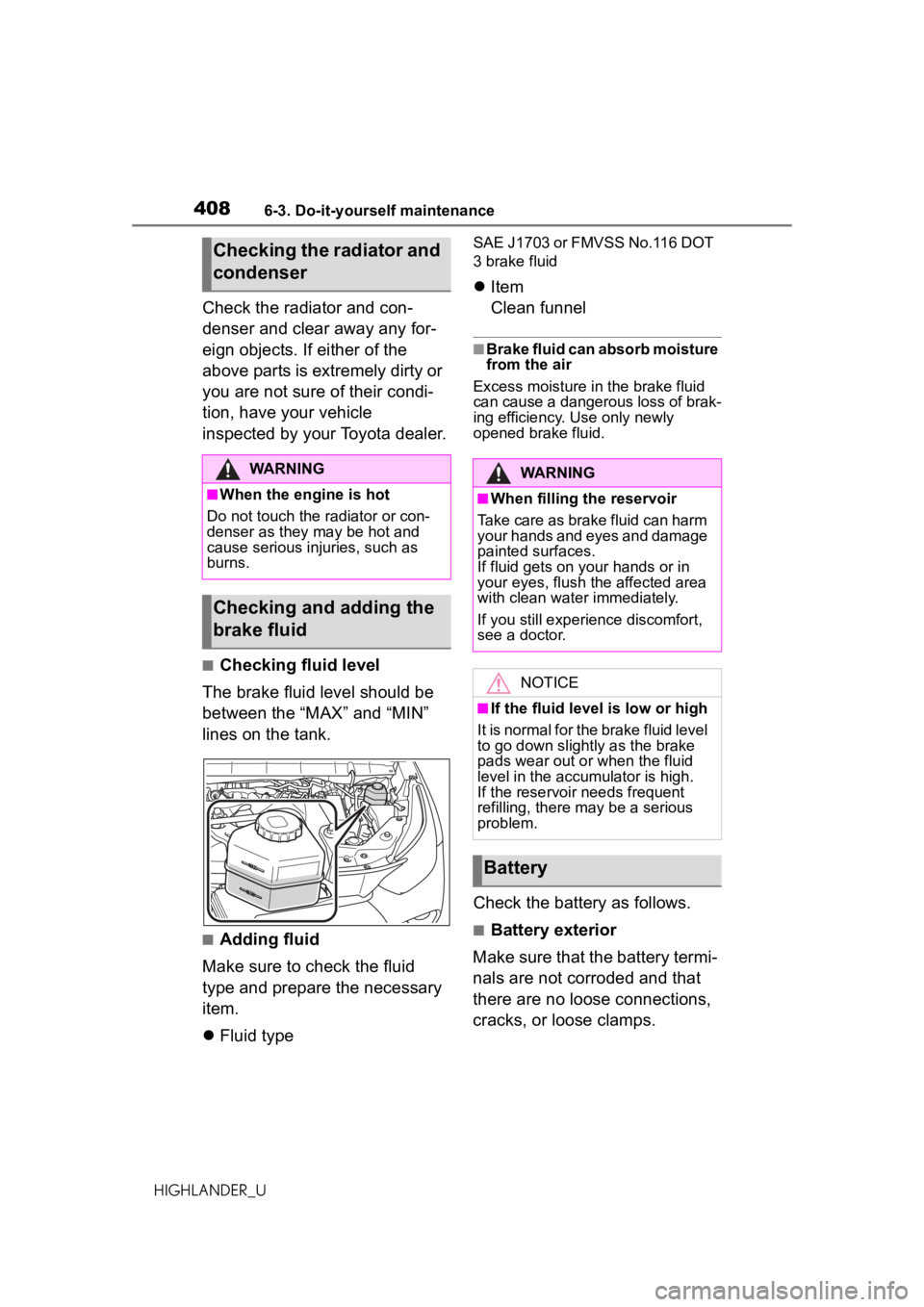
■Checking fluid level
The brake fluid level should be
between the “MAX” and “MIN”
lines on the tank.
■Adding fluid
Make sure to check the fluid
type and prepare the necessary
item.
Fluid type
SAE J1703 or FMVSS No.116 DOT
3 brake fluid
Item
Clean funnel
■Brake fluid can absorb moisture
from the air
Excess moisture in the brake fluid
can cause a dangerous loss of brak-
ing efficiency. Use only newly
opened brake fluid.
Check the battery as follows.
■Battery exterior
Make sure that the battery termi-
nals are not corroded and that
there are no loose connections,
cracks, or loose clamps.
Checking the radiator and
condenser
WARNING
■When the engine is hot
Do not touch the radiator or con-
denser as they may be hot and
cause serious injuries, such as
burns.
Checking and adding the
brake fluid
WARNING
■When filling the reservoir
Take care as brake fluid can harm
your hands and eyes and damage
painted surfaces.
If fluid gets on your hands or in
your eyes, flush the affected area
with clean water immediately.
If you still experience discomfort,
see a doctor.
NOTICE
■If the fluid level is low or high
It is normal for the brake fluid level
to go down slightly as the brake
pads wear out or when the fluid
level in the accu mulator is high.
If the reservoir needs frequent
refilling, there may be a serious
problem.
Battery
Page 487 of 560
4877-2. Steps to take in an emergency
HIGHLANDER_U
7
When trouble arises1 Stop the vehicle in a safe
place and turn off the air con-
ditioning system, and then
stop the engine.
2 If you see steam:
Carefully lift the hood after
the steam subsides.
If you do not see steam:
Carefully lift the hood.
3 After the engine has cooled
down sufficiently, inspect the
hoses and radiator core (radi-
ator) for any leaks.
If a large amount of coolant leaks,
immediately contact your Toyota dealer.
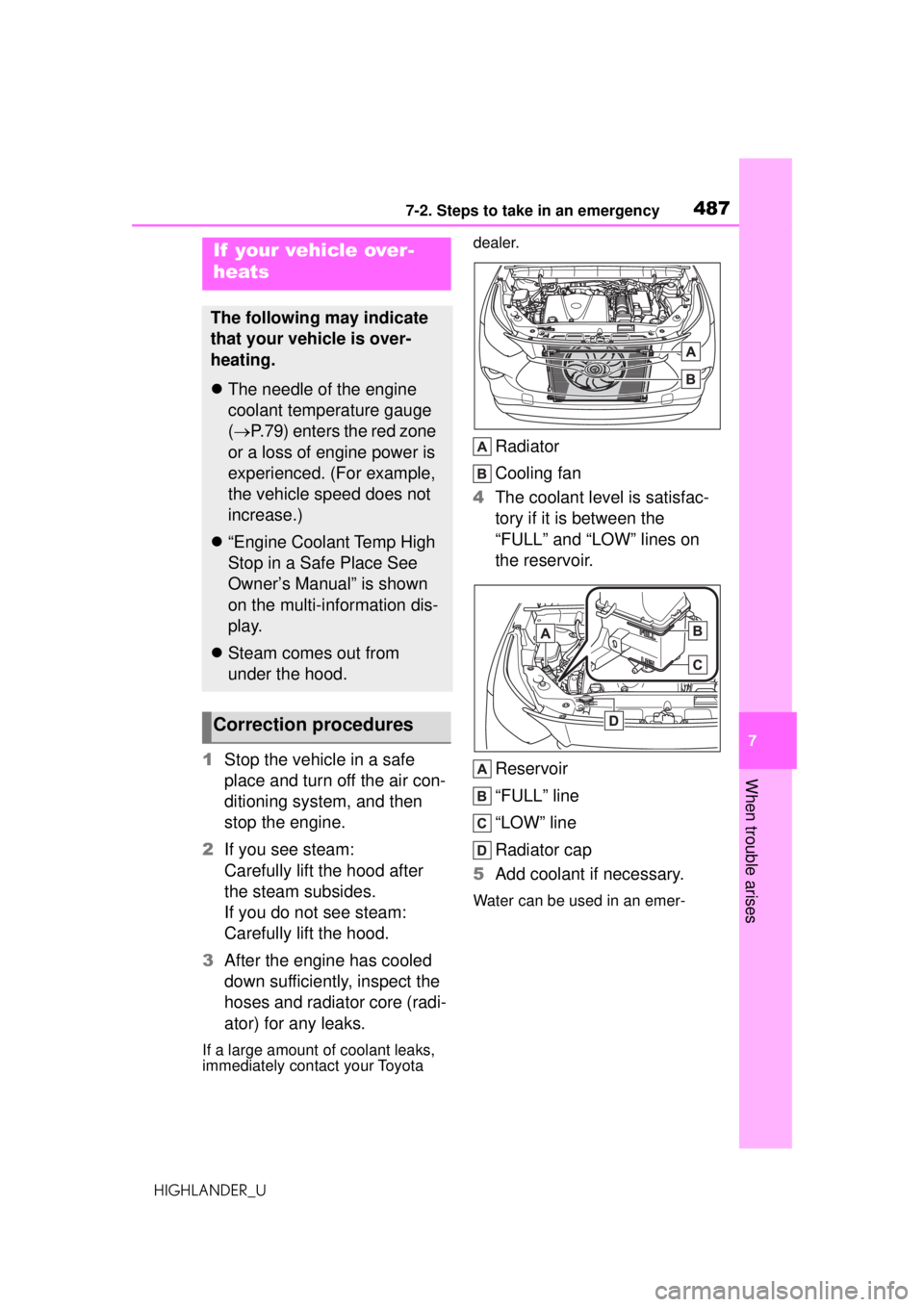
Radiator
Cooling fan
4 The coolant level is satisfac-
tory if it is between the
“FULL” and “LOW” lines on
the reservoir.
Reservoir
“FULL” line
“LOW” line
Radiator cap
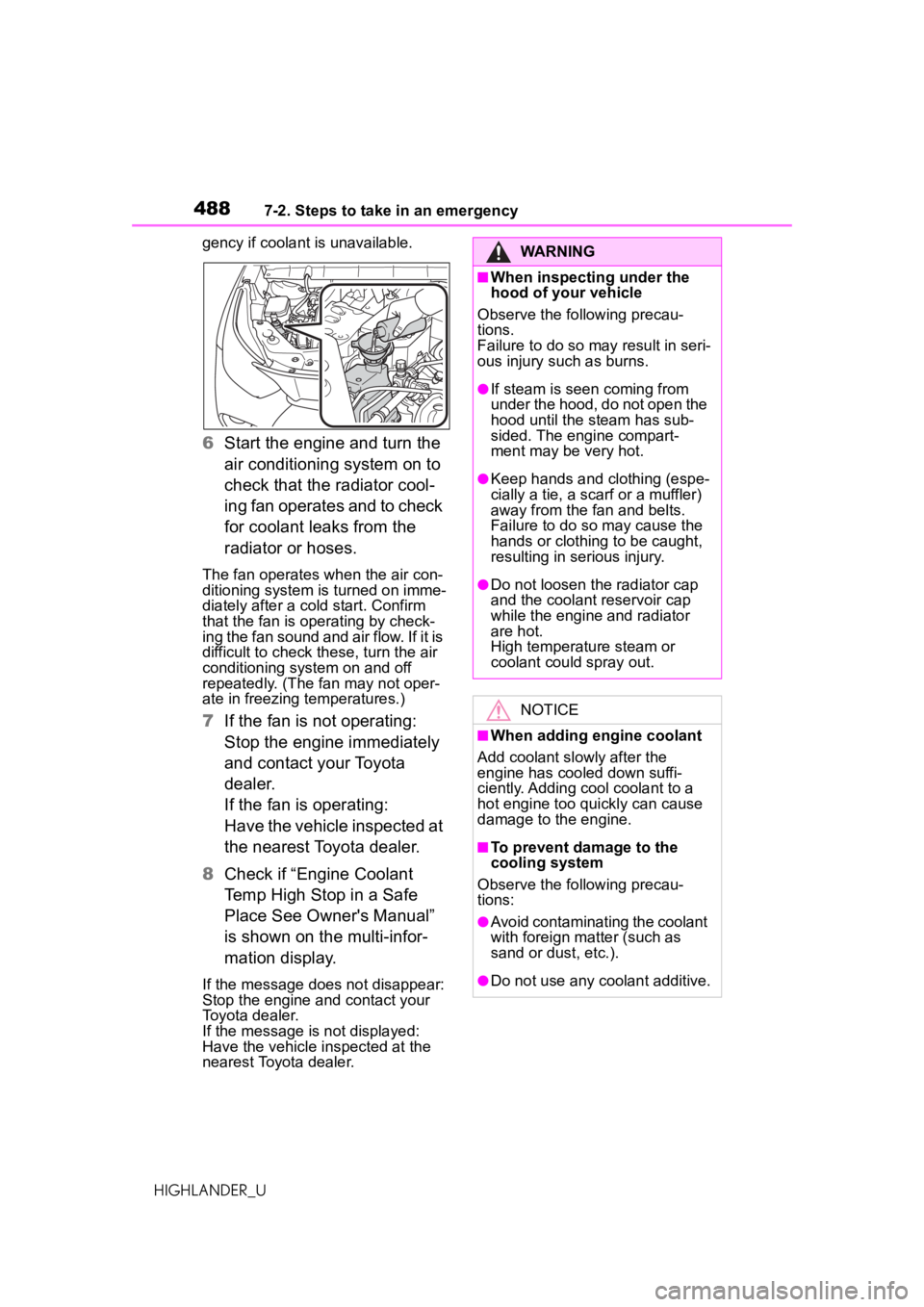
5 Add coolant if necessary.
Water can be used in an emer-
If your vehicle over-
heats
The following may indicate
that your vehicle is over-
heating.
The needle of the engine
coolant temperature gauge
( P.79) enters the red zone
or a loss of engine power is
experienced. (For example,
the vehicle speed does not
increase.)
“Engine Coolant Temp High
Stop in a Safe Place See
Owner’s Manual” is shown
on the multi-information dis-
play.
Steam comes out from
under the hood.
Correction procedures
Page 488 of 560
4887-2. Steps to take in an emergency
HIGHLANDER_Ugency if coolant is unavailable.
6
Start the engine and turn the
air conditioning system on to
check that the radiator cool-
ing fan operates and to check
for coolant leaks from the
radiator or hoses.
The fan operates when the air con-
ditioning system is turned on imme-
diately after a cold start. Confirm
that the fan is operating by check-
ing the fan sound and air flow. If it is
difficult to check these, turn the air
conditioning system on and off
repeatedly. (The fan may not oper-
ate in freezing temperatures.)
7If the fan is not operating:
Stop the engine immediately
and contact your Toyota
dealer.
If the fan is operating:
Have the vehicle inspected at
the nearest Toyota dealer.
8 Check if “Engine Coolant
Temp High Stop in a Safe
Place See Owner's Manual”
is shown on the multi-infor-
mation display.
If the message does not disappear:
Stop the engine and contact your
Toyota dealer.
If the message is not displayed:
Have the vehicle inspected at the
nearest Toyota dealer.
WARNING
■When inspecting under the
hood of your vehicle
Observe the following precau-
tions.
Failure to do so may result in seri-
ous injury such as burns.
●If steam is seen coming from
under the hood, do not open the
hood until the steam has sub-
sided. The engine compart-
ment may be very hot.
●Keep hands and clothing (espe-
cially a tie, a scarf or a muffler)
away from the fan and belts.
Failure to do so may cause the
hands or clothing to be caught,
resulting in serious injury.
●Do not loosen the radiator cap
and the coolant reservoir cap
while the engine and radiator
are hot.
High temperature steam or
coolant could spray out.
NOTICE
■When adding engine coolant
Add coolant slowly after the
engine has cooled down suffi-
ciently. Adding cool coolant to a
hot engine too quickly can cause
damage to the engine.
■To prevent damage to the
cooling system
Observe the following precau-
tions:
●Avoid contaminating the coolant
with foreign matter (such as
sand or dust, etc.).
●Do not use any coolant additive.
Page 553 of 560
553Alphabetical Index
HIGHLANDER_U
PKSB (Parking Support Brake) ............................................... 289Warning message ................ 294
Power outlets .......................... 376
Power steering (Electric power steering system)................... 313Warning light ........................ 452
Power windows Door lock linked window opera-tion ..................................... 165
Jam protection function ........ 164
Operation ............................. 164
Window lock switch .............. 166
Pre-Collision System (PCS) Function ............................... 233
PCS OFF switch................... 235
Warning light ........................ 456
R
Radar cruise control (dynamic radar cruise control with
full-speed range) .................. 254
Radiator ................................... 408
RCTA Function ............................... 284
Warning message ................ 285
RCTA function......................... 286
Rear automatic air conditioning system ................................... 348
Rear Cross Traffic Alert (RCTA) ............................................... 284
Rear door sunshades ............ 378
Rear fog lights Switch................................... 220
Rear manual air conditioning system ................................... 346
Rear seats ............................... 139 Head restraints ..................... 147
Seat heaters ......................... 352
Rear side marker lights Light switch .......................... 214
Replacing light bulbs ............ 432 Rear turn signal lights
Replacing light bulbs ............432
Turn signal lever ...................208
Rear view mirror Digital Rearview Mirror .........152
Inside rear view mirror ..........151
Outside rear view mirrors .....162
Rear window defogger ..329, 335, 339
Refueling Capacity ...............................495
Fuel types .............................495
If the fuel filler door cannot be opened ...............................480
Opening the fuel tank cap ....225
Replacing Electronic key battery ...........428
Fuses....................................429
Light bulbs ............................432
Tires......................................464
Reporting safety defects for U.S. owners ...................................530
Resetting the message indicat- ing maintenance is required 395
Road Sign Assist ....................251
Rock & Dirt mode ...................307
RSA (Road Sign Assist) .........251
S
Safety Connect .........................63
Seat belt reminder light..........453
Seat belts...................................25 Automatic Locking Retractor ..26
Child restraint system installation.............................................50
Cleaning and maintaining the seat belt ..............................391
Emergency Locking Retractor 26
How to wear your seat belt .....26
How your child should wear the seat belt ................................26