inflation pressure TOYOTA HIGHLANDER HYBRID 2019 Owners Manual (in English)
[x] Cancel search | Manufacturer: TOYOTA, Model Year: 2019, Model line: HIGHLANDER HYBRID, Model: TOYOTA HIGHLANDER HYBRID 2019Pages: 716, PDF Size: 14.31 MB
Page 6 of 716

TABLE OF CONTENTS6
HIGHLANDER_HV_U7-1. Maintenance and care
Cleaning and protecting the vehicle exterior .......... 490
Cleaning and protecting the vehicle interior ........... 494
7-2. Maintenance Maintenance requirements ................... 497
General maintenance ........ 500
Emission inspection and maintenance (I/M)
programs ......................... 503
7-3. Do-it-yourself maintenance
Do-it-yourself service precautions ..................... 504
Hood.................................. 506
Positioning a floor jack ...... 508
Engine compartment ......... 509
12-volt battery ................... 517
Tires .................................. 522
Tire inflation pressure........ 532
Wheels .............................. 535
Air conditioning filter .......... 537
Electronic key battery ........ 539
Checking and replacing fuses ................ 541
Light bulbs ......................... 545 8-1. Essential information
Emergency flashers ........... 560
If your vehicle has to be stopped in an
emergency....................... 561
8-2. Steps to take in an emergency
If your vehicle needs to be towed ...................... 562
If you think something is wrong ........................... 566
If a warning light turns on or a warning buzzer
sounds ............................. 567
If a warning message is displayed...................... 576
If you have a flat tire .......... 596
If the hybrid system will not start ..................... 620
If the electronic key does not operate
properly ........................... 622
If the 12-volt battery is discharged ................... 625
If your vehicle overheats......................... 630
If the vehicle becomes stuck ................ 634
7Maintenance and care8When trouble arises
Page 17 of 716
17Pictorial index
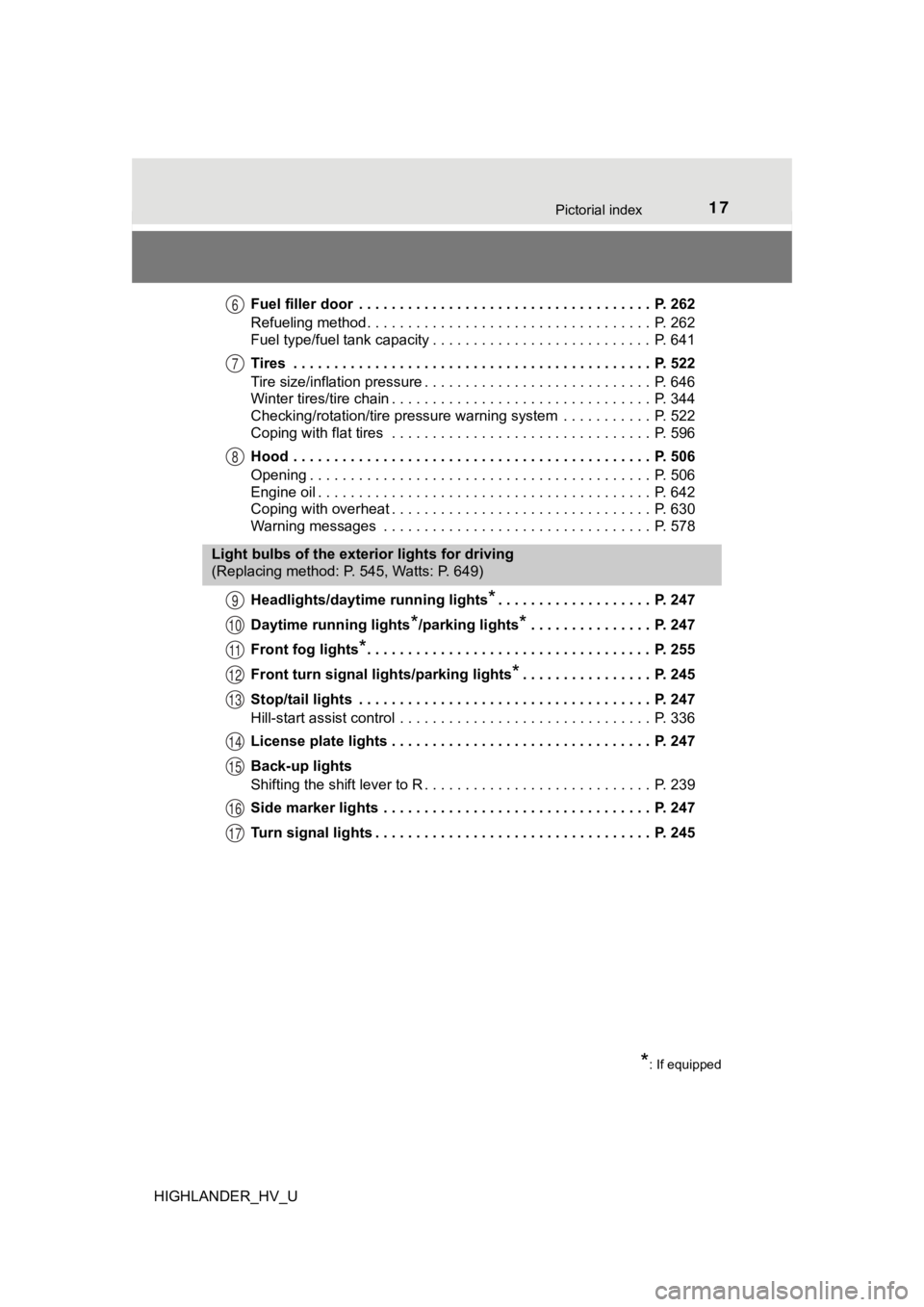
HIGHLANDER_HV_UFuel filler door . . . . . . . . . . . . . . . . . . . . . . . . . . . . . . . . . . . . P. 262
Refueling method . . . . . . . . . . . . . . . . . . . . . . . . . . . . . . . . . . . P. 262
Fuel type/fuel tank capacity . . . . . . . . . . . . . . . . . . . . . . . . . . . P. 641
Tires . . . . . . . . . . . . . . . . . . . . . . . . . . . . . . . . . . . . . . . . . . . . P. 522
Tire size/inflation pressure . . . . . . . . . . . . . . . . . .
. . . . . . . . . . P. 646
Winter tires/tire chain . . . . . . . . . . . . . . . . . . . . . . . . . . . . . . . . P. 344
Checking/rotation/tire pressure warning system . . . . . . . . . . . P. 522
Coping with flat tires . . . . . . . . . . . . . . . . . . . . . . . . . . . . . . . . P. 596
Hood . . . . . . . . . . . . . . . . . . . . . . . . . . . . . . . . . . . . . . . . . . . . P. 506
Opening . . . . . . . . . . . . . . . . . . . . . . . . . . . . . . . . . . . . . . . . . . P. 506
Engine oil . . . . . . . . . . . . . . . . . . . . . . . . . . . . . . . . . . . . . . . . . P. 642
Coping with overheat . . . . . . . . . . . . . . . . . . . . . . . . . . . . . . . . P. 630
Warning messages . . . . . . . . . . . . . . . . . . . . . . . . . . . . . . . . . P. 578
Headlights/daytime running lights
*. . . . . . . . . . . . . . . . . . . P. 247
Daytime running lights
*/parking lights*. . . . . . . . . . . . . . . P. 247
Front fog lights
*. . . . . . . . . . . . . . . . . . . . . . . . . . . . . . . . . . . P. 255
Front turn signal lig hts/parking lights
*. . . . . . . . . . . . . . . . P. 245
Stop/tail lights . . . . . . . . . . . . . . . . . . . . . . . . . . . . . . . . . . . . P. 247
Hill-start assist control . . . . . . . . . . . . . . . . . . . . . . . . . . . . . . . P. 336
License plate lights . . . . . . . . . . . . . . . . . . . . . . . . . . . . . . . . P. 247
Back-up lights
Shifting the shift lever to R . . . . . . . . . . . . . . . . . . . . . . . . . . . . P. 239
Side marker lights . . . . . . . . . . . . . . . . . . . . . . . . . . . . . . . . . P. 247
Turn signal lights . . . . . . . . . . . . . . . . . . . . . . . . . . . . . . . . . . P. 245
6
7
8
Light bulbs of the exterior lights for driving
(Replacing method: P. 545, Watts: P. 649)
*: If equipped
9
10
11
12
13
14
15
16
17
Page 285 of 716
2854-5. Using the driving support systems
4
Driving
HIGHLANDER_HV_U• When driving in inclement weather such as heavy rain, fog, snow or a
sandstorm
• When the vehicle is hit by water, snow, dust, etc. from a vehicle ahead
• When driving through steam or smoke
• When driving in a place where the surrounding brightness changes sud- denly, such as at the entrance or exit of a tunnel
• When a very bright light, such as the sun or the headlights of oncoming
traffic, shines directly into the camera sensor
• When the surrounding area is dim, such as at dawn or dusk, or while at
night or in a tunnel
• After the hybrid system has started the vehicle has not been d riven for a
certain amount of time
• While making a left/right turn and for a few seconds after mak ing a left/
right turn
• While driving on a curve and for a few seconds after driving o n a curve
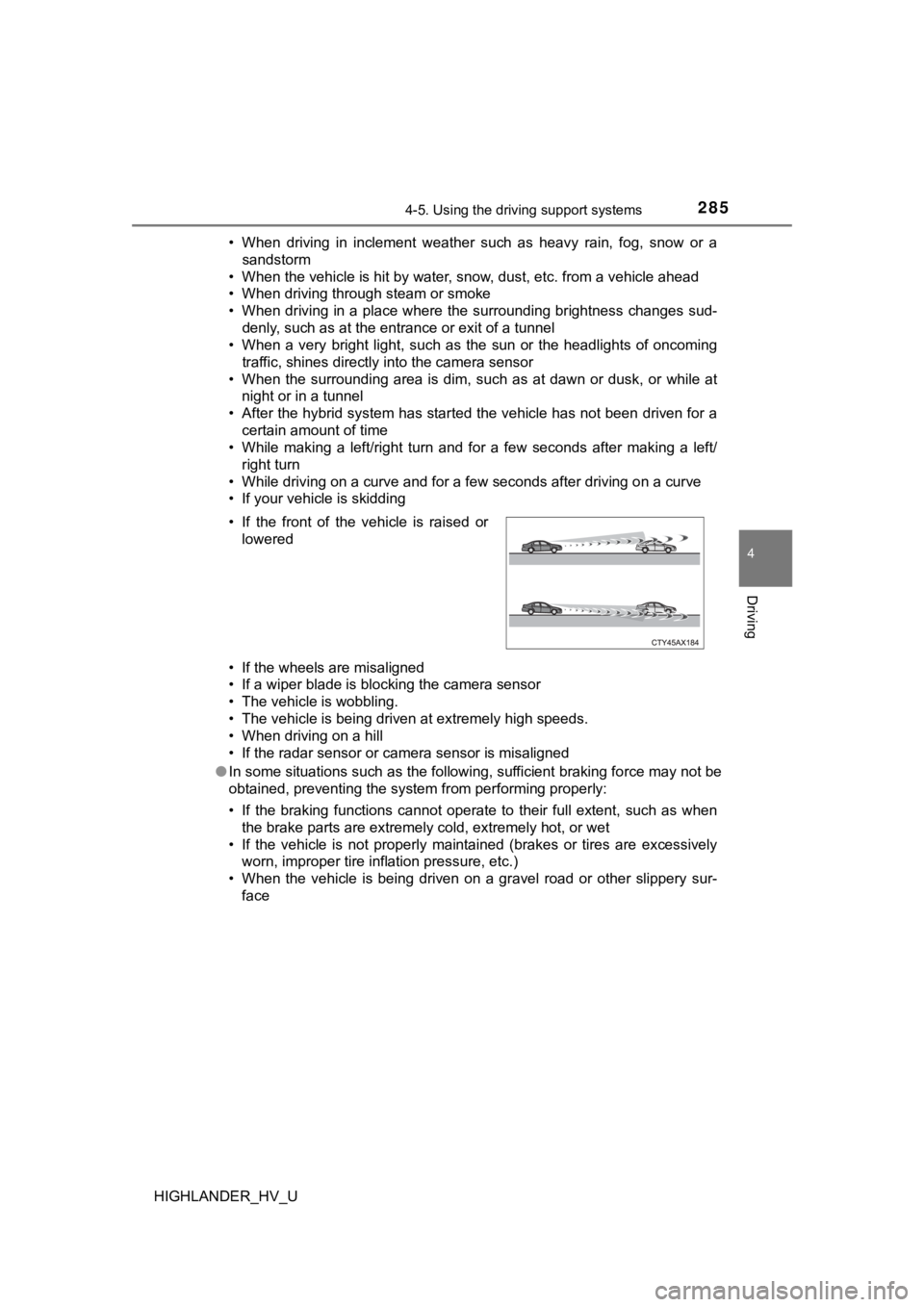
• If your vehicle is skidding
• If the wheels are misaligned
• If a wiper blade is blocking the camera sensor
• The vehicle is wobbling.
• The vehicle is being driven at extremely high speeds.
• When driving on a hill
• If the radar sensor or camera sensor is misaligned
● In some situations such as the following, sufficient braking fo rce may not be
obtained, preventing the system from performing properly:
• If the braking functions cannot operate to their full extent, such as when
the brake parts are extremely cold, extremely hot, or wet
• If the vehicle is not properly maintained (brakes or tires are excessively
worn, improper tire inflation pressure, etc.)
• When the vehicle is being driven on a gravel road or other sli ppery sur-
face
• If the front of the vehicle is raised or
lowered
Page 340 of 716

3404-5. Using the driving support systems
HIGHLANDER_HV_U
WARNING
■TRAC/VSC may not operate effectively when
Directional control and power may not be achievable while driving on slip-
pery road surfaces, even if the TRAC/VSC system is operating.
Drive the vehicle carefully in conditions where stability and p ower may be
lost.
■ Hill- start assist control does not operate effectively when
● Do not overly rely on hill-start assist control. Hill-start ass ist control may
not operate effectively on steep inclines and roads covered wit h ice.
● Unlike the parking brake, hill-start assist control is not inte nded to hold the
vehicle stationary for an extended period of time. Do not attempt to use
hill-start assist control to hold the vehicle on an incline, as doing so may
lead to an accident.
■ When the VSC is activated
The slip indicator light flashes. Always drive carefully. Reckless driving may
cause an accident. Exercise particular care when the indicator light flashes.
■ When the TRAC/VSC systems are turned off
Be especially careful and drive at a speed appropriate to the r oad condi-
tions. As these are the systems to help ensure vehicle stabilit y and driving
force, do not turn the TRAC/VSC systems off unless necessary.
Trailer Sway Control is part of the VSC system and will not ope rate if VSC
turned off or experiences a malfunction.
■ Replacing tires
Make sure that all tires are of the specified size, brand, trea d pattern and
total load capacity. In addition, make sure that the tires are inflated to the
recommended tire inflation pressure level.
The ABS, TRAC and VSC systems will not function correctly if di fferent tires
are installed on the vehicle.
Contact your Toyota dealer for further information when replaci ng tires or
wheels.
■ Handling of tires and the suspension
Using tires with any kind of problem or modifying the suspensio n will affect
the driving assist systems, and may cause a system to malfuncti on.
Page 343 of 716

3434-6. Driving tips
4
Driving
HIGHLANDER_HV_U
◆Checking tire inflation pressure
Make sure to check the tire inflation pressure frequently. Improper
tire inflation pressure can cause poor fuel economy.
Also, as snow tires can cause large amounts of friction, their use on
dry roads can lead to poor fuel economy. Use tires that are app ro-
priate for the season.
◆Luggage
Carrying heavy luggage will lead to poor fuel economy. Avoid carry-
ing unnecessary luggage. Installing a large roof rack will also cause
poor fuel economy.
◆Warming up before driving
Since the gasoline engine starts up and cuts out automatically
when cold, warming up the engine is unnecessary. Moreover, fre-
quently driving short distances will cause the engine to repeat edly
warm up, which can lead to excess fuel consumption.
Page 489 of 716

489
7Maintenance and care
HIGHLANDER_HV_U7-1. Maintenance and care
Cleaning and protecting the vehicle exterior .......... 490
Cleaning and protecting the vehicle interior ........... 494
7-2. Maintenance Maintenance requirements ................... 497
General maintenance........ 500
Emission inspection and maintenance (I/M)
programs......................... 503
7-3. Do-it-yourself maintenance
Do-it-yourself service precautions ..................... 504
Hood ................................. 506
Positioning a floor jack ......................... 508
Engine compartment ......... 509
12-volt battery ................... 517
Tires .................................. 522
Tire inflation pressure ....... 532
Wheels .............................. 535
Air conditioning filter.......... 537
Electronic key battery........ 539
Checking and replacing fuses ................ 541
Light bulbs......................... 545
Page 504 of 716
504
HIGHLANDER_HV_U
7-3. Do-it-yourself maintenance
Do-it-yourself ser vice precautions
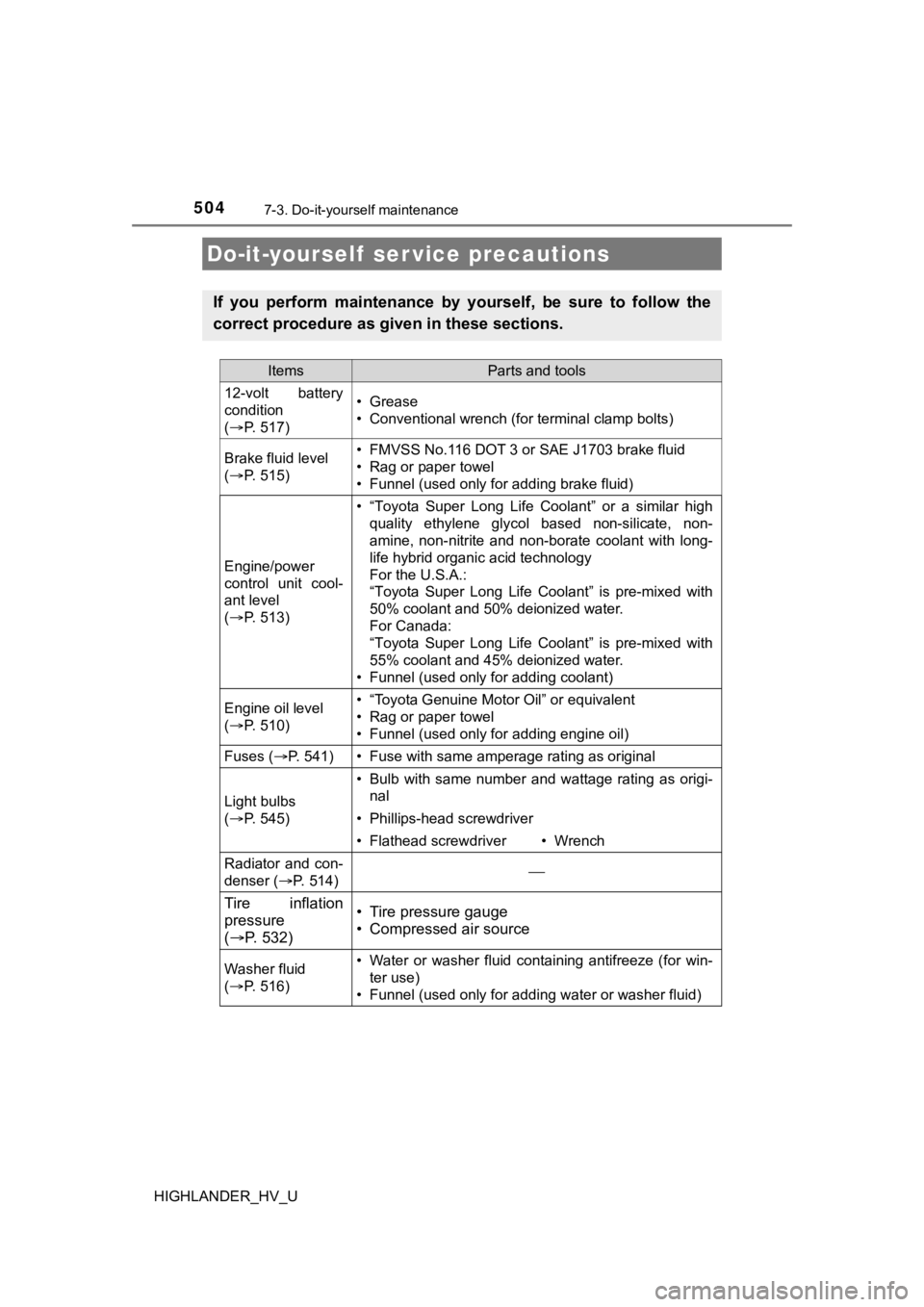
If you perform maintenance by yourself, be sure to follow the
correct procedure as given in these sections.
ItemsParts and tools
12-volt battery
condition
( P. 5 1 7 )•Grease
• Conventional wrench (for terminal clamp bolts)
Brake fluid level
( P. 5 1 5 )• FMVSS No.116 DOT 3 or SAE J1703 brake fluid
• Rag or paper towel
• Funnel (used only for adding brake fluid)
Engine/power
control unit cool-
ant level
( P. 5 1 3 )
• “Toyota Super Long Life Coolant” or a similar high
quality ethylene glycol based non-silicate, non-
amine, non-nitrite and non-borate coolant with long-
life hybrid organic acid technology
For the U.S.A.:
“Toyota Super Long Life Coolant” is pre-mixed with
50% coolant and 50% deionized water.
For Canada:
“Toyota Super Long Life Coolant” is pre-mixed with
55% coolant and 45% deionized water.
• Funnel (used only for adding coolant)
Engine oil level
( P. 5 1 0 )• “Toyota Genuine Motor Oil” or equivalent
• Rag or paper towel
• Funnel (used only for adding engine oil)
Fuses ( P. 541)• Fuse with same amperage rating as original
Light bulbs
( P. 5 4 5 )
• Bulb with same number and wattage rating as origi-
nal
• Phillips-head screwdriver
• Flathead screwdriver• Wrench
Radiator and con-
denser ( P. 514)
Tire inflation
pressure
( P. 532)• Tire pressure gauge
• Compressed air source
Washer fluid
( P. 5 1 6 )• Water or washer fluid containing antifreeze (for win-
ter use)
• Funnel (used only for adding water or washer fluid)
Page 524 of 716

5247-3. Do-it-yourself maintenance
HIGHLANDER_HV_U
Your vehicle is equipped with a tire pressure warning system that uses
tire pressure warning valves and transmitters to detect low tire infla-
tion pressure before serious problems arise.
If the tire pressure drops below a predetermined level, the dri ver is
warned by a warning light. ( P. 569)
◆Installing tire pressure warn ing valves and transmitters
When replacing tires or wheels, tire pressure warning valves an d
transmitters must also be installed.
When new tire pressure warning valves and transmitters are
installed, new ID codes must be registered in the tire pressure
warning computer and the tire pressure warning system must be
initialized. Have tire pressure warning valve and transmitter I D
codes registered by your Toyota dealer. ( P. 526)
◆Initializing the tire pressure warning system
■The tire pressure warning system must be initialized in the fol-
lowing circumstances:
● When the tire inflation pressure is changed such as when chang-
ing traveling speed or load weight.
When the tire pressure warning sy stem is initialized, the current tire
inflation pressure is set as the benchmark pressure.
Tire pressure warning system
Page 525 of 716
5257-3. Do-it-yourself maintenance
7
Maintenance and care
HIGHLANDER_HV_U■
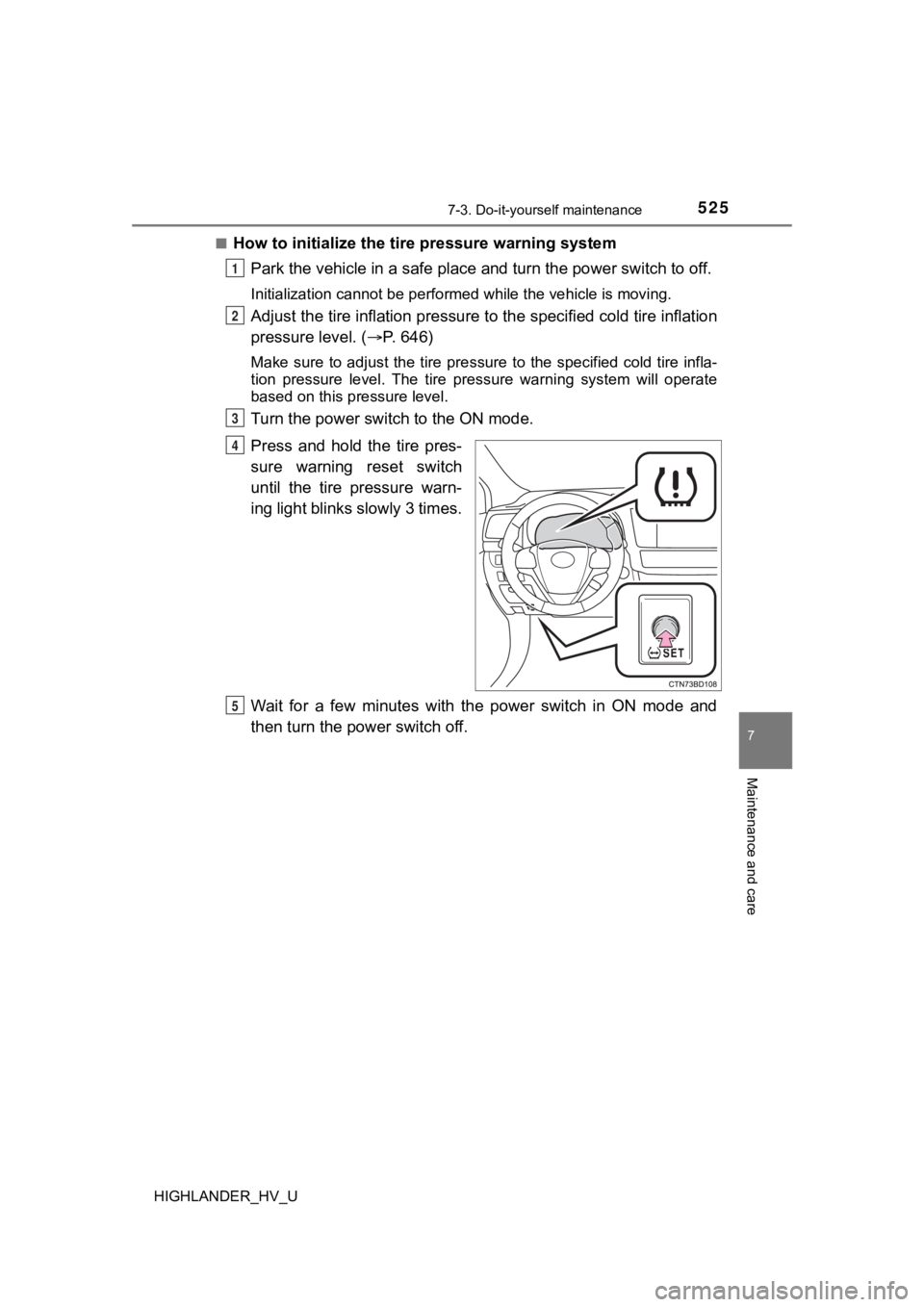
How to initialize the tire pressure warning system
Park the vehicle in a s afe place and turn the power switch to o ff.
Initialization cannot be performed while the vehicle is moving.
Adjust the tire inflation pressure to the specified cold tire i nflation
pressure level. ( P. 646)
Make sure to adjust the tire pre ssure to the specified cold tire infla-
tion pressure level. The tire pressure warning system will oper ate
based on this pr essure level.
Turn the power switch to the ON mode.
Press and hold the tire pres-
sure warning reset switch
until the tire pressure warn-
ing light blinks slowly 3 times.
Wait for a few minutes with the power switch in ON mode and
then turn the power switch off.
1
2
3
4
5
Page 527 of 716
5277-3. Do-it-yourself maintenance
7
Maintenance and care
HIGHLANDER_HV_U■
Routine tire inflation pressure checks
The tire pressure warning system does not replace routine tire
inflation
pressure checks. Make sure to chec k tire inflation pressure as part of
your routine of daily vehicle checks.
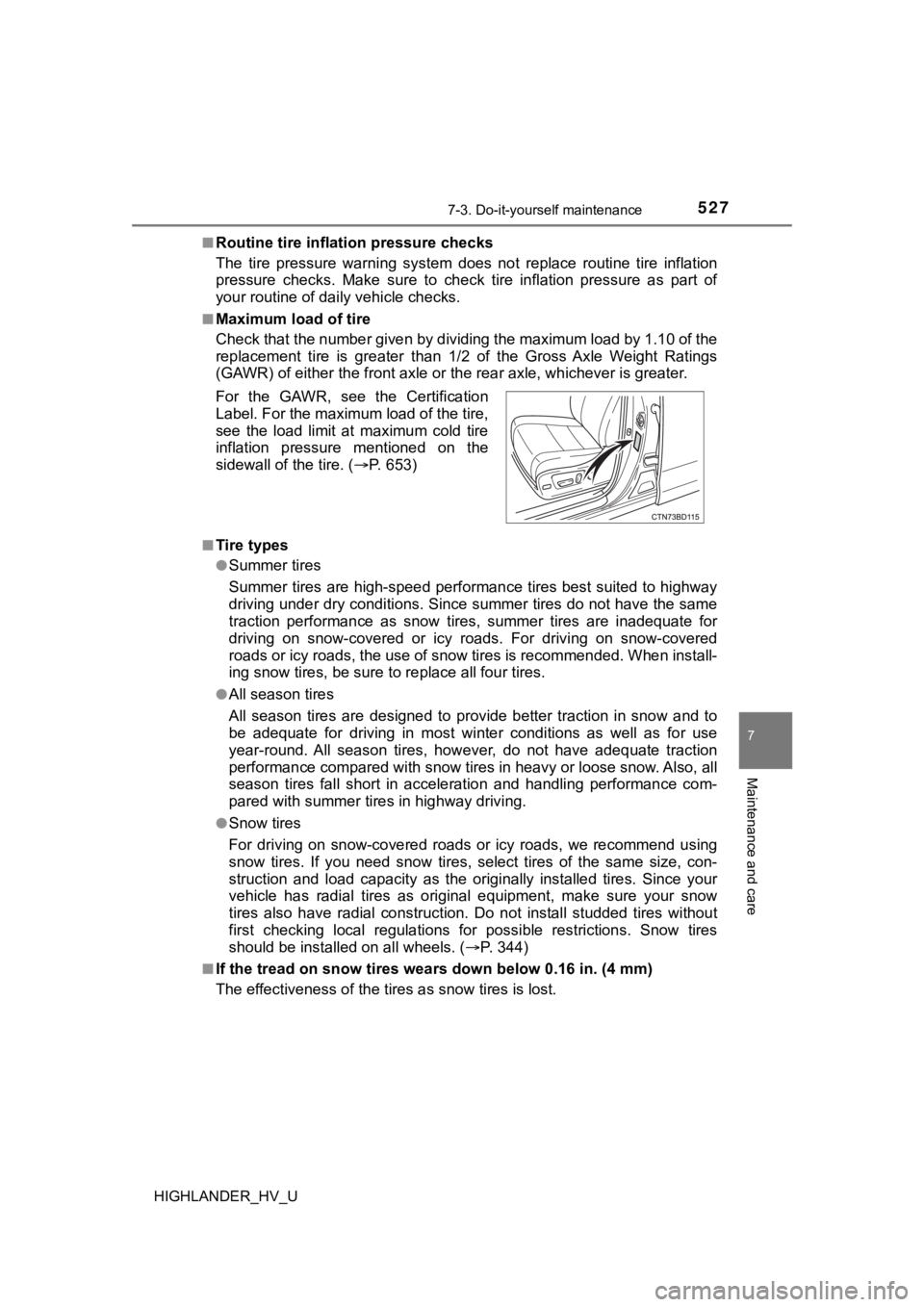
■Maximum load of tire
Check that the number given by dividing the maximum load by 1.1 0 of the
replacement tire is greater than 1/2 of the Gross Axle Weight R atings
(GAWR) of either the front axle or the rear axle, whichever is greater.
■Tire types
●Summer tires
Summer tires are high-speed performance tires best suited to hi ghway
driving under dry conditions. Si nce summer tires do not have th e same
traction performance as snow tires, summer tires are inadequate for
driving on snow-covered or icy ro ads. For driving on snow-covered
roads or icy roads, the use of snow tires is recommended. When install-
ing snow tires, be sure to replace all four tires.
●All season tires
All season tires are designed to provide better traction in sno w and to
be adequate for driving in most winter conditions as well as fo r use
year-round. All season tires, however, do not have adequate tra ction
performance compared with snow tires in heavy or loose snow. Al so, all
season tires fall short in acceleration and handling performanc e com-
pared with summer tires in highway driving.
●Snow tires
For driving on snow-covered roads or icy roads, we recommend us ing
snow tires. If you need snow tires, select tires of the same si ze, con-
struction and load capacity as t he originally installed tires. Since your
vehicle has radial tires as original equipment, make sure your snow
tires also have radial construct ion. Do not install studded tires without
first checking local regulations for possible restrictions. Sno w tires
should be install ed on all wheels. ( P. 344)
■If the tread on snow tires wea rs down below 0.16 in. (4 mm)
The effectiveness of the tires as snow tires is lost. For the GAWR, see the Certification
Label. For the maximum load of the tire,
see the load limit at maximum cold tire
inflation pressure mentioned on the
sidewall of the tire. ( P. 6 5 3 )