ABS TOYOTA HILUX 2020 Owners Manual (in English)
[x] Cancel search | Manufacturer: TOYOTA, Model Year: 2020, Model line: HILUX, Model: TOYOTA HILUX 2020Pages: 744, PDF Size: 108.13 MB
Page 10 of 744
10
HILUX_OM_OM0K321E_(EE)
The vehicle is equipped with sophisticated computers that will record certain
data, such as:
The recorded data varies according to the vehicle grade level and options
with which it is equipped.
These computers do not record conversations or sounds, and only record
images outside of the vehicle in certain situations.
• Engine speed/Electric motor speed (traction motor speed)
• Accelerator status
• Brake status
• Vehicle speed
• Operation status of the driving assist systems, such as the ABS and pre-
collision system (vehicles with pre-collision system)
• Operation status of the driving assist systems, such as the ABS and VSC
(vehicles without pre-collision system)
●Data usage
Toyota may use the data recorded in this computer to diagnose malfunc-
tions, conduct research and development, and improve quality.
Toyota will not disclose the recorded data to a third party except:
• With the consent of the vehicle owner or with the consent of the lessee if
the vehicle is leased
• In response to an official request by the police, a court of law or a govern-
ment agency
• For use by Toyota in a lawsuit
• For research purposes where the data is not tied to a specific vehicle or
vehicle owner
Vehicle data recording
Page 105 of 744
105
1
1-4. Theft deterrent system
HILUX_OM_OM0K321E_(EE)
For safety and security
Engine immobilizer system
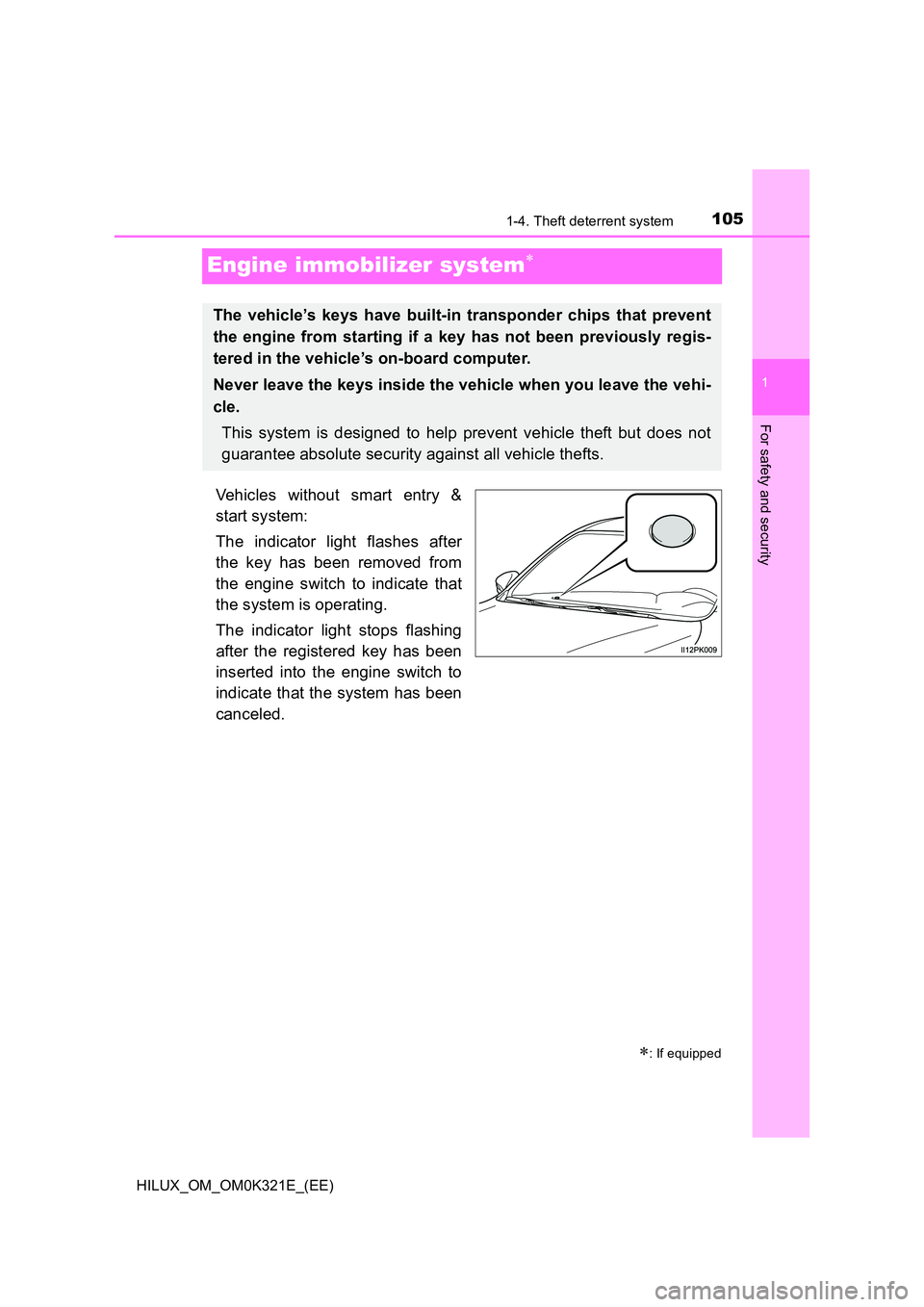
Vehicles without smart entry &
start system:
The indicator light flashes after
the key has been removed from
the engine switch to indicate that
the system is operating.
The indicator light stops flashing
after the registered key has been
inserted into the engine switch to
indicate that the system has been
canceled.
: If equipped
The vehicle’s keys have built-in transponder chips that prevent
the engine from starting if a key has not been previously regis-
tered in the vehicle’s on-board computer.
Never leave the keys inside the vehicle when you leave the vehi-
cle.
This system is designed to help prevent vehicle theft but does not
guarantee absolute security against all vehicle thefts.
Page 135 of 744
1352. Instrument cluster
2
Instrument cluster
HILUX_OM_OM0K321E_(EE)
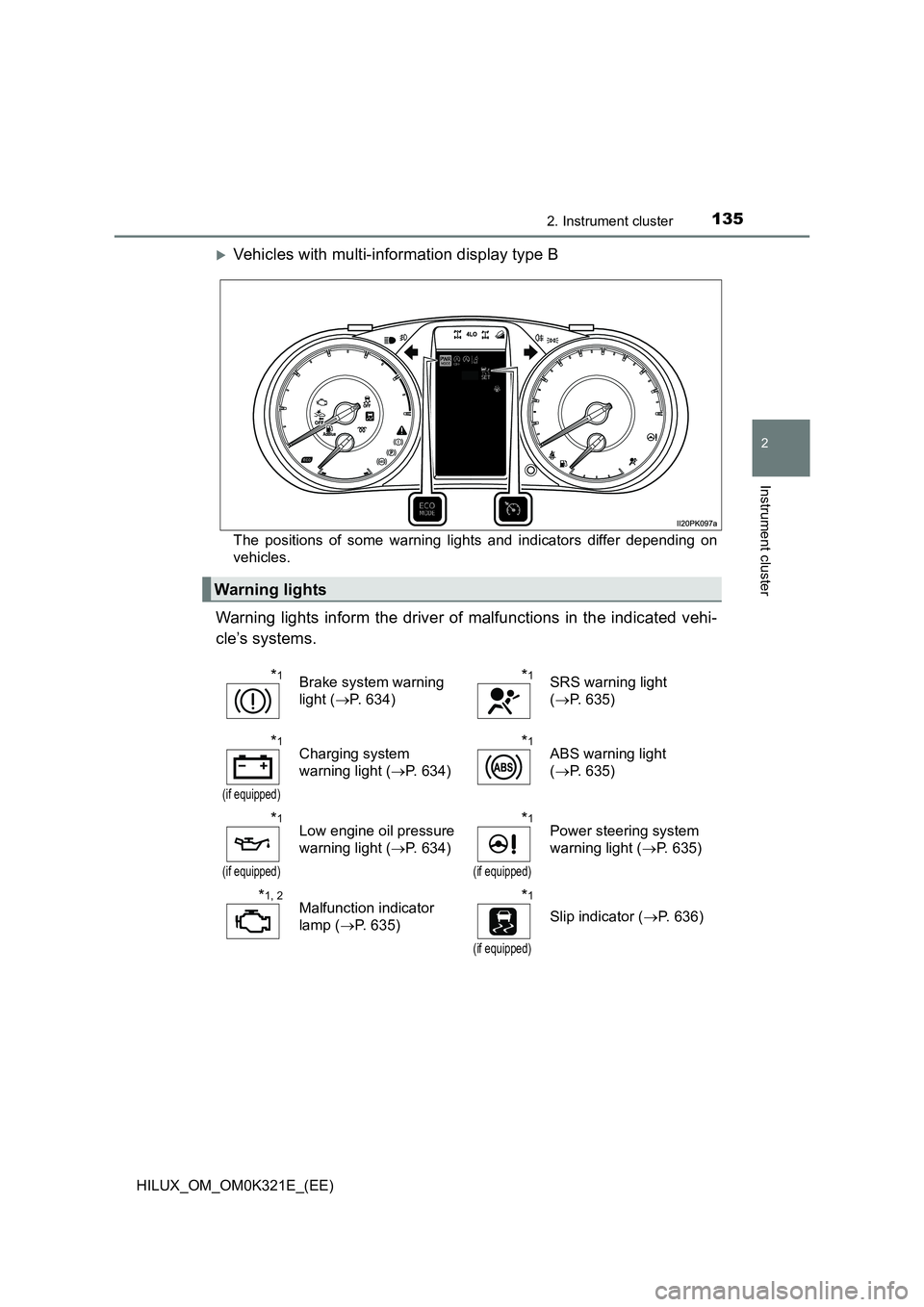
Vehicles with multi-information display type B
The positions of some warning lights and indicators differ depending on
vehicles.
Warning lights inform the driver of malfunctions in the indicated vehi-
cle’s systems.
Warning lights
*1Brake system warning
light ( P. 634)
*1SRS warning light
( P. 635)
*1
(if equipped)
Charging system
warning light ( P. 634)
*1ABS warning light
( P. 635)
*1
(if equipped)
Low engine oil pressure
warning light ( P. 634)
*1
(if equipped)
Power steering system
warning light ( P. 635)
*1, 2Malfunction indicator
lamp ( P. 635)
*1
(if equipped)
Slip indicator (P. 636)
Page 141 of 744
1412. Instrument cluster
2
Instrument cluster
HILUX_OM_OM0K321E_(EE)
Eco Driving Indicator Light can be activated or deactivated.
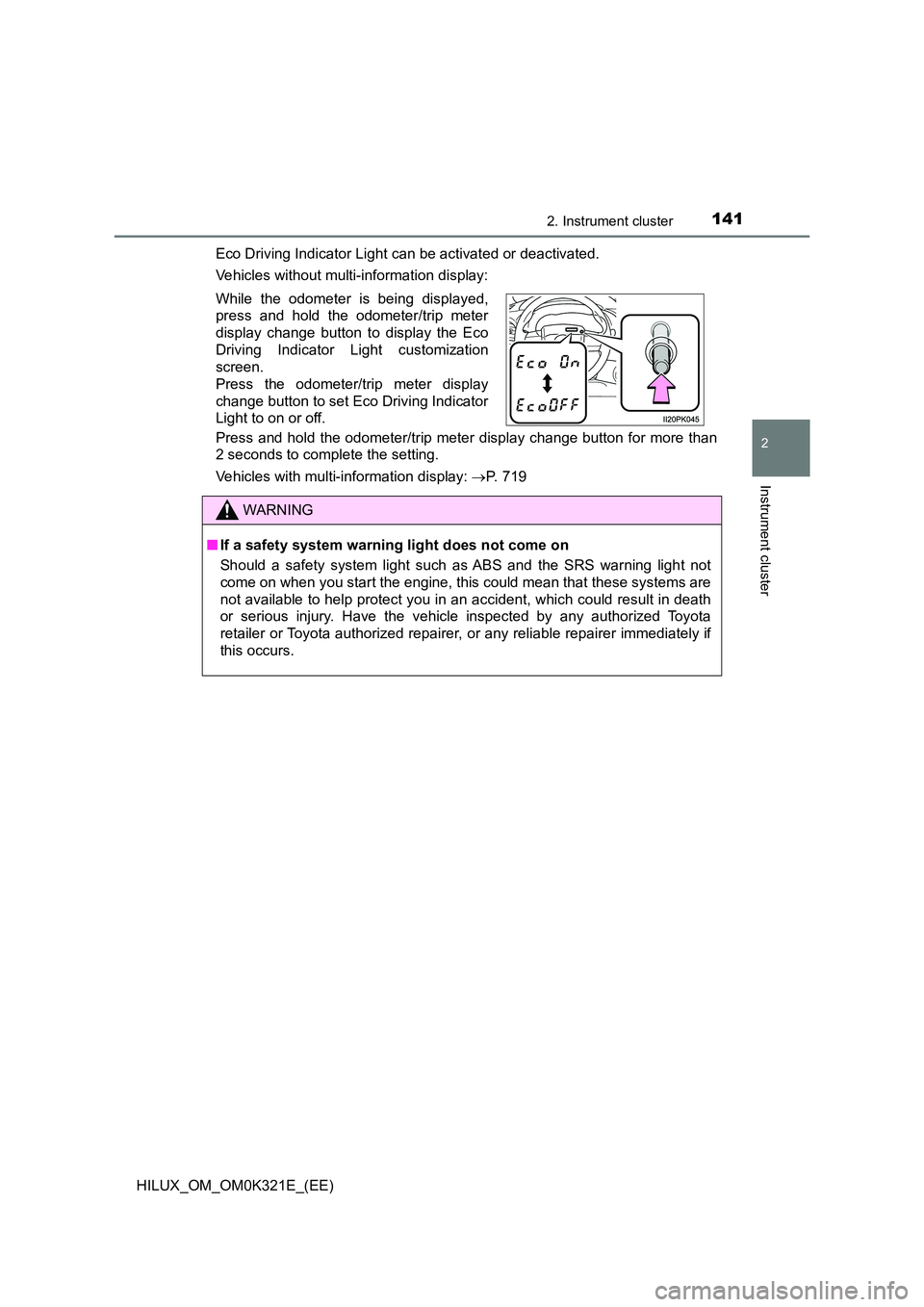
Vehicles without multi-information display:
Press and hold the odometer/trip meter display change button for more than
2 seconds to complete the setting.
Vehicles with multi-information display: P. 719
While the odometer is being displayed,
press and hold the odometer/trip meter
display change button to display the Eco
Driving Indicator Light customization
screen.
Press the odometer/trip meter display
change button to set Eco Driving Indicator
Light to on or off.
WARNING
■ If a safety system warning light does not come on
Should a safety system light such as ABS and the SRS warning light not
come on when you start the engine, this could mean that these systems are
not available to help protect you in an accident, which could result in death
or serious injury. Have the vehicle inspected by any authorized Toyota
retailer or Toyota authorized repairer, or any reliable repairer immediately if
this occurs.
Page 358 of 744
3584-5. Using the driving support systems
HILUX_OM_OM0K321E_(EE)
■Operation conditions of each function
● Lane departure alert function
This function operates when all of the following conditions are met.
• LDA is turned on.
• Vehicle speed is approximately 50 km/h (32 mph) or more.
• System recognizes white (yellow) lane lines or a course*. (When a
white [yellow] line or course* is recognized on only one side, the system
will operate only for the recognized side.)
• Width of traffic lane is approximately 3 m (9.8 ft.) or more.
• Turn signal lever is not operated.
• Vehicle is not being driven around a sharp curve.
• No system malfunctions are detected. ( P. 360)
*: Boundary between asphalt and the side of the road, such as grass, soil,
or a curb
● Yaw assist function
This function operates when all of the following conditions are met in addi-
tion to the operation conditions fo r the lane departure alert function.
• Setting for “Yaw assist” in of the multi-information display is set
to “On” ( P. 151)
• Vehicle is not accelerated or decelerated by a fixed amount or more.
• Steering wheel is not operated with a steering force level suitable for
changing lanes.
• ABS, VSC, TRC/A-TRC and PCS are not operating.
• TRC/A-TRC or VSC is not turned off.
● Vehicle sway warning function
This function operates when all of the following conditions are met.
• Setting for “Sway Warning” in of the multi-information display is
set to “On” ( P. 1 5 1 )
• Vehicle speed is approximately 50 km/h (32 mph) or more.
• Width of traffic lane is approximately 3 m (9.8 ft.) or more.
• No system malfunctions are detected. ( P. 360)
Page 369 of 744
3694-5. Using the driving support systems
4
Driving
HILUX_OM_OM0K321E_(EE)
WARNING
■Cautions regarding the driving assist systems
Observe the following precautions, as there are limitations to the assistance
provided by the system. Failure to do so may cause an accident resulting in
death or serious injury.
● Assisting the driver to measure following distance
The dynamic radar cruise control is only intended to help the driver in
determining the following distance between the driver’s own vehicle and a
designated vehicle traveling ahead. It is not a mechanism that allows care-
less or inattentive driving, and it is not a system that can assist the driver in
low-visibility conditions.
It is still necessary for driver to pay close attention to the vehicle’s sur-
roundings.
● Assisting the driver to judge proper following distance
The dynamic radar cruise control det ermines whether the following dis-
tance between the driver’s own vehicle and a designated vehicle traveling
ahead is within a set range. It is not capable of making any other type of
judgement. Therefore, it is absolutely necessary for the driver to remain
vigilant and to determine whether or not there is a possibility of danger in
any given situation.
● Assisting the driver to operate the vehicle
The dynamic radar cruise control does not include functions which will pre-
vent or avoid collisions with vehicles ahead of your vehicle. Therefore, if
there is ever any possibility of danger, the driver must take immediate and
direct control of the vehicle and act appropriately in order to ensure the
safety of all involved.
Page 411 of 744
4114-5. Using the driving support systems
4
Driving
HILUX_OM_OM0K321E_(EE)
■Locking the rear differential
The following systems do not operate w hen the rear differential is locked.
It is normal operation for the ABS warning light, VSC OFF indicator (if
equipped) and “TRC OFF” indicator (if equipped) to be on or for “TRC
TURNED OFF”/“TRC turned off” to be displayed on the multi-information dis-
play (if equipped) at this time.
•ABS
• Brake assist (if equipped)
• VSC (if equipped)
• TRC/A-TRC (if equipped)
• Trailer Sway Control (if equipped)
• Hill-start assist control (if equipped)
• Downhill assist control (if equipped)
■ Unlocking the rear differential
If the rear differential lock indicator still flashes even after unlocking the rear
differential, check the safety of the surrounding area and slightly turn the
steering wheel in either direction while the vehicle is in motion.
■ Automatic system cancelation of the rear differential lock system
The rear differential lock is also unlocked in any of the following situations:
● The front-wheel drive control switch is turned to H2 or H4 (4WD models)
● The engine switch is turned to the “ACC” or “LOCK” position (vehicles with-
out smart entry & start system) or A CCESSORY or off (vehicles with smart
entry & start system)
■ After unlocking the rear differential
Check that the indicator goes off.
WARNING
■ To avoid an accident
Failure to observe the following precautions may result in an accident.
● Do not use the rear differential lock system except when wheel spinning
occurs in a ditch or on a slippery or rugged surface. Large steering effort
and careful cornering control will be required.
● Do not lock the rear differential until the wheels have stopped spinning.
Otherwise, the vehicle may move in an unexpected direction when the dif-
ferential lock is engaged, resulting in an accident. This may also lead to
possible damage to rear differential lock component parts.
● Do not drive over 8 km/h (5 mph) when the differential is locked.
● Do not keep driving with the rear differential lock switch on.
Page 422 of 744

4224-5. Using the driving support systems
HILUX_OM_OM0K321E_(EE)
Driving assist systems
◆ABS (Anti-lock Brake System)
Helps to prevent wheel lock when the brakes are applied suddenly, or if the
brakes are applied while driving on a slippery road surface
◆Brake assist (if equipped)
Generates an increased level of braking force after the brake pedal is
depressed when the system detects a panic stop situation
◆VSC (Vehicle Stability Control) (if equipped)
Helps the driver to control skidding when swerving suddenly or turning on
slippery road surfaces
◆TRC (Traction Control) for Pre Runner and H2 position on 4WD
models (if equipped)
Helps to maintain drive power and pr event the drive wheels from spinning
when starting the vehicle or accelerating on slippery roads
◆A-TRC (Active Traction Control) for H4 and L4 position on 4WD
models (if equipped)
Helps to maintain drive power and prevent the four wheels from spinning
when starting the vehicle or accelerating on slippery roads
◆Hill-start assist control (if equipped)
Helps to reduce the backward movement of the vehicle when starting on
an uphill
◆Emergency brake signal (if equipped)
When the brakes are applied suddenly, the emergency flashers automati-
cally flash to alert the vehicle behind.
To keep driving safety and performance, the following systems
operate automatically in response to various driving situations.
Be aware, however, that these systems are supplementary and
should not be relied upon too heavily when operating the vehi-
cle.
Page 426 of 744
4264-5. Using the driving support systems
HILUX_OM_OM0K321E_(EE)
■ Sounds and vibrations caused by the ABS, brake assist, VSC, Trailer
Sway Control, TRC, A-TRC and the hill-start assist control systems
● A sound may be heard from the engine compartment when the brake pedal
is depressed repeatedly, when the engine is started or just after the vehicle
begins to move. This sound does not indicate that a malfunction has
occurred in any of these systems.
● Any of the following conditions may occur when the above systems are
operating. None of these indicates that a malfunction has occurred.
• Vibrations may be felt through the vehicle body and steering.
• A motor sound may be heard also after the vehicle comes to a stop.
• The brake pedal may pulsate slightly after the ABS is activated.
• The brake pedal may move down slightly after the ABS is activated.
■ Automatic reactivation of TRC, A-TRC, VSC and Trailer Sway Control
systems
After turning the TRC, A-TRC, VSC and Trailer Sway Control systems off, the
systems will be automatically re-enabled in the following situations:
● When the engine switch is turned to the “LOCK” position (vehicles without
smart entry & start system) or off (vehicles with smart entry & start system).
● If only the TRC/A-TRC system is turned off, the TRC/A-TRC will turn on
when vehicle speed increases.
If the TRC, A-TRC, VSC and Trailer Sway Control systems are turned off,
automatic re-enabling will not occur when vehicle speed increases.
■ Operating conditions of the hill-start assist control
When the following four conditions are me t, the hill-start assist control will
operate:
● Vehicles with automatic transmission: The shift lever is in a position other
than P or N (when starting off forward/backward on an upward incline)
Vehicles with manual transmission: The shift lever is in a position other than
R when starting off forward on an upward incline, or the shift lever is in R
when starting off backward on an upward incline.
● The vehicle is stopped
● The accelerator pedal is not depressed
● The parking brake is not engaged
■ Automatic system cancelation of the hill-start assist control
The hill-start assist control will turn off in any of the following situations:
● Vehicles with automatic transmission: The shift lever is shifted to P or N
Vehicles with manual transmission: The shift lever is shifted to R when start-
ing off forward on an upward incline, or the shift lever is shifted to other than
R when starting off backward on an upward incline.
● The accelerator pedal is depressed
● The parking brake is engaged
● 2 seconds at maximum elapsed after the brake pedal is released
Page 427 of 744
4274-5. Using the driving support systems
4
Driving
HILUX_OM_OM0K321E_(EE)
■ Operating conditions of emergency brake signal
When the following conditions are met, the emergency brake signal will oper-
ate:
● The emergency flashers are off.
● Actual vehicle speed is over 55 km/h (35 mph).
● The system judges from the vehicle deceleration that it is a sudden braking
operation.
■ Automatic system cancelation of emergency brake signal
The emergency brake signal will be canceled in any of the following situa-
tions:
● The emergency flashers are turned on.
● The system judges from the vehicle deceleration that is not a sudden brak-
ing operation.
WARNING
■ The ABS does not operate effectively when
● The limits of tire gripping performance have been exceeded (such as
excessively worn tires on a snow covered road).
● The vehicle hydroplanes while driving at high speed on wet or slick roads.
■ Stopping distance when the ABS is operating may exceed that of nor-
mal conditions
The ABS is not designed to shorten t he vehicle’s stopping distance. Always
maintain a safe distance from the vehicle in front of you, especially in the
following situations:
● When driving on dirt, gravel or snow-covered roads
● When driving with tire chains
● When driving over bumps in the road
● When driving over roads with potholes or uneven surfaces