Car seat TOYOTA HILUX 2020 Owners Manual (in English)
[x] Cancel search | Manufacturer: TOYOTA, Model Year: 2020, Model line: HILUX, Model: TOYOTA HILUX 2020Pages: 744, PDF Size: 108.13 MB
Page 39 of 744
391-1. For safe use
1
HILUX_OM_OM0K321E_(EE)
For safety and security
WARNING
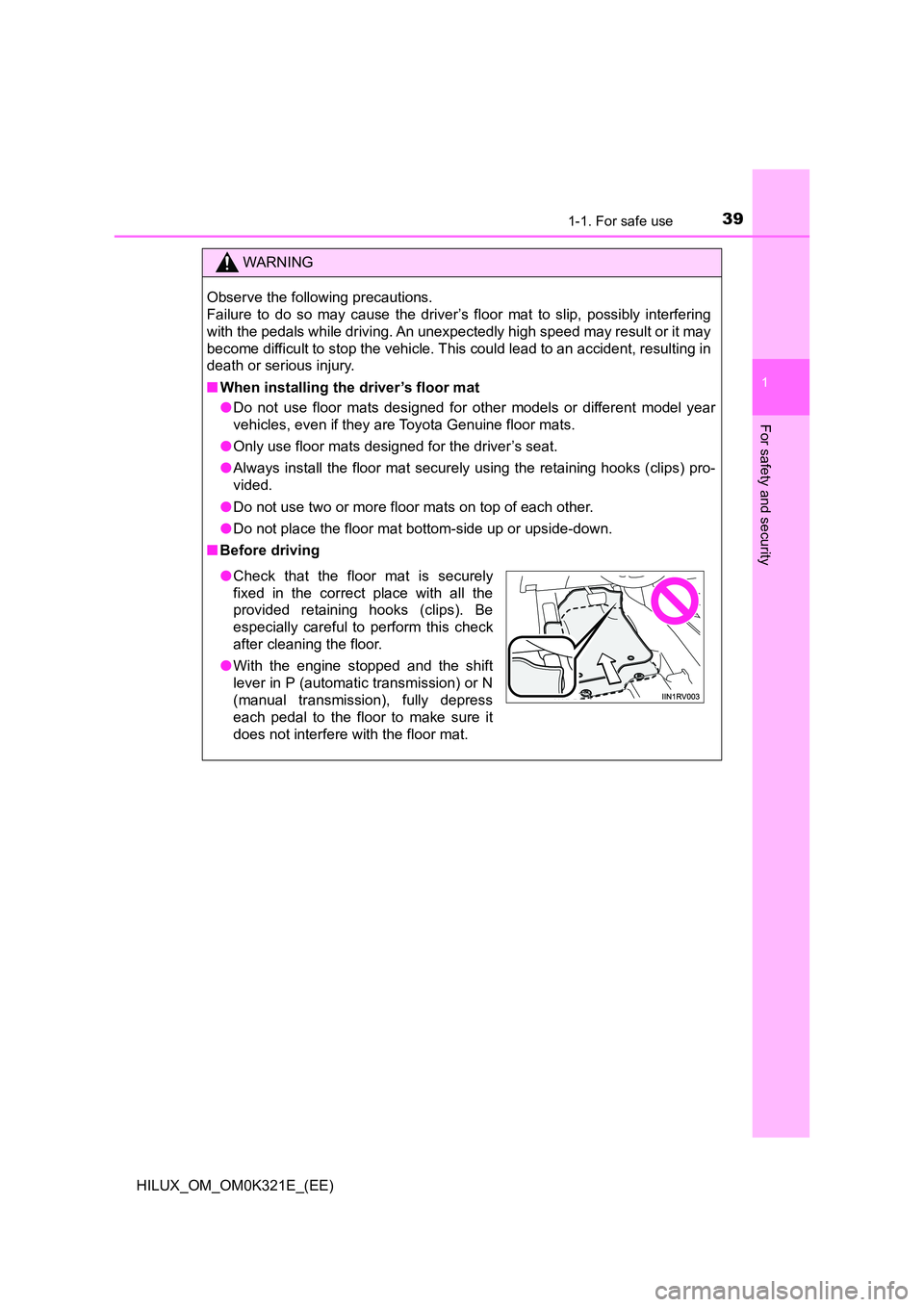
Observe the following precautions.
Failure to do so may cause the driver’s floor mat to slip, possibly interfering
with the pedals while driving. An unexpectedly high speed may result or it may
become difficult to stop the vehicle. This could lead to an accident, resulting in
death or serious injury.
■ When installing the driver’s floor mat
● Do not use floor mats designed for other models or different model year
vehicles, even if they are Toyota Genuine floor mats.
● Only use floor mats designed for the driver’s seat.
● Always install the floor mat securely using the retaining hooks (clips) pro-
vided.
● Do not use two or more floor mats on top of each other.
● Do not place the floor mat bottom-side up or upside-down.
■ Before driving
●Check that the floor mat is securely
fixed in the correct place with all the
provided retaining hooks (clips). Be
especially careful to perform this check
after cleaning the floor.
● With the engine stopped and the shift
lever in P (automatic transmission) or N
(manual transmission), fully depress
each pedal to the floor to make sure it
does not interfere with the floor mat.
Page 46 of 744

461-1. For safe use
HILUX_OM_OM0K321E_(EE)
WARNING
■When children are in the vehicle
P. 9 3
■ Seat belt pretensioners
● Do not place anything, such as a cushion, on the front passenger’s seat.
Doing so will disperse the passenger’s weight, which prevents the sensor
from detecting the passenger’s weight properly. As a result, the seat belt
pretensioner for the front passenger’s seat may not activate in the event of
a collision.
● If the pretensioner has activated, the SRS warning light will come on. In
that case, the seat belt cannot be used again and must be replaced at any
authorized Toyota retailer or Toyota authorized repairer, or any reliable
repairer.
■ Adjustable shoulder anchor (if equipped)
Always make sure the shoulder belt is positioned across the center of your
shoulder. The belt should be kept away from your neck, but not falling off
your shoulder. Failure to do so could reduce the amount of protection in an
accident and cause death or serious injuries in the event of a sudden stop,
sudden swerve or accident. ( P. 43)
■ Seat belt damage and wear
● Do not damage the seat belts by allowing the belt, plate, or buckle to be
jammed in the door.
● Inspect the seat belt system periodically. Check for cuts, fraying, and loose
parts. Do not use a damaged seat belt until it is replaced. Damaged seat
belts cannot protect an occupant from death or serious injury.
● Ensure that the belt and plate are locked and the belt is not twisted.
If the seat belt does not function correctly, immediately contact any autho-
rized Toyota retailer or Toyota authorized repairer, or any reliable repairer.
● Replace the seat assembly, including the belts, if your vehicle has been
involved in a serious accident, even if there is no obvious damage.
● Do not attempt to install, remove, modify, disassemble or dispose of the
seat belts. Have any necessary repairs carried out by any authorized
Toyota retailer or Toyota authorized repairer, or any reliable repairer. Inap-
propriate handling may lead to incorrect operation.
Page 69 of 744
691-2. Child safety
1
HILUX_OM_OM0K321E_(EE)
For safety and security
WARNING
■When a child is riding
Observe the following precautions.
Failure to do so may result in death or serious injury.
● For effective protection in automobile accidents and sudden stops, a child
must be properly restrained, using a seat belt or child restraint system
which is correctly installed. For inst allation details, refer to the operation
manual enclosed with the child restraint system. General installation
instruction is provided in this manual.
● Toyota strongly urges the use of a proper child restraint system that con-
forms to the weight and size of the child, installed on the rear seat. Accord-
ing to accident statistics, the child is safer when properly restrained in the
rear seat than in the front seat.
● Holding a child in your or someone else’s arms is not a substitute for a
child restraint system. In an accident, the child can be crushed against the
windshield or between the holder and the interior of the vehicle.
■ Handling the child restraint system
If the child restraint system is not properly fixed in place, the child or other
passengers may be seriously injured or even killed in the event of sudden
braking, sudden swerving, or an accident.
● If the vehicle were to receive a strong impact from an accident, etc., it is
possible that the child restraint system has damage that is not readily visi-
ble. In such cases, do not reuse the restraint system.
● Depending on the child restraint system, installation may be difficult or
impossible. In those cases, check whether the child restraint system is
suitable for installment in the vehicle. ( P. 74) Be sure to install and
observe the usage rules after carefully reading the child restraint system
fixing method in this manual, as well as the operation manual enclosed
with the child restraint system.
● Keep the child restraint system properly secured on the seat even if it is
not in use. Do not store the child restraint system unsecured in the pas-
senger compartment.
● If it is necessary to detach the child restraint system, remove it from the
vehicle.
Page 84 of 744
841-2. Child safety
HILUX_OM_OM0K321E_(EE)
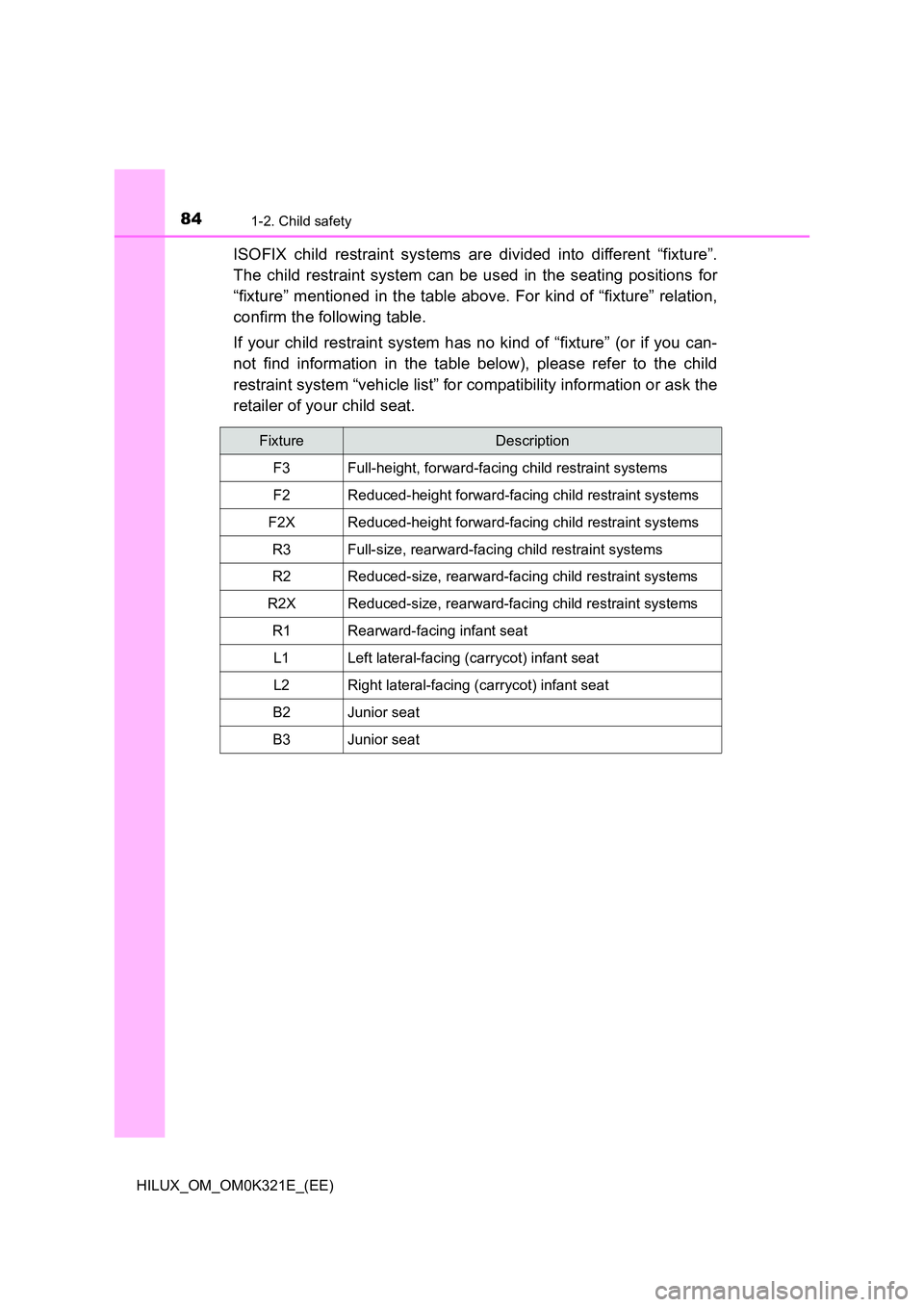
ISOFIX child restraint systems are divided into different “fixture”.
The child restraint system can be used in the seating positions for
“fixture” mentioned in the table above. For kind of “fixture” relation,
confirm the following table.
If your child restraint system has no kind of “fixture” (or if you can-
not find information in the table below), please refer to the child
restraint system “vehicle list” for compatibility information or ask the
retailer of your child seat.
FixtureDescription
F3 Full-height, forward-facing child restraint systems
F2 Reduced-height forward-facing child restraint systems
F2X Reduced-height forward-facing child restraint systems
R3 Full-size, rearward-facing child restraint systems
R2 Reduced-size, rearward-facing child restraint systems
R2X Reduced-size, rearward-facing child restraint systems
R1 Rearward-facing infant seat
L1 Left lateral-facing (carrycot) infant seat
L2 Right lateral-facing (carrycot) infant seat
B2 Junior seat
B3 Junior seat
Page 86 of 744
861-2. Child safety
HILUX_OM_OM0K321E_(EE)
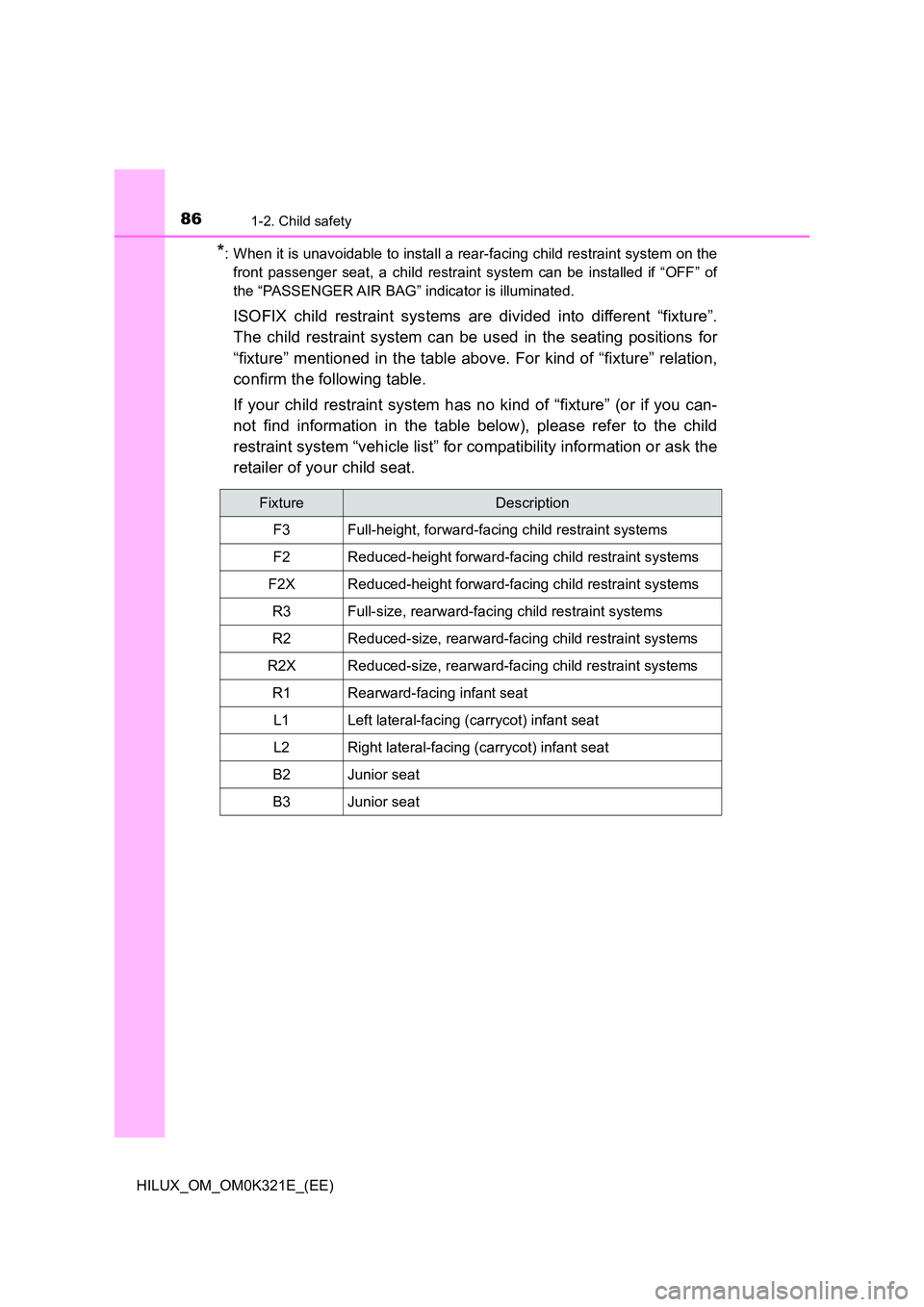
*: When it is unavoidable to install a rear-facing child restraint system on the
front passenger seat, a child restraint system can be installed if “OFF” of
the “PASSENGER AIR BAG” indicator is illuminated.
ISOFIX child restraint systems are divided into different “fixture”.
The child restraint system can be used in the seating positions for
“fixture” mentioned in the table above. For kind of “fixture” relation,
confirm the following table.
If your child restraint system has no kind of “fixture” (or if you can-
not find information in the table below), please refer to the child
restraint system “vehicle list” for compatibility information or ask the
retailer of your child seat.
FixtureDescription
F3 Full-height, forward-facing child restraint systems
F2 Reduced-height forward-facing child restraint systems
F2X Reduced-height forward-facing child restraint systems
R3 Full-size, rearward-facing child restraint systems
R2 Reduced-size, rearward-facing child restraint systems
R2X Reduced-size, rearward-facing child restraint systems
R1 Rearward-facing infant seat
L1 Left lateral-facing (carrycot) infant seat
L2 Right lateral-facing (carrycot) infant seat
B2 Junior seat
B3 Junior seat
Page 193 of 744
1933-2. Opening, closing and locking the doors
3
Operation of each component
HILUX_OM_OM0K321E_(EE)
■Impact detection door lock release system (if equipped)
In the event that the vehicle is subject to a strong impact, all the doors are
unlocked. Depending on the force of the impact or the type of accident, how-
ever, the system may not operate.
■ Conditions affecting operation
Vehicles without smart entry & start system
The wireless remote control function may not operate normally in the follow-
ing situations:
● Near a TV tower, radio station, electric power plant, airport or other facility
that generates strong radio waves
● When carrying a portable radio, cellular phone or other wireless communi-
cation device
● When multiple wireless keys are in the vicinity
● When the wireless key is in contact with, or is covered by a metallic object
● When a wireless key (that emits radio waves) is being used nearby
● When the wireless key has been left near an electrical appliance such as a
personal computer
Vehicles with smart entry & start system
P. 201
WARNING
■To prevent an accident
Observe the following precautions while driving the vehicle.
Failing to do so may result in a door opening and an occupant falling out,
resulting in death or serious injury.
● Ensure that all doors are properly closed and locked.
● Do not pull the inside handle of the doors while driving.
Be especially careful for the driver’s door, as the door may be opened
even if the inside lock button is in locked position.
● Set the rear door child-protector locks when children are seated in the rear
seats.
Page 235 of 744
2353-3. Adjusting the seats
3
Operation of each component
HILUX_OM_OM0K321E_(EE)
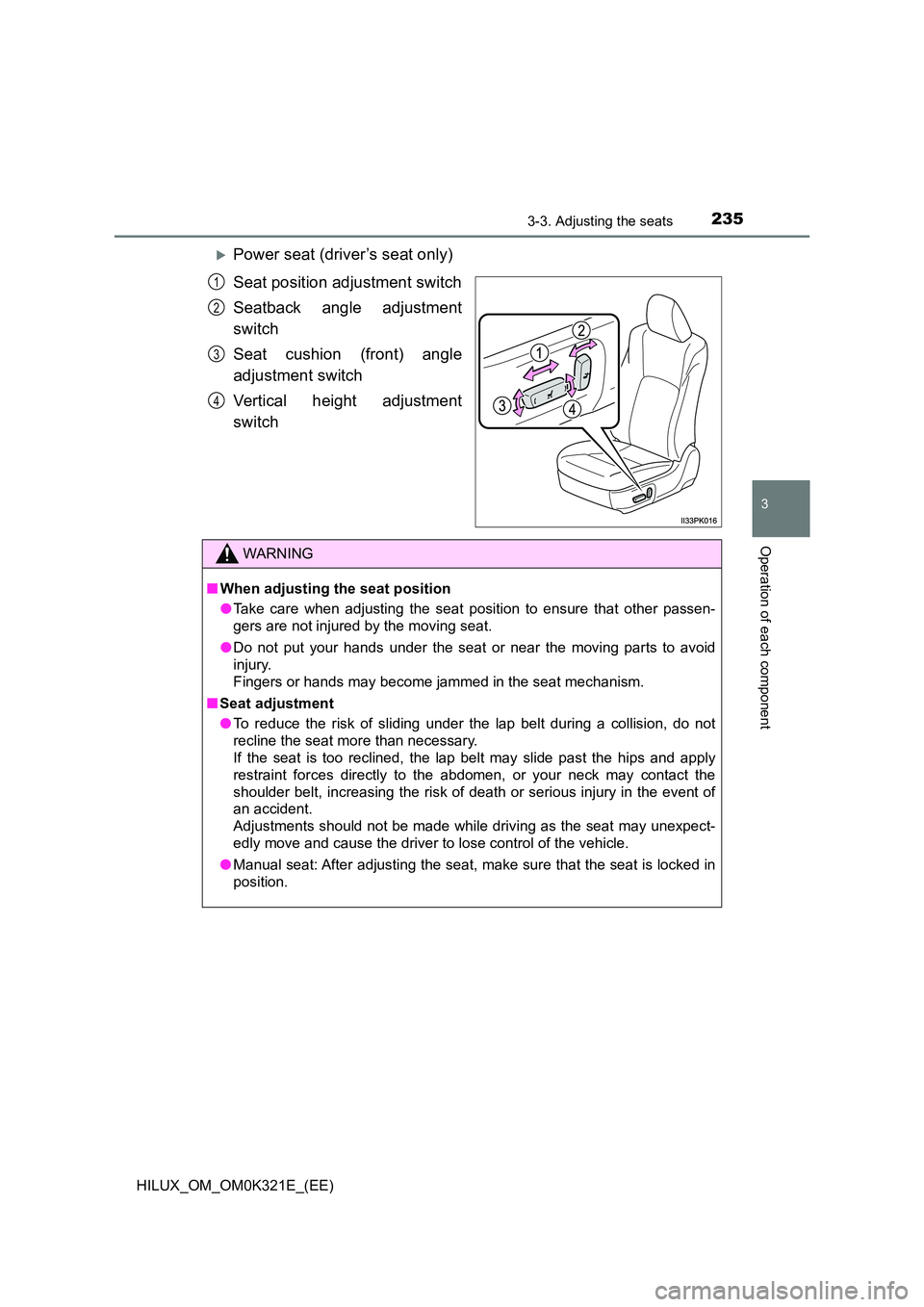
Power seat (driver’s seat only)
Seat position adjustment switch
Seatback angle adjustment
switch
Seat cushion (front) angle
adjustment switch
Vertical height adjustment
switch
1
2
3
4
WARNING
■ When adjusting the seat position
● Take care when adjusting the seat position to ensure that other passen-
gers are not injured by the moving seat.
● Do not put your hands under the seat or near the moving parts to avoid
injury.
Fingers or hands may become jammed in the seat mechanism.
■ Seat adjustment
● To reduce the risk of sliding under the lap belt during a collision, do not
recline the seat more than necessary.
If the seat is too reclined, the lap belt may slide past the hips and apply
restraint forces directly to the abdomen, or your neck may contact the
shoulder belt, increasing the risk of death or serious injury in the event of
an accident.
Adjustments should not be made while driving as the seat may unexpect-
edly move and cause the driver to lose control of the vehicle.
● Manual seat: After adjusting the seat, make sure that the seat is locked in
position.
Page 238 of 744
2383-3. Adjusting the seats
HILUX_OM_OM0K321E_(EE)
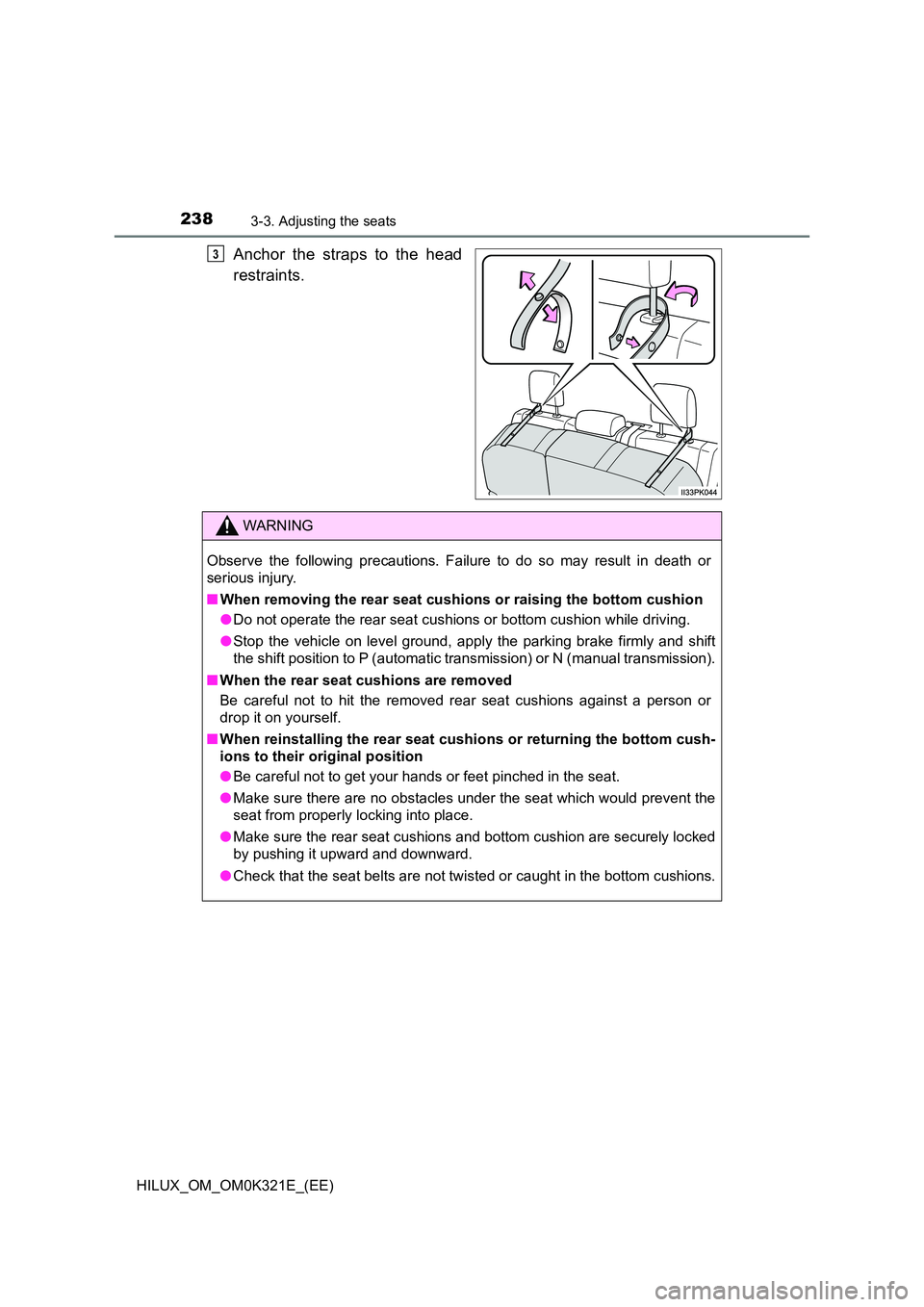
Anchor the straps to the head
restraints.
3
WARNING
Observe the following precautions. Failure to do so may result in death or
serious injury.
■ When removing the rear seat cushions or raising the bottom cushion
● Do not operate the rear seat cushions or bottom cushion while driving.
● Stop the vehicle on level ground, apply the parking brake firmly and shift
the shift position to P (automatic tr ansmission) or N (manual transmission).
■ When the rear seat cushions are removed
Be careful not to hit the removed rear seat cushions against a person or
drop it on yourself.
■ When reinstalling the rear seat cushions or returning the bottom cush-
ions to their original position
● Be careful not to get your hands or feet pinched in the seat.
● Make sure there are no obstacles under the seat which would prevent the
seat from properly locking into place.
● Make sure the rear seat cushions and bottom cushion are securely locked
by pushing it upward and downward.
● Check that the seat belts are not twisted or caught in the bottom cushions.
Page 267 of 744
267
4
4-1. Before driving
Driving
HILUX_OM_OM0K321E_(EE)
Cargo and luggage
Take notice of the following information about storage precau-
tions, cargo capacity and load.
WARNING
■ Things that must not be carried in the rear deck
The following things may cause a fire if loaded in the rear deck:
● Receptacles containing gasoline
● Aerosol cans
■ Storage precautions
Observe the following precautions.
Failure to do so may prevent t he pedals from being depressed properly,
may block the driver’s vision, or may re sult in items hitting the driver or pas-
sengers, possibly causing an accident.
● Stow cargo and luggage in the rear deck whenever possible.
● Except for single-cab models: Do not stack anything behind the front seats
higher than the seatbacks.
● Do not place cargo or luggage in or on the following locations.
• At the feet of the driver
• On the front passenger or rear seats (if equipped) (when stacking
items)
• On the instrument panel
• On the dashboard
● Secure all items in the occupant compartment.
● Never allow anyone to ride in the rear deck. It is not designed for passen-
gers. They should ride in their seats with their seat belts properly fastened.
Otherwise, they are much more likely to suffer death or serious bodily
injury, in the event of sudden braking, sudden swerving or an accident.
■ Load and distribution
● Do not overload your vehicle.
● Do not apply loads unevenly.
Improper loading may cause deterioration of steering or braking control
which may cause death or serious injury.
Page 348 of 744
3484-5. Using the driving support systems
HILUX_OM_OM0K321E_(EE)
• If a vehicle ahead is a motorcycle
• If a vehicle ahead is narrow, such as a personal mobility vehicle
• If a preceding vehicle has a small rear end, such as an unloaded truck
• If a vehicle ahead is carrying a load which protrudes past its rear bumper
• If a vehicle ahead is irregularly shaped, such as a tractor or side car
• If a vehicle ahead is a child sized bicycle, a bicycle that is carrying a large
load, a bicycle ridden by more than one person, or a uniquely shaped
bicycle (bicycle with a child seat, tandem bicycle, etc.)
• If a pedestrian/or the riding height of a bicyclist ahead is shorter than
approximately 3.2 ft. (1 m) or taller than approximately 6.5 ft. (2 m)
• If a pedestrian/bicyclist is wearing oversized clothing (a rain coat, long
skirt, etc.), making their silhouette obscure
• If a pedestrian is bending forward or squatting or bicyclist is bending for-
ward
• If a pedestrian/bicyclist is moving fast
• If a pedestrian is pushing a stroller, wheelchair, bicycle or other vehicle
• When driving in inclement weather such as heavy rain, fog, snow or a
sandstorm
• When driving through steam or smoke
• When the surrounding area is dim, such as at dawn or dusk, or while at
night or in a tunnel, making a detectable object appear to be nearly the
same color as its surroundings
• When driving in a place where the surrounding brightness changes sud-
denly, such as at the entrance or exit of a tunnel
• After the engine has started the vehicle has not been driven for a certain
amount of time
• While making a left/right turn and for a few seconds after making a left/
right turn
• While driving on a curve and for a few seconds after driving on a curve
• If your vehicle is skidding
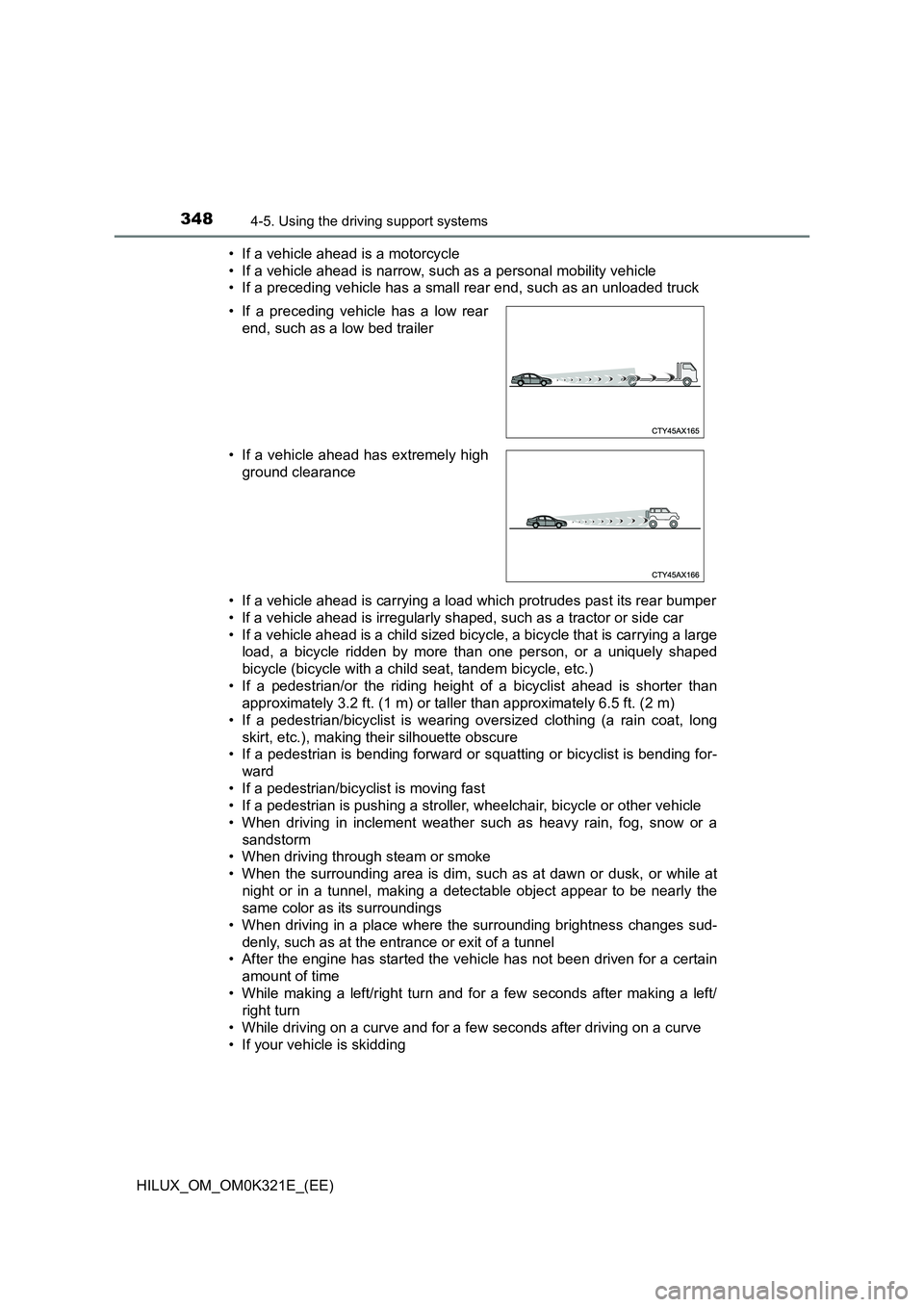
• If a preceding vehicle has a low rear
end, such as a low bed trailer
• If a vehicle ahead has extremely high
ground clearance