start TOYOTA HILUX 2023 Owners Manual
[x] Cancel search | Manufacturer: TOYOTA, Model Year: 2023, Model line: HILUX, Model: TOYOTA HILUX 2023Pages: 810, PDF Size: 131.54 MB
Page 353 of 810

3514-5. Using the driving support systems
4
Driving
HILUX_OM_OM0K789E_(EE)
● When the engine automatically restarts while stopped by the Stop & Start
system
“Preparing to
Operate”
• The vehicle is being driven in a high altitude
area.
• The brake booster vacuum is low.
When the brake booster vacuum reaches a
predetermined level, the system will be
enabled.
“For Climate
Control”
• The air conditioning system is being used
when the ambient temperature is high or low.
If the difference between the set tempera-
ture and cabin temperature is small, the
system will be enabled.
• is on.
• The power heater is on.
MessageDetails/Actions
MessageDetails/Actions
“Preparing to
Operate”
The brake pedal has been depressed further or
pumped.
The system will be enabled after the
engine runs and the brake booster vacuum
reaches a predetermined level.
“For Climate
Control”
• The air conditioning system has been turned
on or is being used.
• has been turned on.
• The power heater has been turned on.
“Battery
Charging”
The battery charge may be low.
The engine is restarted to prioritize battery
charging. Operating the engine for a short
while allows the system to recover.
Page 354 of 810

3524-5. Using the driving support systems
HILUX_OM_OM0K789E_(EE)
■ When the buzzer sounds (vehicles with automatic transmission)
If the driver’s door is opened when the engine is stopped by the Stop & Start
system and the shift lever is in D, a buzzer will sound and the Stop & Start
system indicator will flash. To stop the buzzer, close the driver’s door.
■ The Stop & Start system protection function
● When the volume of the audio system is excessively high, sound output
from the audio system may suddenly be cut off in order to reduce battery
consumption. To prevent the audio system from being cut off, keep the vol-
ume of audio system at a moderate level. If the audio system has been cut
off, turn the engine switch to the “LOCK” position*1 or off*2, wait for 3 sec-
onds or more and then turn it to the “ACC” position*1 or ACCESSORY
mode*2 or the “ON” position*1 or IGNITION ON mode*2 to re-enable the
audio system.
● The audio system may not be activated if the battery terminals are discon-
nected and then reconnected. If this occurs, turn the engine switch to the
“LOCK” position*1 or off*2 and then repeat the following operation twice to
activate the audio system normally.
• Turn the engine switch to the “ON” position*1 or IGNITION ON mode*2
and then to the “LOCK” position*1 or off*2.
*1: Vehicles without smart entry & start system
*2: Vehicles with smart entry & start system
■ Replacing the battery
P. 607
■ If the Stop & Start cancel indicator flashes continuously
The system may be malfunctioning. Have the vehicle inspected by any autho-
rized Toyota retailer or Toyota authorized repairer, or any reliable repairer.
■ If “Stop & Start System Malfunction Visit Your Dealer” is displayed on
the multi-information display
The system may be malfunctioning. Have the vehicle inspected by any autho-
rized Toyota retailer or Toyota authorized repairer, or any reliable repairer.
Page 355 of 810
3534-5. Using the driving support systems
4
Driving
HILUX_OM_OM0K789E_(EE)
WARNING
■When the Stop & Start system is operating
Make sure to disable the Stop & Start system while the vehicle is in a poorly
ventilated area.
If not disabled, the engine may be automatically restarted unexpectedly,
causing exhaust gases to collect and enter the vehicle, possibly resulting in
death or a serious health hazard.
● Do not leave the vehicle while the engine is stopped by the Stop & Start
system (while the Stop & Start indicator is on).
An accident may occur due to the automatic engine start function.
● Depress the brake pedal and apply the parking brake when necessary,
while the engine is stopped by the Stop & Start system (while the Stop &
Start indicator is on).
■ Off-road driving precaution
When driving off-road, such as driving through water, press the Stop & Start
cancel switch to disable the Stop & Start system. Failure to do so may
cause the engine to be unable to restart.
NOTICE
■ To ensure the system operates correctly
If any of the following situations occur, the Stop & Start system may not
operate correctly. Have your vehicle inspected by any authorized Toyota
retailer or Toyota authorized repairer, or any reliable repairer.
● While the driver’s seat belt is fastened, the driver’s and front passenger’s
seat belt reminder light flashes.
● Even though the driver’s seat belt is not fastened, the driver’s and front
passenger’s seat belt reminder light does not illuminate.
● Even though the driver’s door is closed, the open door warning light is illu-
minated or the interior light is illuminated when the interior light switch is in
the door position.
● Even though the driver’s door is open, the open door warning light does
not illuminate or the interior light does not illuminate when the interior light
switch is in the door position.
■ If the engine stalls (vehicles with manual transmission)
If the Stop & Start system is enabled and the clutch pedal is depressed
quickly, the engine may restart.
Page 356 of 810

3544-5. Using the driving support systems
HILUX_OM_OM0K789E_(EE)
Driving assist systems
◆ABS (Anti-lock Brake System)
Helps to prevent wheel lock when the brakes are applied suddenly, or if the
brakes are applied while driving on a slippery road surface
◆Brake assist (if equipped)
Generates an increased level of braking force after the brake pedal is
depressed when the system detects a panic stop situation
◆VSC (Vehicle Stability Control) (if equipped)
Helps the driver to control skidding when swerving suddenly or turning on
slippery road surfaces
◆TRC (Traction Control) for Pre Runner and H2 position on 4WD
models (if equipped)
Helps to maintain drive power and pr event the drive wheels from spinning
when starting the vehicle or accelerating on slippery roads
◆A-TRC (Active Traction Control) for H4 and L4 position on 4WD
models (if equipped)
Helps to maintain drive power and prevent the four wheels from spinning
when starting the vehicle or accelerating on slippery roads
◆Hill-start assist control (if equipped)
Helps to reduce the backward movement of the vehicle when starting on
an uphill
◆Emergency brake signal (if equipped)
When the brakes are applied suddenly, the emergency flashers automati-
cally flash to alert the vehicle behind.
To keep driving safety and performance, the following systems
operate automatically in response to various driving situations.
Be aware, however, that these systems are supplementary and
should not be relied upon too heavily when operating the vehi-
cle.
Page 360 of 810
3584-5. Using the driving support systems
HILUX_OM_OM0K789E_(EE)
■Turning off TRC, A-TRC, VSC and Trailer Sway Control systems
Vehicles without multi-information display
To turn the TRC, A-TRC, VSC and Trailer Sway Control systems off, press
and hold for more than 3 seconds while the vehicle is stopped.
The “TRC OFF” indicator light and VSC OFF indicator light will come on.*
Press again to turn the system back on.
Vehicles with multi-information display
To turn the TRC, A-TRC, VSC and Trailer Sway Control systems off, press
and hold for more than 3 seconds while the vehicle is stopped.
The VSC OFF indicator light will come on and the “TRC turned off” will be
shown on the multi-information display.*
Press again to turn the system back on.
*: On vehicles with pre-collision system, pre-collision brake assist and pre-
collision braking will also be disabled. The PCS warning light will come on
and the message will be shown on the multi-information display. ( P. 282)
■ When “TRC OFF” indicator light comes on or the message is displayed
on the multi-information display sh owing that TRC/A-TRC has been dis-
abled even if has not been pressed
TRC, A-TRC and downhill assist control is temporary deactivated. If the indi-
cator light continues to remain on or the information continues to show, con-
tact any authorized Toyota retailer or Toyota authorized repairer, or any
reliable repairer.
■ Sounds and vibrations caused by the ABS, brake assist, VSC, Trailer
Sway Control, TRC, A-TRC and the hill-start assist control systems
● A sound may be heard from the engine compartment when the brake pedal
is depressed repeatedly, when the engine is started or just after the vehicle
begins to move. This sound does not indicate that a malfunction has
occurred in any of these systems.
● Any of the following conditions may occur when the above systems are
operating. None of these indicates that a malfunction has occurred.
• Vibrations may be felt through the vehicle body and steering.
• A motor sound may be heard also after the vehicle comes to a stop.
• The brake pedal may pulsate slightly after the ABS is activated.
• The brake pedal may move down slightly after the ABS is activated.
Page 361 of 810
3594-5. Using the driving support systems
4
Driving
HILUX_OM_OM0K789E_(EE)
■ Automatic reactivation of TRC, A-TRC, VSC and Trailer Sway Control
systems
After turning the TRC, A-TRC, VSC and Trailer Sway Control systems off, the
systems will be automatically re-enabled in the following situations:
● When the engine switch is turned to the “LOCK” position (vehicles without
smart entry & start system) or off (vehicles with smart entry & start system).
● If only the TRC/A-TRC system is turned off (P. 356), the TRC/A-TRC will
turn on when vehicle speed increases.
If the TRC, A-TRC, VSC and Trailer Sway Control systems are turned off
( P. 358), automatic re-enabling will not occur when vehicle speed
increases.
■ Operating conditions of the hill-start assist control
When the following four conditions are me t, the hill-start assist control will
operate:
● Vehicles with automatic transmission: The shift lever is in a position other
than P or N (when starting off forward/backward on an upward incline)
Vehicles with manual transmission: The shift lever is in a position other than
R when starting off forward on an upward incline, or the shift lever is in R
when starting off backward on an upward incline.
● The vehicle is stopped
● The accelerator pedal is not depressed
● The parking brake is not engaged
■ Automatic system cancelation of the hill-start assist control
The hill-start assist control will turn off in any of the following situations:
● Vehicles with automatic transmission: The shift lever is shifted to P or N
Vehicles with manual transmission: The shift lever is shifted to R when start-
ing off forward on an upward incline, or the shift lever is shifted to other than
R when starting off backward on an upward incline.
● The accelerator pedal is depressed
● The parking brake is engaged
● 2 seconds at maximum elapsed after the brake pedal is released
Page 363 of 810
3614-5. Using the driving support systems
4
Driving
HILUX_OM_OM0K789E_(EE)
WARNING
■TRC/A-TRC/VSC may not operate effectively when
Directional control and power may not be achievable while driving on slip-
pery road surfaces, even if the TRC/A-TRC/VSC system is operating.
Drive the vehicle carefully in conditions where stability and power may be
lost.
■ Hill-start assist control does not operate effectively when
● Do not overly rely on the hill-start assist control. The hill-start assist control
may not operate effectively on steep inclines and roads covered with ice.
● Unlike the parking brake, the hill-start assist control is not intended to hold
the vehicle stationary for an extended period of time. Do not attempt to use
the hill-start assist control to hold the vehicle on an incline, as doing so
may lead to an accident.
■ When the TRC/VSC/Trailer Sway Control is activated
The slip indicator flashes. Always drive carefully.
Reckless driving may cause an accident. Exercise particular care when the
indicator flashes.
■ When the TRC/A-TRC/VSC/Trailer Sway Control systems are turned off
Be especially careful and drive at a speed appropriate to the road condi-
tions. As these are the systems to help ensure vehicle stability and driving
force, do not turn the TRC/A-TRC/VSC/Trailer Sway Control systems off
unless necessary.
■ Replacing tires
Make sure that all tires are of the specified size, brand, tread pattern and
total load capacity. In addition, make sure that the tires are inflated to the
recommended tire inflation pressure level.
The ABS, TRC, A-TRC, VSC, Trailer Sway Control, hill-start assist control
and downhill assist control systems will not function correctly if different tires
are installed on the vehicle.
Contact any authorized Toyota retailer or Toyota authorized repairer, or any
reliable repairer for further information when replacing tires or wheels.
■ Handling of tires and the suspension
Using tires with any kind of problem or modifying the suspension will affect
the driving assist systems, and may cause a system to malfunction.
Page 365 of 810
363
4
4-5. Using the driving support systems
Driving
HILUX_OM_OM0K789E_(EE)
Downhill assist control system
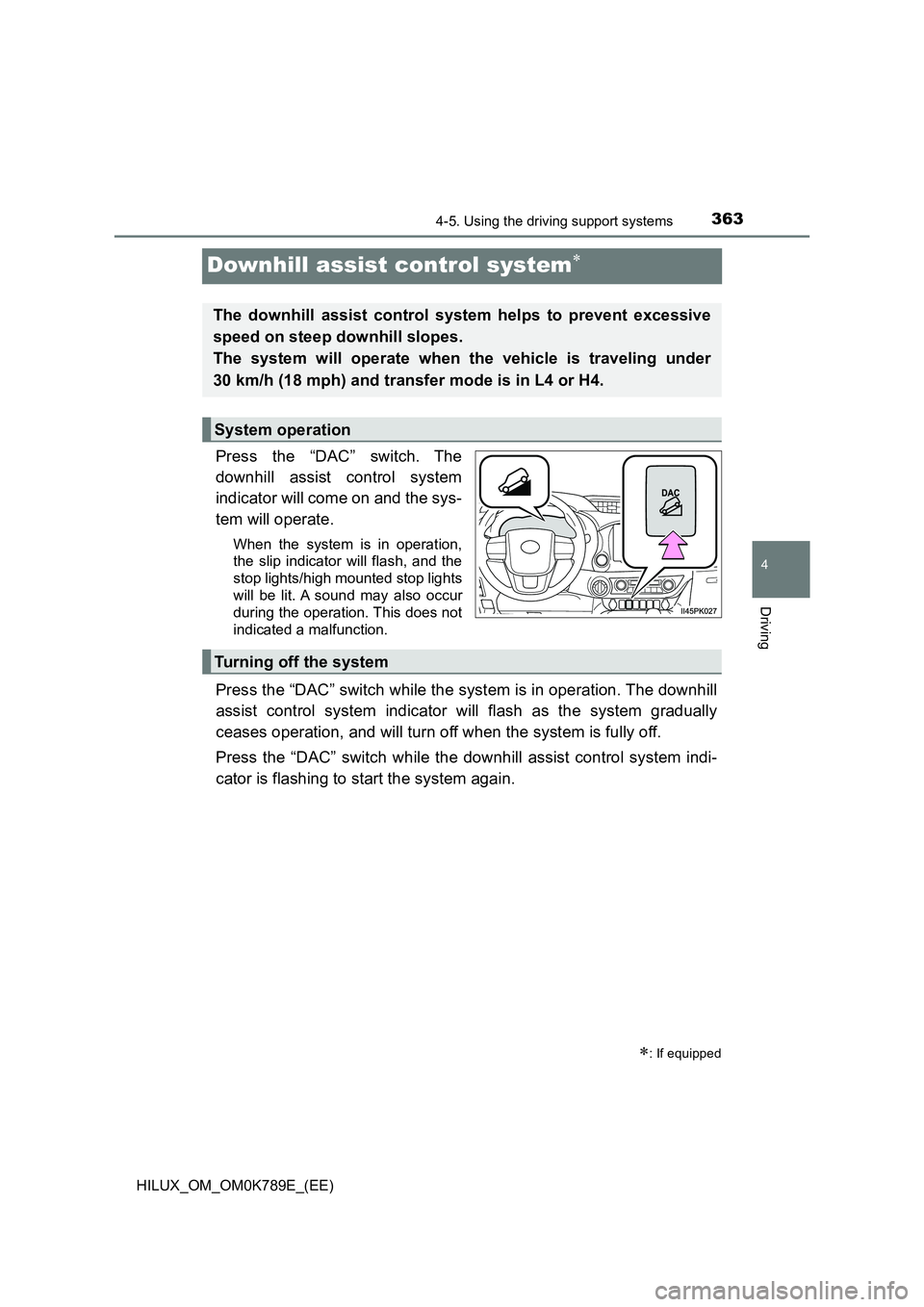
Press the “DAC” switch. The
downhill assist control system
indicator will come on and the sys-
tem will operate.
When the system is in operation,
the slip indicator will flash, and the
stop lights/high mounted stop lights
will be lit. A sound may also occur
during the operation. This does not
indicated a malfunction.
Press the “DAC” switch while the system is in operation. The downhill
assist control system indicator will flash as the system gradually
ceases operation, and will turn off when the system is fully off.
Press the “DAC” switch while the downhill assist control system indi-
cator is flashing to start the system again.
: If equipped
The downhill assist control system helps to prevent excessive
speed on steep downhill slopes.
The system will operate when the vehicle is traveling under
30 km/h (18 mph) and transfer mode is in L4 or H4.
System operation
Turning off the system
Page 366 of 810
3644-5. Using the driving support systems
HILUX_OM_OM0K789E_(EE)
■Operating tips (vehicles with automatic transmission)
The system will operate when the shift lever is in a position other than P, how-
ever to make effective use of the system it is recommended to select a lower
shift range.
■ The system will not operate when
● The transfer mode is in H2.
● The rear differential is locked. (if equipped)
■ If the downhill assist control system indicator flashes
● In the following situations, the indicator flashes and the system will not oper-
ate:
• The transfer mode is not in L4 or H4.
• The rear differential is locked. (if equipped)
• The shift lever is in P. (vehicles with automatic transmission)
• The accelerator or brake pedal is depressed.
• The vehicle speed exceeds approximately 30 km/h (18 mph).
• The brake system overheats.
● In the following situations, the indicator flashes to alert the driver, but the
system will operate:
• The shift lever is in N. (vehicles with automatic transmission)
• The clutch pedal is depressed. (vehicles with manual transmission)
• The “DAC” switch is turned off while the system is operating.
The system will gradually ceases operat ion. The indicator will flash during
operation, and then go off when the system is fully off.
■ When the downhill assist control system is operated continuously
This may cause the brake actuator to overheat. In this case, the downhill
assist control system will stop operating, a buzzer will sound and the downhill
assist control system indicator will start flashing, and “TRC turned off” will be
shown on the multi-information display. Refrain from using the system until
the downhill assist control system indicator stays on and the message goes
off. (The vehicle can be driven normally during this time.)
■ Sounds and vibrations caused by the downhill assist control system
● A sound may be heard from the engine compartment when the engine is
started or just after the vehicle begins to move. This sound does not indicate
that a malfunction has occurred in downhill assist control system.
● Either of the following conditions may occur when the downhill assist control
system is operating. None of these are indicators that a malfunction has
occurred.
• Vibrations may be felt through the vehicle body and steering.
• A motor sound may be heard after the vehicle comes to a stop.
Page 367 of 810
3654-5. Using the driving support systems
4
Driving
HILUX_OM_OM0K789E_(EE)
■ System malfunction
In the following cases, have your vehicle checked by any authorized Toyota
retailer or Toyota authorized repairer, or any reliable repairer.
● The downhill assist control system indicator does not come on when the
engine switch is turned to the “ON” position (vehicles without smart entry &
start system) or IGNITION ON mode (vehicles with smart entry & start sys-
tem).
● The downhill assist control system indicator does not come on when the
“DAC” switch is pressed.
● The slip indicator comes on.
WARNING
■When using downhill assist control system
● Do not rely overmuch on the downhill assist control system. This function
does not extend the vehicle’s performance limitations. Always thoroughly
check the road conditions, and drive safely.
● Vehicles with manual transmission: Drive in a low gear. Driving in a high
gear when using downhill assist control system may cause the engine to
stall, which may lose the brake effectiveness and lock the tires, resulting in
an accident.
● Vehicles with manual transmission: On a steep slope, use the engine brak-
ing efficiently. If the vehicle is driven in N or with the clutch pedal
depressed on a steep slope, the load on the brake increases and con-
trolling the vehicle speed may be impossible, resulting in an accident.
■ The system may not operate on the following surfaces, which may lead
to an accident causing death or serious injury
● Slippery surfaces such as wet or muddy roads
● Icy surface
● Unpaved roads