ECU TOYOTA HILUX 2023 Owner's Manual
[x] Cancel search | Manufacturer: TOYOTA, Model Year: 2023, Model line: HILUX, Model: TOYOTA HILUX 2023Pages: 810, PDF Size: 131.54 MB
Page 67 of 810
651-2. Child safety
1
For safety and security
HILUX_OM_OM0K789E_(EE)
Child restraint systems
Points to remember................................................................. P. 66
When using a child restraint system ....................................... P. 68
Child restraint system compatibility for each seating position.... P. 72
Child restraint system installation method .............................. P. 87
• Fixed with a seat belt .......................................................... P. 88
• Fixed with an ISOFIX lower anchorage (if equipped).......... P. 90
• Using a top tether anchorage (if equipped) ......................... P. 93
Before installing a child restraint system in the vehicle, there are
precautions that need to be observed, different types of child
restraint systems, as well as installation methods, etc., written in
this manual.
● Use a child restraint system when riding with a small child that
cannot properly use a seat belt. For the child’s safety, install the
child restraint system to a rear seat. Be sure to follow the installa-
tion method that is in the operation manual enclosed with the
restraint system.
● The use of a Toyota genuine child restraint system is recom-
mended, as it is safer to use in this vehicle. Toyota genuine child
restraint systems are made specifically for Toyota vehicles. They
can be purchased at a Toyota dealer.
Table of contents
Page 69 of 810
671-2. Child safety
1
HILUX_OM_OM0K789E_(EE)
For safety and security
WARNING
■When a child is riding
Observe the following precautions.
Failure to do so may result in death or serious injury.
● For effective protection in automobile accidents and sudden stops, a child
must be properly restrained, using a seat belt or child restraint system
which is correctly installed. For inst allation details, refer to the operation
manual enclosed with the child restraint system. General installation
instruction is provided in this manual.
● Toyota strongly urges the use of a proper child restraint system that con-
forms to the weight and size of the child, installed on the rear seat. Accord-
ing to accident statistics, the child is safer when properly restrained in the
rear seat than in the front seat.
● Holding a child in your or someone else’s arms is not a substitute for a
child restraint system. In an accident, the child can be crushed against the
windshield or between the holder and the interior of the vehicle.
■ Handling the child restraint system
If the child restraint system is not properly fixed in place, the child or other
passengers may be seriously injured or even killed in the event of sudden
braking, sudden swerving, or an accident.
● If the vehicle were to receive a strong impact from an accident, etc., it is
possible that the child restraint system has damage that is not readily visi-
ble. In such cases, do not reuse the restraint system.
● Depending on the child restraint system, installation may be difficult or
impossible. In those cases, check whether the child restraint system is
suitable for installment in the vehicle. ( P. 72) Be sure to install and
observe the usage rules after carefully reading the child restraint system
fixing method in this manual, as well as the operation manual enclosed
with the child restraint system.
● Keep the child restraint system properly secured on the seat even if it is
not in use. Do not store the child restraint system unsecured in the pas-
senger compartment.
● If it is necessary to detach the child restraint system, remove it from the
vehicle.
Page 71 of 810
691-2. Child safety
1
HILUX_OM_OM0K789E_(EE)
For safety and security
WARNING
■When using a child restraint system
Observe the following precautions.
Failure to do so may result in death or serious injury.
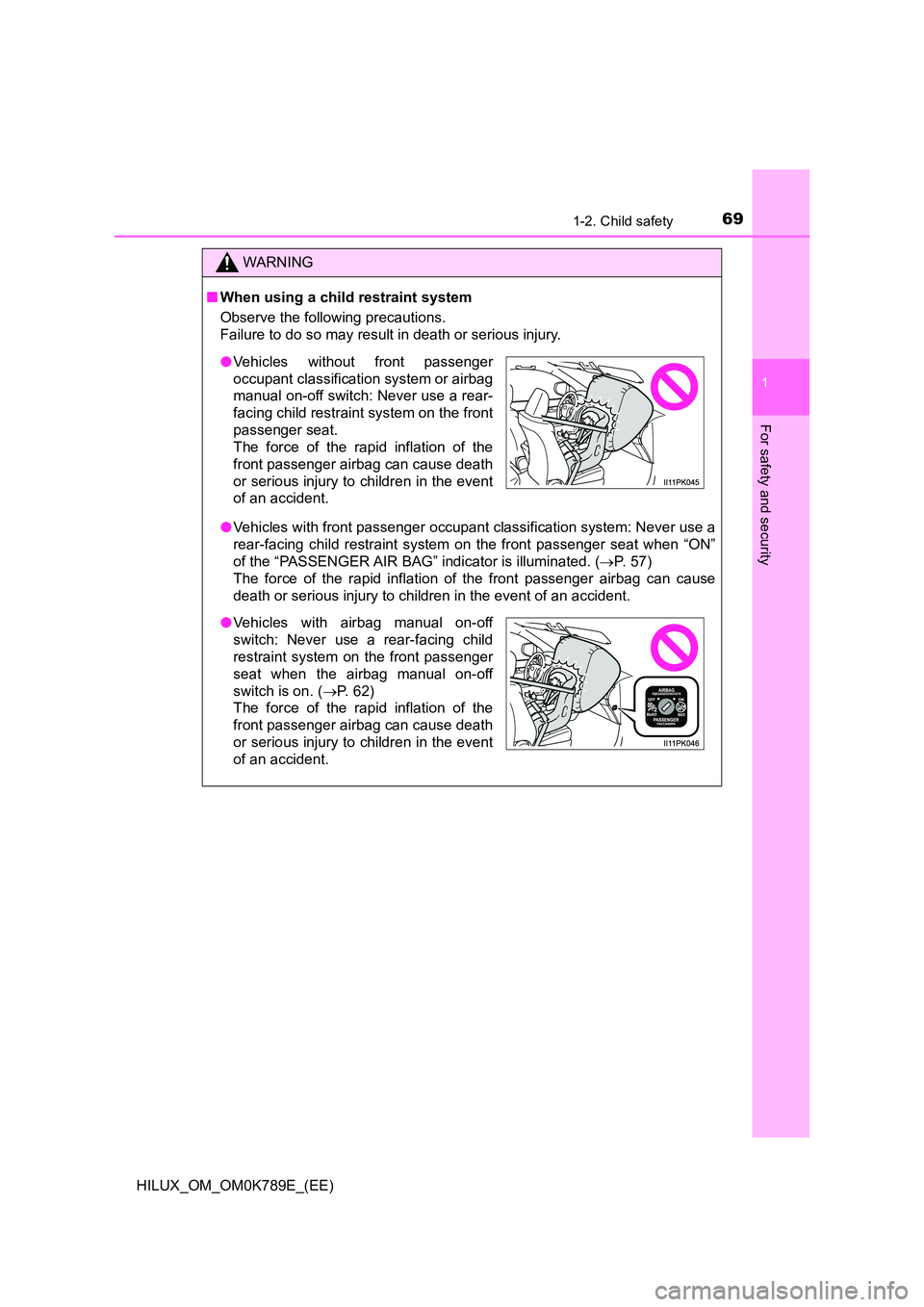
● Vehicles with front passenger occupant classification system: Never use a
rear-facing child restraint system on the front passenger seat when “ON”
of the “PASSENGER AIR BAG” indicator is illuminated. ( P. 57)
The force of the rapid inflation of the front passenger airbag can cause
death or serious injury to children in the event of an accident.
● Vehicles without front passenger
occupant classification system or airbag
manual on-off switch: Never use a rear-
facing child restraint system on the front
passenger seat.
The force of the rapid inflation of the
front passenger airbag can cause death
or serious injury to children in the event
of an accident.
● Vehicles with airbag manual on-off
switch: Never use a rear-facing child
restraint system on the front passenger
seat when the airbag manual on-off
switch is on. ( P. 62)
The force of the rapid inflation of the
front passenger airbag can cause death
or serious injury to children in the event
of an accident.
Page 73 of 810
711-2. Child safety
1
HILUX_OM_OM0K789E_(EE)
For safety and security
WARNING
■When using a child restraint system
● When a junior seat is installed, always ensure that the shoulder belt is
positioned across the center of the child’s shoulder. The belt should be
kept away from the child’s neck, but not so that it could fall off the child’s
shoulder.
● Use child restraint system suitable to the age and size of the child and
install it to the rear seat.
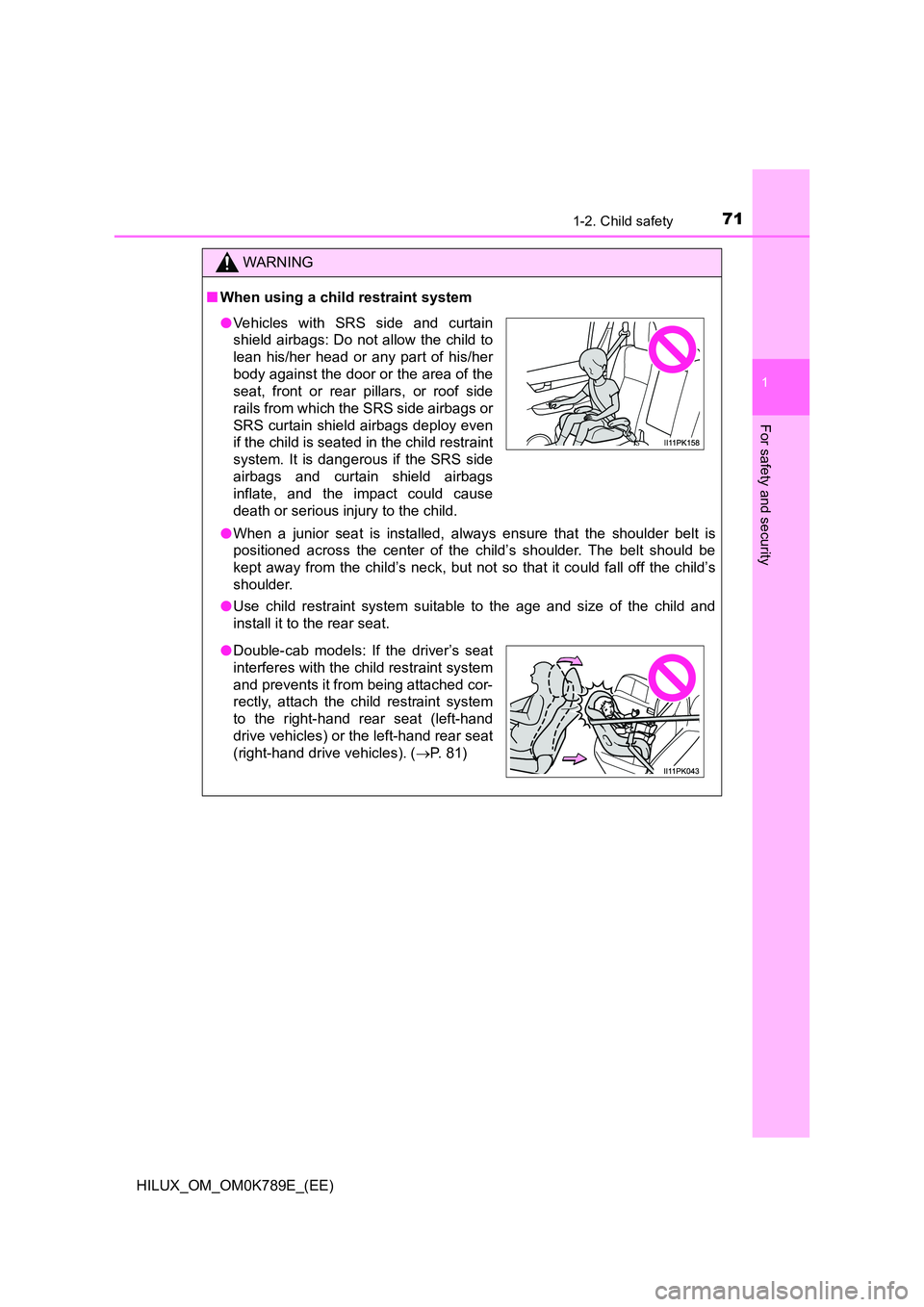
● Vehicles with SRS side and curtain
shield airbags: Do not allow the child to
lean his/her head or any part of his/her
body against the door or the area of the
seat, front or rear pi llars, or roof side
rails from which the SRS side airbags or
SRS curtain shield airbags deploy even
if the child is seated in the child restraint
system. It is dangerous if the SRS side
airbags and curtain shield airbags
inflate, and the impact could cause
death or serious injury to the child.
● Double-cab models: If the driver’s seat
interferes with the child restraint system
and prevents it from being attached cor-
rectly, attach the child restraint system
to the right-hand rear seat (left-hand
drive vehicles) or the left-hand rear seat
(right-hand drive vehicles). ( P. 8 1 )
Page 75 of 810
731-2. Child safety
1
HILUX_OM_OM0K789E_(EE)
For safety and security
*1: UN(ECE) R44 and UN(ECE) R129 are U.N. regulations for child
restraint systems.
*2: The child restraint systems mentioned in the table may not be avail-
able outside of the EU area.
*3: The displayed mark may differ depending on the product.
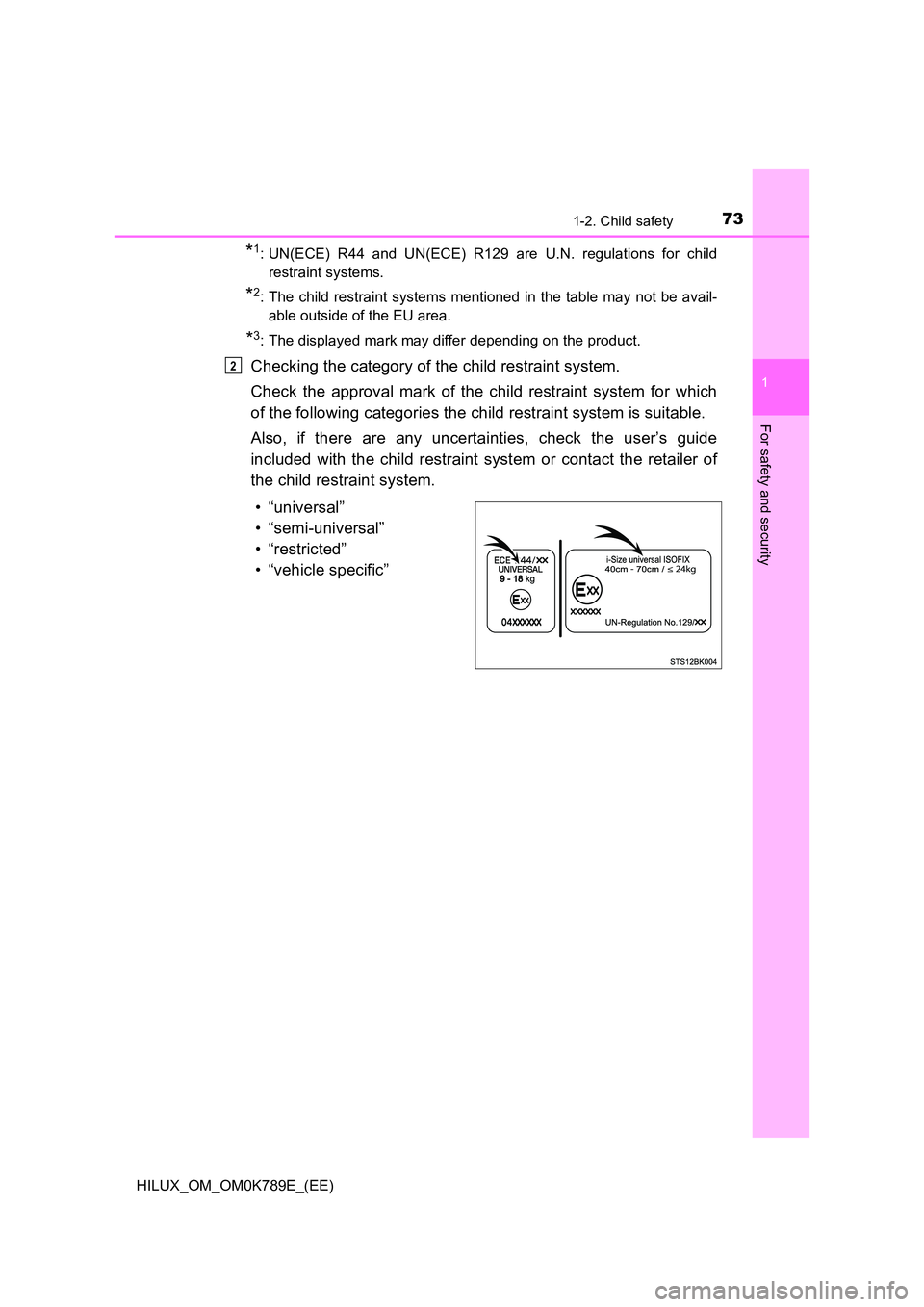
Checking the category of the child restraint system.
Check the approval mark of the child restraint system for which
of the following categories the child restraint system is suitable.
Also, if there are any uncertainties, check the user’s guide
included with the child restraint system or contact the retailer of
the child restraint system.
•“universal”
• “semi-universal”
• “restricted”
• “vehicle specific”
2
Page 77 of 810
751-2. Child safety
1
HILUX_OM_OM0K789E_(EE)
For safety and security
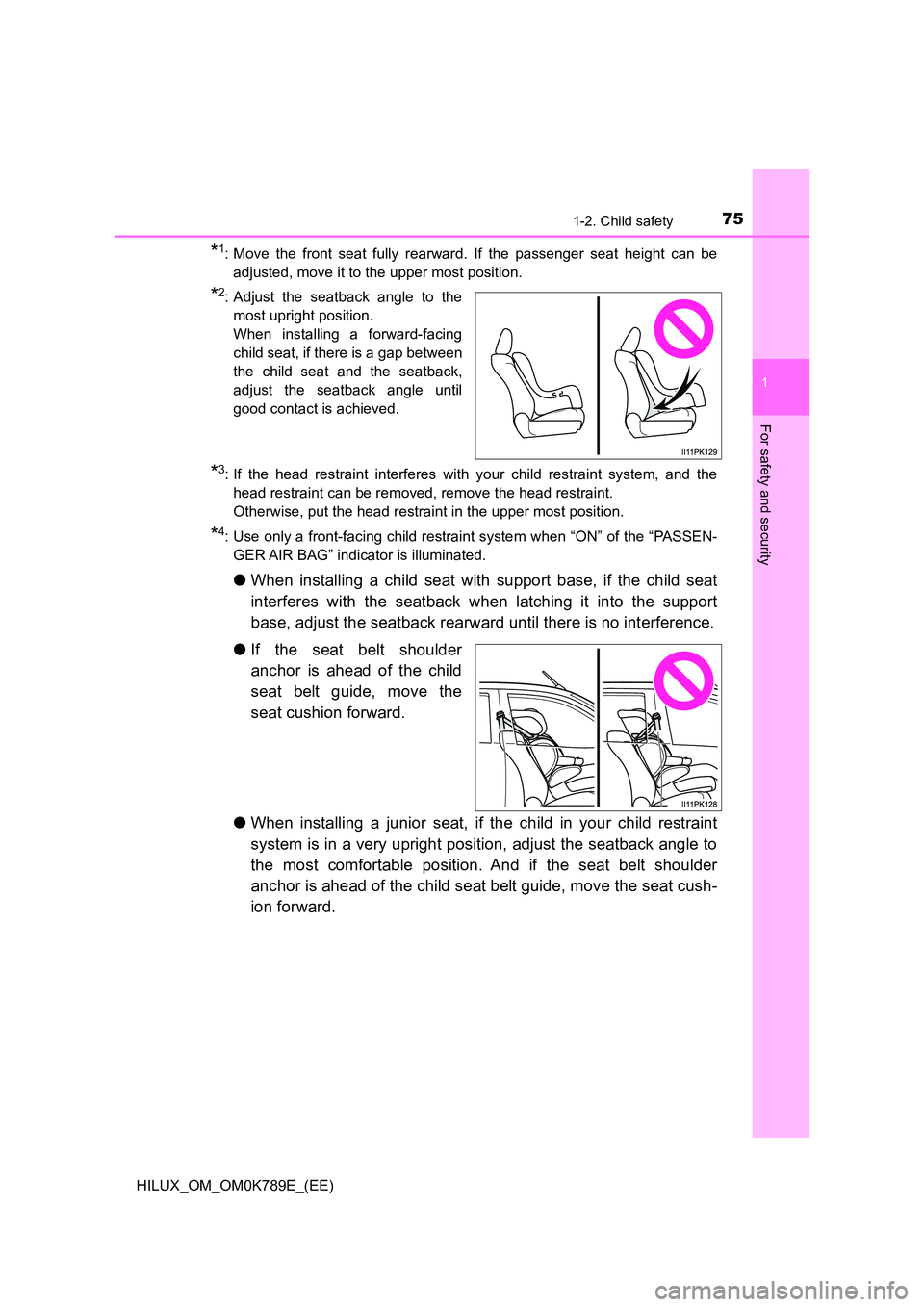
*1: Move the front seat fully rearward. If the passenger seat height can be
adjusted, move it to the upper most position.
*2: Adjust the seatback angle to the
most upright position.
When installing a forward-facing
child seat, if there is a gap between
the child seat and the seatback,
adjust the seatback angle until
good contact is achieved.
*3: If the head restraint interferes with your child restraint system, and the
head restraint can be removed, remove the head restraint.
Otherwise, put the head restraint in the upper most position.
*4: Use only a front-facing child restraint system when “ON” of the “PASSEN-
GER AIR BAG” indicator is illuminated.
● When installing a child seat with support base, if the child seat
interferes with the seatback when latching it into the support
base, adjust the seatback rearward until there is no interference.
● If the seat belt shoulder
anchor is ahead of the child
seat belt guide, move the
seat cushion forward.
● When installing a junior seat, if the child in your child restraint
system is in a very upright position, adjust the seatback angle to
the most comfortable position. And if the seat belt shoulder
anchor is ahead of the child seat belt guide, move the seat cush-
ion forward.
Page 79 of 810
771-2. Child safety
1
HILUX_OM_OM0K789E_(EE)
For safety and security
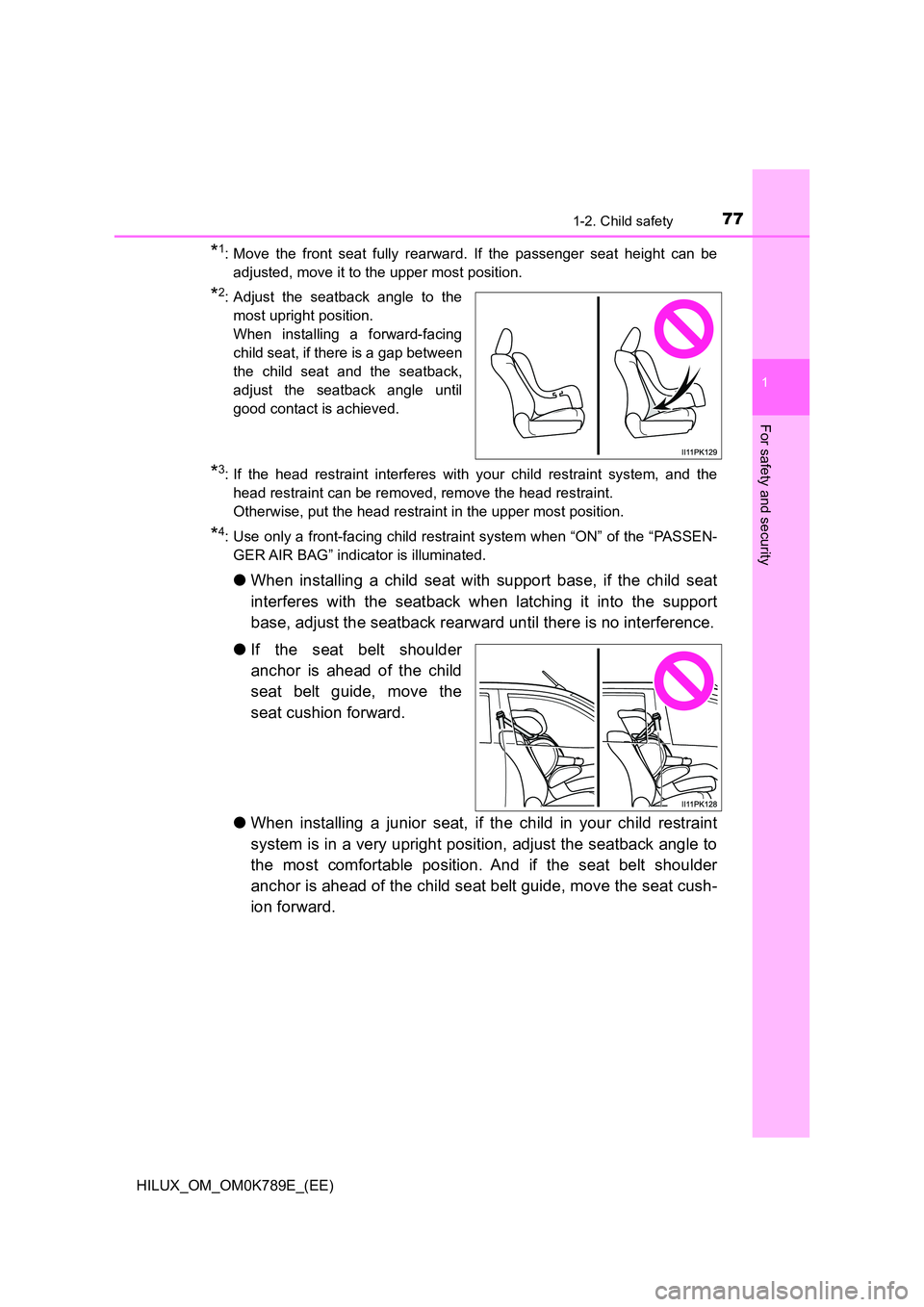
*1: Move the front seat fully rearward. If the passenger seat height can be
adjusted, move it to the upper most position.
*2: Adjust the seatback angle to the
most upright position.
When installing a forward-facing
child seat, if there is a gap between
the child seat and the seatback,
adjust the seatback angle until
good contact is achieved.
*3: If the head restraint interferes with your child restraint system, and the
head restraint can be removed, remove the head restraint.
Otherwise, put the head restraint in the upper most position.
*4: Use only a front-facing child restraint system when “ON” of the “PASSEN-
GER AIR BAG” indicator is illuminated.
● When installing a child seat with support base, if the child seat
interferes with the seatback when latching it into the support
base, adjust the seatback rearward until there is no interference.
● If the seat belt shoulder
anchor is ahead of the child
seat belt guide, move the
seat cushion forward.
● When installing a junior seat, if the child in your child restraint
system is in a very upright position, adjust the seatback angle to
the most comfortable position. And if the seat belt shoulder
anchor is ahead of the child seat belt guide, move the seat cush-
ion forward.
Page 81 of 810
791-2. Child safety
1
HILUX_OM_OM0K789E_(EE)
For safety and security
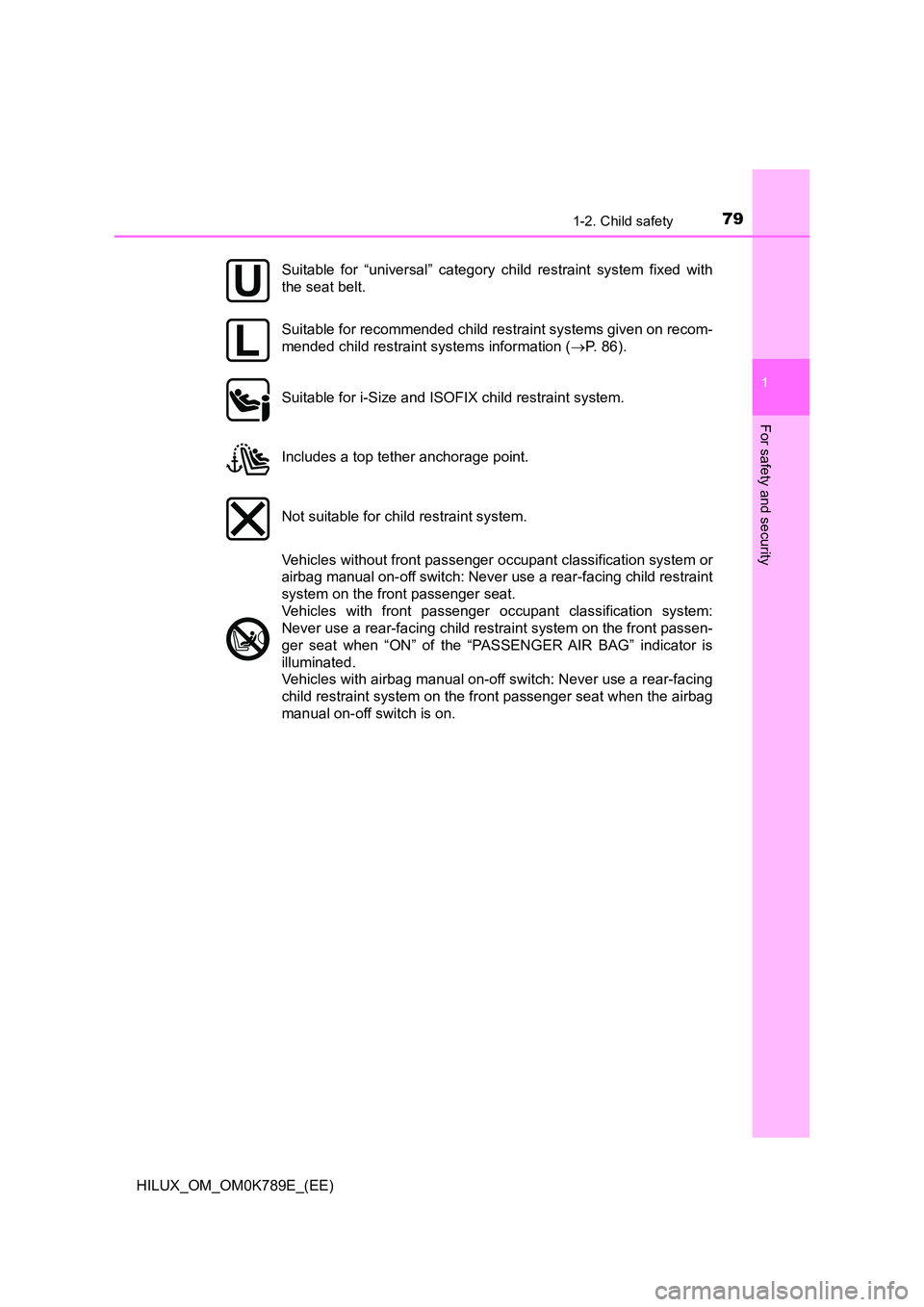
Suitable for “universal” category child restraint system fixed with
the seat belt.
Suitable for recommended child restraint systems given on recom-
mended child restraint systems information ( P. 8 6 ) .
Suitable for i-Size and ISOFIX child restraint system.
Includes a top tether anchorage point.
Not suitable for child restraint system.
Vehicles without front passenger occupant classification system or
airbag manual on-off switch: Never use a rear-facing child restraint
system on the front passenger seat.
Vehicles with front passenger occupant classification system:
Never use a rear-facing child restraint system on the front passen-
ger seat when “ON” of the “PASSENGER AIR BAG” indicator is
illuminated.
Vehicles with airbag manual on-off switch: Never use a rear-facing
child restraint system on the front passenger seat when the airbag
manual on-off switch is on.
Page 83 of 810
811-2. Child safety
1
HILUX_OM_OM0K789E_(EE)
For safety and security
When securing some types of child restraint systems in rear seat, it
may not be possible to properly use the seat belts in positions next
to the child restraint without interfering with it or affecting seat belt
effectiveness. Be sure your seat belt fits snugly across your shoul-
der and low on your hips. If it does not, or if it interferes with the
child restraint, move to a different position.
Failure to do so may result in death or serious injury.
● When installing a child restraint in the rear seats, adjust the front
seat so that it does not interfere with the child or child restraint
system (if equipped).
● When installing a child seat with support base in the front seats, if
the child seat interferes with the seatback when latching it into
the support base, adjust the seatback rearward until there is no
interference.
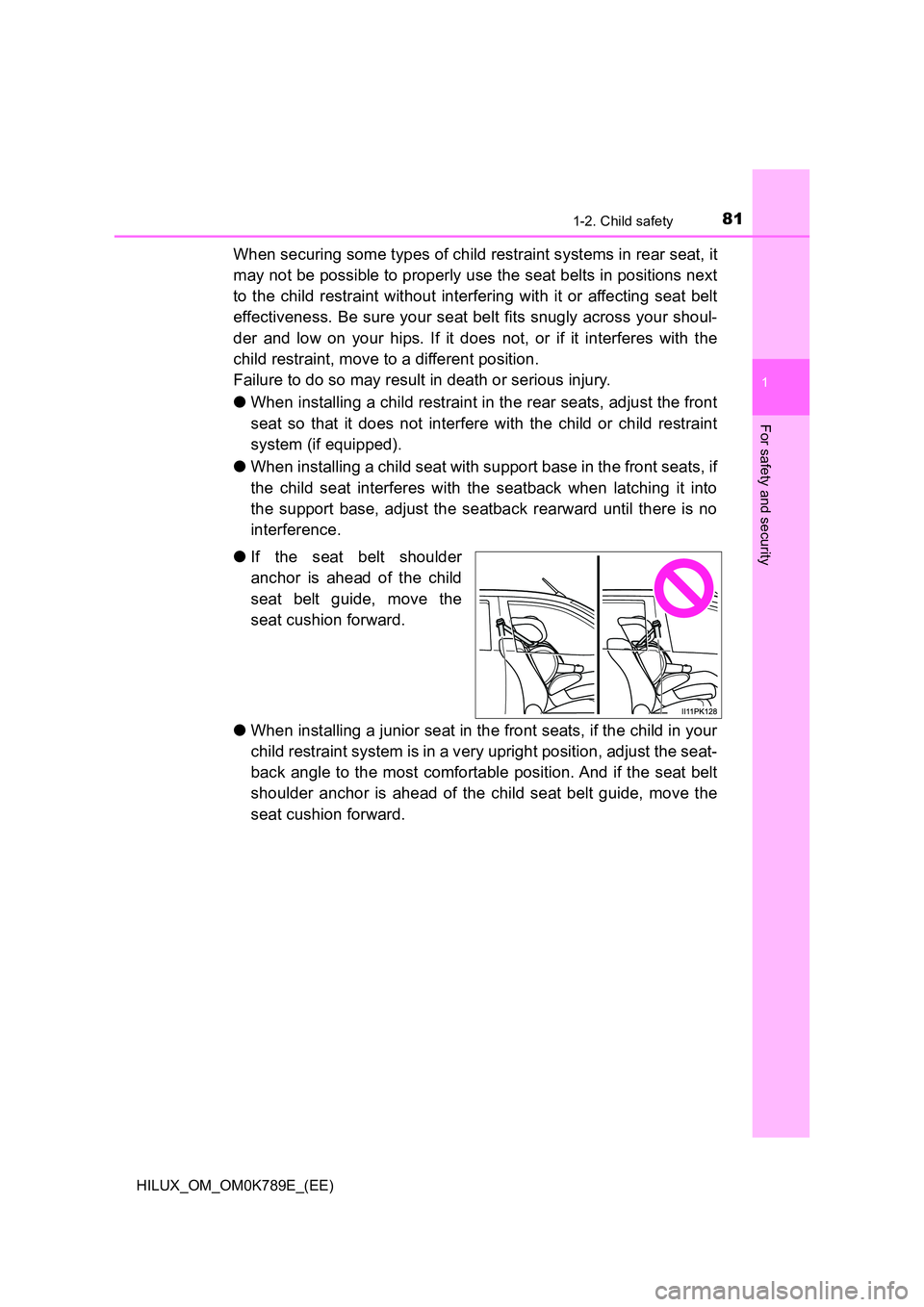
● If the seat belt shoulder
anchor is ahead of the child
seat belt guide, move the
seat cushion forward.
● When installing a junior seat in the front seats, if the child in your
child restraint system is in a very upright position, adjust the seat-
back angle to the most comfortable position. And if the seat belt
shoulder anchor is ahead of the child seat belt guide, move the
seat cushion forward.
Page 85 of 810
831-2. Child safety
1
HILUX_OM_OM0K789E_(EE)
For safety and security
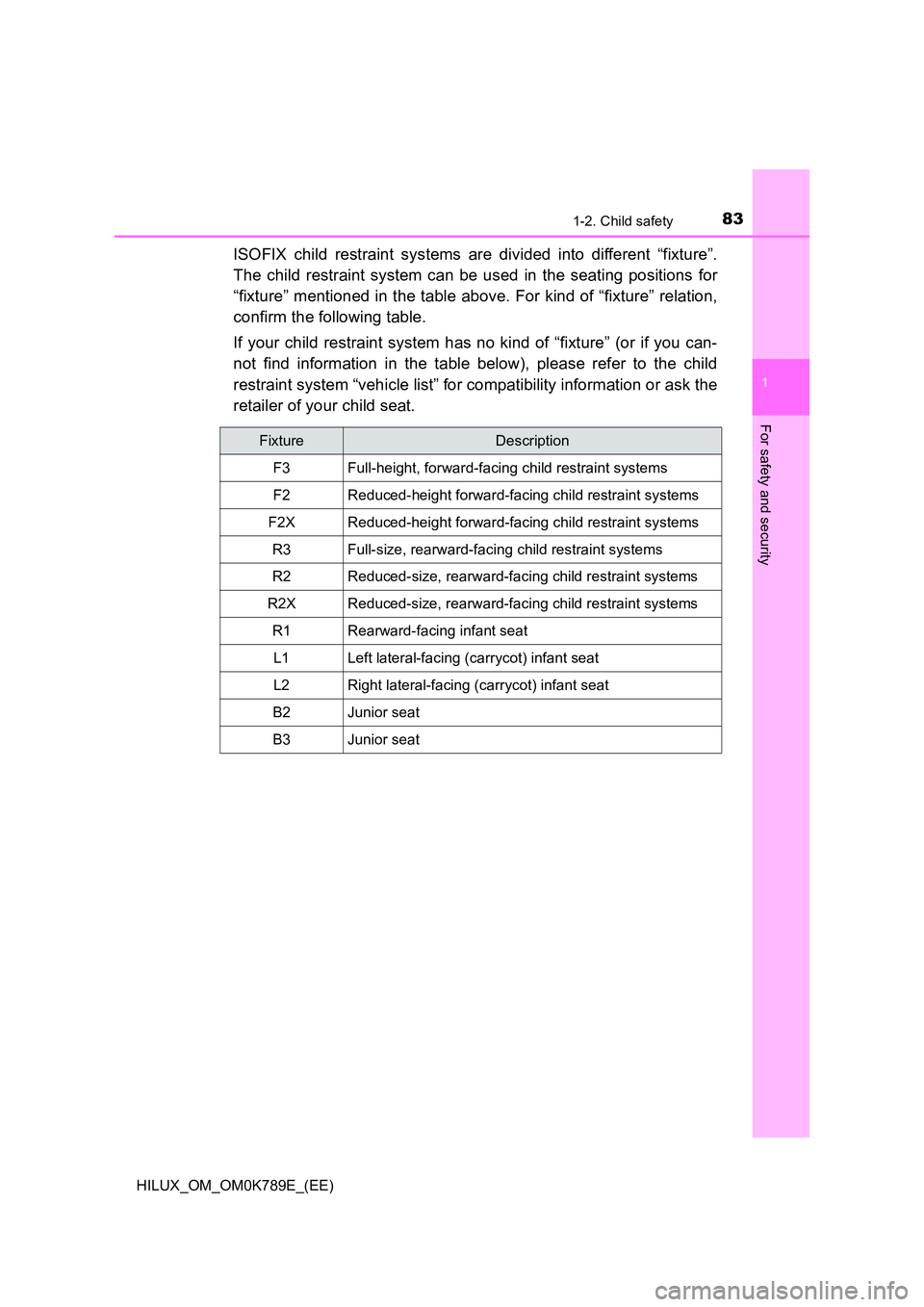
ISOFIX child restraint systems are divided into different “fixture”.
The child restraint system can be used in the seating positions for
“fixture” mentioned in the table above. For kind of “fixture” relation,
confirm the following table.
If your child restraint system has no kind of “fixture” (or if you can-
not find information in the table below), please refer to the child
restraint system “vehicle list” for compatibility information or ask the
retailer of your child seat.
FixtureDescription
F3 Full-height, forward-facing child restraint systems
F2 Reduced-height forward-facing child restraint systems
F2X Reduced-height forward-facing child restraint systems
R3 Full-size, rearward-facing child restraint systems
R2 Reduced-size, rearward-facing child restraint systems
R2X Reduced-size, rearward-facing child restraint systems
R1 Rearward-facing infant seat
L1 Left lateral-facing (carrycot) infant seat
L2 Right lateral-facing (carrycot) infant seat
B2 Junior seat
B3 Junior seat