brake TOYOTA HILUX 2023 Manual PDF
[x] Cancel search | Manufacturer: TOYOTA, Model Year: 2023, Model line: HILUX, Model: TOYOTA HILUX 2023Pages: 810, PDF Size: 131.54 MB
Page 361 of 810
3594-5. Using the driving support systems
4
Driving
HILUX_OM_OM0K789E_(EE)
■ Automatic reactivation of TRC, A-TRC, VSC and Trailer Sway Control
systems
After turning the TRC, A-TRC, VSC and Trailer Sway Control systems off, the
systems will be automatically re-enabled in the following situations:
● When the engine switch is turned to the “LOCK” position (vehicles without
smart entry & start system) or off (vehicles with smart entry & start system).
● If only the TRC/A-TRC system is turned off (P. 356), the TRC/A-TRC will
turn on when vehicle speed increases.
If the TRC, A-TRC, VSC and Trailer Sway Control systems are turned off
( P. 358), automatic re-enabling will not occur when vehicle speed
increases.
■ Operating conditions of the hill-start assist control
When the following four conditions are me t, the hill-start assist control will
operate:
● Vehicles with automatic transmission: The shift lever is in a position other
than P or N (when starting off forward/backward on an upward incline)
Vehicles with manual transmission: The shift lever is in a position other than
R when starting off forward on an upward incline, or the shift lever is in R
when starting off backward on an upward incline.
● The vehicle is stopped
● The accelerator pedal is not depressed
● The parking brake is not engaged
■ Automatic system cancelation of the hill-start assist control
The hill-start assist control will turn off in any of the following situations:
● Vehicles with automatic transmission: The shift lever is shifted to P or N
Vehicles with manual transmission: The shift lever is shifted to R when start-
ing off forward on an upward incline, or the shift lever is shifted to other than
R when starting off backward on an upward incline.
● The accelerator pedal is depressed
● The parking brake is engaged
● 2 seconds at maximum elapsed after the brake pedal is released
Page 362 of 810
3604-5. Using the driving support systems
HILUX_OM_OM0K789E_(EE)
■ Operating conditions of emergency brake signal
When the following conditions are met, the emergency brake signal will oper-
ate:
● The emergency flashers are off.
● Actual vehicle speed is over 55 km/h (35 mph).
● The system judges from the vehicle deceleration that it is a sudden braking
operation.
■ Automatic system cancelation of emergency brake signal
The emergency brake signal will be canceled in any of the following situa-
tions:
● The emergency flashers are turned on.
● The system judges from the vehicle deceleration that is not a sudden brak-
ing operation.
WARNING
■ The ABS does not operate effectively when
● The limits of tire gripping performance have been exceeded (such as
excessively worn tires on a snow covered road).
● The vehicle hydroplanes while driving at high speed on wet or slick roads.
■ Stopping distance when the ABS is operating may exceed that of nor-
mal conditions
The ABS is not designed to shorten the vehicle’s stopping distance. Always
maintain a safe distance from the vehicle in front of you, especially in the
following situations:
● When driving on dirt, gravel or snow-covered roads
● When driving with tire chains
● When driving over bumps in the road
● When driving over roads with potholes or uneven surfaces
Page 363 of 810
3614-5. Using the driving support systems
4
Driving
HILUX_OM_OM0K789E_(EE)
WARNING
■TRC/A-TRC/VSC may not operate effectively when
Directional control and power may not be achievable while driving on slip-
pery road surfaces, even if the TRC/A-TRC/VSC system is operating.
Drive the vehicle carefully in conditions where stability and power may be
lost.
■ Hill-start assist control does not operate effectively when
● Do not overly rely on the hill-start assist control. The hill-start assist control
may not operate effectively on steep inclines and roads covered with ice.
● Unlike the parking brake, the hill-start assist control is not intended to hold
the vehicle stationary for an extended period of time. Do not attempt to use
the hill-start assist control to hold the vehicle on an incline, as doing so
may lead to an accident.
■ When the TRC/VSC/Trailer Sway Control is activated
The slip indicator flashes. Always drive carefully.
Reckless driving may cause an accident. Exercise particular care when the
indicator flashes.
■ When the TRC/A-TRC/VSC/Trailer Sway Control systems are turned off
Be especially careful and drive at a speed appropriate to the road condi-
tions. As these are the systems to help ensure vehicle stability and driving
force, do not turn the TRC/A-TRC/VSC/Trailer Sway Control systems off
unless necessary.
■ Replacing tires
Make sure that all tires are of the specified size, brand, tread pattern and
total load capacity. In addition, make sure that the tires are inflated to the
recommended tire inflation pressure level.
The ABS, TRC, A-TRC, VSC, Trailer Sway Control, hill-start assist control
and downhill assist control systems will not function correctly if different tires
are installed on the vehicle.
Contact any authorized Toyota retailer or Toyota authorized repairer, or any
reliable repairer for further information when replacing tires or wheels.
■ Handling of tires and the suspension
Using tires with any kind of problem or modifying the suspension will affect
the driving assist systems, and may cause a system to malfunction.
Page 364 of 810
3624-5. Using the driving support systems
HILUX_OM_OM0K789E_(EE)
WARNING
■Trailer Sway Control precaution
The Trailer Sway Control system is not able to reduce trailer sway in all situ-
ations. Depending on many factors such as the conditions of the vehicle,
trailer, road surface, and driving envi ronment, the Trailer Sway Control sys-
tem may not be effective. Refer to your trailer owner’s manual for informa-
tion on how to tow your trailer properly.
■ If trailer sway occurs (vehicles with Trailer Sway Control)
Observe the following precautions.
Failing to do so may cause death or serious injury.
● Firmly grip the steering wheel. Steer straight ahead.
Do not try to control trailer sway by turning the steering wheel.
● Begin releasing the accelerator pedal immediately but very gradually to
reduce speed.
Do not increase speed. Do not apply vehicle brakes.
If you make no extreme correction with the steering or brakes, your vehicle
and trailer should stabilize. ( P. 214)
Page 366 of 810
3644-5. Using the driving support systems
HILUX_OM_OM0K789E_(EE)
■Operating tips (vehicles with automatic transmission)
The system will operate when the shift lever is in a position other than P, how-
ever to make effective use of the system it is recommended to select a lower
shift range.
■ The system will not operate when
● The transfer mode is in H2.
● The rear differential is locked. (if equipped)
■ If the downhill assist control system indicator flashes
● In the following situations, the indicator flashes and the system will not oper-
ate:
• The transfer mode is not in L4 or H4.
• The rear differential is locked. (if equipped)
• The shift lever is in P. (vehicles with automatic transmission)
• The accelerator or brake pedal is depressed.
• The vehicle speed exceeds approximately 30 km/h (18 mph).
• The brake system overheats.
● In the following situations, the indicator flashes to alert the driver, but the
system will operate:
• The shift lever is in N. (vehicles with automatic transmission)
• The clutch pedal is depressed. (vehicles with manual transmission)
• The “DAC” switch is turned off while the system is operating.
The system will gradually ceases operat ion. The indicator will flash during
operation, and then go off when the system is fully off.
■ When the downhill assist control system is operated continuously
This may cause the brake actuator to overheat. In this case, the downhill
assist control system will stop operating, a buzzer will sound and the downhill
assist control system indicator will start flashing, and “TRC turned off” will be
shown on the multi-information display. Refrain from using the system until
the downhill assist control system indicator stays on and the message goes
off. (The vehicle can be driven normally during this time.)
■ Sounds and vibrations caused by the downhill assist control system
● A sound may be heard from the engine compartment when the engine is
started or just after the vehicle begins to move. This sound does not indicate
that a malfunction has occurred in downhill assist control system.
● Either of the following conditions may occur when the downhill assist control
system is operating. None of these are indicators that a malfunction has
occurred.
• Vibrations may be felt through the vehicle body and steering.
• A motor sound may be heard after the vehicle comes to a stop.
Page 367 of 810
3654-5. Using the driving support systems
4
Driving
HILUX_OM_OM0K789E_(EE)
■ System malfunction
In the following cases, have your vehicle checked by any authorized Toyota
retailer or Toyota authorized repairer, or any reliable repairer.
● The downhill assist control system indicator does not come on when the
engine switch is turned to the “ON” position (vehicles without smart entry &
start system) or IGNITION ON mode (vehicles with smart entry & start sys-
tem).
● The downhill assist control system indicator does not come on when the
“DAC” switch is pressed.
● The slip indicator comes on.
WARNING
■When using downhill assist control system
● Do not rely overmuch on the downhill assist control system. This function
does not extend the vehicle’s performance limitations. Always thoroughly
check the road conditions, and drive safely.
● Vehicles with manual transmission: Drive in a low gear. Driving in a high
gear when using downhill assist control system may cause the engine to
stall, which may lose the brake effectiveness and lock the tires, resulting in
an accident.
● Vehicles with manual transmission: On a steep slope, use the engine brak-
ing efficiently. If the vehicle is driven in N or with the clutch pedal
depressed on a steep slope, the load on the brake increases and con-
trolling the vehicle speed may be impossible, resulting in an accident.
■ The system may not operate on the following surfaces, which may lead
to an accident causing death or serious injury
● Slippery surfaces such as wet or muddy roads
● Icy surface
● Unpaved roads
Page 369 of 810
3674-5. Using the driving support systems
4
Driving
HILUX_OM_OM0K789E_(EE)
■If the engine is turned off and restarted
The AUTO LSD system and the indicators are automatically turned off.
■ Reactivation of the VSC system linked to vehicle speed
When the AUTO LSD system is turned on, the VSC and TRC systems will
turn on automatically if vehicle speed increase.
■ If the brake system overheats
The system will cease operation and a buzzer will alert the driver. At this time,
the “AUTO LSD” indicator will flash and “TRC turned off” will be shown on the
multi-information display. Stop the vehicle in a safe place. (There is no prob-
lem with continuing normal driving.) The system will be automatically restored
after a short time.
WARNING
■ To avoid an accident
Failure to do so, a much greater steer ing effort and more careful cornering
control will be required.
● Do not use the AUTO LSD system in conditions other than when one of
the drive wheels spinning occurs in a ditch or rough surface.
● Do not drive with the AUTO LSD system continuously turned on.
NOTICE
■Activating while driving
Do not activate the AUTO LSD system if the wheel is slipping. Stop the slip-
ping or spinning before activating.
Page 373 of 810
3714-5. Using the driving support systems
4
Driving
HILUX_OM_OM0K789E_(EE)
When regenerating the filter by pressing the DPF system switch
Stop the vehicle in a safe place.
Shift the shift lever to P (automatic transmission) or N (manual
transmission), and firmly set the parking brake.
Do not stop the engine.
Also, make sure that there are no flammable materials near the exhaust
pipe. ( P. 368)
Check the engine is warmed up. If the engine is cold, warm up the engine
by depressing the accelerator pedal.*1
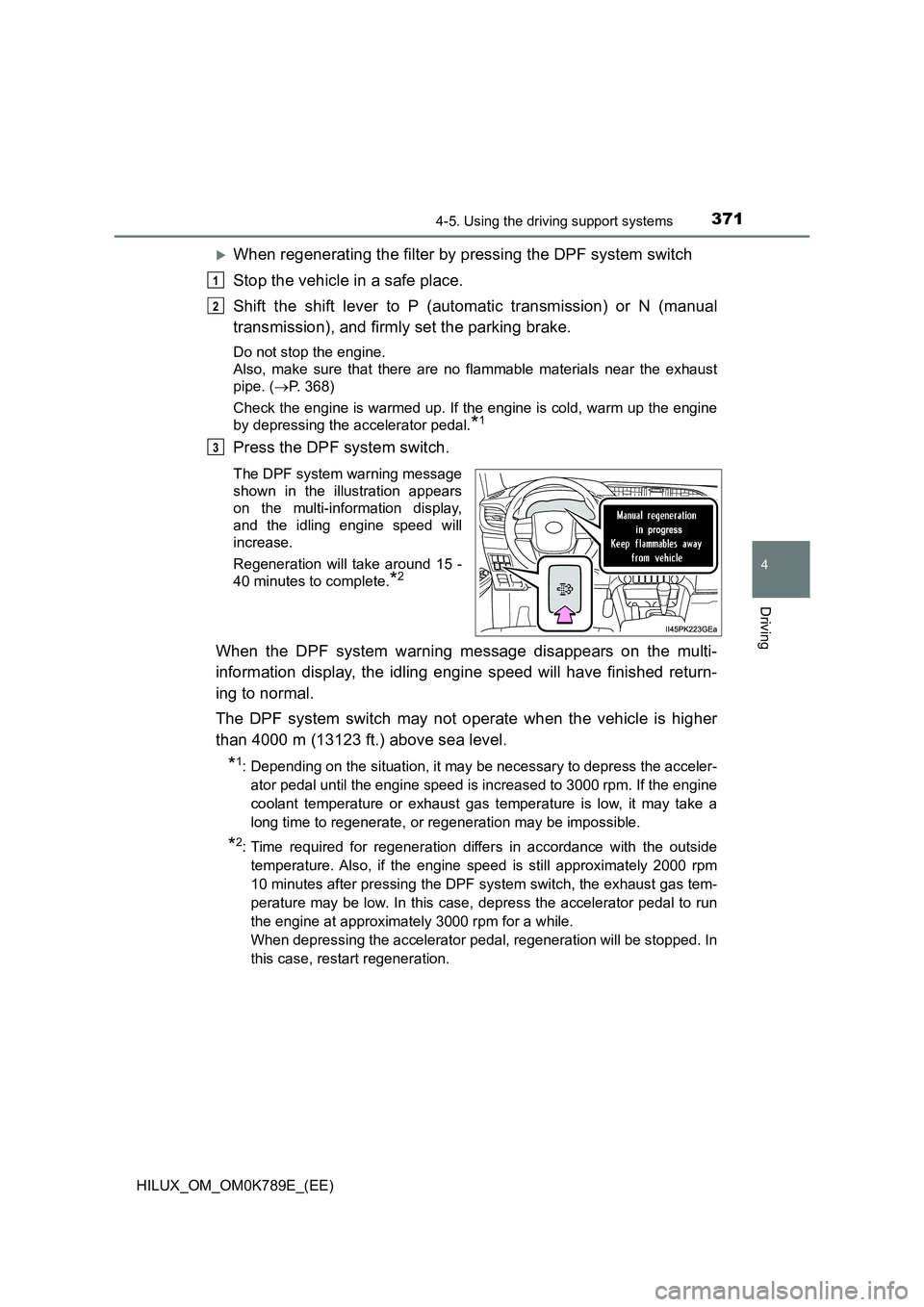
Press the DPF system switch.
The DPF system warning message
shown in the illustration appears
on the multi-information display,
and the idling engine speed will
increase.
Regeneration will take around 15 -
40 minutes to complete.*2
When the DPF system warning message disappears on the multi-
information display, the idling engine speed will have finished return-
ing to normal.
The DPF system switch may not operate when the vehicle is higher
than 4000 m (13123 ft.) above sea level.
*1: Depending on the situation, it may be necessary to depress the acceler-
ator pedal until the engine speed is increased to 3000 rpm. If the engine
coolant temperature or exhaust gas temperature is low, it may take a
long time to regenerate, or regeneration may be impossible.
*2: Time required for regeneration differs in accordance with the outside
temperature. Also, if the engine speed is still approximately 2000 rpm
10 minutes after pressing the DPF system switch, the exhaust gas tem-
perature may be low. In this case, depress the accelerator pedal to run
the engine at approximately 3000 rpm for a while.
When depressing the accelerator pedal, regeneration will be stopped. In
this case, restart regeneration.
1
2
3
Page 375 of 810
373
4
4-6. Driving tips
Driving
HILUX_OM_OM0K789E_(EE)
Winter driving tips
●Use fluids that are appropriate to the prevailing outside tempera-
tures.
• Engine oil
• Engine coolant
• Washer fluid
● Have a service technician inspect the condition of the battery.
● Have the vehicle fitted with four snow tires or purchase a set of tire
chains for the rear tires.
Ensure that all tires are the same size and brand, and that chains match
the size of the tires.
Perform the following according to the driving conditions:
● Do not try to forcibly open a window or move a wiper that is frozen.
Pour warm water over the frozen area to melt the ice. Wipe away
the water immediately to prevent it from freezing.
● To ensure proper operation of the climate control system fan,
remove any snow that has accumulated on the air inlet vents in
front of the windshield.
● Check for and remove any excess ice or snow that may have accu-
mulated on the exterior lights, vehicle’s roof, chassis, around the
tires or on the brakes.
● Remove any snow or mud from the bottom of your shoes before
getting in the vehicle.
Carry out the necessary preparations and inspections before
driving the vehicle in winter. Always drive the vehicle in a man-
ner appropriate to the prevailing weather conditions.
Preparation for winter
Before driving the vehicle
Page 376 of 810
3744-6. Driving tips
HILUX_OM_OM0K789E_(EE)
Accelerate the vehicle slowly, keep a safe distance between you and
the vehicle ahead, and drive at a reduced speed suitable to road con-
ditions.
● Park the vehicle and move the shift lever to P (automatic transmis-
sion) or 1 or R (manual transmission) without setting the parking
brake. The parking brake may freeze up, preventing it from being
released. If the vehicle is parked without setting the parking brake,
make sure to block the wheels.
Failure to do so may be dangerous because it may cause the vehi-
cle to move unexpectedly, possibly leading to an accident.
● Vehicles with automatic transmission: If the vehicle is parked with-
out setting the parking brake, confirm that the shift lever cannot be
moved out of P*.
*: The shift lever will be locked if it is attempted to be shifted from P to any
other position without depressing the brake pedal. If the shift lever can be
shifted from P, there may be a problem with the shift lock system. Have the
vehicle inspected by any authorized Toyota retailer or Toyota authorized
repairer, or any reliable repairer.
Use the correct tire chain size when mounting the snow chains.
Chain size is regulated for each tire size.
Regulations regarding the use of tire chains vary depending on loca-
tion and type of road. Always check local regulations before installing
chains.
When driving the vehicle
When parking the vehicle (in the winter time or in the cold lati-
tudes)
Selecting tire chains
Regulations on the use of tire chains