ECU TOYOTA iQ EV 2013 (in English) User Guide
[x] Cancel search | Manufacturer: TOYOTA, Model Year: 2013, Model line: iQ EV, Model: TOYOTA iQ EV 2013Pages: 444, PDF Size: 7.34 MB
Page 33 of 444

331-1. For safe use
1
For safety and security
◆SRS front airbags
SRS driver airbag/front passenger airbag
Can help protect the head and chest of the driver and front passen-
ger from impact with interior components.
SRS knee airbags
Can help provide driver and front passenger protection.
SRS seat cushion airbags
Can help restrain the driver and front passenger.
◆SRS side and curtain shield airbags
SRS side airbags
Can help protect the torso of the front seat occupants.
SRS curtain shield airbags
Can help protect primarily the head of occupants.
◆Other SRS airbag
SRS rear window curtain shield airbag
Can help protect primarily the head of rear occupants.
1
2
3
4
5
6
Page 34 of 444
341-1. For safe use
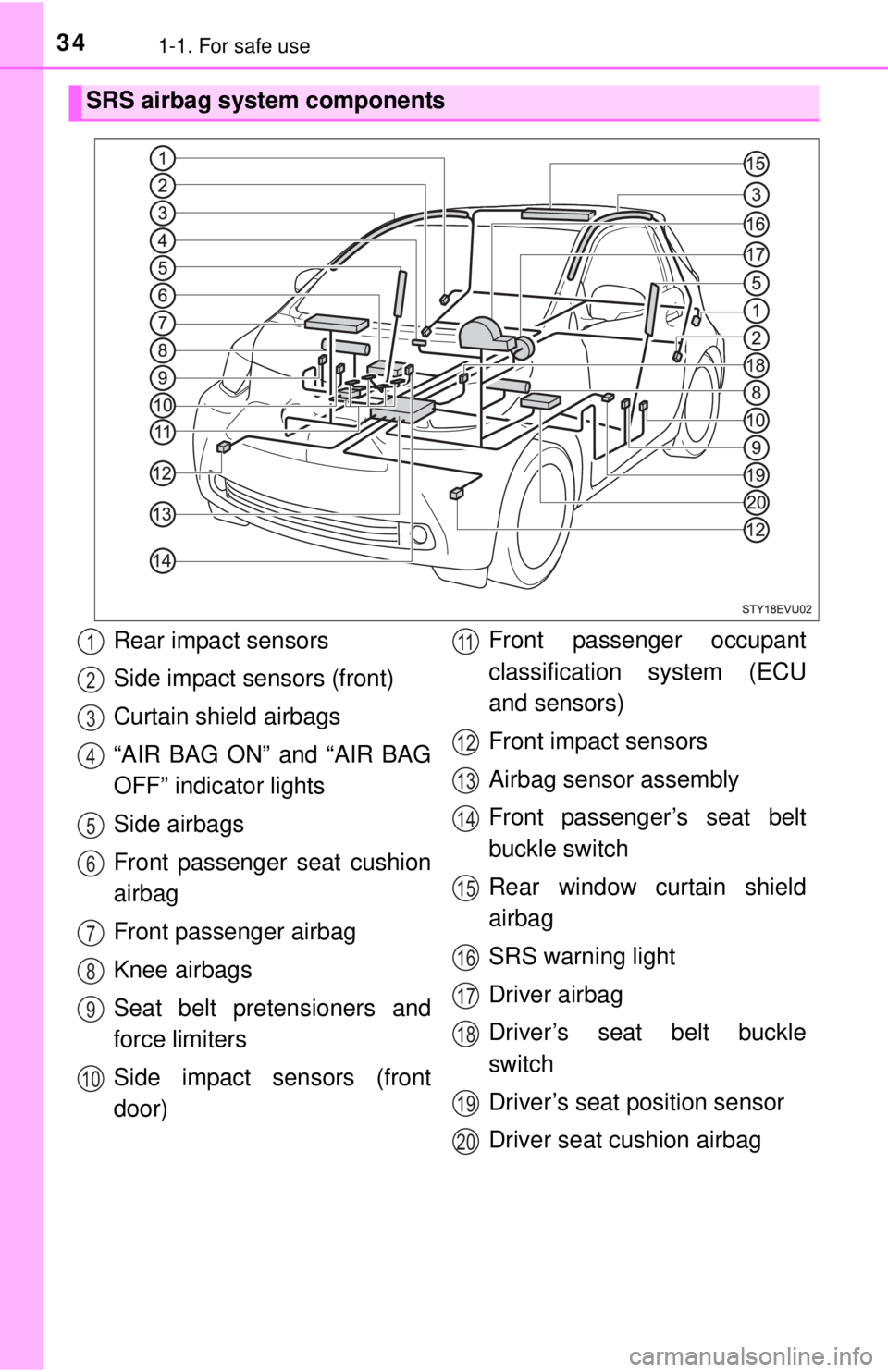
SRS airbag system components
Rear impact sensors
Side impact sensors (front)
Curtain shield airbags
“AIR BAG ON” and “AIR BAG
OFF” indicator lights
Side airbags
Front passenger seat cushion
airbag
Front passenger airbag
Knee airbags
Seat belt pretensioners and
force limiters
Side impact sensors (front
door)Front passenger occupant
classification system (ECU
and sensors)
Front impact sensors
Airbag sensor assembly
Front passenger’s seat belt
buckle switch
Rear window curtain shield
airbag
SRS warning light
Driver airbag
Driver’s seat belt buckle
switch
Driver’s seat position sensor
Driver seat cushion airbag1
2
3
4
5
6
7
8
9
10
11
12
13
14
15
16
17
18
19
20
Page 35 of 444
351-1. For safe use
1
For safety and security
Your vehicle is equipped with ADVANCED AIRBAGS designed based
on the US motor vehicle safety standards (FMVSS208). The airbag
sensor assembly (ECU) controls airbag deployment based on infor-
mation obtained from the sensors et c. shown in the system compo-
nents diagram above. This informat ion includes crash severity and
occupant information. As the airbags deploy, a chemical reaction in
the inflators quickly fills the airbag s with non-toxic gas to help restrain
the motion of the occupants.
CAUTION
■ SRS airbag precautions
Observe the following precautions regarding the SRS airbags.
Failure to do so may cause death or serious injury.
● The driver and all passengers in the vehicle must wear their seat belts
properly.
The SRS airbags are supplemental devices to be used with the seat belts.
● The SRS driver airbag deploys with considerable force, and can cause
death or serious injury especially if the driver is very close to the airbag.
The National Highway Traffic Safety Administration (NHTSA) advises:
Since the risk zone for the driver’s airbag is the first 2 - 3 in. (50 - 75 mm)
of inflation, placing yourself 10 in. (250 mm) from your driver airbag pro-
vides you with a clear margin of safety. This distance is measured from
the center of the steering wheel to your breastbone. If you sit less than 10
in. (250 mm) away now, you can change your driving position in several
ways:
• Move your seat to the rear as far as you can while still reaching the ped- als comfortably.
• Slightly recline the back of the seat. Although vehicle designs vary, many drivers can achieve the 10 in. (250
mm) distance, even with the driver seat all the way forward, simply by
reclining the back of the seat somewhat. If reclining the back of your
seat makes it hard to see the road, raise yourself by using a firm, non-
slippery cushion, or raise the seat if your vehicle has that feature.
• If your steering wheel is adjustable, tilt it downward. This points the air- bag toward your chest instead of your head and neck.
The seat should be adjusted as recommended by NHTSA above, while
still maintaining control of the foot pedals, steering wheel, and your view
of the instrument panel controls.
Page 36 of 444

361-1. For safe use
CAUTION
■SRS airbag precautions
● The SRS front passenger airbag also deploys with considerable force, and
can cause death or serious injury especially if the front passenger is very
close to the airbag. The front passenger seat should be as far from the air-
bag as possible with the seatback adjusted, so the front passenger sits
upright.
● Improperly seated and/or restrained infants and children can be killed or
seriously injured by a deploying airbag. An infant or child who is too small
to use a seat belt should be properly secured using a child restraint sys-
tem. Scion strongly recommends that all infants and children be placed in
the rear seats of the vehicle and proper ly restrained. The rear seats are
safer for infants and children than the front passenger seat. (P. 52)
● If the seat belt extender has been con-
nected to the front seat belt buckle but
the seat belt extender has not also been
fastened to the latch plate of the seat
belt, the SRS front airbags will judge
that the driver and front passenger are
wearing the seat belt even though the
seat belt has not been connected. In
this case, the SRS front airbags may
not activate correctly in a collision,
resulting in death or serious injury in the
event of a collision. Be sure to wear the
seat belt with the seat belt extender.
●Do not sit on the edge of the seat or
lean against the dashboard.
Page 37 of 444

371-1. For safe use
1
For safety and security
CAUTION
■SRS airbag precautions
● Do not allow a child to stand in front of
the SRS front passenger airbag unit or
sit on the knees of a front passenger.
● Do not allow the front seat occupants to
hold items on their knees.
● Do not lean against the door, the roof
side rail or the front, side and rear pil-
lars.
● Do not allow anyone to kneel on the
passenger seat toward the door or put
their head or hands outside the vehicle.
● Do not allow anyone to kneel on the
rear seat toward the back door.
● Do not attach anything to or lean any-
thing against areas such as the dash-
board, steering wheel pad and lower
portion of the instrument panel.
These items can become projectiles
when the SRS driver, front passenger
and knee airbags deploy.
Page 39 of 444

391-1. For safe use
1
For safety and security
■If the SRS airbags deploy (inflate)
●Bruising and slight abrasions may result from contact with a deploying
(inflating) SRS airbag.
● A loud noise and white powder will be emitted.
● Parts of the airbag module (steering wheel hub, airbag cover and inflator) as
well as the front seats, parts of the front and rear pillars, roof side rails and
rear roof headlining, may be hot for several minutes. The airbag itself may
also be hot.
● The windshield may crack.
CAUTION
■Modification and disposal of SRS airbag system components
Do not dispose of your vehicle or per form any of the following modifications
without consulting your Scion dealer. The SRS airbags may malfunction or
deploy (inflate) accidentally, causing death or serious injury.
● Installation, removal, disassembly and repair of the SRS airbags
● Repairs, modifications, removal or replacement of the steering wheel,
instrument panel, dashboard, seats or seat upholstery, front, side and rear
pillars, roof side rails or roof headlining
● Repairs or modifications of the front fender, front and rear bumper, or side
or rear of the occupant compartment
● Installation of snow plows, winches, etc. to the front grille (bull bars or kan-
garoo bar etc.)
● Installation of racks etc. to the back door (strap racks, bicycle rack etc.)
● Modifications to the vehicle’s suspension system
● Installation of electronic devices such as mobile two-way radios and CD
players
● Modifications to your vehicle for a person with a physical disability
Page 41 of 444

411-1. For safe use
1
For safety and security
■Conditions under which the SRS airbags may deploy (inflate), other than
a collision
The SRS front airbags and SRS curtain shield airbags may also deploy if a
serious impact occurs to the underside of your vehicle. Some examples are
shown in the illustration.
The SRS rear window curtain shield airbag may also deploy if a serious
impact occurs to the underside of your vehicle. Some examples are shown in
the illustration.
■ Types of collisions that may not depl oy the SRS airbags (SRS front air-
bags)
The SRS front airbags do not generally inflate if the vehicle is involved in a
side or rear collision, if it rolls over, or if it is involved in a low-speed frontal
collision. But, whenever a collision of any type causes sufficient forward
deceleration of the vehicle, deployment of the SRS front airbags may occur. ● Hitting a curb, edge of pavement or hard
surface
● Falling into or jumping over a deep hole
● Landing hard or falling
● Hitting a curb, edge of pavement or hard
surface
● Falling into or jumping over a deep hole
● Landing hard or vehicle falling
● Collision from the side
● Collision from the rear
● Vehicle rollover
Page 43 of 444

431-1. For safe use
1
For safety and security
■Types of collisions that may not depl oy the SRS airbag (SRS rear win-
dow curtain shield airbag)
The SRS rear window curtain shield airbag is generally not designed to inflate
if the vehicle is involved in a front collision, if it rolls over, or if it is involved in a
low-speed rear or low-speed side collision.
■ When to contact your Scion dealer
In the following cases, the vehicle will require inspection and/or repair. Con-
tact your Scion dealer as soon as possible.
●Any of the SRS airbags have been inflated.
●
Collision from the front
● Vehicle rollover
● The front of the vehicle is damaged or
deformed, or was involved in an acci-
dent that was not severe enough to
cause the SRS front airbags to inflate.
● A portion of a door or surroundings
areas is damaged or deformed, or the
vehicle was involved in an accident that
was not severe enough to cause the
SRS side and curtain shield airbags to
inflate.
● The rear of the vehicle is damaged or
deformed, or the vehicle was involved in
an accident that was not severe enough
to cause the SRS rear window curtain
shield airbag to inflate.
Page 45 of 444

451-1. For safe use
1
For safety and security
Front passenger occupant classification
system
Your vehicle is equipped with a front passenger occupant classi-
fication system. This system detects the conditions of the front
passenger seat and activates or deactivates the devices for the
front passenger.
SRS warning light
“AIR BAG OFF” indicator light
“AIR BAG ON” indicator light
Front passenger’s seat belt reminder light1
2
3
4
Page 47 of 444

471-1. For safe use
1
For safety and security
■Child*4 or child restraint system*5
■Unoccupied
Indicator/
warning light
“AIR BAG ON” and “AIR BAG OFF”
indicator lights“AIR BAG OFF”
*6
SRS warning lightOff
Front passenger’s seat belt reminder light
Off*2
or
Flashing
*3
Devices
Front passenger airbagDeactivated
Side airbag
on the front passenger seat
ActivatedCurtain shield airbag
in the front passenger side
Front passenger knee airbag
DeactivatedSeat cushion airbag
in the front passenger side
Front passenger’s seat belt pretensionerActivated
Indicator/
warning light
“AIR BAG ON” and “AIR BAG OFF” indicator lightsNot illuminated
SRS warning light
Off
Front passenger’s seat belt reminder light
Devices
Front passenger airbagDeactivated
Side airbag
on the front passenger seat
ActivatedCurtain shield airbag
in the front passenger side
Front passenger knee airbag
DeactivatedSeat cushion airbag
in the front passenger side
Front passenger’s seat belt pretensioner