fuel TOYOTA iQ EV 2013 Owners Manual (in English)
[x] Cancel search | Manufacturer: TOYOTA, Model Year: 2013, Model line: iQ EV, Model: TOYOTA iQ EV 2013Pages: 444, PDF Size: 7.34 MB
Page 72 of 444
722-1. Electric vehicle
Characteristics of the EV (Electric Vehicle)
system
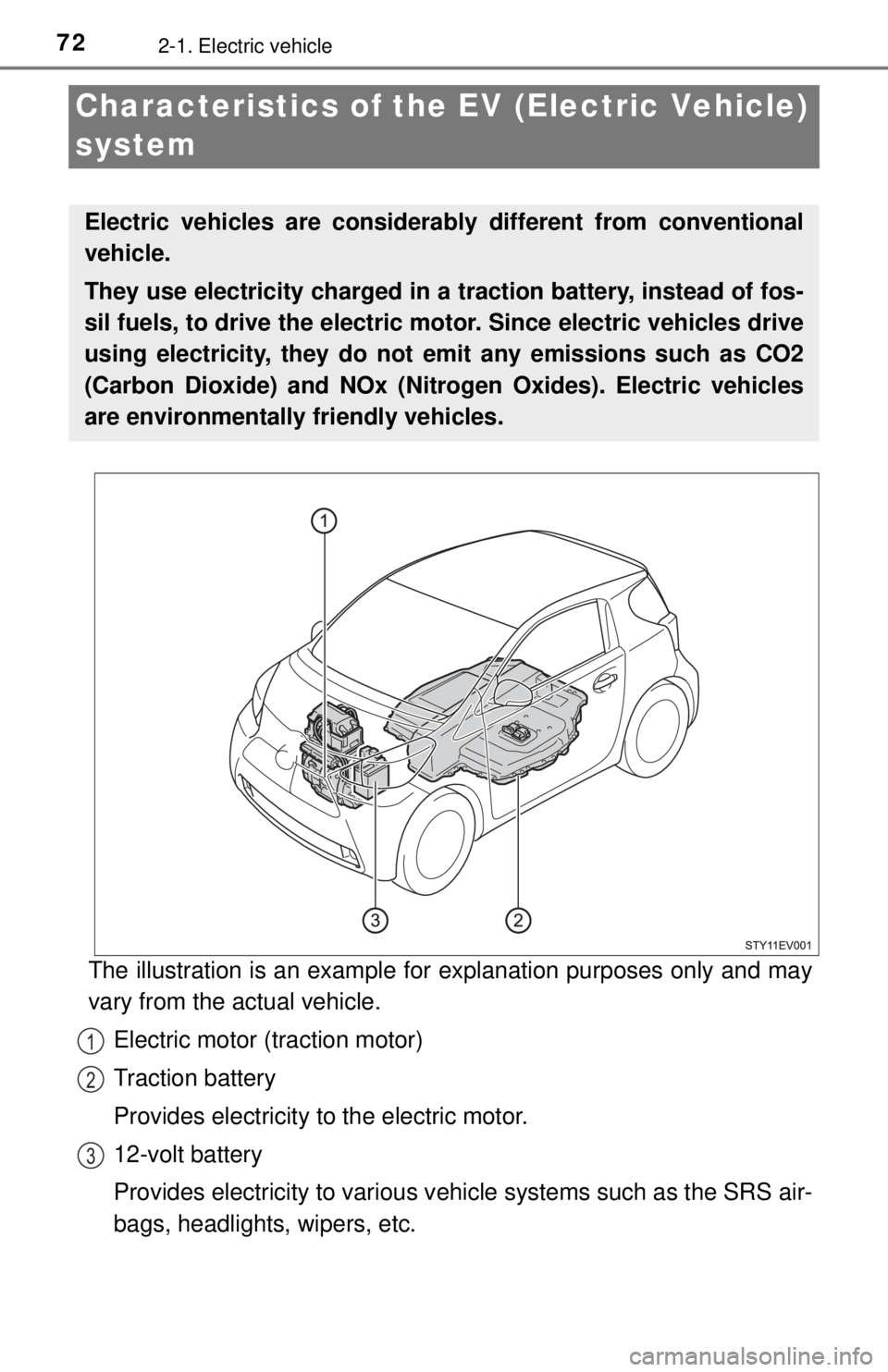
The illustration is an example for explanation purposes only and may
vary from the actual vehicle.Electric motor (traction motor)
Traction battery
Provides electricity to the electric motor.
12-volt battery
Provides electricity to various v ehicle systems such as the SRS air-
bags, headlights, wipers, etc.
Electric vehicles are considerab ly different from conventional
vehicle.
They use electricity charged in a traction battery, instead of fos-
sil fuels, to drive the electric motor. Since electric vehicles drive
using electricity, they do not emit any emissions such as CO2
(Carbon Dioxide) and NOx (Nitroge n Oxides). Electric vehicles
are environmentally friendly vehicles.
1
2
3
Page 73 of 444

732-1. Electric vehicle
2
EV system
◆When braking (regenerative braking)
The electric motor (traction motor) charges the traction battery.
The driving range can be extended by actively using this regenera-
tive braking to store electricity in the traction battery.
◆Charging
The electric vehicle is driven using electricity, received from an
external power source, that is stored in the traction battery. Not only
public charging stations, but also household electrical outlets can
be used for charging. Procedures are different from refueling a con-
ventional vehicle. Theref ore, make sure to read the following thor-
oughly.
● Charging equipment ( P. 84)
● Power sources that can be used ( P. 88)
● How to charge your vehicle ( P. 181, 195)
● If charging cannot be done ( P. 377)
● Inspecting the charging cable ( P. 262)
Page 95 of 444
952-3. Driving the EV (Electric Vehicle)
2
EV system
■Use of EV System Indicator
Keeping the EV System Indicator within Eco area or Charge area
can help minimize consumption of the traction battery, allowing the
vehicle to drive in an Eco-friendly manner. ( P. 107)
■When braking the vehicle
Make sure to operate the brakes gently and in good time. A greater
amount of electrical energy can be retained when slowing down.
■Highway driving
● The 3 different possible driving ranges, displayed by the multi-
information display, are calculation results estimated by 3 differ-
ent calculation methods ( P. 109). For driving in comfort, it will
be very helpful to check the possible driving range for highways
before entering highways.
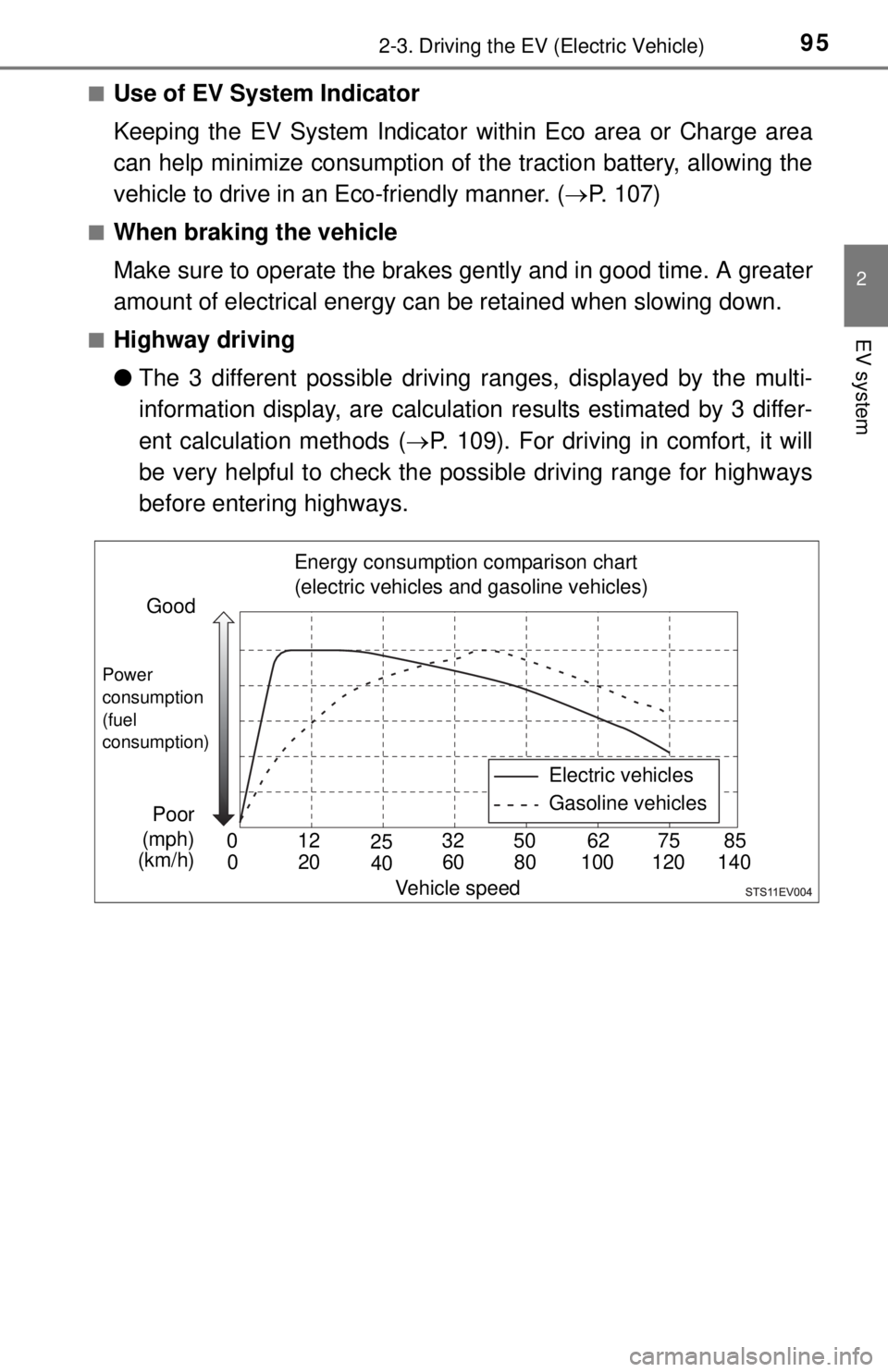
Energy consumption comparison chart
(electric vehicles and gasoline vehicles)
Good
Power
consumption
(fuel
consumption)
Poor Electric vehicles
Gasoline vehicles
020 4060 80 100 120 140
Vehicle speed
012
2532 50 62 75 85
(mph)
(km/h)
Page 96 of 444

962-3. Driving the EV (Electric Vehicle)
The chart shown above is for explaining the energy consumption differ-
ence between electric vehicles and gasoline engine vehicles.
Gasoline engine vehicles achieve the best fuel efficiency while they are
driven at a speed of approximately 43 mph (70 km/h). However, electric
vehicles obtain the best energy efficiency while being driven at speeds
between approximately 12 to 25 mph (20 to 40 km/h).
For electric vehicles, the faster the speed, the more power is consumed,
and the driving range decreases. If driven at a speed of approximately
62 mph (100 km/h), compared to approximately 25 mph (40 km/h), the
vehicle’s energy efficiency drops by approximately 40%. For instance,
an electric vehicle can achieve a driving range of approximately 62
miles (100 km) with a constant vehicle speed of 25 mph (40 km/h), how-
ever, driving at 62 mph (100 km/h) will reduce such a driving range to
approximately 32 miles (60 km).
● Control your speed and keep at a constant speed. Also, before
stopping at a toll booth or similar, allow plenty of time to release
the accelerator and gently apply the brakes. A greater amount of
electrical energy can be retained when slowing down.
Page 342 of 444

3428-2. Steps to take in an emergency
CAUTION
■Maintenance of the tires
Each tire, including the spare (if provided), should be checked monthly
when cold and inflated to the inflation pressure recommended by the
vehicle manufacturer on the vehicle placard or tire inflation pressure
label (tire and load information label). (If your vehicle has tires of a dif-
ferent size than the size indicated on the vehicle placard or tire inflation
pressure label [tire and load information label], you should determine
the proper tire inflation pressure for those tires.)
As an added safety feature, your vehicle has been equipped with a tire
pressure monitoring system (TPMS-ti re pressure warning system) that
illuminates a low tire pre ssure telltale (tire pressure warning light) when
one or more of your tires is significantly under-inflated. Accordingly,
when the low tire pressure telltale (tire pressure warning light) illumi-
nates, you should stop and check your tires as soon as possible, and
inflate them to the proper pressure. Driving on a significantly under-
inflated tire causes the tire to overheat and can lead to tire failure.
Under-inflation also reduces fuel effici ency (for electric vehicles, traction
battery efficiency) and tire tread lif e, and may affect the vehicle’s han-
dling and stopping ability.
Please note that the TPMS (tire pres sure warning system) is not a sub-
stitute for proper ti re maintenance, and it is the driver’s responsibility to
maintain correct tire pressure, even if under-inflation has not reached
the level to trigger illumina tion of the TPMS low tire pressure telltale (tire
pressure warning light).
Your vehicle has also been equipped with a TPMS (tire pressure warn-
ing system) malfunction indicator to indicate when the system is not
operating properly. The TPMS (tire pressure warning system) malfunc-
tion indicator is combined with the lo w tire pressure telltale (tire pressure
warning light). When the system dete cts a malfunction, the telltale will
flash for approximately one minute and then remain continuously illumi-
nated. This sequence will continue up on subsequent vehicle start-ups
as long as the malfunction exists. When the malfunction indicator is illu-
minated, the system may not be able to detect or signal low tire pres-
sure as intended.
Page 408 of 444
4089-1. Specifications
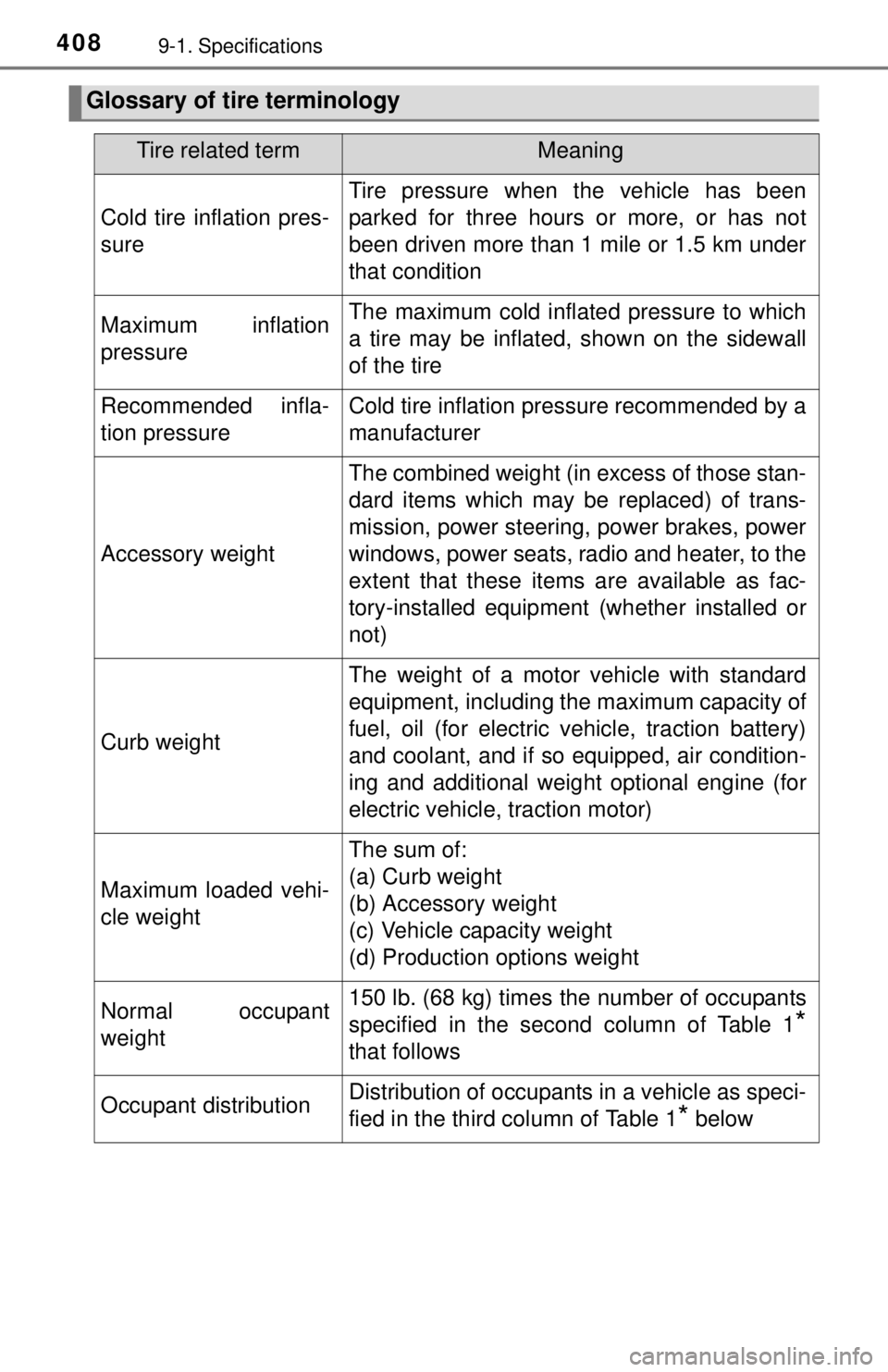
Glossary of tire terminology
Tire related termMeaning
Cold tire inflation pres-
sure
Tire pressure when the vehicle has been
parked for three hours or more, or has not
been driven more than 1 mile or 1.5 km under
that condition
Maximum inflation
pressureThe maximum cold inflated pressure to which
a tire may be inflated, shown on the sidewall
of the tire
Recommended infla-
tion pressureCold tire inflation pressure recommended by a
manufacturer
Accessory weight
The combined weight (in excess of those stan-
dard items which may be replaced) of trans-
mission, power steering, power brakes, power
windows, power seats, radio and heater, to the
extent that these item s are available as fac-
tory-installed equipment (whether installed or
not)
Curb weight
The weight of a motor vehicle with standard
equipment, including the maximum capacity of
fuel, oil (for electric vehicle, traction battery)
and coolant, and if so equipped, air condition-
ing and additional weight optional engine (for
electric vehicle, traction motor)
Maximum loaded vehi-
cle weight
The sum of:
(a) Curb weight
(b) Accessory weight
(c) Vehicle capacity weight
(d) Production options weight
Normal occupant
weight150 lb. (68 kg) times the number of occupants
specified in the second column of Table 1
*
that follows
Occupant distributionDistribution of occupants in a vehicle as speci-
fied in the third column of Table 1
* below