power steering TOYOTA iQ EV 2013 Owners Manual (in English)
[x] Cancel search | Manufacturer: TOYOTA, Model Year: 2013, Model line: iQ EV, Model: TOYOTA iQ EV 2013Pages: 444, PDF Size: 7.34 MB
Page 2 of 444

TABLE OF CONTENTS2
For your information....................... 6
Reading this manual .................... 10
How to search .............................. 11
Pictorial index .............................. 12
1-1. For safe useBefore driving ...................... 22
For safety drive ................... 24
Seat belts ............................ 26
SRS airbags ........................ 32
Front passenger occupant classification system ......... 45
Safety information for children ........................ 51
Child restraint systems ........ 52
Installing child restraints ...... 57
1-2. Theft deterrent system Immobilizer system ............. 66
Theft prevention labels ........ 68
2-1. Electric vehicle Electric vehicle’s day ........... 70
Characteristics of the EV (Electric Vehicle)
system............................... 72
EV (Electric Vehicle) system precautions ........... 79
2-2. Charging Charging equipment ............ 84
Power sources that can be used ............................. 88
Charge methods.................. 91 2-3. Driving the EV
(Electric Vehicle)
EV (Electric Vehicle)
driving tips ........................... 94
3. Instrument cluster Warning lights and indicators .................. 100
Gauges and meters ........... 105
Multi-information display .... 108
4-1. Key information Keys................................... 118
4-2. Opening, closing and locking the doors
Smart key system .............. 120
Wireless remote control ..... 130
Side doors ......................... 132
Back door .......................... 134
4-3. Adjusting the seats Front seats......................... 138
Rear seats ......................... 140
4-4. Adjusting the steering wheel and mirrors
Steering wheel ................... 143
Inside rear view mirror ....... 144
Outside rear view mirrors ............................. 145
4-5. Opening, closing the windows
Power windows.................. 147
1For safety and security
2EV system
3Instrument cluster
4Operation of
each component
Page 102 of 444
1023. Instrument cluster
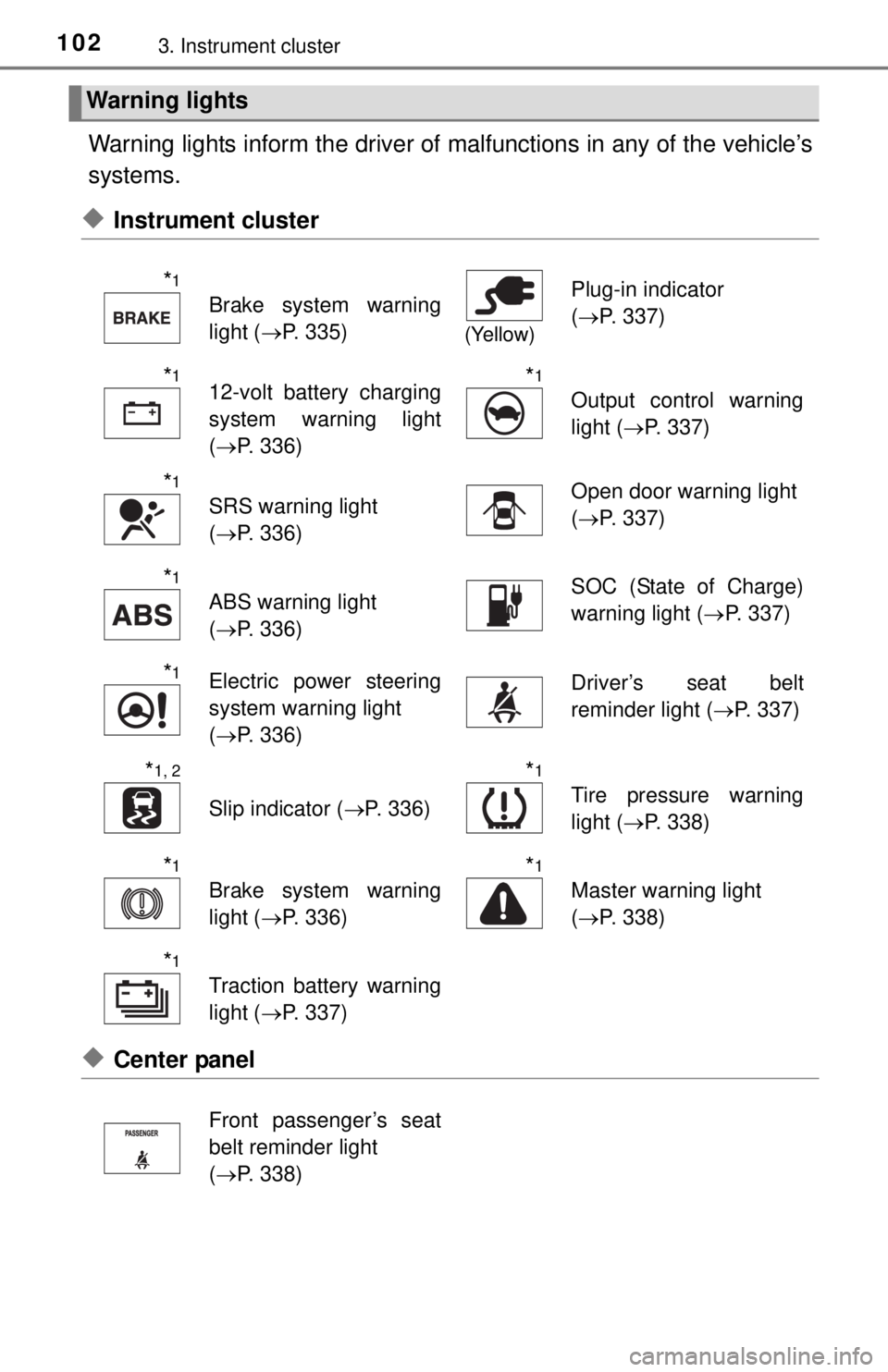
Warning lights inform the driver of malfunctions in any of the vehicle’s
systems.
◆Instrument cluster
◆Center panel
Warning lights
*1
Brake system warning
light ( P. 335)
(Yellow)
Plug-in indicator
(P. 337)
*112-volt battery charging
system warning light
(P. 336)*1
Output control warning
light ( P. 337)
*1
SRS warning light
(P. 336)Open door warning light
(P. 337)
*1
ABS warning light
(P. 336)SOC (State of Charge)
warning light ( P. 337)
*1Electric power steering
system warning light
(P. 336)Driver’s seat belt
reminder light ( P. 337)
*1, 2
Slip indicator (P. 336)
*1
Tire pressure warning
light (P. 338)
*1
Brake system warning
light (P. 336)
*1
Master warning light
(P. 338)
*1
Traction battery warning
light ( P. 337)
Front passenger’s seat
belt reminder light
(P. 338)
Page 117 of 444

117
4
Operation of
each component
4-1. Key information
Keys .................................. 118
4-2. Opening, closing and locking the doors
Smart key system ............. 120
Wireless remote control .... 130
Side doors ......................... 132
Back door .......................... 134
4-3. Adjusting the seats Front seats ........................ 138
Rear seats......................... 140
4-4. Adjusting the steering wheel and mirrors
Steering wheel .................. 143
Inside rear view mirror ...... 144
Outside rear view mirrors ............................. 145
4-5. Opening, closing the windows
Power windows ................. 147
Page 146 of 444

1464-4. Adjusting the steering wheel and mirrors
■Mirror angle can be adjusted when
The power switch is in ACCESSORY or ON mode.
CAUTION
■Important points while driving
Observe the following precautions while driving.
Failure to do so may result in loss of control of the vehicle and cause an
accident, resulting in death or serious injury.
● Do not adjust the mirrors while driving.
● Do not drive with the mirrors folded.
● Both the driver and passenger side mirrors must be extended and properly
adjusted before driving.
■ When a mirror is moving
To avoid personal injury and mirror malfunction, be careful not to get your
hand caught by the moving mirror.
Page 151 of 444

1515-1. Before driving
5
Driving
Make sure that the parking brake is set and shift the shift lever to D.
Gently depress the accelerator pedal.
Release the parking brake.
■When starting off on a uphill
The hill-start assist control is available. ( P. 213)
■ Driving in the rain
●Drive carefully when it is raining, because visibility will be reduced, the win-
dows may become fogged-up, and the road will be slippery.
● Drive carefully when it starts to rain, because the road surface will be espe-
cially slippery.
● Refrain from high speeds when driving on an expressway in the rain,
because there may be a layer of water between the tires and the road sur-
face, preventing the steering and brakes from operating properly.
■ Breaking in your new Scion
To extend the life of the vehicle, observing the following precautions is recom-
mended:
●For the first 200 miles (300 km):
Avoid sudden stops.
● For the first 1000 miles (1600 km):
• Do not drive at extremely high speeds.
• Avoid sudden acceleration.
• Do not drive at a constant speed for extended periods.
■ Operating your vehicle in a foreign country
Comply with the relevant vehicle registration laws.
■ For efficient use
●Shift the shift lever to D when driving.
For good power economy and noise reduction, shift the shift lever to D posi-
tion should usually be used.
● Drive your vehicle smoothly.
Avoid abrupt acceleration and deceleration.
● Avoid repeated acceleration.
Repeated acceleration consumes traction battery power, resulting in poor
acceleration. Battery power can be restored by driving with the accelerator
pedal slightly released.
Starting off on a steep uphill
1
2
3
Page 153 of 444

1535-1. Before driving
5
Driving
CAUTION
Observe the following precautions.
Failure to do so may result in death or serious injury.
■When driving the vehicle
● Do not drive if you are unfamiliar with the location of the brake and ac\
cel-
erator pedals to avoid depressing the wrong pedal.
• Accidentally depressing the accelerator pedal instead of the brake
pedal will result in sudden acceleration that may lead to an accident.
• When backing up, you may twist your body around, leading to a diffi- culty in operating the pedals. Make sure to operate the pedals properly.
• Make sure to keep a correct driving posture even when moving the vehicle only slightly. This allows you to depress the brake and accelera-
tor pedals properly.
• Depress the brake pedal using your right foot. Depressing the brake pedal using your left foot may delay response in an emergency, result-
ing in an accident.
● The driver should pay extra attenti on to pedestrians. Because there is no
engine noise, the pedestrians may misjudge the vehicle’s movement.
● During normal driving, do not turn off the EV system. Turning the EV sys-
tem off while driving will not cause loss of steering or braking control, but
the power assist to these systems will be lost. This will make it more diffi-
cult to steer and brake, so you should pull over and stop the vehicle as
soon as it is safe to do so.
However, in the event of an emergency, such as if it becomes impossible
to stop the vehicle in the normal way: P. 329
● Use regenerative braking to maintain a safe speed when driving down a
steep hill.
Using the brakes continuously may cause the brakes to overheat and lose
effectiveness. ( P. 171)
● If “REGENERATIVE BRAKING LIMITED” appears on the multi-informa-
tion display, firmly depress the brake pedal to decelerate the vehicle.
( P. 347)
● Do not adjust the positions of the steering wheel, the seat, or the inside or
outside rear view mirrors while driving.
Doing so may result in a loss of vehicle control.
● Always check that all passengers’ arms, heads or other parts of their body
are not outside the vehicle.
Page 157 of 444

1575-1. Before driving
5
Driving
NOTICE
■When driving the vehicle
● Do not depress the accelerator and brake pedals at the same time during
driving, as this may restrain driving torque.
● Do not use the accelerator pedal or depress the accelerator and brake
pedals at the same time to hold the vehicle on a hill.
■ When parking the vehicle
Always shift the shift lever to P. Failure to do so may cause the vehicle to
move or the vehicle may accelerate suddenly if the accelerator pedal is
accidentally depressed.
■ Avoiding damage to vehicle parts
● Do not turn the steering wheel fully in either direction and hold it there for
an extended period of time.
Doing so may damage the power steering motor.
● When driving over bumps in the road, drive as slowly as possible to avoid
damaging the wheels, underside of the vehicle, etc.
■ If you get a flat tire while driving
A flat or damaged tire may cause the following situations. Hold the steering
wheel firmly and gradually depress the brake pedal to slow down the vehi-
cle.
● It may be difficult to control your vehicle.
● The vehicle will make abnormal sounds or vibrations.
● The vehicle will lean abnormally.
Information on what to do in case of a flat tire ( P. 359)
■ When encounterin g flooded roads
Do not drive on a road that has flooded after heavy rain etc. Doing so may
cause the following serious damage to the vehicle:
● Short in electrical components
● Traction battery damage caused by water immersion
In the event that you drive on a flooded road and the vehicle is flooded, be
sure to have your Scion dealer check the following:
● Brake function
● Changes in quantity and quality of transmission fluid, etc.
● Lubricant condition for the bearings and suspension joints (where possi-
ble), and the function of all joints, bearings, etc.
● Components connected to the traction battery.
Page 168 of 444
1685-2. Driving procedures
■If the EV system does not start
●The charging cable may be attached to the vehicle. ( P. 188)
● The immobilizer system may not have been deactivated. ( P. 66)
Contact your Scion dealer.
● Check that the shift lever is securely set in P. The EV system may not start if
the shift lever is displaced out of P. “SHIFT TO P POSITION WHEN
STARTING” will be displayed on the multi-information display.
● The steering lock may not have been deactivated.
■ Steering lock
After turning the power switch off and opening and closing the doors, the
steering wheel will be locked due to the steering lock function. Operating the
power switch again automatically cancels the steering lock.
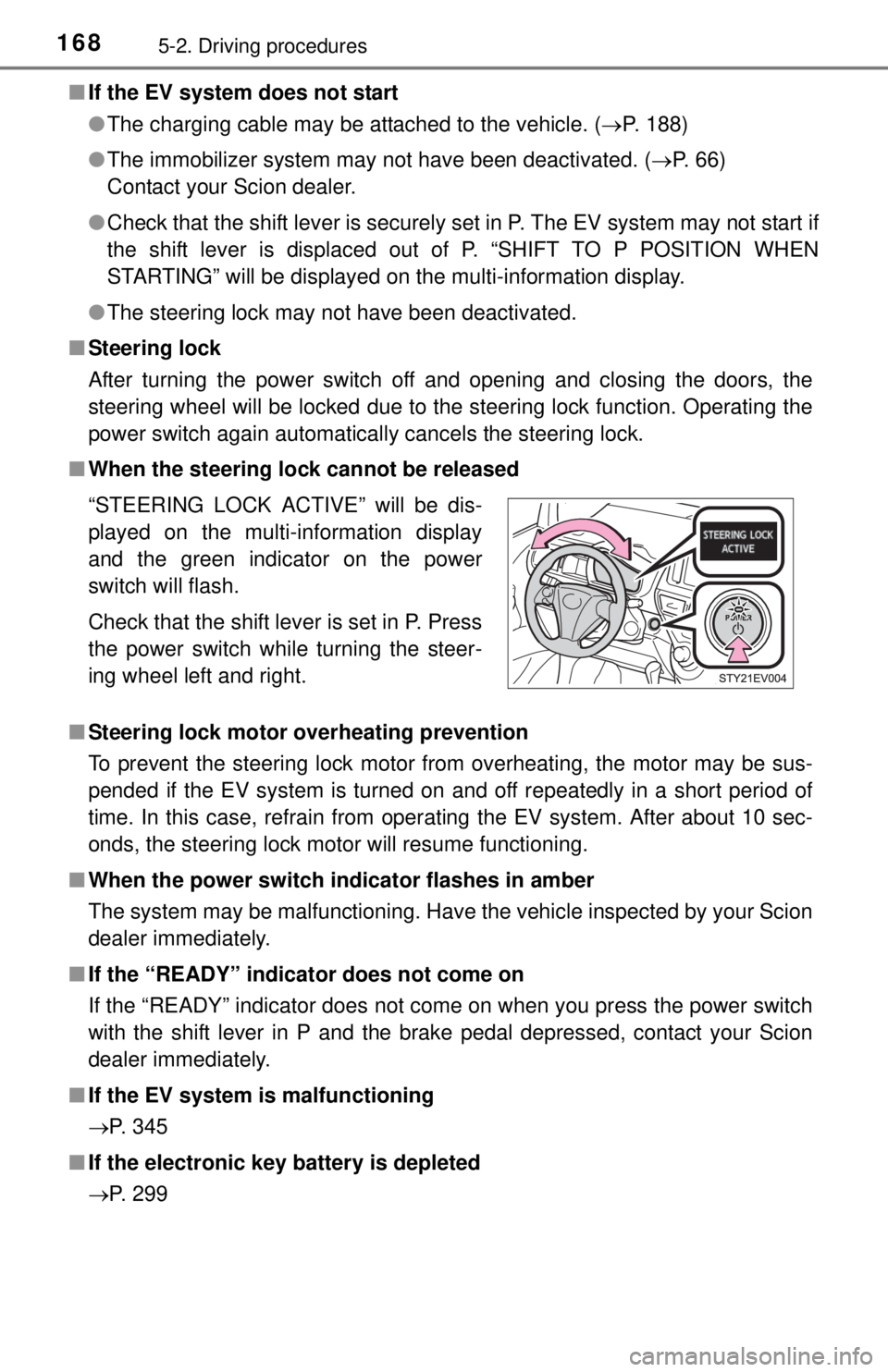
■ When the steering lock cannot be released
■ Steering lock motor overheating prevention
To prevent the steering lock motor from overheating, the motor may be sus-
pended if the EV system is turned on and off repeatedly in a short period of
time. In this case, refrain from operating the EV system. After about 10 sec-
onds, the steering lock motor will resume functioning.
■ When the power switch in dicator flashes in amber
The system may be malfunctioning. Have the vehicle inspected by your Scion
dealer immediately.
■ If the “READY” indicator does not come on
If the “READY” indicator does not come on when you press the power switch
with the shift lever in P and the brake pedal depressed, contact your Scion
dealer immediately.
■ If the EV system is malfunctioning
P. 345
■ If the electronic key battery is depleted
P. 299 “STEERING LOCK ACTIVE” will be dis-
played on the multi-information display
and the green indicator on the power
switch will flash.
Check that the shift lever is set in P. Press
the power switch while turning the steer-
ing wheel left and right.
Page 169 of 444

1695-2. Driving procedures
5
Driving
■Operation of the power switch
●When operating the power switch, one short, firm press is enough. If the
switch is pressed improperly, the EV system may not start or the power
switch mode may not change. It is not necessary to press and hold the
switch.
● If attempting to restart the EV system immediately after turning the power
switch off, the EV system may not start in some cases. After turning the
power switch off, please wait a few seconds before restarting the EV sys-
tem.
■ If the smart key system has been deactivated in a customized setting
P. 384
CAUTION
■When starting the EV system
Always start the EV system while sitting in the driver’s seat. Do not depress
the accelerator pedal while starting the EV system under any circum-
stances.
Doing so may cause an accident resulting in death or serious injury.
■ Caution while driving
If EV system failure occurs while the vehicle is moving, do not lock or open
the doors until the vehicle reaches a safe and complete stop. Activation of
the steering lock in this circumstance may lead to an accident, resulting in
death or serious injury.
■ Stopping the EV system in an emergency
If you want to stop the EV system in an emergency while driving the vehicle,
press and hold the power switch for more than 2 seconds, or press it briefly
3 times or more in succession. ( P. 329)
However, do not touch the power switch while driving except in an emer-
gency. Turning the EV system off while driving will not cause loss of steering
or braking control, but the power assist to these systems will be lost. This
will make it more difficult to steer and brake, so you should pull over and
stop the vehicle as soon as it is safe to do so.
Page 210 of 444
2105-5. Using the driving support systems
Driving assist systems
◆ABS (Anti-lock Brake System)
Helps to prevent wheel lock when the brakes are applied suddenly,
or if the brakes are applied while driving on a slippery road surface
◆Brake assist
Generates an increased level of braking force after the brake pedal
is depressed when the system detects a panic stop situation
◆VSC (Vehicle Stability Control)
Helps the driver to control skidding when swerving suddenly or
turning on slippery road surfaces
◆Enhanced VSC (Enhanced Ve hicle Stability Control)
Provides cooperative control of the ABS, TRAC, VSC and EPS.
Helps to maintain directional st ability when swerving on slippery
road surfaces by controllin g steering performance.
◆TRAC (Traction Control)
Helps to maintain drive power and prevent the drive wheels from
spinning when starting the vehicle or accelerating on slippery roads
◆Hill-start assist control
P. 2 1 3
◆EPS (Electric Power Steering)
Employs an electric motor to redu ce the amount of effort needed to
turn the steering wheel
To help enhance driving safety and performance, the following
systems operate automatically in response to various driving
situations. Be aware, however, that these systems are supple-
mentary and should not be relied upon too heavily when operat-
ing the vehicle.