tow TOYOTA iQ EV 2013 Owners Manual (in English)
[x] Cancel search | Manufacturer: TOYOTA, Model Year: 2013, Model line: iQ EV, Model: TOYOTA iQ EV 2013Pages: 444, PDF Size: 7.34 MB
Page 3 of 444
3
9 8
7
6
5
4
3
10
1
2
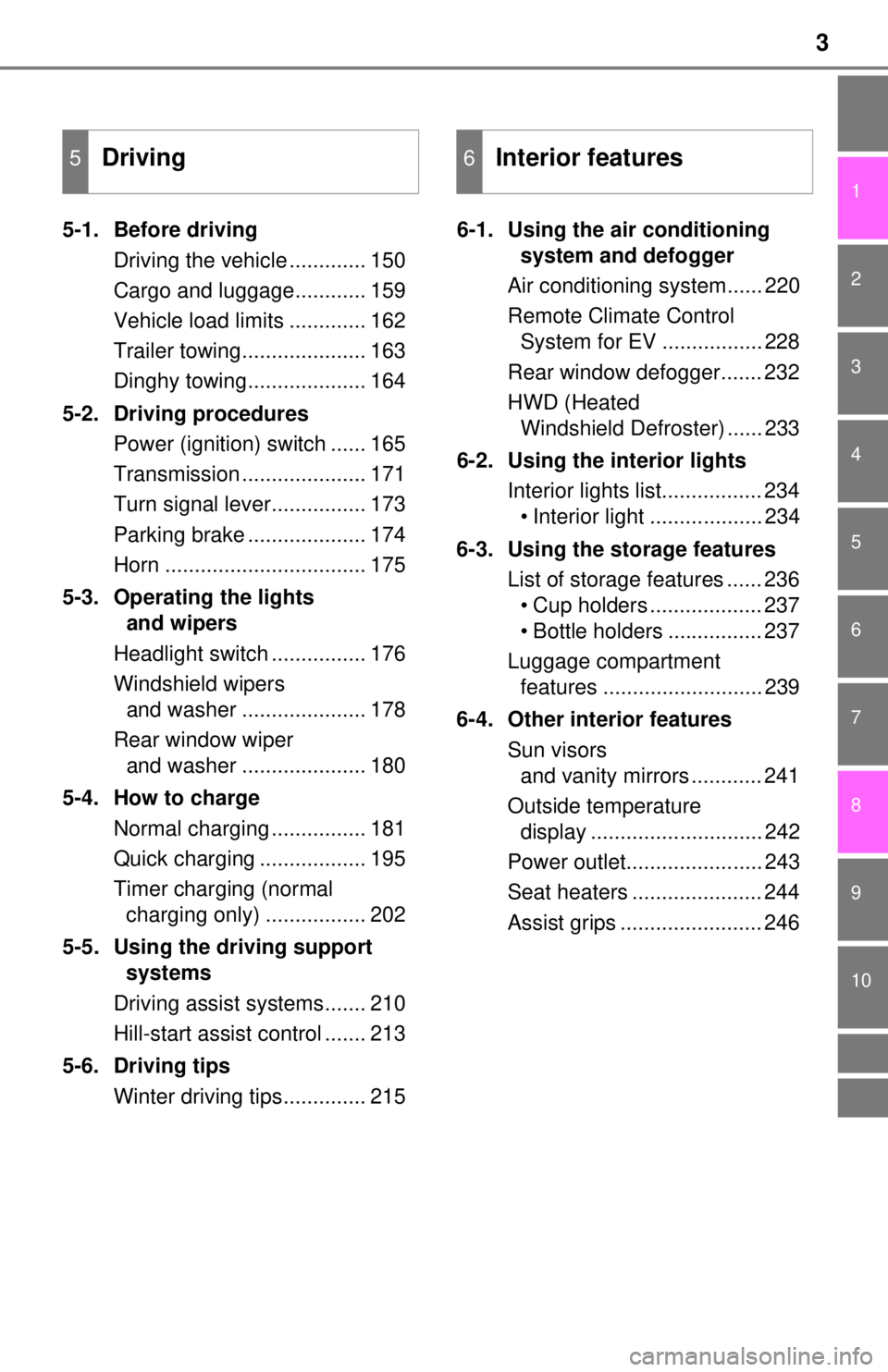
5-1. Before drivingDriving the vehicle ............. 150
Cargo and luggage............ 159
Vehicle load limits ............. 162
Trailer towing..................... 163
Dinghy towing.................... 164
5-2. Driving procedures Power (ignition) switch ...... 165
Transmission ..................... 171
Turn signal lever................ 173
Parking brake .................... 174
Horn .................................. 175
5-3. Operating the lights and wipers
Headlight switch ................ 176
Windshield wipers and washer ..................... 178
Rear window wiper and washer ..................... 180
5-4. How to charge Normal charging ................ 181
Quick charging .................. 195
Timer charging (normal charging only) ................. 202
5-5. Using the driving support systems
Driving assist systems....... 210
Hill-start assist control ....... 213
5-6. Driving tips Winter driving tips.............. 215 6-1. Using the air conditioning
system and defogger
Air conditioning system...... 220
Remote Climate Control System for EV ................. 228
Rear window defogger....... 232
HWD (Heated Windshield Defroster) ...... 233
6-2. Using the interior lights Interior lights list................. 234• Interior light ................... 234
6-3. Using the storage features List of storage features ...... 236• Cup holders ................... 237
• Bottle holders ................ 237
Luggage compartment features ........................... 239
6-4. Other interior features Sun visors and vanity mirrors ............ 241
Outside temperature display ............................. 242
Power outlet....................... 243
Seat heaters ...................... 244
Assist grips ........................ 246
5Driving6Interior features
Page 4 of 444
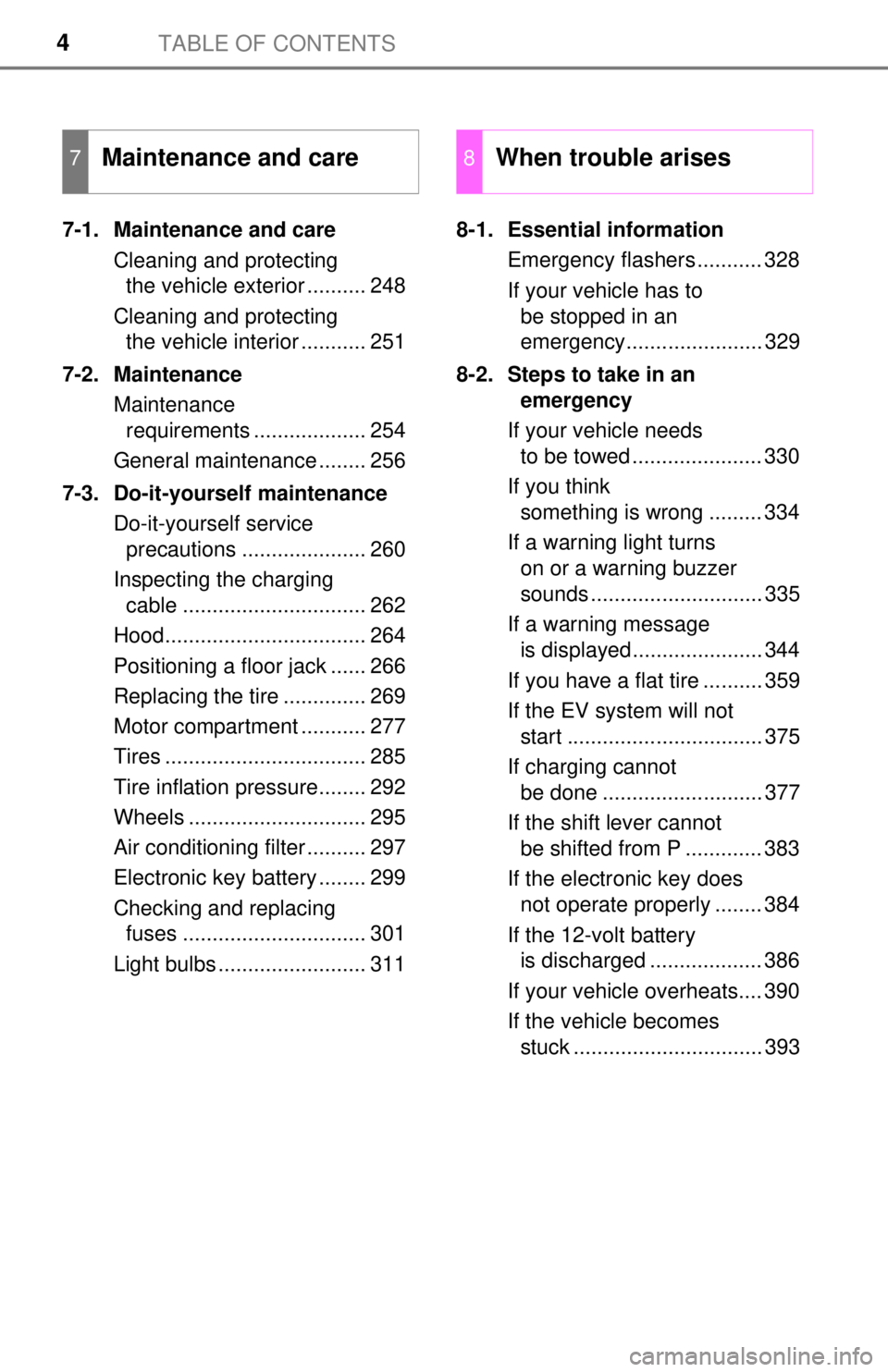
TABLE OF CONTENTS4
7-1. Maintenance and careCleaning and protecting the vehicle exterior .......... 248
Cleaning and protecting the vehicle interior ........... 251
7-2. Maintenance Maintenance requirements ................... 254
General maintenance ........ 256
7-3. Do-it-yourself maintenance Do-it-yourself service precautions ..................... 260
Inspecting the charging cable ............................... 262
Hood.................................. 264
Positioning a floor jack ...... 266
Replacing the tire .............. 269
Motor compartment ........... 277
Tires .................................. 285
Tire inflation pressure........ 292
Wheels .............................. 295
Air conditioning filter .......... 297
Electronic key battery ........ 299
Checking and replacing fuses ............................... 301
Light bulbs ......................... 311 8-1. Essential information
Emergency flashers ........... 328
If your vehicle has to be stopped in an
emergency....................... 329
8-2. Steps to take in an emergency
If your vehicle needs to be towed ...................... 330
If you think something is wrong ......... 334
If a warning light turns on or a warning buzzer
sounds ............................. 335
If a warning message is displayed...................... 344
If you have a flat tire .......... 359
If the EV system will not start ................................. 375
If charging cannot be done ........................... 377
If the shift lever cannot be shifted from P ............. 383
If the electronic key does not operate properly ........ 384
If the 12-volt battery is discharged ................... 386
If your vehicle overheats.... 390
If the vehicle becomes stuck ................................ 393
7Maintenance and care8When trouble arises
Page 14 of 444

14Pictorial index
■Instrument panel
Power switch . . . . . . . . . . . . . . . . . . . . . . . . . . . . . . . . . . . . . P. 165
Starting the EV system/changing the modes . . . . . . . . . . P. 165, 166
Emergency stop of the EV system . . . . . . . . . . . . . . . . . . . . . . P. 329
When the EV system will not start . . . . . . . . . . . . . . . . . . . . . . P. 375
Warning messages . . . . . . . . . . . . . . . . . . . . . . . . . . . . . . . . . P. 350
Shift lever . . . . . . . . . . . . . . . . . . . . . . . . . . . . . . . . . . . . . . . . P. 171
Shifting the shift position . . . . . . . . . . . . . . . . . . . . . . . . . . . . . P. 171
Precautions against towing . . . . . . . . . . . . . . . . . . . . . . . . . . . P. 330
When the shift lever does not move. . . . . . . . . . . . . . . . . . . . . P. 383
Meters . . . . . . . . . . . . . . . . . . . . . . . . . . . . . . . . . . . . . . . . . . . P. 105
Reading the meters/
adjusting the instrument panel light . . . . . . . . . . . . . . . . . P. 105, 106
Warning lights/indicator . . . . . . . . . . . . . . . . . . . . . . . . . . . . . . P. 100
When the warning lights come on . . . . . . . . . . . . . . . . . . . . . . P. 3351
2
3
Page 27 of 444

271-1. For safe use
1
For safety and security
When not using the seat belt, follow the method and hook the plate
into the seat belt holder to fasten the seat belt.Flip the plate
Hook the plate in to the seat belt
holder
The pretensioners help the seat
belts to quickly restrain the occu-
pants by retracting the seat belts
when the vehicle is subjected to
certain types of severe frontal or
side collision.
The pretensioners do not activate
in the event of a minor frontal
impact, a minor side impact, a rear
impact or a vehicle rollover.
Stowing the seat belts (rear seat)
1
2
Seat belt pretensioners (front seats)
Page 35 of 444
351-1. For safe use
1
For safety and security
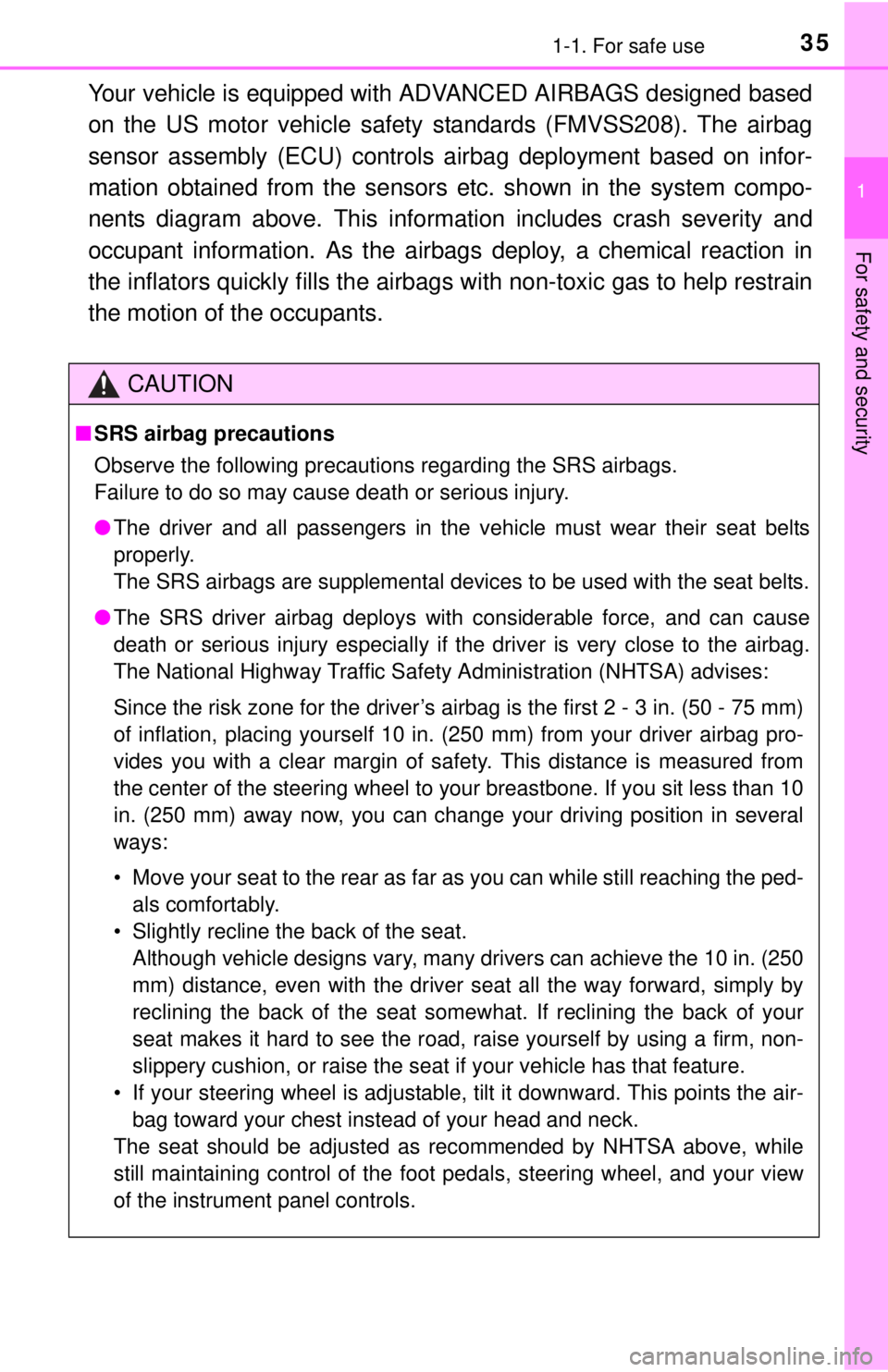
Your vehicle is equipped with ADVANCED AIRBAGS designed based
on the US motor vehicle safety standards (FMVSS208). The airbag
sensor assembly (ECU) controls airbag deployment based on infor-
mation obtained from the sensors et c. shown in the system compo-
nents diagram above. This informat ion includes crash severity and
occupant information. As the airbags deploy, a chemical reaction in
the inflators quickly fills the airbag s with non-toxic gas to help restrain
the motion of the occupants.
CAUTION
■ SRS airbag precautions
Observe the following precautions regarding the SRS airbags.
Failure to do so may cause death or serious injury.
● The driver and all passengers in the vehicle must wear their seat belts
properly.
The SRS airbags are supplemental devices to be used with the seat belts.
● The SRS driver airbag deploys with considerable force, and can cause
death or serious injury especially if the driver is very close to the airbag.
The National Highway Traffic Safety Administration (NHTSA) advises:
Since the risk zone for the driver’s airbag is the first 2 - 3 in. (50 - 75 mm)
of inflation, placing yourself 10 in. (250 mm) from your driver airbag pro-
vides you with a clear margin of safety. This distance is measured from
the center of the steering wheel to your breastbone. If you sit less than 10
in. (250 mm) away now, you can change your driving position in several
ways:
• Move your seat to the rear as far as you can while still reaching the ped- als comfortably.
• Slightly recline the back of the seat. Although vehicle designs vary, many drivers can achieve the 10 in. (250
mm) distance, even with the driver seat all the way forward, simply by
reclining the back of the seat somewhat. If reclining the back of your
seat makes it hard to see the road, raise yourself by using a firm, non-
slippery cushion, or raise the seat if your vehicle has that feature.
• If your steering wheel is adjustable, tilt it downward. This points the air- bag toward your chest instead of your head and neck.
The seat should be adjusted as recommended by NHTSA above, while
still maintaining control of the foot pedals, steering wheel, and your view
of the instrument panel controls.
Page 37 of 444

371-1. For safe use
1
For safety and security
CAUTION
■SRS airbag precautions
● Do not allow a child to stand in front of
the SRS front passenger airbag unit or
sit on the knees of a front passenger.
● Do not allow the front seat occupants to
hold items on their knees.
● Do not lean against the door, the roof
side rail or the front, side and rear pil-
lars.
● Do not allow anyone to kneel on the
passenger seat toward the door or put
their head or hands outside the vehicle.
● Do not allow anyone to kneel on the
rear seat toward the back door.
● Do not attach anything to or lean any-
thing against areas such as the dash-
board, steering wheel pad and lower
portion of the instrument panel.
These items can become projectiles
when the SRS driver, front passenger
and knee airbags deploy.
Page 82 of 444

822-1. Electric vehicle
CAUTION
■Road accident cautions
Follow the instructions described below to reduce the risk of death or seri-
ous injury, and immediately contact your Scion dealer:
● Stop the vehicle in a safe place, apply the parking brake while depressing
the brake pedal, shift the shift lever to P and turn the EV system off.
Then, slowly release the brake pedal.
● Do not touch the high voltage parts, cables (orange) and connectors.
● If electric wires are exposed inside or outside your vehicle, an electric
shock may occur. Never touch exposed electric wires.
● Do not touch the traction battery if liquid is leaking from or adhered to it.
If electrolyte (Organic Carbonate-based electrolyte) from the traction bat-
tery comes into contact with the eyes or skin, it could cause blindness or
skin wounds. In the unlikely event that it comes into contact with the eyes
or skin, wash it off immediately with a large amount of water, and seek
immediate medical attention.
● If electrolyte is leaking from the traction battery, do not approach the vehi-
cle.
Even in the unlikely event that the traction battery has been damaged, the
internal construction of the battery will prevent a large amount of electro-
lyte from leaking out. However, if electrolyte leaks, vapors will be emitted.
These vapors are an irritant to skin and eyes and could cause acute poi-
soning if inhaled.
● Do not bring burning or high-temperat ure items close to the electrolyte.
The electrolyte may ignite and cause a fire.
● If a fire occurs in the electric vehicle, leave the vehicle as soon as possi-
ble. Never use a fire extinguisher that is not meant for electrical fires.
Using even a small amount of water may be dangerous.
● If your vehicle needs to be towed, do so with the front wheels raised. If the
wheels connected to the electric motor (traction motor) are on the ground
when towing, the motor may continue to generate electricity. This may
cause an electricity leakage leading to a fire. ( P. 330)
Page 125 of 444
1254-2. Opening, closing and locking the doors
4
Operation of each component
■Conditions affecting operation
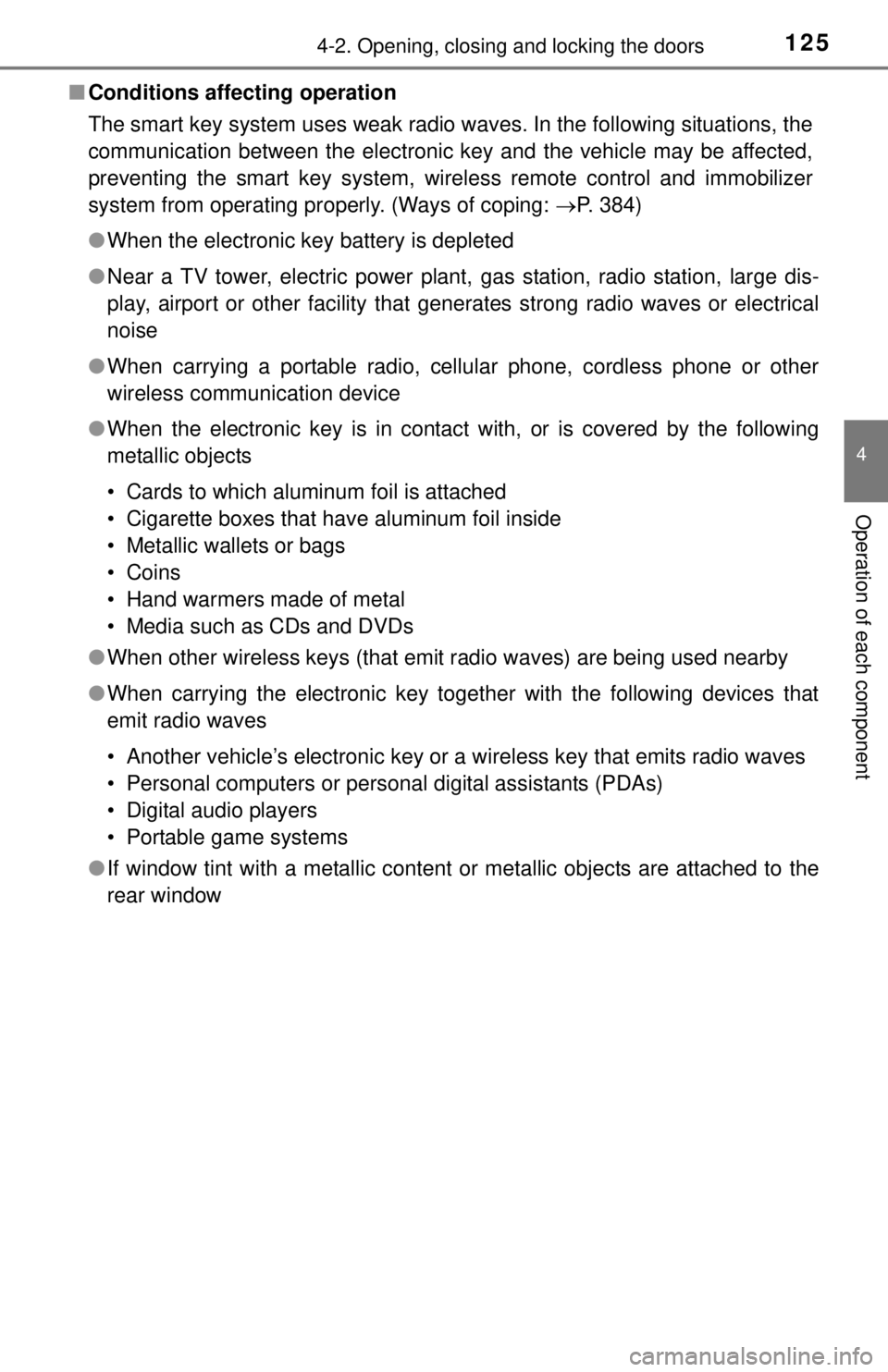
The smart key system uses weak radio waves. In the following situations, the
communication between the electronic key and the vehicle may be affected,
preventing the smart key system, wireless remote control and immobilizer
system from operating properly. (Ways of coping: P. 384)
● When the electronic key battery is depleted
● Near a TV tower, electric power plant, gas station, radio station, large dis-
play, airport or other facility that generates strong radio waves or electrical
noise
● When carrying a portable radio, cellular phone, cordless phone or other
wireless communication device
● When the electronic key is in contact with, or is covered by the following
metallic objects
• Cards to which aluminum foil is attached
• Cigarette boxes that have aluminum foil inside
• Metallic wallets or bags
• Coins
• Hand warmers made of metal
• Media such as CDs and DVDs
● When other wireless keys (that emit radio waves) are being used nearby
● When carrying the electronic key together with the following devices that
emit radio waves
• Another vehicle’s electronic key or a wireless key that emits radio waves
• Personal computers or personal digital assistants (PDAs)
• Digital audio players
• Portable game systems
● If window tint with a metallic content or metallic objects are attached to the
rear window
Page 140 of 444

1404-3. Adjusting the seats
Rear seats
Stow the seat belt buckles as
shown.
Press the seatback lock release
button and fold the seatback
down until it reaches the posi-
tion where the head restraints
can be removed.
Remove the head restraints.
Pull the head restraint up while
pushing the lock release button.
Fold down the seatbacks.
Stow the head restraints between
seatbacks and seat cushion as
shown.
Folding down procedure
1
2
3
4
Page 142 of 444
1424-3. Adjusting the seats
CAUTION
■Head restraint precautions
Observe the following precautions regarding the head restraints.
Failure to do so may result in death or serious injury.
● Use the head restraints designed for each respective seat.
● After installing the head restraints, push down on them and make sure
they are locked in position.
● Do not drive with the head restraints removed.
NOTICE
■Before folding the seatbacks
● The seat belts buckles must be stowed.
● The head restraints must be removed.
■ When operating the rear seat
Make sure that the rear seat does not come into contact with the front seat.
Do not forcibly operate the rear seat. Otherwise, the seat cover may be
damaged or the seat may be broken.