lock TOYOTA LAND CRUISER 2000 Repair Manual
[x] Cancel search | Manufacturer: TOYOTA, Model Year: 2000, Model line: LAND CRUISER, Model: TOYOTA LAND CRUISER 2000Pages: 235, PDF Size: 5.13 MB
Page 149 of 235
L/C 100_U171
2000 L/C 100 (OM60866U)
CAUTION
Do not overestimate the anti −lock
brake system: Although the anti −lock
brake system assists in providing ve-
hicle control, it is still important to
drive with all due care and maintain
a moderate speed and safe distance
from the vehicle in front of you, be-
cause there are limits to the vehicle
stability and effectiveness of steering
wheel operation even with the anti −
lock brake system on.
If tires grip performance exceeds its
capability, or if hydroplaning occurs
during high speed driving in the rain,
the anti −lock brake system does not
provide vehicle control.
Anti −lock brake system is not de-
signed to shorten the stopping dis-
tance: Always drive at the moderate
speed and maintain a safe distance
from the vehicle in front of you.
Compared with vehicles not fitted
with an anti −lock brake system, your
vehicle may require a longer stopping
distance in the following cases: Driving on rough, gravel or snow −
covered roads.
Driving with tire chains installed.
Driving over the steps such as the
joints on the road.
Driving on roads where the road
surface is pitted or has other differ-
ences in surface height.
Install all 4 tires of specified size at
designated pressure: The anti −lock
brake system detects vehicle speeds
using the speed sensors for respec-
tive wheels’ turning speeds. The use
of tires other than specified may fail
to detect the accurate turning speed,
resulting in a longer stopping dis-
tance.
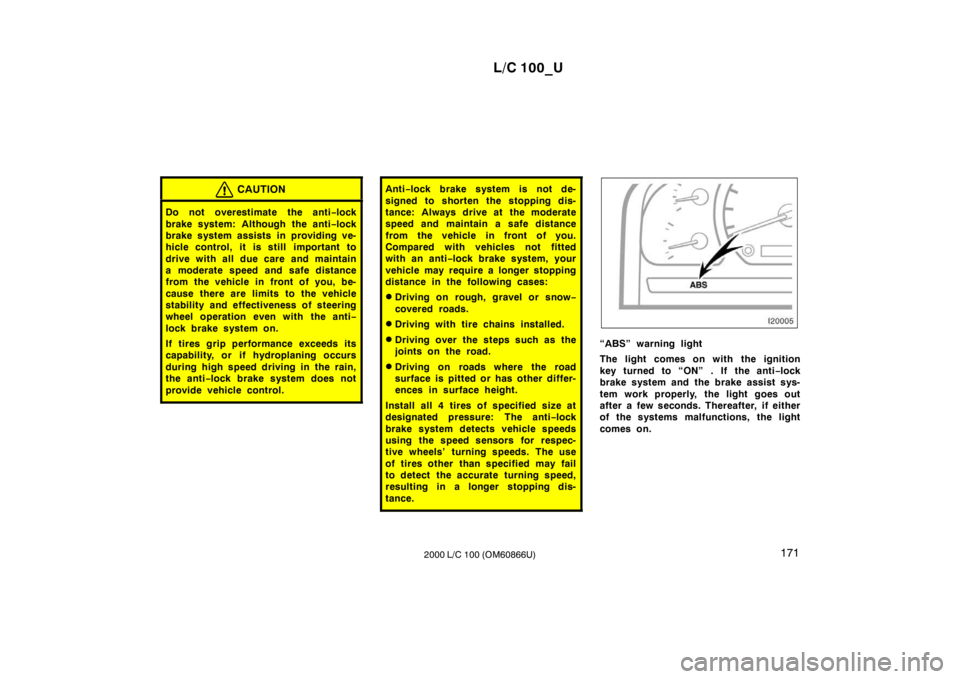
“ABS” warning light
The light comes on with the ignition
key turned to “ON” . If the anti −lock
brake system and the brake assist sys-
tem work properly, the light goes out
after a few seconds. Thereafter, if either
of the systems malfunctions, the light
comes on.
Page 150 of 235
L/C 100_U
172 2000 L/C 100 (OM60866U)
When the “ABS” warning light is on (and
the brake system warning light is off), the
anti
−lock brake system, the brake assist
system, the vehicle skid control system
and/or active traction control system do/
does not operate, but the brake system
still operates conventionally.
When the “ABS” warning light is on (and
the brake system warning light is off), the
anti −lock brake system does not operate
so that the wheels could lock up during
a sudden braking or braking on slippery
road surfaces.
If the following conditions occurs, this
indicates a malfunction somewhere in
the parts monitored by the warning
light system. Contact your Toyota deal-
er as soon as possible to service the
vehicle.
The light does not come on with the
ignition key turned to “ON”, or remainson.
The light comes on while driving.
If the light lit during driving goes out and
does not come on again, it is a normal
operation.
CAUTION
If the “ABS” warning light remains on
together with the brake system warn-
ing light, immediately stop your ve-
hicle at a safe place and contact your
Toyota dealer.
In this case, the vehicle may become
harder to control or skid during hard
braking or braking on slippery road
surfaces.
Either of the following conditions may
occur, but do not indicate the malfunc-
tion. The light may stay on for about 60
seconds after the engine is started. It
is normal if it goes out after a while.
Depressing the brake pedal repeatedly
may turn on the light. It is normal if it
goes off after a few seconds. DRUM
−IN −DISC TYPE PARKING BRAKE
SYSTEM
Your vehicle has a drum −in −disc type
parking brake system. This type of brake
system n eeds bedding −down of the brake
shoes periodically or whenever the parking
brake shoes and/or drums are replaced.
Have your Toyota dealer perform the bed-
ding −down.
BRAKE ASSIST SYSTEM
When you slam the brakes on, the
brake assist system judges as an emer-
gency stop and provides more powerful
braking for a driver who cannot hold
down the brake pedal firmly.
When you slam the brakes on, more pow-
erful braking will be applied. At this time,
you may hear a sound in the engine
compartment and feel the vibrations of the
brake pedal. This does not indicate a mal-
function.
The brake assist system becomes opera-
tive after the vehicle has accelerated to
a speed in excess of approximately 10
km/h (6 mph). It stops operating when the
vehicle decelerates to a speed below
approximately 5 km/h (3 mph).
Page 154 of 235
L/C 100_U
176 2000 L/C 100 (OM60866U)
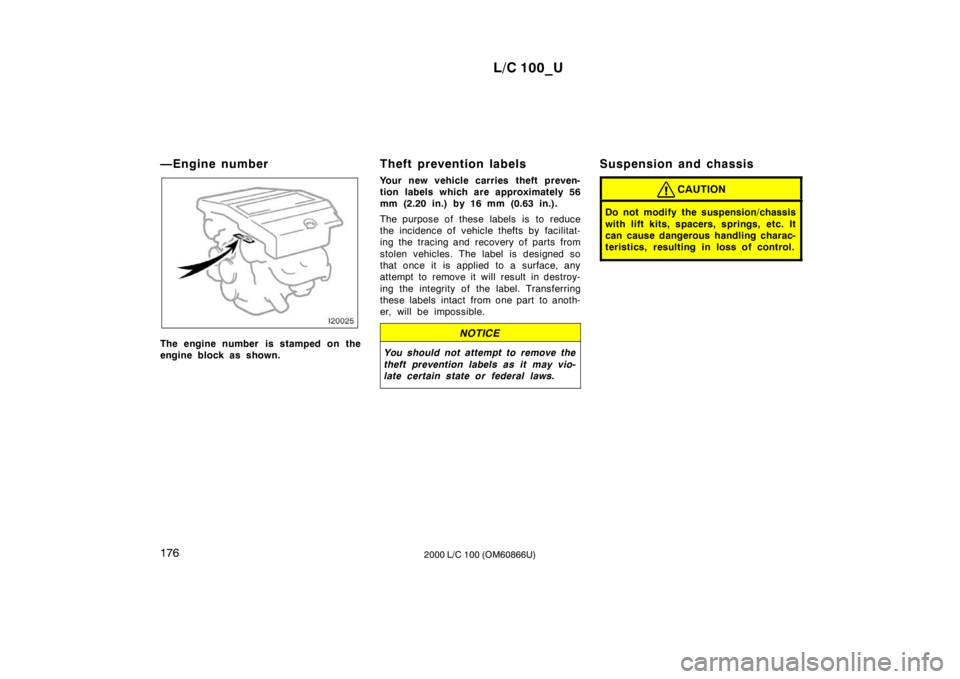
—Engine number
The engine number is stamped on the
engine block as shown.
Theft prevention labels
Your new vehicle carries theft preven-
tion labels which are approximately 56
mm (2.20 in.) by 16 mm (0.63 in.).
The purpose of these labels is to reduce
the incidence of vehicle thefts by facilitat-
ing the tracing and recovery of parts from
stolen vehicles. The label is designed so
that once it is applied to a surface, any
attempt to remove it will result in destroy-
ing the integrity of the label. Transferring
these labels intact from one part to anoth-
er, will be impossible.NOTICE
You should not attempt to remove the
theft prevention labels as it may vio-
late certain state or federal laws.
Suspension and chassis
CAUTION
Do not modify the suspension/chassis
with lift kits, spacers, springs, etc. It
can cause dangerous handling charac-
teristics, resulting in loss of control.
Page 163 of 235
L/C 100_U199
2000 L/C 100 (OM60866U)
CAUTION
Do not attempt to remove the radiator
cap when the engine and radiator are
hot. Serious injury could result from
scalding hot fluid and steam blown
out under pressure.
7. After the engine coolant temperature
has cooled to normal, again check the
coolant level in the reservoir. If neces-
sary, bring it up to half full again. Seri-
ous coolant loss indicates a leak in the
system. You s hould have it checked as
soon as possible at your Toyota dealer. If you have a flat tire—
1. Reduce your speed gradually, keeping a straight line. Move cautiously off the
road to a safe place well away from
the traffic. Avoid stopping on the center
divider of a highway. Park on a level
spot with firm ground.
2. Stop the engine and turn on your emergency flashers.
3. Firmly set the parking brake and put the transmission in ”P”.
4. Have everyone get out of the vehicle on the side away from traffic.
5. Read the following instructions thor- oughly.
CAUTION
When jacking, be sure to observe the
following to reduce the possibility of
personal injury: Follow jacking instructions.
Do not put any part of your body
under the vehicle supported by the
jack. Personal injury may occur.
Do not start or run the engine while
your vehicle is supported by the
jack.
Stop the vehicle on a level firm
ground, firmly set the parking brake
and put the transmission in reverse.
Block the wheel diagonally opposite
to the one being changed if neces-
sary.
Make sure to set the jack properly
in the jack point. Raising the ve-
hicle with jack improperly posi-
tioned will damage the vehicle or
may allow the vehicle to fall off the
jack and cause personal injury.
Never get under the vehicle when
the vehicle is supported by the jack
alone.
Use the jack only for lifting your
vehicle during wheel changing.
Do not raise the vehicle with some-
one in the vehicle.
When raising the vehicle, do not
put an object on or under the jack.
Raise the vehicle only high enough
to remove and change the tire.
Page 166 of 235
L/C 100_U
202 2000 L/C 100 (OM60866U)
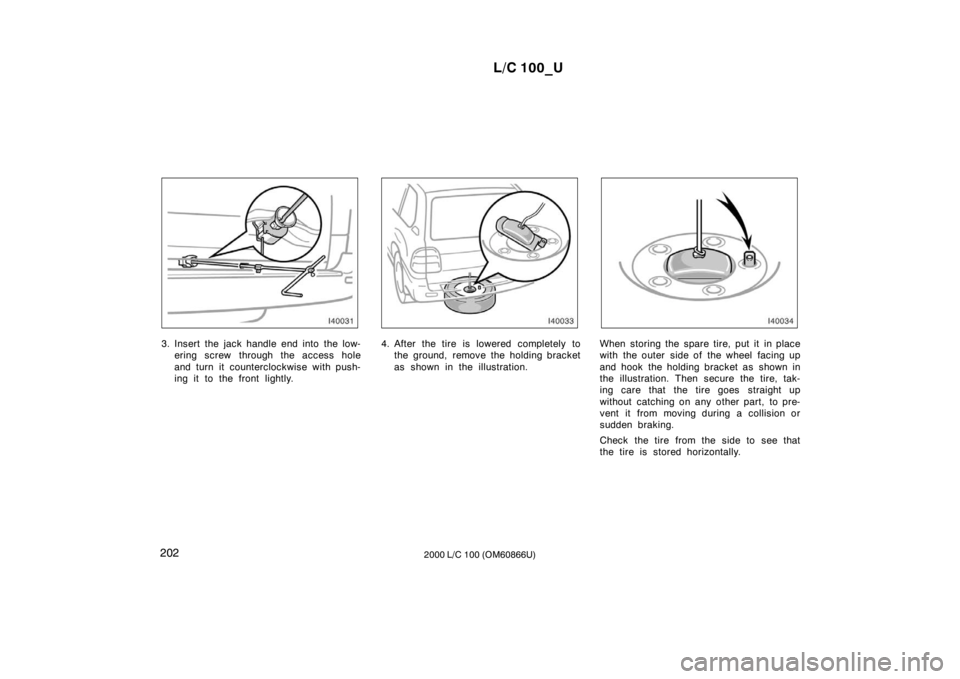
3. Insert the jack handle end into the low-
ering screw through the access hole
and turn it counterclockwise with push-
ing it to the front lightly.4. After the tire is lowered completely tothe ground, remove the holding bracket
as shown in the illustration.When storing the spare tire, put it in place
with the outer side of the wheel facing up
and hook the holding bracket as shown in
the illustration. Then secure the tire, tak-
ing care that the tire goes straight up
without catching on any other part, to pre-
vent it from moving during a collision or
sudden braking.
Check the tire from the side to see that
the tire is stored horizontally.
Page 167 of 235
L/C 100_U203
2000 L/C 100 (OM60866U)
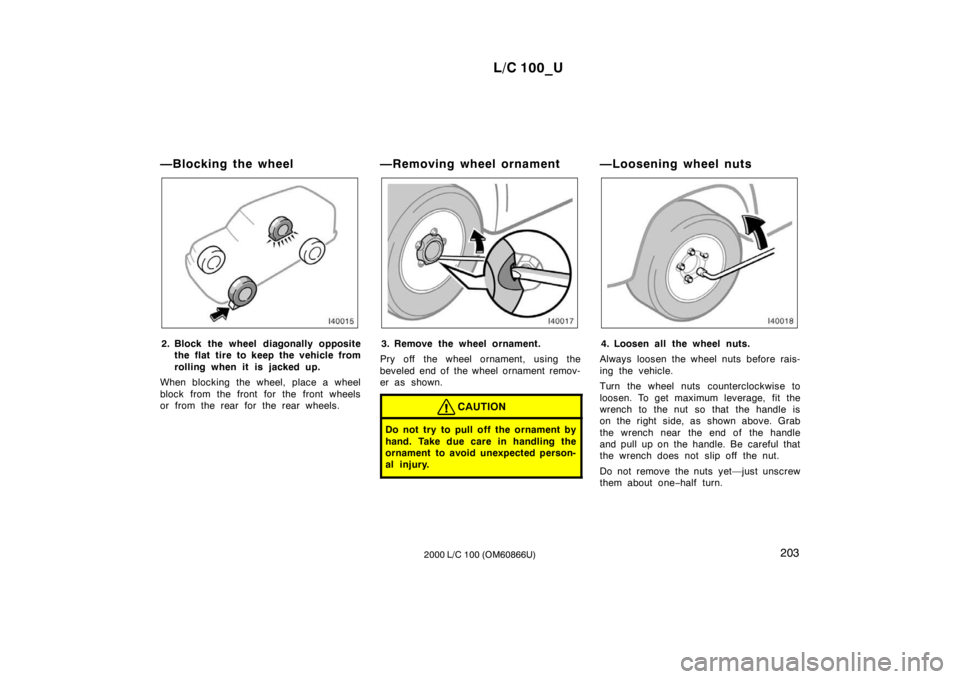
—Blocking the wheel
2. Block the wheel diagonally opposite
the flat tire to keep the vehicle from
rolling when it is j acked up.
When blocking the wheel, place a wheel
block from the front for the front wheels
or from the rear for the rear wheels. —Removing wheel ornament3. Remove the wheel ornament.
Pry off the wheel ornament, using the
beveled end of the wheel ornament remov-
er as shown.
CAUTION
Do not try to pull off the ornament by
hand. Take due care in handling the
ornament to avoid unexpected person-
al injury.
—Loosening wheel nuts
4. Loosen all the wheel nuts.
Always loosen the wheel nuts before rais-
ing the vehicle.
Turn the wheel nuts counterclockwise to
loosen. To get maximum leverage, fit the
wrench to the nut so that the handle is
on the right side, as shown above. Grab
the wrench near the end of the handle
and pull up on the handle. Be careful that
the wrench does not slip off the nut.
Do not remove the nuts yet—just unscrew
them about one −half turn.
Page 169 of 235
L/C 100_U205
2000 L/C 100 (OM60866U)
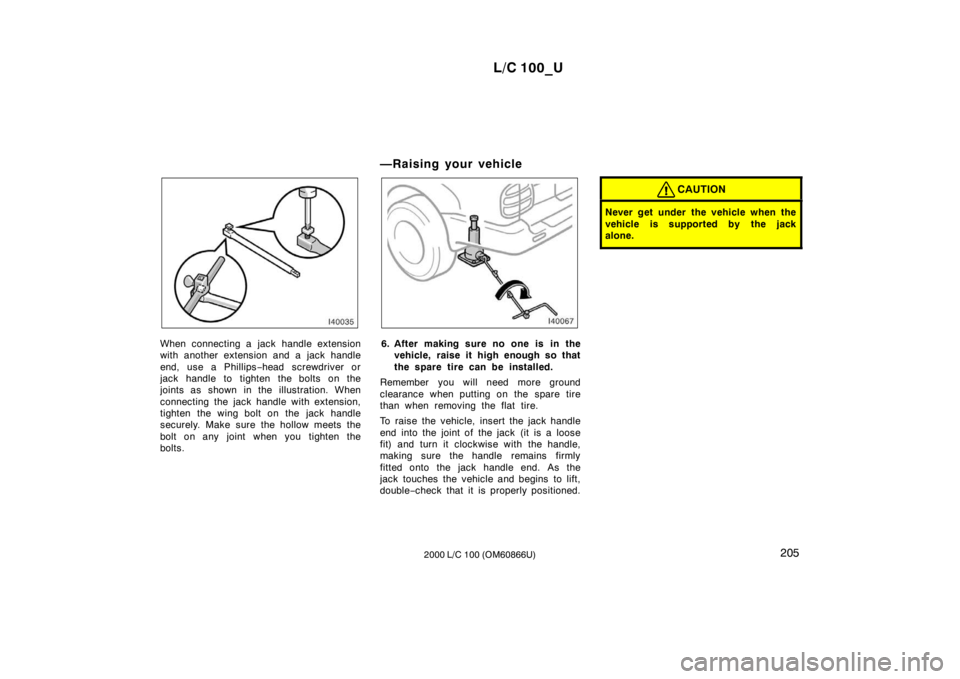
When connecting a jack handle extension
with another extension and a jack handle
end, use a Ph illips−head screwdriver or
jack handle to tighten the bolts on the
joints as shown in the illustration. When
connecting the jack handle with extension,
tighten the wing bolt on the jack handle
securely. Make sure the hollow meets the
bolt on any joint when you tighten the
bolts. —Raising your vehicle6. After making sure no one is in the
vehicle, raise it high enough so that
the spare tire can be installed.
Remember you will need more ground
clearance when putting on the spare tire
than when removing the flat tire.
To raise the vehicle, insert the jack handle
end into the joint of the jack (it is a loose
fit) and turn it clockwise with the handle,
making sure the handle remains firmly
fitted onto the jack handle end. As the
jack touches the vehicle and begins to lift,
double −check that it is properly positioned.
CAUTION
Never get under the vehicle when the
vehicle is supported by the jack
alone.
Page 171 of 235
L/C 100_U207
2000 L/C 100 (OM60866U)
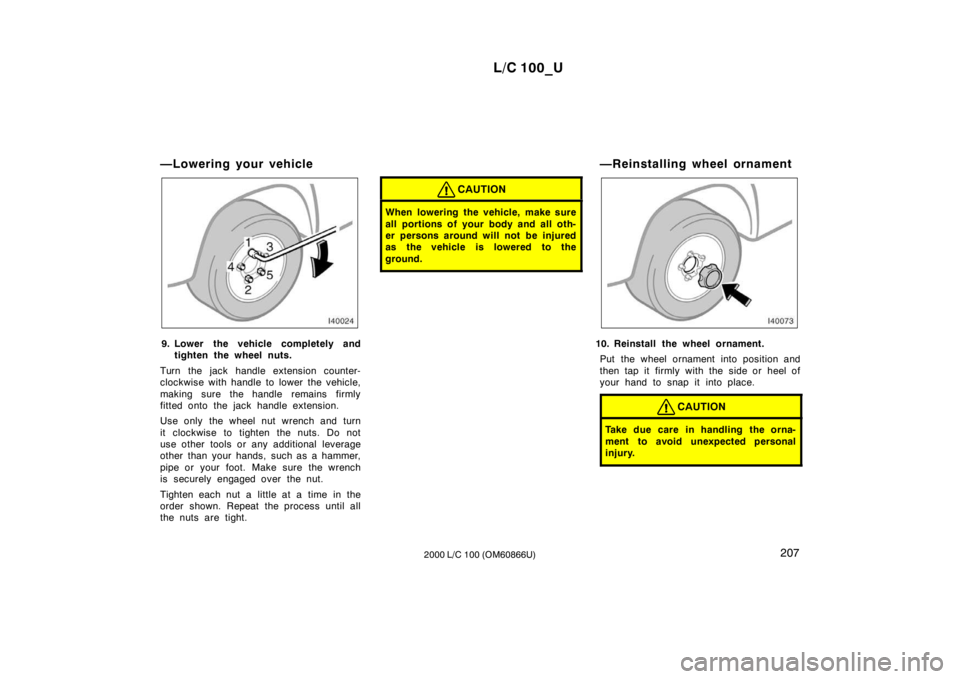
—Lowering your vehicle
9. Lower the vehicle completely and
tighten the wheel nuts.
Turn the jack handle extension counter-
clockwise with handle to lower the vehicle,
making sure the handle remains firmly
fitted onto the jack handle extension.
Use only the wheel nut wrench and turn
it clockwise to tighten the nuts. Do not
use other tools or any additional leverage
other than your hands, such as a hammer,
pipe or your foot. Make sure the wrench
is securely engaged over the nut.
Tighten each nut a little at a time in the
order shown. Repeat the process until all
the nuts are tight.
CAUTION
When lowering the vehicle, make sure
all portions of your body and all oth-
er persons around will not be injured
as the vehicle is lowered to the
ground.
—Reinstalling wheel ornament
10. Reinstall the wheel ornament. Put the wheel ornament into position and
then tap it firmly with the side or heel of
your hand to snap it into place.
CAUTION
Take due care in handling the orna-
ment to avoid unexpected personal
injury.
Page 174 of 235
L/C 100_U
210 2000 L/C 100 (OM60866U)
If towing is necessary, we recommend
you to have it done by your Toyota
dealer or a commercial tow truck ser-
vice.
If towing service is not available in an
emergency, your vehicle may be tempo-
rarily towed by a cable or chain se-
cured to one of the following parts:
Front: Front emergency towing hook
Rear: Rear emergency towing hook
Use extreme caution when towing the
vehicle.
A driver must be in the vehicle to steer it
and operate the brakes.
Towing in this manner may be done only
on hard
−surfaced roads for a short dis-
tance and at low speeds. Also, the
wheels, axles, drive train, steering and
brakes must all be in good condition.
CAUTION
Use extreme caution when towing ve-
hicle. Avoid sudden starts or erratic
driving maneuvers which would place
excessive stress on the emergency
towing hook and towing cable or
chain. The hook and towing cable or
chain may break and cause serious
injury or damage.
NOTICE
Do not use front and rear eyelets.
It is not designed for towing.
Use only a cable or chain specifi-
cally intended for use in towing ve-
hicles. Securely fasten the cable or
chain to the towing hook provided.
Before towing, release the parking brake
and put the transmission in ”N”. Unlock
the center differential. The key must be in
”ACC” (engine off) or ”ON” (engine run-
ning).
CAUTION
If the engine is not running, the pow-
er assist for the brakes and steering
will not work so steering and braking
will be much harder than usual.
Page 176 of 235
L/C 100_U
212 2000 L/C 100 (OM60866U)
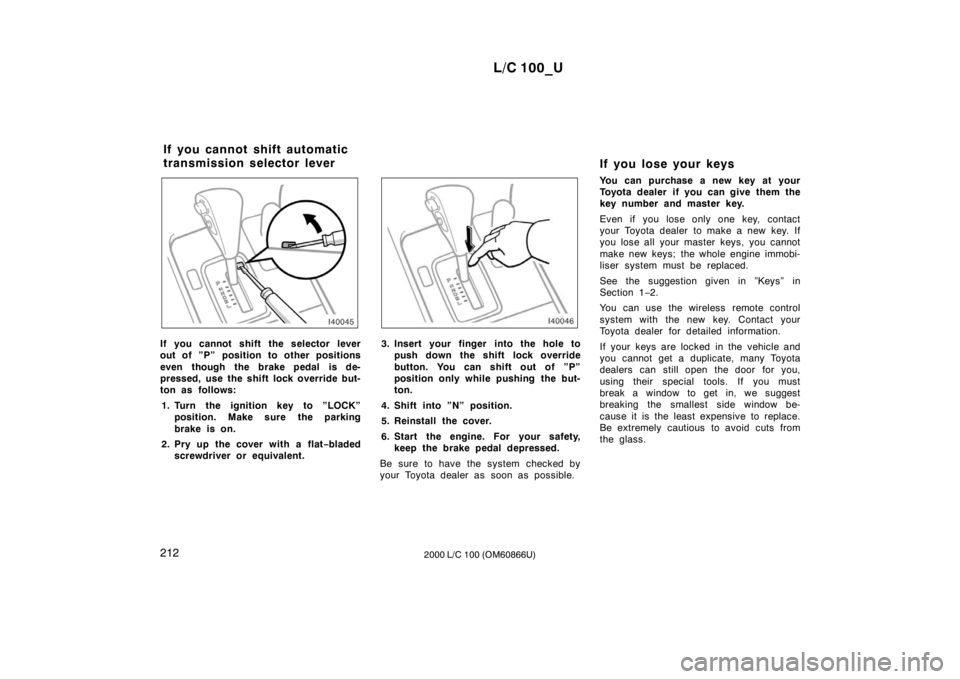
If you cannot shift the selector lever
out of ”P” position to other positions
even though the brake pedal is de-
pressed, use the shift lock override but-
ton as follows:
1. Turn the ignition key to ”LOCK” position. Make sure the parking
brake is on.
2. Pry up the cover with a flat −bladed
screwdriver or equivalent.3. Insert your finger into the hole to push down the shift lock override
button. You can shift out of ”P”
position only while pushing the but-
ton.
4. Shift into ”N” position.
5. Reinstall the cover.
6. Start the engine. For your safety, keep the brake pedal depressed.
Be sure to have the system checked by
your Toyota dealer as soon as possible. If you lose your keys
You can purchase a new key at your
Toyota dealer if you can give them the
key number and master key.
Even if you lose only one key, contact
your Toyota dealer to make a new key. If
you lose all your master keys, you cannot
make new keys; the whole engine immobi-
liser system must be replaced.
See the suggestion given in ”Keys” in
Section 1
−2.
You can use the wireless remote control
system with the new key. Contact your
Toyota dealer for detailed information.
If your keys are locked in the vehicle and
you cannot get a duplicate, many Toyota
dealers can still open the door for you,
using their special tools. If you must
break a window to get in, we suggest
breaking the smallest side window be-
cause it is the least expensive to replace.
Be extremely cautious to avoid cuts from
the glass.
If you cannot shift automatic
transmission selector lever