lock TOYOTA LAND CRUISER 2000 Manual PDF
[x] Cancel search | Manufacturer: TOYOTA, Model Year: 2000, Model line: LAND CRUISER, Model: TOYOTA LAND CRUISER 2000Pages: 235, PDF Size: 5.13 MB
Page 185 of 235
L/C 100_U221
2000 L/C 100 (OM60866U)
If you are a skilled do
−it−yourself
mechanic, the Toyota service manuals are
recommended. Please be aware that do −it−yourself maintenance can affect your
warranty coverage. See ”Owner ’s Warranty
Information Booklet” or ”Owner ’s Manual
Supplement” for the details. General maintenance
Listed below are the general maintenance
items that should be performed as fre-
quently as specified. In addition to check-
ing the items listed, if you notice any
unusual noise, smell or vibration, you
should investigate the cause or take your
vehicle to your Toyota dealer or a quali-
fied service shop immediately. It is recom-
mended that any problem you notice be
brought to the attention of your dealer or
the qualified service shop for their advice.
CAUTION
Make these checks only where ade-
quate ventilation can be obtained if
you run the engine.
OUTSIDE THE VEHICLE
Items listed below should be performed
from time to time, unless otherwise
specified.
Tire pressure
Check the pressure with a gauge every
two weeks, or at least once a month. See
Section 7
−2 for additional information. Tire surface and wheel nuts
Check the tires carefully for cuts, damage
or excessive wear. See Section 7
−2 for
additional information. When checking the
tires, make sure no nuts are missing, and
check the nuts for looseness. Tighten
them if necessary.
Tire rotation
Rotate the tires every 12000 km (7500
miles). See Section 7 −2 for additional in-
formation.
Fluid leaks
Check underneath for leaking fuel, oil, wa-
ter or other fluid after the vehicle has
been parked for a while. If you smell fuel
fumes or notice any leak, have the cause
found and corrected immediately.
Doors and engine hood
Check that all doors and back door oper-
ate smoothly and all latches lock securely.
Make sure the engine hood secondary
latch secures the hood from opening when
the primary latch is released.
Page 186 of 235

L/C 100_U
222 2000 L/C 100 (OM60866U)
INSIDE THE VEHICLE
Items listed below should be checked
regularly, e.g. while performing periodic
services, cleaning the vehicle, etc.
Lights
Make sure the headlights, stop lights, tail
lights, turn signal lights, and other lights
are all working. Check headlight aim.
Service reminder indicators and warning
buzzers
Check that all service reminder indicators
and warning buzzers function properly.
Steering wheel
Be alert for changes in steering condition,
such as hard steering or strange noise.
Seats
Check that all front seat controls such as
seat adjusters, seatback recliner, etc. op-
erate smoothly and that all latches lock
securely in any position. Check that the
head restraint move up and down smooth-
ly and that the locks hold securely in any
latched position. For folding
−down rear
seatbacks, swing −up rear seat cushions
and detachable third seats, check that the
latches lock securely. Seat belts
Check that the seat belt system such as
buckles, retractors and anchors operate
properly and smoothly. Make sure the belt
webbing is not cut, frayed, worn or dam-aged.
Accelerator pedal
Check the pedal for smooth operation and
uneven pedal effort or catching.
Brake pedal
Check the pedal for smooth operation and
that the pedal has the proper clearance.
Check the brake booster function.
Brakes
At a safe place, check that the brakes do
not pull to one side when applied.
Parking brake
Check that the lever has the proper travel
and that, on a safe incline, your vehicle
is held securely with only the parking
brake applied.
Automatic transmission ”Park” mecha-
nism
Check the lock release button of the se-
lector lever for proper and smooth opera-
tion. On a safe incline, check that your
vehicle is held securely with the selector
lever in ”P” position and all brakes re-
leased.
IN THE ENGINE COMPARTMENT
Items listed below should be checked
from time to time, e.g. each time when
refueling.
Washer fluid
Make sure there is sufficient fluid in the
tank. See Section 7
−3 for additional in-
formation.
Engine coolant level
Make sure the coolant level is between
the ”FULL” and ”LOW” lines on the see −
through reservoir when the engine is cold.
See Section 7 −2 for additional information.
Battery electrolyte level
Make sure the electrolyte level of all bat-
tery cells is between upper and lower lev-
el lines on the case. Add only distilled
water when replenishing. See Section 7 −3
for additional information.
Page 190 of 235
L/C 100_U
226 2000 L/C 100 (OM60866U)
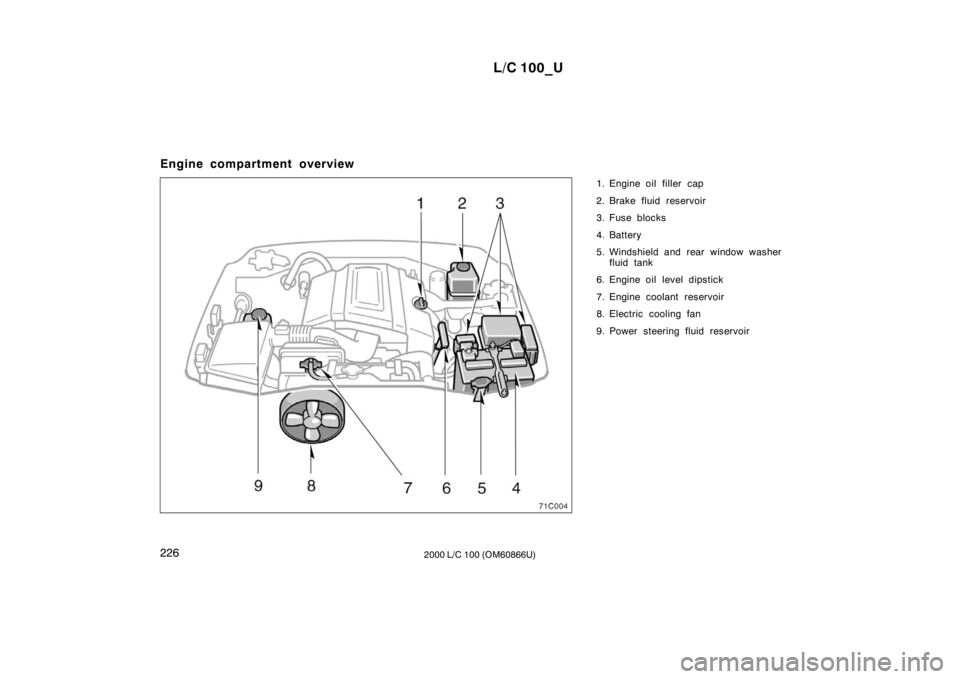
Engine compartment overview
1. Engine oil filler cap
2. Brake fluid reservoir
3. Fuse blocks
4. Battery
5. Windshield and rear window washerfluid tank
6. Engine oil level dipstick
7. Engine coolant reservoir
8. Electric cooling fan
9. Power steering fluid reservoir
Page 200 of 235
L/C 100_U
236 2000 L/C 100 (OM60866U)
NOTICE
If you spill the fluid, be sure to wipe
it off to prevent it from damaging the
parts or painting.
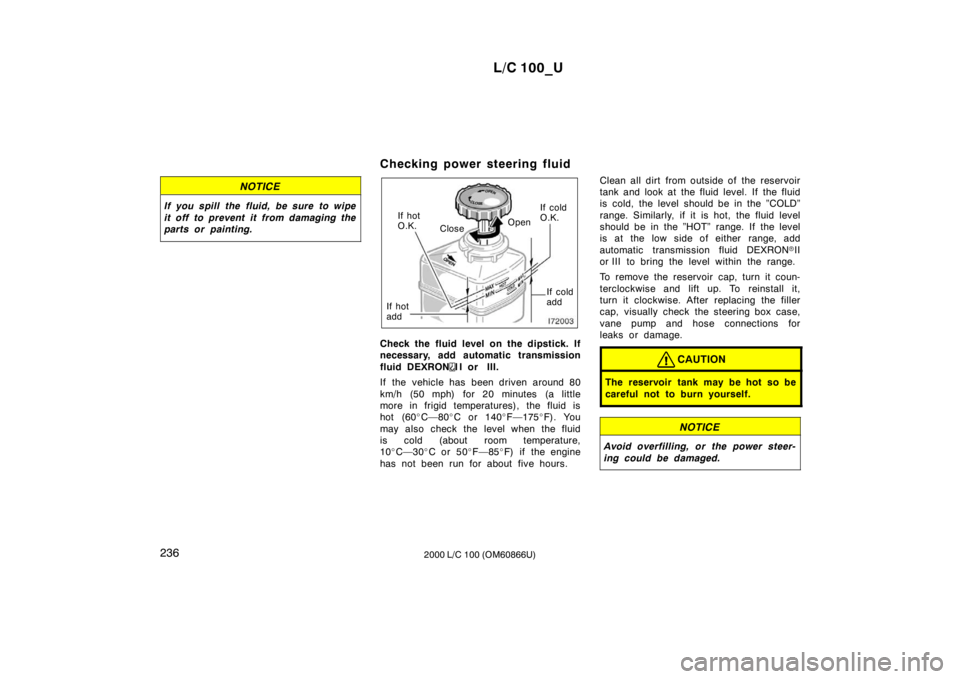
Checking power steering fluid
Open
Close If cold
O.K.
If coldadd
If hot
O.K.
If hotadd
Check the fluid level on the dipstick. If
necessary, add automatic transmission
fluid DEXRON
I I or III.
If the vehicle has been driven around 80
km/h (50 mph) for 20 minutes (a little
more in frigid temperatures), the fluid is
hot (60 C—80 C or 140 F—175 F). You
may also check the level when the fluid
is cold (about room temperature,10 C—30 C or 50 F—85 F) if the engine
has not been run for about five hours. Clean all dirt from outside of the reservoir
tank and look at the fluid level. If the fluid
is cold, the level should be in the ”COLD”
range. Similarly, if it is hot, the fluid level
should be in the ”HOT” range. If the level
is at the low side of either range, add
automatic transmission fluid DEXRON
II
or III to bring the level within the range.
To remove the reservoir cap, turn it coun-
terclockwise and lift up. To reinstall it,
turn it clockwise. After replacing the filler
cap, visually check the steering box case,
vane pump and hose connections for
leaks or damage.CAUTION
The reservoir tank may be hot so be
careful not to burn yourself.
NOTICE
Avoid overfilling, or the power steer-
ing could be damaged.
Page 204 of 235
L/C 100_U
240 2000 L/C 100 (OM60866U)
Regulations regarding the use of tire
chains vary according to location or
type of road, so always check them
before installing chains.
NOTICE
If the wrong combination of tire and
chain is used, the chains could dam-
age the vehicle body.
CHAIN INSTALLATION
Install the chains on the rear tires as
tightly as possible. Do not use tire
chains on the front tires. Retighten
chains after driving 0.5—1.0 km
(1/4—1/2 mile).
When installing chains on your tires, care-
fully follow the instructions of the chain
manufacturer.
If wheel covers are used, they will be
scratched by the chain band, so remove
the covers before putting on the chains.
CAUTION
Do not exceed 50 km/h (30 mph) or
the chain manufacturer ’s recom-
mended speed limit, whichever is
lower.
Drive carefully avoiding bumps,
holes, and sharp turns, which may
cause the vehicle to bounce.
Avoid sharp turns or locked −wheel
braking, as use of chains may ad-
versely affect vehicle handling.
Replacing wheels
WHEN TO REPLACE YOUR WHEELS
If you have wheel damage such as
bending, cracks or heavy corrosion, the
wheel should be replaced.
If you fail to replace damaged wheels, the
tire may slip off the wheel or cause loss
of handling control.
WHEEL SELECTION
When replacing wheels, care should be
taken to ensure that the wheels are re-
placed by ones with the same load ca-
pacity, diameter, rim width, and offset.
Correct replacement wheels are available
at your Toyota dealer.
A wheel of a different size or type may
adversely affect handling, wheel and bear-
ing life, brake cooling, speedometer/odom-
eter calibration, stopping ability, headlight
aim, bumper height, vehicle ground clear-
ance, and tire or snow chain clearance to
the body and chassis.
Page 212 of 235
L/C 100_U
248 2000 L/C 100 (OM60866U)
Light bulbs
Bulb
No.WTy p e
Front fog lights900651B
Parking lights—5D
Rear turn signal
lights744021D
Stop and tail lights744321/5D
Back −up lights744021D
License plate lights—5D
Interior lights—8E
Personal lights
Ty p e A
Ty p e B
— —5 8F
E
Glove box light—1.4D
Door courtesy
lights—3D
Vanity lights—1.5E
A : HB3 halogen bulbs
B : HB4 halogen bulbs
C : Single end bulbs (amber)
D : Wedge base bulbs
E : Double end bulbs
F : Single end bulbs —Headlights
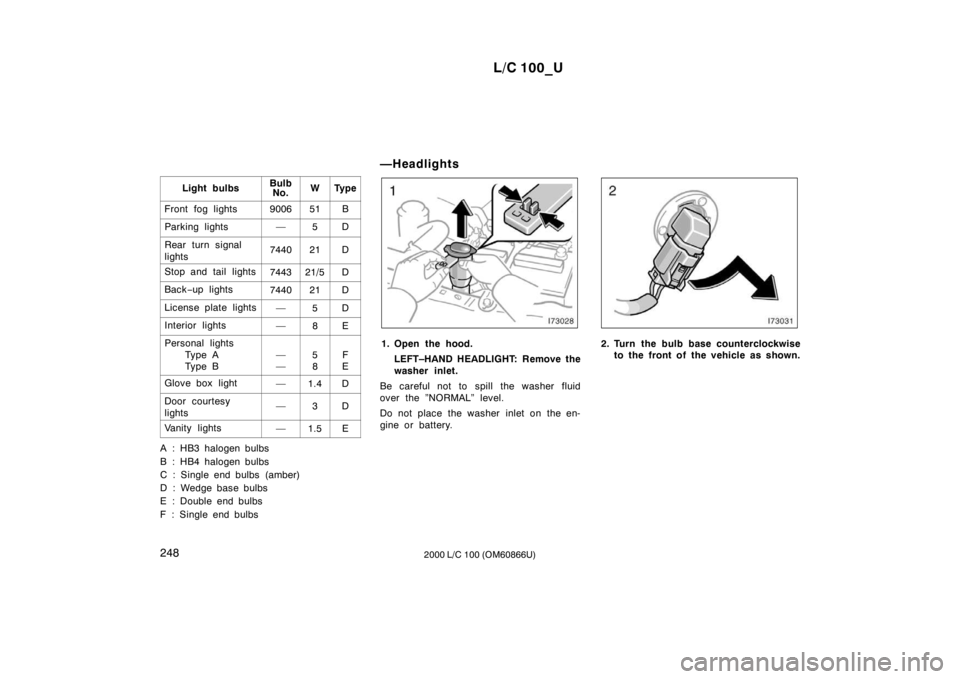
1. Open the hood.
LEFT–HAND HEADLIGHT: Remove the
washer inlet.
Be careful not to spill the washer fluid
over the ”NORMAL” level.
Do not place the washer inlet on the en-
gine or battery.2. Turn the bulb base counterclockwise to the front of the vehicle as shown.
Page 213 of 235
L/C 100_U249
2000 L/C 100 (OM60866U)
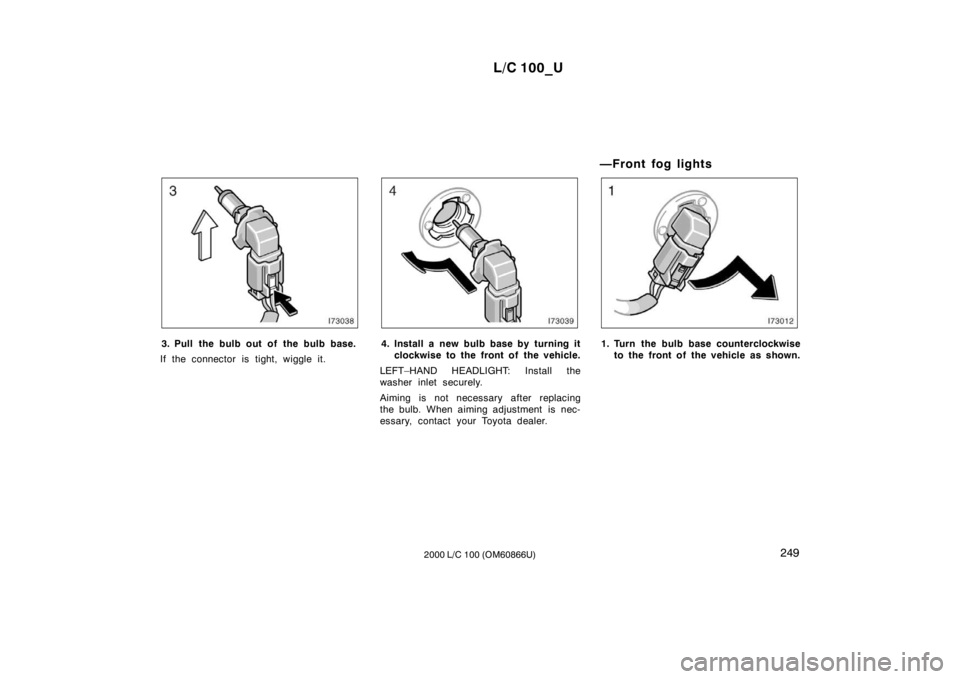
3. Pull the bulb out of the bulb base.
If the connector is tight, wiggle it.4. Install a new bulb base by turning it clockwise to the front of the vehicle.
LEFT–HAND HEADLIGHT: Install the
washer inlet securely.
Aiming is not necessary after replacing
the bulb. When aiming adjustment is nec-
essary, contact your Toyota dealer. —Front fog lights1. Turn the bulb base counterclockwise
to the front of the vehicle as shown.
Page 214 of 235
L/C 100_U
250 2000 L/C 100 (OM60866U)
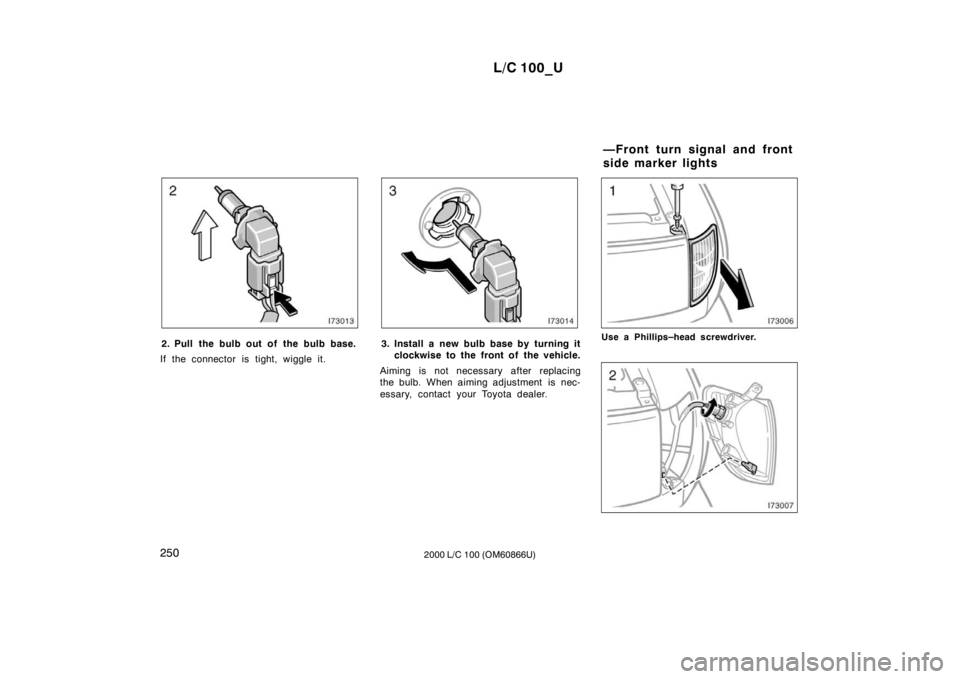
2. Pull the bulb out of the bulb base.
If the connector is tight, wiggle it.3. Install a new bulb base by turning it clockwise to the front of the vehicle.
Aiming is not necessary after replacing
the bulb. When aiming adjustment is nec-
essary, contact your Toyota dealer.Use a Phillips –head screwdriver.
—Front turn signal and front
side marker lights
Page 221 of 235
L/C 100_U257
2000 L/C 100 (OM60866U)
Service specifications
ENGINE
Valve clearance (engine cold), mm (in.):
Intake 0.15—0.25 (0.006—0.010)
Exhaust 0.25—0.35 (0.010—0.014)
Spark plug type: DENSO SK20R11
NGK IFR6A11
Spark plug gap, mm (in.): 1.1 (0.043)
ENGINE LUBRICATION
Oil capacity (drain and ref ill), L (qt., Imp.
qt.)
With filter 6.8 (7.2, 6.0)
Without filter 6.4 (6.8, 5.6)
Oil grade: API grade SJ, ”Energy −Conserving” mul-
tigrade engine oil or ILSAC multigrade
engine oil is recommended.
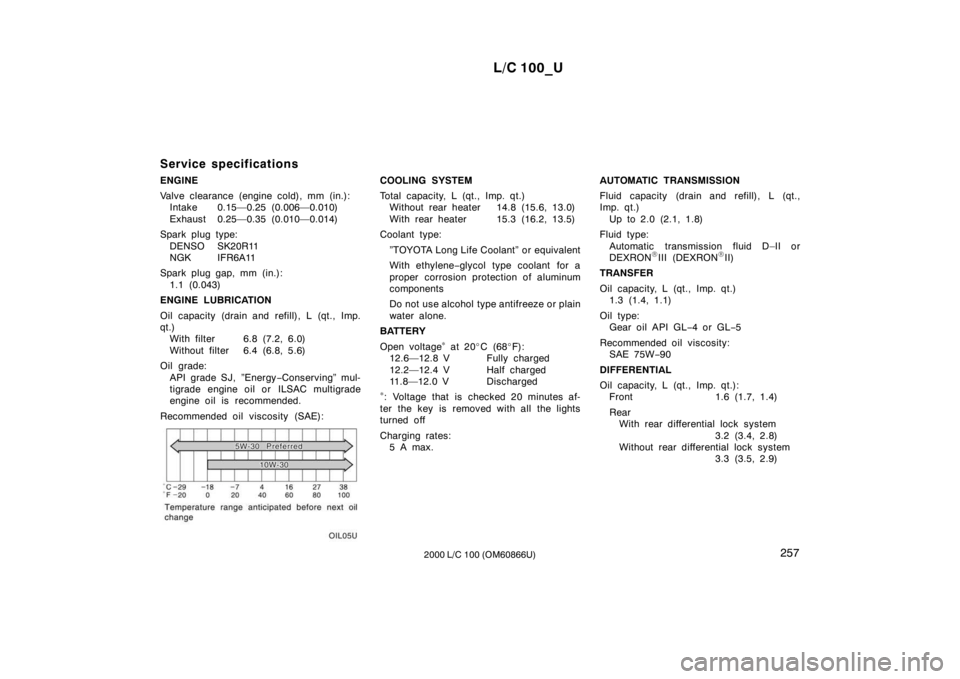
Recommended oil viscosity (SAE):
COOLING SYSTEM
Total capacity, L (qt., Imp. qt.) Without rear heater 14.8 (15.6, 13.0)
With rear heater 15.3 (16.2, 13.5)
Coolant type:
”TOYOTA Long Life Coolant” or equivalent
With ethylene −glycol type coolant for a
proper corrosion protection of aluminum
components
Do not use alcohol type antifreeze or plain
water alone.
BATTERY
Open voltage
at 20 C (68 F):
12.6—12.8 V Fully charged
12.2—12.4 V Half charged
11.8—12.0 V Discharged
: Voltage that is checked 20 minutes af-
ter the key is removed with all the lights
turned off
Charging rates: 5 A max. AUTOMATIC TRANSMISSION
Fluid capacity (drain and refill), L (qt.,
Imp. qt.)
Up to 2.0 (2.1, 1.8)
Fluid type: Automatic transmission fluid D–II orDEXRON
III (DEXRON
II)
TRANSFER
Oil capacity, L (qt., Imp. qt.) 1.3 (1.4, 1.1)
Oil type: Gear oil API GL −4 or GL −5
Recommended oil viscosity: SAE 75W −90
DIFFERENTIAL
Oil capacity, L (qt., Imp. qt.): Front 1.6 (1.7, 1.4) Rear
With rear differential lock system
3.2 (3.4, 2.8)
Without rear differential lock system 3.3 (3.5, 2.9)
Page 223 of 235
L/C 100_U259
2000 L/C 100 (OM60866U)
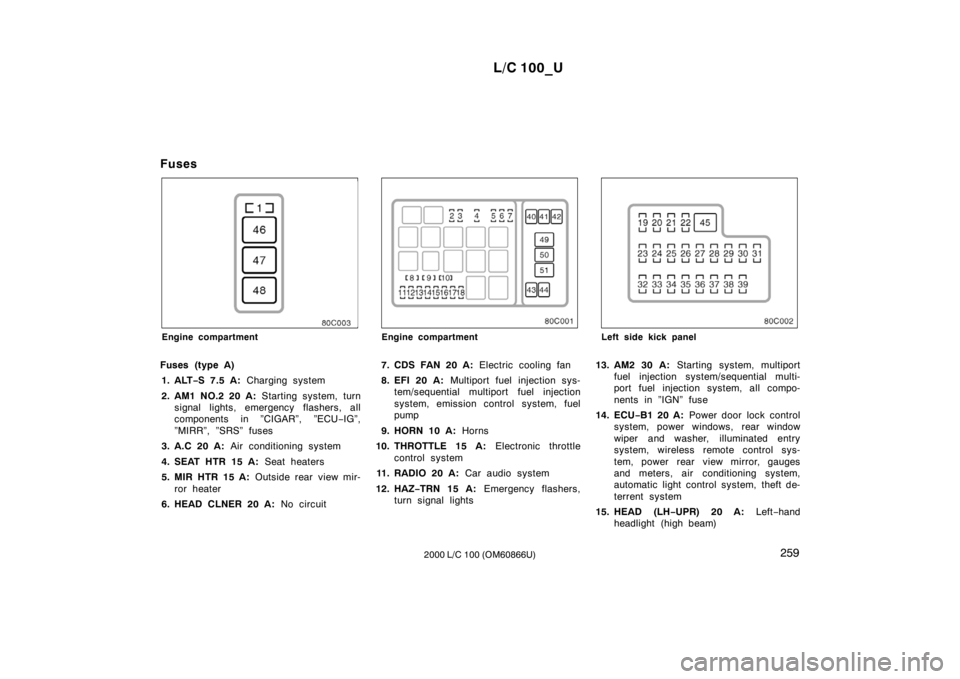
Fuses
Engine compartment
Fuses (type A) 1. ALT −S 7.5 A: Charging system
2. AM1 NO.2 20 A: Starting system, turn
signal lights, emergency flashers, all
components in ”CIGAR”, ”ECU −IG”,
”MIRR”, ”SRS” fuses
3. A.C 20 A: Air conditioning system
4. SEAT HTR 15 A: Seat heaters
5. MIR HTR 15 A: Outside rear view mir-
ror heater
6. HEAD CLNER 20 A: No circuitEngine compartment
7. CDS FAN 20 A: Electric cooling fan
8. EFI 20 A: Multiport fuel injection sys-
tem/sequential multiport fuel injection
system, emission control system, fuel
pump
9. HORN 10 A: Horns
10. THROTTLE 15 A: Electronic throttle
control system
11. RADIO 20 A: Car audio system
12. HAZ −TRN 15 A: Emergency flashers,
turn signal lightsLeft side kick panel
13. AM2 30 A: Starting system, multiport
fuel injection system/sequential multi-
port fuel injection system, all compo-
nents in ”IGN” fuse
14. ECU −B1 20 A: Power door lock control
system, power wi ndows, rear window
wiper and washer, illuminated entry
system, wireless remote control sys-
tem, power rear view mirror, gauges
and meters, air conditioning system,
automatic light control system, theft de-
terrent system
15. HEAD (LH −UPR) 20 A: Left−hand
headlight (high beam)