height TOYOTA LAND CRUISER 2012 Owner's Manual
[x] Cancel search | Manufacturer: TOYOTA, Model Year: 2012, Model line: LAND CRUISER, Model: TOYOTA LAND CRUISER 2012Pages: 692, PDF Size: 29.3 MB
Page 257 of 692
257 2-4. Using other driving systems
2
When driving
L/C200_EE (OM60G38E)
NOTICE
When parking in areas with limited overhead height
After leaving the vehicle or unloading the luggage, the vehicle height may be
slightly higher than normal. Take care when overhead height is limited.
To avoid damage to the vehicle
Normal mode will be switched to automatically even if the vehicle is started
off in low mode. Take care when overhead height is limited.
Do not select the low mode when driving on bumpy roads, as the under-
body of the vehicle may contact the road surface.
Avoid rapid changes to the vehicle height
As the pump may overheat. Leave at a few seconds between selections
when changing the vehicle height mode.
Page 313 of 692
313
2
When driving
L/C200_EE (OM60G38E)
2-5. Driving information
Off-road precautions
Off-road vehicle feature
Specific design characteristics give it a higher center of gravity
than ordinary passenger cars. This vehicle design feature causes
this type of vehicle to be more likely to rollover. And, utility vehicles
have a significantly higher rollover rate than other types of vehi-
cles.
An advantage of the higher ground clearance is a better view of the
road allowing you to anticipate problems.
It is not designed for cornering at the same speeds as ordinary
passenger cars any more than low-slung sports cars are designed
to perform satisfactorily under off-road conditions. Therefore, sharp
turns at excessive speeds may cause rollover.
This vehicle belongs to the utility vehicle class, which has higher
ground clearance and narrower tread in relation to the height of its
center of gravity to make it capable of performing in a wide variety
of off-road applications.
Page 322 of 692
322 2-5. Driving information
L/C200_EE (OM60G38E)
CAUTION
Driving with snow tires
Observe the following precautions to reduce the risk of accidents.
Failing to do so may result in a loss of vehicle control and cause death or
serious injury.
Use tires of the size specified for your vehicle.
Maintain the recommended level of tire inflation pressure.
Do not drive at speeds in excess of the speed limit or the speed limit spec-
ified for the snow tires being used.
Snow tires should be installed on all wheels.
Driving with tire chains
Observe the following precautions to reduce the risk of accidents.
Failing to do so may result in the vehicle being unable to be driven safely,
and may cause death or serious injury.
Do not drive in excess of the speed limit specified for the tire chains being
used or 50 km/h (30 mph), whichever is lower.
Avoid driving on bumpy road surfaces or over potholes.
Avoid sudden acceleration, abrupt steering, sudden braking and shifting
operations that cause sudden engine braking.
Slow down sufficiently before entering a curve to ensure that vehicle con-
trol is maintained.
When installing tire chains
Vehicles with the 4-Wheel AHC: Turn off the vehicle height control.
The vehicle height may change due to the automatic leveling function and
you may catch part of your body in the vehicle, resulting in an accident.
(P. 248)
Page 327 of 692
327 2-5. Driving information
2
When driving
L/C200_EE (OM60G38E)
Connecting and disconnecting a trailer (vehicles with 4-Wheel
AHC)
Stop your vehicle and a trailer in line and perform the following:
Connecting a trailer
Put the 4-Wheel AHC in the “LO” (low) mode.
Turn off the “ENGINE START STOP” switch or the 4-Wheel
AHC.
Connect a trailer.
Turn on the “ENGINE START STOP” switch or the 4-Wheel
AHC.
Select the “N” (normal) mode with the height select switch.
When a vehicle loaded with four occupants tows a trailer of about
1800 kg (4000 lb.) with more than about 180 kg (400 lb.) tongue
load, the normal mode may not be selected. However, there is no
problem to continue normal driving. Drive with sufficient care
because of large load.
Disconnecting a trailer
Put the 4-Wheel AHC in the “LO” (low) mode. (Make sure the
vehicle height is in the “LO” mode by pushing
“” on the
height select switch.)
Turn off the “ENGINE START STOP” switch or the 4-Wheel
AHC.
Set the supporting leg of a trailer on the ground and raise the
hitch by 100 mm (4 in.).
Turn on the “ENGINE START STOP” switch or the 4-Wheel
AHC.
STEP1
STEP2
STEP3
STEP4
STEP5
STEP1
STEP2
STEP3
STEP4
Page 328 of 692
328 2-5. Driving information
L/C200_EE (OM60G38E)Wait for about 20 seconds until the rear vehicle height is low-
ered by the automatic leveling function.
Make sure the hitch is disconnected. If not, raise the hitch
higher and repeat steps 2 through 5.
Move the vehicle forward in the “LO” mode where the hitch
does not touch anything in the “N” (normal) mode.
Put the 4-Wheel AHC in the “N” mode.
Tire information
Increase the air pressure of the trailer tires in accordance with the total trailer
weight and according to the values recommended by the manufacturer of
your trailer.
Trailer lights
Please consult at any authorized dealer or repairer, or another duly qualified
and equipped professional when installing trailer lights, as incorrect installa-
tion may cause damage to the vehicle’s lights. Please take care to comply
with your state’s laws when installing trailer lights.
Break-in schedule
Toyota recommends that vehicles fitted with new power train components
should not be used for towing trailers for the first 800 km (500 miles).
Maintenance
Maintenance must be performed more frequently when using the vehicle
for towing due to the greater weight burden placed on the vehicle com-
pared to normal driving.
Retighten all bolts securing the hitching ball and bracket after towing for
approximately 1000 km (600 miles).
STEP5
STEP6
STEP7
STEP8
Page 329 of 692
329 2-5. Driving information
2
When driving
L/C200_EE (OM60G38E)
Safety checks before towing
Check that the maximum load limit for the towing hitch/bracket and hitch
ball is not exceeded. Bear in mind that the coupling weight of the trailer
will add to the load exerted on the vehicle. Also make sure that total load
exerted on the vehicle is within the range of the weight limits. (P. 324)
Ensure that the trailer load is secure.
Supplementary outside rear view mirrors should be added to the vehicle
if the traffic behind cannot be clearly seen with standard mirrors. Adjust
the extending arms of these mirrors on both sides of the vehicle so that
they always provide maximum visibility of the road behind.
CAUTION
To avoid accident or injury
Set the vehicle height to the “LO” mode and turn off the 4-Wheel AHC when
you connect a trailer, otherwise the vehicle height may change due to the
automatic leveling function, and you may catch part of your body in the vehi-
cle, resulting in an accident. (P. 248)
NOTICE
When the rear bumper strengthening material is aluminum
Ensure the steel bracket part does not come directly in contact with that
area.
When steel and aluminum come into contact, there is a reaction similar to
corrosion, which will weaken the section concerned which may result in
damage. Apply a rust inhibitor to parts that will come in contact when attach-
ing a steel bracket.
Page 566 of 692
566 5-1. Essential information
L/C200_EE (OM60G38E)
Emergency towing
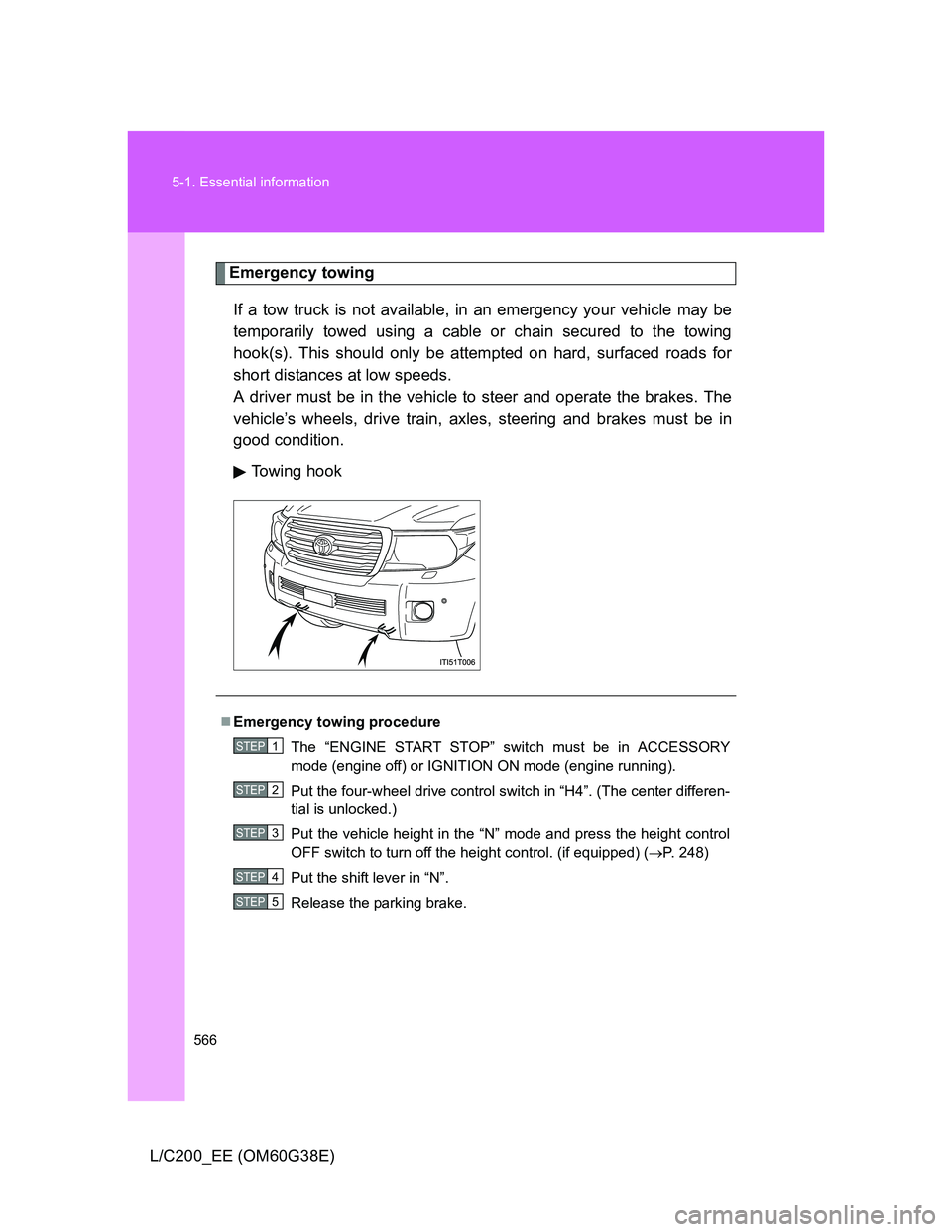
If a tow truck is not available, in an emergency your vehicle may be
temporarily towed using a cable or chain secured to the towing
hook(s). This should only be attempted on hard, surfaced roads for
short distances at low speeds.
A driver must be in the vehicle to steer and operate the brakes. The
vehicle’s wheels, drive train, axles, steering and brakes must be in
good condition.
Towing hook
Emergency towing procedure
The “ENGINE START STOP” switch must be in ACCESSORY
mode (engine off) or IGNITION ON mode (engine running).
Put the four-wheel drive control switch in “H4”. (The center differen-
tial is unlocked.)
Put the vehicle height in the “N” mode and press the height control
OFF switch to turn off the height control. (if equipped) (P. 248)
Put the shift lever in “N”.
Release the parking brake.
STEP1
STEP2
STEP3
STEP4
STEP5
Page 607 of 692
5
607 5-2. Steps to take in an emergency
When trouble arises
L/C200_EE (OM60G38E)
CAUTION
Using the tire jack
Improper use of the tire jack may lead to death or serious injuries due to the
vehicle suddenly falling off the jack.
Do not use the tire jack for any purpose other than replacing tires or install-
ing and removing tire chains.
Only use the tire jack that comes with this vehicle for replacing a flat tire.
Do not use it on other vehicles, and do not use other tire jacks for replac-
ing tires on this vehicle.
Always check that the tire jack is securely set to the jack point.
Be sure to turn off the 4-Wheel AHC and stop the engine. (Vehicles with 4-
Wheel AHC)
Do not put any part of your body under the vehicle supported by a jack.
Do not start or run the engine while your vehicle is supported by the jack.
Do not raise the vehicle while someone is in it.
When raising the vehicle, do not put an object on or under the jack.
Do not raise the vehicle to a height greater than that required to replace
the tire.
Use a jack stand if it is necessary to get under the vehicle.
Take particular care when lowering the vehicle to ensure that no one working
on or near the vehicle will be injured.
Using the jack handle
Tighten all the jack handle bolts securely using a Phillips-head screwdriver,
to prevent the extension parts from coming apart unexpectedly.
Page 608 of 692
608 5-2. Steps to take in an emergency
L/C200_EE (OM60G38E)
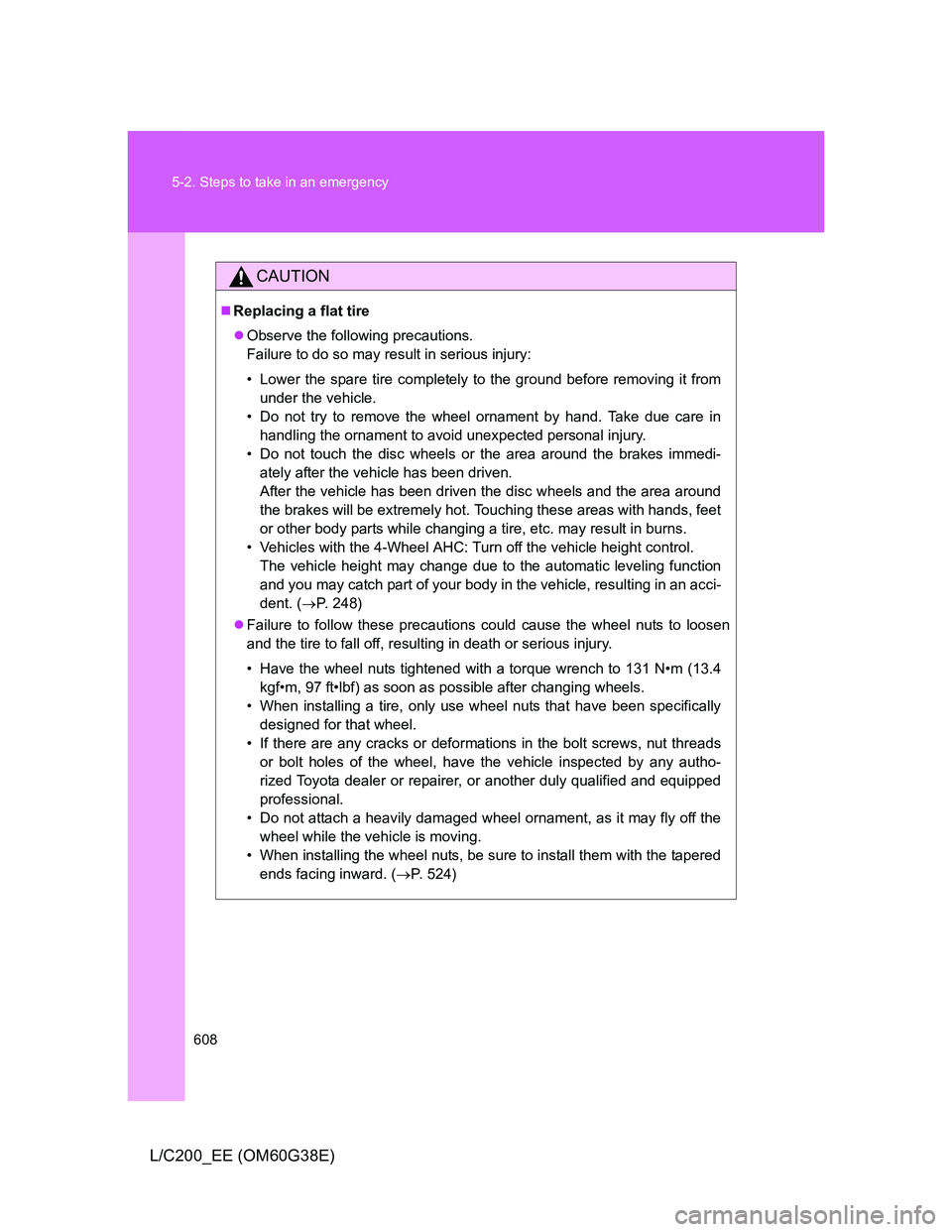
CAUTION
Replacing a flat tire
Observe the following precautions.
Failure to do so may result in serious injury:
• Lower the spare tire completely to the ground before removing it from
under the vehicle.
• Do not try to remove the wheel ornament by hand. Take due care in
handling the ornament to avoid unexpected personal injury.
• Do not touch the disc wheels or the area around the brakes immedi-
ately after the vehicle has been driven.
After the vehicle has been driven the disc wheels and the area around
the brakes will be extremely hot. Touching these areas with hands, feet
or other body parts while changing a tire, etc. may result in burns.
• Vehicles with the 4-Wheel AHC: Turn off the vehicle height control.
The vehicle height may change due to the automatic leveling function
and you may catch part of your body in the vehicle, resulting in an acci-
dent. (P. 248)
Failure to follow these precautions could cause the wheel nuts to loosen
and the tire to fall off, resulting in death or serious injury.
• Have the wheel nuts tightened with a torque wrench to 131 N•m (13.4
kgf•m, 97 ft•lbf) as soon as possible after changing wheels.
• When installing a tire, only use wheel nuts that have been specifically
designed for that wheel.
• If there are any cracks or deformations in the bolt screws, nut threads
or bolt holes of the wheel, have the vehicle inspected by any autho-
rized Toyota dealer or repairer, or another duly qualified and equipped
professional.
• Do not attach a heavily damaged wheel ornament, as it may fly off the
wheel while the vehicle is moving.
• When installing the wheel nuts, be sure to install them with the tapered
ends facing inward. (P. 524)
Page 644 of 692
644
L/C200_EE (OM60G38E)
6-1. Specifications
Maintenance data (fuel, oil level, etc.)
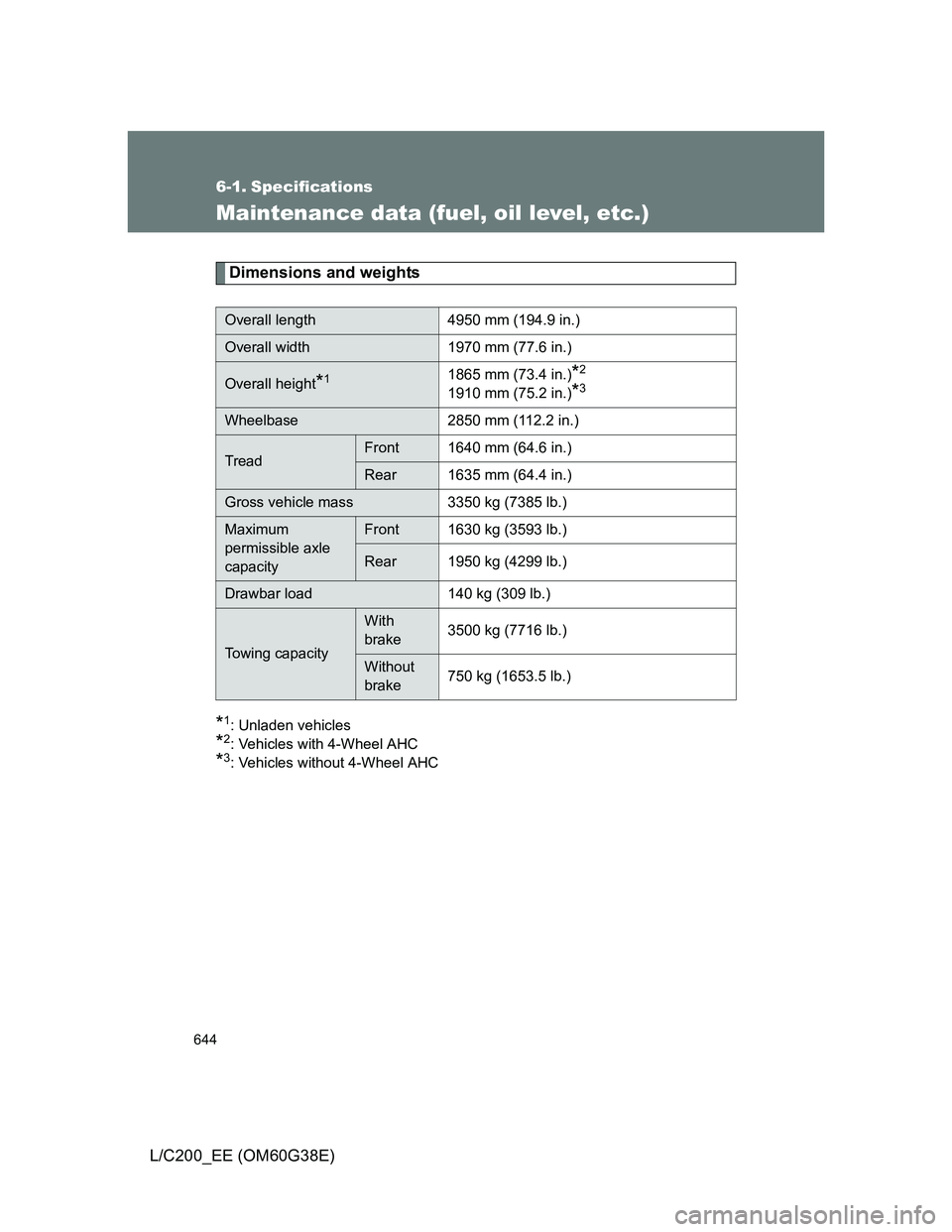
Dimensions and weights
*1: Unladen vehicles
*2: Vehicles with 4-Wheel AHC
*3: Vehicles without 4-Wheel AHC
Overall length 4950 mm (194.9 in.)
Overall width 1970 mm (77.6 in.)
Overall height*11865 mm (73.4 in.)*2
1910 mm (75.2 in.)*3
Wheelbase 2850 mm (112.2 in.)
TreadFront 1640 mm (64.6 in.)
Rear 1635 mm (64.4 in.)
Gross vehicle mass 3350 kg (7385 lb.)
Maximum
permissible axle
capacityFront 1630 kg (3593 lb.)
Rear 1950 kg (4299 lb.)
Drawbar load 140 kg (309 lb.)
Towing capacity
With
brake3500 kg (7716 lb.)
Without
brake750 kg (1653.5 lb.)