light TOYOTA LAND CRUISER 2012 Owner's Guide
[x] Cancel search | Manufacturer: TOYOTA, Model Year: 2012, Model line: LAND CRUISER, Model: TOYOTA LAND CRUISER 2012Pages: 692, PDF Size: 29.3 MB
Page 117 of 692
117 1-5. Refueling
1
Before driving
L/C200_EE (OM60G38E)
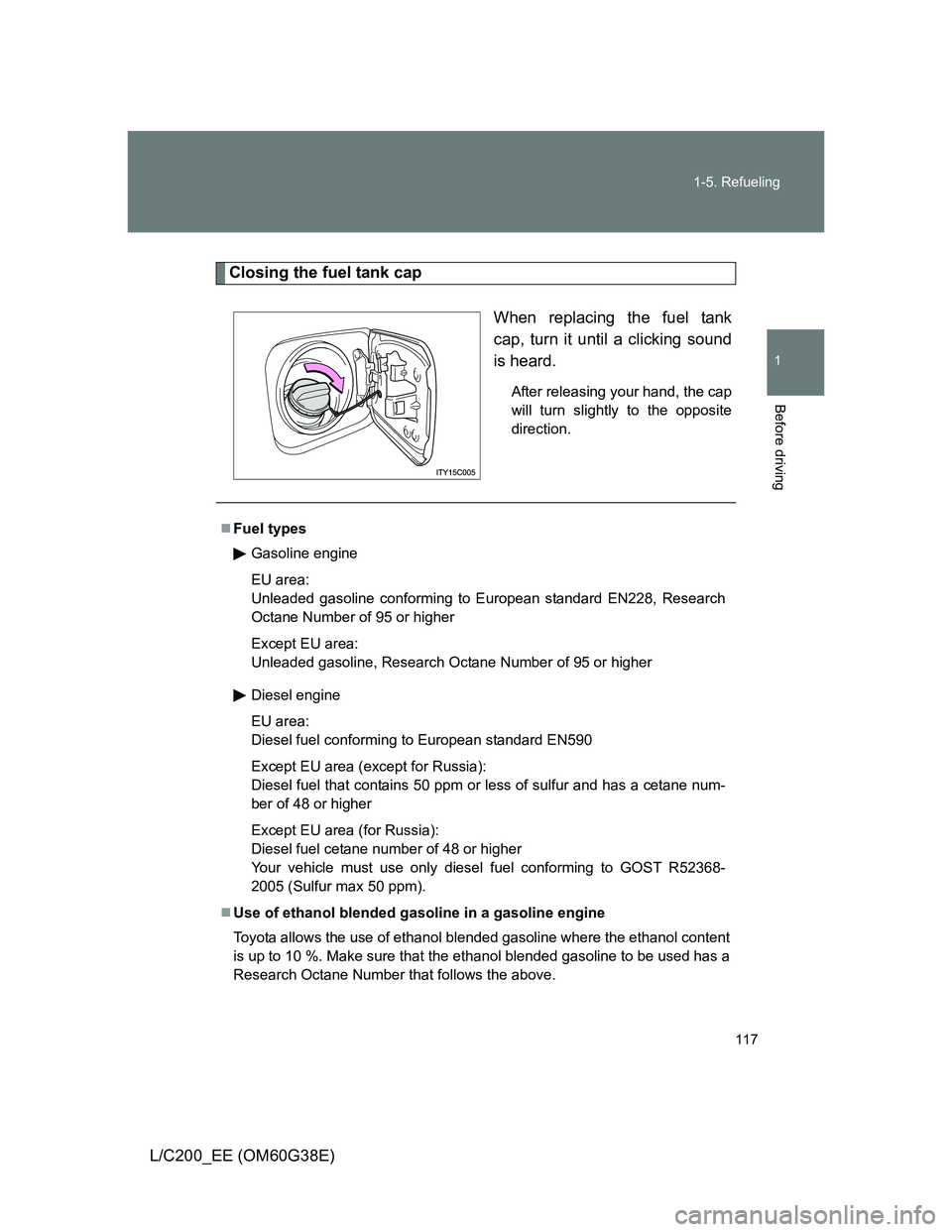
Closing the fuel tank cap
When replacing the fuel tank
cap, turn it until a clicking sound
is heard.
After releasing your hand, the cap
will turn slightly to the opposite
direction.
Fuel types
Gasoline engine
EU area:
Unleaded gasoline conforming to European standard EN228, Research
Octane Number of 95 or higher
Except EU area:
Unleaded gasoline, Research Octane Number of 95 or higher
Diesel engine
EU area:
Diesel fuel conforming to European standard EN590
Except EU area (except for Russia):
Diesel fuel that contains 50 ppm or less of sulfur and has a cetane num-
ber of 48 or higher
Except EU area (for Russia):
Diesel fuel cetane number of 48 or higher
Your vehicle must use only diesel fuel conforming to GOST R52368-
2005 (Sulfur max 50 ppm).
Use of ethanol blended gasoline in a gasoline engine
Toyota allows the use of ethanol blended gasoline where the ethanol content
is up to 10 %. Make sure that the ethanol blended gasoline to be used has a
Research Octane Number that follows the above.
Page 120 of 692
120
L/C200_EE (OM60G38E)
1-6. Theft deterrent system
Engine immobilizer system
The vehicle’s keys have built-in transponder chips that prevent the
engine from starting if the key has not been previously registered in
the vehicle’s on-board computer.
Never leave the keys inside the vehicle when you leave the vehicle.
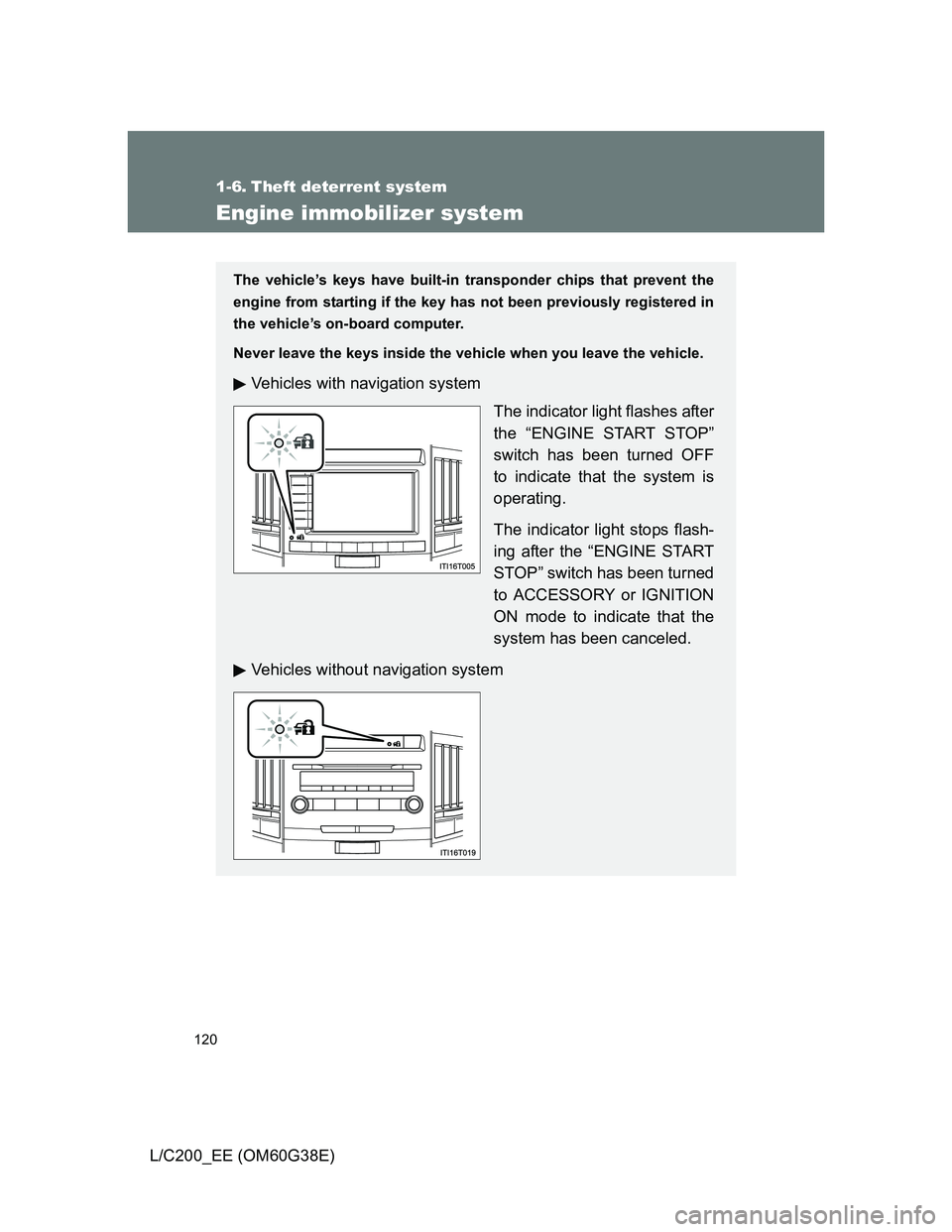
Vehicles with navigation system
The indicator light flashes after
the “ENGINE START STOP”
switch has been turned OFF
to indicate that the system is
operating.
The indicator light stops flash-
ing after the “ENGINE START
STOP” switch has been turned
to ACCESSORY or IGNITION
ON mode to indicate that the
system has been canceled.
Vehicles without navigation system
Page 127 of 692
127
1
1-6. Theft deterrent system
Before driving
L/C200_EE (OM60G38E)
Alarm
The system sounds the alarm and flashes lights when forcible entry
is detected.
Triggering of the alarm
The alarm is triggered in the following situations when the alarm
is set:
A locked door is unlocked or opened in any way other than
using the entry function or the wireless remote control. (The
doors will lock again automatically.)
The hood is opened.
The intrusion sensor detects something moving inside the
vehicle. (An intruder gets in the vehicle.) (if equipped)
The tilt sensor detects a change of vehicle inclination. (if
equipped)
The quarter windows or back door window are broken. (if
equipped)
Page 128 of 692

128 1-6. Theft deterrent system
L/C200_EE (OM60G38E)
Setting the alarm system
Vehicles with navigation system
Close the doors and hood,
and lock all the doors using
the entry function or wireless
remote control. The system
will be set automatically after
30 seconds.
The indicator light changes
from being on to flashing when
the system is set.
Vehicles without navigation system
Deactivating or stopping the alarm
Do one of the following to deactivate or stop the alarm.
Unlock the doors using the entry function or the wireless
remote control.
Start the engine. (The alarm will be deactivated or stopped
after a few seconds.)
Page 133 of 692
133 1-6. Theft deterrent system
1
Before driving
L/C200_EE (OM60G38E)
The vehicle is inside an automatic or high-pressure car wash.
The vehicle experiences impacts, such as hail, lightning strikes, and
other kinds of repeated impacts or vibrations.
Tilt sensor detection considerations
The sensor may trigger the alarm in the following situations:
The vehicle is transported by a ferry, trailer, train, etc.
The vehicle is parked in a parking garage.
The vehicle is inside a car wash that moves the vehicle.
Any of the tires loses air pressure.
The vehicle is jacked up.
An earthquake occurs or the road caves in.
Cargo is loaded onto or unloaded from the roof luggage carrier.
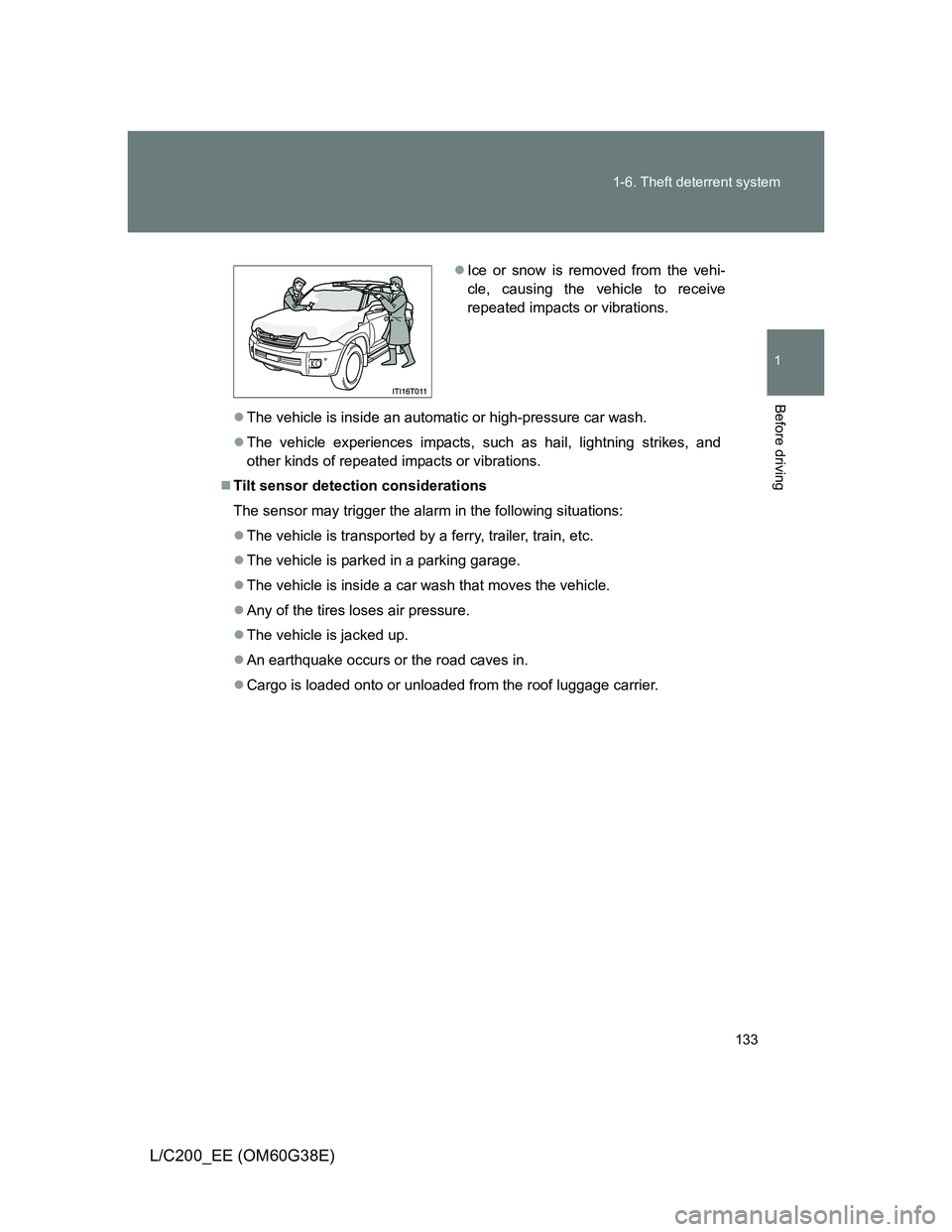
Ice or snow is removed from the vehi-
cle, causing the vehicle to receive
repeated impacts or vibrations.
Page 139 of 692
139 1-7. Safety information
1
Before driving
L/C200_EE (OM60G38E)
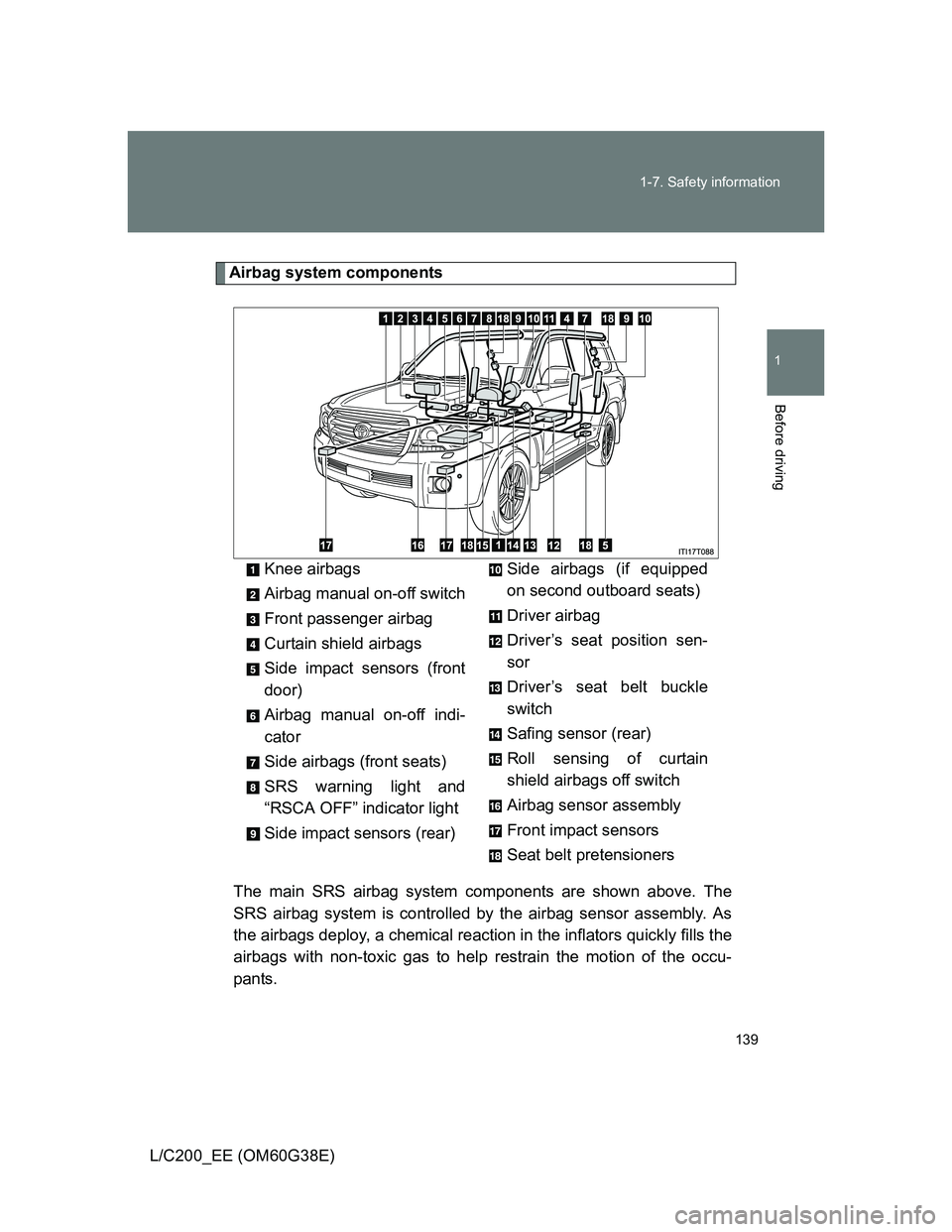
Airbag system components
The main SRS airbag system components are shown above. The
SRS airbag system is controlled by the airbag sensor assembly. As
the airbags deploy, a chemical reaction in the inflators quickly fills the
airbags with non-toxic gas to help restrain the motion of the occu-
pants.Knee airbags
Airbag manual on-off switch
Front passenger airbag
Curtain shield airbags
Side impact sensors (front
door)
Airbag manual on-off indi-
cator
Side airbags (front seats)
SRS warning light and
“RSCA OFF” indicator light
Side impact sensors (rear)Side airbags (if equipped
on second outboard seats)
Driver airbag
Driver’s seat position sen-
sor
Driver’s seat belt buckle
switch
Safing sensor (rear)
Roll sensing of curtain
shield airbags off switch
Airbag sensor assembly
Front impact sensors
Seat belt pretensioners
Page 140 of 692
140 1-7. Safety information
L/C200_EE (OM60G38E)
If the SRS airbags deploy (inflate)
Bruising and slight abrasions may result from contact with a deploying
(inflating) SRS airbag.
A loud noise and white powder will be emitted.
Parts of the airbag module (steering wheel hub, airbag cover and inflator)
as well as the front seats, second seats, and parts of the front, side and
rear pillars and roof side rail, may be hot for several minutes. The airbag
itself may also be hot.
The windshield may crack.
SRS airbag deployment conditions (SRS front airbags)
The SRS front airbag will deploy in the event of an impact that exceeds
the set threshold level (the level of force corresponding to an approxi-
mately 20 - 30 km/h [12 - 18 mph] frontal collision with a fixed wall that
does not move or deform).
However, this threshold velocity will be considerably higher if the vehicle
strikes an object, such as a parked vehicle and sign pole, which can move
or deform on impact, or if the vehicle is involved in an underride collision
(e.g. a collision in which the front of the vehicle “underrides”, or goes
under, the bed of a truck, etc.).
It is possible that in some collisions where the forward deceleration of the
vehicle is very close to the designed threshold level, the SRS front air-
bags and the seat belt pretensioners may not activate together.
SRS airbag deployment conditions (SRS side airbags and SRS curtain
shield airbags)
The SRS side airbags and SRS curtain shield airbags will deploy in the
event of an impact that exceeds the set threshold level (the level of force
corresponding to the impact force produced by an approximately 1500 kg
[3300 lb.] vehicle colliding with the vehicle cabin from a direction perpen-
dicular to the vehicle orientation at an approximate speed of 20 - 30 km/h
[12 - 18 mph]).
The SRS curtain shield airbags will deploy in the event of vehicle rollover.
Page 145 of 692
145 1-7. Safety information
1
Before driving
L/C200_EE (OM60G38E)
CAUTION
SRS airbag precautions
Observe the following precautions regarding the SRS airbags.
Failure to do so may cause death or serious injury.
The driver and all passengers in the vehicle must wear their seat belts
properly.
The SRS airbags are supplemental devices to be used with the seat belts.
The SRS driver airbag deploys with considerable force, and can cause
death or serious injury especially if the driver is very close to the airbag.
Since the risk zone for the driver’s airbag is the first 50 - 75 mm (2 - 3 in.)
of inflation, placing yourself 250 mm (10 in.) from your driver airbag pro-
vides you with a clear margin of safety. This distance is measured from the
center of the steering wheel to your breastbone. If you sit less than 250
mm (10 in.) away now, you can change your driving position in several
ways:
• Move your seat to the rear as far as you can while still reaching the
pedals comfortably.
• Slightly recline the back of the seat.
Although vehicle designs vary, many drivers can achieve the 250 mm
(10 in.) distance, even with the driver seat all the way forward, simply
by reclining the back of the seat somewhat. If reclining the back of your
seat makes it hard to see the road, raise yourself by using a firm, non-
slippery cushion, or raise the seat if your vehicle has that feature.
• If your steering wheel is adjustable, tilt it downward. This points the air-
bag toward your chest instead of your head and neck.
The seat should be adjusted as recommended above, while still maintain-
ing control of the foot pedals, steering wheel, and your view of the instru-
ment panel controls.
Page 177 of 692
2When driving
177
L/C200_EE (OM60G38E)
2-1. Driving procedures
Driving the vehicle ............ 178
Engine (ignition) switch..... 190
Automatic transmission .... 194
Turn signal lever ............... 200
Parking brake ................... 201
Horn .................................. 202
2-2. Instrument cluster
Gauges and meters .......... 203
Indicators and
warning lights.................. 207
Multi-information
display ............................ 212
2-3. Operating the lights and
wipers
Headlight switch ............... 218
Fog light switch ................. 222
Windshield wipers and
washer ............................ 224
Rear window wiper and
washer ............................ 231
Headlight cleaner
switch ............................. 2322-4. Using other driving systems
Cruise control.................... 233
Toyota parking
assist-sensor .................. 237
4-Wheel AHC
(Active Height Control
Suspension).................... 248
AVS (Adaptive Variable
Suspension system) ....... 258
Four-wheel drive
system ............................ 259
Crawl Control (with Turn
Assist function) ............... 264
Multi-terrain Select ............ 270
Multi-terrain Monitor .......... 276
Driving assist systems ...... 300
PCS
(Pre-Crash Safety).......... 307
DPF (Diesel Particulate
Filter) system .................. 308
2-5. Driving information
Off-road precautions ......... 313
Cargo and luggage ........... 317
Winter driving tips ............. 319
Trailer towing .................... 323
Page 181 of 692
181 2-1. Driving procedures
2
When driving
L/C200_EE (OM60G38E)
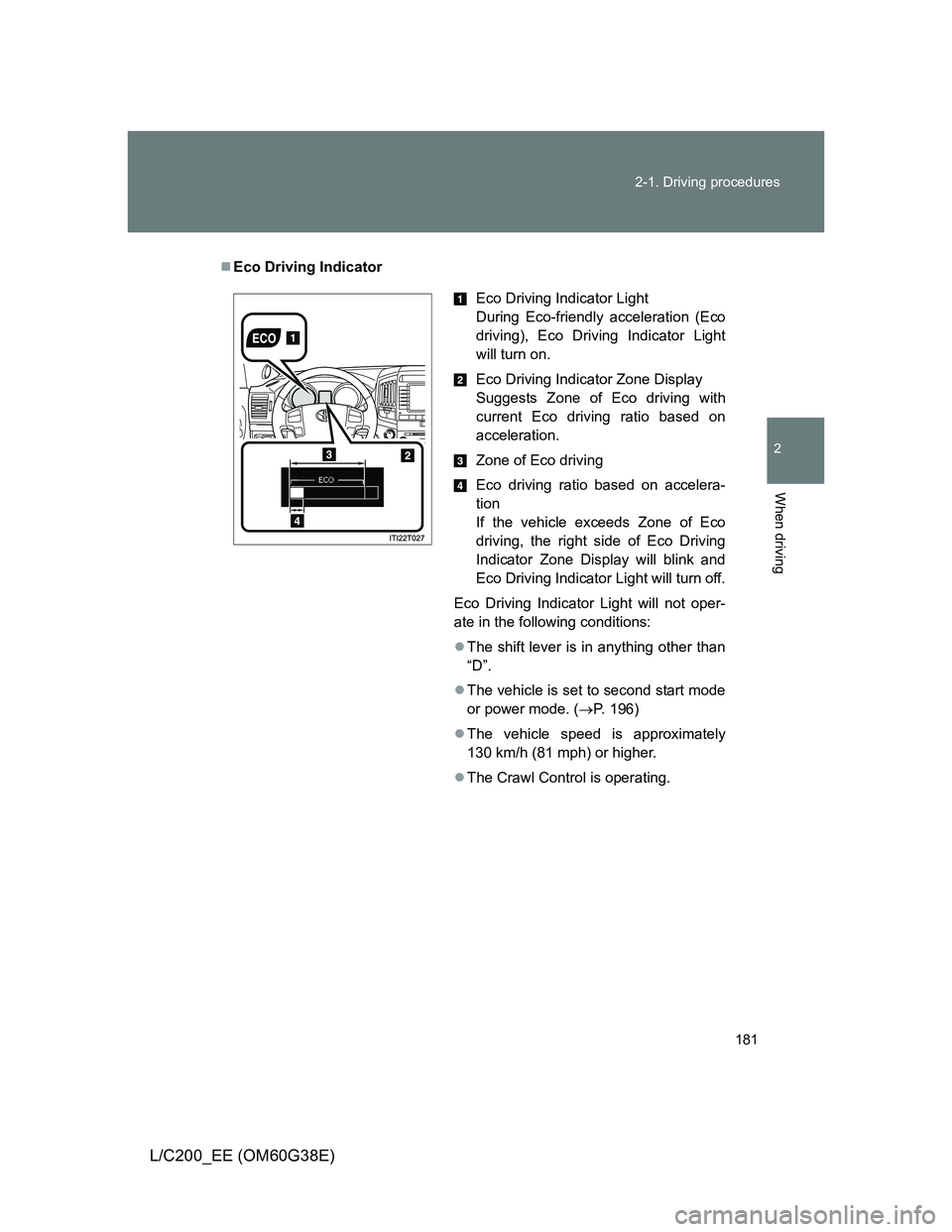
Eco Driving Indicator
Eco Driving Indicator Light
During Eco-friendly acceleration (Eco
driving), Eco Driving Indicator Light
will turn on.
Eco Driving Indicator Zone Display
Suggests Zone of Eco driving with
current Eco driving ratio based on
acceleration.
Zone of Eco driving
Eco driving ratio based on accelera-
tion
If the vehicle exceeds Zone of Eco
driving, the right side of Eco Driving
Indicator Zone Display will blink and
Eco Driving Indicator Light will turn off.
Eco Driving Indicator Light will not oper-
ate in the following conditions:
The shift lever is in anything other than
“D”.
The vehicle is set to second start mode
or power mode. (P. 1 9 6 )
The vehicle speed is approximately
130 km/h (81 mph) or higher.
The Crawl Control is operating.