automatic transmission TOYOTA LAND CRUISER 2012 Owners Manual
[x] Cancel search | Manufacturer: TOYOTA, Model Year: 2012, Model line: LAND CRUISER, Model: TOYOTA LAND CRUISER 2012Pages: 692, PDF Size: 29.3 MB
Page 3 of 692
1
2
3
4
5
6
3
L/C200_EE (OM60G38E)
2-1. Driving procedures
Driving the vehicle .............. 178
Engine (ignition) switch ....... 190
Automatic transmission....... 194
Turn signal lever ................. 200
Parking brake...................... 201
Horn .................................... 202
2-2. Instrument cluster
Gauges and meters ............ 203
Indicators and
warning lights.................... 207
Multi-information display ..... 212
2-3. Operating the lights and
wipers
Headlight switch.................. 218
Fog light switch ................... 222
Windshield wipers and
washer .............................. 224
Rear window wiper and
washer .............................. 231
Headlight cleaner switch ..... 2322-4. Using other driving systems
Cruise control ..................... 233
Toyota parking
assist-sensor .................... 237
4-Wheel AHC
(Active Height Control
Suspension) ..................... 248
AVS (Adaptive Variable
Suspension system)......... 258
Four-wheel drive system .... 259
Crawl Control (with Turn
Assist function)................. 264
Multi-terrain Select ............. 270
Multi-terrain Monitor ........... 276
Driving assist systems........ 300
PCS (Pre-Crash Safety) ..... 307
DPF (Diesel Particulate
Filter) system ................... 308
2-5. Driving information
Off-road precautions .......... 313
Cargo and luggage............. 317
Winter driving tips............... 319
Trailer towing...................... 323
2When driving
Page 177 of 692
2When driving
177
L/C200_EE (OM60G38E)
2-1. Driving procedures
Driving the vehicle ............ 178
Engine (ignition) switch..... 190
Automatic transmission .... 194
Turn signal lever ............... 200
Parking brake ................... 201
Horn .................................. 202
2-2. Instrument cluster
Gauges and meters .......... 203
Indicators and
warning lights.................. 207
Multi-information
display ............................ 212
2-3. Operating the lights and
wipers
Headlight switch ............... 218
Fog light switch ................. 222
Windshield wipers and
washer ............................ 224
Rear window wiper and
washer ............................ 231
Headlight cleaner
switch ............................. 2322-4. Using other driving systems
Cruise control.................... 233
Toyota parking
assist-sensor .................. 237
4-Wheel AHC
(Active Height Control
Suspension).................... 248
AVS (Adaptive Variable
Suspension system) ....... 258
Four-wheel drive
system ............................ 259
Crawl Control (with Turn
Assist function) ............... 264
Multi-terrain Select ............ 270
Multi-terrain Monitor .......... 276
Driving assist systems ...... 300
PCS
(Pre-Crash Safety).......... 307
DPF (Diesel Particulate
Filter) system .................. 308
2-5. Driving information
Off-road precautions ......... 313
Cargo and luggage ........... 317
Winter driving tips ............. 319
Trailer towing .................... 323
Page 186 of 692
186 2-1. Driving procedures
L/C200_EE (OM60G38E)
CAUTION
If the shift lever is moved before the low speed four-wheel drive indicator
turns on/off, the transfer mode may not be shifted completely. The transfer
mode disengages both the front and rear driveshafts from the powertrain
and allows the vehicle to move regardless of the shift position. (At this
time, the indicator blinks and the buzzer sounds.)
Therefore, the vehicle is free to roll even if the automatic transmission is in
“P”. You or someone else could be seriously injured. You must complete
the shifting of the transfer mode. (P. 259)
Do not touch the exhaust pipe while the engine is running or immediately
after turning the engine off.
Doing so may cause burns.
Do not leave the engine running in an area with snow build-up, or where it
is snowing. If snowbanks build up around the vehicle while the engine is
running, exhaust gases may collect and enter the vehicle. This may lead
to death or a serious health hazard.
Exhaust gases
Exhaust gases include harmful carbon monoxide (CO) that is colorless and
odorless. Inhaling exhaust gases may lead to death or a serious health haz-
ard.
If the vehicle is in a poorly ventilated area, stop the engine. In a closed
area, such as a garage, exhaust gases may collect and enter the vehicle.
This may lead to death or a serious health hazard.
The exhaust should be checked occasionally. If there is a hole or crack
caused by corrosion, damage to a joint or abnormal exhaust noise, be
sure to have the vehicle inspected and repaired by any authorized Toyota
dealer or repairer, or another duly qualified and equipped professional.
Failure to do so may allow exhaust gases to enter the vehicle, resulting in
death or a serious health hazard.
Page 194 of 692
194
2-1. Driving procedures
L/C200_EE (OM60G38E)
Automatic transmission
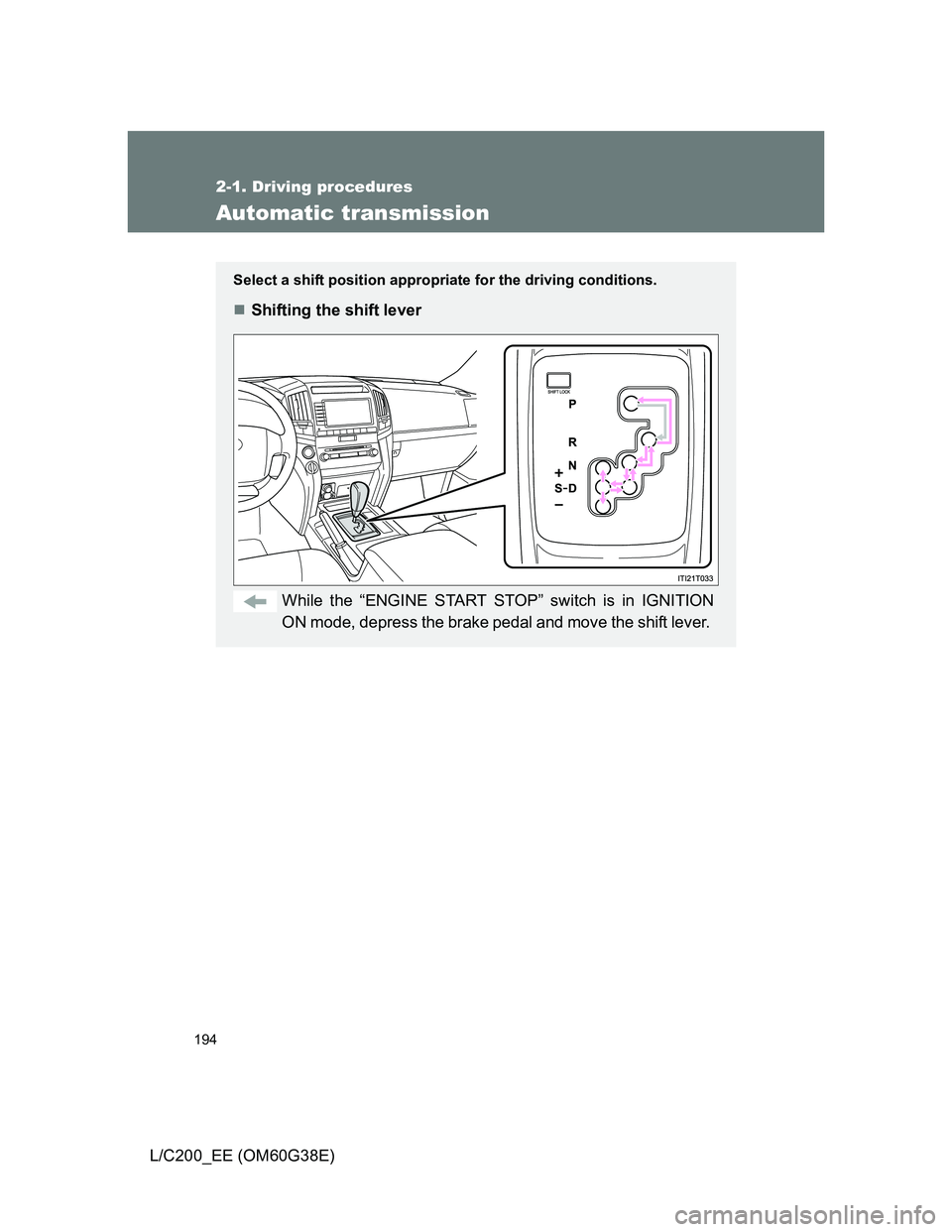
Select a shift position appropriate for the driving conditions.
Shifting the shift lever
While the “ENGINE START STOP” switch is in IGNITION
ON mode, depress the brake pedal and move the shift lever.
Page 198 of 692
198 2-1. Driving procedures
L/C200_EE (OM60G38E)Shift ranges and their functions
Automatically selecting gears between 1 and 6 according to
vehicle speed and driving conditions. But, the gear is limited
according to selected shift range.
You can choose from 6 levels of engine braking force.
A lower shift range will provide greater engine braking force than
a higher shift range, and the engine speed will also increase.
“S” mode
When the shift range is “5” or lower, holding the shift lever toward “+” sets
the shift range to “6”.
To prevent excessive engine speed, a function was adopted that auto-
matically selects a higher shift range before the engine speed becomes
too high.
To protect the automatic transmission, a function is adopted that auto-
matically selects a higher shift range when the fluid temperature is high.
Downshifting restrictions warning buzzer (in the “S” mode)
To help ensure safety and driving performance, downshifting operation may
sometimes be restricted. In some circumstances, downshifting may not be
possible even when the shift lever is operated. (The warning buzzer will
sound twice.)
When driving with the cruise control activated
Even when performing the following actions with the intent of enabling
engine braking, engine braking will not activate because cruise control will
not be canceled.
While driving in “S” mode, downshifting to “5” or “4”. (P. 233)
When switching the driving mode to power mode while driving in “D”
position. (P. 196)
Page 199 of 692
199 2-1. Driving procedures
2
When driving
L/C200_EE (OM60G38E)
Second start mode automatic deactivation
Second start mode is automatically deactivated if the engine is turned off
after driving in second start mode.
If the shift lever cannot be shifted from “P”
P. 625
If the “S” indicator does not come on even after shifting the shift lever
to “S”
This may indicate a malfunction in the automatic transmission system. Have
the vehicle inspected by any authorized Toyota dealer or repairer, or another
duly qualified and equipped professional, immediately.
(In this situation, the vehicle will operate as if the shift lever is in “D”.)
AI-SHIFT
The AI-SHIFT automatically shifts the gear to the suitable position according
to the driver performance and driving conditions.
The AI-SHIFT automatically operates when the shift lever is in the “D” posi-
tion. (Shifting the shift lever to the “S” position cancels the function.)
Page 209 of 692
209 2-2. Instrument cluster
2
When driving
L/C200_EE (OM60G38E)
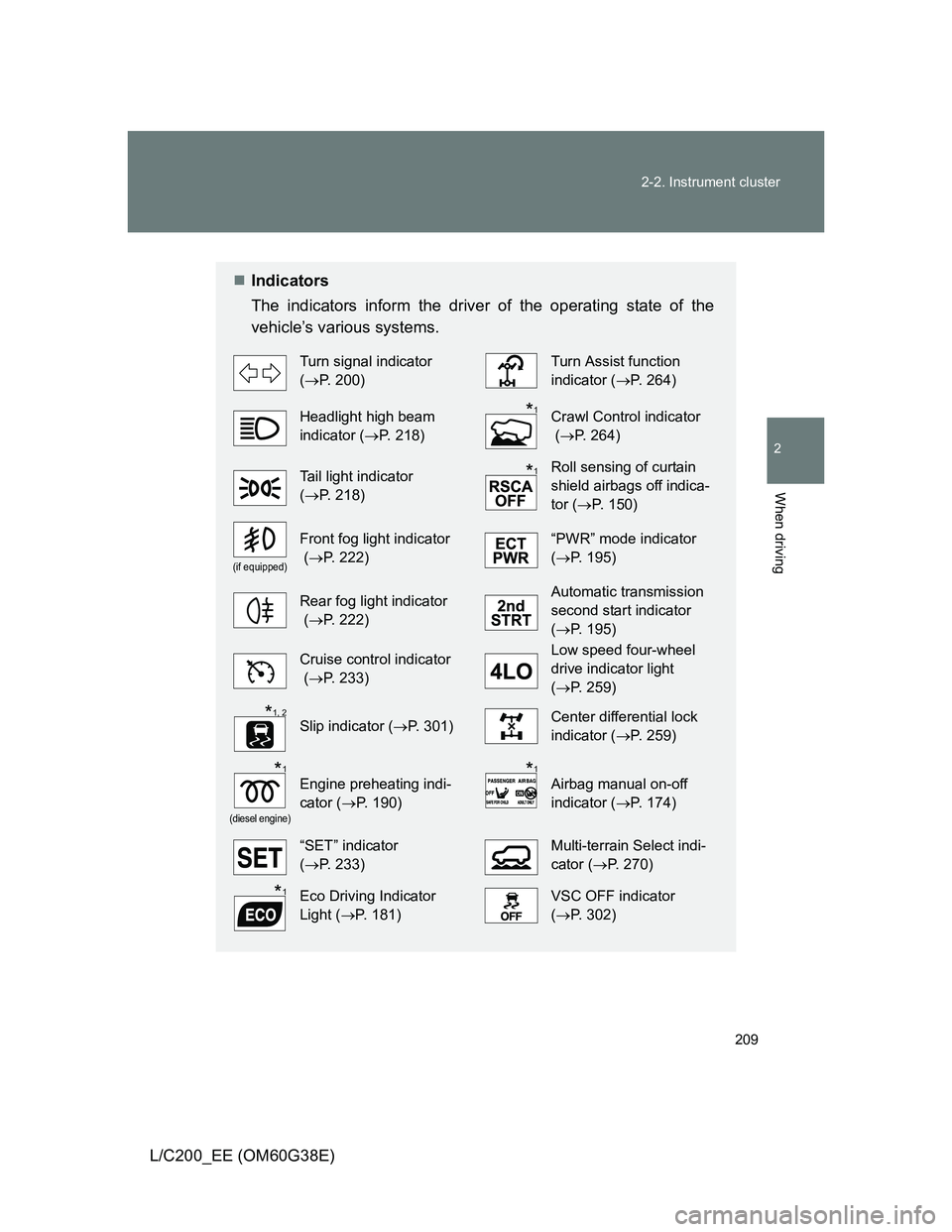
Indicators
The indicators inform the driver of the operating state of the
vehicle’s various systems.
Turn signal indicator
(P. 200)Turn Assist function
indicator (P. 264)
Headlight high beam
indicator (P. 218)Crawl Control indicator
(P. 264)
Tail light indicator
(P. 218) Roll sensing of curtain
shield airbags off indica-
tor (P. 150)
(if equipped)
Front fog light indicator
(P. 222)“PWR” mode indicator
(P. 195)
Rear fog light indicator
(P. 222)Automatic transmission
second start indicator
(P. 195)
Cruise control indicator
(P. 233)Low speed four-wheel
drive indicator light
(P. 259)
Slip indicator (P. 301)Center differential lock
indicator (P. 259)
(diesel engine)
Engine preheating indi-
cator (P. 190)Airbag manual on-off
indicator (P. 174)
“SET” indicator
(P. 233)Multi-terrain Select indi-
cator (P. 270)
Eco Driving Indicator
Light (P. 181)VSC OFF indicator
(P. 302)
*1
*1
*1, 2
*1*1
*1
Page 235 of 692
235 2-4. Using other driving systems
2
When driving
L/C200_EE (OM60G38E)
Cruise control can be set when
Vehicles with an automatic transmission: The shift lever is in the “D” or
more than range “4” of “S” has been selected.
Vehicle speed is above approximately 40 km/h (25 mph).
Accelerating after setting the vehicle speed
The vehicle can be accelerated normally. After acceleration, the set
speed resumes.
Even without canceling the cruise control, the set speed can be
increased by first accelerating the vehicle to the desired speed and then
pushing the lever down to set the new speed.
Automatic cruise control cancelation
Cruise control will stop maintaining the vehicle speed in any of the following
situations.
Actual vehicle speed falls more than approximately 16 km/h (10 mph)
below the preset vehicle speed.
At this time, the memorized set speed is not retained.
Actual vehicle speed is below approximately 40 km/h (25 mph).
VSC is activated (if equipped).
The switching operation continues for 5 seconds or more after the center
differential lock switch has been operated.
If the warning message for the cruise control is shown on the multi-
information display
Press the “ON-OFF” button once to deactivate the system, and then press
the button again to reactivate the system.
If the cruise control speed cannot be set or if the cruise control cancels
immediately after being activated, there may be a malfunction in the cruise
control system. Have the vehicle inspected by any authorized Toyota dealer
or repairer, or another duly qualified and equipped professional.
Page 262 of 692
262 2-4. Using other driving systems
L/C200_EE (OM60G38E)
If the low speed four-wheel drive indicator light or the center differen-
tial lock indicator light blinks
If the low speed four-wheel drive indicator light continues to blink when
using the four-wheel drive control switch, stop the vehicle completely,
move the shift lever to “N” and operate the switch again.
If the shift lever is moved before the low speed four-wheel drive indicator
turns on/off, the transfer mode may not be shifted completely. The trans-
fer mode disengages both the front and rear driveshafts from the power-
train and allows the vehicle to move regardless of the shift position. (At
this time, the indicator blinks and the buzzer sounds.)
Therefore, the vehicle is free to roll even if the automatic transmission is in
“P”. You or someone else could be seriously injured. You must complete
the shifting of the transfer mode.
To complete the shifting, stop the vehicle completely, return the shift lever
to “N”, and confirm that the shift was completed (the indicator turns on/off).
If the engine coolant temperature is too low, the four-wheel drive control
system may not be able to shift. When the engine is warmer operate the
switch again.
If the low speed four-wheel drive indicator light or the center differential lock
indicator light continues to blink even after attempting the above, there may
be a malfunction in the engine, the brake system or the four-wheel drive sys-
tem. In this case, you may not be able to shift between “H4” and “L4”, and
the center differential lock may not be operable. Have the vehicle inspected
by any authorized Toyota dealer or repairer, or another duly qualified and
equipped professional immediately.
Page 263 of 692
263 2-4. Using other driving systems
2
When driving
L/C200_EE (OM60G38E)
CAUTION
While driving
Never move the four-wheel drive control switch if the wheels have lost trac-
tion. Doing so may cause an accident resulting in death or serious injury.
When the vehicle is parked
If the shift lever is moved before the low speed four-wheel drive indicator
turns on/off, the transfer mode may not be shifted completely. The transfer
mode disengages both the front and rear driveshafts from the powertrain
and allows the vehicle to move regardless of the shift position. (At this time,
the indicator blinks and the buzzer sounds.)
Therefore, the vehicle is free to roll even if the automatic transmission is in
“P”. You or someone else could be seriously injured. You must complete the
shifting of the transfer mode. (P. 259)
NOTICE
To prevent damage to the center differential
For normal driving on dry and hard surface roads, unlock the center differ-
ential.
Unlock the center differential after the wheels are out of the ditch or off the
slippery or bumpy surface.
Do not push the center differential lock/unlock button when the vehicle is
turning or when its wheels are spinning freely off the ground.