tire size TOYOTA MATRIX 2010 E140 / 2.G User Guide
[x] Cancel search | Manufacturer: TOYOTA, Model Year: 2010, Model line: MATRIX, Model: TOYOTA MATRIX 2010 E140 / 2.GPages: 448, PDF Size: 9.74 MB
Page 322 of 448
322 4-3. Do-it-yourself maintenance
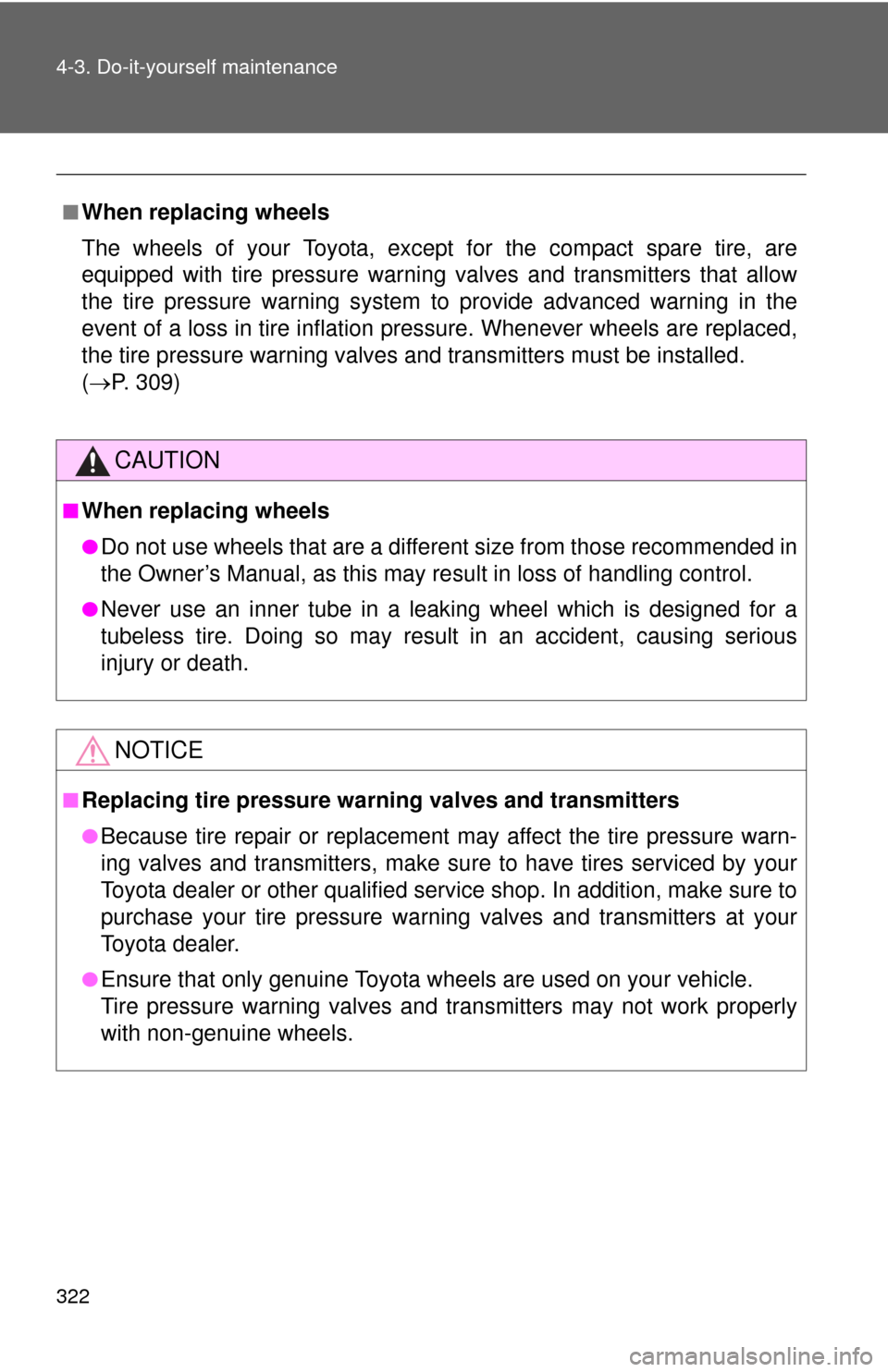
■When replacing wheels
The wheels of your Toyota, except for the compact spare tire, are
equipped with tire pressure warning valves and transmitters that allow
the tire pressure warning system to provide advanced warning in the
event of a loss in tire inflation pressure. Whenever wheels are replaced,
the tire pressure warning valves and transmitters must be installed.
(P. 309)
CAUTION
■When replacing wheels
●Do not use wheels that are a different size from those recommended in
the Owner’s Manual, as this may result in loss of handling control.
●Never use an inner tube in a leaking wheel which is designed for a
tubeless tire. Doing so may result in an accident, causing serious
injury or death.
NOTICE
■Replacing tire pressure warning valves and transmitters
●Because tire repair or replacement may affect the tire pressure warn-
ing valves and transmitters, make sure to have tires serviced by your
Toyota dealer or other qualified service shop. In addition, make sure to
purchase your tire pressure warning valves and transmitters at your
Toyota dealer.
●Ensure that only genuine Toyota wheels are used on your vehicle.
Tire pressure warning valves and transmitters may not work properly
with non-genuine wheels.
Page 367 of 448
5
When trouble arises
367 5-2. Steps to take in an emergency
CAUTION
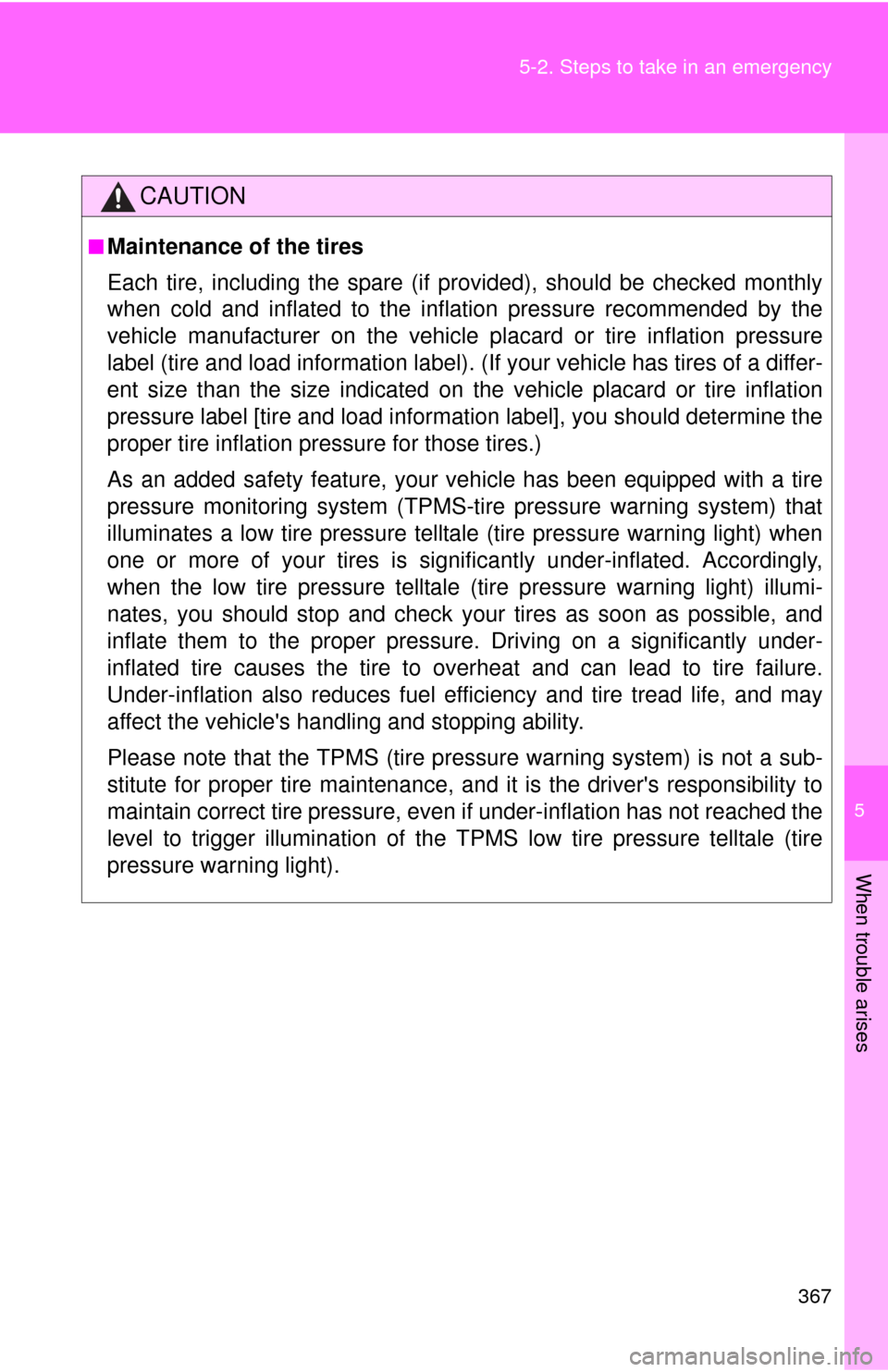
■Maintenance of the tires
Each tire, including the spare (if provided), should be checked monthly
when cold and inflated to the inflation pressure recommended by the
vehicle manufacturer on the vehicle placard or tire inflation pressure
label (tire and load information label). (If your vehicle has tires of a differ-
ent size than the size indicated on the vehicle placard or tire inflation
pressure label [tire and load information label], you should determine the
proper tire inflation pressure for those tires.)
As an added safety feature, your vehicle has been equipped with a tire
pressure monitoring system (TPMS-tire pressure warning system) that
illuminates a low tire pressure telltale (tire pressure warning light) when
one or more of your tires is significantly under-inflated. Accordingly,
when the low tire pressure telltale (tire pressure warning light) illumi-
nates, you should stop and check your tires as soon as possible, and
inflate them to the proper pressure. Driving on a significantly under-
inflated tire causes the tire to overheat and can lead to tire failure.
Under-inflation also reduces fuel efficiency and tire tread life, and may
affect the vehicle's handling and stopping ability.
Please note that the TPMS (tire pressure warning system) is not a sub-
stitute for proper tire maintenance, and it is the driver's responsibility to
maintain correct tire pressure, even if under-inflation has not reached the
level to trigger illumination of the TPMS low tire pressure telltale (tire
pressure warning light).
Page 407 of 448
407 6-1. Specifications
6
Vehicle specifications
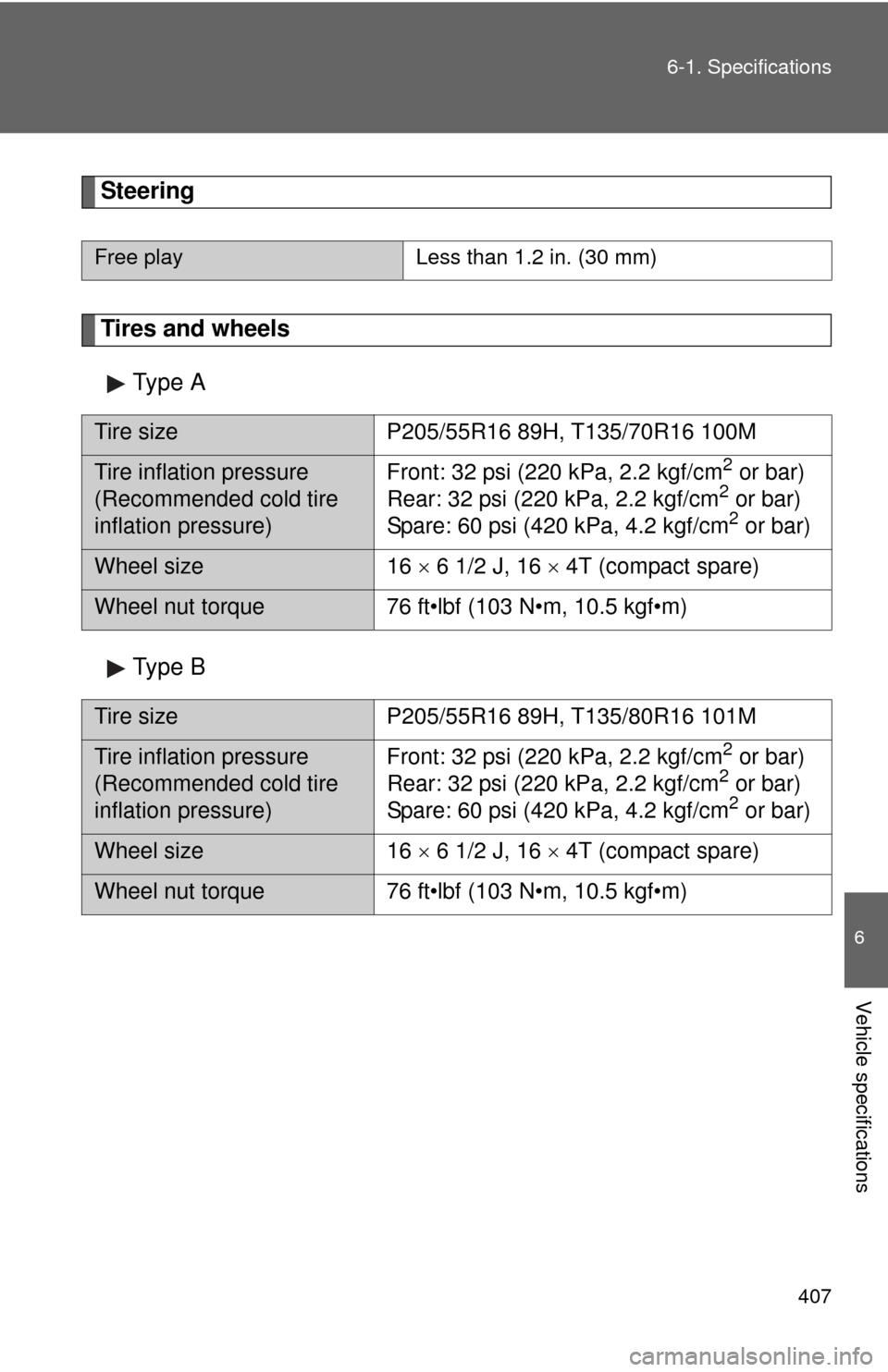
Steering
Tires and wheels
Type A
Type B
Free play Less than 1.2 in. (30 mm)
Tire size P205/55R16 89H, T135/70R16 100M
Tire inflation pressure
(Recommended cold tire
inflation pressure)Front: 32 psi (220 kPa, 2.2 kgf/cm2 or bar)
Rear: 32 psi (220 kPa, 2.2 kgf/cm2 or bar)
Spare: 60 psi (420 kPa, 4.2 kgf/cm2 or bar)
Wheel size 16 6 1/2 J, 16 4T (compact spare)
Wheel nut torque 76 ft•lbf (103 N•m, 10.5 kgf•m)
Tire size P205/55R16 89H, T135/80R16 101M
Tire inflation pressure
(Recommended cold tire
inflation pressure)Front: 32 psi (220 kPa, 2.2 kgf/cm2 or bar)
Rear: 32 psi (220 kPa, 2.2 kgf/cm2 or bar)
Spare: 60 psi (420 kPa, 4.2 kgf/cm2 or bar)
Wheel size 16 6 1/2 J, 16 4T (compact spare)
Wheel nut torque 76 ft•lbf (103 N•m, 10.5 kgf•m)
Page 408 of 448
408 6-1. Specifications
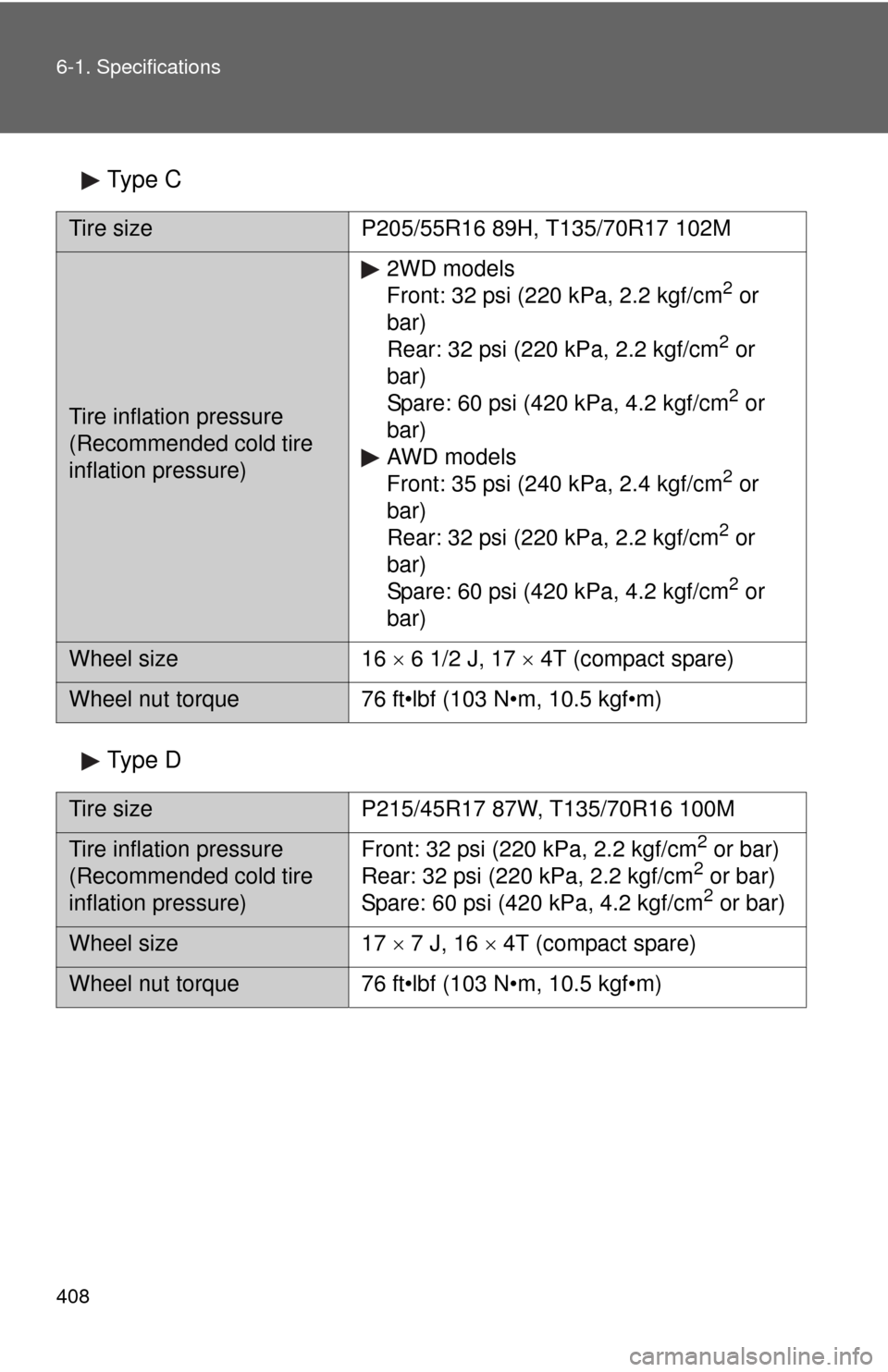
Type C
Type D
Tire size P205/55R16 89H, T135/70R17 102M
Tire inflation pressure
(Recommended cold tire
inflation pressure)2WD models
Front: 32 psi (220 kPa, 2.2 kgf/cm
2 or
bar)
Rear: 32 psi (220 kPa, 2.2 kgf/cm
2 or
bar)
Spare: 60 psi (420 kPa, 4.2 kgf/cm
2 or
bar)
AWD models
Front: 35 psi (240 kPa, 2.4 kgf/cm
2 or
bar)
Rear: 32 psi (220 kPa, 2.2 kgf/cm
2 or
bar)
Spare: 60 psi (420 kPa, 4.2 kgf/cm
2 or
bar)
Wheel size 16 6 1/2 J, 17 4T (compact spare)
Wheel nut torque 76 ft•lbf (103 N•m, 10.5 kgf•m)
Tire size P215/45R17 87W, T135/70R16 100M
Tire inflation pressure
(Recommended cold tire
inflation pressure)Front: 32 psi (220 kPa, 2.2 kgf/cm2 or bar)
Rear: 32 psi (220 kPa, 2.2 kgf/cm2 or bar)
Spare: 60 psi (420 kPa, 4.2 kgf/cm2 or bar)
Wheel size 17 7 J, 16 4T (compact spare)
Wheel nut torque 76 ft•lbf (103 N•m, 10.5 kgf•m)
Page 409 of 448
409 6-1. Specifications
6
Vehicle specifications
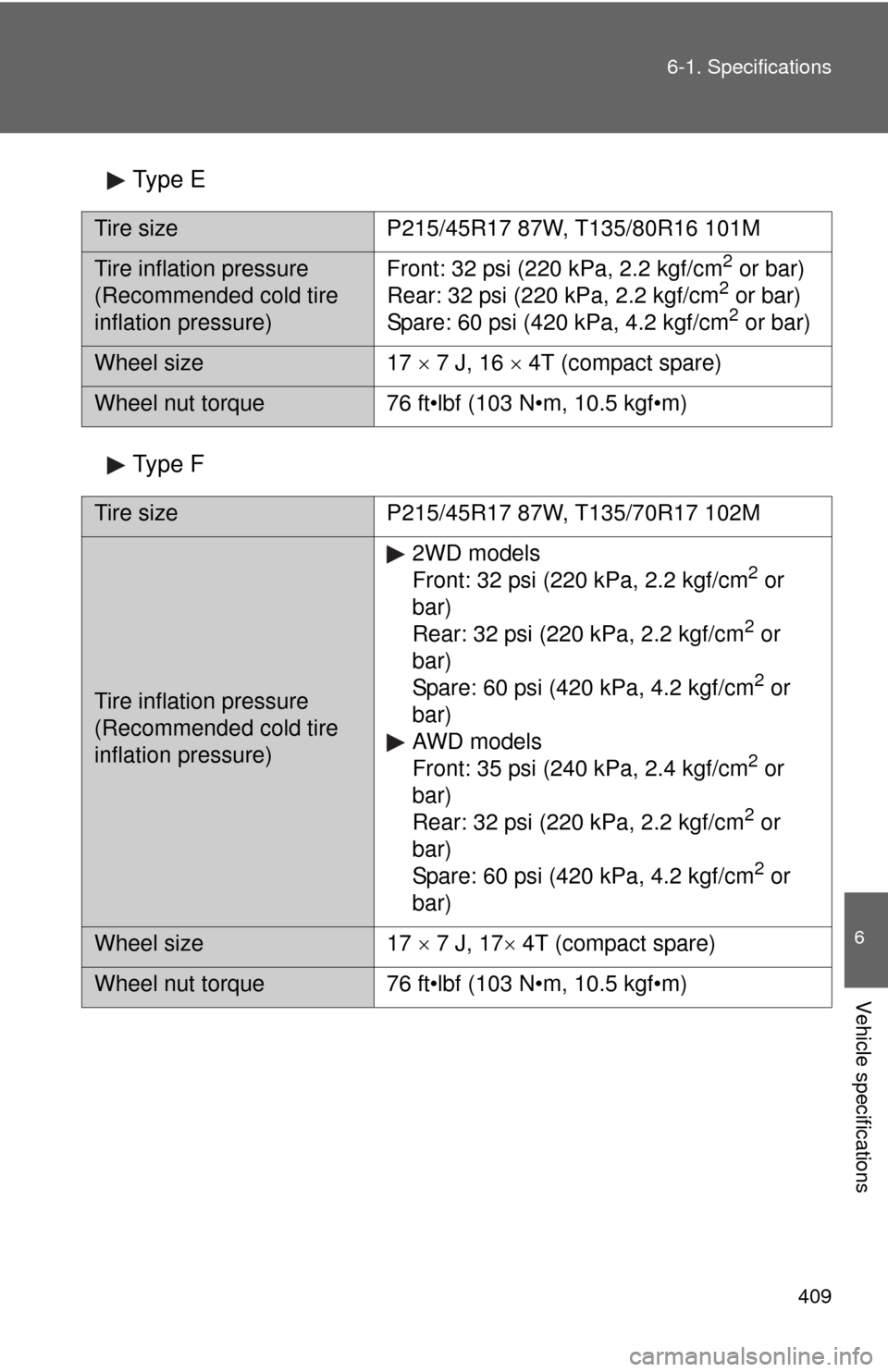
Type E
Type F
Tire size P215/45R17 87W, T135/80R16 101M
Tire inflation pressure
(Recommended cold tire
inflation pressure)Front: 32 psi (220 kPa, 2.2 kgf/cm2 or bar)
Rear: 32 psi (220 kPa, 2.2 kgf/cm2 or bar)
Spare: 60 psi (420 kPa, 4.2 kgf/cm2 or bar)
Wheel size 17 7 J, 16 4T (compact spare)
Wheel nut torque 76 ft•lbf (103 N•m, 10.5 kgf•m)
Tire size P215/45R17 87W, T135/70R17 102M
Tire inflation pressure
(Recommended cold tire
inflation pressure)2WD models
Front: 32 psi (220 kPa, 2.2 kgf/cm
2 or
bar)
Rear: 32 psi (220 kPa, 2.2 kgf/cm
2 or
bar)
Spare: 60 psi (420 kPa, 4.2 kgf/cm
2 or
bar)
AWD models
Front: 35 psi (240 kPa, 2.4 kgf/cm
2 or
bar)
Rear: 32 psi (220 kPa, 2.2 kgf/cm
2 or
bar)
Spare: 60 psi (420 kPa, 4.2 kgf/cm
2 or
bar)
Wheel size 17 7 J, 17 4T (compact spare)
Wheel nut torque 76 ft•lbf (103 N•m, 10.5 kgf•m)
Page 410 of 448
410 6-1. Specifications
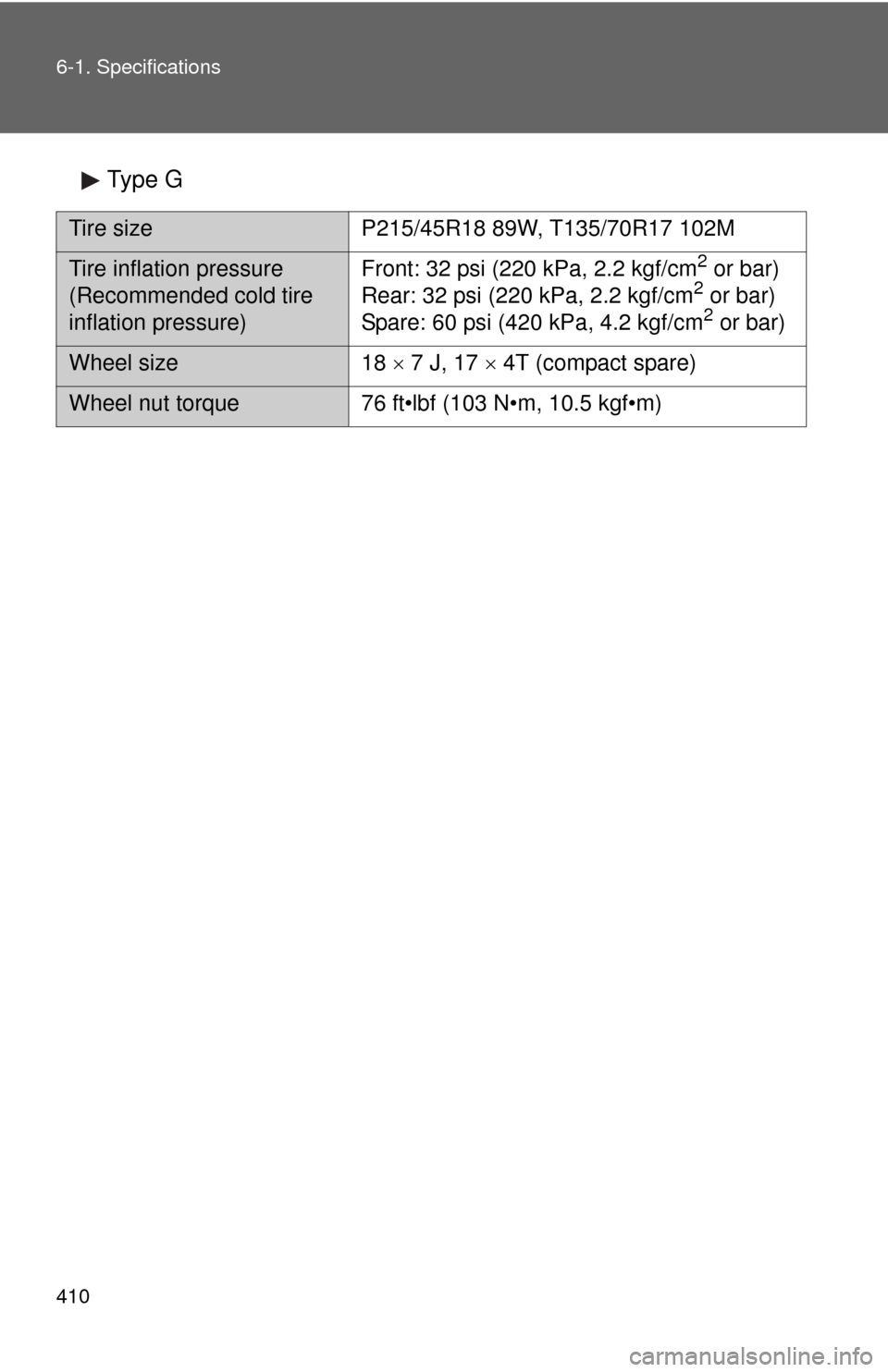
Type G
Tire size P215/45R18 89W, T135/70R17 102M
Tire inflation pressure
(Recommended cold tire
inflation pressure)Front: 32 psi (220 kPa, 2.2 kgf/cm2 or bar)
Rear: 32 psi (220 kPa, 2.2 kgf/cm2 or bar)
Spare: 60 psi (420 kPa, 4.2 kgf/cm2 or bar)
Wheel size 18 7 J, 17 4T (compact spare)
Wheel nut torque 76 ft•lbf (103 N•m, 10.5 kgf•m)
Page 415 of 448
415
6-1. Specifications
6
Vehicle specifications
Tire infor mation
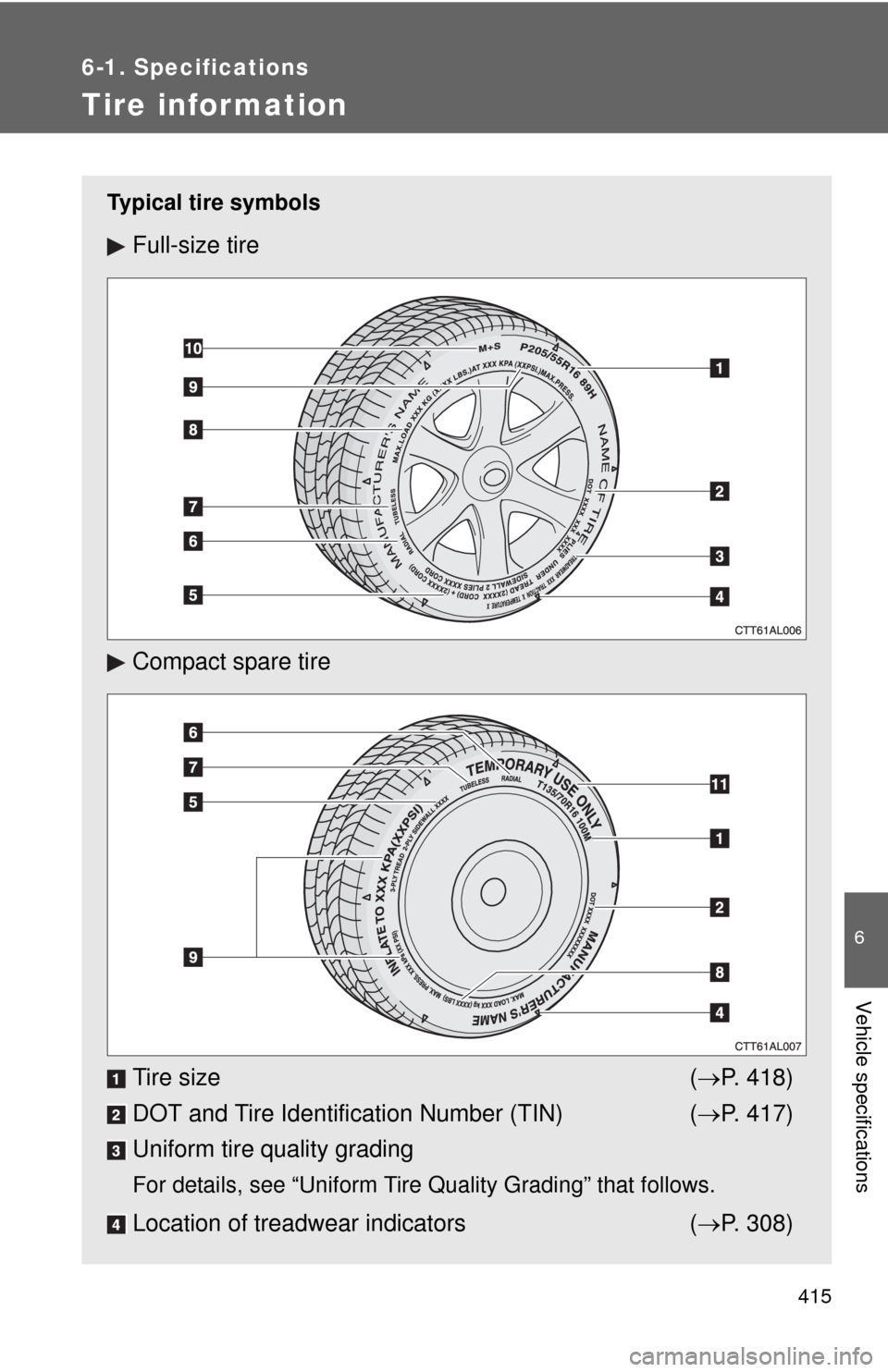
Typical tire symbols
Full-size tire
Compact spare tire
Tire size (P. 418)
DOT and Tire Identification Number (TIN) (P. 417)
Uniform tire quality grading
For details, see “Uniform Tire Quality Grading” that follows.
Location of treadwear indicators (P. 308)
Page 417 of 448
417 6-1. Specifications
6
Vehicle specifications
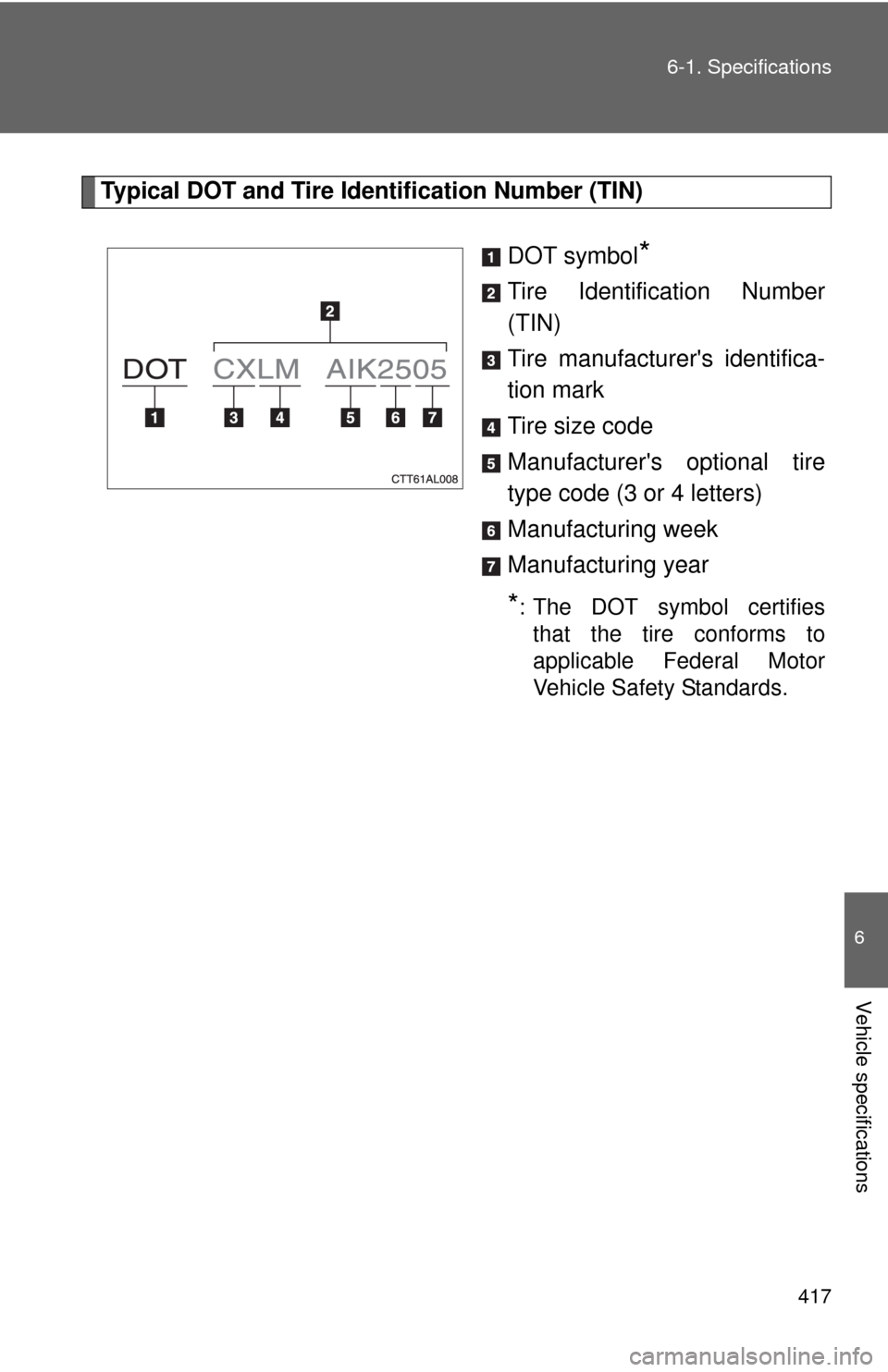
Typical DOT and Tire Identification Number (TIN)
DOT symbol
*
Tire Identification Number
(TIN)
Tire manufacturer's identifica-
tion mark
Tire size code
Manufacturer's optional tire
type code (3 or 4 letters)
Manufacturing week
Manufacturing year
*: The DOT symbol certifies
that the tire conforms to
applicable Federal Motor
Vehicle Safety Standards.
Page 418 of 448
418 6-1. Specifications
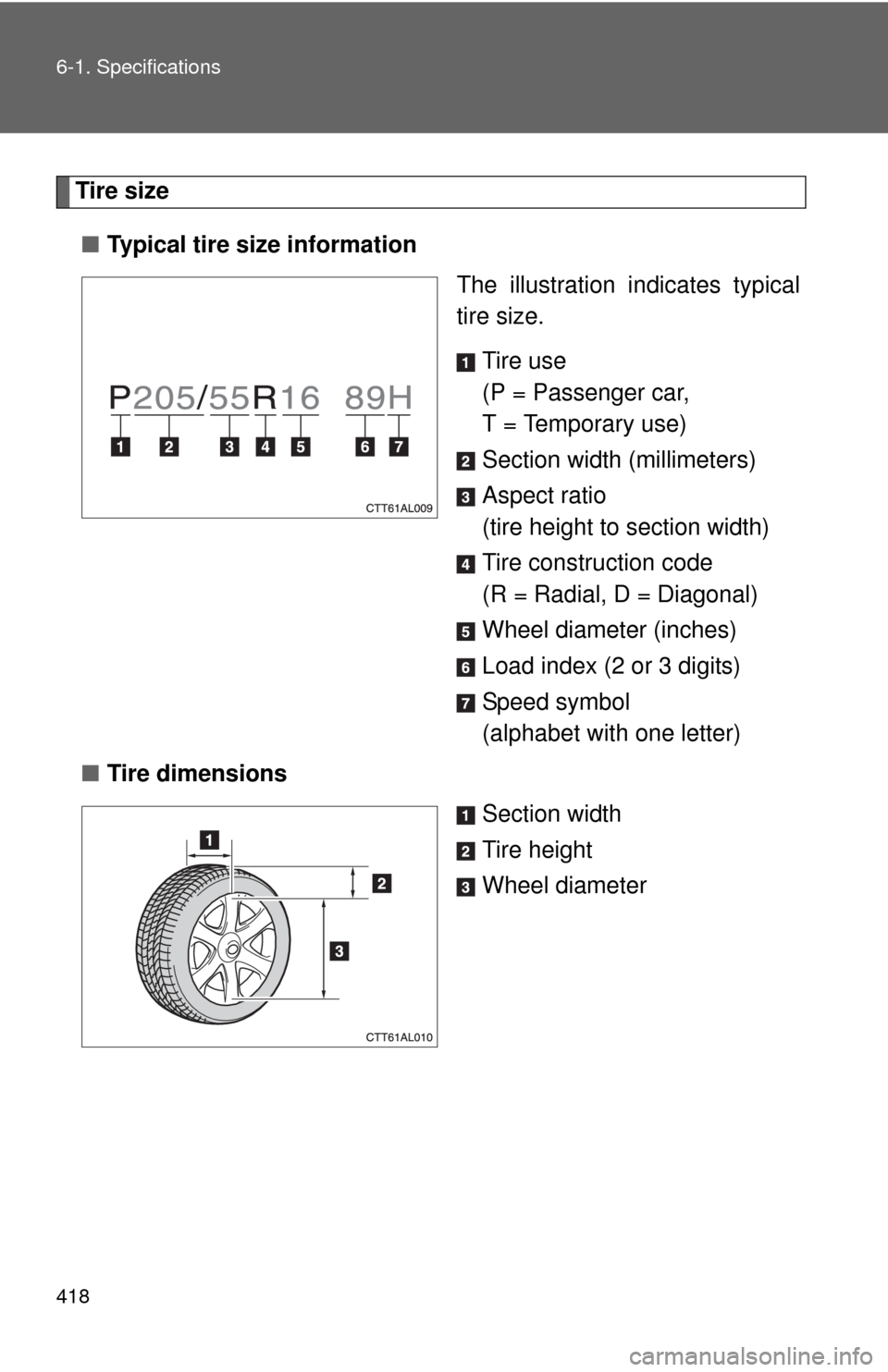
Tire size
■Typical tire size information
The illustration indicates typical
tire size.
Tire use
(P = Passenger car,
T = Temporary use)
Section width (millimeters)
Aspect ratio
(tire height to section width)
Tire construction code
(R = Radial, D = Diagonal)
Wheel diameter (inches)
Load index (2 or 3 digits)
Speed symbol
(alphabet with one letter)
■Tire dimensions
Section width
Tire height
Wheel diameter
Page 422 of 448

422 6-1. Specifications
Tire related termMeaning
Normal occupant
weight150 lb. (68 kg) times the number of occupants
specified in the second column of Table 1
* that
follows
Occupant distributionDistribution of occupants in a vehicle as speci-
fied in the third column of Table 1
* below
Production options
weightThe combined weight of installed regular pro-
duction options weighing over 5 lb. (2.3 kg) in
excess of the standard items which they
replace, not previously considered in curb
weight or accessory weight, including heavy
duty brakes, ride levelers, roof rack, heavy duty
battery, and special trim
RimA metal support for a tire or a tire and tube
assembly upon which the tire beads are seated
Rim diameter
(Wheel diameter)Nominal diameter of the bead seat
Rim size designation Rim diameter and width
Rim type designationThe industry manufacturer's designation for a
rim by style or code
Rim width Nominal distance between rim flanges
Vehicle capacity
weight (Total load
capacity)The rated cargo and luggage load plus 150 lb.
(68 kg) times the vehicle's designated seating
capacity
Vehicle maximum load
on the tireThe load on an individual tire that is determined
by distributing to each axle its share of the
maximum loaded vehicle weight, and dividing
by two
Vehicle normal load
on the tireThe load on an individual tire that is determined
by distributing to each axle its share of curb
weight, accessory weight, and normal occu-
pant weight (distributed in accordance with
Ta b l e 1
* below), and dividing by two