wheel TOYOTA MATRIX 2012 E140 / 2.G Manual PDF
[x] Cancel search | Manufacturer: TOYOTA, Model Year: 2012, Model line: MATRIX, Model: TOYOTA MATRIX 2012 E140 / 2.GPages: 516, PDF Size: 7.02 MB
Page 379 of 516
379
4-3. Do-it-yourself maintenance
4
Maintenance and care
■When replacing wheels
The wheels of your Toyota, except for the compact spare tire, are
equipped with tire pressure warning valves and transmitters that allow
the tire pressure warning system to provide advanced warning in the
event of a loss in tire inflation pressure. Whenever wheels are replaced,
the tire pressure warning valves a
nd transmitters must be installed.
( P. 366)
CAUTION
■When replacing wheels
●Do not use wheels that are a different size from those recommended in
the Owner’s Manual, as this may re sult in loss of handling control.
●Never use an inner tube in a leaking wheel which is designed for a
tubeless tire. Doing so may result in an accident, causing serious
injury or death.
■When installing the wheel nuts
●Never use oil or grease on the wheel bolts or wheel nuts.
Oil and grease may cause the wheel nuts to be excessively tightened,
leading to bolt or disc wheel damage. In addition, the oil or grease can
cause the wheel nuts to loosen and the wheel may fall off, causing an
accident and resulting in death or serious injury. Remove any oil or
grease from the wheel bolts or wheel nuts.
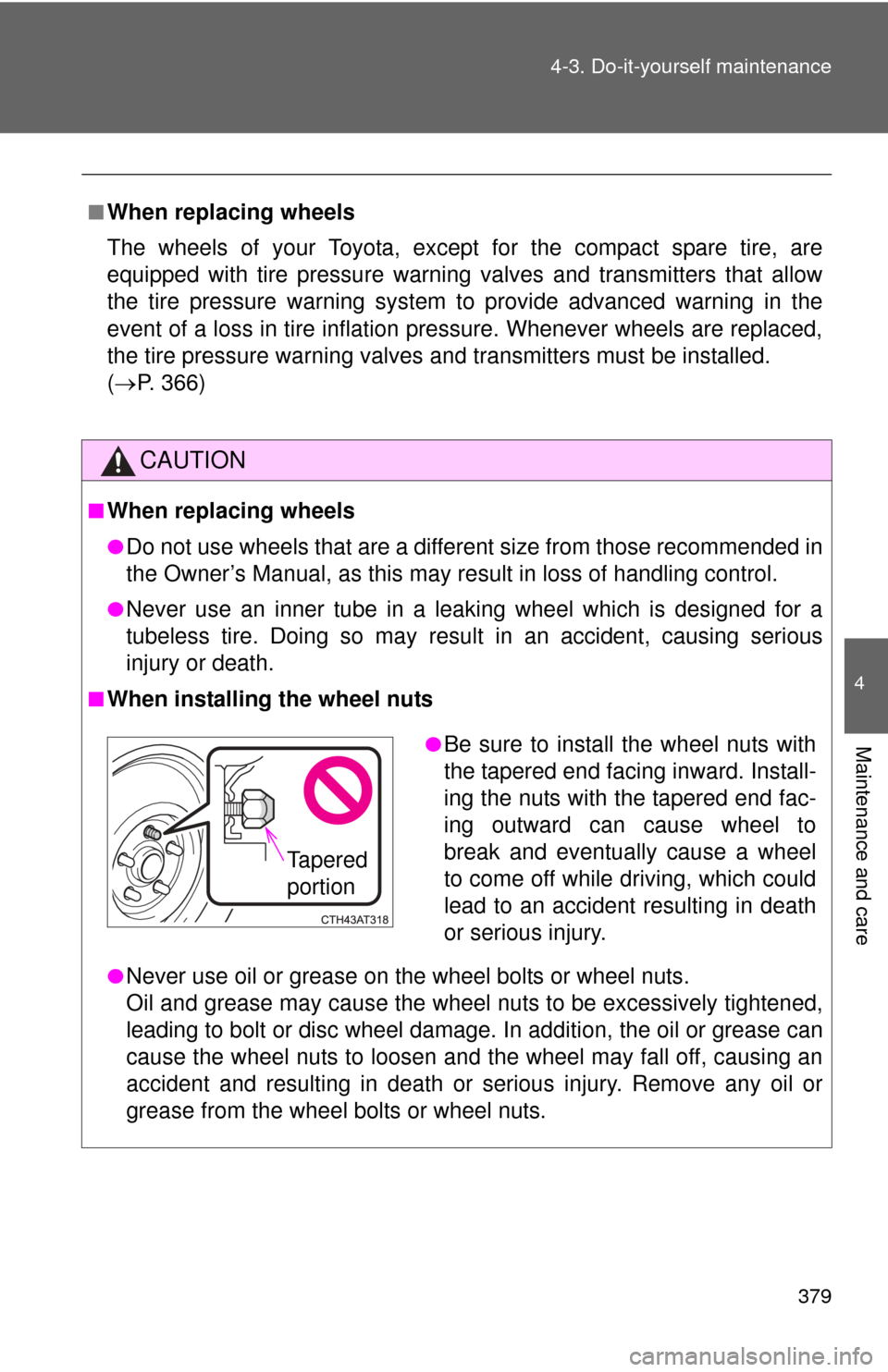
●Be sure to install the wheel nuts with
the tapered end faci ng inward. Install-
ing the nuts with the tapered end fac-
ing outward can cause wheel to
break and eventually cause a wheel
to come off while driving, which could
lead to an accident resulting in death
or serious injury.
Tapered
portion
Page 380 of 516

380 4-3. Do-it-yourself maintenance
NOTICE
■Replacing tire pressure warning valves and transmitters
●Because tire repair or replacement may affect the tire pressure warn-
ing valves and transmitters, make sure to have tires serviced by your
Toyota dealer or other qualified service shop. In addition, make sure to
purchase your tire pressure warning valves and transmitters at your
Toyota dealer.
●Ensure that only genuine Toyota wheels are used on your vehicle.
Tire pressure warning valves and transmitters may not work properly
with non-genuine wheels.
Page 392 of 516

392 4-3. Do-it-yourself maintenance
11 IGN7.5 ASRS airbag system, multiport fuel
injection system/sequential multi-
port fuel injection system, front
passenger occupant classification
system
12 METER 7.5 A Gauge and meters
13 HTR-IG 10 AAir conditioning system, rear win-
dow defogger, PTC heater
14 WIPER 25 A Windshield wipers
15 RR WIPER 15 A Rear window wiper
16 WASHER 15 A Windshield washer
17 ECU-IG NO. 1 10 A Main body ECU, electric power
steering, electric cooling fan(s),
shift lock control system, anti-lock
brake system, multiport fuel injec-
tion system/sequential multiport
fuel injection system, tire pressure
warning system, vehicle stability
control system, all wheel drive sys-
tem
18 ECU-IG NO. 2 10 A Back-up lights, charging system,
rear window defogger, auto anti-
glare inside rear view mirror
19 OBD 7.5 A On-board diagnosis system
20 STOP 10 AStop lights, high mounted stop-
light, anti-lock brake system, vehi-
cle stability control system,
multiport fuel injection system/
sequential multiport fuel injection
system, shift lock control system
21 DOOR 25 A Power door lock system
22 ACC-B 25 A CIG, ACC
23 4WD 7.5 A All wheel drive system
FuseAmpereCircuit
Page 405 of 516
5
When trouble arises
405
5-1. Essential information
If your vehicle needs to be towed
Before towingThe following may indicate a problem with your transmission. Contact
your Toyota dealer before towing.
● The engine is running, but the vehicle will not move.
● The vehicle makes an abnormal sound.
If towing is necessary, we recommend having your vehicle towed by
your Toyota dealer or a commerci al towing service, using a lift-type
truck or a flat bed truck.
Use a safety chain system for all to wing, and abide by all state/pro-
vincial and local laws.
2WD models: If towing your vehicle with a wheel-lift type truck from
the front, the vehicle's rear wheels and axles must be in good condi-
tions. ( P. 407, 410)
If they are damaged, use a towing dolly or flat bed truck.
AWD models: If towing your vehicle with a wheel-lift type truck, use a
towing dolly. ( P. 407, 410)
Page 406 of 516
406 5-1. Essential information
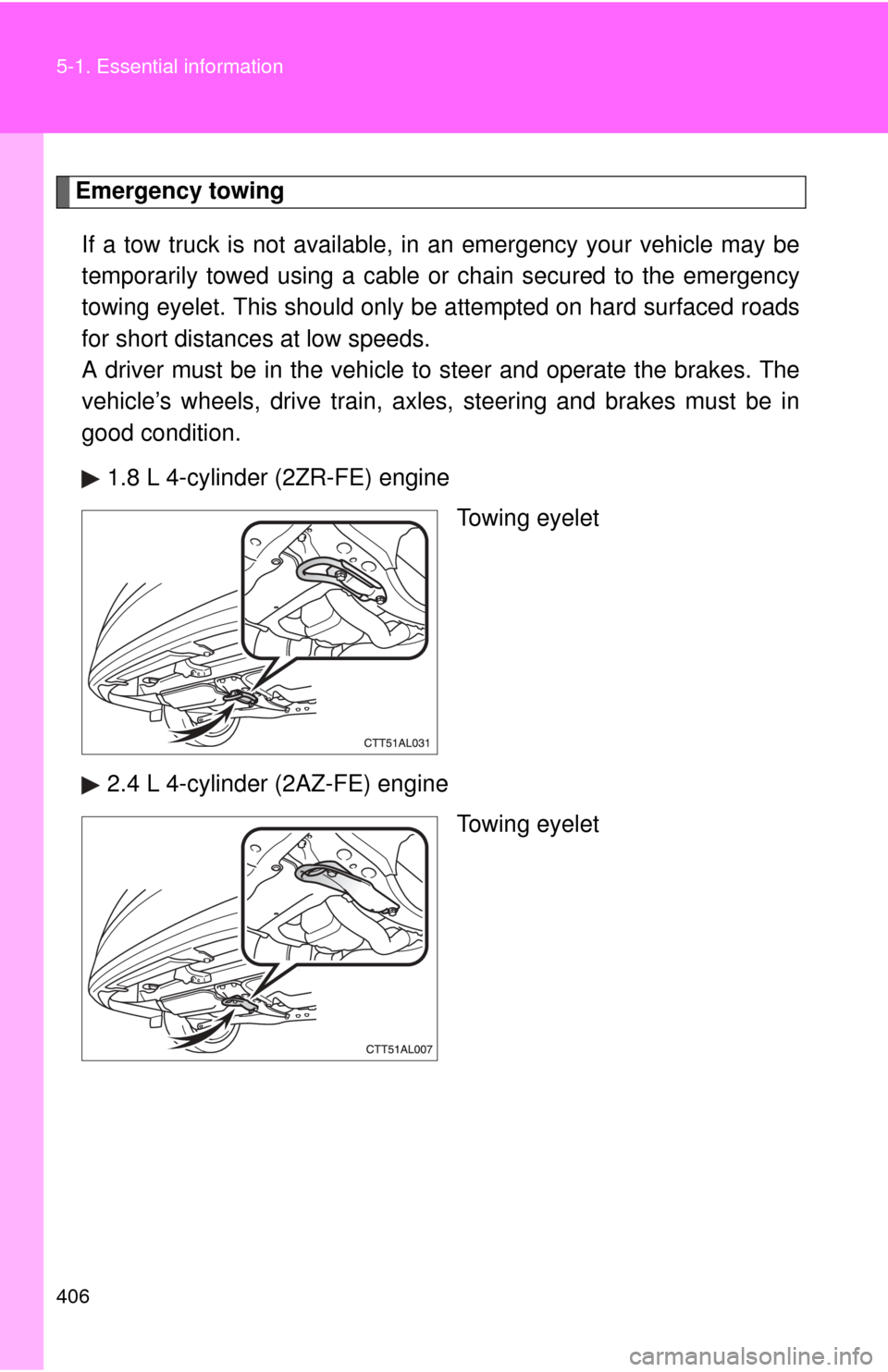
Emergency towingIf a tow truck is not available, in an emergency your vehicle may be
temporarily towed using a cable or chain secured to the emergency
towing eyelet. This should only be attempted on hard surfaced roads
for short distances at low speeds.
A driver must be in the vehicle to steer and operate the brakes. The
vehicle’s wheels, drive train, axles, steering and brakes must be in
good condition.
1.8 L 4-cylinder (2ZR-FE) engine Towing eyelet
2.4 L 4-cylinder (2AZ-FE) engine Towing eyelet
Page 407 of 516
5
When trouble arises
407
5-1. Essential information
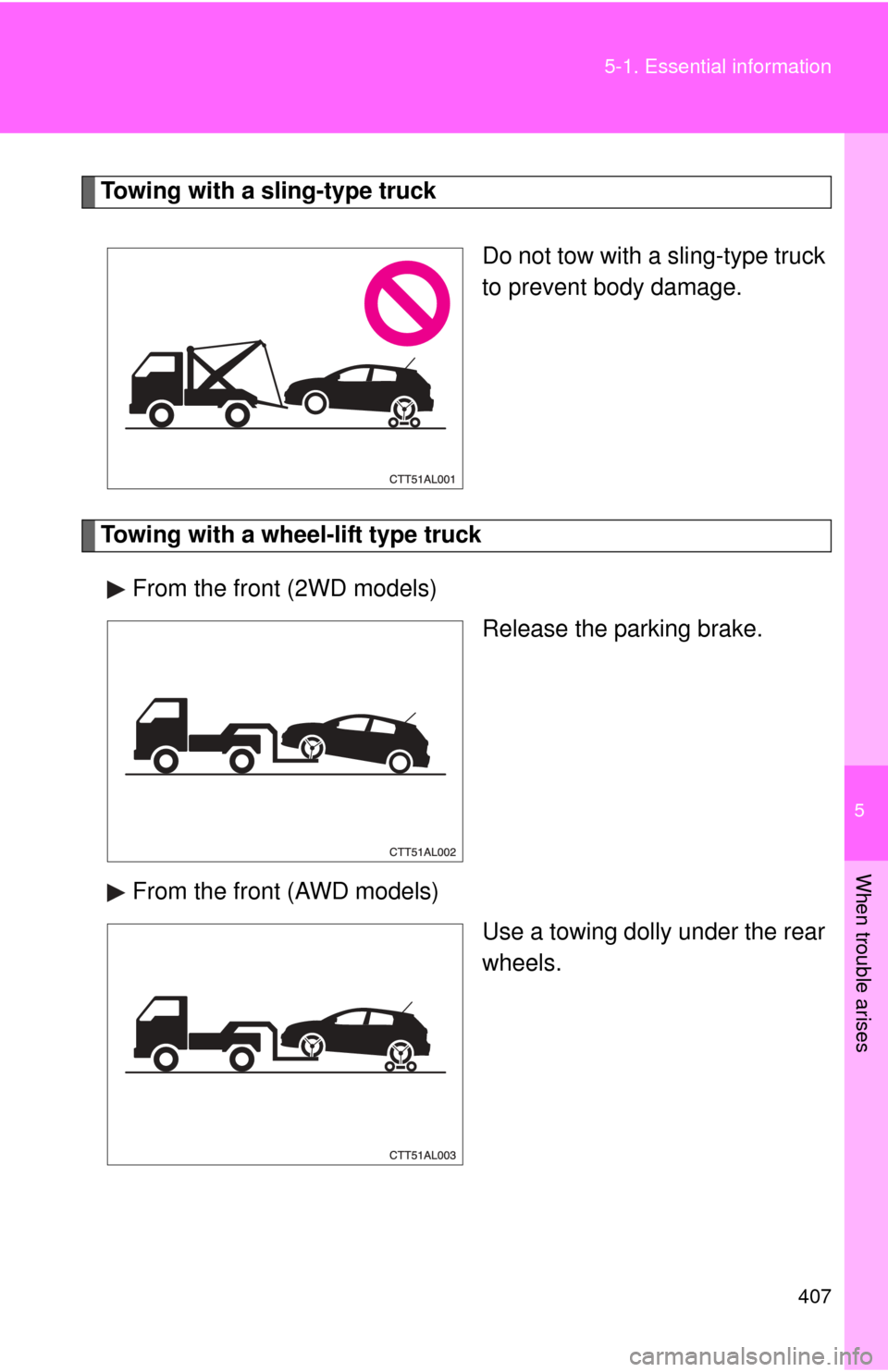
Towing with a sling-type truck
Do not tow with a sling-type truck
to prevent body damage.
Towing with a wheel-lift type truckFrom the front (2WD models) Release the parking brake.
From the front (AWD models) Use a towing dolly under the rear
wheels.
Page 408 of 516
408 5-1. Essential information
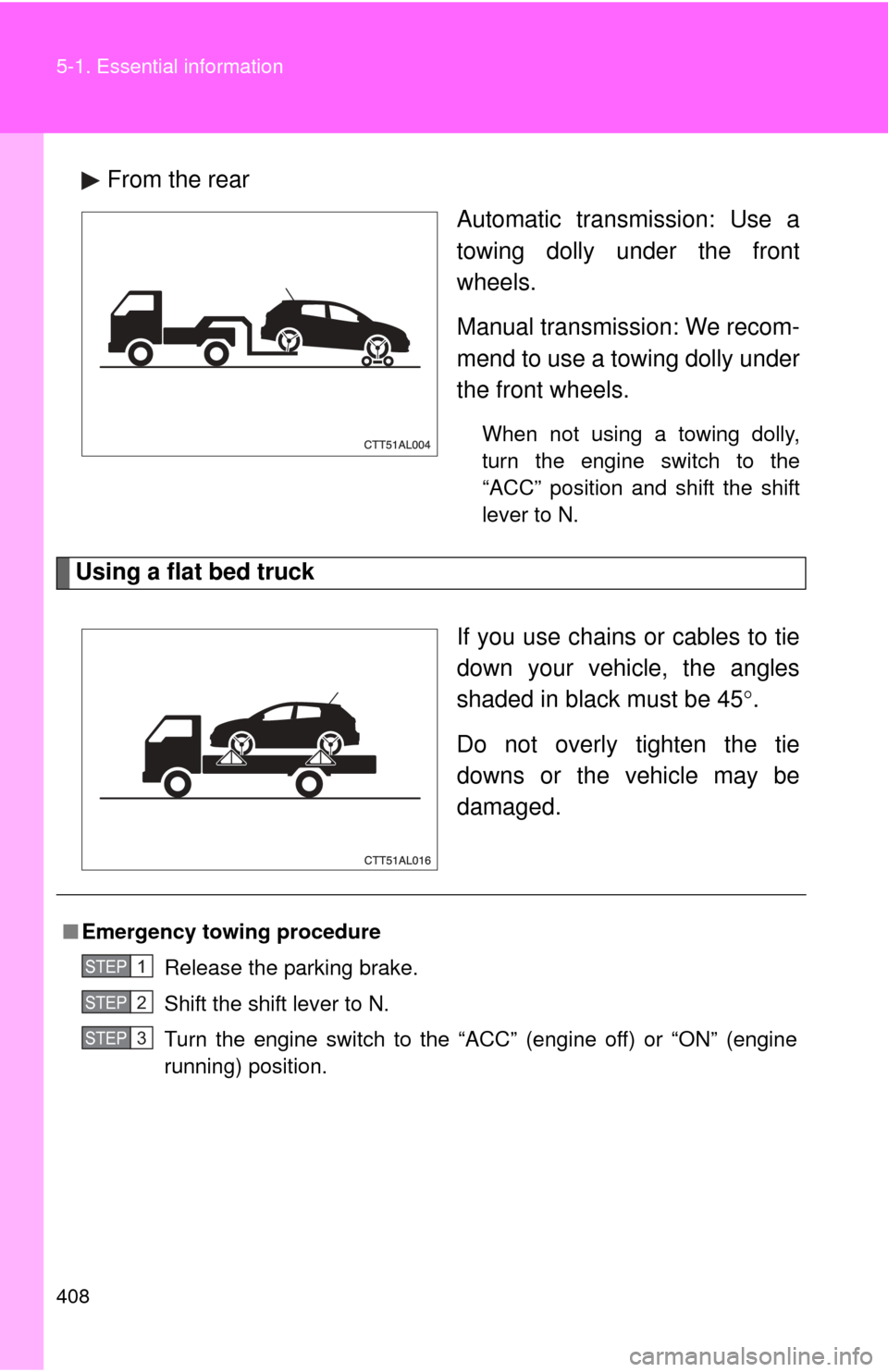
From the rearAutomatic transmission: Use a
towing dolly under the front
wheels.
Manual transmission: We recom-
mend to use a towing dolly under
the front wheels.
When not using a towing dolly,
turn the engine switch to the
“ACC” position and shift the shift
lever to N.
Using a flat bed truck
If you use chains or cables to tie
down your vehicle, the angles
shaded in black must be 45.
Do not overly tighten the tie
downs or the vehicle may be
damaged.
■ Emergency towin g procedure
Release the parking brake.
Shift the shift lever to N.
Turn the engine switch to the “ACC” (engine off) or “ON” (engine
running) position.
STEP1
STEP2
STEP3
Page 410 of 516
410 5-1. Essential information
NOTICE
■To prevent body damage when towing with a sling-type truck
Do not tow with a sling-type truck, either from the front or rear.
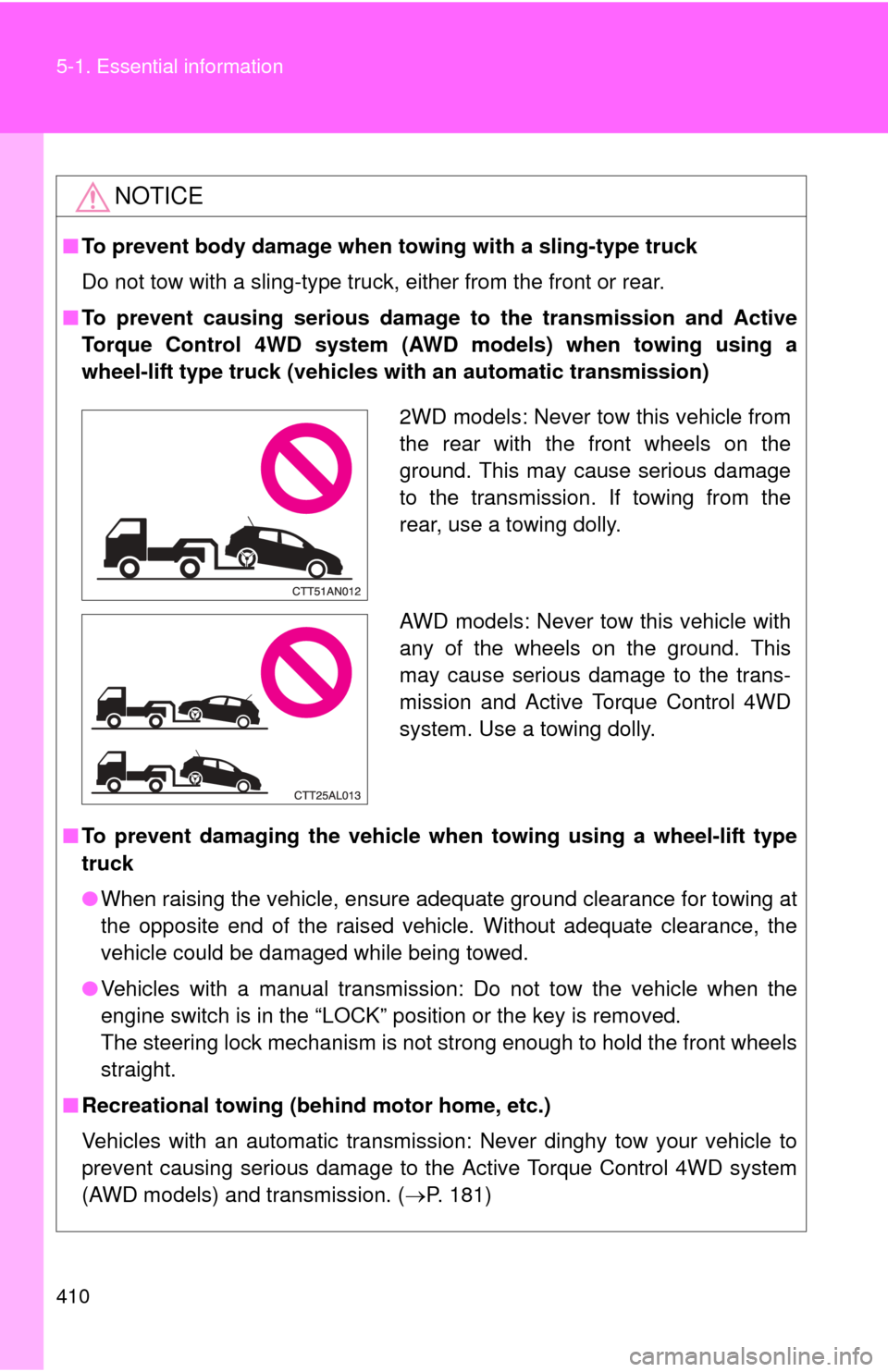
■ To prevent causing serious damage to the transmission and Active
Torque Control 4WD system (AWD models) when towing using a
wheel-lift type truck (vehicles with an automatic transmission)
■ To prevent damaging the vehicle wh en towing using a wheel-lift type
truck
● When raising the vehicle, ensure adequate ground clearance for towing at
the opposite end of the raised vehicle. Without adequate clearance, the
vehicle could be damaged while being towed.
● Vehicles with a manual transmission: Do not tow the vehicle when the
engine switch is in the “LOCK” position or the key is removed.
The steering lock mechanism is not strong enough to hold the front wheel\
s
straight.
■ Recreational towing (behind motor home, etc.)
Vehicles with an automatic transmission: Never dinghy tow your vehicle to
prevent causing serious damage to the Active Torque Control 4WD system
(AWD models) and transmission. ( P. 181)
2WD models: Never tow this vehicle from
the rear with the front wheels on the
ground. This may cause serious damage
to the transmission. If towing from the
rear, use a towing dolly.
AWD models: Never tow this vehicle with
any of the wheels on the ground. This
may cause serious damage to the trans-
mission and Active Torque Control 4WD
system. Use a towing dolly.
Page 416 of 516
416 5-2. Steps to take in an emergency
Follow the correction procedures.After taking the specified steps to correct the suspected problem,
check that the warning light turns off.
CAUTION
■ When the electric power steering warning light comes on
The steering wheel may become extremely heavy.
If the steering wheel becomes heavier than usual when operating, firmly
hold and operate it using more force than usual.
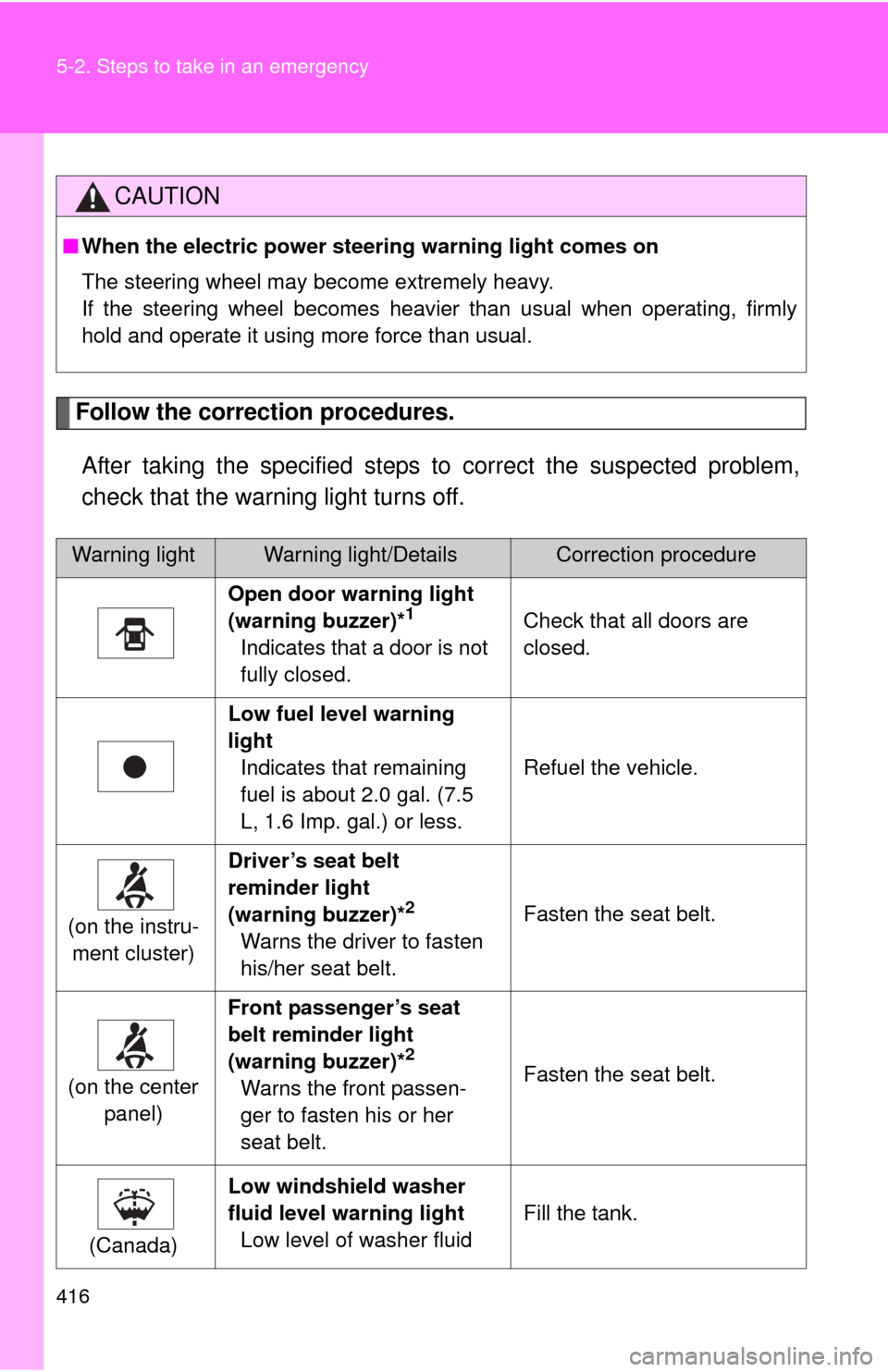
Warning lightWarning light/DetailsCorrection procedure
Open door warning light
(warning buzzer)*
1
Indicates that a door is not
fully closed. Check that all doors are
closed.
Low fuel level warning
light Indicates that remaining
fuel is about 2.0 gal. (7.5
L, 1.6 Imp. gal.) or less. Refuel the vehicle.
(on the instru- ment cluster) Driver’s seat belt
reminder light
(warning buzzer)*
2
Warns the driver to fasten
his/her seat belt.
Fasten the seat belt.
(on the center panel) Front passenger’s seat
belt reminder light
(warning buzzer)*
2
Warns the front passen-
ger to fasten his or her
seat belt.
Fasten the seat belt.
(Canada) Low windshield washer
fluid level warning light
Low level of washer fluid Fill the tank.
Page 420 of 516

420 5-2. Steps to take in an emergency
■If the tire pressure warning system is inoperative
The tire pressure warning system will be disabled in the following condi-
tions:
(When the condition becomes normal, the system will work properly.)
●If tires not equipped with tire pressure warning valves and transmit-
ters are used.
●If the ID code on the tire pressure warning valves and transmitters is
not registered in the tire pressure warning computer.
●If the tire inflation pressure is 73 psi (500 kPa, 5.1 kgf/cm2 or bar) or
higher.
The tire pressure warning system may be disabled in the following condi-
tions:
(When the condition becomes normal, the system will work properly.)
●If electronic devices or facilities using similar radio wave frequencies
are nearby.
●If a radio set at similar frequencies is in use in the vehicle.
●If a window tint that affects the radio wave signals is installed.
●If there is a lot of snow or ice on the vehicle, in particular around the
wheels or wheel housings.
●If non-genuine Toyota wheels are used. (Even if you use Toyota
wheels, the tire pressu re warning system may not work properly with
some types of tires.)
●If tire chains are used.
■If the tire pressure warning light frequently comes on after blinking
for 1 minute
If the tire pressure warning light comes on after blinking for 1 minute fre-
quently when the engine switch is turned to the “ON” position, have it
checked by your Toyota dealer.
■ Customization that can be co nfigured at Toyota dealer
The vehicle speed linked seat belt reminder buzzer can be disabled.
(Customizable features P. 485) However, Toyota recommends that the
seat belt reminder buzzer be operational to alert the driver and front passen-
ger that the seat belts are not fastened.