remove TOYOTA MIRAI 2019 (in English) User Guide
[x] Cancel search | Manufacturer: TOYOTA, Model Year: 2019, Model line: MIRAI, Model: TOYOTA MIRAI 2019Pages: 528, PDF Size: 11.84 MB
Page 70 of 528
701-1. For safe use
MIRAI_OM_USA_OM62054U(18MY)_O
M62048U(19MY)■
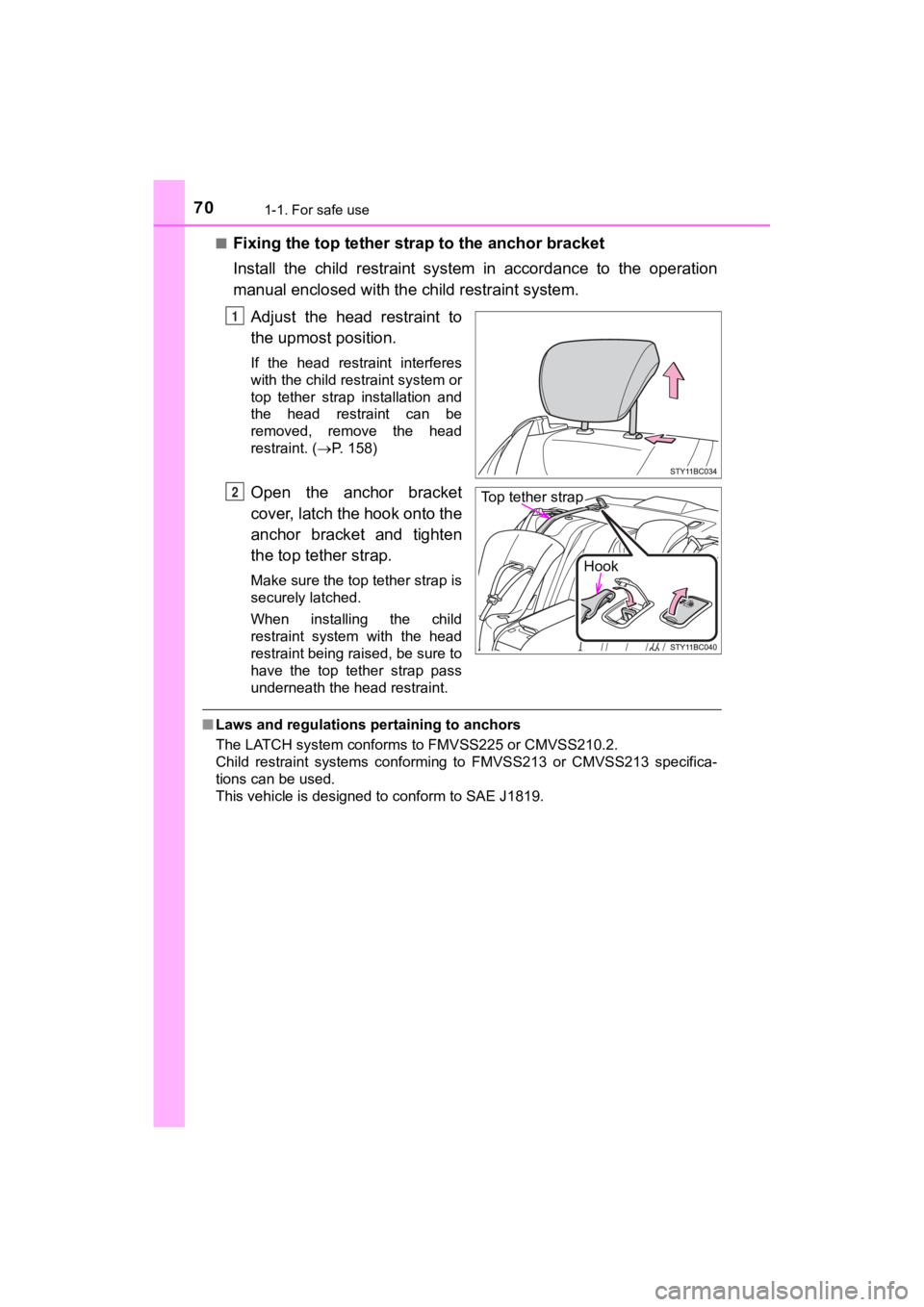
Fixing the top tether strap to the anchor bracket
Install the child restraint system in accordance to the operati
on
manual enclosed with the child restraint system.
Adjust the head restraint to
the upmost position.
If the head restraint interferes
with the child restraint system or
top tether strap installation and
the head restraint can be
removed, remove the head
restraint. (P. 158)
Open the anchor bracket
cover, latch the hook onto the
anchor bracket and tighten
the top tether strap.
Make sure the top tether strap is
securely latched.
When installing the child
restraint system with the head
restraint being raised, be sure to
have the top tether strap pass
underneath the head restraint.
■ Laws and regulations pertaining to anchors
The LATCH system conforms to FMVSS225 or CMVSS210.2.
Child restraint systems conforming to FMVSS213 or CMVSS213 spec ifica-
tions can be used.
This vehicle is designed to conform to SAE J1819.
1
Hook
Top tether strap
O
Page 80 of 528
801-3. Theft deterrent system
MIRAI_OM_USA_OM62054U(18MY)_O
M62048U(19MY)
For Canada
WARNING
■Certifications for the immobilizer system
Changes or modifications not expressly approved by the party re sponsible
for compliance could void the user’s authority to operate the e quipment.
NOTICE
■To ensure the system operates correctly
Do not modify or remove the system. If modified or removed, the proper
operation of the system cannot be guaranteed.
Page 82 of 528
821-3. Theft deterrent system
MIRAI_OM_USA_OM62054U(18MY)_O
M62048U(19MY)
■System maintenance
The vehicle has a maintenance-free type alarm system.
■ Items to check before locking the vehicle
To prevent unexpected triggering of the alarm and vehicle theft , make sure of
the following:
● Nobody is in the vehicle.
● The windows are closed before the alarm is set.
● No valuables or other personal items are left in the vehicle.
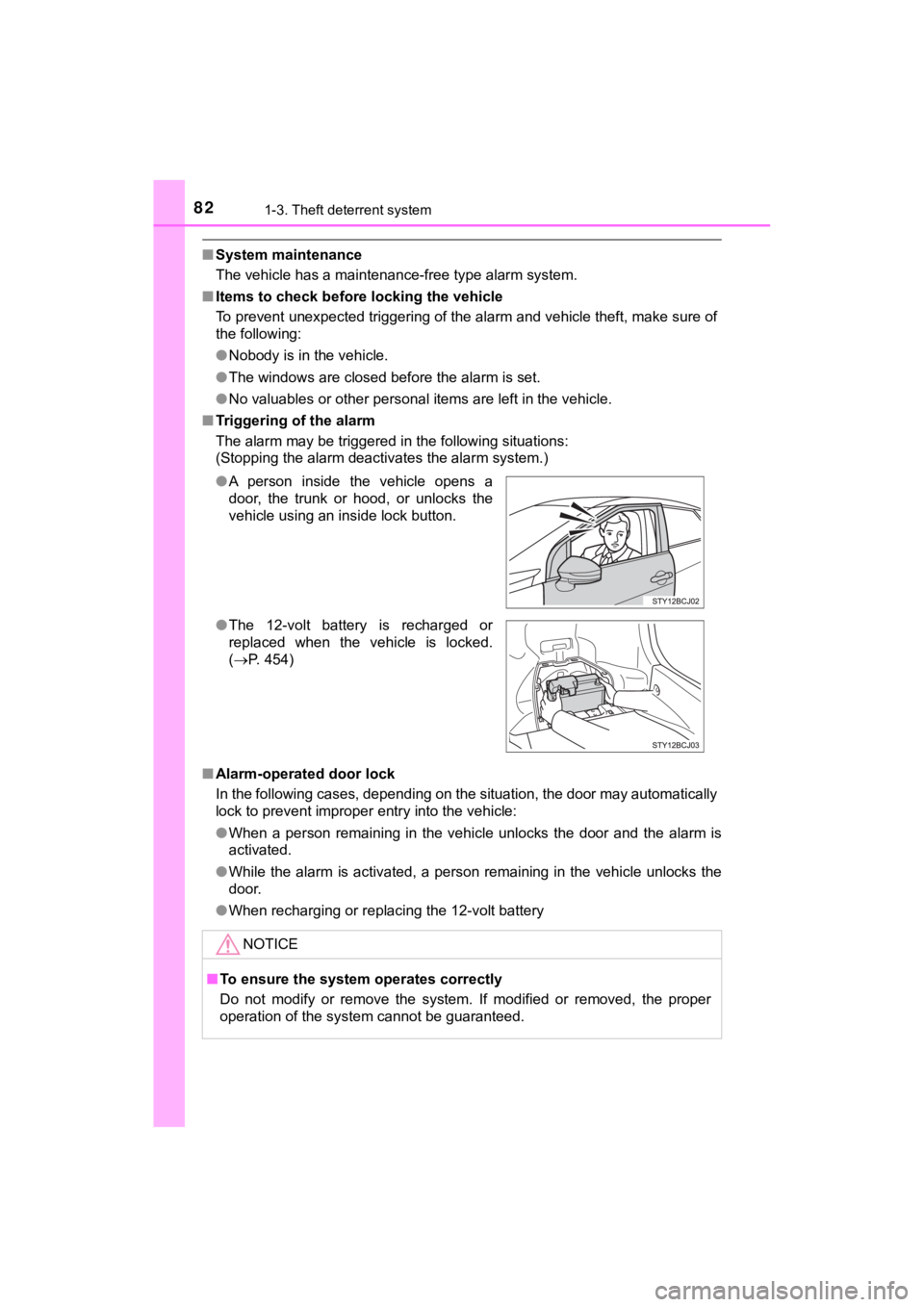
■ Triggering of the alarm
The alarm may be triggered in the following situations:
(Stopping the alarm deactivates the alarm system.)
■ Alarm-operated door lock
In the following cases, depending on the situation, the door ma y automatically
lock to prevent improper entry into the vehicle:
● When a person remaining in the vehicle unlocks the door and the alarm is
activated.
● While the alarm is activated, a person remaining in the vehicle unlocks the
door.
● When recharging or replacing the 12-volt battery
●
A person inside the vehicle opens a
door, the trunk or hood, or unlocks the
vehicle using an inside lock button.
● The 12-volt battery is recharged or
replaced when the vehicle is locked.
(P. 454)
NOTICE
■ To ensure the system operates correctly
Do not modify or remove the system. If modified or removed, the proper
operation of the system cannot be guaranteed.
Page 83 of 528
831-3. Theft deterrent system
1
For safety and security
MIRAI_OM_USA_OM62054U(18MY)_O
M62048U(19MY)
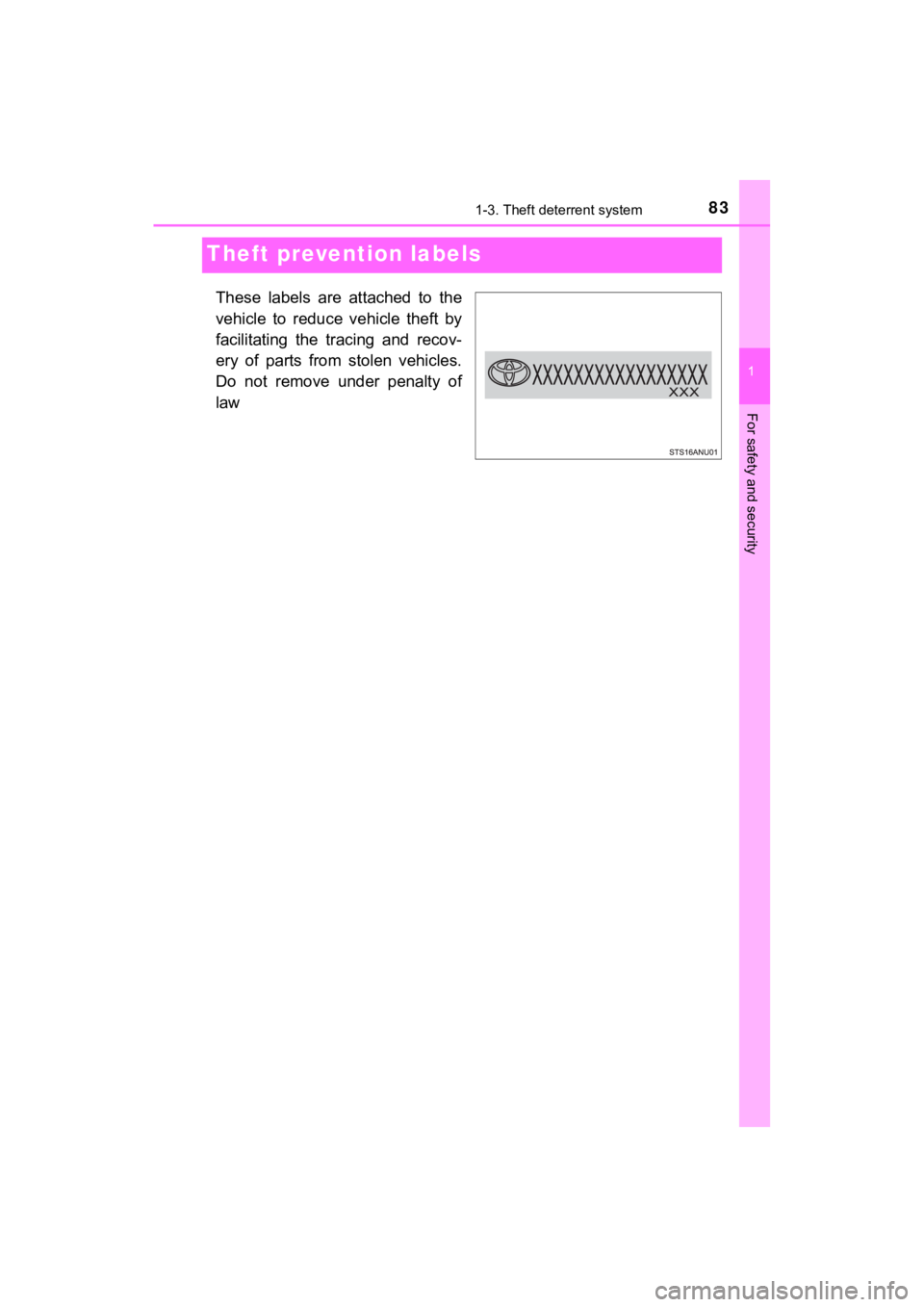
Theft prevention labels
These labels are attached to the
vehicle to reduce vehicle theft by
facilitating the tracing and recov-
ery of parts from stolen vehicles.
Do not remove under penalty of
law
Page 98 of 528
982. Fuel cell vehicle
MIRAI_OM_USA_OM62054U(18MY)_O
M62048U(19MY)■
Basic concepts of hydrogen safety
●Prevent leakage
The pipe joints of the hydrogen pipelines are designed to preve nt leaks.
The joints are checked for gas leakage at every official vehicle inspection.
● Detect to stop leakage
• The vehicle is equipped with hydrogen detectors. If the hydrog en detec-
tors detect a leak, the hydrogen tank valves automatically clos e to pre-
vent more hydrogen from escaping.
• The vehicle is equipped with a collision sensor. If the collis ion sensor
detects a collision, the hydrogen tank valves automatically clo se to pre-
vent hydrogen gas from leaking from any damaged components.
● Disperse the leaked hydrogen gas
The hydrogen tanks and pipelines are located outside of the passenger
compartment, so any leaked gas will disperse into the atmospher e by
design.
● Eliminate sources of fire
No source of fire is located near the hydrogen pipelines by des ign.
WARNING
■Hydrogen-related components
● Never alter, customize, or disassemble any hydrogen-related par ts.
● The hydrogen tanks, fuel cell stack, hydrogen pipelines, and co nnecting
components are filled with hydrogen gas. Do not remove or disassemble
these parts. Doing so can cause a hydrogen gas leak, resulting in fire or
explosion of the vehicle, which may result in death or serious injury.
■ When hydrogen gas leak or other malfunction is detected
● If a large amount of hydrogen gas leaking is noticed, turn off the power
switch, exit the vehicle, and stay far away from it. Display wa rning signs
and keep sources of fire away from the vehicle. If possible, get assistance.
When the above is done, immediately contact your Toyota dealer.
● If you notice gas leaking or any other malfunction, immediately stop the
vehicle in a safe and well-ventilated place, exit the vehicle, and stay far
away from it.
● If a warning message is shown on the multi-information display, immedi-
ately stop the vehicle in a safe, well-ventilated place.
Page 99 of 528
992. Fuel cell vehicle
2
Fuel cell system
MIRAI_OM_USA_OM62054U(18MY)_O
M62048U(19MY)
WARNING
■Tailpipe
● Do not directly touch the water or steam coming out of the tail pipe. Doing
so may cause low-temperature burns.
● The fuel cell vehicle generates water during power generation. The gener-
ated water discharged from the tailpipe is not suitable for dri nking. Never
drink the water coming out of the tailpipe.
● You may notice a strange odor from the tailpipe for a while aft er the pur-
chase of a new vehicle or after an extended period of non-use, but this is
not a malfunction. Also, the odor is harmless but it may be unpleasant, so
do not breathe in the exhaust.
■ High-voltage and high-temperature precautions
This vehicle is equipped with a high-voltage system. Follow the instructions
below as high-voltages can cause severe burns and electric shock that may
result in death or serious injury.
● Never touch, disassemble, remove, or replace the high-voltage p arts,
cables (orange), or connectors.
● The components inside the motor compartment will become hot dur ing
operation. Be careful of both the high-voltage and high-tempera ture, and
always obey the warning labels on the vehicle.
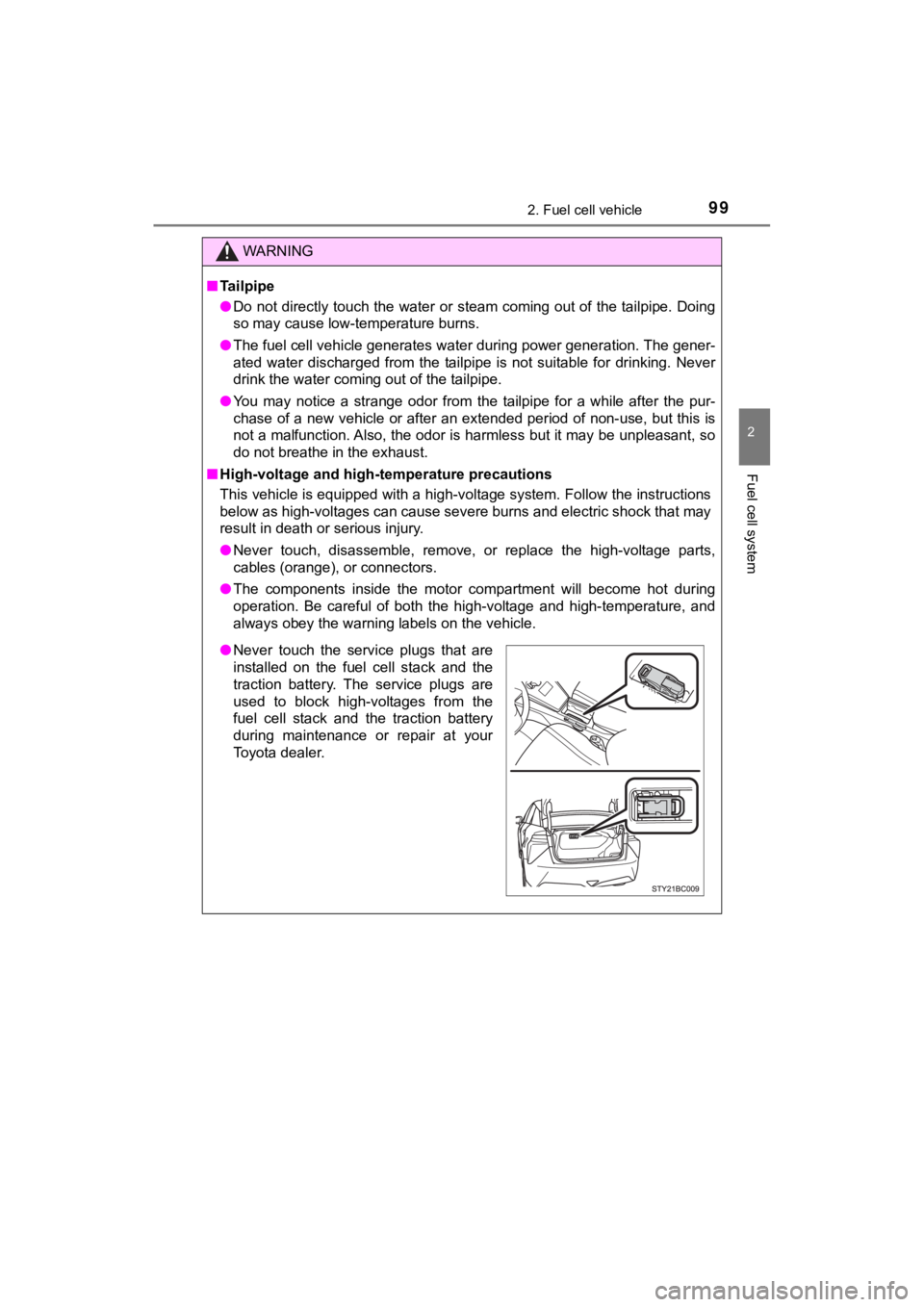
● Never touch the service plugs that are
installed on the fuel cell stack and the
traction battery. The service plugs are
used to block high-voltages from the
fuel cell stack and the traction battery
during maintenance or repair at your
Toyota dealer.
Page 101 of 528
1012. Fuel cell vehicle
2
Fuel cell system
MIRAI_OM_USA_OM62054U(18MY)_O
M62048U(19MY)
WARNING
■Traction battery
● Never resell, transfer, or modify the traction battery. To prev ent accidents,
traction batteries that have been removed from disposed vehicle are col-
lected through Toyota dealers. Do not dispose of the traction battery your-
self.
If the traction battery is not properly collected, the following may occur,
resulting in death or serious injury:
• The traction battery may be illegally disposed or dumped, and it is haz-
ardous to the environment. Additionally, someone may touch a high-volt-
age part, resulting in an electric shock.
• The traction battery is intended to be used exclusively with your fuel cell vehicle. If the traction battery is used outside of your vehicl e or modified
in any way, accidents, such as electric shock, heat generation, smoke
generation, ignition, explosion and electrolyte leakage may occ ur.
In particular, reselling or transferring the traction battery exposes the
receiving party to risks of accidents as they may not be aware of these
dangers. Make sure to inform them of the contents of this Owner ’s Man-
ual.
● If your vehicle is disposed without the traction battery having been
removed, there is a danger of serious electric shock in case hi gh-voltage
parts, cables, or their connectors are touched. When disposing of your
vehicle, the traction battery must be disposed by your Toyota d ealer, or a
qualified service shop. If the traction battery is not disposed of properly, it
may cause electric shock that can result in death or serious in jury.
NOTICE
■Traction battery air intake vent
● If the traction battery output decreases due to the entry of dust or debris,
foreign material, a warning message is shown on the multi-infor mation dis-
play. Have the vehicle inspected at your Toyota dealer.
● Do not place objects where the air intake vent will be obstruct ed. This may
lead to a reduction in traction battery power output and damage .
● Clean the air intake vent regularly to prevent clogging.
● Do not allow water or objects to enter the air intake vent, as this may dam-
age the traction battery.
■ Traction Battery
Do not spill a large amount of water near the traction battery in the vehicle.
If water spills onto the traction battery, have the vehicle ins pected at your
Toyota dealer.
Page 129 of 528
1294-1. Key information
4
Operation of each component
MIRAI_OM_USA_OM62054U(18MY)_O
M62048U(19MY)
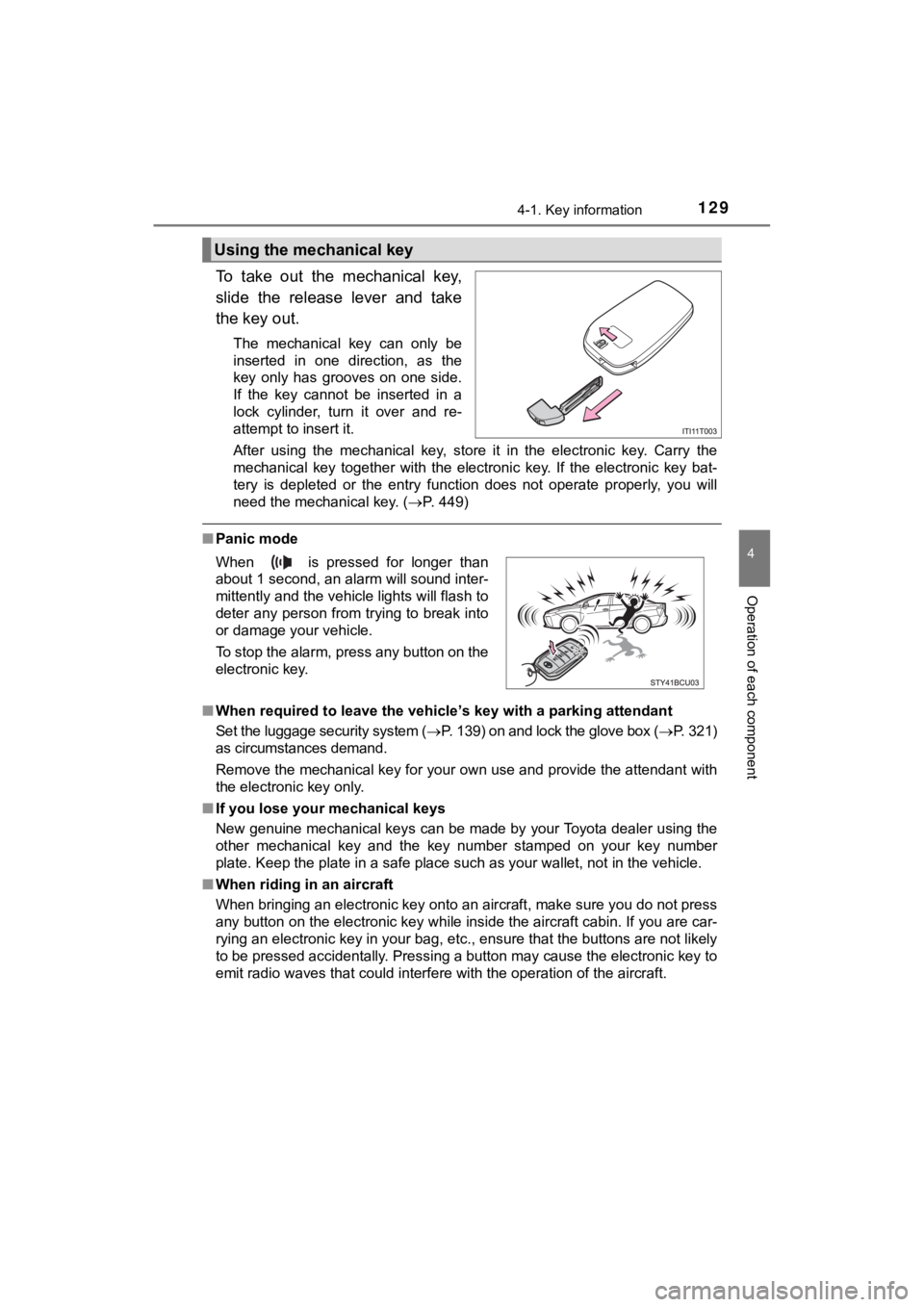
To take out the mechanical key,
slide the release lever and take
the key out.
The mechanical key can only be
inserted in one direction, as the
key only has grooves on one side.
If the key cannot be inserted in a
lock cylinder, turn it over and re-
attempt to insert it.
After using the mechanical key, store it in the electronic key. Carry the
mechanical key together with the electronic key. If the electro nic key bat-
tery is depleted or the entry function does not operate properl y, you will
need the mechanical key. ( P. 449)
■Panic mode
■ When required to leave the vehicle’s key with a parking attendant
Set the luggage security system ( P. 139) on and lock the glove box ( P. 3 2 1 )
as circumstances demand.
Remove the mechanical key for your own use and provide the attendant with
the electronic key only.
■ If you lose your mechanical keys
New genuine mechanical keys can be made by your Toyota dealer u sing the
other mechanical key and the key number stamped on your key num ber
plate. Keep the plate in a safe place such as your wallet, not in the vehicle.
■ When riding in an aircraft
When bringing an electronic key onto an aircraft, make sure you do not press
any button on the electronic key while inside the aircraft cabi n. If you are car-
rying an electronic key in your bag, etc., ensure that the butt ons are not likely
to be pressed accidentally. Pressing a button may cause the electronic key to
emit radio waves that could interfere with the operation of the aircraft.
Using the mechanical key
When is pressed for longer than
about 1 second, an alarm will sound inter-
mittently and the vehicle lights will flash to
deter any person from trying to break into
or damage your vehicle.
To stop the alarm, press any button on the
electronic key.
Page 133 of 528
1334-2. Opening, closing and locking the doors
4
Operation of each component
MIRAI_OM_USA_OM62054U(18MY)_O
M62048U(19MY)
■Operation signals
Doors:
A buzzer sounds and the emergency flashers flash to indicate th at the doors
have been locked/unlocked. (Locked: Once; Unlocked: Twice)
Windows:
A buzzer sounds to indicate that the windows are opening.
■ Security feature
If a door is not opened within approximately 60 seconds after t he vehicle is
unlocked, the security feature automatically locks the vehicle again.
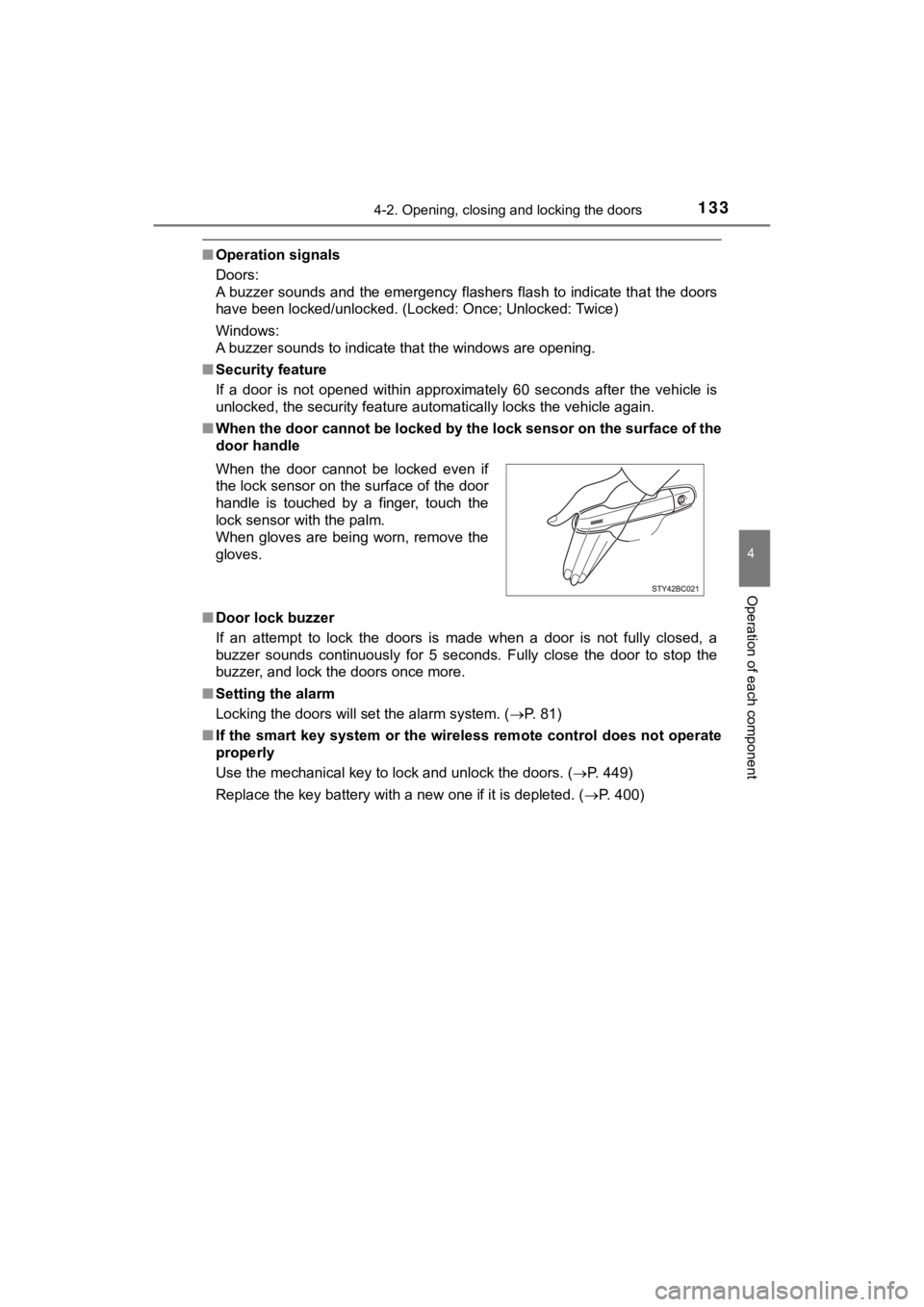
■ When the door cannot be locked by the lock sensor on the surface of the
door handle
■ Door lock buzzer
If an attempt to lock the doors is made when a door is not full y closed, a
buzzer sounds continuously for 5 seconds. Fully close the door to stop the
buzzer, and lock the doors once more.
■ Setting the alarm
Locking the doors will set the alarm system. ( P. 81)
■ If the smart key system or the wireless remote control does not operate
properly
Use the mechanical key to lock and unlock the doors. ( P. 449)
Replace the key battery with a new one if it is depleted. ( P. 400)
When the door cannot be locked even if
the lock sensor on the surface of the door
handle is touched by a finger, touch the
lock sensor with the palm.
When gloves are being worn, remove the
gloves.
Page 142 of 528
1424-2. Opening, closing and locking the doors
MIRAI_OM_USA_OM62054U(18MY)_O
M62048U(19MY)
WARNING
■Using the trunk
Observe the following precautions.
Failure to do so may cause parts of the body to be caught, resu lting in seri-
ous injury.
● Remove any heavy loads, such as snow and ice, from the trunk li d before
opening it. Failure to do so may cause the trunk lid to suddenl y shut again
after it is opened.
● When opening or closing the trunk lid, thoroughly check to make sure the
surrounding area is safe.
● If anyone is in the vicinity, make sure they are safe and let t hem know that
the trunk is about to open or close.
● Use caution when opening or closing the trunk lid in windy weat her as it
may move abruptly in strong wind.
● Do not attach any accessories other than genuine Toyota parts t o the trunk
lid. Such additional weight on the trunk lid may cause the lid to suddenly
shut again after it is opened.
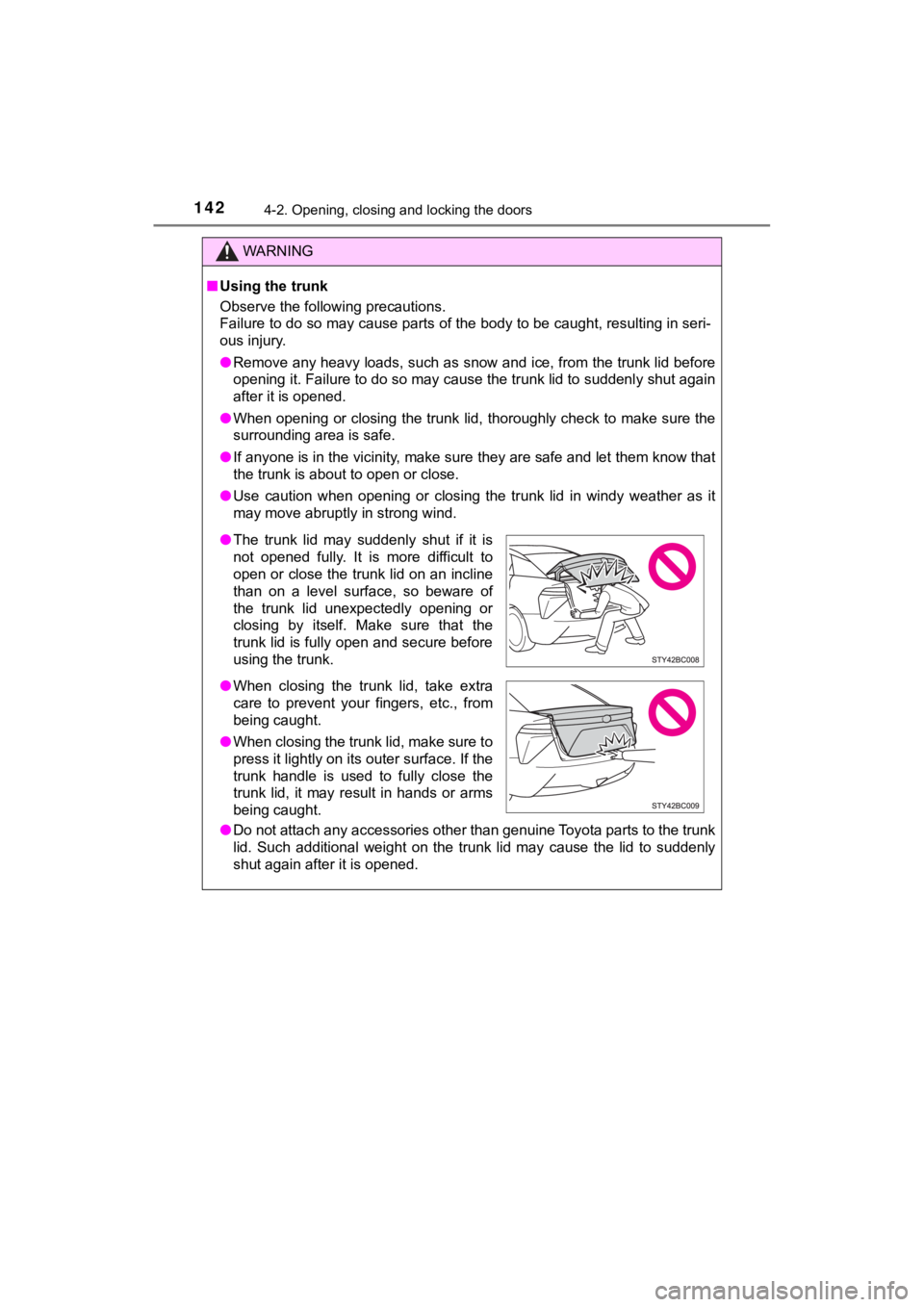
● The trunk lid may suddenly shut if it is
not opened fully. It is more difficult to
open or close the trunk lid on an incline
than on a level surface, so beware of
the trunk lid unexpectedly opening or
closing by itself. Make sure that the
trunk lid is fully open and secure before
using the trunk.
● When closing the trunk lid, take extra
care to prevent your fingers, etc., from
being caught.
● When closing the trunk lid, make sure to
press it lightly on its outer surface. If the
trunk handle is used to fully close the
trunk lid, it may result in hands or arms
being caught.