emergency TOYOTA MIRAI 2020 (in English) Owner's Manual
[x] Cancel search | Manufacturer: TOYOTA, Model Year: 2020, Model line: MIRAI, Model: TOYOTA MIRAI 2020Pages: 528, PDF Size: 11.98 MB
Page 229 of 528
2295-5. Using the driving support systems
5
Driving
MIRAI_OM_USA_OM62073U
WARNING
■When to disable the pre-collision system
In the following situations, disable the system, as it may not operate prop-
erly, possibly leading to an accident resulting in death or ser ious injury:
● When the vehicle is being towed
● When your vehicle is towing another vehicle
● When transporting the vehicle via truck, boat, train or similar means of
transportation
● When the vehicle is raised on a lift with the fuel cell system on and the tires
are allowed to rotate freely
● When inspecting the vehicle using a drum tester such as a chass is dyna-
mometer or speedometer tester, or when using an on vehicle whee l bal-
ancer
● When a strong impact is applied to the front bumper or front gr ille, due to
an accident or other reasons
● If the vehicle cannot be driven in a stable manner, such as when the vehi-
cle has been in an accident or is malfunctioning
● When the vehicle is driven in a sporty manner or off-road
● When the tires are not properly inflated
● When the tires are very worn
● When tires of a size other than specified are installed
● When tire chains are installed
● When a compact spare tire or an emergency tire puncture repair kit is used
● If equipment (snow plow, etc.) that may obstruct the radar sens or or front
camera is temporarily installed to the vehicle
Page 239 of 528
2395-5. Using the driving support systems
5
Driving
MIRAI_OM_USA_OM62073U
WARNING
●When the tires have been excessively worn, or when the tire inf lation pres-
sure is low.
● When tires of a size other than specified are installed.
● Vehicle is driven in traffic lanes other than that highways and freeways.
● During emergency towing
■ Preventing LDA system malfunctio ns and operations performed by
mistake
● Do not modify the headlights or place stickers, etc. on the sur face of the
lights.
● Do not modify the suspension etc. If the suspension etc. needs to be
replaced, contact your Toyota dealer.
● Do not install or place anything on the hood or grille. Also, d o not install a
grille guard (bull bars, kangaroo bar, etc.).
● If your windshield needs repairs, contact your Toyota dealer.
■ Conditions in which functions may not operate properly
In the following situations, the functions may not operate prop erly and the
vehicle may depart from its lane. Drive safely by always paying careful
attention to your surroundings and operate the steering wheel t o correct the
path of the vehicle without relying solely on the functions.
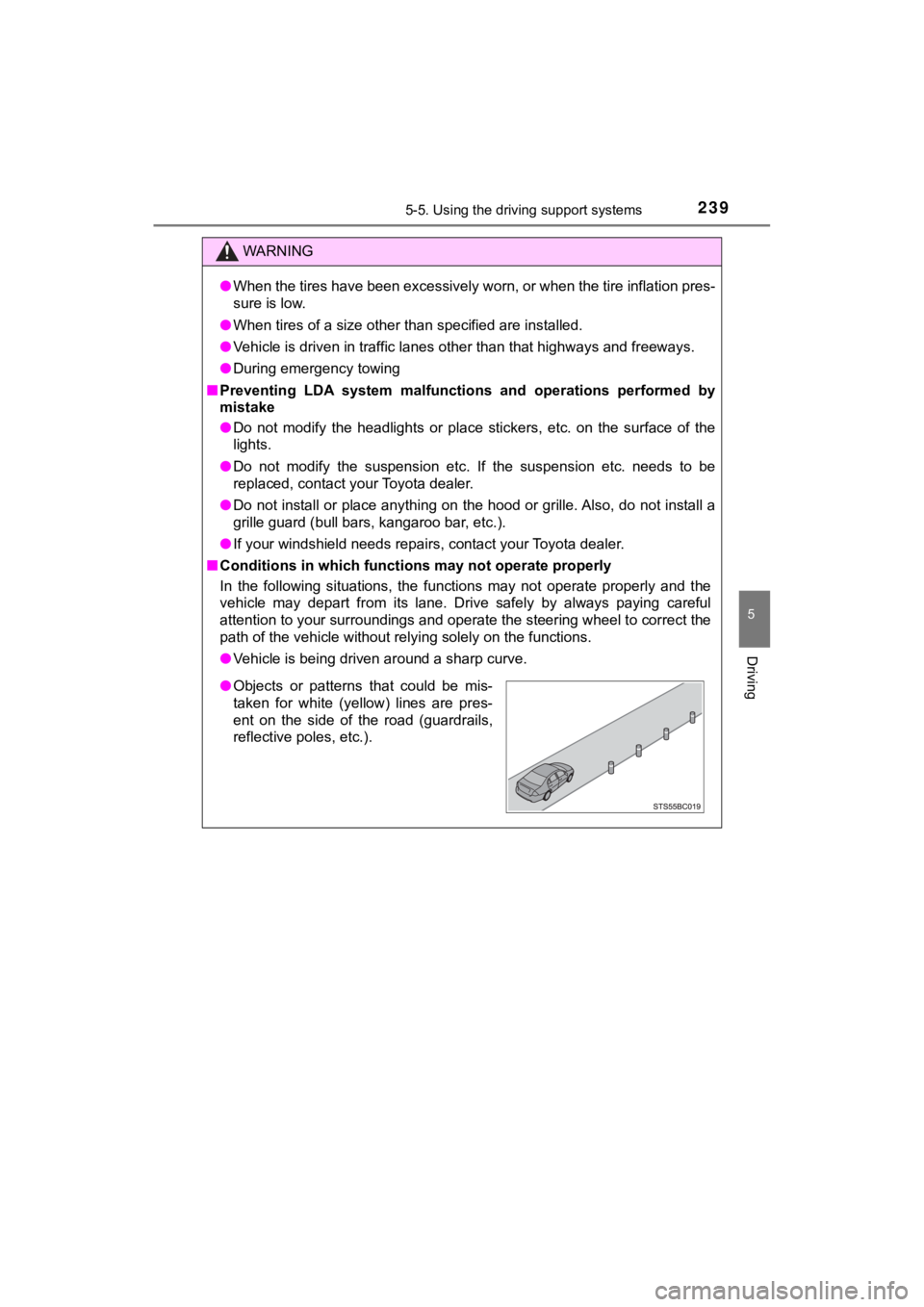
● Vehicle is being driven around a sharp curve.
●Objects or patterns that could be mis-
taken for white (yellow) lines are pres-
ent on the side of the road (guardrails,
reflective poles, etc.).
Page 255 of 528

2555-5. Using the driving support systems
5
Driving
MIRAI_OM_USA_OM62073U
WARNING
●Assisting the driver to judge proper following distance
The dynamic radar cruise control determines whether the followi ng dis-
tance between the driver’s own vehicle and a designated vehicle traveling
ahead is within a set range. It is not capable of making any ot her type of
judgement.Therefore, it is absolutely necessary for the driver to remain
vigilant and to determine whether or not there is a possibility of danger in
any given situation.
● Assisting the driver to operate the vehicle
The dynamic radar cruise control does not include functions whi ch will
prevent or avoid collisions with vehicles ahead of your vehicle . Therefore,
if there is ever any possibility of danger, the driver must tak e immediate
and direct control of the vehicle and act appropriately in orde r to ensure
the safety of all involved.
■ Situations unsuitable for dynamic radar cruise control
Do not use dynamic radar cruise control in any of the following situations.
Doing so may result in inappropriate speed control and could ca use an acci-
dent resulting in death or serious injury.
● Roads where there are pedestrians, cyclists, etc.
● In heavy traffic
● On roads with sharp bends
● On winding roads
● On slippery roads, such as those covered with rain, ice or snow
● On steep downhills, or where there are sudden changes between s harp up
and down gradients
Vehicle speed may exceed the set speed when driving down a stee p hill.
● At entrances to freeways and highways
● When weather conditions are bad enough that they may prevent the sen-
sors from detecting correctly (fog, snow, sandstorm, heavy rain, etc.)
● When there is rain, snow, etc. on the front surface of the rada r or front
camera
● In traffic conditions that require frequent repeated acceleration and decel-
eration
● During emergency towing
● When an approach warning buzzer is heard often
Page 278 of 528
2785-5. Using the driving support systems
MIRAI_OM_USA_OM62073U■
Operation starting conditions
When the PKSB OFF indicator is not illuminated or flashing
(
P. 283, 419) and all of the fo llowing conditions are met, the
system operates.
Fuel cell system output restriction control
● The Parking Support Brake functi on (for static objects) is ON
(enabled).
● The vehicle speed is 10 mph (15 km/h) or less.
● There is a static obstacle in th e traveling direction of the vehicle
(6 to 13 ft. [2 to 4 m] ahead).
● The system determined that a stronger-than-normal brake opera-
tion was necessary to avoid a collision.
Brake control
● Fuel cell system output restrict ion control is being performed.
● The system determined that a n emergency brake operation was
necessary to av oid a collision.
■Operation ending conditions
In any of the following conditi ons, the system stops operating.
Fuel cell system output restriction control
● The Parking Support Brake function (for static objects) has been
turned OFF (disabled).
● The collision became a voidable with normal brake operation.
● The static object is no longer in the traveling direction of th e vehi-
cle (6 to 13 ft. [2 to 4 m] ahead).
Brake control
● The Parking Support Brake function (for static objects) has been
turned OFF (disabled).
● Approximately 2 seconds elapsed after the vehicle was stopped
by brake control.
● The brake control was depress ed after the vehicle was stopped
by brake control.
● The static obstacle is no longer in the traveling direction of the
vehicle (6 to 13 ft. [2 to 4 m] ahead).
Operation conditions
Page 279 of 528
2795-5. Using the driving support systems
5
Driving
MIRAI_OM_USA_OM62073U
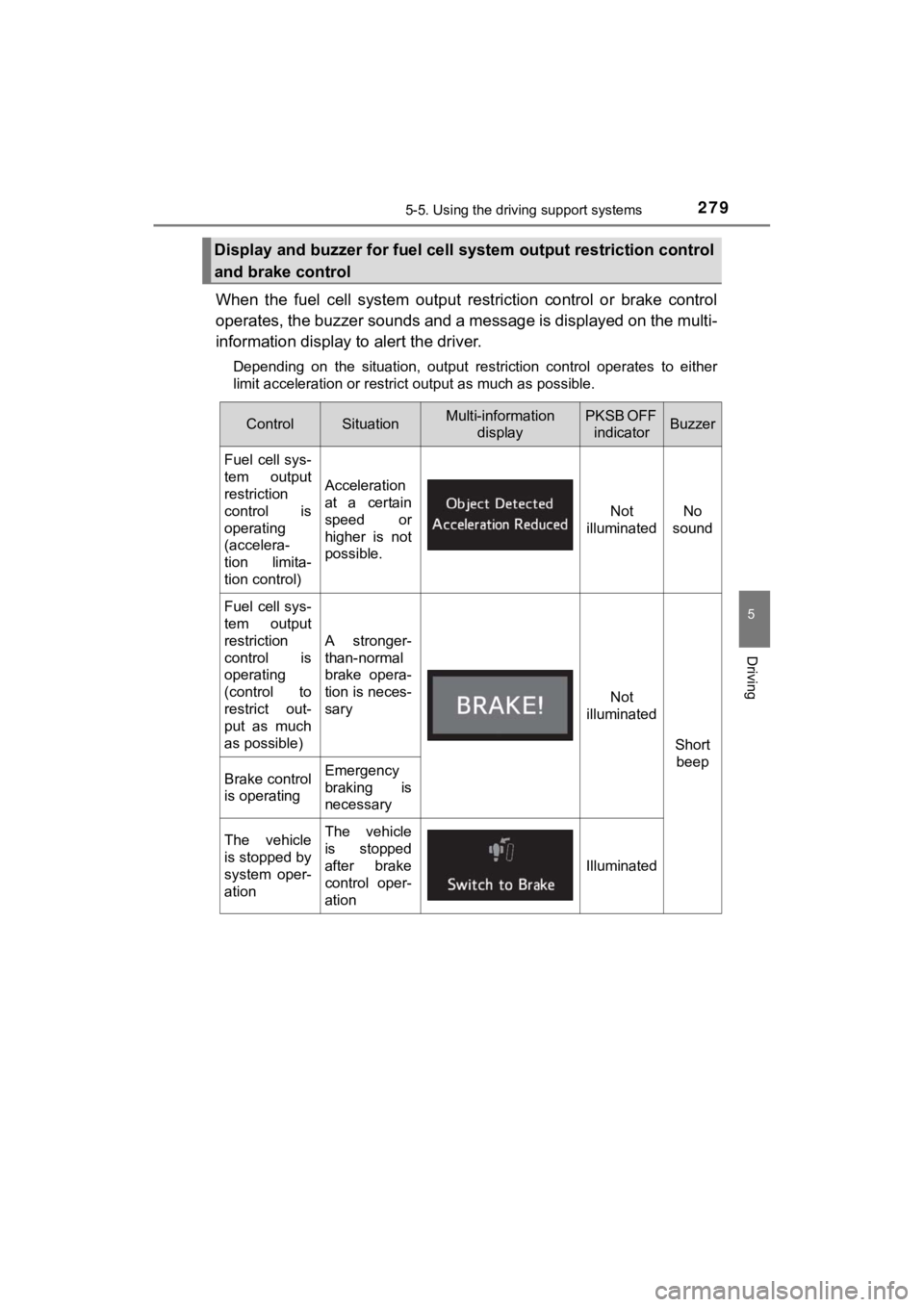
When the fuel cell system output restriction control or brake control
operates, the buzzer sounds and a message is displayed on the m ulti-
information display to alert the driver.
Depending on the situation, output restriction control operates to either
limit acceleration or restrict output as much as possible.
Display and buzzer for fuel cell system output restriction cont rol
and brake control
ControlSituationMulti-information displayPKSB OFF indicatorBuzzer
Fuel cell sys-
tem output
restriction
control is
operating
(accelera-
tion limita-
tion control)
Acceleration
at a certain
speed or
higher is not
possible.
Not
illuminatedNo
sound
Fuel cell sys-
tem output
restriction
control is
operating
(control to
restrict out-
put as much
as possible)
A stronger-
than-normal
brake opera-
tion is neces-
sary
Not
illuminated
Short
beep
Brake control
is operatingEmergency
braking is
necessary
The vehicle
is stopped by
system oper-
ationThe vehicle
is stopped
after brake
control oper-
ation
Illuminated
Page 376 of 528

3767-3. Do-it-yourself maintenance
MIRAI_OM_USA_OM62073U
WARNING
■Chemicals in the 12-volt battery
The 12-volt battery contains poisonous and corrosive sulfuric a cid and may
produce hydrogen gas which is flammable and explosive. To reduce the risk
of death or serious injury, take the following precautions while working on or
near the 12-volt battery:
● Do not cause sparks by touching the 12-volt battery terminals w ith tools.
● Do not smoke or light a match near the 12-volt battery.
● Avoid contact with eyes, skin and clothes.
● Never inhale or swallow electrolyte.
● Wear protective safety glasses when working near the 12-volt ba ttery.
● Keep children away from the 12-volt battery.
■ Where to safely charge the 12-volt battery
Always charge the 12-volt battery in an open area. Do not charg e the
12-volt battery in a garage or closed room where there is insufficient ventila-
tion.
■ How to recharge the 12-volt battery
Only perform a slow charge (5 A or less). The 12-volt battery m ay explode if
charged at a quicker rate.
■ Emergency measures regarding electrolyte
● If electrolyte gets in your eyes
Flush your eyes with clean water for at least 15 minutes and ge t immedi-
ate medical attention. If possible, continue to apply water wit h a sponge or
cloth while traveling to the nearest medical facility.
● If electrolyte gets on your skin
Wash the affected area thoroughly. If you feel pain or burning, get medical
attention immediately.
● If electrolyte gets on your clothes
It can soak through clothing on to your skin. Immediately take off the cloth-
ing and follow the procedure above if necessary.
● If you accidentally swallow electrolyte
Drink a large quantity of water or milk. Get emergency medical attention
immediately.
■ When replacing the 12-volt battery
Use a 12-volt battery designed for this vehicle. Failure to do so may cause
gas (hydrogen) to enter the passenger compartment, causing a fire or
explosion.
For replacement of the 12-volt battery, contact your Toyota dea ler.
Page 407 of 528
407
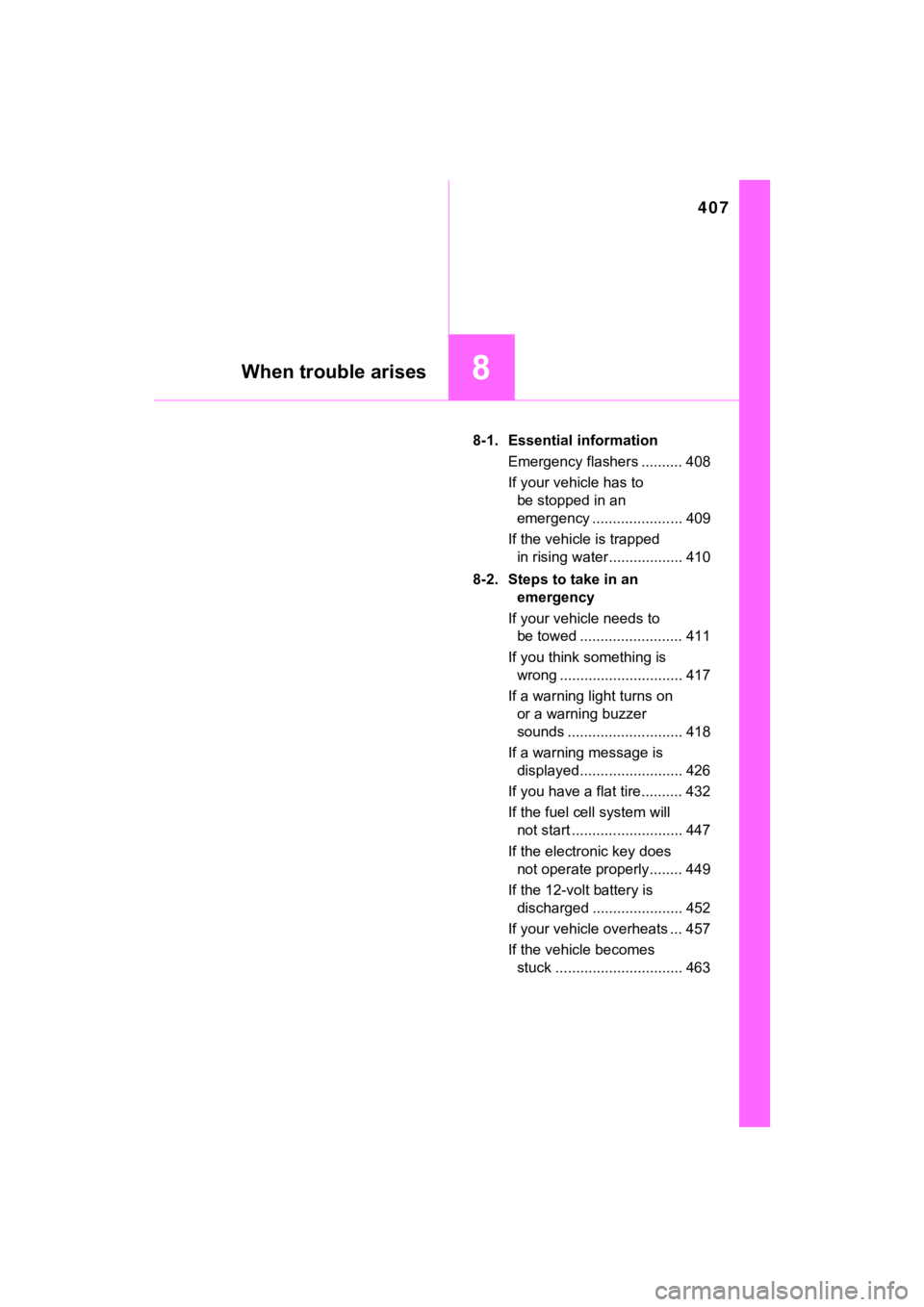
8When trouble arises
MIRAI_OM_USA_OM62073U8-1. Essential information
Emergency flashers .......... 408
If your vehicle has to be stopped in an
emergency ...................... 409
If the vehicle is trapped in rising water.................. 410
8-2. Steps to take in an emergency
If your vehicle needs to be towed ......................... 411
If you think something is wrong .............................. 417
If a warning light turns on or a warning buzzer
sounds ............................ 418
If a warning message is displayed......................... 426
If you have a flat tire.......... 432
If the fuel cell system will not start ........................... 447
If the electronic key does not operate properly ........ 449
If the 12-volt battery is discharged ...................... 452
If your vehicle overheats ... 457
If the vehicle becomes stuck ............................... 463
Page 408 of 528

4088-1. Essential information
MIRAI_OM_USA_OM62073U
Emergency flashers
Press the switch.
All the turn signal lights will flash.
To turn them off, press the switch
once again.
■Emergency flashers
If the emergency flashers are used for a long time while the fu el cell system is
not operating (while the “READY” indicator is not illuminated), the 12-volt bat-
tery may discharge.
The emergency flashers are used to warn other drivers when the
vehicle has to be stopped in the road due to a breakdown, etc.
Page 409 of 528

4098-1. Essential information
MIRAI_OM_USA_OM62073U
8
When trouble arises
If your vehicle has to be stopped in an
emergency
Steadily step on the brake pedal with both feet and firmly depress it.
Do not pump the brake pedal repeatedly as this will increase th e effort
required to slow the vehicle.
Shift the shift position to N.
If the shift positi on is shifted to N
After slowing down, stop the vehi cle in a safe place by the road.
Stop the fuel cell system.
If the shift position c annot be shifted to N
Keep depressing the brake pedal with both feet to reduce vehicl e
speed as much as possible.
To stop the fuel cell system,
press and hold the power
switch for 2 consecutive sec-
onds or more, or press it briefly
3 times or more in succession.
Stop the vehicle in a s afe place by the road.
Only in an emergency, such as if it becomes impossible to stop
the vehicle in the normal way, st op the vehicle using the follow-
ing procedure:
1
2
3
4
3
Press and hold for 2 seconds or more,
or press briefly 3 times or more
Q
WARNING
■ If the fuel cell system has to be turned off while driving
Power assist for the steering wheel will be lost, making the steering wheel
heavier to turn. Decelerate as much as possible before turning off the fuel
cell system.
5
Page 410 of 528

4108-1. Essential information
MIRAI_OM_USA_OM62073U
If the vehicle is trapped in rising water
●Remove the seat belt first.
● If the door can be opened, open the door and exit the vehicle.
● If the door can not be opened, open the window using the power
window switch and exit the vehicle through the window.
● If the window can not be opened using the power window switch,
remain calm, wait until the water level inside the vehicle rise s to the
point that the water pressure i nside of the vehicle equals the water
pressure outside of the vehicl e, and then open the door and exi t the
vehicle.
In the event the vehicle is submerged in water, remain calm and
perform the following.
WARNING
■ Using an emergency hammer* for emergency escape
The rear window of this vehicle can be shattered by an emergenc y ham-
mer
* used for emergency escape, however, since the windshield, front side
windows and rear side windows are laminated glass they can not be shat-
tered by an emergency hammer
*.
*: Contact your Toyota dealer or aftermarket accessory manufacturer for fur-
ther information about an emergency hammer.
■ Escaping the vehicle from the window
There are cases where escaping the vehicle from the window is n ot possi-
ble due to seating position, passenger body type, etc.
When using an emergency hammer, consider your seat location and the
size of the window opening to ensure that the opening is accessible and
large enough to escape.