light TOYOTA MIRAI 2022 Owners Manual
[x] Cancel search | Manufacturer: TOYOTA, Model Year: 2022, Model line: MIRAI, Model: TOYOTA MIRAI 2022Pages: 556, PDF Size: 17.34 MB
Page 451 of 556
4518-2. Steps to take in an emergency
Owners Manual_USA_M62084_en
8
When trouble arises■Warning messages
The warning messages explained
below may differ from the actual
messages according to operation
conditions and vehicle specifica-
tions.
■Warning buzzer
A buzzer may sound when a mes-
sage is displayed.
In some cases, the buzzer may not
be heard due to being in a noisy
location or audio sound.
WARNING
Your vehicle has also been
equipped with a TPMS (tire pres-
sure warning system) malfunc-
tion indicator to indicate when the
system is not opera ting properly.
The TPMS (tire pressure warning
system) malfunction indicator is
combined with the low tire pres-
sure telltale (tire pressure warning
light). When the system detects a
malfunction, the telltale will flash
for approximately one minute and
then remain continuously illumi-
nated. This sequence will con-
tinue upon subsequent vehicle
start-ups as long as the malfunc-
tion exists. When the malfunction
indicator is illuminated, the sys-
tem may not be able to detect or
signal low tire pressure as
intended.
TPMS (tire pressure warning sys-
tem) malfunctions may occur for a
variety of reasons, including the
installation of replacement or
alternate tires or wheels on the
vehicle that prevent the TPMS
(tire pressure warning system)
from functioning properly. Always
check the TPMS (tire pressure
warning system) malfunction tell-
tale after replacing one or more
tires or wheels on your vehicle to
ensure that the r eplacement or
alternate tires and wheels allow
the TPMS (tire pressure warning
system) to continue to function
properly.
NOTICE
■To ensure the tire pressure
warning system operates
properly
Do not install tires with different
specifications or makers, as the
tire pressure warning system may
not operate properly.
If a war ning message
is displayed
The multi-information dis-
play shows warnings for
system malfunctions and
incorrectly performed oper-
ations, and messages that
indicate a need for mainte-
nance. When a message is
displayed, perform the
appropriate corrective
action for the message.
If a warning message is dis-
played again after the
appropriate actions have
been performed, contact
your Toyota dealer.
Additionally, if a warning
light comes on or flashes at
the same time that a warn-
ing message is displayed,
take the appropriate correc-
tive action for the warning
light. ( P.441)
Page 452 of 556

4528-2. Steps to take in an emergency
Owners Manual_USA_M62084_en
■If “FCV System Stopped Steer-
ing Power Low” is displayed
This message is displayed if the fuel
cell system is stopped while driving.
When steering wheel operations are
heavier than usual, grip the steering
wheel firmly and operate it using
more force th an usual.
■If “FCV System High Temp. FCV
Power Reduced” or “FCV
Power Reduced Due to Exces-
sive Acceleration” is displayed
1 Lower the speed while check the
safety, and run the vehicle like
this for several minutes.
2 If the message goes off, the vehi-
cle can be driven as is, since it
temporarily overheated.
This message may be displayed
when driving under severe operat-
ing conditions. (For example, when
driving up a lo ng steep hill.)
■If “FCV Power Significantly
Reduced” is displayed
The output power of the fuel cell
system is greatly restrained. If it is
displayed frequently, contact your
Toyota dealer.
■If “Stop Vehicle in a Safe Place
Push P Switch” is displayed
There may be a malfunction in the
fuel cell system or the shift position
may be shifted to N for a long time.
Immediately stop the vehicle and
contact your Toyota dealer.
■If “Shift is in N Release Acceler-
ator Before Shif ting” is dis-
played
The accelerator pedal has been
depressed when the shift position is
in N.
Release the accelerator pedal and
shift the shift position to D or R.
■If “Press brake when vehicle is
stopped FCV system may over-
heat” is displayed
The message may be displayed
when the accelerator pedal is depressed to hold the vehicle while
the vehicle is stopped on an incline,
etc. The fuel cell system may over-
heat. Release the accelerator pedal
and depress the brake pedal.
■If “Auto Power OFF to Conserve
Battery” is displayed
Power was turned off due to the
automatic power off function. Next
time when starting the fuel cell sys-
tem, operate the fuel cell system for
approximately 5 minutes to
recharge the 12-volt battery.
■If “Headlight System Malfunc-
tion Visit Your Dealer” is dis-
played
The following systems may be mal-
functioning. Hav e the vehicle
inspected by your Toyota dealer
immediately.
●The LED headlight system
●The automatic headlight leveling
system (if equipped)
●AHB (Automatic High Beam)
■If “Radar Cruise Control
Unavailable See Owner’s Man-
ual” is displayed
The dynamic radar cruise control
with full-speed range system is sus-
pended temporarily or until the prob-
lem shown in the message is
resolved. (Causes and coping meth-
ods: P.210)
■If “Radar Cruise Control
Unavailable” is displayed
The dynamic radar cruise control
with full-speed range system cannot
be used temporarily. Use the system
when it becomes available again.
■If a message that indicates the
malfunction of front camera is
displayed
The following systems may be sus-
pended until the problem shown in
the message is resolved. (P.210,
441)
●PCS (Pre-Collision system)
Page 463 of 556
4638-2. Steps to take in an emergency
Owners Manual_USA_M62084_en
8
When trouble arises
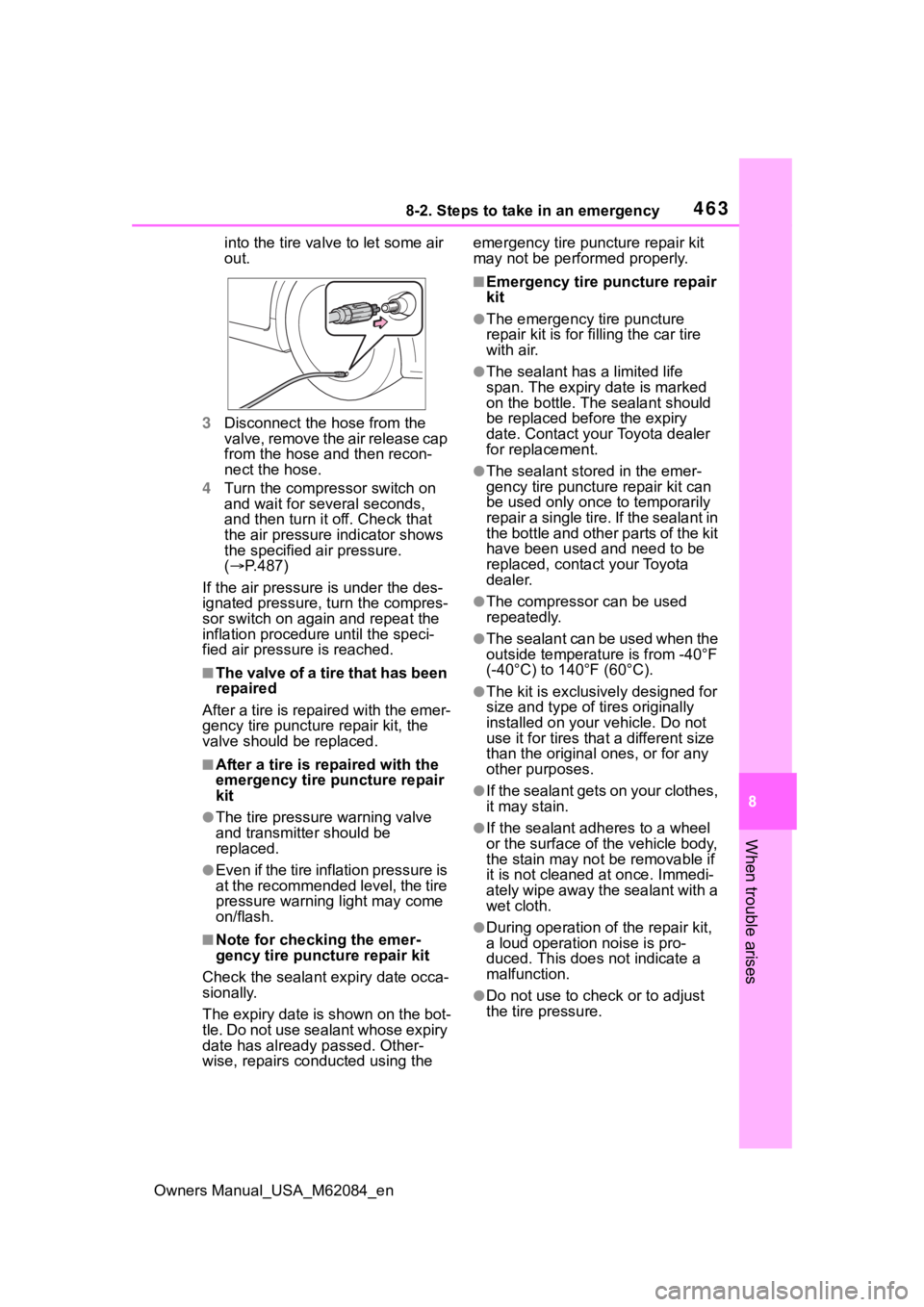
into the tire valve to let some air
out.
3 Disconnect the hose from the
valve, remove the air release cap
from the hose and then recon-
nect the hose.
4 Turn the compressor switch on
and wait for several seconds,
and then turn i t off. Check that
the air pressure indicator shows
the specified air pressure.
( P.487)
If the air pressure is under the des-
ignated pressure, turn the compres-
sor switch on again and repeat the
inflation procedure until the speci-
fied air pressure is reached.
■The valve of a tire that has been
repaired
After a tire is repaired with the emer-
gency tire puncture repair kit, the
valve should be replaced.
■After a tire is repaired with the
emergency tire puncture repair
kit
●The tire pressure warning valve
and transmitter should be
replaced.
●Even if the tire inflation pressure is
at the recommended level, the tire
pressure warning light may come
on/flash.
■Note for checking the emer-
gency tire puncture repair kit
Check the sealant expiry date occa-
sionally.
The expiry date is shown on the bot-
tle. Do not use sealant whose expiry
date has already passed. Other-
wise, repairs conducted using the emergency tire puncture repair kit
may not be performed properly.
■Emergency tire puncture repair
kit
●The emergency tire puncture
repair kit is for f
illing the car tire
with air.
●The sealant has a limited life
span. The expiry date is marked
on the bottle. The sealant should
be replaced before the expiry
date. Contact your Toyota dealer
for replacement.
●The sealant stored in the emer-
gency tire puncture repair kit can
be used only once to temporarily
repair a single tire. If the sealant in
the bottle and other parts of the kit
have been used and need to be
replaced, contact your Toyota
dealer.
●The compressor can be used
repeatedly.
●The sealant can be used when the
outside temperature is from -40°F
(-40°C) to 140°F (60°C).
●The kit is exclusi vely designed for
size and type of ti res originally
installed on your vehicle. Do not
use it for tires tha t a different size
than the original ones, or for any
other purposes.
●If the sealant gets on your clothes,
it may stain.
●If the sealant adhe res to a wheel
or the surface of the vehicle body,
the stain may not be removable if
it is not cleaned at once. Immedi-
ately wipe away the sealant with a
wet cloth.
●During operation of the repair kit,
a loud operation noise is pro-
duced. This does not indicate a
malfunction.
●Do not use to check or to adjust
the tire pressure.
Page 466 of 556
4668-2. Steps to take in an emergency
Owners Manual_USA_M62084_en
One of the following may be the
cause of the problem:
The electronic key may not be
functioning properly.
( P.468)
There may not be sufficient
fuel in the vehicle’s tank.
Refuel the vehicle.
The fuel door may be open.
( P.205)
There may be a malfunction
in the immobilizer system.
( P. 6 9 )
There may be a malfunction
in the shift control system.
*
( P.175, 453)
There may be a malfunction
in the steering lock system.
The fuel cell system may be
malfunctioning due to an elec-
trical problem such as elec- tronic key battery depletion or
a blown fuse. However,
depending on the type of mal-
function, an interim measure
is available to start the fuel
cell system. (
P.467)
There is a possibility that the
temperature of the traction
battery is extremely low
(approximately below -22˚F [-
30˚C]). ( P.83, 172)
It is possible the fuel cell sys-
tem is frozen. ( P.172)
*: It may not be possible to shift the
shift position from P.
One of the following may be the
cause of the problem:
The 12-volt battery may be
discharged. ( P.471)
The 12-volt battery terminal
connections may be loose or
corroded. ( P.400)
One of the following may be the
cause of the problem:
One or both of the 12-volt bat-
tery terminals may be discon-
If the fuel cell system
will not start
Reasons for the fuel cell
system not starting vary
depending on the situation.
Check the following and
perform the appropriate
procedure:
The fuel cell system will
not start even though the
correct starting procedure
is being followed.
( P.172)
The interior lights and
headlights are dim, or the
horn does not sound or
sounds at a low volume.
The interior lights and
headlights do not turn on,
or the horn does not
sound.
Page 472 of 556
4728-2. Steps to take in an emergency
Owners Manual_USA_M62084_enafter checking the surrounding a
rea. Also, do not make any connections
where parts nearby may interfere.
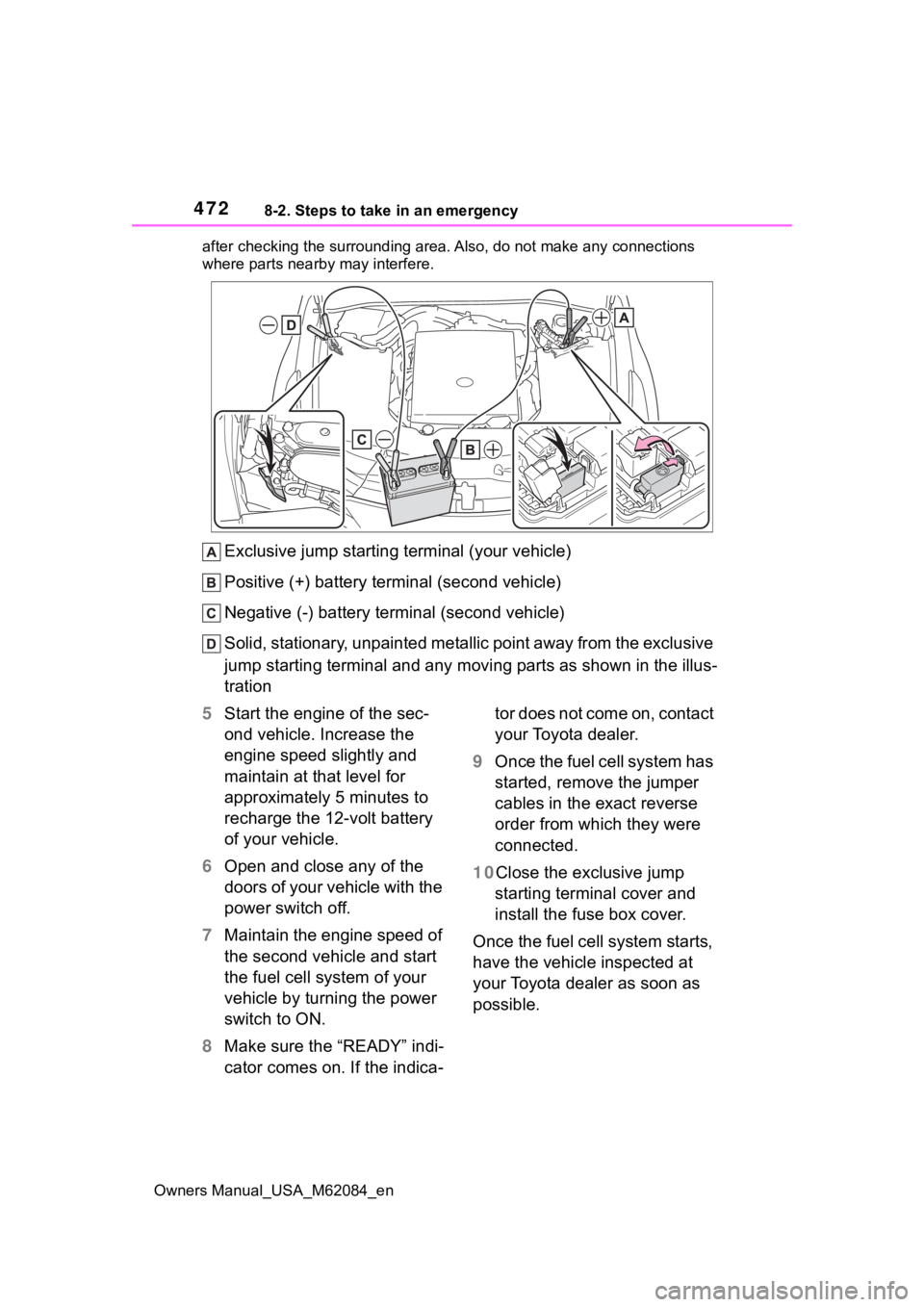
Exclusive jump starting terminal (your vehicle)
Positive (+) battery terminal (second vehicle)
Negative (-) battery term inal (second vehicle)
Solid, stationary, unpainted metallic point away from the exclu sive
jump starting terminal and any m oving parts as shown in the illus-
tration
5 Start the engine of the sec-
ond vehicle. Increase the
engine speed slightly and
maintain at that level for
approximately 5 minutes to
recharge the 12-volt battery
of your vehicle.
6 Open and close any of the
doors of your vehicle with the
power switch off.
7 Maintain the engine speed of
the second vehicle and start
the fuel cell system of your
vehicle by turning the power
switch to ON.
8 Make sure the “READY” indi-
cator comes on. If the indica- tor does not come on, contact
your Toyota dealer.
9 Once the fuel cell system has
started, remove the jumper
cables in the exact reverse
order from which they were
connected.
10Close the exclusive jump starting terminal cover and
install the fuse box cover.
Once the fuel cell system starts,
have the vehicle inspected at
your Toyota dealer as soon as
possible.
Page 473 of 556
4738-2. Steps to take in an emergency
Owners Manual_USA_M62084_en
8
When trouble arises
■Starting the fuel cell system
when the 12-volt battery is dis-
charged
The fuel cell system cannot be
started by push-starting.
■To prevent 12-volt battery dis-
charge
●Turn off the headlights and the
audio system while the fuel cell
system is off.
●Turn off any unnecessary electri-
cal components when the vehicle
is running at a low speed for an
extended period, such as in heavy
traffic.
■When the 12-volt battery is
removed or discharged
●Information stor ed in the ECU is
cleared. When the 12-volt battery
is depleted, have the vehicle
inspected at you r Toyota dealer.
●Some systems may require initial-
ization. ( P.510)
●If the 12-volt battery discharges, it
may not be possible to shift the
shift position to other positions.
In this case, the vehicle cannot be
towed without lifting both rear
wheels because the rear wheels will
be locked.
■When removing the 12-volt bat-
tery terminals
When the 12-volt battery terminals
are removed, the information stored
in the ECU is cleared. Before
removing the 12-volt battery termi-
nals, contact your Toyota dealer.
■Charging the 1 2-volt battery
The electricity stor ed in the 12-volt
battery will discharge gradually even
when the vehicle is not in use, due
to natural discharge and the drain-
ing effects of certain electrical appli-
ances. If the vehicle is left for a long
time, the 12-volt battery may dis-
charge, and the fuel cell system
may be unable to s tart. (The 12-volt battery recharges automatically
while the fuel cell
system is operat-
ing.)
■When recharging or replacing
the 12-volt battery
●In some cases, it may not be pos-
sible to unlock the doors using the
smart key system when the 12-
volt battery is discharged. Use the
wireless remote c ontrol or the
mechanical key to lock or unlock
the doors.
●The fuel cell system may not start
on the first attempt after the 12-
volt battery has recharged but will
start normally after the second
attempt. This is not a malfunction.
●The power switch mode is memo-
rized by the vehicle. When the 12-
volt battery is reconnected, the
system will return to the mode it
was in before the 12-volt battery
was discharged. Before discon-
necting the 12-volt battery, turn
the power switch off.
If you are unsure what mode the
power switch was in before the
12-volt battery discharged, be
especially careful when recon-
necting the 12-volt battery.
●When the 12-volt battery is recon-
nected, start the fuel cell system,
depress the brake pedal, and con-
firm that it is possible to shift into
each shift position.
●If the battery is removed or the ter-
minals disconnected without oper-
ating the water release function
during cold weather, the vehicle
may not start due to the fuel cell
system being frozen. To prevent
this, operate th e water release
function before removing the bat-
tery or disconnecting the termi-
nals. ( P.189)
■When replacing t he 12-volt bat-
tery
●Use a Central De gassing type 12-
volt battery (European Regula-
tions).
Page 474 of 556
4748-2. Steps to take in an emergency
Owners Manual_USA_M62084_en
●Use a 12-volt battery with the
same case size as the previous
12-volt battery and an equivalent
20 hour rate capacity (20HR) or
greater.
• If the sizes differ, the 12-volt bat-
tery cannot be properly secured.
• If the 20 hour rate capacity is low,
even if the time period where the
vehicle is not used is a short time,
the 12-volt battery may discharge
and the fuel cell system may not
be able to start.
●Use a 12-volt battery with a han-
dle. If a 12-volt b attery without a
handle is used, removal is more
difficult.
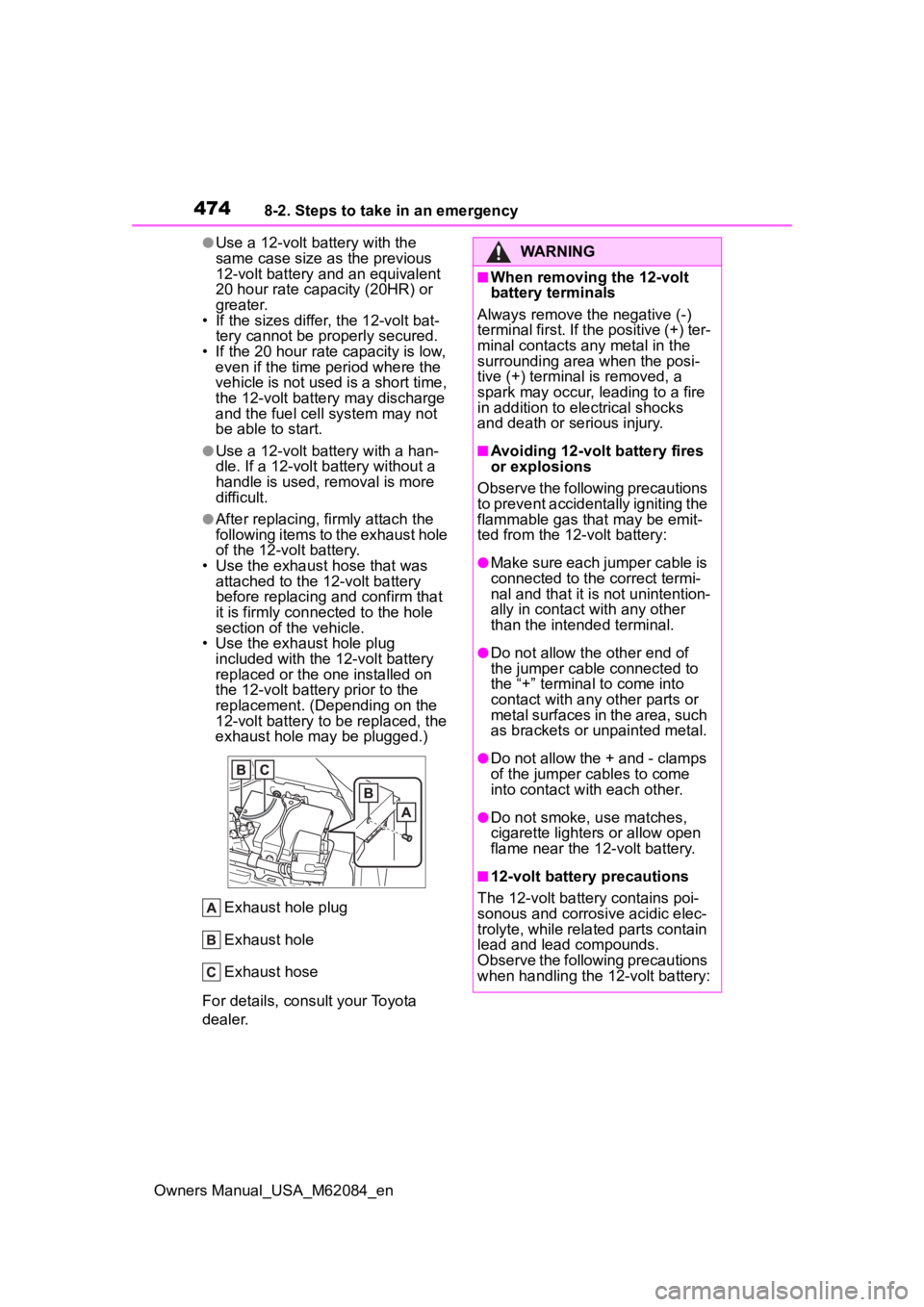
●After replacing, firmly attach the
following items to the exhaust hole
of the 12-volt battery.
• Use the exhaust hose that was attached to the 12-volt battery
before replacing an d confirm that
it is firmly connected to the hole
section of t he vehicle.
• Use the exhaust hole plug included with the 12-volt battery
replaced or the one installed on
the 12-volt battery prior to the
replacement. (Depending on the
12-volt battery to be replaced, the
exhaust hole may be plugged.)
Exhaust hole plug
Exhaust hole
Exhaust hose
For details, consult your Toyota
dealer.
WARNING
■When removing the 12-volt
battery terminals
Always remove the negative (-)
terminal first. If the positive (+) ter-
minal contacts any metal in the
surrounding area when the posi-
tive (+) terminal is removed, a
spark may occur, leading to a fire
in addition to ele ctrical shocks
and death or serious injury.
■Avoiding 12-volt battery fires
or explosions
Observe the following precautions
to prevent accidentally igniting the
flammable gas that may be emit-
ted from the 12-volt battery:
●Make sure each jumper cable is
connected to the correct termi-
nal and that it is not unintention-
ally in contact with any other
than the intended terminal.
●Do not allow the other end of
the jumper cable connected to
the “+” terminal to come into
contact with any other parts or
metal surfaces in the area, such
as brackets or unpainted metal.
●Do not allow the + and - clamps
of the jumper cables to come
into contact with each other.
●Do not smoke, use matches,
cigarette lighter s or allow open
flame near the 1 2-volt battery.
■12-volt battery precautions
The 12-volt battery contains poi-
sonous and corrosive acidic elec-
trolyte, while related parts contain
lead and lead compounds.
Observe the following precautions
when handling the 12-volt battery:
Page 476 of 556
4768-2. Steps to take in an emergency
Owners Manual_USA_M62084_en
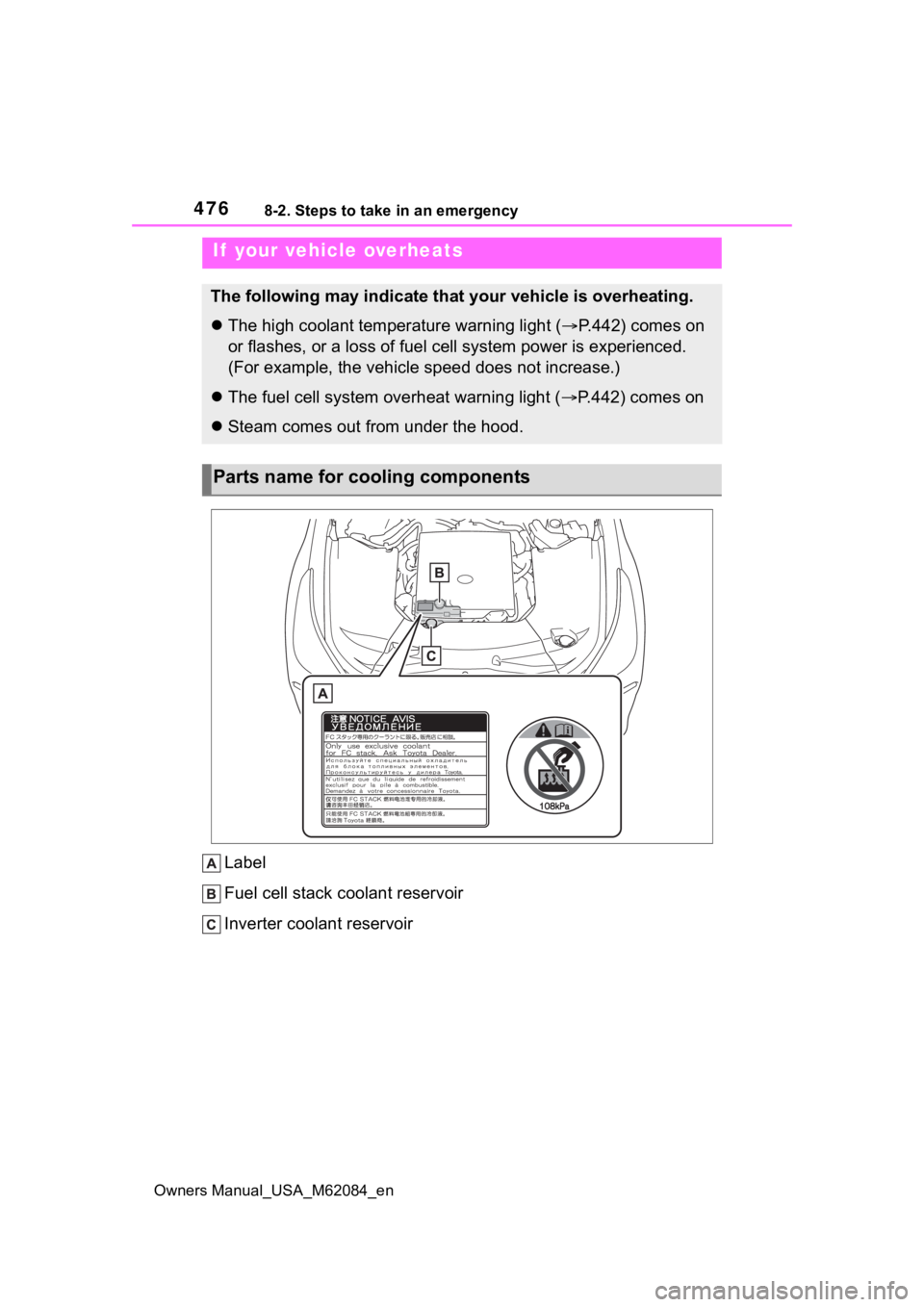
Label
Fuel cell stack coolant reservoir
Inverter coolant reservoir
If your vehicle overheats
The following may indicate that your vehicle is overheating.
The high coolant temperature warning light ( P.442) comes on
or flashes, or a loss of fuel cell system power is experienced.
(For example, the vehicle speed does not increase.)
The fuel cell system overheat warning light ( P.442) comes on
Steam comes out from under the hood.
Parts name for cooling components
Page 477 of 556
4778-2. Steps to take in an emergency
Owners Manual_USA_M62084_en
8
When trouble arises
If the high coolant tempera-
ture warning light comes on or
flashes
1 Stop the vehicle in a safe
place and turn off the air con-
ditioning system, and then
stop the fuel cell system.
2 If you see steam:
Carefully lift the hood after
the steam subsides.
If you do not see steam:
Carefully lift the hood.
3 After the fuel cell system has
cooled down sufficiently,
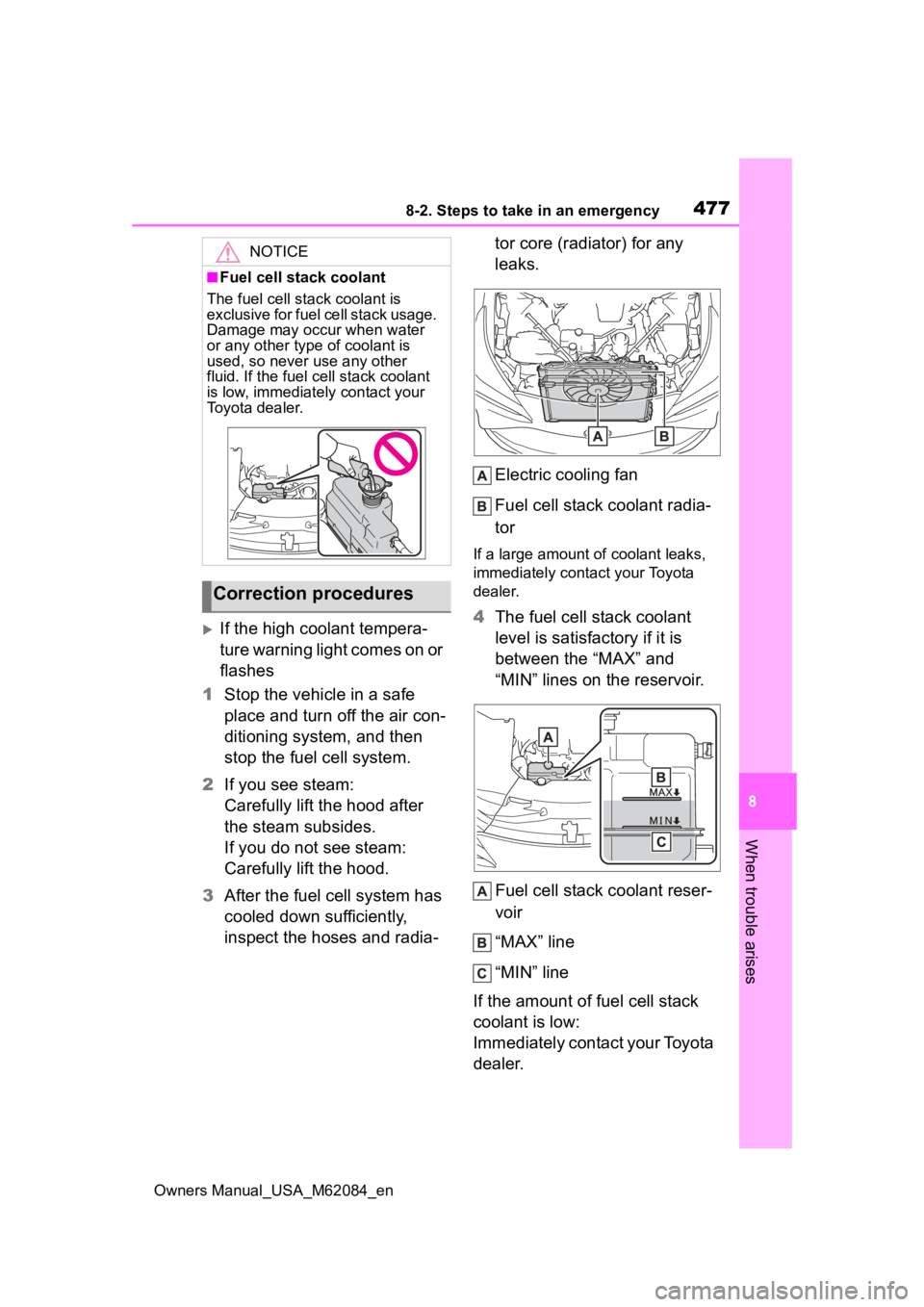
inspect the hoses and radia- tor core (radiator) for any
leaks.
Electric cooling fan
Fuel cell stack coolant radia-
tor
If a large amount of coolant leaks,
immediately contact your Toyota
dealer.
4
The fuel cell stack coolant
level is satisfactory if it is
between the “MAX” and
“MIN” lines on the reservoir.
Fuel cell stack coolant reser-
voir
“MAX” line
“MIN” line
If the amount of fuel cell stack
coolant is low:
Immediately contact your Toyota
dealer.
NOTICE
■Fuel cell stack coolant
The fuel cell stack coolant is
exclusive for fuel cell stack usage.
Damage may occur when water
or any other type of coolant is
used, so never use any other
fluid. If the fuel cell stack coolant
is low, immediately contact your
Toyota dealer.
Correction procedures
Page 478 of 556
4788-2. Steps to take in an emergency
Owners Manual_USA_M62084_en
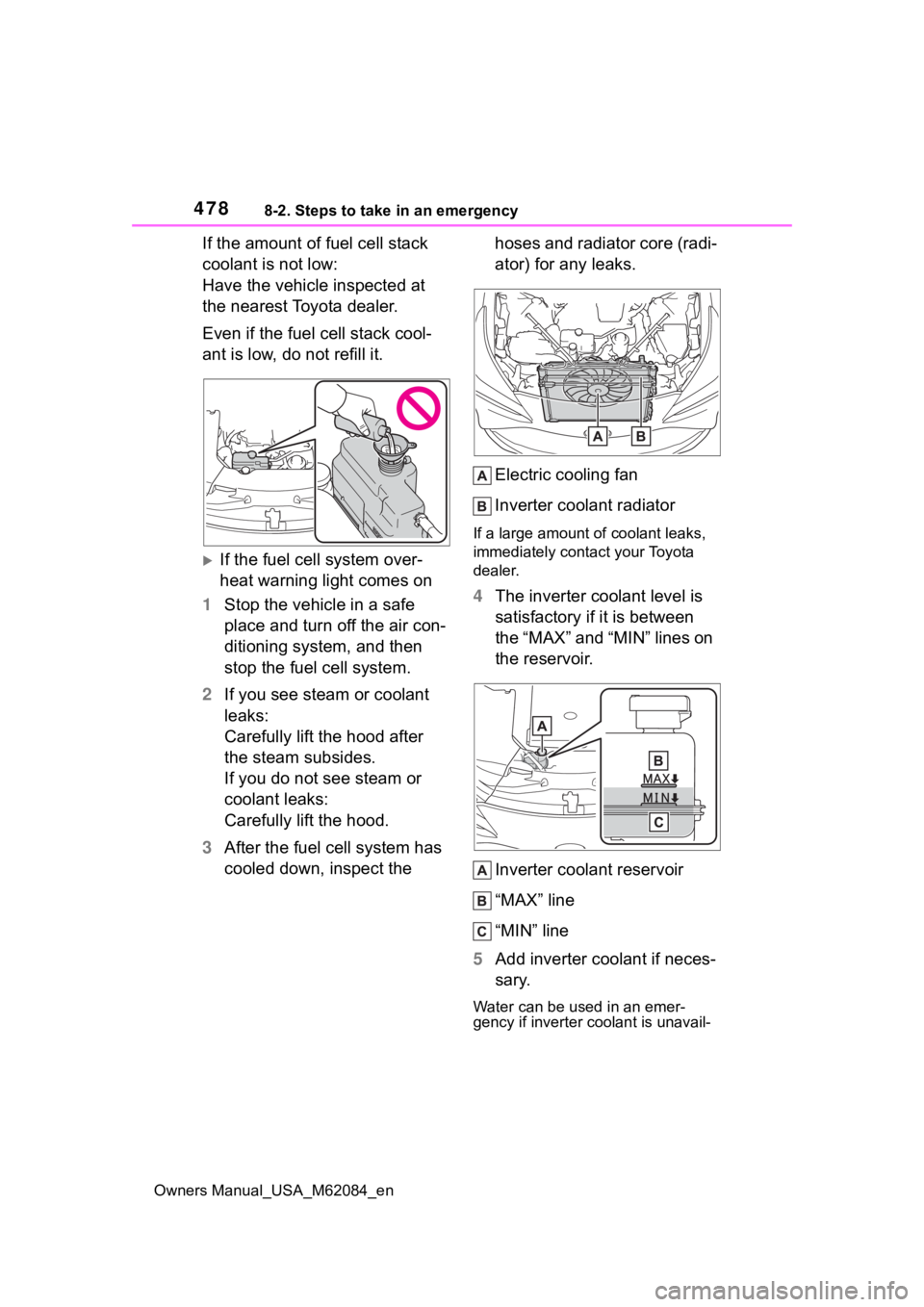
If the amount of fuel cell stack
coolant is not low:
Have the vehicle inspected at
the nearest Toyota dealer.
Even if the fuel cell stack cool-
ant is low, do not refill it.
If the fuel cell system over-
heat warning light comes on
1 Stop the vehicle in a safe
place and turn off the air con-
ditioning system, and then
stop the fuel cell system.
2 If you see steam or coolant
leaks:
Carefully lift the hood after
the steam subsides.
If you do not see steam or
coolant leaks:
Carefully lift the hood.
3 After the fuel cell system has
cooled down, inspect the hoses and radiator core (radi-
ator) for any leaks.
Electric cooling fan
Inverter coolant radiator
If a large amount of coolant leaks,
immediately contact your Toyota
dealer.
4
The inverter coolant level is
satisfactory if it is between
the “MAX” and “MIN” lines on
the reservoir.
Inverter coolant reservoir
“MAX” line
“MIN” line
5 Add inverter coolant if neces-
sary.
Water can be used in an emer-
gency if inverter coolant is unavail-