warning TOYOTA MIRAI 2023 Owners Manual
[x] Cancel search | Manufacturer: TOYOTA, Model Year: 2023, Model line: MIRAI, Model: TOYOTA MIRAI 2023Pages: 572, PDF Size: 17.71 MB
Page 488 of 572
4888-2. Steps to take in an emergency
Owners Manual_USA_M62064_en
■When replacing the 12-volt bat-
tery
●Use a Central Degassing type 12-
volt battery (European Regula-
tions).
●Use a 12-volt battery with the
same case size as the previous
12-volt battery and an equivalent
20 hour rate capacity (20HR) or
greater.
• If the sizes differ, the 12-volt bat- tery cannot be properly secured.
• If the 20 hour rate capacity is low,
even if the time period where the
vehicle is not used is a short time,
the 12-volt battery may discharge
and the fuel cell system may not
be able to start.
●Use a 12-volt battery with a han-
dle. If a 12-volt b attery without a
handle is used, removal is more
difficult.
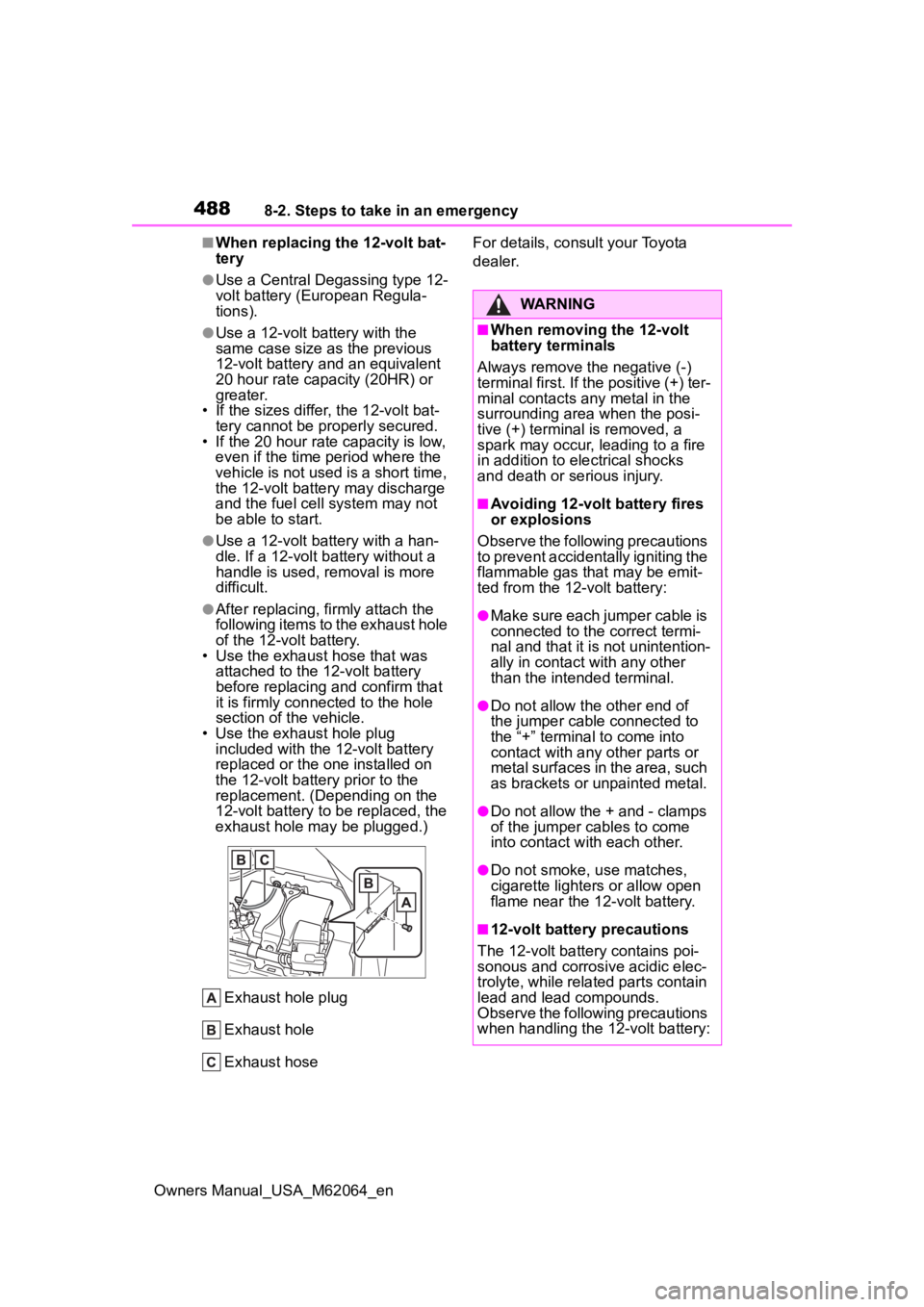
●After replacing, firmly attach the
following items to the exhaust hole
of the 12-volt battery.
• Use the exhaust hose that was
attached to the 12-volt battery
before replacing an d confirm that
it is firmly connected to the hole
section of t he vehicle.
• Use the exhaust hole plug included with the 12-volt battery
replaced or the one installed on
the 12-volt battery prior to the
replacement. (Depending on the
12-volt battery to be replaced, the
exhaust hole may be plugged.)
Exhaust hole plug
Exhaust hole
Exhaust hose For details, consult your Toyota
dealer.
WARNING
■When removing the 12-volt
battery terminals
Always remove the negative (-)
terminal first. If the positive (+) ter-
minal contacts any metal in the
surrounding area when the posi-
tive (+) terminal is removed, a
spark may occur, leading to a fire
in addition to ele ctrical shocks
and death or serious injury.
■Avoiding 12-volt battery fires
or explosions
Observe the following precautions
to prevent accidentally igniting the
flammable gas that may be emit-
ted from the 12-volt battery:
●Make sure each jumper cable is
connected to the correct termi-
nal and that it is not unintention-
ally in contact with any other
than the intended terminal.
●Do not allow the other end of
the jumper cable connected to
the “+” terminal to come into
contact with any other parts or
metal surfaces in the area, such
as brackets or unpainted metal.
●Do not allow the + and - clamps
of the jumper cables to come
into contact with each other.
●Do not smoke, use matches,
cigarette lighter s or allow open
flame near the 1 2-volt battery.
■12-volt battery precautions
The 12-volt battery contains poi-
sonous and corrosive acidic elec-
trolyte, while related parts contain
lead and lead compounds.
Observe the following precautions
when handling the 12-volt battery:
Page 489 of 572
4898-2. Steps to take in an emergency
Owners Manual_USA_M62064_en
8
When trouble arises
WARNING
●When working with the 12-volt
battery, always wear safety
glasses and take care not to
allow any battery fluids (acid) to
come into contact with skin,
clothing or the vehicle body.
●Do not lean over the 12-volt bat-
tery.
●In the event that battery fluid
comes into contact with the skin
or eyes, immediately wash the
affected area with water and
seek medical attention. Place a
wet sponge or cloth over the
affected area until medical
attention can be received.
●Always wash your hands after
handling the 12-volt battery sup-
port, terminals, and other bat-
tery-related parts.
●Do not allow child ren near the
12-volt battery.
■After recharging the 12-volt
battery
Have the 12-volt battery
inspected at your Toyota dealer
as soon as possible.
If the 12-volt battery is deteriorat-
ing, continued use may cause the
12-volt battery to emit a malodor-
ous gas, which may be detrimen-
tal to the health of passengers.
■When replacing the 12-volt
battery
●When the vent plug and indica-
tor are close to the hold down
clamp, the battery fluid (sulfuric
acid) may leak.
●For information regarding 12-
volt battery rep lacement, con-
tact your Toyota dealer.
●After replacing, s ecurely attach
the exhaust hose and exhaust
hole plug to the exhaust hole of
the replaced 12-volt battery. If
not properly installed, gases
(hydrogen) may leak into the
vehicle interior, and there is the
possible danger of the gas ignit-
ing and exploding.
NOTICE
■When handling jumper cables
When connecting the jumper
cables, ensure that they do not
become entangled in the cooling
fan.
■When connecting jumper
cables
Make sure to connect jumper
cables to the specified terminals
and connecting point. Failure to
do so may adversely affect the
electronic devices or damage to
them.
■To prevent damaging the
vehicle
The exclusive jump starting termi-
nal is to be used when charging
the 12-volt battery from another
vehicle in an emergency. It cannot
be used to jump start another
vehicle.
Page 490 of 572
4908-2. Steps to take in an emergency
Owners Manual_USA_M62064_en
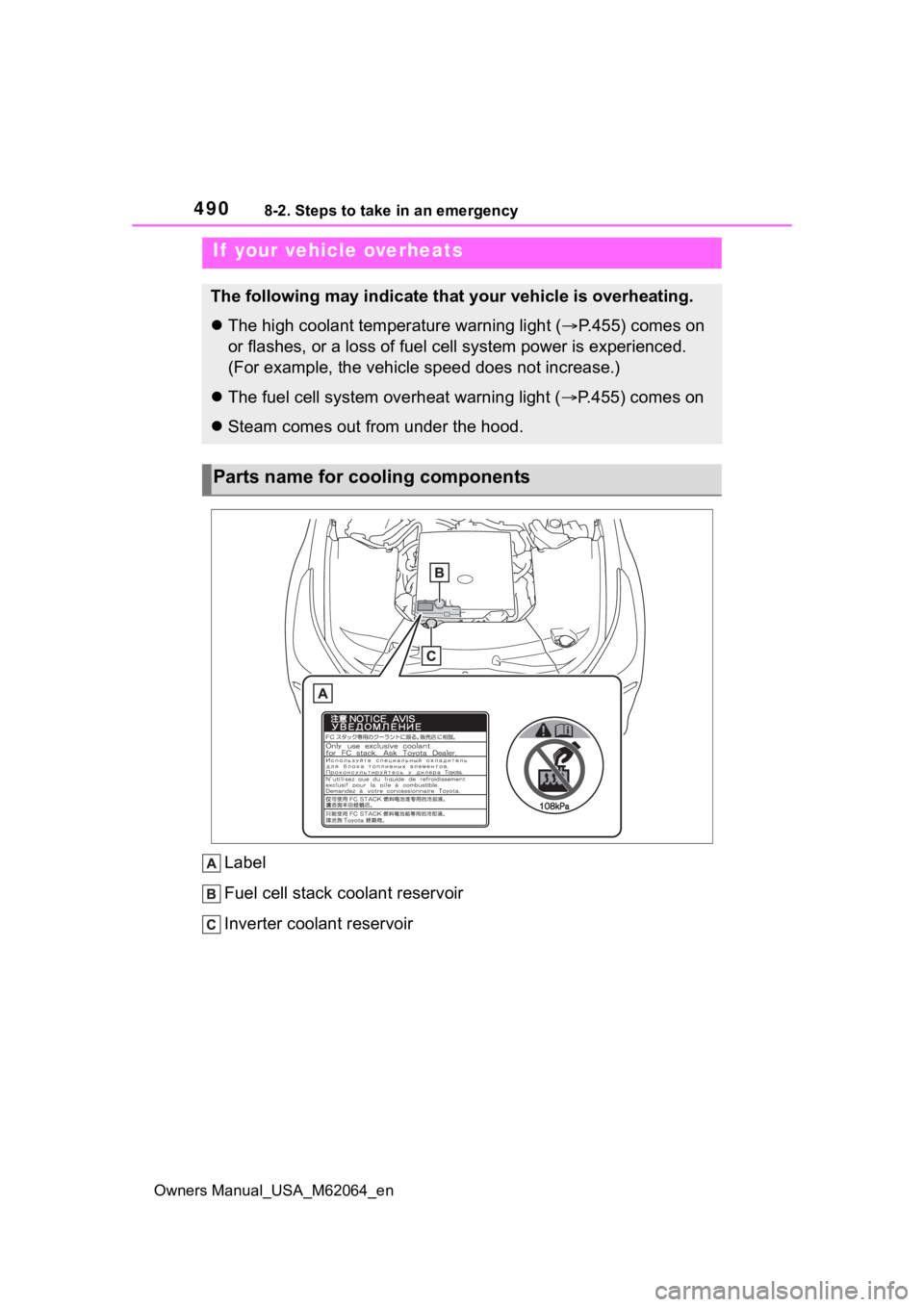
Label
Fuel cell stack coolant reservoir
Inverter coolant reservoir
If your vehicle overheats
The following may indicate that your vehicle is overheating.
The high coolant temperature warning light ( P.455) comes on
or flashes, or a loss of fuel cell system power is experienced.
(For example, the vehicle speed does not increase.)
The fuel cell system overheat warning light ( P.455) comes on
Steam comes out from under the hood.
Parts name for cooling components
Page 491 of 572
4918-2. Steps to take in an emergency
Owners Manual_USA_M62064_en
8
When trouble arises
If the high coolant tempera-
ture warning light comes on or
flashes
1 Stop the vehicle in a safe
place and turn off the air con-
ditioning system, and then
stop the fuel cell system.
2 If you see steam:
Carefully lift the hood after
the steam subsides.
If you do not see steam:
Carefully lift the hood.
3 After the fuel cell system has
cooled down sufficiently,
inspect the hoses and radia- tor core (radiator) for any
leaks.
Electric cooling fan
Fuel cell stack coolant radia-
tor
If a large amount of coolant leaks,
immediately contact your Toyota
dealer.
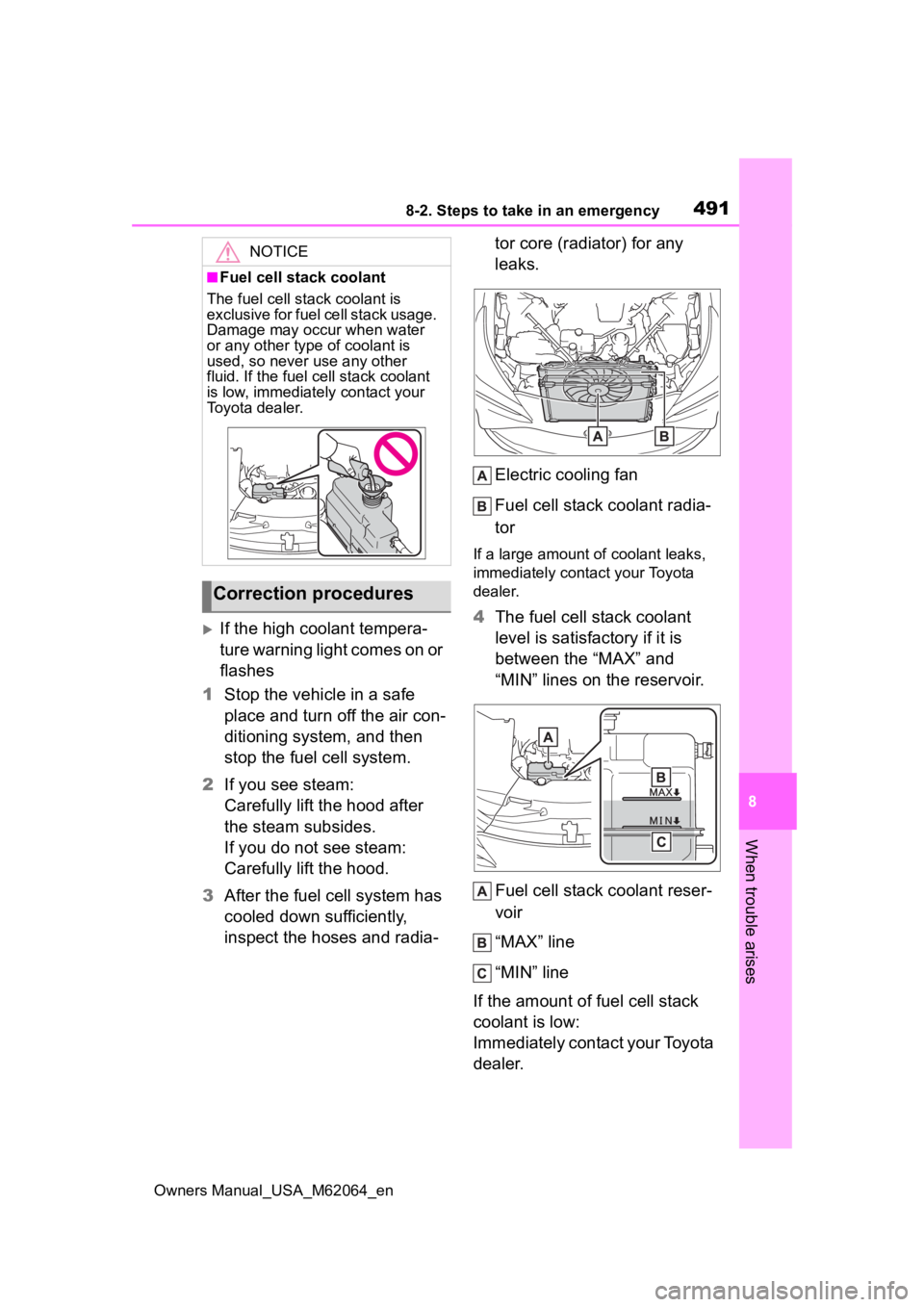
4
The fuel cell stack coolant
level is satisfactory if it is
between the “MAX” and
“MIN” lines on the reservoir.
Fuel cell stack coolant reser-
voir
“MAX” line
“MIN” line
If the amount of fuel cell stack
coolant is low:
Immediately contact your Toyota
dealer.
NOTICE
■Fuel cell stack coolant
The fuel cell stack coolant is
exclusive for fuel cell stack usage.
Damage may occur when water
or any other type of coolant is
used, so never use any other
fluid. If the fuel cell stack coolant
is low, immediately contact your
Toyota dealer.
Correction procedures
Page 492 of 572
4928-2. Steps to take in an emergency
Owners Manual_USA_M62064_en
If the amount of fuel cell stack
coolant is not low:
Have the vehicle inspected at
the nearest Toyota dealer.
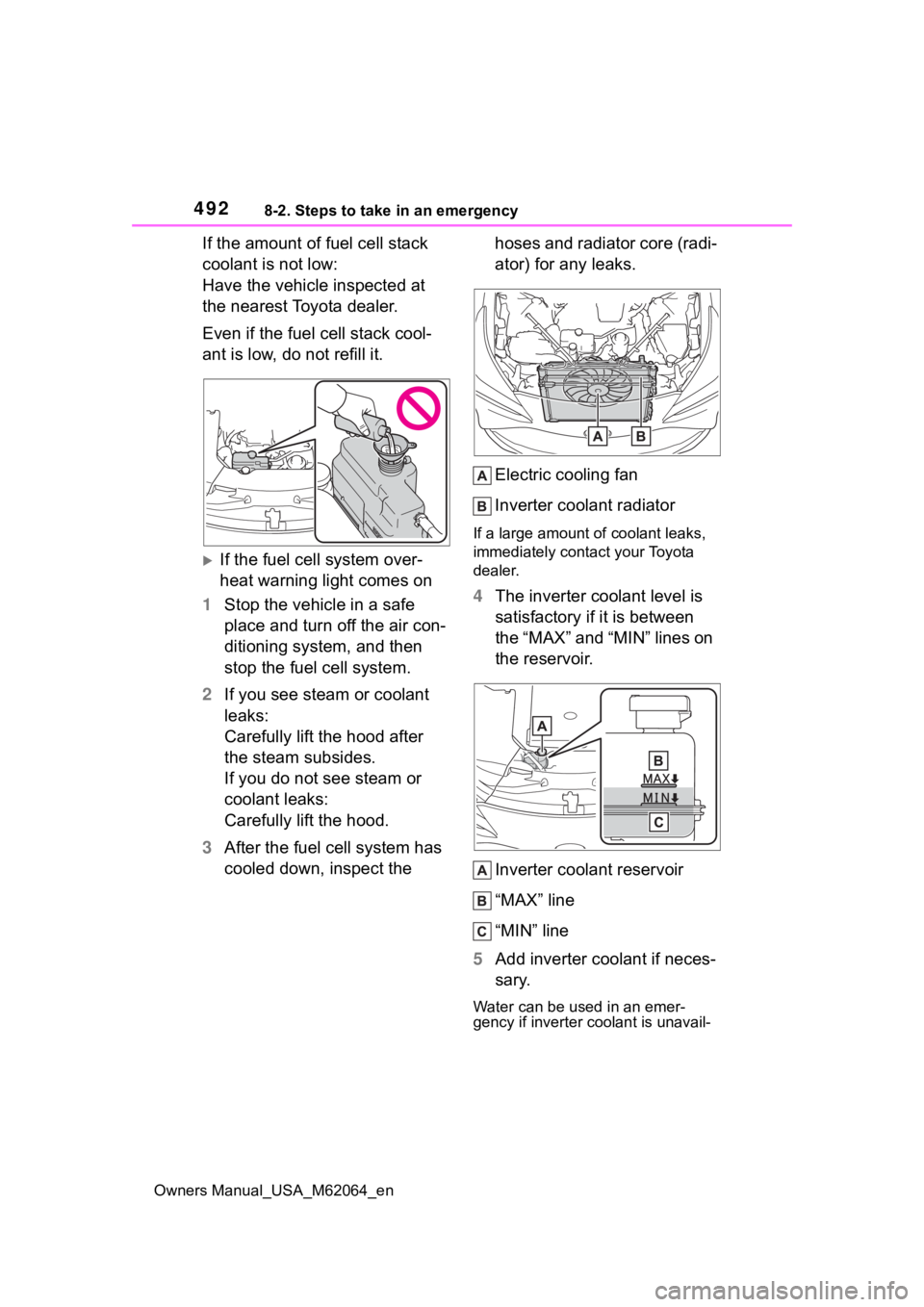
Even if the fuel cell stack cool-
ant is low, do not refill it.
If the fuel cell system over-
heat warning light comes on
1 Stop the vehicle in a safe
place and turn off the air con-
ditioning system, and then
stop the fuel cell system.
2 If you see steam or coolant
leaks:
Carefully lift the hood after
the steam subsides.
If you do not see steam or
coolant leaks:
Carefully lift the hood.
3 After the fuel cell system has
cooled down, inspect the hoses and radiator core (radi-
ator) for any leaks.
Electric cooling fan
Inverter coolant radiator
If a large amount of coolant leaks,
immediately contact your Toyota
dealer.
4
The inverter coolant level is
satisfactory if it is between
the “MAX” and “MIN” lines on
the reservoir.
Inverter coolant reservoir
“MAX” line
“MIN” line
5 Add inverter coolant if neces-
sary.
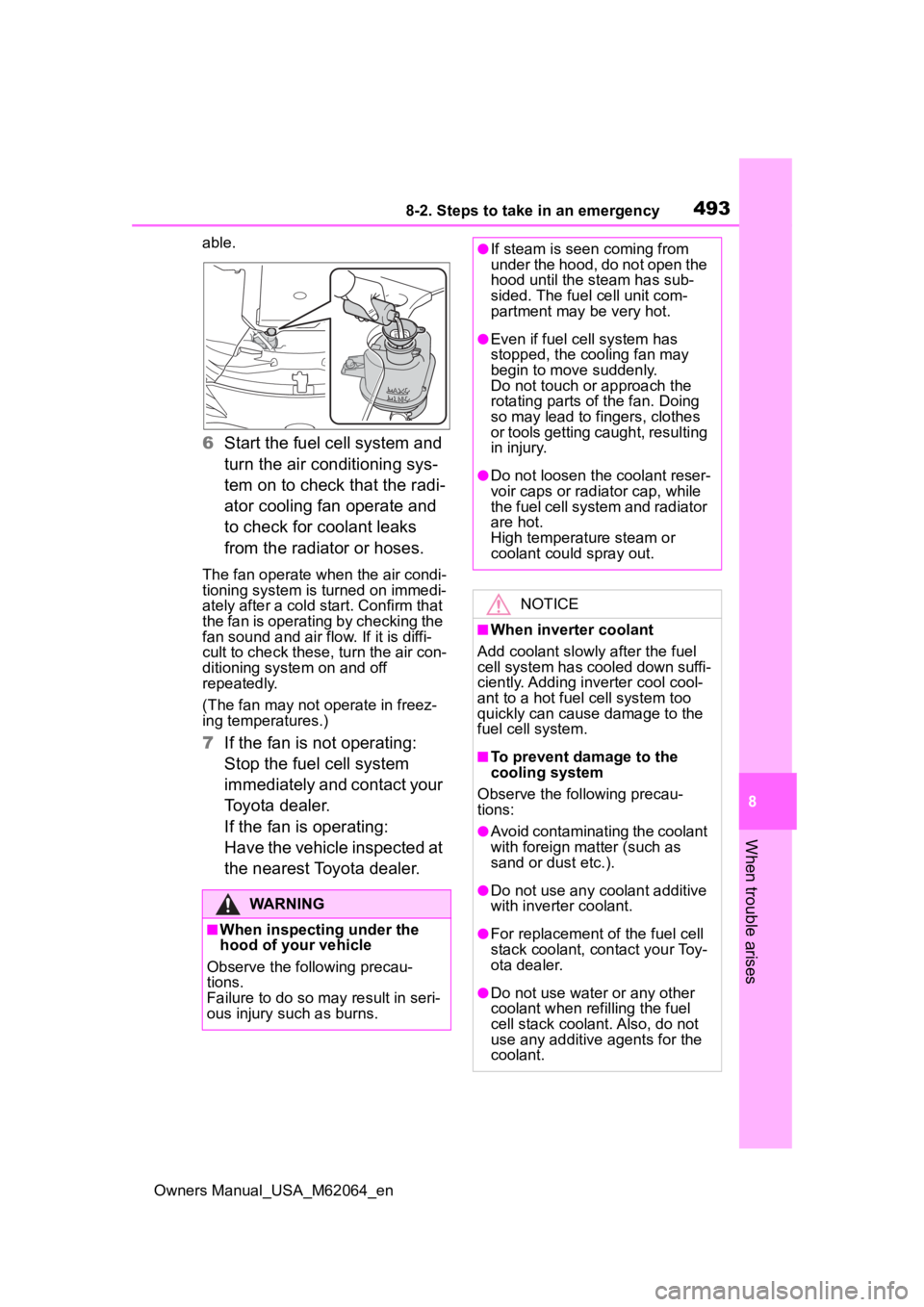
Water can be used in an emer-
gency if inverter coolant is unavail-
Page 493 of 572
4938-2. Steps to take in an emergency
Owners Manual_USA_M62064_en
8
When trouble arises
able.
6 Start the fuel cell system and
turn the air conditioning sys-
tem on to check that the radi-
ator cooling fan operate and
to check for coolant leaks
from the radiator or hoses.
The fan operate when the air condi-
tioning system is turned on immedi-
ately after a cold s tart. Confirm that
the fan is operating by checking the
fan sound and air flow. If it is diffi-
cult to check these, turn the air con-
ditioning system on and off
repeatedly.
(The fan may not o perate in freez-
ing temperatures.)
7 If the fan is not operating:
Stop the fuel cell system
immediately and contact your
Toyota dealer.
If the fan is operating:
Have the vehicle inspected at
the nearest Toyota dealer.
WARNING
■When inspecting under the
hood of your vehicle
Observe the following precau-
tions.
Failure to do so may result in seri-
ous injury such as burns.
●If steam is seen coming from
under the hood, do not open the
hood until the steam has sub-
sided. The fuel cell unit com-
partment may be very hot.
●Even if fuel cell system has
stopped, the cooling fan may
begin to move suddenly.
Do not touch or approach the
rotating parts of the fan. Doing
so may lead to fingers, clothes
or tools getting caught, resulting
in injury.
●Do not loosen the coolant reser-
voir caps or radia tor cap, while
the fuel cell system and radiator
are hot.
High temperature steam or
coolant could spray out.
NOTICE
■When inverter coolant
Add coolant slowly after the fuel
cell system has cooled down suffi-
ciently. Adding inverter cool cool-
ant to a hot fuel cell system too
quickly can cause damage to the
fuel cell system.
■To prevent damage to the
cooling system
Observe the following precau-
tions:
●Avoid contaminating the coolant
with foreign matter (such as
sand or dust etc.).
●Do not use any coolant additive
with inverter coolant.
●For replacement of the fuel cell
stack coolant, contact your Toy-
ota dealer.
●Do not use water or any other
coolant when refilling the fuel
cell stack coolant. Also, do not
use any additive agents for the
coolant.
Page 494 of 572
4948-2. Steps to take in an emergency
Owners Manual_USA_M62064_en
1Set the parking brake and
stop the fuel cell system.
2 Remove the mud, snow or
sand from around the rear
wheels.
3 Place wood, stones or some
other material under the rear
wheels to help provide trac-
tion.
4 Restart the fuel cell system.
5 Shift the shift position to D or
R and release the parking
brake. Then, while exercising
caution, depress the acceler-
ator pedal.
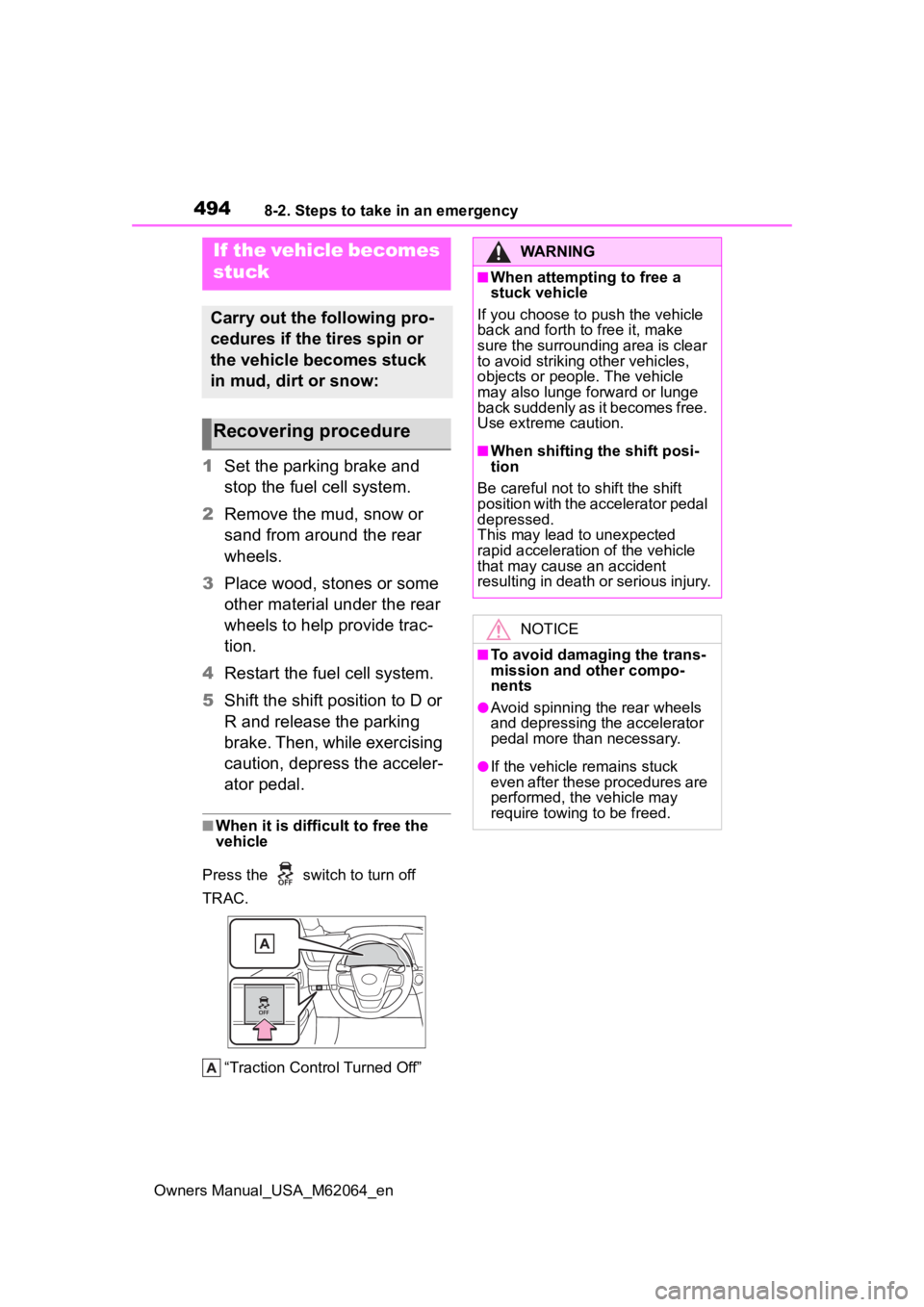
■When it is difficult to free the
vehicle
Press the switch to turn off
TRAC.
“Traction Control Turned Off”
If the vehicle becomes
stuck
Carry out the following pro-
cedures if the tires spin or
the vehicle becomes stuck
in mud, dirt or snow:
Recovering procedure
WARNING
■When attempting to free a
stuck vehicle
If you choose to push the vehicle
back and forth to free it, make
sure the surrounding area is clear
to avoid striking other vehicles,
objects or people. The vehicle
may also lunge forward or lunge
back suddenly as it becomes free.
Use extreme caution.
■When shifting the shift posi-
tion
Be careful not to shift the shift
position with the accelerator pedal
depressed.
This may lead to unexpected
rapid acceleration of the vehicle
that may cause an accident
resulting in death o r serious injury.
NOTICE
■To avoid damaging the trans-
mission and other compo-
nents
●Avoid spinning the rear wheels
and depressing the accelerator
pedal more than necessary.
●If the vehicle remains stuck
even after these procedures are
performed, the vehicle may
require towing to be freed.
Page 501 of 572
5019-1. Specifications
Owners Manual_USA_M62064_en
9
Vehicle specifications
the brake system warning light is not illuminated when the fuel cell sys-
tem is operating. (If the brake system warning light is illuminated, refer to
P.454.)
*2: Make sure to confirm that the brake warning light (yellow) doe s not illumi-
nate. (If the brake warning light illuminates, refer to P.454.)
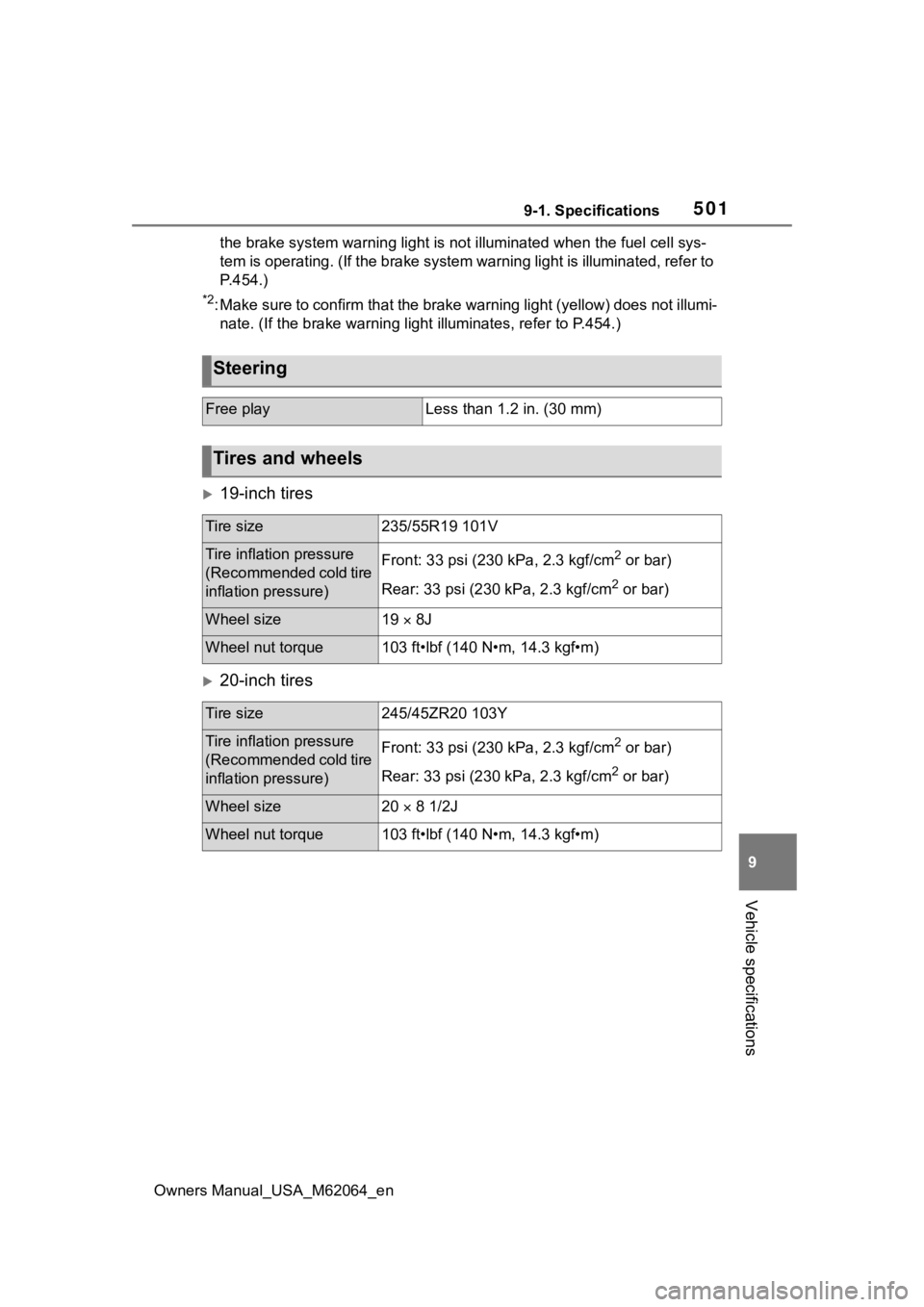
19-inch tires
20-inch tires
Steering
Free playLess than 1.2 in. (30 mm)
Tires and wheels
Tire size235/55R19 101V
Tire inflation pressure
(Recommended cold tire
inflation pressure)Front: 33 psi (230 kPa, 2.3 kgf/cm2 or bar)
Rear: 33 psi (230 kPa, 2.3 kgf/cm
2 or bar)
Wheel size19 8J
Wheel nut torque103 ft•lbf (140 N•m, 14.3 kgf•m)
Tire size245/45ZR20 103Y
Tire inflation pressure
(Recommended cold tire
inflation pressure)Front: 33 psi (230 kPa, 2.3 kgf/cm2 or bar)
Rear: 33 psi (230 kPa, 2.3 kgf/cm
2 or bar)
Wheel size20 8 1/2J
Wheel nut torque103 ft•lbf (140 N•m, 14.3 kgf•m)
Page 505 of 572

5059-1. Specifications
Owners Manual_USA_M62064_en
9
Vehicle specifications
tration of the U.S. Department of
Transportation.
It provides the purchasers
and/or prospective purchasers
of Toyota vehicles with informa-
tion on uniform tire quality grad-
ing.
Your Toyota dealer will help answer
any questions you may have as you
read this information.
■DOT quality grades
All passenger vehicle tires must
conform to Federal Safety
Requirements in addition to
these grades. Quality grades
can be found where applicable
on the tire sidewall between
tread shoulder and maximum
section width.
For example: Treadwear 200 Trac-
tion AA Temperature A
■Treadwear
The treadwear grade is a com-
parative rating based on the
wear rate of the tire when tested
under controlled conditions on a
specified government test
course.
For example, a tire graded 150
would wear one and a half (1 - 1/2)
times as well on the government
course as a tire graded 100.
The relative perfo rmance of tires
depends upon the actual conditions
of their use. Performance may differ
significantly from the norm due to
variations in driving habits, service
practices and differences in road
characteristics and climate.
■Traction AA, A, B, C
The traction grades, from high-
est to lowest, are AA, A, B and
C, and they represent the tire’s
ability to stop on wet pavement
as measured under controlled
conditions on specified govern-
ment test surfaces of asphalt
and concrete.
A tire marked C may have poor
traction performance.
Warning: The traction grade
assigned to this tire is based on
braking (straight ahead) traction
tests and does not include corner-
ing (turning) traction.
■Temperature A, B, C
The temperature grades are A
(the highest), B, and C, repre-
senting the tire’s resistance to
the generation of heat and its
ability to dissipate heat when
tested under controlled condi-
tions on a specified indoor labo-
ratory test wheel.
Sustained high temperature can
cause the material of the tire to
degenerate and reduce tire life, and
excessive temperature can lead to
sudden tire failure.
Grade C corresponds to a level of
performance which all passenger
car tires must meet under the Fed-
eral Motor Vehicle Safety Standard
No. 109.
Grades B and A represent higher
levels of performance on the labo-
ratory test wheel than the minimum
required by law.
Page 506 of 572
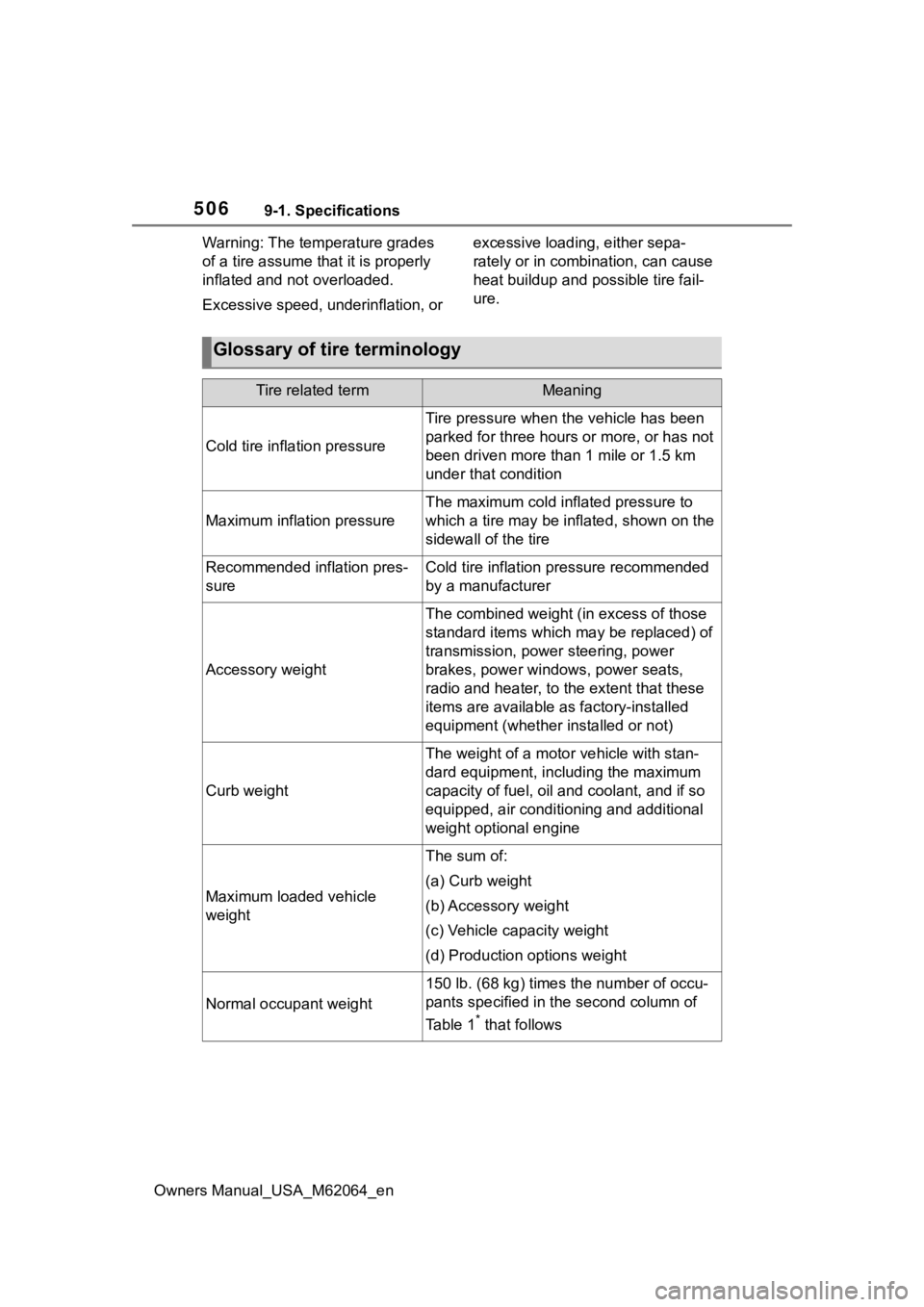
5069-1. Specifications
Owners Manual_USA_M62064_enWarning: The temperature grades
of a tire assume that it is properly
inflated and not overloaded.
Excessive speed, underinflation, or
excessive loading, either sepa-
rately or in combination, can cause
heat buildup and possible tire fail-
ure.
Glossary of tire terminology
Tire related termMeaning
Cold tire inflation pressure
Tire pressure when the vehicle has been
parked for three hours or more, or has not
been driven more than
1 mile or 1.5 km
under that condition
Maximum inflation pressure
The maximum cold inf lated pressure to
which a tire may be inflated, shown on the
sidewall of the tire
Recommended inflation pres-
sureCold tire inflation pressure recommended
by a manufacturer
Accessory weight
The combined weight (in excess of those
standard items which may be replaced) of
transmission, power steering, power
brakes, power windows, power seats,
radio and heater, to the extent that these
items are available as factory-installed
equipment (whether installed or not)
Curb weight
The weight of a moto r vehicle with stan-
dard equipment, including the maximum
capacity of fuel, oil and coolant, and if so
equipped, air conditioning and additional
weight optional engine
Maximum loaded vehicle
weight
The sum of:
(a) Curb weight
(b) Accessory weight
(c) Vehicle capacity weight
(d) Production options weight
Normal occupant weight
150 lb. (68 kg) times the number of occu-
pants specified in the second column of
Ta b l e 1
* that follows