coolant level TOYOTA MIRAI 2023 Owners Manual
[x] Cancel search | Manufacturer: TOYOTA, Model Year: 2023, Model line: MIRAI, Model: TOYOTA MIRAI 2023Pages: 572, PDF Size: 17.71 MB
Page 84 of 572
842-1. Fuel cell electric vehicle
Owners Manual_USA_M62064_enhydrogen tanks or valves need to
be disposed.
■Fuel cell stack coolant
●Fuel cell stack coolant uses a spe-
cifically-designed fluid with high
electrical insulation properties, in
order to safely cool the high-volt-
age fuel cell stack.
●Never add water or other coolants
to the fuel cell st
ack cooling sys-
tem, as they will cause permanent
damage.
●Consult your Toyota dealer for
replenishing or changing the fuel
cell stack coolant.
■Ion filter
●An ion filter is inst alled in the cool-
ant lines for the fuel cell stack, in
order to maintain the normal insu-
lation properties of the coolant.
●It is necessary to periodically
change the ion filter. ( P.466)
Contact your Toyota dealer for this
periodic maintenance.
■Tailpipe
●When the power switch is turned
off and the fuel cell system is
stopped ( P.182) after driving,
exhaust water is discharged. Be
careful when standing behind the
vehicle to avoid dripping or spray-
ing.
●It is possible to manually purge
the exhaust. Thi s may be desir-
able, for instance, before parking
in a garage. This is done by press-
ing the H
2O switch. ( P.196)
●On cold days, water vapor in the
exhaust may appe ar as a white
mist emitted from the tailpipe. This
is not a malfunction. A white mist
may be emitted from the vehicle
side depending on the wind direc-
tion. If it is a concern, consult with
a Toyota dealer.
●If the tailpipe is blocked, the fuel
cell system will stop.
●In the following state when cold, a white mist may be emitted. Water
vapor is being emitted as a sys-
tem protection and it is not a mal-
function.
• If several minutes have passed after opening the fuel lid, such as
refueling.
• Several hours have passed after the power switch was turned off.
■Hydrogen detectors
When the power switch is turned to
ON, the hydrogen detectors are
activated.
■Power output restriction
When the power output is restricted,
the vehicle may fa il to accelerate or
even decelerate, even though the
accelerator pedal is depressed. If a
safe driving speed cannot be main-
tained, stop the ve hicle in a safe
place away from the traffic. This
may be caused by the following con-
ditions:
●The coolant temperature may be
too high. This can be caused by
driving conditions such as
repeated sudden acceleration and
deceleration, continuous driving
on an incline, continuous driving
at high altitudes with a high load,
etc. In such situations, “FCV sys-
tem overheated Output power
reduced” is displayed on the multi-
information display, and the power
output is restricted. Once the cool-
ant returns to normal temperature,
the power output will retu rn to nor-
mal. ( P.464)
●The remaining fuel may be low.
After the low fuel level warning
light comes on, the output power
will be gradually restricted in order
to extend the possible driving dis-
tance. Once getting to this point,
the remaining driving distance
possible is short. Immediately refill
the vehicle with hydrogen.
●On cold days, the low fuel level
warning light comes on faster than
usual and the output power is
restricted.
Page 96 of 572
963-1. Instrument cluster
Owners Manual_USA_M62064_en
*1: These lights turn on when the power switch is turned to ON to
indicate that a system check is
being performed. They will turn
off after the fuel cell system is
on, or after a few seconds. There
may be a malfunction in a sys-
tem if the light does not come on,
or turn off. Have the vehicle
inspected by your Toyota dealer.
*2: This light illuminates on the multi-informatio n display with a
message.
*3: Intuitive parking assist OFF indi- cator turns on when the power
switch is turned to ON while the
Intuitive parking assist function is
on. It will turn off after a few sec-
onds.
*4: Refer to “Toyota Teammate Advanced Drive OWNER’S
MANUAL” at Toyota.com.
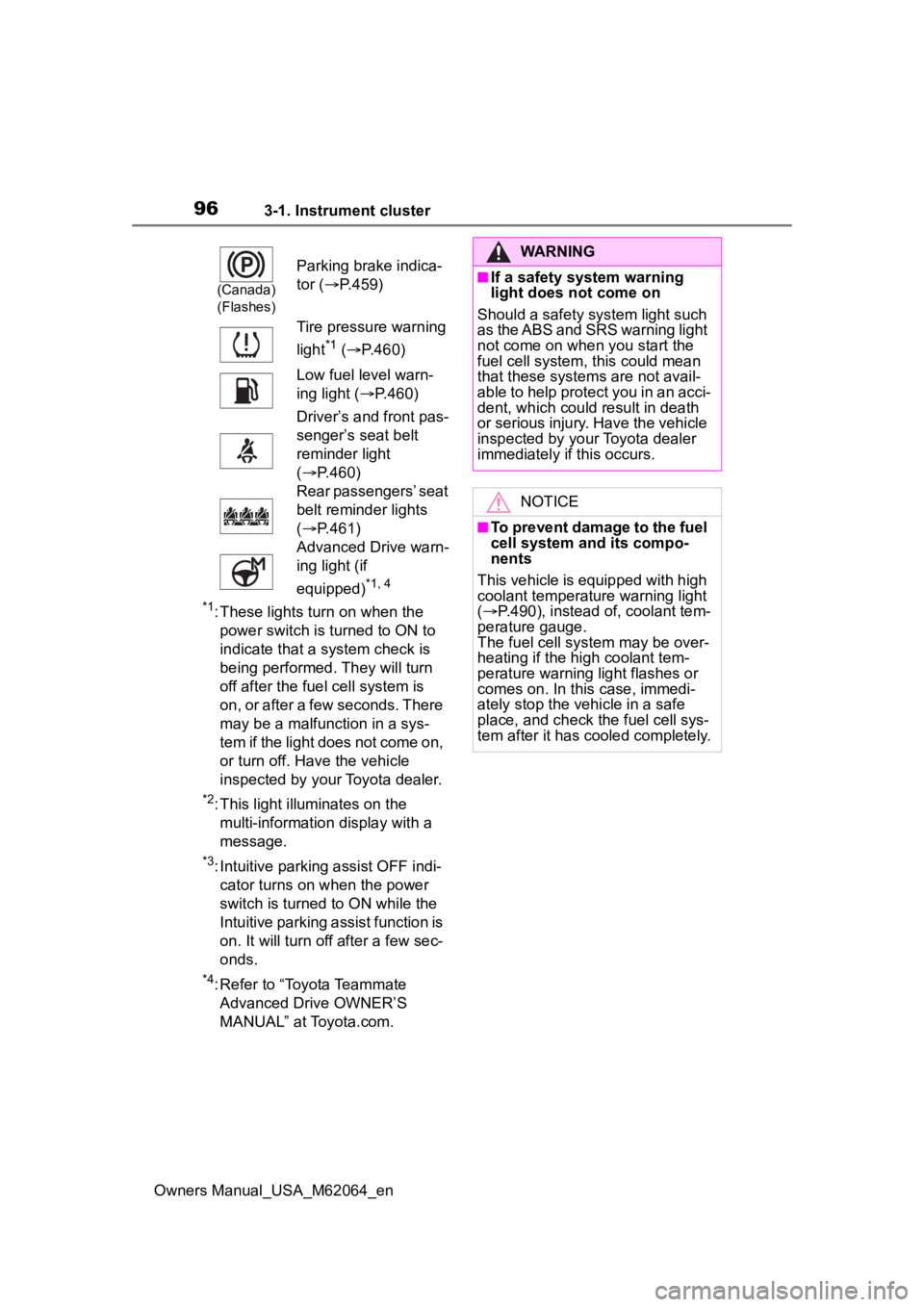
(Canada)
(Flashes)
Parking brake indica-
tor ( P.459)
Tire pressure warning
light
*1 ( P.460)
Low fuel level warn-
ing light ( P.460)
Driver’s and front pas-
senger’s seat belt
reminder light
( P.460)
Rear passengers’ seat
belt reminder lights
( P.461)
Advanced Drive warn-
ing light (if
equipped)
*1, 4
WARNING
■If a safety system warning
light does not come on
Should a safety system light such
as the ABS and SRS warning light
not come on when you start the
fuel cell system, this could mean
that these system s are not avail-
able to help protect you in an acci-
dent, which could result in death
or serious injury. Have the vehicle
inspected by you r Toyota dealer
immediately if this occurs.
NOTICE
■To prevent damage to the fuel
cell system and its compo-
nents
This vehicle is equipped with high
coolant temperature warning light
( P.490), instead of, coolant tem-
perature gauge.
The fuel cell sys tem may be over-
heating if the high coolant tem-
perature warning light flashes or
comes on. In this case, immedi-
ately stop the vehicle in a safe
place, and check the fuel cell sys-
tem after it has cooled completely.
Page 401 of 572
4017-2. Maintenance
Owners Manual_USA_M62064_en
7
Maintenance and care
warranty coverage.
The use of Toyota repair manuals is
recommended.
For details about warranty cover-
age, refer to the separate “Owner’s
Warranty Information Booklet” or
“Owner’s Manual Supplement”.
General maintenance
Listed below are the general
maintenance items that
should be performed at the
intervals specified in the
“Owner’s Warranty Informa-
tion Booklet” or “Owner’s
Manual Supplement/Sched-
uled Maintenance Guide”. It
is recommended that any
problem you notice should
be brought to the attention
of your Toyota dealer or
qualified service shop for
advice.
WARNING
■If the fuel cell system is oper-
ating
Turn the fuel cell system off and
ensure that there is adequate
ventilation before performing
maintenance checks.
Fuel cell unit compart-
ment
ItemsCheck points
Brake fluid
Is the brake fluid at
the correct level?
( P.412)
Coolant
Is the coolant at
the correct level?
( P.410)
Page 404 of 572
4047-3. Do-it-yourself maintenance
Owners Manual_USA_M62064_en
7-3.Do-it-yourself maintenance
Do-it-yourself ser vice
precautions
If you perform maintenance
by yourself, be sure to fol-
low the correct procedure
as given in these sections.
Maintenance
ItemsParts and tools
12-volt battery
condition
( P.413)
•Grease
• Conventional
wrench (for ter-
minal clamp
bolts)
Brake fluid
level ( P.412)
• FMVSS No.116
DOT 3 or SAE
J1703 brake fluid
FMVSS No.116
DOT 4 or SAE
J1704 brake fluid
• Rag or paper towel
• Funnel (used only for adding
brake fluid)
Inverter cool-
ant level
( P.410)
• “Toyota Super
Long Life Cool-
ant” or a similar
high quality eth-
ylene glycol-
based non-sili-
cate, non-amine,
non-nitrite and
non-borate cool-
ant with long-life
hybrid organic
acid technology
For the U.S.A.:
“Toyota Super
Long Life Cool-
ant” is pre-mixed
with 50% cool-
ant and 50%
deionized water.
For Canada:
“Toyota Super
Long Life Cool-
ant” is pre-mixed
with 55% cool-
ant and 45%
deionized water.
• Funnel (used only for adding
coolant)
Fuses
( P.438)
• Fuse with same
amperage rating
as original
• Flathead screw- driver
Headlight aim
( P.442)• Phillips-head
screwdriver
Radiator and
condenser
( P.411)
ItemsParts and tools
Page 410 of 572
4107-3. Do-it-yourself maintenance
Owners Manual_USA_M62064_en
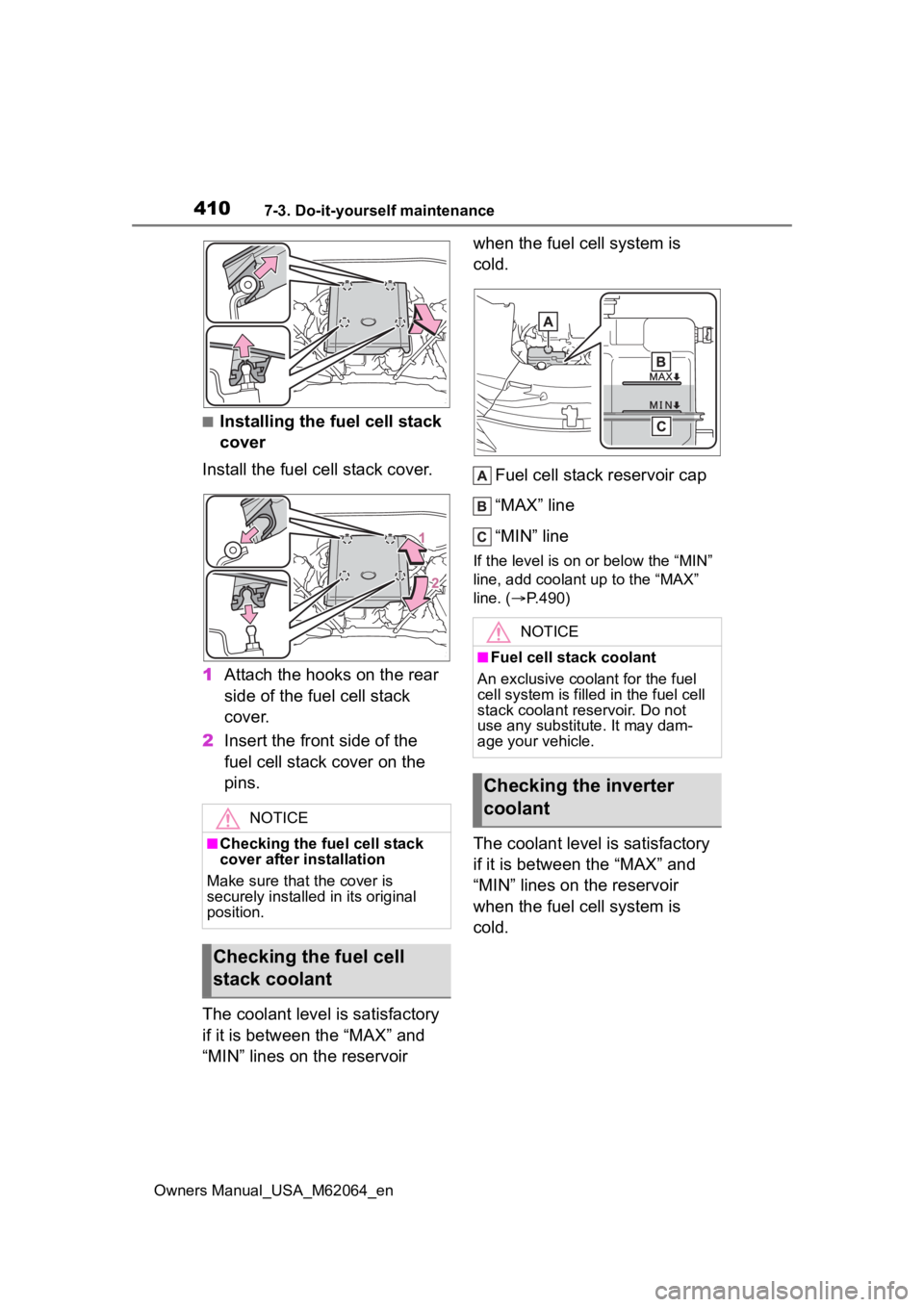
■Installing the fuel cell stack
cover
Install the fuel cell stack cover.
1 Attach the hooks on the rear
side of the fuel cell stack
cover.
2 Insert the front side of the
fuel cell stack cover on the
pins.
The coolant level is satisfactory
if it is between the “MAX” and
“MIN” lines on the reservoir when the fuel cell system is
cold.
Fuel cell stack reservoir cap
“MAX” line
“MIN” line
If the level is on or below the “MIN”
line, add coolant up to the “MAX”
line. ( P.490)
The coolant level is satisfactory
if it is between the “MAX” and
“MIN” lines on the reservoir
when the fuel cell system is
cold.
NOTICE
■Checking the fuel cell stack
cover after installation
Make sure that the cover is
securely installed in its original
position.
Checking the fuel cell
stack coolant
NOTICE
■Fuel cell stack coolant
An exclusive coola nt for the fuel
cell system is filled in the fuel cell
stack coolant reservoir. Do not
use any substitute. It may dam-
age your vehicle.
Checking the inverter
coolant
Page 411 of 572
4117-3. Do-it-yourself maintenance
Owners Manual_USA_M62064_en
7
Maintenance and care
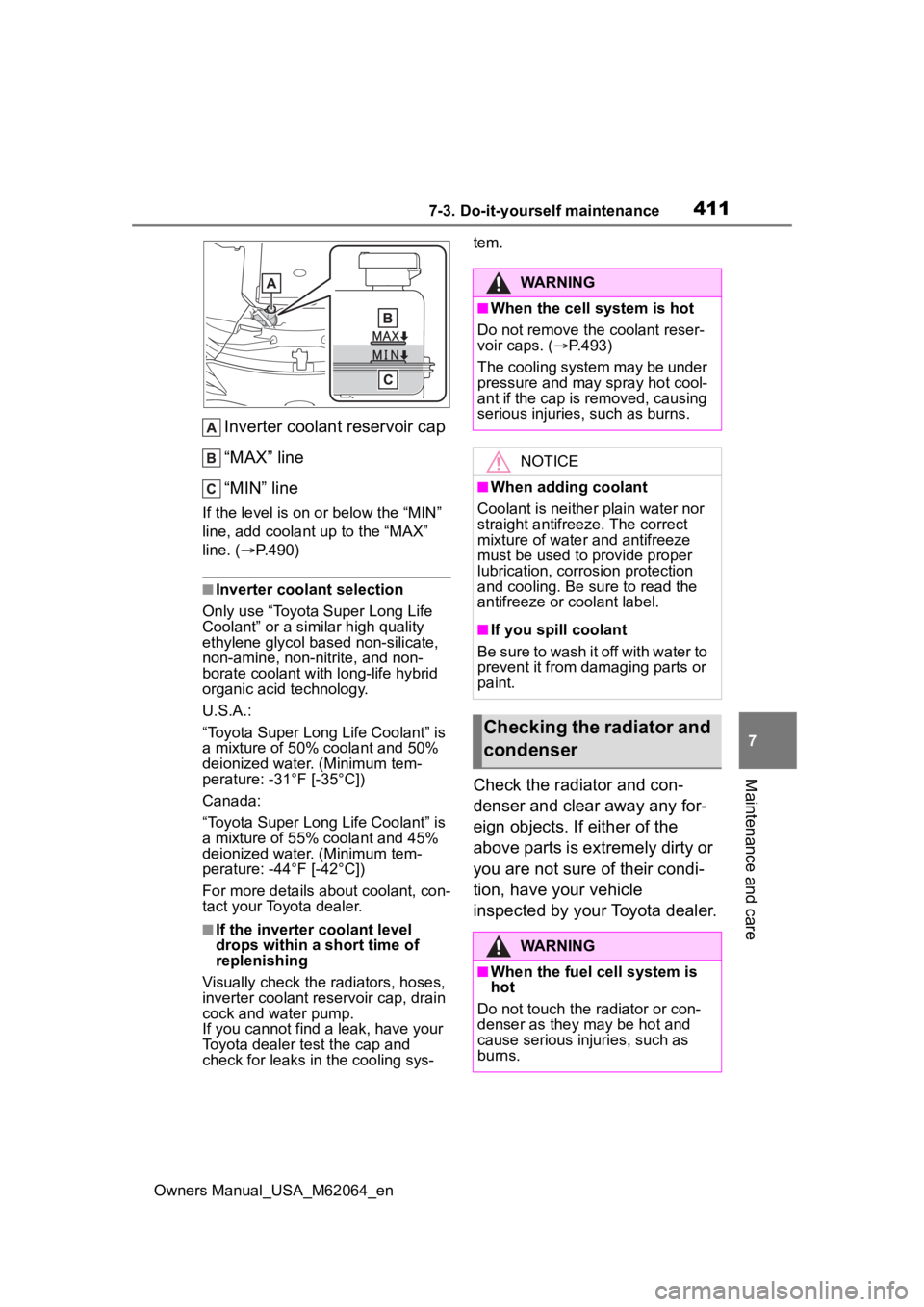
Inverter coolant reservoir cap
“MAX” line
“MIN” line
If the level is on or below the “MIN”
line, add coolant up to the “MAX”
line. ( P.490)
■Inverter coolant selection
Only use “Toyota Super Long Life
Coolant” or a similar high quality
ethylene glycol based non-silicate,
non-amine, non-nitrite, and non-
borate coolant with long-life hybrid
organic acid technology.
U.S.A.:
“Toyota Super Long Life Coolant” is
a mixture of 50% coolant and 50%
deionized water. (Minimum tem-
perature: -31°F [-35°C])
Canada:
“Toyota Super Long Life Coolant” is
a mixture of 55% coolant and 45%
deionized water. (Minimum tem-
perature: -44°F [-42°C])
For more details about coolant, con-
tact your Toyota dealer.
■If the inverter coolant level
drops within a short time of
replenishing
Visually check the radiators, hoses,
inverter coolant reservoir cap, drain
cock and water pump.
If you cannot find a leak, have your
Toyota dealer test the cap and
check for leaks in the cooling sys- tem.
Check the radiator and con-
denser and clear away any for-
eign objects. If either of the
above parts is extremely dirty or
you are not sure of their condi-
tion, have your vehicle
inspected by your Toyota dealer.
WARNING
■When the cell system is hot
Do not remove the coolant reser-
voir caps. ( P.493)
The cooling system may be under
pressure and may spray hot cool-
ant if the cap is removed, causing
serious injuries, such as burns.
NOTICE
■When adding coolant
Coolant is neither plain water nor
straight antifreeze. The correct
mixture of water and antifreeze
must be used to provide proper
lubrication, corrosion protection
and cooling. Be sure to read the
antifreeze or coolant label.
■If you spill coolant
Be sure to wash it off with water to
prevent it from damaging parts or
paint.
Checking the radiator and
condenser
WARNING
■When the fuel cell system is
hot
Do not touch the radiator or con-
denser as they may be hot and
cause serious injuries, such as
burns.
Page 453 of 572
4538-2. Steps to take in an emergency
Owners Manual_USA_M62064_en
8
When trouble arises
Fluid leaks under the vehicle.
(Water dripping from the air
conditioning after use is nor-
mal.)
Flat-looking tires or uneven
tire wear
The high coolant temperature
gauge needle continually
points higher than normal.
Hydrogen gas leakage noises
can be heard. ( P.87)
Excessive tire squeal when
cornering
Strange noises related to the
suspension system
Other noises related to the
fuel cell system
Stumbling or running roughly
Appreciable loss of power
Vehicle pulls heavily to one
side when braking
Vehicle pulls heavily to one
side when driving on a level
road
Loss of brake effectiveness,
spongy feeling, pedal almost
touches the floor
If you think something
is wrong
If you notice any of the fol-
lowing symptoms, your
vehicle probably needs
adjustment or repair. Con-
tact your Toyota dealer as
soon as possible.
Visible symptoms
Audible symptoms
Operational symptoms
Page 491 of 572
4918-2. Steps to take in an emergency
Owners Manual_USA_M62064_en
8
When trouble arises
If the high coolant tempera-
ture warning light comes on or
flashes
1 Stop the vehicle in a safe
place and turn off the air con-
ditioning system, and then
stop the fuel cell system.
2 If you see steam:
Carefully lift the hood after
the steam subsides.
If you do not see steam:
Carefully lift the hood.
3 After the fuel cell system has
cooled down sufficiently,
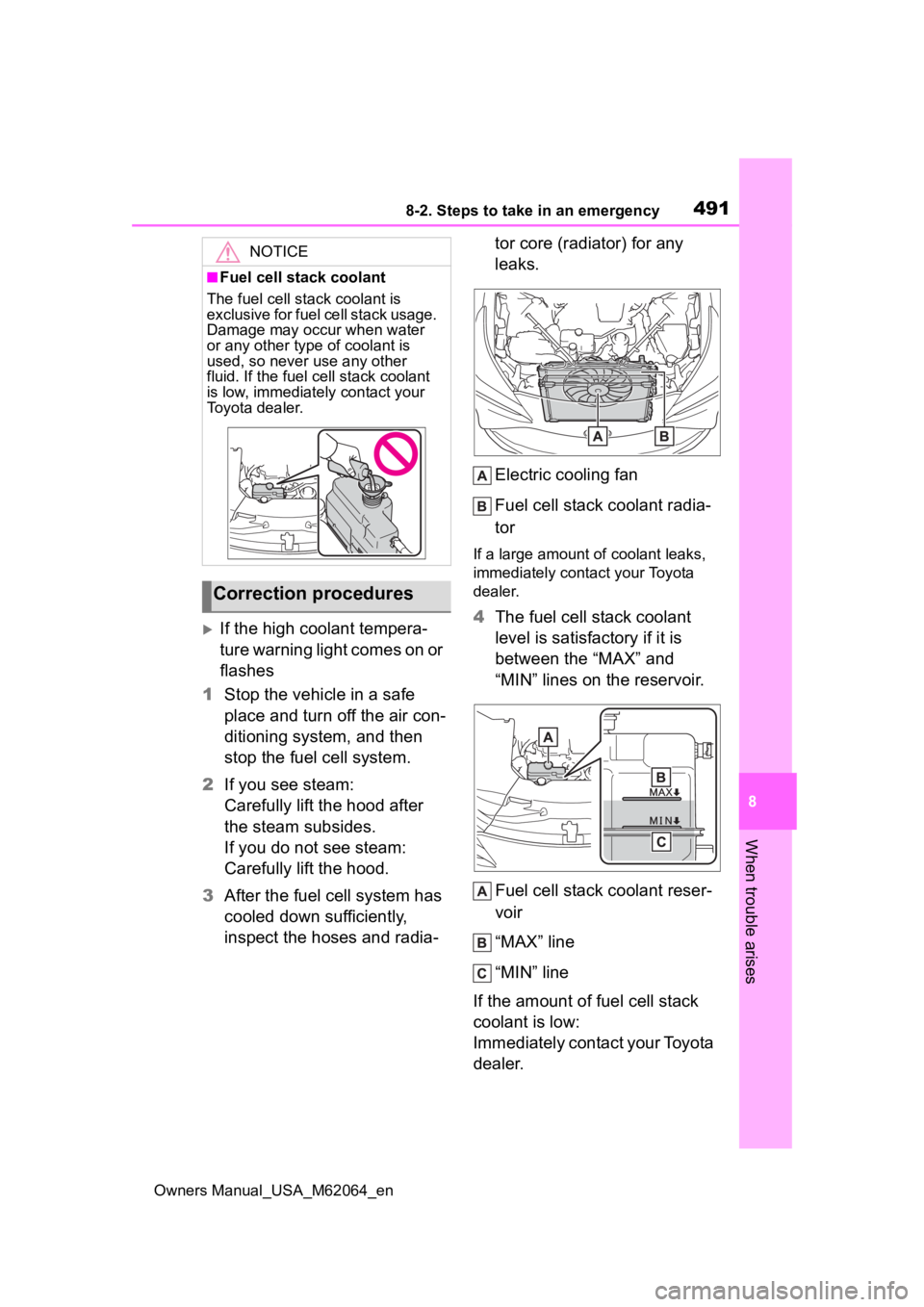
inspect the hoses and radia- tor core (radiator) for any
leaks.
Electric cooling fan
Fuel cell stack coolant radia-
tor
If a large amount of coolant leaks,
immediately contact your Toyota
dealer.
4
The fuel cell stack coolant
level is satisfactory if it is
between the “MAX” and
“MIN” lines on the reservoir.
Fuel cell stack coolant reser-
voir
“MAX” line
“MIN” line
If the amount of fuel cell stack
coolant is low:
Immediately contact your Toyota
dealer.
NOTICE
■Fuel cell stack coolant
The fuel cell stack coolant is
exclusive for fuel cell stack usage.
Damage may occur when water
or any other type of coolant is
used, so never use any other
fluid. If the fuel cell stack coolant
is low, immediately contact your
Toyota dealer.
Correction procedures
Page 492 of 572
4928-2. Steps to take in an emergency
Owners Manual_USA_M62064_en
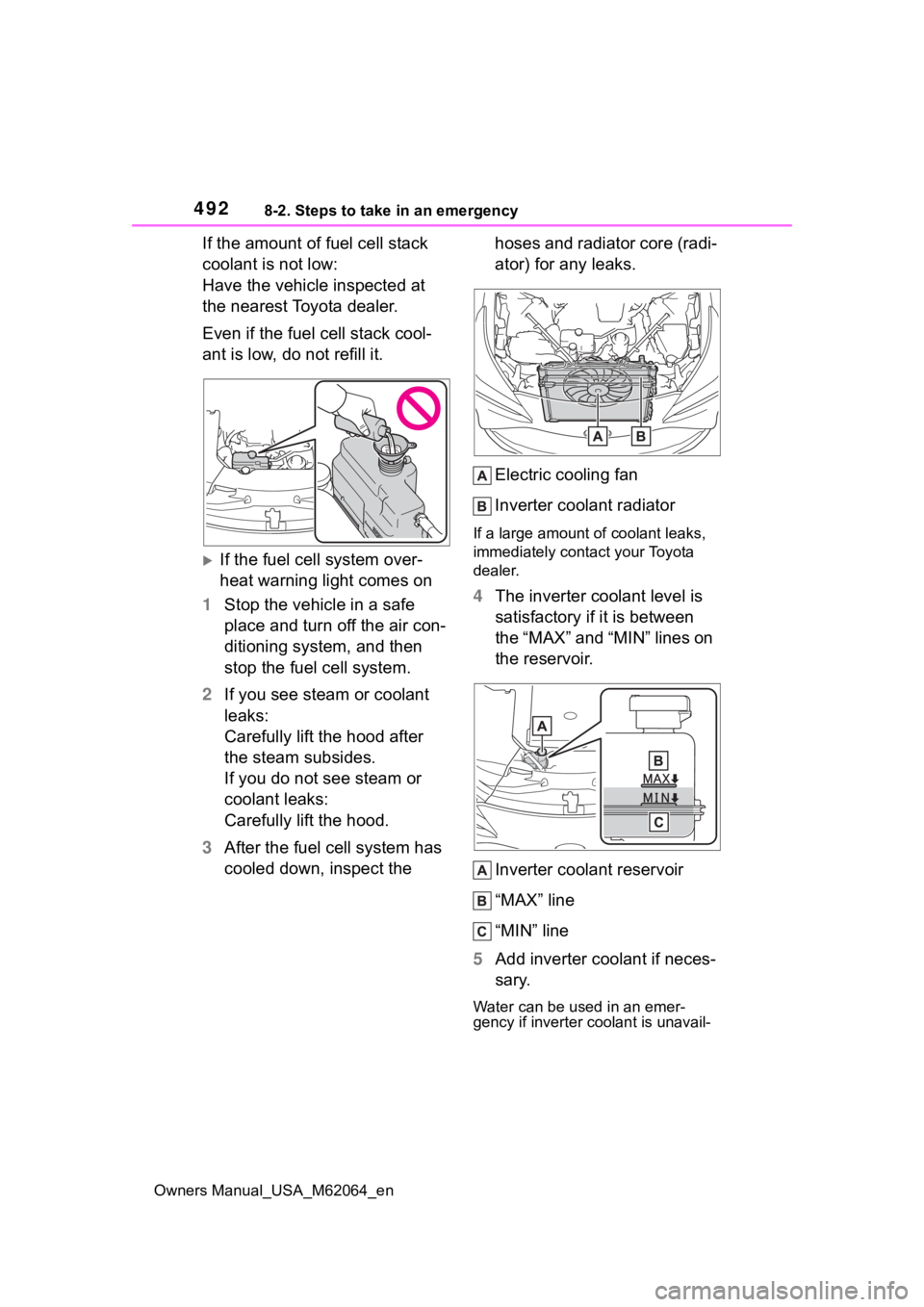
If the amount of fuel cell stack
coolant is not low:
Have the vehicle inspected at
the nearest Toyota dealer.
Even if the fuel cell stack cool-
ant is low, do not refill it.
If the fuel cell system over-
heat warning light comes on
1 Stop the vehicle in a safe
place and turn off the air con-
ditioning system, and then
stop the fuel cell system.
2 If you see steam or coolant
leaks:
Carefully lift the hood after
the steam subsides.
If you do not see steam or
coolant leaks:
Carefully lift the hood.
3 After the fuel cell system has
cooled down, inspect the hoses and radiator core (radi-
ator) for any leaks.
Electric cooling fan
Inverter coolant radiator
If a large amount of coolant leaks,
immediately contact your Toyota
dealer.
4
The inverter coolant level is
satisfactory if it is between
the “MAX” and “MIN” lines on
the reservoir.
Inverter coolant reservoir
“MAX” line
“MIN” line
5 Add inverter coolant if neces-
sary.
Water can be used in an emer-
gency if inverter coolant is unavail-
Page 556 of 572

556Alphabetical Index
Owners Manual_USA_M62064_en
Trunk grip ............................. 134
Trunk light............................. 134
Trunk opener main switch .... 135
Trunk opener switch ............. 133
Wireless remote control ....... 134
Trunk light ............................... 134
Turn signal lights.................... 190 Replacing light bulbs ............ 443
Turn signal lever ................... 190
U
USB charging ports................ 364
V
Vanity lights ............................ 380
Vanity mirrors ......................... 380Vanity lights .......................... 380
VDIM (Vehicle Dynamics Inte- grated Management) ............ 322
Vehicle data recording ............... 7
Vehicle Dynamics Integrated Management (VDIM) ............. 322
Vehicle identifi cation number496
Vehicle information display ... 111
Vehicle Stability Control (VSC) ............................................... 322
Ventilators (seat ventilators) . 351
VSC (Vehicle Stability Control) ............................................... 322
W
Warning buzzers Approach warning ................ 251
Brake hold ............................ 459
Brake Override System ........ 459
Brake system ....................... 454
Drive-Start Control ............... 459
Electric power steering ......... 456
Fuel cell system overheat .... 455 Hands off steering wheel warn-
ing (LTA) .............................239
High coolant temperature .....455
Hydrogen leak ......................454
Intuitive parking assist ..268, 457
LTA (Lane Tracing Assist) ...230, 234, 457
Open door ....................128, 130
Open window........................163
PCS (Pre-Collisio n System) .456
PKSB (Parking Support Brake) ...........................................457
Pre-collision braking .............219
Pre-collision warn ing ............219
RCD (Rear Camera Detection) ...........................................458
RCTA (Rear Cross Traffic Alert) ...........................................458
Rear seat reminder ...............129
Seat belt .......................460, 461
SRS airbag ...........................455
Vehicle sway warning function (LTA) ...................................240
Warning label ............................81
Warning lights ...................95, 454 ABS ......................................456
Brake hold operated indicator...........................................459
Brake Override System ........459
Brake system ........................454
Charging system ..................455
Drive-Start Control ................459
Electric power steering .........456
Fuel cell system overheat .....455
High coolant temperature .....455
Hydrogen leak ......................454
Intuitive parking assist OFF indi- cator ...................................457
Low fuel level........................460
LTA indicator .........................457
Parking brake indicator.........459