Eco TOYOTA PRIUS 2008 2.G Owner's Manual
[x] Cancel search | Manufacturer: TOYOTA, Model Year: 2008, Model line: PRIUS, Model: TOYOTA PRIUS 2008 2.GPages: 512, PDF Size: 7.23 MB
Page 88 of 512
88 1-8. Safety information
PRIUS_U_(L/O_0802)
CAUTION
■While driving
● Do not adjust the position of the driver’s seat.
Doing so could cause the driver to lose control of the vehicle.
● Do not place a cushion between the driver or passenger and the seatback.
A cushion may prevent correct posture from being achieved, and reduce
the effectiveness of the seat belt and head restraint, increasing the risk of
death or serious injury to the driver or passenger.
● Do not place anything under the front seats.
Objects placed under the front seats may become jammed in the seat
tracks and stop the seat from locking in place. This may lead to an acci-
dent. The adjustment mechanism may also be damaged.
■ Adjusting the seat position
● Take care when adjusting the seat position to ensure that other passen-
gers are not injured by the moving seat.
● Do not put your hands under the seat or near the moving parts to avoid
injury.
Fingers or hands may become jammed in the seat mechanism.
Page 96 of 512

96 1-8. Safety information
PRIUS_U_(L/O_0802)
CAUTION
■SRS airbag precautions
Observe the following precautions regarding the airbags. Failure to do so
may cause death or serious injury.
● The driver and all passengers in the vehicle must wear their seat belts
properly.
The SRS airbags are supplemental devices to be used with the seat belts.
● The SRS driver airbag deploys with considerable force, and can cause
death or serious injury especially if the driver is very close to the airbag.
The National Highway Traffic Safety Administration (“NHTSA”) advises:
Since the risk zone for driver airbag is the first 2 - 3 in. (50 - 75 mm) of
inflation, placing yourself 10 in. (250 mm) from your driver airbag provides
you with a clear margin of safety. This distance is measured from the cen-
ter of the steering wheel to your breastbone. If you sit less than 10 in. (250
mm) away now, you can change your driving position in several ways:
• Move your seat to the rear as far as you can while still reaching the pedals comfortably.
• Slightly recline the back of the seat. Although vehicle designs vary, many drivers can achieve the 10 in. (250 mm) distance, even with the
driver seat all the way forward, simply by reclining the back of the seat
somewhat. If reclining the back of your seat makes it hard to see the
road, raise yourself by using a firm, non-slippery cushion, or raise the
seat if your vehicle has that feature.
• If your steering wheel is adjustable, tilt it downward. This points the air- bag toward your chest instead of your head and neck.
The seat should be adjusted as recommended by NHTSA above, while still
maintaining control of the foot pedals, steering wheel, and your view of the
instrument panel controls.
Page 97 of 512
97
1-8. Safety information
1
Before driving
PRIUS_U_(L/O_0802)
CAUTION
■
SRS airbag precautions
● The SRS front passenger airbag also deploys with considerable force, and
can cause death or serious injury especially if the front passenger is very
close to the airbag. The front passenger seat should be as far from the air-
bag as possible with the seatback adjusted, so the front passenger sits
upright.
● Improperly seated and/or restrained infants and children can be killed or
seriously injured by a deploying airbag. An infant or child who is too small
to use a seat belt should be properly secured using a child restraint sys-
tem. Toyota strongly recommends that all infants and children be placed in
the rear seats of the vehicle and properly restrained. The rear seats are
the safest for infants and children. (P. 107)
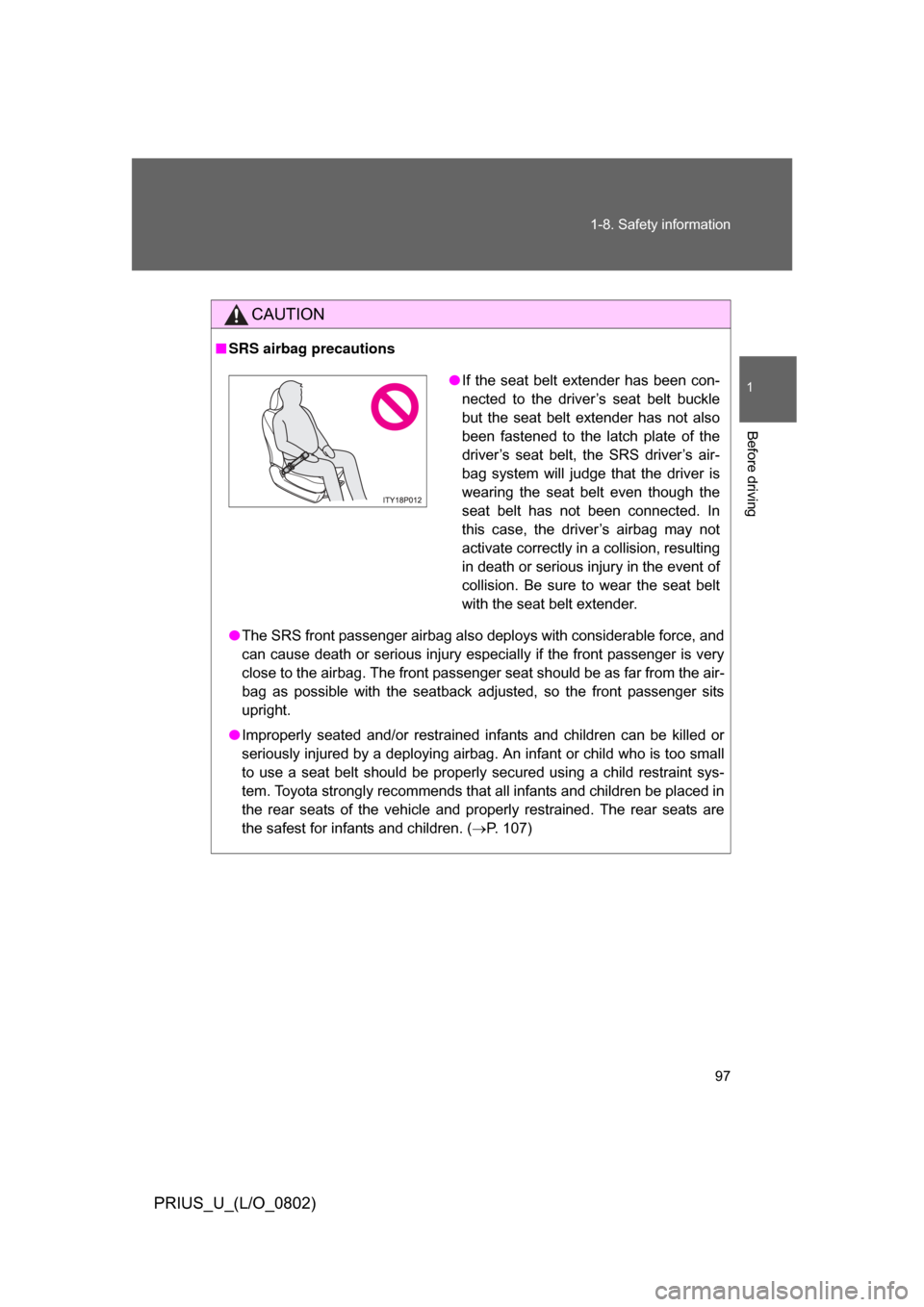
● If the seat belt extender has been con-
nected to the driver’s seat belt buckle
but the seat belt extender has not also
been fastened to the latch plate of the
driver’s seat belt, the SRS driver’s air-
bag system will judge that the driver is
wearing the seat belt even though the
seat belt has not been connected. In
this case, the driver’s airbag may not
activate correctly in a collision, resulting
in death or serious injury in the event of
collision. Be sure to wear the seat belt
with the seat belt extender.
Page 99 of 512
99
1-8. Safety information
1
Before driving
PRIUS_U_(L/O_0802)
CAUTION
■
SRS airbag precautions
● Do not use seat accessories which cover the parts where the SRS side
airbags inflate as they may interf ere with inflation of the airbags.
● Do not strike or apply significant levels of force to the area of the SRS air-
bag components shown on P. 90. Doing so can cause the SRS airbags to
malfunction.
● Do not touch any of the component parts immediately after the SRS air-
bags have deployed (inflated) as they may be hot.
● If breathing becomes difficult after the SRS airbag has deployed, open a
door or window to allow fresh air in, or leave the vehicle if it is safe to do
so. Wash off any residue as soon as possible to prevent skin irritation.
● If the areas where the SRS airbags are stored, such as the steering wheel
pad and front pillar garnish, are dam aged or cracked, have them replaced
by your Toyota dealer.
● Do not place anything, such as a cushion, on the front passenger’s seat
Doing so will disperse the passenger’s weight, which prevents the sensor
from detecting the passenger’s weight properly. As a result, the SRS front
passenger airbag may not deploy in the event of a collision.
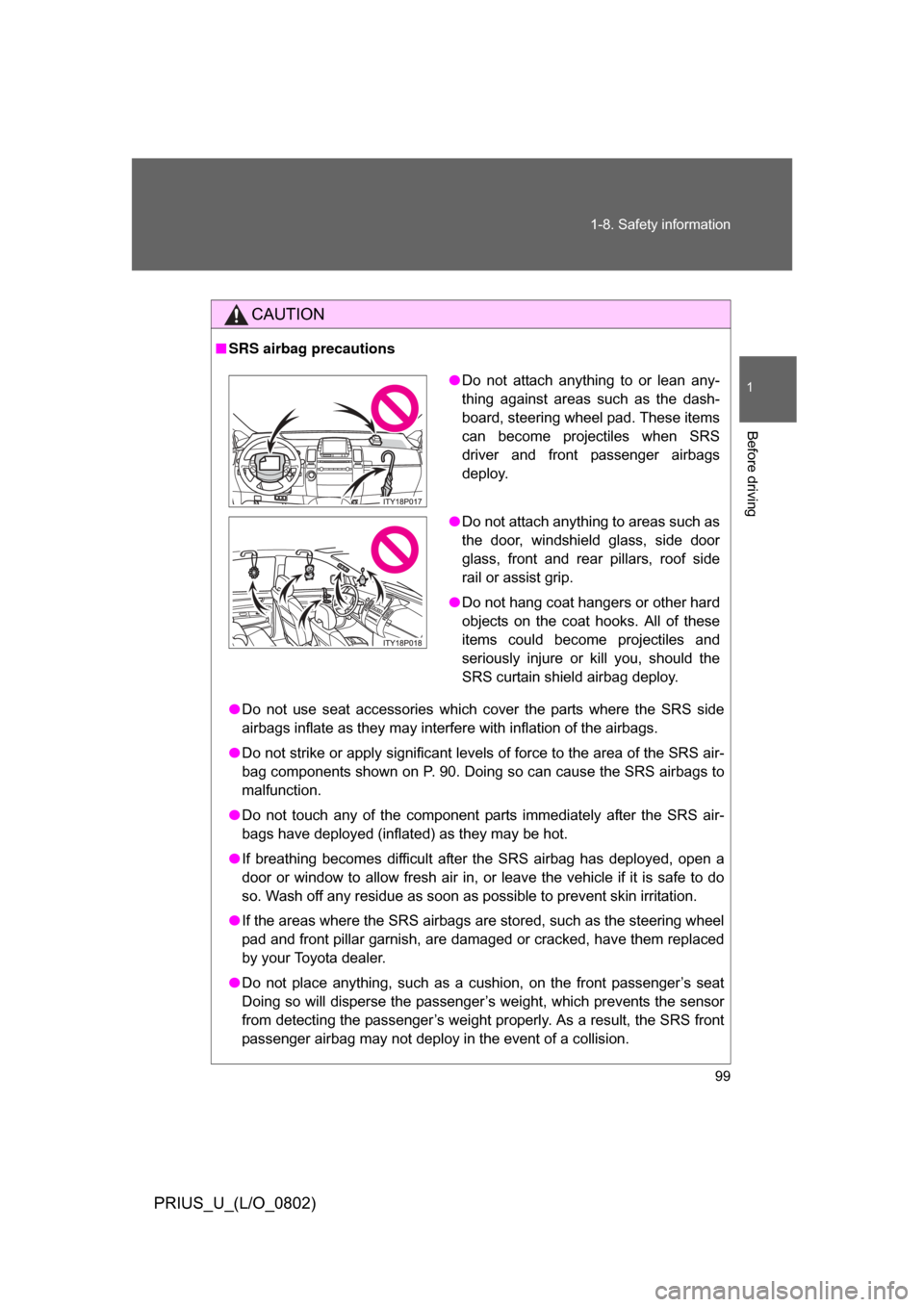
●Do not attach anything to or lean any-
thing against areas such as the dash-
board, steering wheel pad. These items
can become projectiles when SRS
driver and front passenger airbags
deploy.
● Do not attach anything to areas such as
the door, windshield glass, side door
glass, front and rear pillars, roof side
rail or assist grip.
● Do not hang coat hangers or other hard
objects on the coat hooks. All of these
items could become projectiles and
seriously injure or kill you, should the
SRS curtain shield airbag deploy.
Page 104 of 512

104 1-8. Safety information
PRIUS_U_(L/O_0802)■
There is a malfunction in the system
*1: The system judges a person of adult size as an adult. When a
smaller adult sits in the front passenger seat, the system may rec-
ognize him/her as a child depending on his/her physique and pos-
ture.
*2: In the event the front passenger does not wear a seat belt.
*3: When a large child who has outgrow n a child restraint system sits
in the front passenger seat, the system may recognize him/her as
an adult depending on his/her physique or posture.
*4: Never install a rear-facing child restraint system on the front pas- senger seat. A forward-facing ch ild restraint system should only
be installed on the front passenger seat when it is unavoidable.
( P. 107)
*5: In case the indicator is not illumi nated, consult this manual as for
installing the child restraint system properly. ( P. 1 1 0 )
Indicator/
warning light “AIR BAG ON” and “AIR BAG OFF”
indicator lights “AIR BAG
OFF”
SRS warning light On
Front passenger’s seat belt reminder light Off
Devices Front passenger airbag
Deactivated
Side airbag on the right side
passenger seats
Curtain shield airbag in the front passenger side Activated
Front passenger’s seat belt pretensioner Activated
Page 105 of 512
105
1-8. Safety information
1
Before driving
PRIUS_U_(L/O_0802)
CAUTION
■
Front passenger occupant cl assification system precautions
Observe the following precautions regarding front passenger occupant clas-
sification system.
Failure to do so may cause death or serious injury.
● Wear the seat belt properly.
● Make sure the front passenger’s seat belt tab has not been left inserted
into the buckle before someone sits in the front passenger seat.
● Make sure the “AIR BAG OFF” indicator lights is not illuminated when
using the seat belt extender for the front passenger seat. If the “AIR BAG
OFF” indicator light is illuminated, disconnect the extender tongue from
the seat belt buckle, then reconnect the seat belt. Reconnect the seat belt
extender after making sure the “AIR BAG ON” indicator light is illuminated.
If you use the seat belt extender while the “AIR BAG OFF” indicator light is
illuminated, the front passenger airbag and side airbag on the front pas-
senger side may not activate correctly, which could cause death or serious
injury in the event of collision.
● Do not put weight on the front passenger seat by putting your hands or
feet on the front passenger seatback from the rear passenger seat.
● Do not let a rear passenger lift the front passenger seat with their feet or
press on the seatback with their legs.
● Do not put objects under the front passenger seat.
● Do not recline the front passenger seatback so far that it touches a rear
seat. This may cause the “AIR BAG OFF” indicator light to be illuminated,
which indicates that the passenger’s airbags will not deploy in the event of
a severe accident. If the seatback touches the rear seat, return the seat-
back to a position where it does not touch the rear seat. Keep the front
passenger seatback as upright as possible when the vehicle is moving.
Reclining the seatback excessively may lessen the effectiveness of the
seat belt system.
● If an adult sits in the front passenger seat, the “AIR BAG ON” indicator
light is illuminated, If the “AIR BAG OFF” indicator is illuminated, ask the
passenger to sit up straight, well back in the seat, feet on the floor, and
with the seat belt worn correctly. If the “AIR BAG OFF” indicator still
remain illuminated, either ask the passenger to move to the rear seat, or if
that is not possible, move the front passenger seat fully rearward.
Page 121 of 512
121
2-1. Driving procedures
2
When driving
PRIUS_U_(L/O_0802)
■
Driving in the rain
● Drive carefully when it is raining, because visibility will be reduced, the
windows may become fogged-up, and the road will be slippery.
● Drive carefully when it starts to rain, because the road surface will be
especially slippery.
● Refrain from high speeds when driving on an expressway in the rain,
because there may be a layer of water between the tires and the road
surface, preventing the steering and brakes from operating properly.
■ Breaking in your new Toyota
To extend the life of the vehicle, the following precautions are recommended
to observe:
● For the first 180 miles (300 km):
Avoid sudden stops.
● For the first 621 miles (1000 km):
• Do not drive at extremely high speeds.
• Avoid sudden acceleration.
• Do not drive continuously in the low gears.
• Do not drive at a constant speed for extended periods.
■ Operating your vehicle in a foreign country
Comply with the relevant vehicle registration laws and confirm the availability
of the correct fuel. ( P. 464)
■ For efficient use
● Put the shift lever into “D” when driving
In the “N” position, the gasoline engine operates but electricity cannot be
generated.
The hybrid battery (traction battery) will be discharged requiring unnec-
essary engine power to recharge.
● Drive your vehicle smoothly
Avoid abrupt acceleration and deceleration. Gradual acceleration and
deceleration will make more effective use of the traction motor without
having to use gasoline engine power.
Page 127 of 512
127
2-1. Driving procedures
2
When driving
PRIUS_U_(L/O_0802)
CAUTION
■
When taking a nap in the vehicle
Always turn the hybrid system off. Otherwise, you may accidentally move the
shift lever or depress the accelerator pedal, which could cause an accident
or fire due to hybrid system overheating. Additionally, if the vehicle is parked
in a poorly ventilated area, exhaust gases may collect and enter the vehicle,
leading to death or a serious health hazard.
■ When braking the vehicle
● When the brakes are wet, drive more cautiously. Braking distance
increases when the brakes are wet, and may cause one side of the vehicle
to brake differently than the other side. Also the parking brake may not
securely hold the vehicle.
● If the power brake assist function does not operate, do not follow other
vehicles closely and avoid downhill or sharp turns that require braking.
In this case, braking is still possible, but it will require more force on the
pedal than usual. Braking distance may also increase.
● Do not pump the brake pedal if the hybrid system stalls.
Each push on the pedal uses up your reserved brake fluid pressure.
● The brake system consists of 3 individual hydraulic systems: if one of the
systems fails, the other will still operate. In this case, the brake pedal
should be depressed more firmly than usual and braking distance
becomes longer.
Do not drive your vehicle with only a single brake system. Have your
brakes fixed immediately.
Page 128 of 512
128 2-1. Driving procedures
PRIUS_U_(L/O_0802)
NOTICE
■While driving the vehicle
Do not use the accelerator pedal or depress accelerator and brake pedals
together to hold the vehicle on a hill.
■ When parking the vehicle
Always push the “P” position switch. Failure to do so may cause the vehicle
to move or the vehicle may accelerate suddenly if the accelerator pedal is
accidentally depressed.
■ Avoiding damage to vehicle parts
● Do not turn the steering wheel fully in either direction and hold it there for a
long time.
Doing so may damage the power steering motor.
● When driving over bumps in the road, drive as slowly as possible to avoid
damaging the wheels, underside of the vehicle, etc.
■ If you hear a squealing or scraping noise (brake pad wear limit indica-
tors)
Have your Toyota dealer check and replace the brake pads as soon as pos-
sible.
The rotor damage can result if the pads are not replaced when needed.
Front brake only: Moderate levels of the brake pad and disc wear allow
enhanced front braking power. As a result, the discs may wear more quickly
than conventional brake discs. Therefore, when replacing the brake pads,
Toyota recommends that you also have the thickness of the discs measured.
It is dangerous to drive the vehicle when the wear limits of the brake pads
and/or that of the brake discs are exceeded.
Page 131 of 512
131
2-1. Driving procedures
2
When driving
PRIUS_U_(L/O_0802)
■
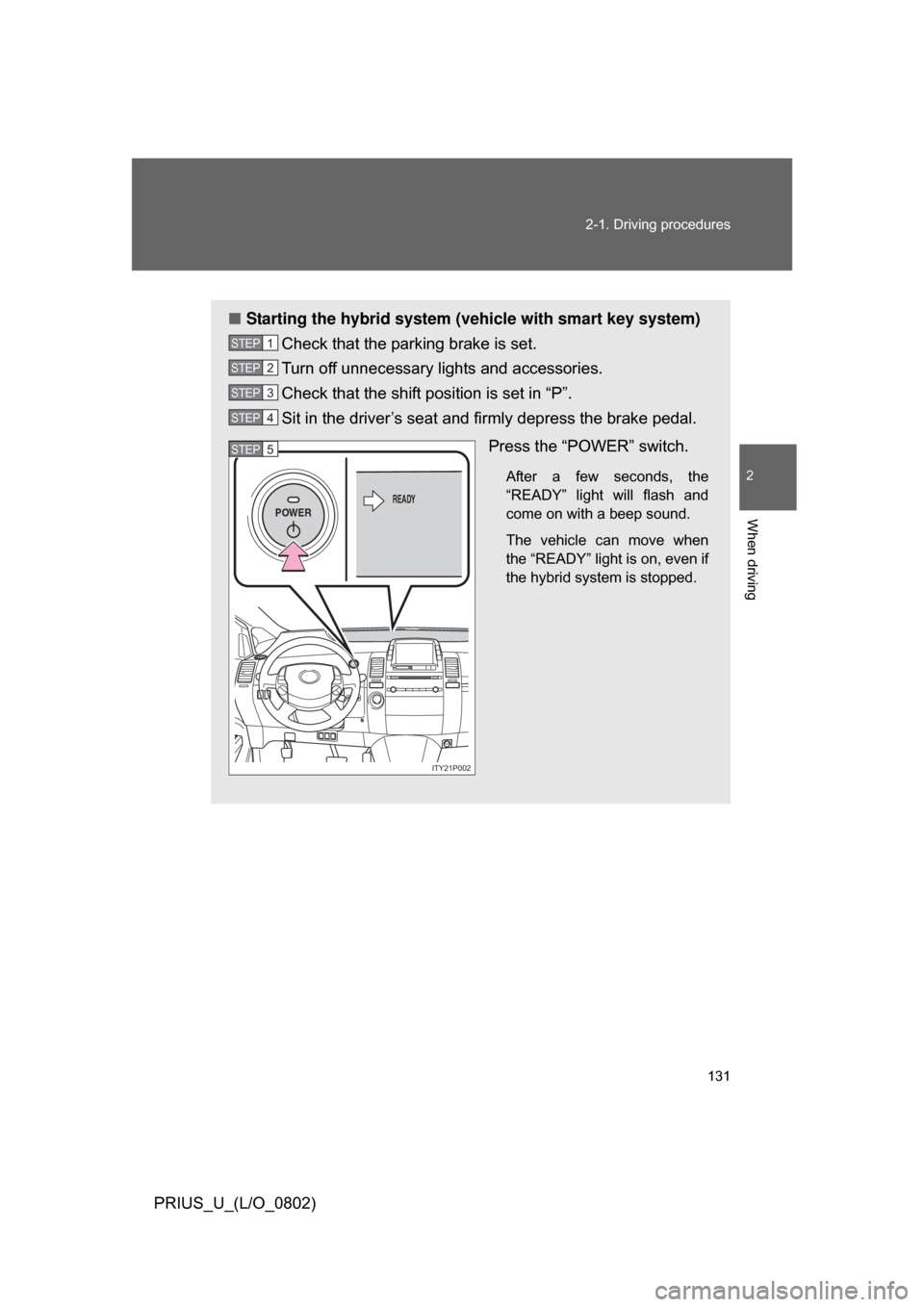
Starting the hybrid system (vehicle with smart key system)
Check that the parking brake is set.
Turn off unnecessary lights and accessories.
Check that the shift position is set in “P”.
Sit in the driver’s seat and firmly depress the brake pedal.
Press the “POWER” switch.
After a few seconds, the
“READY” light will flash and
come on with a beep sound.
The vehicle can move when
the “READY” light is on, even if
the hybrid system is stopped.
STEP1
STEP2
STEP3
STEP4
POWERREADY
ITY21P002
STEP5