power steering TOYOTA PRIUS 2023 User Guide
[x] Cancel search | Manufacturer: TOYOTA, Model Year: 2023, Model line: PRIUS, Model: TOYOTA PRIUS 2023Pages: 770, PDF Size: 122.55 MB
Page 432 of 770
4304-5. Using the driving support systems
PRIUS_OM_OM47F32E_(EE)
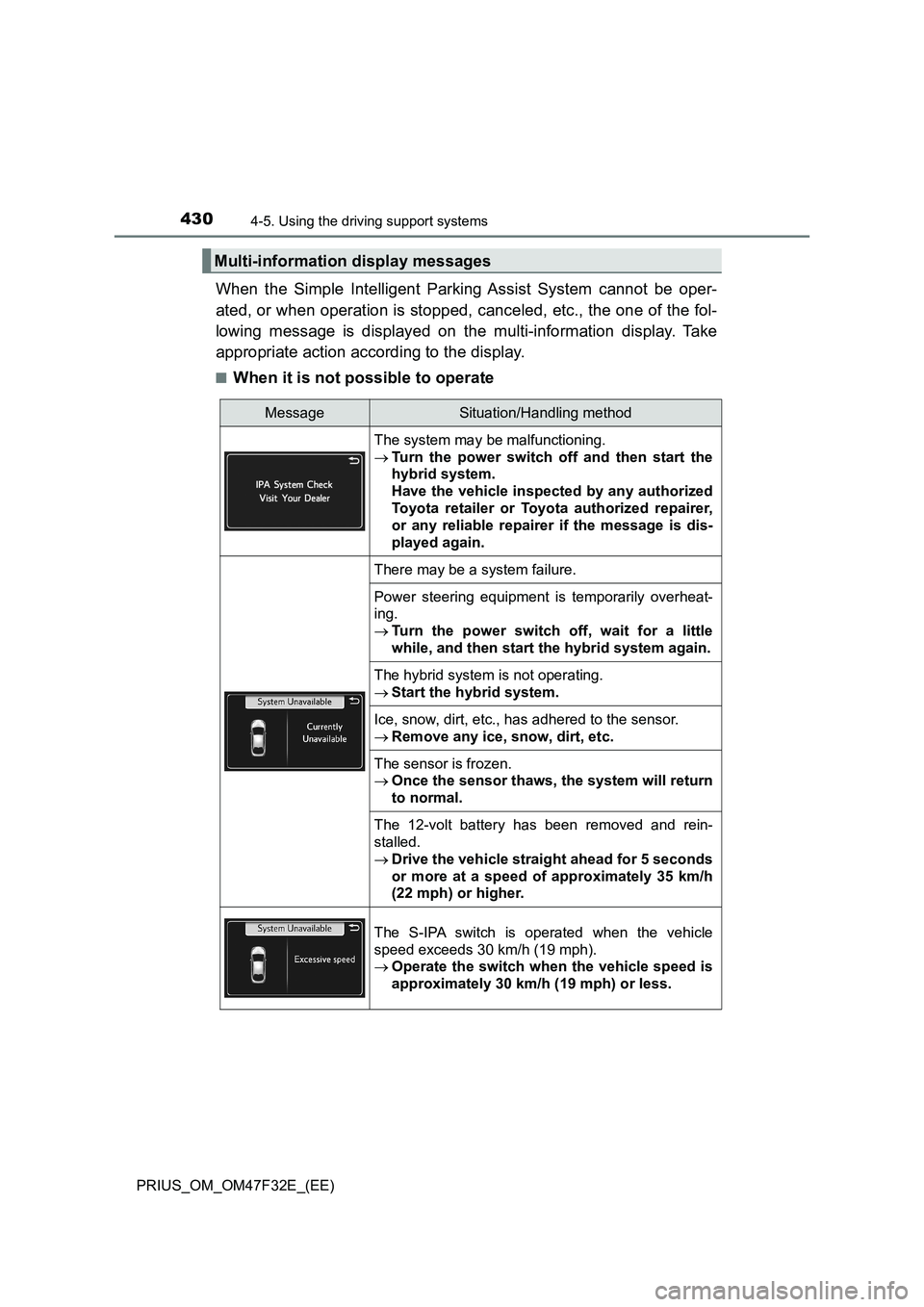
When the Simple Intelligent Parking Assist System cannot be oper-
ated, or when operation is stopped, canceled, etc., the one of the fol-
lowing message is displayed on the multi-information display. Take
appropriate action according to the display.
■When it is not possible to operate
Multi-information display messages
MessageSituation/Handling method
The system may be malfunctioning.
Turn the power switch off and then start the
hybrid system.
Have the vehicle inspected by any authorized
Toyota retailer or Toyota authorized repairer,
or any reliable repairer if the message is dis-
played again.
There may be a system failure.
Power steering equipment is temporarily overheat-
ing.
Turn the power switch off, wait for a little
while, and then start the hybrid system again.
The hybrid system is not operating.
Start the hybrid system.
Ice, snow, dirt, etc., has adhered to the sensor.
Remove any ice, snow, dirt, etc.
The sensor is frozen.
Once the sensor thaws, the system will return
to normal.
The 12-volt battery has been removed and rein-
stalled.
Drive the vehicle straight ahead for 5 seconds
or more at a speed of approximately 35 km/h
(22 mph) or higher.
The S-IPA switch is operated when the vehicle
speed exceeds 30 km/h (19 mph).
Operate the switch when the vehicle speed is
approximately 30 km/h (19 mph) or less.
Page 443 of 770
441
4
4-5. Using the driving support systems
Driving
PRIUS_OM_OM47F32E_(EE)
Driving assist systems
◆ECB (Electronically Controlled Brake System)
The electronically controlled system generates braking force corre-
sponding to the brake operation
◆ABS (Anti-lock Brake System)
Helps to prevent wheel lock when the brakes are applied suddenly,
or if the brakes are applied while driving on a slippery road surface
◆Brake assist
Generates an increased level of braking force after the brake pedal
is depressed when the system detects a panic stop situation
◆VSC (Vehicle Stability Control)
Helps the driver to control skidding when swerving suddenly or
turning on slippery road surfaces.
◆VSC+ (Vehicle Stability Control+)
Provides cooperative control of the ABS, TRC, VSC and EPS.
Helps to maintain directional stability when swerving on slippery
road surfaces by controlling steering performance.
◆TRC (Traction Control)
Helps to maintain drive power and prevent the drive wheels from
spinning when starting the vehicle or accelerating on slippery roads
◆Active Cornering Assist (ACA)
Helps to prevent the vehicle from drifting to the outer side by per-
forming inner wheel brake control when attempting to accelerate
while turning
To keep driving safety and performance, the following systems
operate automatically in response to various driving situations.
Be aware, however, that these systems are supplementary and
should not be relied upon too heavily when operating the vehi-
cle.
Page 444 of 770
4424-5. Using the driving support systems
PRIUS_OM_OM47F32E_(EE)
◆Hill-start assist control
Helps to reduce the backward movement of the vehicle when start-
ing on an uphill
◆EPS (Electric Power Steering)
Employs an electric motor to reduce the amount of effort needed to
turn the steering wheel
◆Emergency brake signal
When the brakes are applied suddenly, the emergency flashers
automatically flash to alert the vehicle behind.
◆E-Four (Electronic On-Demand AWD system) (AWD models)
Automatically switches from front-wheel drive to all-wheel drive
(AWD) according to the driving conditions, helping to ensure reli-
able handling and stability. Examples of conditions where the sys-
tem will switch to AWD are when cornering, going uphill, starting off
or accelerating, and when the road surface is slippery due to snow,
rain, etc.
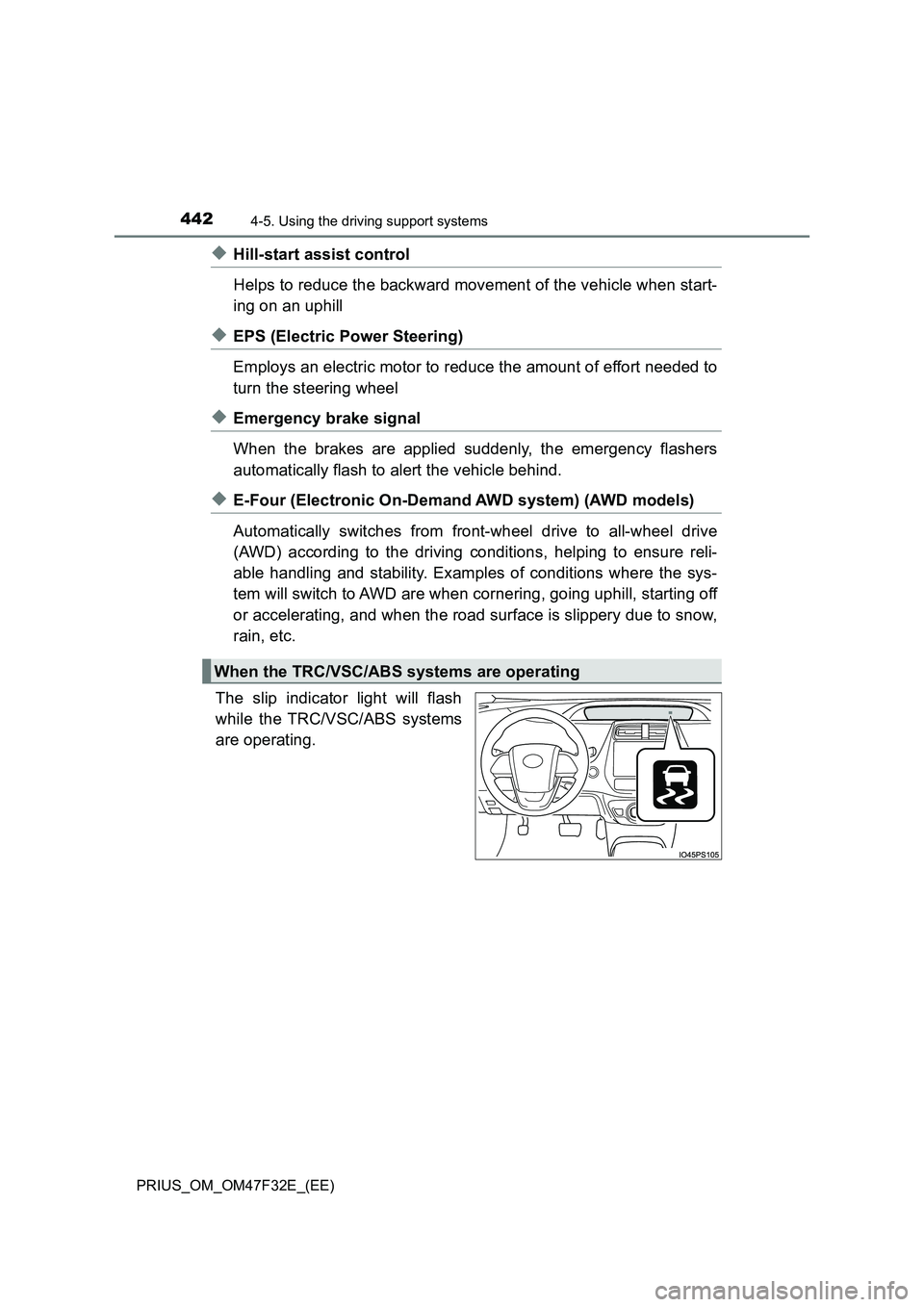
The slip indicator light will flash
while the TRC/VSC/ABS systems
are operating.
When the TRC/VSC/ABS systems are operating
Page 447 of 770
4454-5. Using the driving support systems
4
Driving
PRIUS_OM_OM47F32E_(EE)■Automatic reactivation of TRC and VSC systems
After turning the TRC and VSC systems off, the systems will be automatically
re-enabled in the following situations:
●When the power switch is turned off
●If only the TRC system is turned off, the TRC will turn on when vehicle
speed increases
If both the TRC and VSC systems are turned off, automatic re-enabling will
not occur when vehicle speed increases.
■Operating conditions of Active Cornering Assist
The system operates when the following occurs.
●TRC/VSC can operate
●The driver is attempting to accelerate while turning
●The system detects that the vehicle is drifting to the outer side
●The brake pedal is released
■Reduced effectiveness of the EPS system
The effectiveness of the EPS system is reduced to prevent the system from
overheating when there is frequent steering input over an extended period of
time. The steering wheel may feel heavy as a result. Should this occur, refrain
from excessive steering input or stop the vehicle and turn the hybrid system
off. The EPS system should return to normal within 10 minutes.
■Electric power steering system warning light (warning buzzer)
P. 581
■Operating conditions of emergency brake signal
When the following conditions are met, the emergency brake signal will oper-
ate:
●The emergency flashers are off.
●Actual vehicle speed is over 55 km/h (35 mph).
●The system judges from the vehicle deceleration that it is a sudden braking
operation.
■Automatic system cancelation of emergency brake signal
The emergency brake signal will be canceled in any of the following situa-
tions:
●The emergency flashers are turned on.
●The system judges from the vehicle deceleration that is not a sudden brak-
ing operation.
Page 571 of 770
5697-1. Essential information
PRIUS_OM_OM47F32E_(EE)
7
When trouble arises
If your vehicle has to be stopped in an
emergency
Steadily step on the brake pedal with both feet and firmly depress it.
Do not pump the brake pedal repeatedly as this will increase the effort
required to slow the vehicle.
Shift the shift position to N.
If the shift position is shifted to N
After slowing down, stop the vehicle in a safe place by the road.
Stop the hybrid system.
If the shift position cannot be shifted to N
Keep depressing the brake pedal with both feet to reduce vehicle
speed as much as possible.
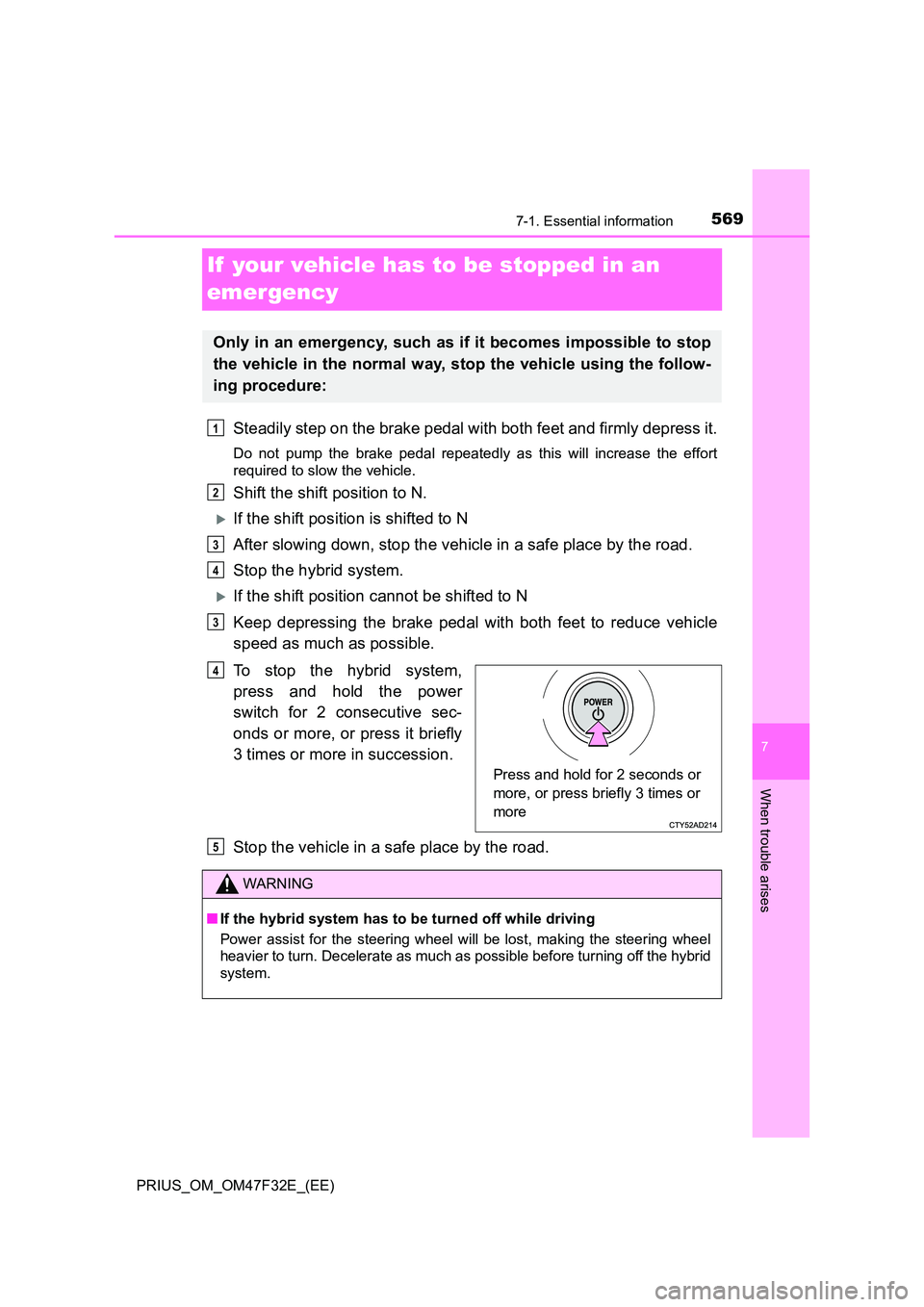
To stop the hybrid system,
press and hold the power
switch for 2 consecutive sec-
onds or more, or press it briefly
3 times or more in succession.
Stop the vehicle in a safe place by the road.
Only in an emergency, such as if it becomes impossible to stop
the vehicle in the normal way, stop the vehicle using the follow-
ing procedure:
1
2
3
4
3
Press and hold for 2 seconds or
more, or press briefly 3 times or
more
4
WARNING
■ If the hybrid system has to be turned off while driving
Power assist for the steering wheel will be lost, making the steering wheel
heavier to turn. Decelerate as much as possible before turning off the hybrid
system.
5
Page 576 of 770
5747-2. Steps to take in an emergency
PRIUS_OM_OM47F32E_(EE)
When using a flatbed truck to transport the vehicle, use tire strapping
belts. Refer to the owner’s manual of the flatbed truck for the tire
strapping method.
In order to suppress vehicle movement during transportation, set the
parking brake and turn the power switch off.
If a tow truck is not available in an emergency, your vehicle may be
temporarily towed using cables or chains secured to the emergency
towing eyelets. This should only be attempted on hard surfaced roads
for short distances at under 30 km/h (18 mph).
A driver must be in the vehicle to steer and operate the brakes. The
vehicle’s wheels, drive train, axles, steering and brakes must be in
good condition.
Using a flatbed truck
Emergency towing
Page 578 of 770
5767-2. Steps to take in an emergency
PRIUS_OM_OM47F32E_(EE)
Shift the shift position to N* and release the parking brake.
*: If the shift position cannot be changed or the current shift position can
not be confirmed, contact any authorized Toyota retailer or Toyota
authorized repairer, or any reliable repairer or commercial towing ser-
vice before towing.
■ While towing
If the hybrid system is off, the power assist for the brakes and steering will not
function, making steering and braking more difficult.
■ Wheel nut wrench
Wheel nut wrench is installed in luggage compartment. ( P. 600, 619)
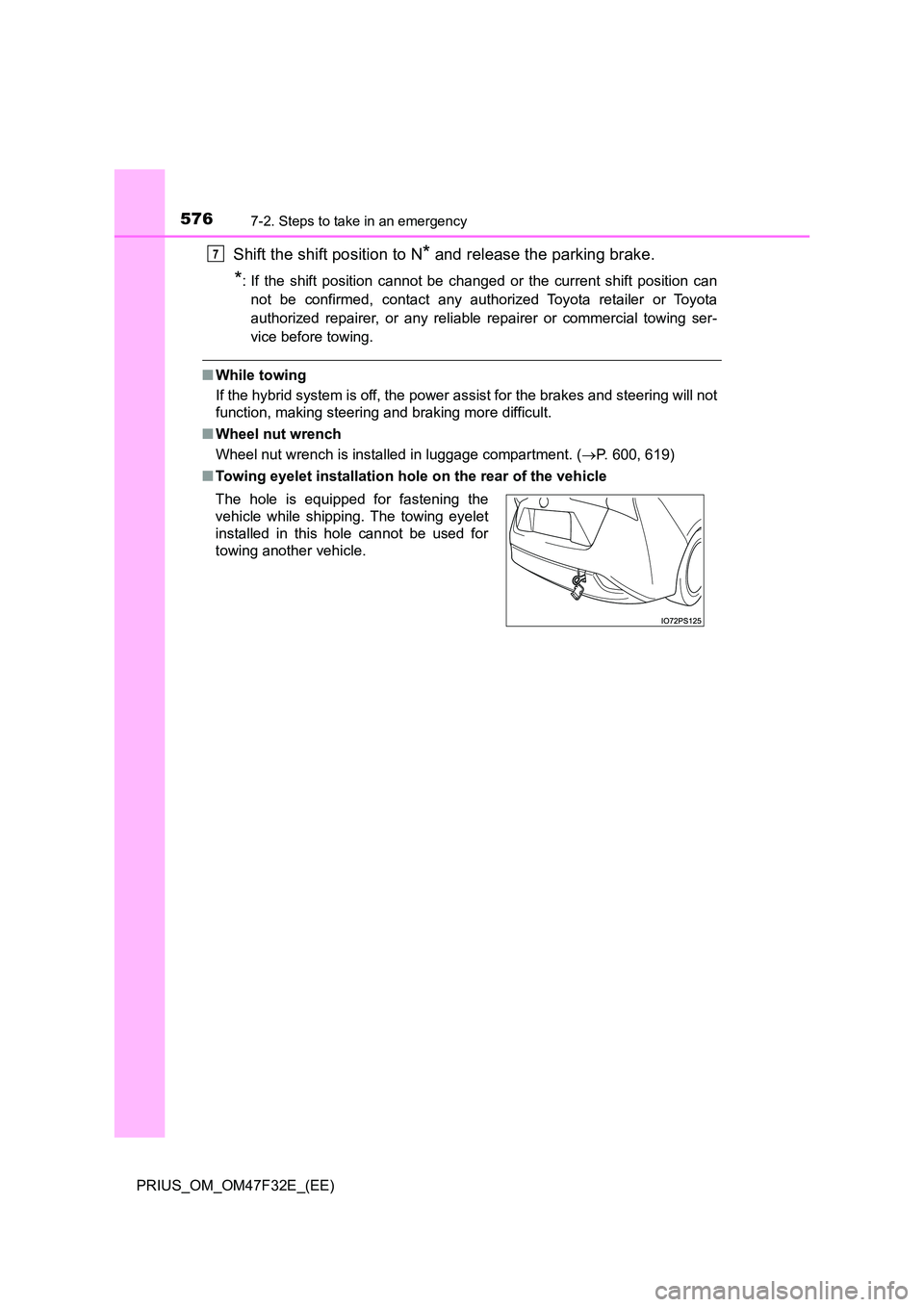
■ Towing eyelet installation hole on the rear of the vehicle
The hole is equipped for fastening the
vehicle while shipping. The towing eyelet
installed in this hole cannot be used for
towing another vehicle.
7
Page 583 of 770
5817-2. Steps to take in an emergency
PRIUS_OM_OM47F32E_(EE)
7
When trouble arises
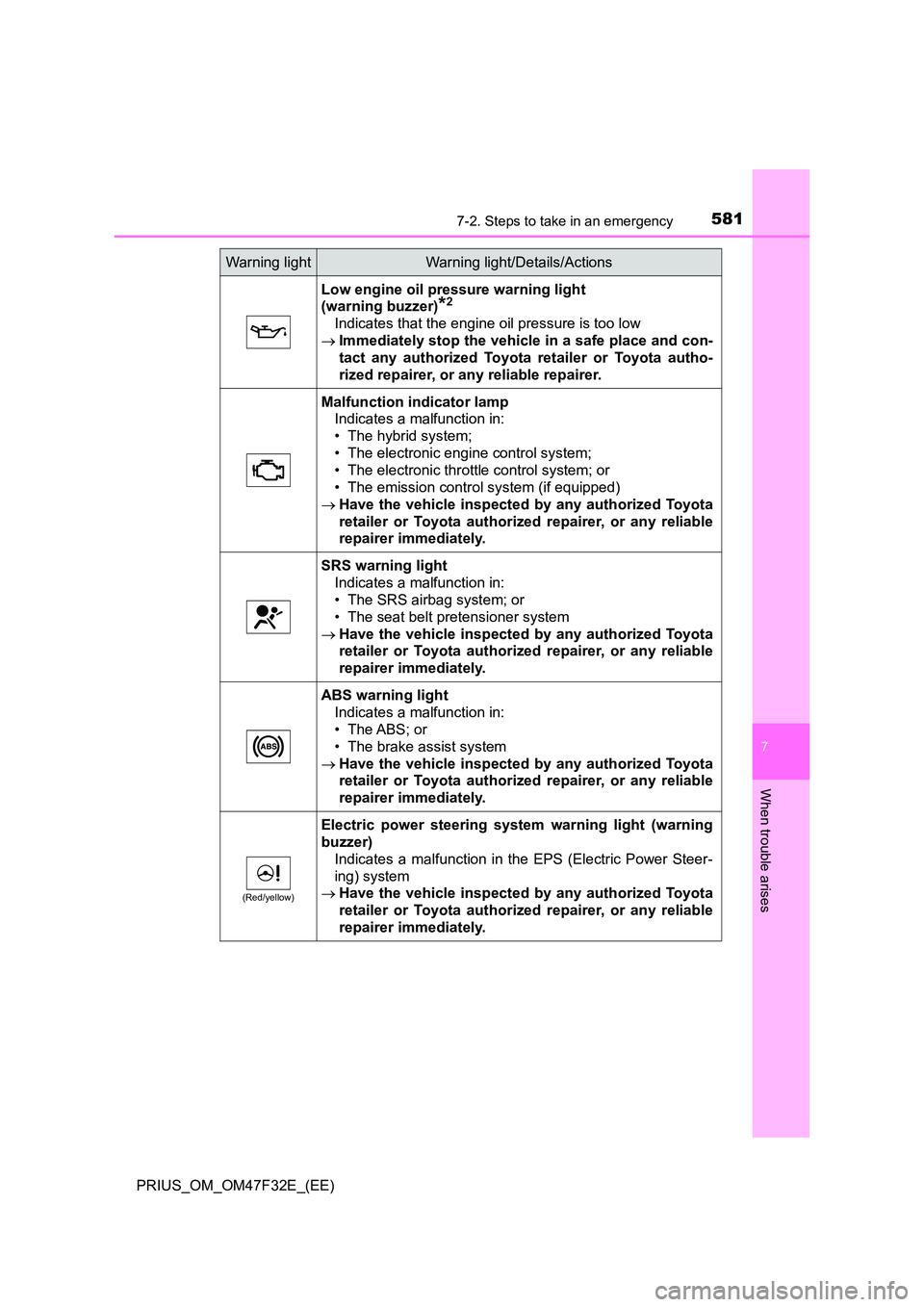
Low engine oil pressure warning light
(warning buzzer)*2
Indicates that the engine oil pressure is too low
Immediately stop the vehicle in a safe place and con-
tact any authorized Toyota retailer or Toyota autho-
rized repairer, or any reliable repairer.
Malfunction indicator lamp
Indicates a malfunction in:
• The hybrid system;
• The electronic engine control system;
• The electronic throttle control system; or
• The emission control system (if equipped)
Have the vehicle inspected by any authorized Toyota
retailer or Toyota authorized repairer, or any reliable
repairer immediately.
SRS warning light
Indicates a malfunction in:
• The SRS airbag system; or
• The seat belt pretensioner system
Have the vehicle inspected by any authorized Toyota
retailer or Toyota authorized repairer, or any reliable
repairer immediately.
ABS warning light
Indicates a malfunction in:
• The ABS; or
• The brake assist system
Have the vehicle inspected by any authorized Toyota
retailer or Toyota authorized repairer, or any reliable
repairer immediately.
(Red/yellow)
Electric power steering system warning light (warning
buzzer)
Indicates a malfunction in the EPS (Electric Power Steer-
ing) system
Have the vehicle inspected by any authorized Toyota
retailer or Toyota authorized repairer, or any reliable
repairer immediately.
Warning lightWarning light/Details/Actions
Page 588 of 770
5867-2. Steps to take in an emergency
PRIUS_OM_OM47F32E_(EE)
*5: Rear passengers’ seat belt warning buzzer:
The rear passengers’ seat belt warning buzzer sounds to alert the rear
passenger that his or her seat belt is not fastened. If the seat belt is unfas-
tened, the buzzer sounds intermittently for a certain period of time, after
the seat belt is fastened and unfastened and the vehicle reaches a certain
speed.
*6: This symbol is displayed on the multi-information display.
■ Front passenger detection sensor, seat belt reminder and warning
buzzer
● If luggage is placed on the front passenger seat, the front passenger detec-
tion sensor may cause the warning light to flash and the warning buzzer to
sound even if a passenger is not sitting in the seat.
● If a cushion is placed on the seat, the sensor may not detect a passenger,
and the warning light may not operate properly.
■ Electric power steering system warning light (warning buzzer)
When the 12-volt battery charge becomes insufficient or the voltage tempo-
rarily drops, the electric power steering system warning light may come on
and the warning buzzer may sound.
■ If the malfunction indicator lamp comes on while driving
For some models, the malfunction indicator lamp will come on if the fuel tank
becomes completely empty. If the fuel tank is empty, refuel the vehicle imme-
diately. The malfunction indicator lamp will go off after several trips.
If the malfunction indicator lamp does not go off, contact any authorized
Toyota retailer or Toyota authorized repai rer, or any reliable repairer as soon
as possible.
■ When the tire pressure warning light comes on (if equipped)
Inspect the appearance of the tire to check that the tire is not punctured.
If the tire is punctured: P. 598, 618
If the tire is not punctured:
Carry out the following procedure after the tire temperature has lowered suffi-
ciently.
● Check the tire inflation pressure and adjust to the appropriate level.
● If the warning light does not go out even after several minutes, check that
the tire inflation pressure is at the specified level and carry out initialization.
( P. 531)
The warning light may come on again if the above operations are conducted
without first allowing the tire temperature to lower sufficiently.
Page 590 of 770
5887-2. Steps to take in an emergency
PRIUS_OM_OM47F32E_(EE)
WARNING
■When the electric power steering system warning light comes on
When the light comes on yellow, the assist to the power steering is
restricted. When the light comes on red, the assist to the power steering is
lost and handling operations of the steering wheel become extremely
heavy. When steering wheel operations are heavier than usual, grip the
steering wheel firmly and operate it using more force than usual.
■ If the tire pressure warning light comes on (vehicles with the tire pres-
sure warning system)
Be sure to observe the following precautions. Failure to do so could cause a
loss of vehicle control and result in death or serious injury.
● Stop your vehicle in a safe place as soon as possible. Adjust the tire infla-
tion pressure immediately.
● Vehicles with emergency tire puncture repair kit: If the tire pressure warn-
ing light comes on even after tire inflat ion pressure adjustment, it is proba-
ble that you have a flat tire. Check the tire s. If a tire is flat, repair the flat tire
by using emergency tire puncture repair kit.
● Vehicles with spare tire: If the tire pressure warning light comes on even
after tire inflation pressure adjustment, it is probable that you have a flat
tire. Check the tires. If a tire is flat, change it with the spare tire and have
the flat tire repaired by the nearest any authorized Toyota retailer or Toyota
authorized repairer, or any reliable repairer.
● Avoid abrupt maneuvering and braking. If the vehicle tires deteriorate, you
could lose control of the steering wheel or the brakes.
■ If a blowout or sudden air leakage should occur (vehicles with the tire
pressure warning system)
The tire pressure warning system may not activate immediately.
NOTICE
■ To ensure the tire pressure warning system operates properly (vehi-
cles with the tire pressure warning system)
Do not install tires with different specif ications or makers, as the tire pres-
sure warning system may not operate properly.