tow TOYOTA PRIUS 2023 User Guide
[x] Cancel search | Manufacturer: TOYOTA, Model Year: 2023, Model line: PRIUS, Model: TOYOTA PRIUS 2023Pages: 770, PDF Size: 122.55 MB
Page 192 of 770
1903-2. Opening, closing and locking the doors
PRIUS_OM_OM47F32E_(EE)■Conditions affecting operation
The smart entry & start system, wireless remote control and immobilizer sys-
tem use weak radio waves. In the following situations, the communication
between the electronic key and the vehicle may be affected, preventing the
smart entry & start system, wireless remote control and immobilizer system
from operating properly. (Ways of coping: P. 636)
●When the electronic key battery is depleted
●Near a TV tower, electric power plant, gas station, radio station, large dis-
play, airport or other facility that generates strong radio waves or electrical
noise
●When the electronic key is in contact with, or is covered by the following
metallic objects
• Cards to which aluminum foil is attached
• Cigarette boxes that have aluminum foil inside
• Metallic wallets or bags
• Coins
• Hand warmers made of metal
• Media such as CDs and DVDs
●When other wireless key (that emit radio waves) is being used nearby
●When carrying the electronic key together with the following devices that
emit radio waves
• Portable radio, cellular phone, cordless phone or other wireless commu-
nication devices
• Another vehicle’s electronic key or a wireless key that emits radio waves
• Personal computers or personal digital assistants (PDAs)
• Digital audio players
• Portable game systems
●If window tint with a metallic content or metallic objects are attached to the
rear window
●When the electronic key is placed near a battery charger or electronic
devices
Page 198 of 770
1963-3. Adjusting the seats
PRIUS_OM_OM47F32E_(EE)
Rear seats
Park the vehicle in a safe place.
Apply the parking brake firmly (P. 260) and shift the shift position to P.
(P. 254)
Adjust the position of the front seat and the angle of the seatback.
(
P. 194)
Depending on the position of the front seat, if the seatback is folded back-
ward, it may interfere with the operation of the rear seat.
Lower the head restraint of the rear seat. (P. 199)
Stow the armrest of the rear seat if it is pulled out. (P. 493)
This step is not necessary when operating the left side seat only.
The seatbacks can be folded down.
Before folding down the seatbacks
1
2
3
4
Page 203 of 770
2013-3. Adjusting the seats
3
Operation of each component
PRIUS_OM_OM47F32E_(EE)
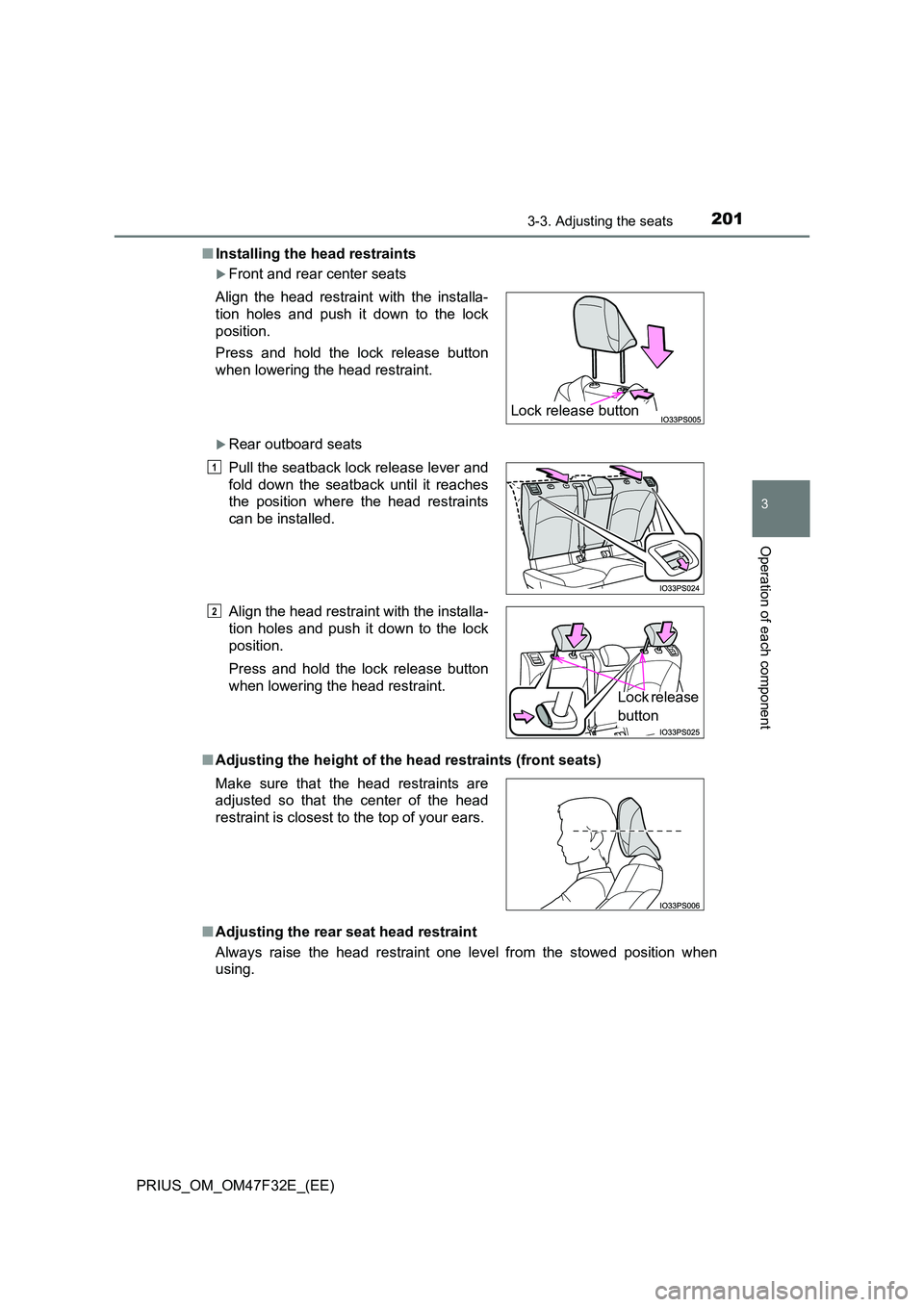
■ Installing the head restraints
Front and rear center seats
Rear outboard seats
■ Adjusting the height of the head restraints (front seats)
■ Adjusting the rear seat head restraint
Always raise the head restraint one level from the stowed position when
using.
Align the head restraint with the installa-
tion holes and push it down to the lock
position.
Press and hold the lock release button
when lowering the head restraint.
Pull the seatback lock release lever and
fold down the seatback until it reaches
the position where the head restraints
can be installed.
Align the head restraint with the installa-
tion holes and push it down to the lock
position.
Press and hold the lock release button
when lowering the head restraint.
Make sure that the head restraints are
adjusted so that the center of the head
restraint is closest to the top of your ears.
Lock release button
1
2
Lock release
button
Page 210 of 770
2083-4. Adjusting the steering wheel and mirrors
PRIUS_OM_OM47F32E_(EE)
■Mirror angle can be adjusted when
The power switch is in ACCESSORY or ON mode.
■When the mirrors are fogged up
The outside rear view mirrors can be cleared using the mirror defoggers. Turn
on the rear window defogger to turn on the outside rear view mirror defog-
gers. (P. 463)
■Using automatic mode in cold weather
When automatic mode is used in cold weather, the door mirror could freeze
up and automatic stowing and return may not be possible. In this event,
remove any ice and snow from the door mirror, then either operate the mirror
using manual mode or move the mirror by hand.
■Customization
The automatic mirror folding and extending operation can be changed.
(Customizable features: P. 670)
Page 221 of 770
219
4Driving
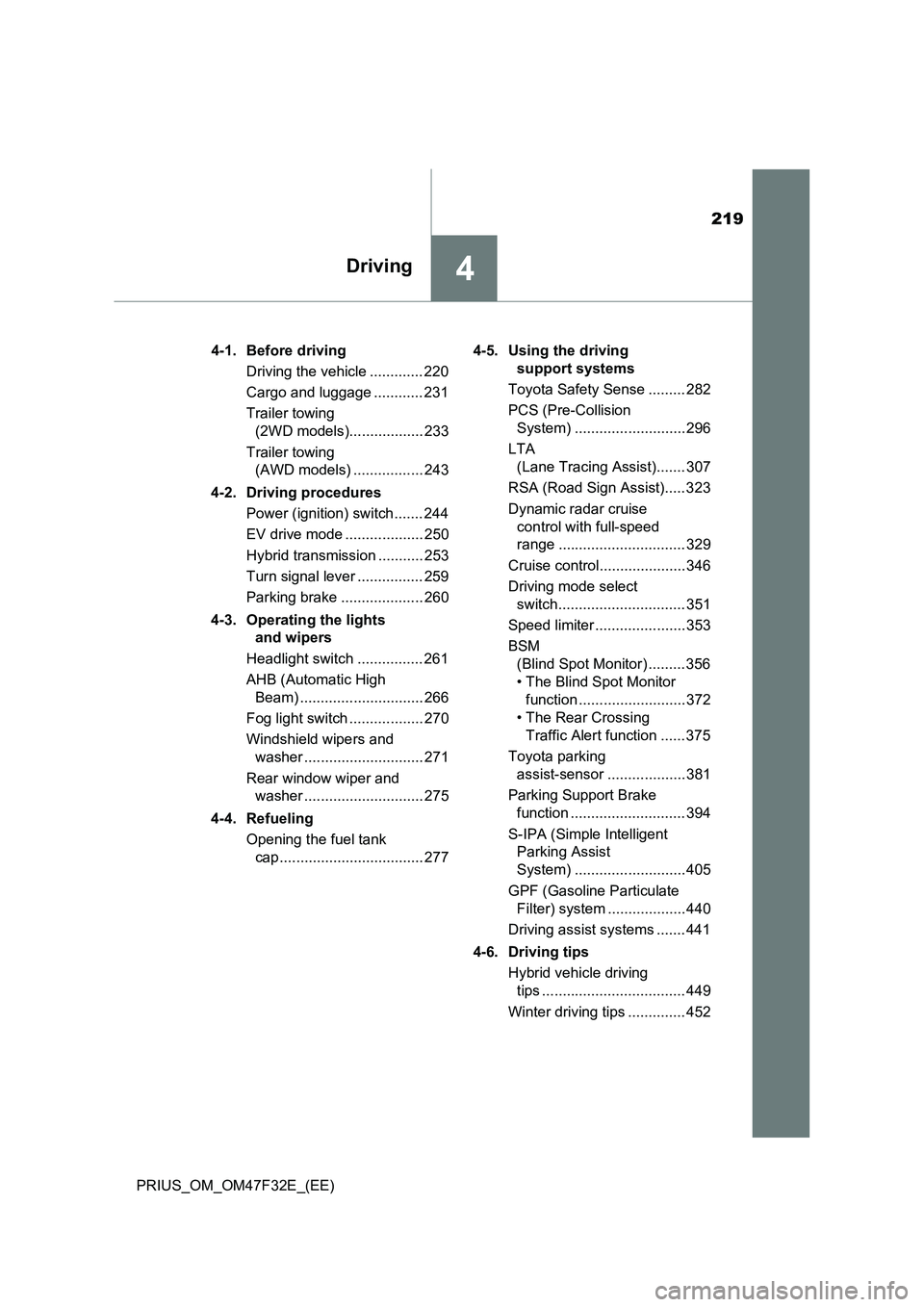
PRIUS_OM_OM47F32E_(EE)4-1. Before driving
Driving the vehicle ............. 220
Cargo and luggage ............ 231
Trailer towing
(2WD models).................. 233
Trailer towing
(AWD models) ................. 243
4-2. Driving procedures
Power (ignition) switch ....... 244
EV drive mode ................... 250
Hybrid transmission ........... 253
Turn signal lever ................ 259
Parking brake .................... 260
4-3. Operating the lights
and wipers
Headlight switch ................ 261
AHB (Automatic High
Beam) .............................. 266
Fog light switch .................. 270
Windshield wipers and
washer ............................. 271
Rear window wiper and
washer ............................. 275
4-4. Refueling
Opening the fuel tank
cap ................................... 2774-5. Using the driving
support systems
Toyota Safety Sense ......... 282
PCS (Pre-Collision
System) ........................... 296
LTA
(Lane Tracing Assist)....... 307
RSA (Road Sign Assist)..... 323
Dynamic radar cruise
control with full-speed
range ............................... 329
Cruise control..................... 346
Driving mode select
switch............................... 351
Speed limiter ...................... 353
BSM
(Blind Spot Monitor) ......... 356
• The Blind Spot Monitor
function .......................... 372
• The Rear Crossing
Traffic Alert function ...... 375
Toyota parking
assist-sensor ................... 381
Parking Support Brake
function ............................ 394
S-IPA (Simple Intelligent
Parking Assist
System) ........................... 405
GPF (Gasoline Particulate
Filter) system ................... 440
Driving assist systems ....... 441
4-6. Driving tips
Hybrid vehicle driving
tips ................................... 449
Winter driving tips .............. 452
Page 224 of 770
2224-1. Before driving
PRIUS_OM_OM47F32E_(EE)■“ECO Accelerator Guidance” (P. 133)
It is easier to drive in an Eco-friendly manner by driving while referring to the
“ECO Accelerator Guidance” display. Also, by using the “ECO Accelerator
Guidance”, it is easier to increase the Eco score evaluation.
●When starting off:
While staying within the “ECO Accelerator Guidance” range, gradually
depress the accelerator pedal and accelerate to the desired speed. If exces-
sive acceleration is avoided, the “Eco-Start” score will increase.
●When driving:
After accelerating to the desired speed, release the accelerator pedal and
drive at a stable speed within the “ECO Accelerator Guidance” range. By
keeping the vehicle within the “ECO Accelerator Guidance” range, the “Eco-
Cruise” score will increase.
●When stopping:
When stopping the vehicle, early releasing the accelerator pedal will cause
the “Eco-Stop” score to increase.
■Drive-Start Control (DSC)
When the TRC is turned off (P. 443), sudden start restraint control also
does not operate. If your vehicle have trouble escaping from the mud or fresh
snow due to sudden start restraint control operation, deactivate TRC
(P. 443) so that the vehicle may become able to escape from the mud or
fresh snow.
■Breaking in your new Toyota
To extend the life of the vehicle, observing the following precautions is recom-
mended:
●For the first 300 km (200 miles):
Avoid sudden stops.
●For the first 800 km (500 miles):
Do not tow a trailer.
●For the first 1600 km (1000 miles):
• Do not drive at extremely high speeds.
• Avoid sudden acceleration.
• Do not drive at a constant speed for extended periods.
■Operating your vehicle in a foreign country
Comply with the relevant vehicle registration laws and confirm the availability
of the correct fuel. (P. 657)
Page 232 of 770
2304-1. Before driving
PRIUS_OM_OM47F32E_(EE)
NOTICE
■When encountering flooded roads
Do not drive on a road that has flooded after heavy rain etc. Doing so may
cause the following serious damage to the vehicle:
● Engine stalling
● Short in electrical components
● Engine damage caused by water immersion
In the event that you drive on a flooded road and the vehicle is flooded, be
sure to have any authorized Toyota retailer or Toyota authorized repairer, or
any reliable repairer check the following:
● Brake function
● Changes in quantity and quality of oil and fluid used for the engine, hybrid
transmission, etc.
● Lubricant condition for the bearings and suspension joints (where possi-
ble), and the function of all joints, bearings, etc.
If the shift control system is damaged by flooding, it may not be possible to
shift the shift position to P, or from P to other positions. When the shift posi-
tion cannot be changed from P to any other position, the front wheels will
lock, and you will be unable to tow the vehicle with the front wheels on the
ground. In this case, transport the vehicle with both front wheels or all four
wheels lifted. ( P. 572)
Page 233 of 770
231
4
4-1. Before driving
Driving
PRIUS_OM_OM47F32E_(EE)
Cargo and luggage
Take notice of the following information about storage precau-
tions, cargo capacity and load.
WARNING
■ Things that must not be carried in the luggage compartment
The following things may cause a fire if loaded in the luggage compartment:
● Receptacles containing gasoline
● Aerosol cans
■ Storage precautions
Observe the following precautions.
Failure to do so may prevent t he pedals from being depressed properly,
may block the driver’s vision, or may re sult in items hitting the driver or pas-
sengers, possibly causing an accident.
● Stow cargo and luggage in the luggage compartment whenever possible.
● Do not stack cargo and luggage in the luggage compartment higher than
the seatbacks.
● When you fold down the rear seats, long items should not be placed
directly behind the front seats.
● Never allow anyone to ride in the luggage compartment. It is not designed
for passengers. They should ride in their seats with their seat belts prop-
erly fastened.
● Do not place cargo or luggage in or on the following locations.
• At the feet of the driver
• On the front passenger or rear seats (when stacking items)
• On the luggage cover
• On the instrument panel
• On the dashboard
● Secure all items in the occupant compartment.
Page 235 of 770
233
4
4-1. Before driving
Driving
PRIUS_OM_OM47F32E_(EE)
Trailer towing (2WD models)
For Russia, Bosnia and Herzegovina, Madeira, New Caledonia,
Saint Martin, Guadeloupe, Martinique and Israel
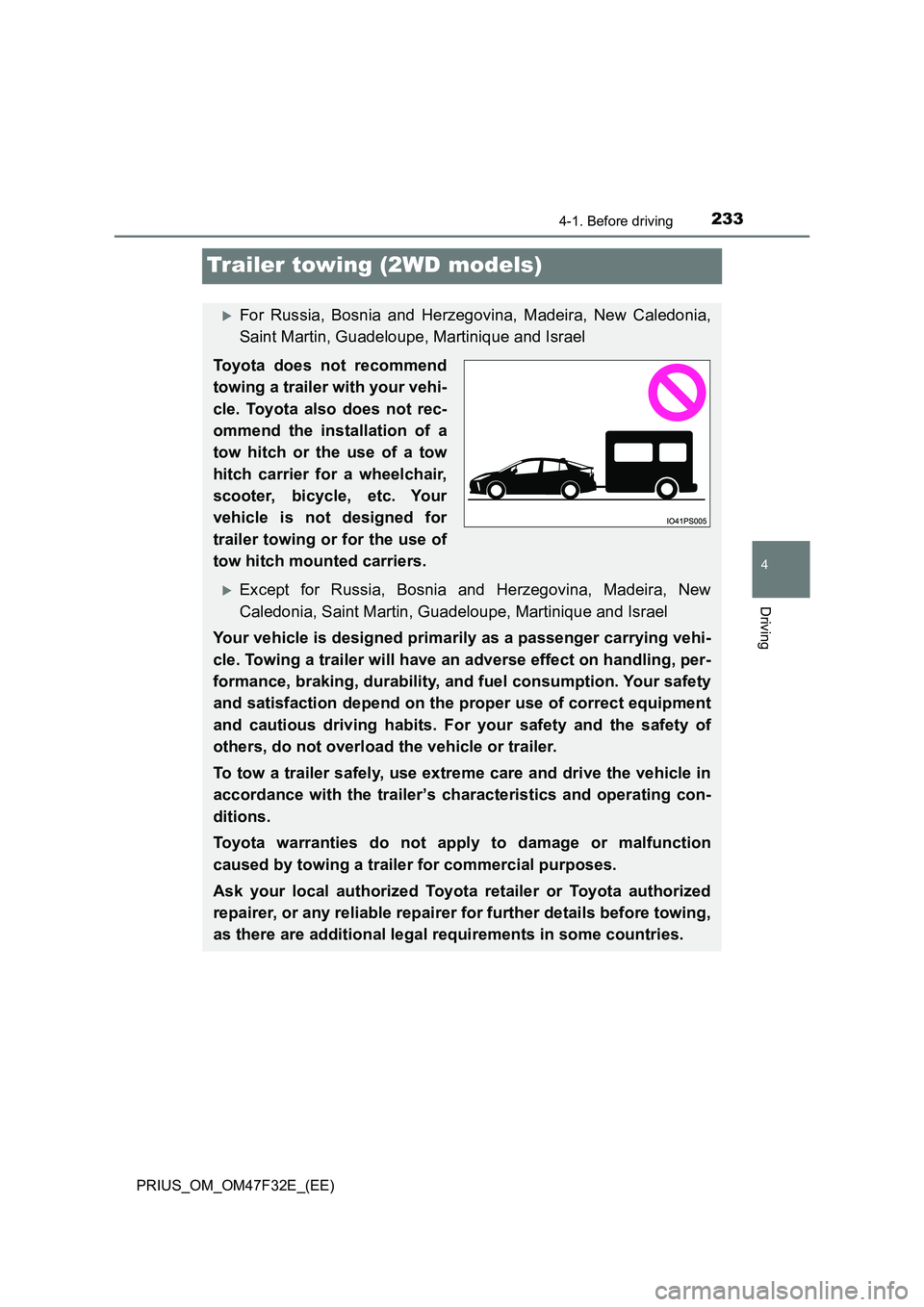
Toyota does not recommend
towing a trailer with your vehi-
cle. Toyota also does not rec-
ommend the installation of a
tow hitch or the use of a tow
hitch carrier for a wheelchair,
scooter, bicycle, etc. Your
vehicle is not designed for
trailer towing or for the use of
tow hitch mounted carriers.
Except for Russia, Bosnia and Herzegovina, Madeira, New
Caledonia, Saint Martin, Guadeloupe, Martinique and Israel
Your vehicle is designed primarily as a passenger carrying vehi-
cle. Towing a trailer will have an adverse effect on handling, per-
formance, braking, durability, and fuel consumption. Your safety
and satisfaction depend on the proper use of correct equipment
and cautious driving habits. For your safety and the safety of
others, do not overload the vehicle or trailer.
To tow a trailer safely, use extreme care and drive the vehicle in
accordance with the trailer’s characteristics and operating con-
ditions.
Toyota warranties do not apply to damage or malfunction
caused by towing a trailer for commercial purposes.
Ask your local authorized Toyota retailer or Toyota authorized
repairer, or any reliable repairer for further details before towing,
as there are additional legal requirements in some countries.
Page 236 of 770
2344-1. Before driving
PRIUS_OM_OM47F32E_(EE)
◆Weight limits
Check the allowable towing capacity, GVM (Gross Vehicle Mass),
MPAC (Maximum Permissible Axle Capacity), and permissible
drawbar load before towing. (P. 654)
◆Towing hitch/bracket
Toyota recommends the use of the Toyota hitch/bracket for your
vehicle. Other products of a suitable nature and comparable quality
may also be used.
For vehicles where the towing device blocks any of the lights or
license plate, the following shall be observed:
●Do not use towing devices that cannot be easily removed or
repositioned.
●Towing devices must be removed or repositioned when not in
use.
Please consult at any authorized dealer or repairer, or another duly
qualified and equipped professional when installing trailer lights, as
incorrect installation may cause damage to the vehicle’s lights. Please
take care to comply with your state’s laws when installing trailer lights.
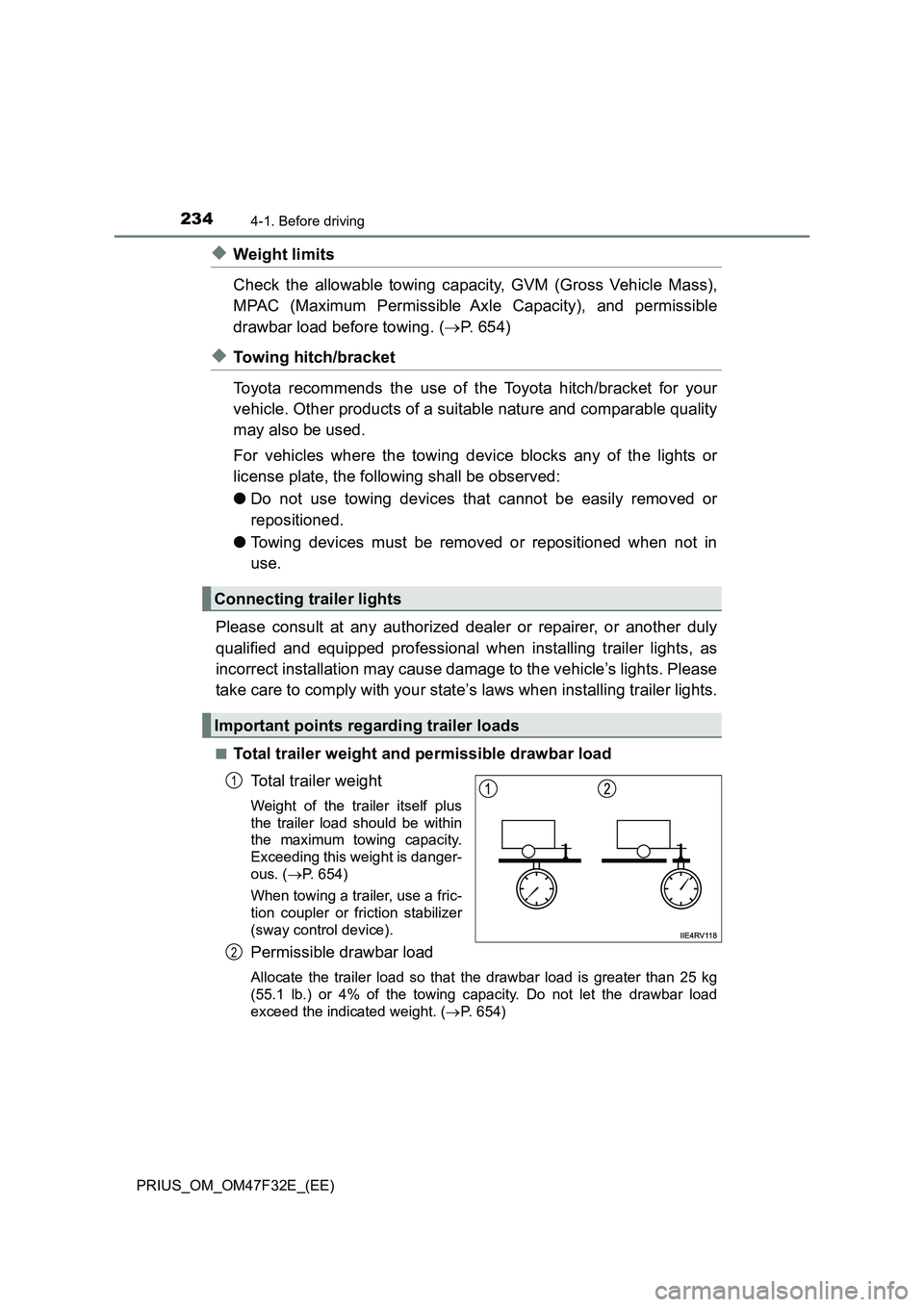
■Total trailer weight and permissible drawbar load
Total trailer weight
Weight of the trailer itself plus
the trailer load should be within
the maximum towing capacity.
Exceeding this weight is danger-
ous. (P. 654)
When towing a trailer, use a fric-
tion coupler or friction stabilizer
(sway control device).
Permissible drawbar load
Allocate the trailer load so that the drawbar load is greater than 25 kg
(55.1 lb.) or 4% of the towing capacity. Do not let the drawbar load
exceed the indicated weight. (P. 654)
Connecting trailer lights
Important points regarding trailer loads
1
2