charging TOYOTA PRIUS PRIME 2017 2.G User Guide
[x] Cancel search | Manufacturer: TOYOTA, Model Year: 2017, Model line: PRIUS PRIME, Model: TOYOTA PRIUS PRIME 2017 2.GPages: 784, PDF Size: 14.98 MB
Page 85 of 784
PRIUS PRIME_OM_OM47A88U_(U)
852-1. Plug-in hybrid system
2
Plug-in hybrid system
■When braking (regenerative braking)
The electric motor (traction motor) charges the hybrid battery (trac-
tion battery).
The EV driving range can be extend ed by actively using this regen-
erative braking to store electricity in the hybrid battery (traction bat-
tery).
Moreover, as fuel consumption is also reduced when in HV mode,
the regenerative braking system can be used effectively.
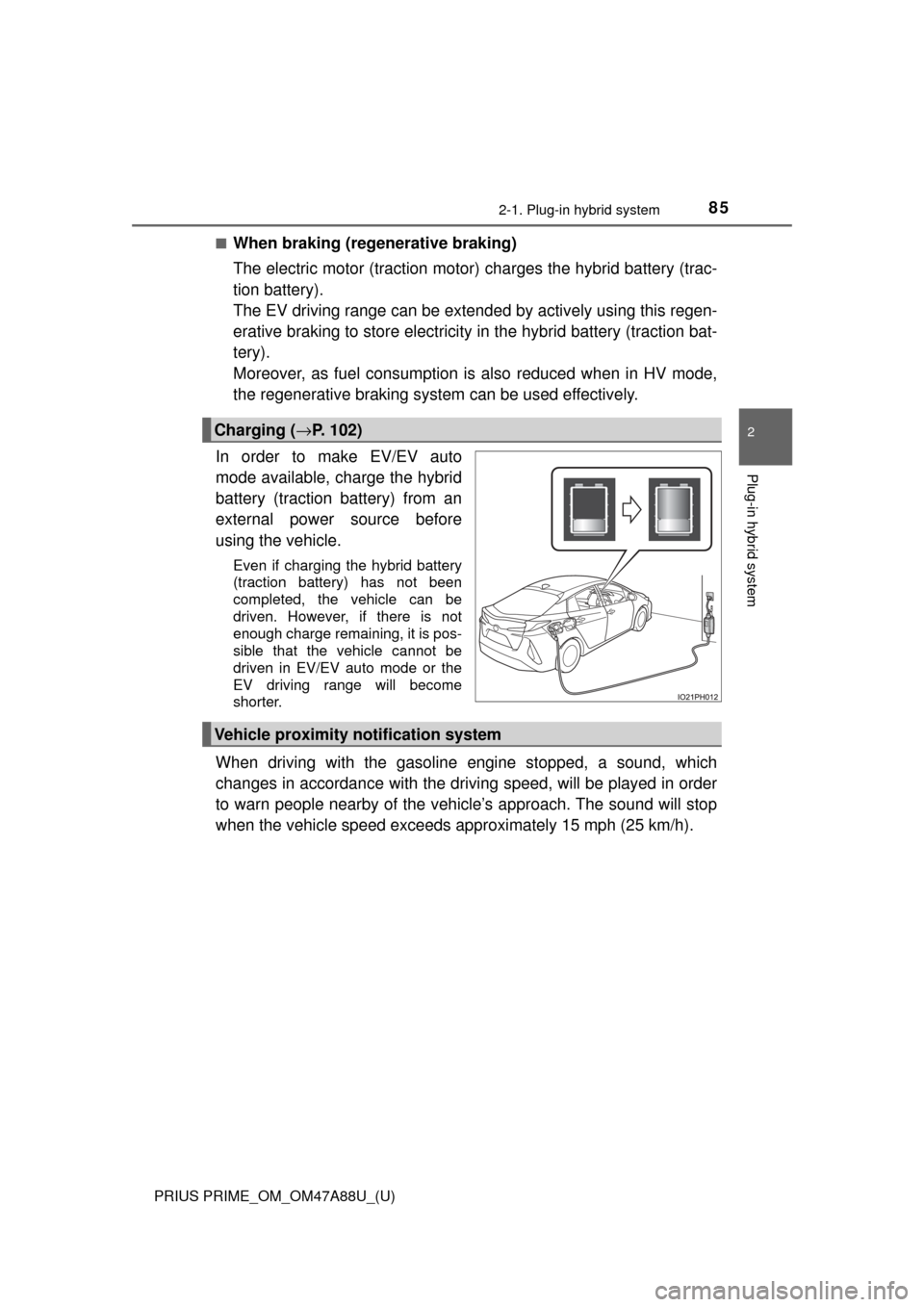
In order to make EV/EV auto
mode available, charge the hybrid
battery (traction battery) from an
external power source before
using the vehicle.
Even if charging the hybrid battery
(traction battery) has not been
completed, the vehicle can be
driven. However, if there is not
enough charge remaining, it is pos-
sible that the vehicle cannot be
driven in EV/EV auto mode or the
EV driving range will become
shorter.
When driving with the gasoline engine stopped, a sound, which
changes in accordance with the driving speed, will be played in order
to warn people nearby of the vehi cle’s approach. The sound will stop
when the vehicle speed exceeds approximately 15 mph (25 km/h).
Charging (→P. 102)
Vehicle proximity notification system
Page 86 of 784

86
PRIUS PRIME_OM_OM47A88U_(U)
2-1. Plug-in hybrid system
■Regenerative braking
In the following situations, kinetic energy is converted to electric energy and
deceleration force can be obtained in conjunction with the recharging of the
hybrid battery (traction battery).
●The accelerator pedal is released while driving with the shift position in D or
B.
● The brake pedal is depressed while driving with the shift position in D or \
B.
■ EV driving range
●The EV driving range is displayed on the multi-information display etc.
(→P. 199, 215, 222, 239)
● The EV driving range changes in accordance with the charge status of the
hybrid battery (traction battery), the speed of the vehicle, etc.
● Even if there is enough charge remaining in the hybrid battery (traction bat-
tery), EV driving may be canceled and both gasoline engine and electric
motor are used depending on the situation. ( →P. 87)
■ After EV mode has switched to HV mo de due to low hybrid battery (trac-
tion battery) charge
If the hybrid battery (traction battery) is regenerated by driving continuously
down a long slope, the EV driving range etc. will be displayed on the multi-
information display and EV mode will be automatically switched to.
If EV mode is not switched to even though EV driving range is being dis-
played, EV mode can be switched to by pressing the EV/HV mode selection
switch.
■ Refilling fuel
Plug-in hybrid vehicles can be driven using electricity charged from an exter-
nal power source. However, as the gasoline engine is used depending on the
situation even if in EV mode, and the gasoline engine is provided on board as
a power source for driving in HV mode, it is needed to refueling the vehicle.
Check the fuel amount and refill immediately when the fuel level becomes
low. ( →P. 356)
Page 87 of 784

PRIUS PRIME_OM_OM47A88U_(U)
872-1. Plug-in hybrid system
2
Plug-in hybrid system
■Gasoline engine operatio n in EV/EV auto mode
Even if there is a sufficient amount of electricity remaining in the hybrid bat-
tery (traction battery) and EV driving range ( →P. 199, 215, 222, 239) is being
displayed on the multi-information display etc., EV driving (driving using only
the electric motor) may be canceled and both gasoline engine and electric
motor are used depending on the situat ion (EV driving will be returned to
automatically after EV driving becomes possible again).
EV driving may be canceled automatically in the following circumstances:
● When vehicle speed is more than approximately 84 mph (135 km/h).
● When power is needed temporarily, for example when the accelerator pedal
is depressed firmly or when accelerating suddenly.
*
●When the temperature of the hybrid system is high.
The vehicle has been left in the sun, driven on a hill, driven at high speeds,
etc.
● When the temperature of the hybrid system is low.
● When the heater is switched on when the outside temperature is below
about 14°F (-10°C).
● When the windshield defogger switch is pressed. ( →P. 491, 501)
● When the system determines that the gasoline engine needs to be started.\
The gasoline engine may also operate in circumstances other than those
listed above, depending on conditions.
*: When traveling in the EV auto mode only
■ Conditions in which the gasoline engine may not stop
The gasoline engine starts and stops automatically. However, it may not stop
automatically in the following conditions
*:
● During gasoline engine warm-up
● During hybrid battery (traction battery) charging
● When the temperature of the hybrid battery (traction battery) is high or low
● When the windshield defogger switch is pressed. ( →P. 491, 501)
*: Depending on the circumstances, the gasoline engine may also not stop
automatically in situations other than those above.
Page 88 of 784

88
PRIUS PRIME_OM_OM47A88U_(U)
2-1. Plug-in hybrid system
■If the vehicle is not used for a long time
●The 12-volt battery may discharge. In this event, charge the 12-volt battery.
(→P. 587)
In order to prevent the hybrid battery (traction battery) from becoming
extremely low in charge, charge the hybrid battery (traction battery) from
external power source or start the hybrid system at least once every 2 or 3
months, and turn the power switch off after the gasoline engine has
stopped automatically. (If the gasoline engine does not start up even after
approximately 10 seconds have passed since the “READY” indicator came
on, the power switch can be turned to off without any further action.)
● When the vehicle is left with the charging cable connected, the electricity
consumption amount of the 12-volt battery increases due to controls, suc\
h
as the system checking, operating. When the charging cable is not needed,
immediately remove it from the vehicle.
■ Sounds and vibrations specific to a hybrid vehicle
There may be no engine sound or vibration even though the vehicle is able to
move with the “READY” indicator is illuminated. For safety, apply the parking
brake and make sure to shift the shift position to P when parked.
The following sounds or vibrations may occur when the hybrid system is
operating and are not a malfunction.
●Motor sounds may be heard from the engine compartment.
● Sounds may be heard from the hybrid battery (traction battery) when the
hybrid system starts or stops.
● Relay operating sounds such as a snap or soft clank will be emitted from the
hybrid battery (traction battery), behind the rear seats, when the hybrid sys-
tem is started or stopped.
● Sounds from the hybrid system may be heard when the back door is open.
● Sounds may be heard from the transmission when the gasoline engine
starts or stops, when driving at low speeds, or during idling.
● Engine sounds may be heard when accelerating sharply.
● Sounds may be heard due to regenerative braking when the brake pedal is
depressed or as the accelerator pedal is released.
● Vibration may be felt when the gasoline engine starts or stops.
● Cooling fan sounds may be heard from the air intake vent. ( →P. 91)
■ Vehicle proximity notification system
In the following cases, the vehicle proximity notification system may be diffi-
cult for surrounding people to hear.
●In very noisy areas
● In the wind or the rain
Also, as the vehicle proximity notification system is installed on the front of
the vehicle, it may be more difficult to hear from the rear of the vehicle com-
pared to the front.
Page 90 of 784
90
PRIUS PRIME_OM_OM47A88U_(U)
2-1. Plug-in hybrid system
Plug-in hybrid system precautions
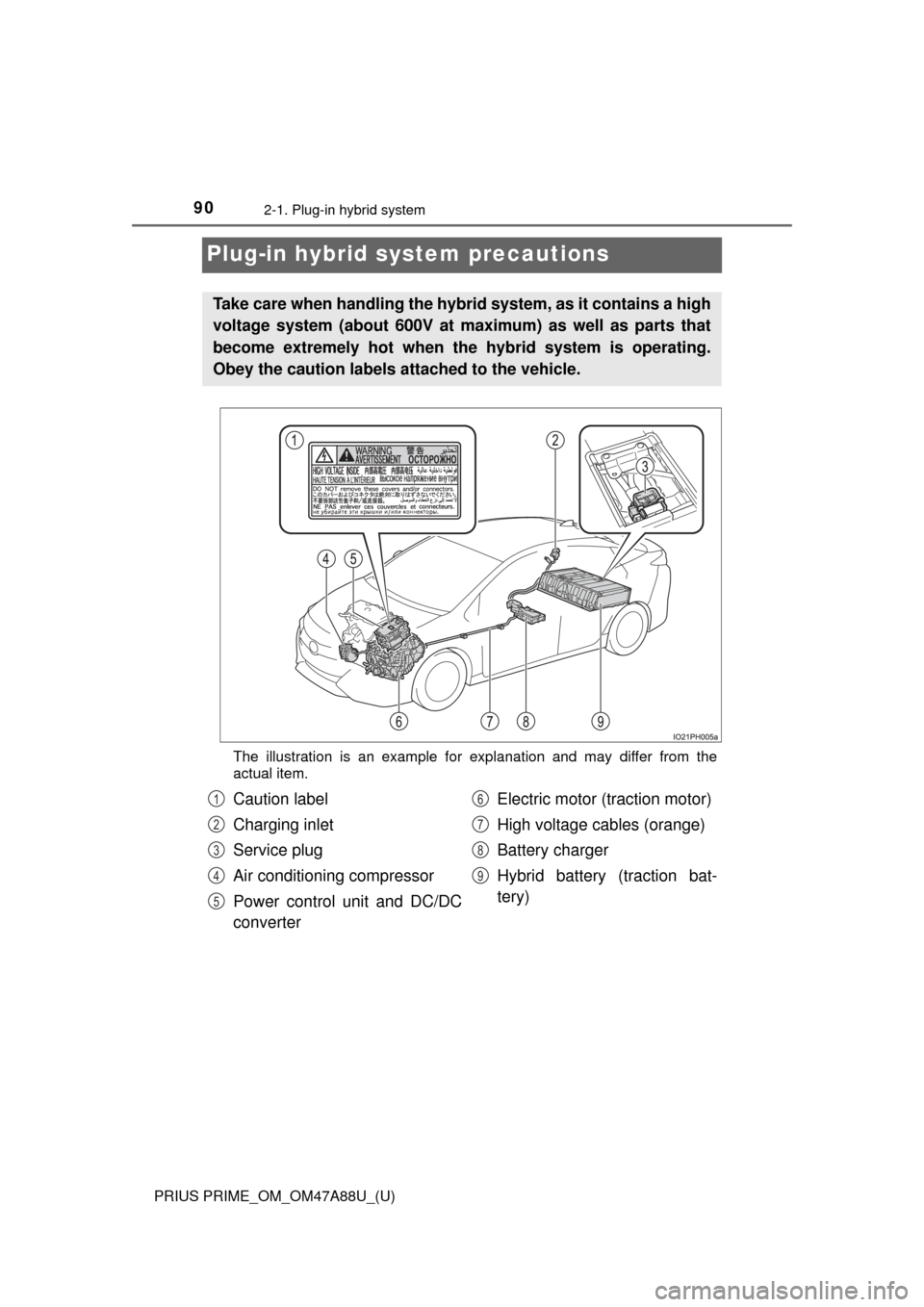
The illustration is an example for explanation and may differ from the
actual item.
Take care when handling the hybrid system, as it contains a high
voltage system (about 600V at maximum) as well as parts that
become extremely hot when the hybrid system is operating.
Obey the caution labels attached to the vehicle.
Caution label
Charging inlet
Service plug
Air conditioning compressor
Power control unit and DC/DC
converter Electric motor (traction motor)
High voltage cables (orange)
Battery charger
Hybrid battery (traction bat-
tery)1
2
3
4
5
6
7
8
9
Page 98 of 784

98
PRIUS PRIME_OM_OM47A88U_(U)
2-1. Plug-in hybrid system
◆Accelerator pedal/brake pedal operation
●Drive your vehicle smoothly. Avoid abrupt acceleration and
deceleration. Gradual accelerati on and deceleration will make
more effective use of the electric motor (traction motor) without
having to use gasoline engine power.
● Avoid repeated acceleration. Repeated acceleration consumes
hybrid battery (traction battery) power, resulting in poor fuel con-
sumption. Battery power can be restored by driving with the
accelerator pedal slightly released.
◆When braking
Make sure to operate the brakes gently and a timely manner. A
greater amount of electrical energy can be regenerated when slow-
ing down.
◆Delays
Repeated acceleration and deceleration, as well as long waits at
traffic lights, will lead to high fuel and electricity consumption.
Check traffic reports before leav ing and avoid delays as much as
possible. When driving in a traffi c jam, gently release the brake
pedal to allow the vehicle to move forward slightly while avoiding
overuse of the accelerator pedal. Doing so can help control exces-
sive electricity and fuel consumption.
◆Highway driving
● Control and maintain the vehicl e at a constant speed. Before
stopping at a toll booth or similar, allow plenty of time to release
the accelerator and gently apply the brakes. A greater amount of
electrical energy can be regenerated when slowing down.
● Electricity consumption will increa se significantly when driving at
high speeds in EV mode. If there will be a long distance to the
next external charging point after leaving a freeway, it is recom-
mended to drive in HV mode while on the freeway and change to
EV mode after leaving the freeway.
Page 99 of 784

PRIUS PRIME_OM_OM47A88U_(U)
992-1. Plug-in hybrid system
2
Plug-in hybrid system
◆Air conditioning
●Turn the “A/C” switch (
*1 • *2) off when it is
not needed. Doing so can help r educe excessive electricity and
fuel consumption.
In summer: When the ambient temperature is high, use the recir-
culated air mode. Doing so will he lp to reduce the burden on the
air conditioning system and reduc e electricity and fuel consump-
tion as well.
In winter: Avoid excessive and unn ecessary use of the heater.
Usage of the heated steering wheel (if equipped) and seat heat-
ers is effective. ( →P. 513)
● Using the Remote Air Conditioning System (→P. 509) while the
charging cable is connected to th e vehicle can reduce electricity
consumption immediately after starting off by operating air condi-
tioning mainly using electricity from an external power source.
● When setting the timer, selecting the start time setting mode and
setting “Climate Prep” to “On” can reduce electricity consumption
immediately after starting off by operating air conditioning before
charging is completed. ( →P. 147)
*1: Vehicles with 7-inch display
*2: Vehicles with 11.6-inch display
◆Checking tire inflation pressure
Make sure to check the tire infl ation pressure frequently. If there is
improper tire inflation pressure in the tires, the EV driving range will
become shorter, and fuel c onsumption when in HV mode will
increase.
Also, as snow tires can cause larg e amounts of friction, their use on
dry roads can lead to increased fuel and electricity consumption.
◆Luggage
Carrying heavy luggage will lead to poor fuel economy. Avoid carry-
ing unnecessary luggage. Installing a large roof rack will also cause
poor fuel economy.
◆Warming up before driving
Since the gasoline engine starts up and cuts out automatically,
warming up is not necessary.
Page 100 of 784
100
PRIUS PRIME_OM_OM47A88U_(U)
2-1. Plug-in hybrid system
EV driving range
The value displayed on the multi-information display etc. (→P. 199,
215, 222, 239) is estimated from the following information.
● The amount of hybrid battery (traction battery) charge currently
remaining
● The electricity consumption (the estimated distance that can be
driven in EV mode per unit of electrical energy) based on the
recorded value
● Past air conditioning system electricity consumption amount
The electricity consum ption varies depending on how the vehicle is
driven. The vehicle automatically re cords the electricity consumption
when being charged and uses the el ectricity consumption for estimat-
ing the EV driving range. Therefor e, the EV driving range displayed
when the hybrid battery (traction ba ttery) is fully charged may differ
from the previous EV driving range depending on how the vehicle was
driven.
The EV driving range may change si gnificantly with each charging
until the electricity consumption based on the recorded value is stable
(for approximately the fi rst month or two). However, this does not indi-
cate a malfunction.
When the air conditioning system is turned on, the EV driving range
(with using the air conditioning syst em) is estimated based on the past
air conditioning electricity consumption amount considering that the
electricity consumpt ion may become higher.
The EV driving range displayed on the multi-information display
etc. shows the reference distance that EV driving (driving using
only the electric motor) is possible, and the actual distance that
can be driven may differ from that displayed.
Even if the EV driving range is displayed, EV driving may be can-
celed and both gasoline engine and electric motor are used depend-
ing on the situation. ( →P. 8 7 )
Displayed value
Page 101 of 784
PRIUS PRIME_OM_OM47A88U_(U)
1012-1. Plug-in hybrid system
2
Plug-in hybrid system
The distance that can be driven in EV mode varies significantly
depending on how the vehicle is driven, road conditions, the weather,
the outside temperature, usage cond itions of electrical components
and the number of occupants.
The distance that can be driven in EV mode can be extended if the fol-
lowing is performed:
● Maintain a safe distance from the vehicle in front and avoid unnec-
essary acceleration and deceleration
● Accelerate and decelerate the v ehicle as smoothly as possible
● Drive at moderate speeds as much as possible and maintain a con-
stant speed
● Set the air conditioning to a moderate temperature and turn the “A/C”
switch (
*1 • *2) off when it is not needed
● Use tires of the specified size and maintain the specified tire pres-
sure
● Use the EV/HV mode selection switch to drive in HV mode when
driving on a highway
Electricity consumption will increa se substantially when driving on a
highway in EV mode.
● Do not add unnecessary weight to the vehicle
*1: Vehicles with 7-inch display
*2: Vehicles with 11.6-inch display
The following indicate that charging has been carried out properly.
●The charging indicator turns off
● The Hybrid battery (traction battery ) status indicators illuminate for
approximately 15 seconds. ( →P. 104)
● “Charging Complete” is displayed on the multi-information display
when starting off ( →P. 130)
Regardless of the type of power source or whether the charging timer
function is used, charging is completed if the above can be confirmed.
Charging-related messages: →P. 175
Tips for extending the EV driving range
Display when charging is completed
Page 102 of 784
102
PRIUS PRIME_OM_OM47A88U_(U)
2-2. Charging
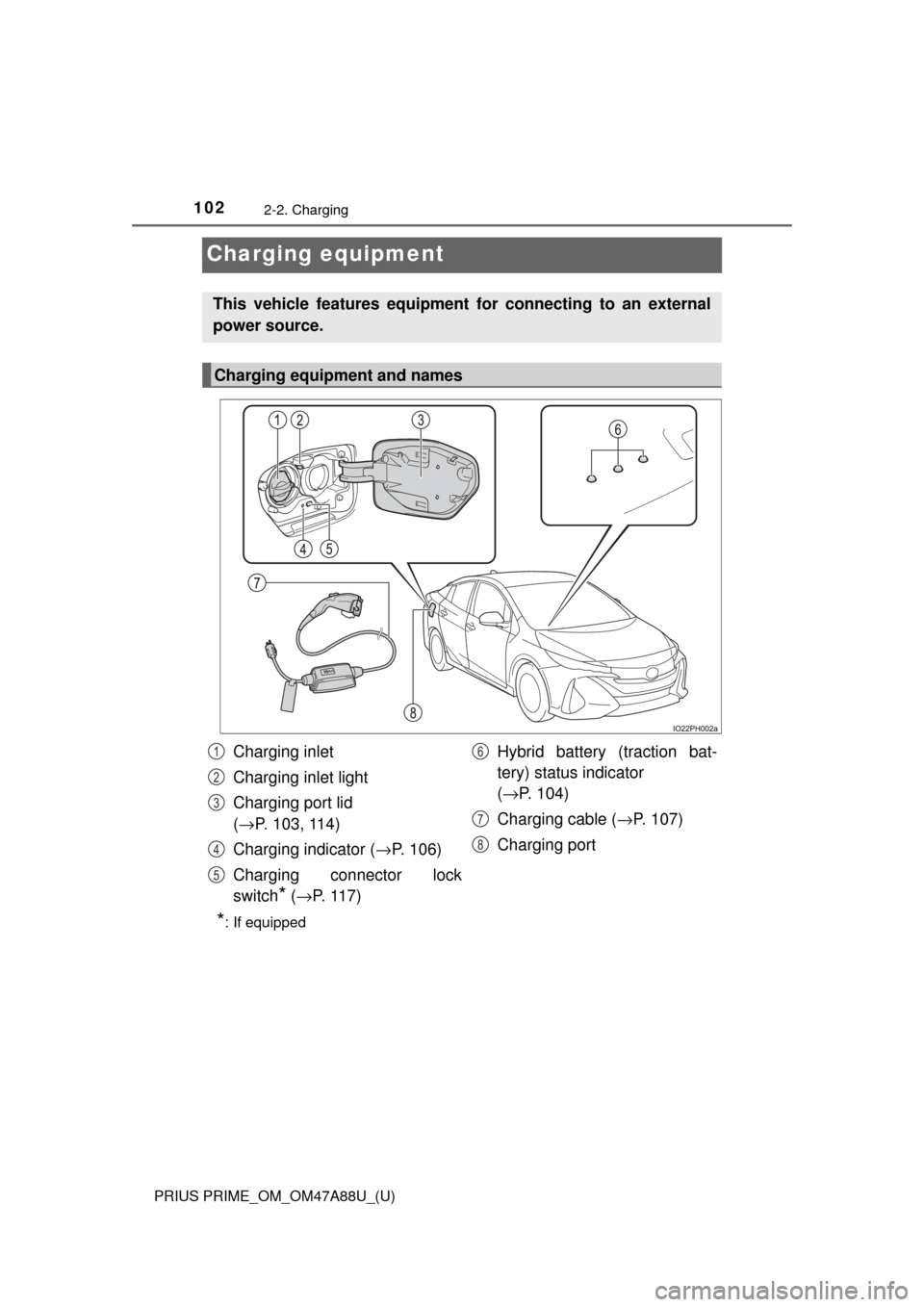
Charging equipment
*: If equipped
This vehicle features equipment for connecting to an external
power source.
Charging equipment and names
Charging inlet
Charging inlet light
Charging port lid
(→ P. 103, 114)
Charging indicator ( →P. 106)
Charging connector lock
switch
* ( → P. 117) Hybrid battery (traction bat-
tery) status indicator
(
→ P. 104)
Charging cable ( →P. 107)
Charging port
1
2
3
4
5
6
7
8