wheel TOYOTA PRIUS PRIME 2023 Owners Manual
[x] Cancel search | Manufacturer: TOYOTA, Model Year: 2023, Model line: PRIUS PRIME, Model: TOYOTA PRIUS PRIME 2023Pages: 680, PDF Size: 14.97 MB
Page 433 of 680
433
6
6
Interior features
Interior features
6-1. Using the air conditioning system and defogger
Automatic air conditioning system ....................... 434
Heated steering wheel/seat heaters/seat ventilators
.................................. 443
6-2. Using the interior lights Interior lights list .......... 446
6-3. Using the storage features List of storage features 450
Luggage compartment fea- tures .......................... 454
6-4. Using the other interior features
Other interior features . 456
Power outlet (1500 W) 468
When the power outlet (1500 W) cannot be used
properly ..................... 475
Garage door opener.... 477
Page 443 of 680
4436-1. Using the air conditioning system and defogger
6
Interior features
*: If equipped
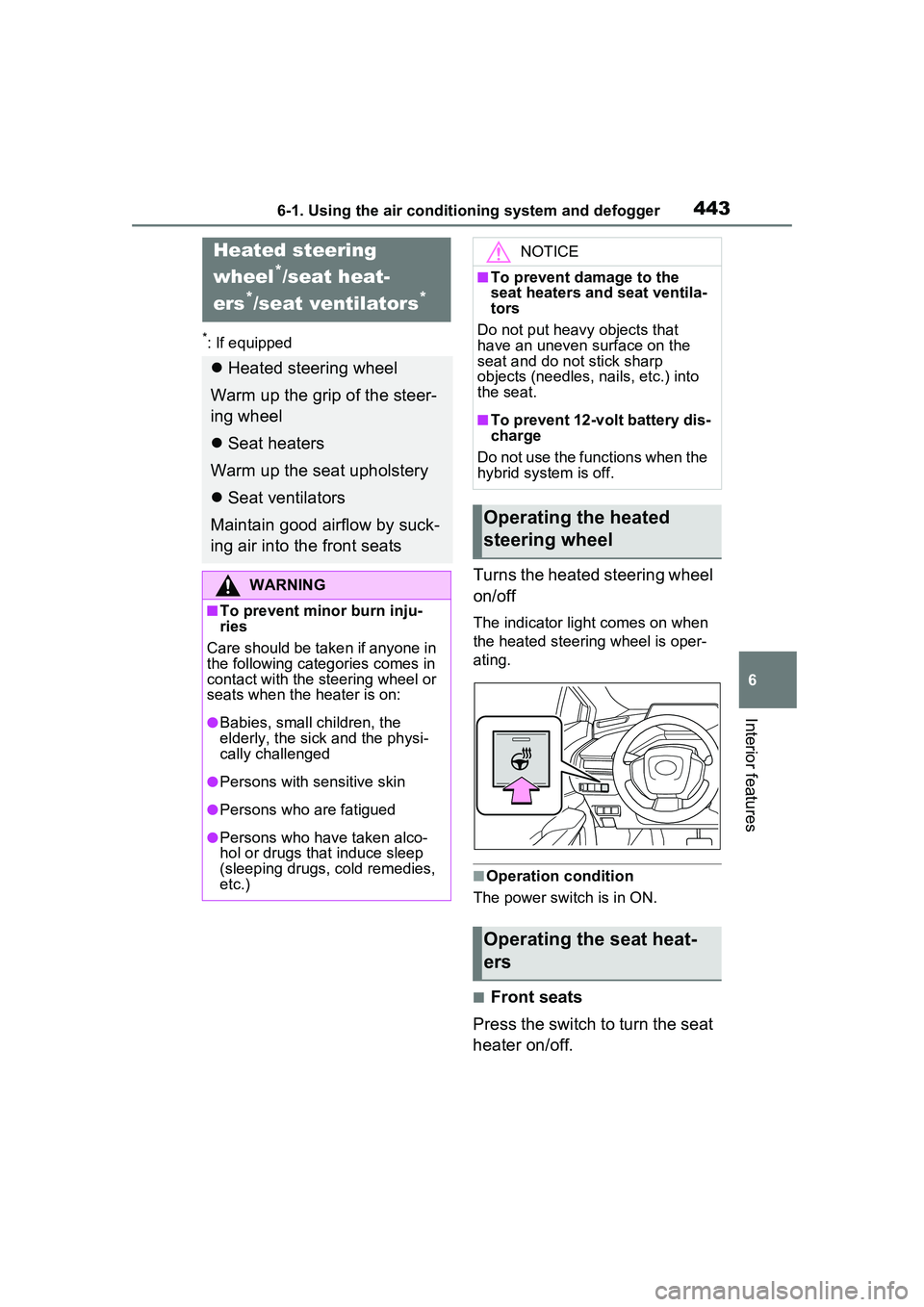
Turns the heated steering wheel
on/off
The indicator light comes on when
the heated steering wheel is oper-
ating.
■Operation condition
The power switch is in ON.
■Front seats
Press the switch to turn the seat
heater on/off.
Heated steering
wheel
*/seat heat-
ers
*/seat ventilators*
Heated steering wheel
Warm up the grip of the steer-
ing wheel
Seat heaters
Warm up the seat upholstery
Seat ventilators
Maintain good airflow by suck-
ing air into the front seats
WARNING
■To prevent minor burn inju-
ries
Care should be take n if anyone in
the following catego ries comes in
contact with the steering wheel or
seats when the heater is on:
●Babies, small children, the
elderly, the sick and the physi-
cally challenged
●Persons with sensitive skin
●Persons who are fatigued
●Persons who have taken alco-
hol or drugs that induce sleep
(sleeping drugs, cold remedies,
etc.)
NOTICE
■To prevent damage to the
seat heaters and seat ventila-
tors
Do not put heavy objects that
have an uneven surface on the
seat and do not stick sharp
objects (needles, nails, etc.) into
the seat.
■To prevent 12-volt battery dis-
charge
Do not use the functions when the
hybrid system is off.
Operating the heated
steering wheel
Operating the seat heat-
ers
Page 472 of 680
4726-4. Using the other interior features
Observe the following precau-
tions before starting the power
supply:
Park the vehicle in a well-ven-
tilated area, avoiding loca-
tions with poor ventilation
such as garages, as the
engine may start while the
system is operating.
Park the vehicle on a solid
and level place.
Block the wheels as needed.
Check that the hood is closed.
Check that the parking brake
is engaged.
Check that the shift position is
in P.
Check that the power switch
is off.
Note that the alarm system
WARNING
• When a device is likely to fall
under the pedals and prevent
the brake pedal from being
depressed, such as a hair dryer,
AC adapter, mouse, etc.
●Do not use devices which pro-
duce steam while the windows
are closed. Doing so may cause
the windows to fog up, reducing
visibility and making it difficult to
drive safely. Also, the steam
may damage or negatively
affect other devices. If the
device must be used, stop the
vehicle and open the windows
before use.
NOTICE
■To avoid short circuit or mal-
function
Observe the following precau-
tions. Failure to do so may lead to
the power outlets not operating
correctly or damage to the vehicle
or a connected device.
●Do not set a toaster or other
device which generates heat
near the interior components or
on a seat. Heat may cause
these parts to melt or burn.
●Do not use devices which are
sensitive to vibration or heat in
the vehicle. These devices may
malfunction due to vibration
while driving or heat while the
vehicle is parked in the sun.
●When not using a power outlet,
make sure to close the lid. If for-
eign matter or a liquid enters the
power outlet, it may cause a
malfunction or short circuit.
■Using the power outlet while
parked or stopped
●Water may leak from the
exhaust pipe while the engine
running if the power outlet is
used for a long time. However,
this is not a malfunction.
●At extremely low temperatures,
water may freeze in the exhaust
pipe and make it difficult to start
the engine, or an odor may
come from the exhaust pipe. In
this case, stop using the power
outlet, and then drive the vehi-
cle for 15 to 30 minutes.
Precautions for using the
power outlets while
parked
Page 485 of 680
485
7
7
Maintenance and care
Maintenance and care
7-1. Maintenance and careCleaning and protecting the vehicle exterior .......... 486
Cleaning and protecting the vehicle interior ........... 490
7-2. Maintenance Maintenance requirements.................................. 494
General maintenance.. 495
Emission inspection and maintenance (I/M) pro-
grams ........................ 498
7-3. Do-it-yourself mainte- nance
Do-it-yourself service pre- cautions ..................... 499
Hood ........................... 501
Positioning a floor jack 502
Engine compartment ... 504
12-volt battery ............. 511
Tires ............................ 513
Replacing the tire ........ 526
Tire inflation pressure . 532
Wheels ......... ...............534
Air conditioning filter .... 535
Electronic key battery.. 538
Checking and replacing fuses.......................... 540
Headlight aim .............. 542
Exterior lights .............. 543
Page 486 of 680
4867-1. Maintenance and care
7-1.Maintenance and care
Working from top to bottom,
liberally apply water to the
vehicle body, wheel wells and
underside of the vehicle to
remove any dirt and dust.
Wash the vehicle body using
a sponge or soft cloth, such
as a chamois.
For hard-to-remove marks,
use car wash soap and rinse
thoroughly with water.
Wipe away any water.
Wax the vehicle when the
waterproof coating deterio-
rates.
If water does not bead on a clean
surface, apply wax when the vehi-
cle body is cool.
■Before car washes
Check that the fuel filler door and
charging port lid on your vehicle are
closed properly.
■Automatic car washes
●Before washing the vehicle:
• Fold the mirrors
• Turn off the power back door
Start washing from the front of the vehicle. Make sure to extend the
mirrors before driving.
●Brushes used in automatic car
washes may scratch the vehicle
surface, parts (wheel, etc.) and
harm your vehicle’s paint.
●Rear spoiler may not be washable
in some automatic car washes.
There may also be an increased
risk of damage to vehicle.
●When the shift position needs to
be held in N, refer to P.259.
●If you need to release the parking
brake, turn off the brake hold sys-
tem, release the parking brake,
and set the power switch to ACC
while holding the N position.
(
P.259)
■High pressure car washes
As water may enter the cabin, do
not bring the nozzle tip near the
gaps around the doors or perimeter
of the windows, or spray these
areas continuously.
■Note for a smart key system
If the door handle becomes wet
while the electronic key is within the
effective range, the door may lock
and unlock repeatedly. In that case,
follow the following correction pro-
cedures to wash the vehicle:
●Place the key in a position 6 ft. (2
m) or more separate from the
vehicle while the vehicle is being
washed. (Take care to ensure that
the key is not stolen.)
●Set the electronic key to battery-
saving mode to disable the smart
key system. ( P.205)
■Wheels and wheel ornaments
(vehicles without matte painted
wheels)
●Remove any dirt immediately by
using a neutral detergent.
●Wash detergent off with water
immediately after use.
●To protect the paint from damage,
make sure to observe the follow-
Cleaning a nd protect-
ing the vehicle exte-
rior
Perform the following to
protect the vehicle and
maintain it in prime condi-
tion:
Cleaning instructions
Page 487 of 680
4877-1. Maintenance and care
7
Maintenance and care
ing precautions.
• Do not use acidic, alkaline or abrasive detergent
• Do not use hard brushes
• Do not use detergent on the wheels when they are hot, such
as after driving or parking in hot
weather
■Wheels and wheel ornaments
(vehicles with matte painted
wheels)
A different set of care is necessary
for matte painted wheels and wheel
ornaments.
Contact your Toyota dealer for
details.
●Remove dirt using water as early
as possible.
If the wheels are excessively dirty,
use diluted neutral detergent.
●When using detergent, make sure
to rinse it off with water immedi-
ately. Then use a soft cloth to
wipe off the water.
●Use a sponge or soft cloth to
remove the dirt by hand.
●To prevent the ma tte paint from
being damaged or glossy, make
sure to observe the following pre-
cautions:
• Do not apply any coatings or wax.
• Do not use acidic, alkaline or
abrasive detergents.
• When using tire cleaners or tire
wax, do not allow them to be
applied to the wheels.
• Do not scrub or polish the wheels
using a brush or dry cloth, etc.
• When using an automatic car wash, do not select the wheel
brush function.
• Do not use a high pressure washer or steam cleaner.
• Do not use detergent on the
wheels when they are hot, such
as after driving or parking in hot
weather.
■Brake pads and calipers
Rust may form if the vehicle is
parked with wet brake pads or disc rotors, causing them to stick. Before
parking the vehicle after it is
washed, drive slowly and apply the
brakes several times to dry the
parts.
■Bumpers
Do not scrub with abrasive cleaners.
■Front side windows water-
repellent coating (if equipped)
The following precautions can
extend the effectiveness of the
water-repellent coating.
●Remove any dirt, etc., from the
front side windows regularly.
●Do not allow dirt and dust to accu-
mulate on the windows for a long
period. Clean the windows with a
soft, damp cloth as soon as possi-
ble.
●Do not use wax or glass cleaners
that contain abrasives when
cleaning the windows.
●Do not use any metallic objects to
remove condensation build up.
■Plated portions
If dirt cannot be removed, clean the
parts as follows:
●Use a soft cloth dampened with
an approximately 5% solution of
neutral detergent and water to
clean the dirt off.
●Wipe the surface with a dry, soft
cloth to remove any remaining
moisture.
●To remove oily deposits, use alco-
hol wet wipes or a similar product.
WARNING
■When washing the vehicle
Do not apply water to the inside of
the engine compartment. Doing
so may cause the electrical com-
ponents, etc. to catch fire.
Page 489 of 680
4897-1. Maintenance and care
7
Maintenance and care
NOTICE
■To prevent paint deterioration
and corrosion on the body
and components (aluminum
wheels, etc.)
●Wash the vehicle immediately in
the following cases:
• After driving near the sea coast
• After driving on salted roads
• If coal tar or tree sap is present on the paint surface
• If dead insects, insect droppings or bird droppings are present on
the paint surface
• After driving in an area contami- nated with soot, oily smoke,
mine dust, iron powder or chem-
ical substances
• If the vehicle becomes heavily soiled with dust or mud
• If liquids such as benzene and gasoline are spilled on the paint
surface
●If the paint is chipped or
scratched, have it repaired
immediately.
●To prevent the wheels from cor-
roding, remove any dirt and
store in a place with low humid-
ity when storing the wheels.
■To prevent damage to the
windshield wiper arms
When lifting the wiper arms away
from the windshield pull the driver
side wiper arm upward first, and
repeat for the passenger’s side.
When returning the wipers to their
original position, do so from the
passenger’s side first.
■Cleaning the exterior lights
●Wash carefully. Do not use
organic substances or scrub
with a hard brush.
This may damage the surfaces
of the lights.
●Do not apply wax to the sur-
faces of the lights.
Wax may cause damage to the
lenses.
■Cleaning the radiator grille
Observe the following precautions
to avoid damage to the radiator
grille surface.
●Do not use a hard brush. Use a
soft cloth or sponge to wipe.
●Remove any dirt by using a
neutral detergent. Do not use
waxes or alcohols (e.g. glass
cleaner).
●Wash detergent off with water
after washing the vehicle.
■When using an automatic car
wash
Set the wiper switch to off posi-
tion.
If the wiper switch is in “AUTO”,
the wipers may operate and the
wiper blades may be damaged.
■When using a high pressure
car wash
●When washing the vehicle, do
not spray the camera or its sur-
rounding area directly with a
high pressure washer. Shock
applied from high pressure
water may cause the device to
not operate normally.
●Do not spray water directly on
the radar which is equipped
behind the emblem. Otherwise
it may cause the device to be
damaged.
Page 495 of 680
4957-2. Maintenance
7
Maintenance and care
■Resetting the message indicat-
ing maintenance is required
After the required maintenance is
performed according to the mainte-
nance schedule, please reset the
reminder light or message.
To reset the reminder light or mes-
sage, follow the procedure
described below:
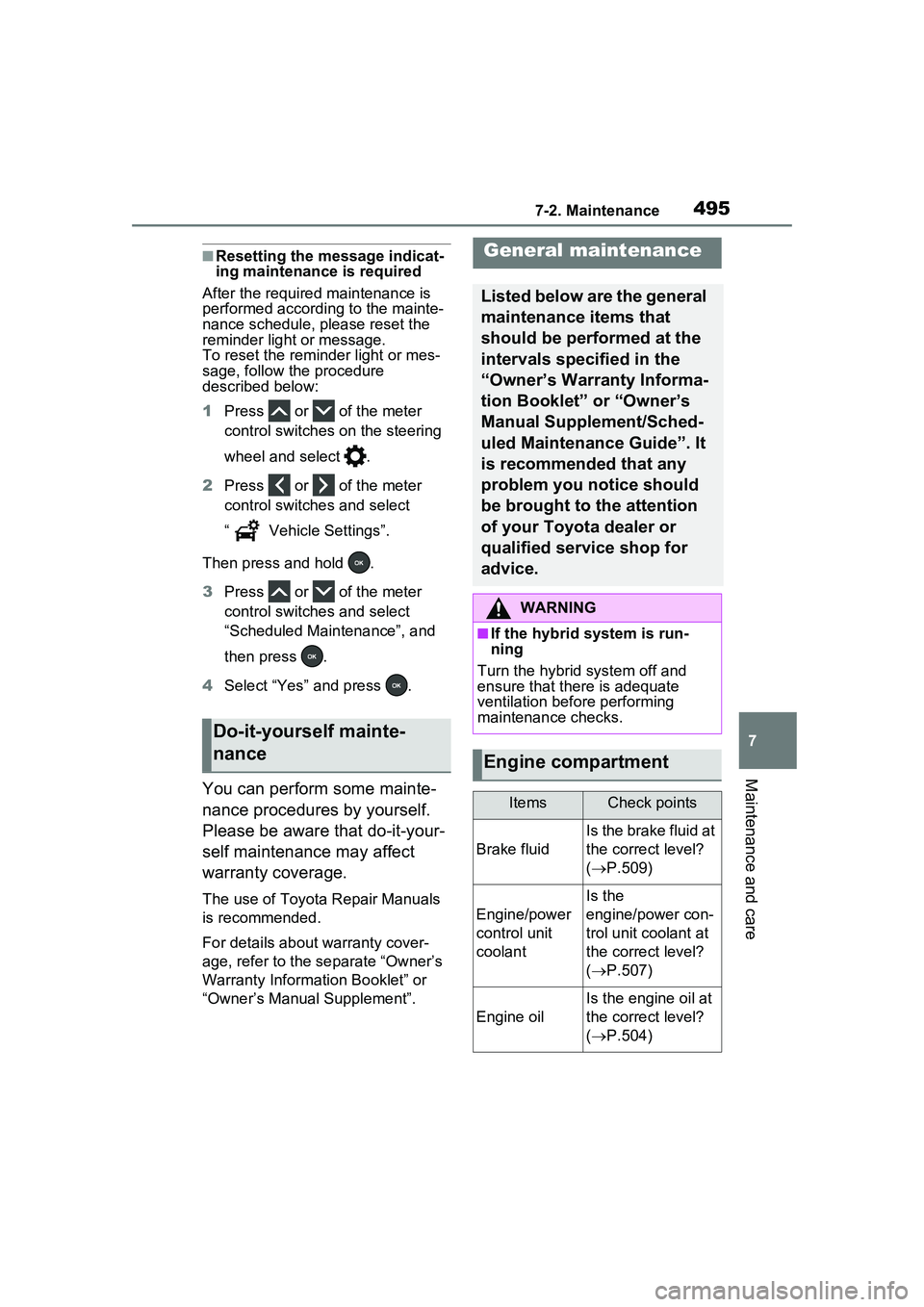
1 Press or of the meter
control switches on the steering
wheel and select .
2 Press or of the meter
control switches and select
“ Vehicle Settings”.
Then press and hold .
3 Press or of the meter
control switches and select
“Scheduled Maintenance”, and
then press .
4 Select “Yes” and press .
You can perform some mainte-
nance procedures by yourself.
Please be aware that do-it-your-
self maintenance may affect
warranty coverage.
The use of Toyota Repair Manuals
is recommended.
For details about warranty cover-
age, refer to the separate “Owner’s
Warranty Information Booklet” or
“Owner’s Manual Supplement”.
Do-it-yourself mainte-
nance
General maintenance
Listed below are the general
maintenance items that
should be performed at the
intervals specified in the
“Owner’s Warranty Informa-
tion Booklet” or “Owner’s
Manual Supplement/Sched-
uled Maintenance Guide”. It
is recommended that any
problem you notice should
be brought to the attention
of your Toyota dealer or
qualified service shop for
advice.
WARNING
■If the hybrid system is run-
ning
Turn the hybrid system off and
ensure that there is adequate
ventilation before performing
maintenance checks.
Engine compartment
ItemsCheck points
Brake fluid
Is the brake fluid at
the correct level?
( P.509)
Engine/power
control unit
coolant
Is the
engine/power con-
trol unit coolant at
the correct level?
( P.507)
Engine oil
Is the engine oil at
the correct level?
( P.504)
Page 497 of 680
4977-2. Maintenance
7
Maintenance and care
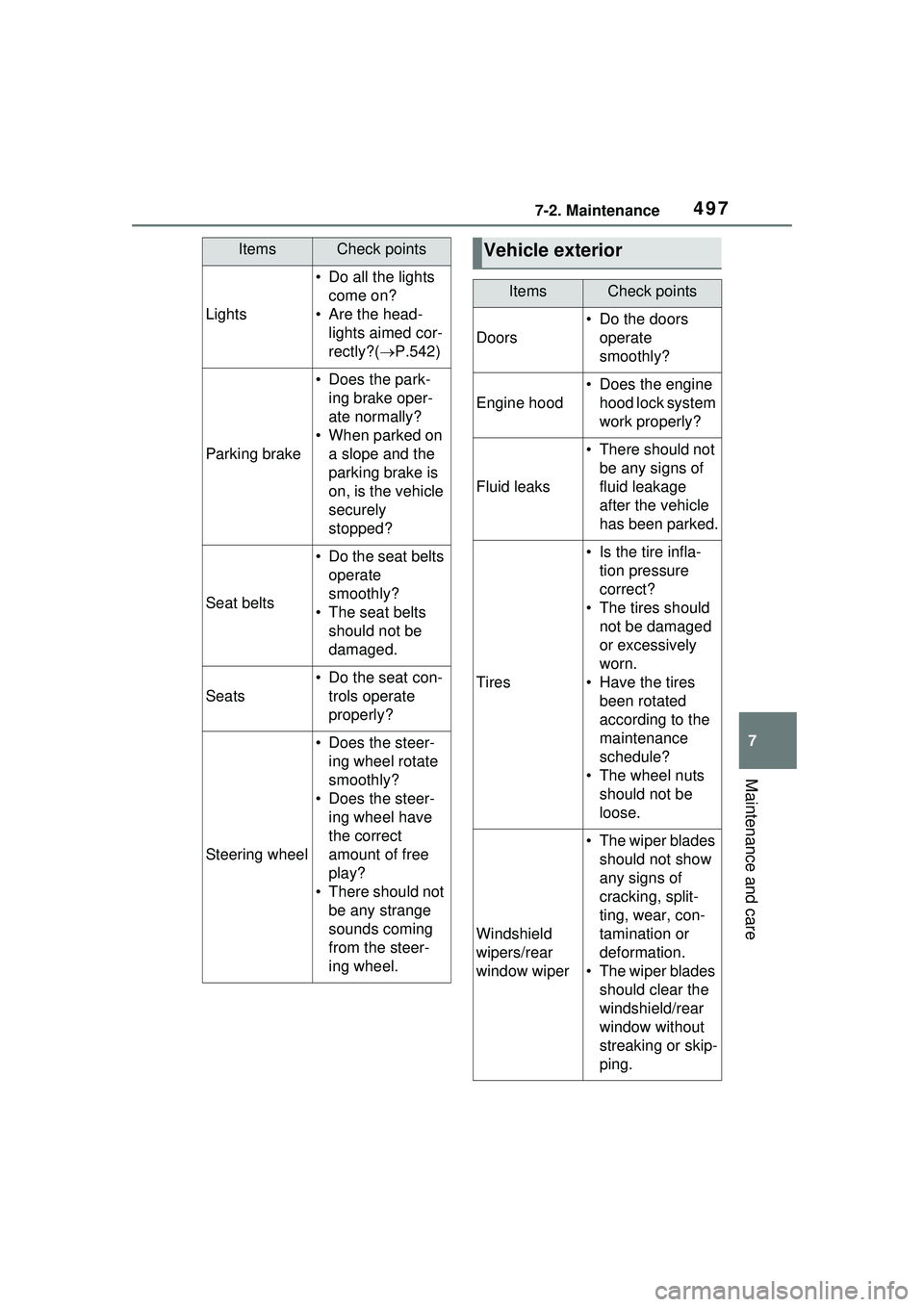
Lights
• Do all the lights come on?
• Are the head- lights aimed cor-
rectly?( P.542)
Parking brake
• Does the park-
ing brake oper-
ate normally?
• When parked on a slope and the
parking brake is
on, is the vehicle
securely
stopped?
Seat belts
• Do the seat belts operate
smoothly?
• The seat belts should not be
damaged.
Seats
• Do the seat con-trols operate
properly?
Steering wheel
• Does the steer-ing wheel rotate
smoothly?
• Does the steer- ing wheel have
the correct
amount of free
play?
• There should not be any strange
sounds coming
from the steer-
ing wheel.
ItemsCheck pointsVehicle exterior
ItemsCheck points
Doors
• Do the doors operate
smoothly?
Engine hood
• Does the engine hood lock system
work properly?
Fluid leaks
• There should not be any signs of
fluid leakage
after the vehicle
has been parked.
Tires
• Is the tire infla-tion pressure
correct?
• The tires should not be damaged
or excessively
worn.
• Have the tires been rotated
according to the
maintenance
schedule?
• The wheel nuts should not be
loose.
Windshield
wipers/rear
window wiper
• The wiper blades should not show
any signs of
cracking, split-
ting, wear, con-
tamination or
deformation.
• The wiper blades should clear the
windshield/rear
window without
streaking or skip-
ping.
Page 514 of 680
5147-3. Do-it-yourself maintenance
indicators are showing on a tire.
■When to replace your vehicle’s
tires
Tires should be replaced if:
●The treadwear indicators are
showing on a tire.
●You have tire damage such as
cuts, splits, cracks deep enough
to expose the fabric, and bulges
indicating internal damage
●A tire goes flat repeatedly or can-
not be properly repaired due to
the size or location of a cut or
other damage
If you are not sure, consult your
Toyota dealer.
■Tire life
Any tire over 6 years old must be
checked by a qualified technician
even if it has seldom or never been
used or damage is not obvious.
■Low profile tires (vehicles with
195/50R19 tires)
Generally, low profile tires will wear
more rapidly and tire grip perfor-
mance will be reduced on snowy
and/or icy roads when compared to
standard tires. Be sure to use snow
tires on snowy and/or icy roads and
drive carefully at a speed appropri-
ate for road and weather conditions.
■Maximum load of tire
Check that the maximum load of the
replacement tire is greater than 1/2
of the Gross Axle Weight Ratings
(GAWR) of either the front axle or
the rear axle, whic hever is greater.
For the GAWR, see the Certification
Label. For the maximum load of the
tire, see the load limit at maximum
cold tire inflation pressure men-
tioned on the sidewall of the tire.
( P.609)
■Tire types
●Summer tires
Summer tires are high-speed per-
formance tires best suited to high-
way driving under dry conditions.
Since summer tires do not have
the same traction performance as
snow tires, summer tires are inad-
equate for driving on snow-cov-
ered or icy roads. For driving on
snow-covered roads or icy roads,
the use of snow tires is recom-
mended. When installing snow
tires, be sure to replace all four
tires.
●All season tires
All season tires are designed to
provide better traction in snow and
to be adequate for driving in most
winter conditions as well as for
use year-round. All season tires,
however, do not have adequate
traction performance compared
with snow tires in heavy or loose
snow. Also, all season tires fall
short in acceleration and handling
performance compared with sum-
mer tires in highway driving.
●Snow tires
For driving on snow-covered
roads or icy roads, we recom-
mend using snow tires. If you
need snow tires, select tires of the
same size, construction and load
capacity as the originally installed
tires. Since your vehicle has radial
tires as original equipment, make
sure your snow tires also have
radial construction. Do not install
studded tires without first checking
local regulation s for possible
restrictions. Snow tires should be
installed on all wheels. ( P.429)