cooling TOYOTA PRIUS PRIME 2023 User Guide
[x] Cancel search | Manufacturer: TOYOTA, Model Year: 2023, Model line: PRIUS PRIME, Model: TOYOTA PRIUS PRIME 2023Pages: 680, PDF Size: 14.97 MB
Page 437 of 680
4376-1. Using the air conditioning system and defogger
6
Interior features
■Water droplets during air condi-
tioning operation
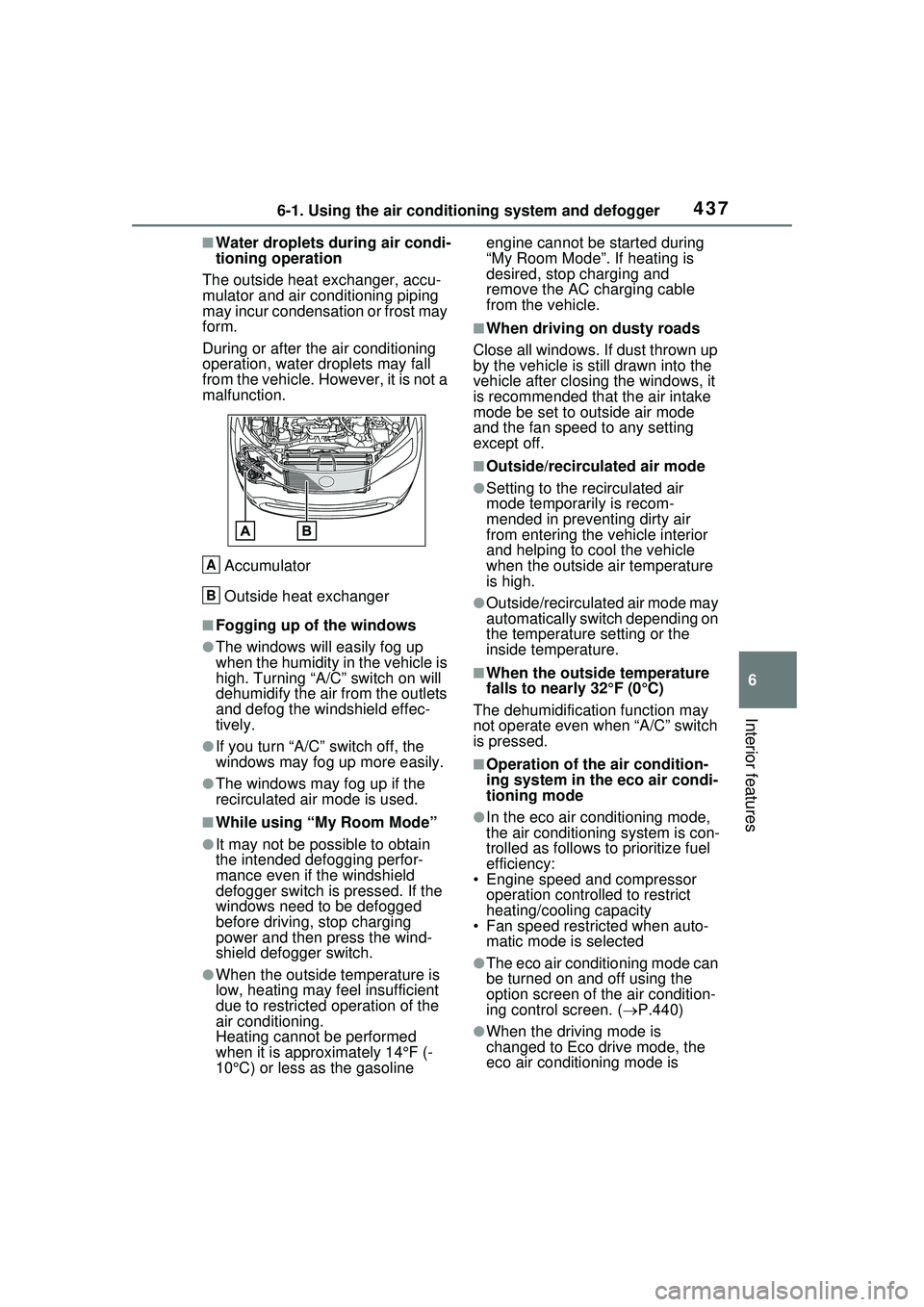
The outside heat exchanger, accu-
mulator and air conditioning piping
may incur condensation or frost may
form.
During or after the air conditioning
operation, water droplets may fall
from the vehicle. Ho wever, it is not a
malfunction.
Accumulator
Outside heat exchanger
■Fogging up of the windows
●The windows will easily fog up
when the humidity in the vehicle is
high. Turning “A/C” switch on will
dehumidify the air from the outlets
and defog the windshield effec-
tively.
●If you turn “A/C” switch off, the
windows may fog up more easily.
●The windows may fog up if the
recirculated air mode is used.
■While using “My Room Mode”
●It may not be possible to obtain
the intended defogging perfor-
mance even if the windshield
defogger switch is pressed. If the
windows need to be defogged
before driving, stop charging
power and then press the wind-
shield defogger switch.
●When the outside temperature is
low, heating may feel insufficient
due to restricted operation of the
air conditioning.
Heating cannot be performed
when it is approximately 14°F (-
10°C) or less as the gasoline engine cannot be started during
“My Room Mode”. If heating is
desired, stop charging and
remove the AC charging cable
from the vehicle.
■When driving on dusty roads
Close all windows. If dust thrown up
by the vehicle is still drawn into the
vehicle after closing the windows, it
is recommended that the air intake
mode be set to outside air mode
and the fan speed to any setting
except off.
■Outside/recirculated air mode
●Setting to the recirculated air
mode temporarily is recom-
mended in preventing dirty air
from entering the vehicle interior
and helping to cool the vehicle
when the outside air temperature
is high.
●Outside/recirculated air mode may
automatically switch depending on
the temperature setting or the
inside temperature.
■When the outside temperature
falls to nearly 32°F (0°C)
The dehumidification function may
not operate even when “A/C” switch
is pressed.
■Operation of the air condition-
ing system in the eco air condi-
tioning mode
●In the eco air conditioning mode,
the air conditioning system is con-
trolled as follows to prioritize fuel
efficiency:
• Engine speed and compressor
operation controlled to restrict
heating/cooling capacity
• Fan speed restricted when auto-
matic mode is selected
●The eco air conditioning mode can
be turned on and off using the
option screen of the air condition-
ing control screen. ( P.440)
●When the driving mode is
changed to Eco drive mode, the
eco air conditioning mode is
A
B
Page 441 of 680
4416-1. Using the air conditioning system and defogger
6
Interior features
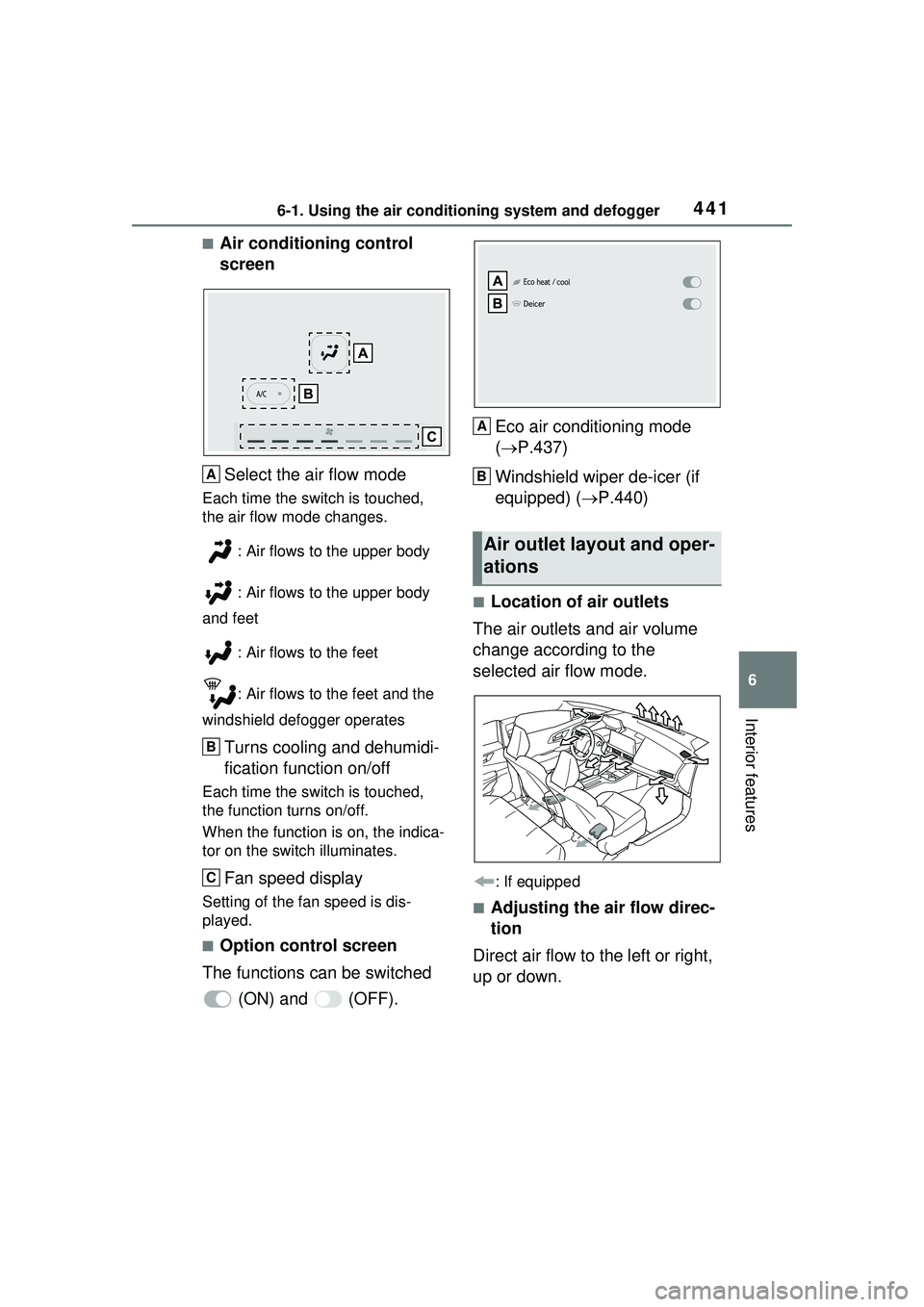
■Air conditioning control
screenSelect the air flow mode
Each time the switch is touched,
the air flow mode changes. : Air flows to the upper body
: Air flows to the upper body
and feet
: Air flows to the feet
: Air flows to the feet and the
windshield defogger operates
Turns cooling and dehumidi-
fication function on/off
Each time the switch is touched,
the function turns on/off.
When the function is on, the indica-
tor on the switch illuminates.
Fan speed display
Setting of the fan speed is dis-
played.
■Option control screen
The functions can be switched (ON) and (OFF). Eco air conditioning mode
(
P.437)
Windshield wiper de-icer (if
equipped) ( P.440)
■Location of air outlets
The air outlets and air volume
change according to the
selected air flow mode.
: If equipped
■Adjusting the air flow direc-
tion
Direct air flow to the left or right,
up or down.
A
B
C
Air outlet la yout and oper-
ations
A
B
Page 468 of 680
4686-4. Using the other interior features
■Power outlets
●With these power outlets, use
devices which operate on 120
VAC and have a combined maxi-
mum power consumption of 1500
W or less. If a device is connected
and the power consumption is
exceeded, a protection circuit may
be activated and the power supply
function may be stopped.
●Some of the devices that con-
sume a large amount of power,
such as an electric grille, may
require the exclusive use of the
power outlets. When such a
device is connected, do not con-nect other device(s) to the power
outlets.
●When multiple devices are con-
nected, depending on the device,
a connected device may not oper-
ate properly. For such a device,
use exclusively the power outlets.
●When a power outlet is being
used, depending on the device to
be used, the current flow may be
high and the initial peak wattage
may exceed 1500 W.
●When a power outlet is being
used, depending on the device to
be used, it may cause interference
with TV and radio broadcasts.
●While a power outlet is being
used, a cooling fan sound may be
heard from near a luggage com-
partment. This does not indicate a
malfunction.
■Devices which may not operate
properly
The following devices may not oper-
ate properly even if the combined
power consumption is 1500 W or
less:
●Devices with high initial peak watt-
age
●Devices requiring larger amount of
power supply than the power con-
sumption specified in its instruc-
tion manual
●Measuring devices that process
precise data
●Devices that require an extremely
stable power supply
●Devices that require a constant
power supply from the power out-
let, such as a device with a timer.
■Idling stop regulations
The engine starts automatically and
charging is performed when the
remaining charge of the hybrid bat-
tery (traction battery) decreases,
etc. Some local governments have
regulations against starting the
engine while parked or stopped.
Use the power outlets appropriately
Power outlet (1500 W)
The system allows the on-
board use of electric
devices which operate on
120 VAC and have a com-
bined power consumption
of 1500 W or less.
Depending on the country
or region where used, it is
not recommended to supply
power to electrical devices
outside of the vehicle as
this may be in conflict with
applicable regulations.
When supplying power to
electrical devices outside of
the vehicle, confirm with the
related local governments
regarding the applicable
regulations in each country
and region in advance. In
addition, be careful not to
drag electrical appliances or
cords when moving the
vehicle.
Page 500 of 680
5007-3. Do-it-yourself maintenance
Radiator and
condenser
( P.508)
Tire inflation
pressure
( P.532)• Tire pressure
gauge
• Compressed air source
Washer fluid
( P.510)
• Water or washer
fluid containing
antifreeze (for win-
ter use)
• Funnel (used only for adding water or
washer fluid)
WARNING
The engine compartment contains
many mechanisms and fluids that
may move suddenly, become hot,
or become electrically energized.
To avoid death or serious injury,
observe the following precautions.
■When working on the engine
compartment
●Make sure that “POWER ON”
on the meter and the “READY”
indicator are both off.
●Keep hands, clothing and tools
away from the moving fan.
●Be careful not to touch the
engine, power control unit, radi-
ator, exhaust manifold, etc. right
after driving as they may be hot.
Oil and other fluids may also be
hot.
●Do not leave anything that may
burn easily, such as paper and
rags, in the engine compart-
ment.
ItemsParts and tools●Do not smoke, cause sparks or
expose an open flame to fuel or
the battery. Fuel and battery
fumes are flammable.
■When working near the elec-
tric cooling fan or radiator
grille
Be sure the power switch is OFF.
With the power switch in ON, the
electric cooling fan may automati-
cally start to run if the air condi-
tioning is on and/or the coolant
temperature is high. ( P.508)
■Safety glasses
Wear safety glasses to prevent
flying or falling material, fluid
spray, etc., from getting in your
eyes.
NOTICE
■If you remove the air cleaner
filter
Driving with the air cleaner filter
removed may cause excessive
engine wear due to dirt in the air.
Page 504 of 680
5047-3. Do-it-yourself maintenance
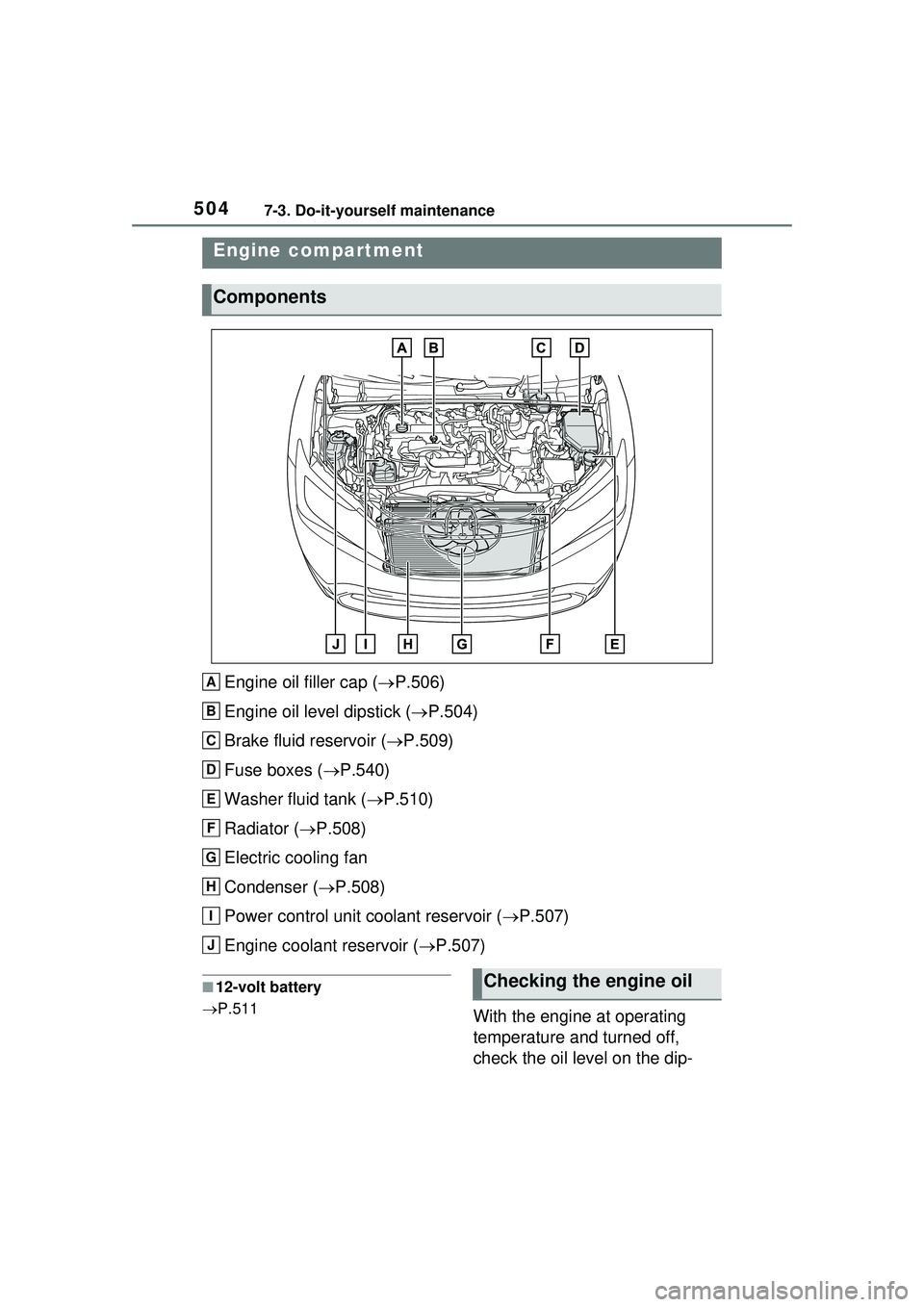
Engine oil filler cap (P.506)
Engine oil level dipstick ( P.504)
Brake fluid reservoir ( P.509)
Fuse boxes ( P.540)
Washer fluid tank ( P.510)
Radiator ( P.508)
Electric cooling fan
Condenser ( P.508)
Power control unit coolant reservoir ( P.507)
Engine coolant reservoir ( P.507)
■12-volt battery
P.511
With the engine at operating
temperature and turned off,
check the oil level on the dip-
Engine compartment
Components
A
B
C
D
E
F
G
H
I
J
Checking the engine oil
Page 508 of 680
5087-3. Do-it-yourself maintenance
line. (P.595)
■Coolant selection
Only use “Toyota Super Long Life
Coolant” or a similar high quality
ethylene glycol based non-silicate,
non-amine, non-nitrite, and non-
borate coolant with long-life hybrid
organic acid technology.
U.S.A.:
“Toyota Super Long Life Coolant” is
a mixture of 50% coolant and 50%
deionized water. (Minimum tem-
perature: -31°F [-35°C])
Canada:
“Toyota Super Long Life Coolant” is
a mixture of 55% coolant and 45%
deionized water. (Minimum tem-
perature: -44°F [-42°C])
For more details about coolant, con-
tact your Toyota dealer.
■If the coolant level drops within
a short time of replenishing
Visually check the radiators, hoses,
engine/power control unit coolant
reservoir caps, drain cock and water
pump.
If you cannot find a leak, have your
Toyota dealer, test the cap and
check for leaks in the cooling sys-
tem.
Check the radiator and con-
denser, and clear away any for-
eign objects.
If either of the above parts is
extremely dirty or you are not
sure of their condition, have
your vehicle inspected by your
Toyota dealer.
WARNING
■When the hybrid system is
hot
Do not remove the engine/power
control unit coolant reservoir caps
or the radiator cap.
The cooling system may be under
pressure and may spray hot cool-
ant if the cap is removed, causing
serious injuries, such as burns.
NOTICE
■When adding coolant
Coolant is neither plain water nor
straight antifreeze. The correct
mixture of water and antifreeze
must be used to provide proper
lubrication, corrosion protection
and cooling. Be sure to read the
antifreeze or coolant label.
■If you spill coolant
Be sure to wash it off with water to
prevent it from damaging parts or
paint.
Checking the radiator and
condenser
WARNING
■When the hybrid system is
hot
Do not touch the radiator or con-
denser as they may be hot and
cause serious injuries, such as
burns.
Page 509 of 680
5097-3. Do-it-yourself maintenance
7
Maintenance and care
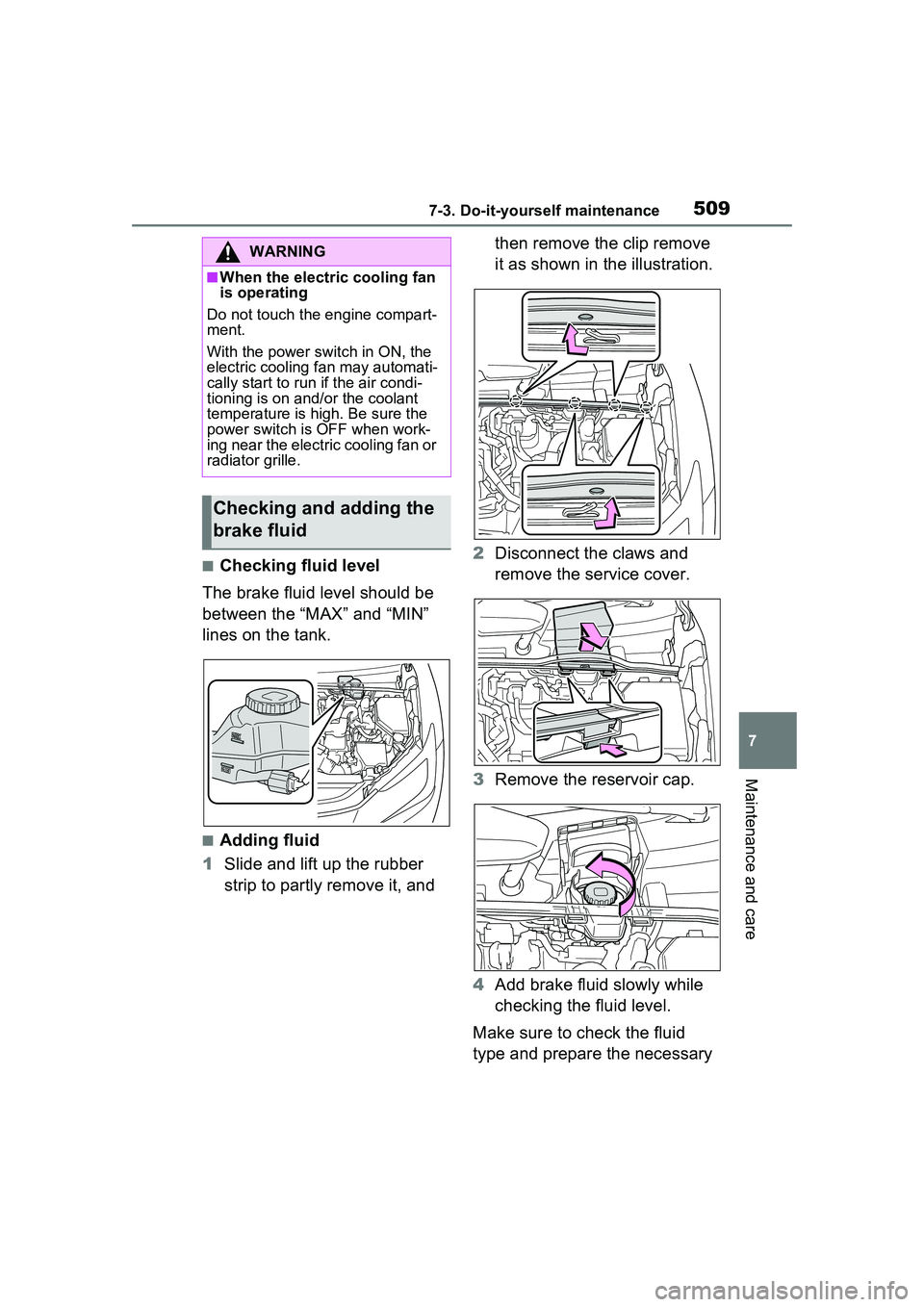
■Checking fluid level
The brake fluid level should be
between the “MAX” and “MIN”
lines on the tank.
■Adding fluid
1 Slide and lift up the rubber
strip to partly remove it, and then remove the clip remove
it as shown in the illustration.
2 Disconnect the claws and
remove the service cover.
3 Remove the reservoir cap.
4 Add brake fluid slowly while
checking the fluid level.
Make sure to check the fluid
type and prepare the necessary
WARNING
■When the electric cooling fan
is operating
Do not touch the engine compart-
ment.
With the power switch in ON, the
electric cooling fan may automati-
cally start to run if the air condi-
tioning is on and/or the coolant
temperature is high. Be sure the
power switch is OFF when work-
ing near the electric cooling fan or
radiator grille.
Checking and adding the
brake fluid
Page 593 of 680
5938-2. Steps to take in an emergency
8
When trouble arises
WARNING
●Always wash your hands after
handling the 12-volt battery sup-
port, terminals, and other bat-
tery-related parts.
●Do not allow children near the
12-volt battery.
■After recharging the 12-volt
battery
Have the 12-volt battery
inspected at your Toyota dealer
as soon as possible.
If the 12-volt batter y is deteriorat-
ing, continued use may cause the
12-volt battery to emit a malodor-
ous gas, which may be detrimen-
tal to the health of passengers.
■When replacing the 12-volt
battery
●For information regarding 12-
volt battery replacement, con-
tact your Toyota dealer.
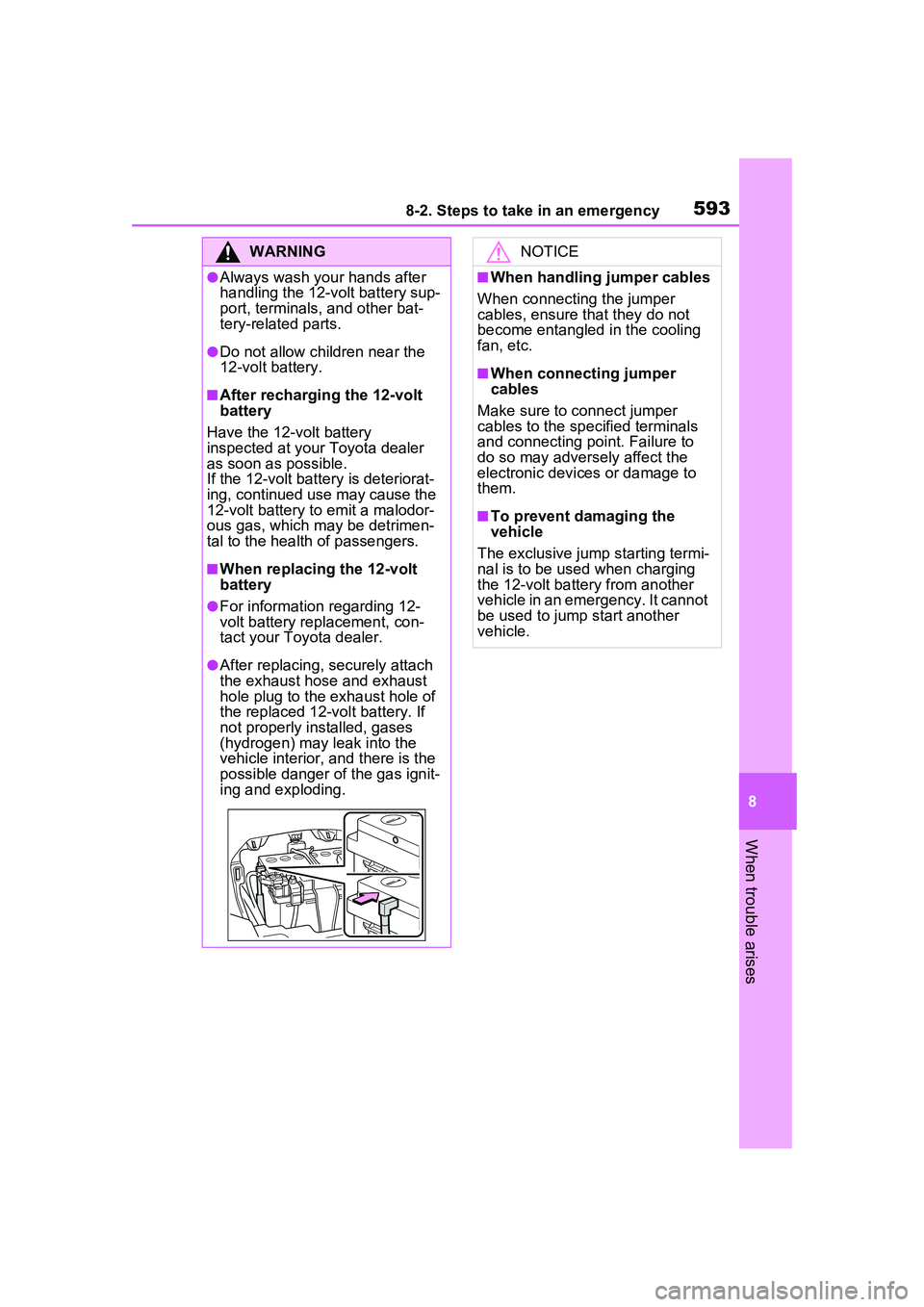
●After replacing, securely attach
the exhaust hose and exhaust
hole plug to the exhaust hole of
the replaced 12-volt battery. If
not properly installed, gases
(hydrogen) may leak into the
vehicle interior, and there is the
possible danger of the gas ignit-
ing and exploding.
NOTICE
■When handling jumper cables
When connecting the jumper
cables, ensure that they do not
become entangled in the cooling
fan, etc.
■When connecting jumper
cables
Make sure to connect jumper
cables to the specified terminals
and connecting point. Failure to
do so may adversely affect the
electronic devices or damage to
them.
■To prevent damaging the
vehicle
The exclusive jump starting termi-
nal is to be used when charging
the 12-volt battery from another
vehicle in an emergency. It cannot
be used to jump start another
vehicle.
Page 594 of 680
5948-2. Steps to take in an emergency
■If the high coolant tempera-
ture warning light comes on
or flashes or “Engine Cool-
ant Temp High Stop in a
Safe Place See Owner’s
Manual” is shown on the
multi-information display
1 Stop the vehicle in a safe
place and turn off the air con-
ditioning system, and then
stop the hybrid system.
2 If you see steam:
Carefully lift the hood after the steam subsides.
If you do not see steam:
Carefully lift the hood.
3 After the hybrid system has
cooled down sufficiently,
inspect the hoses and radia-
tor core (radiator) for any
leaks.
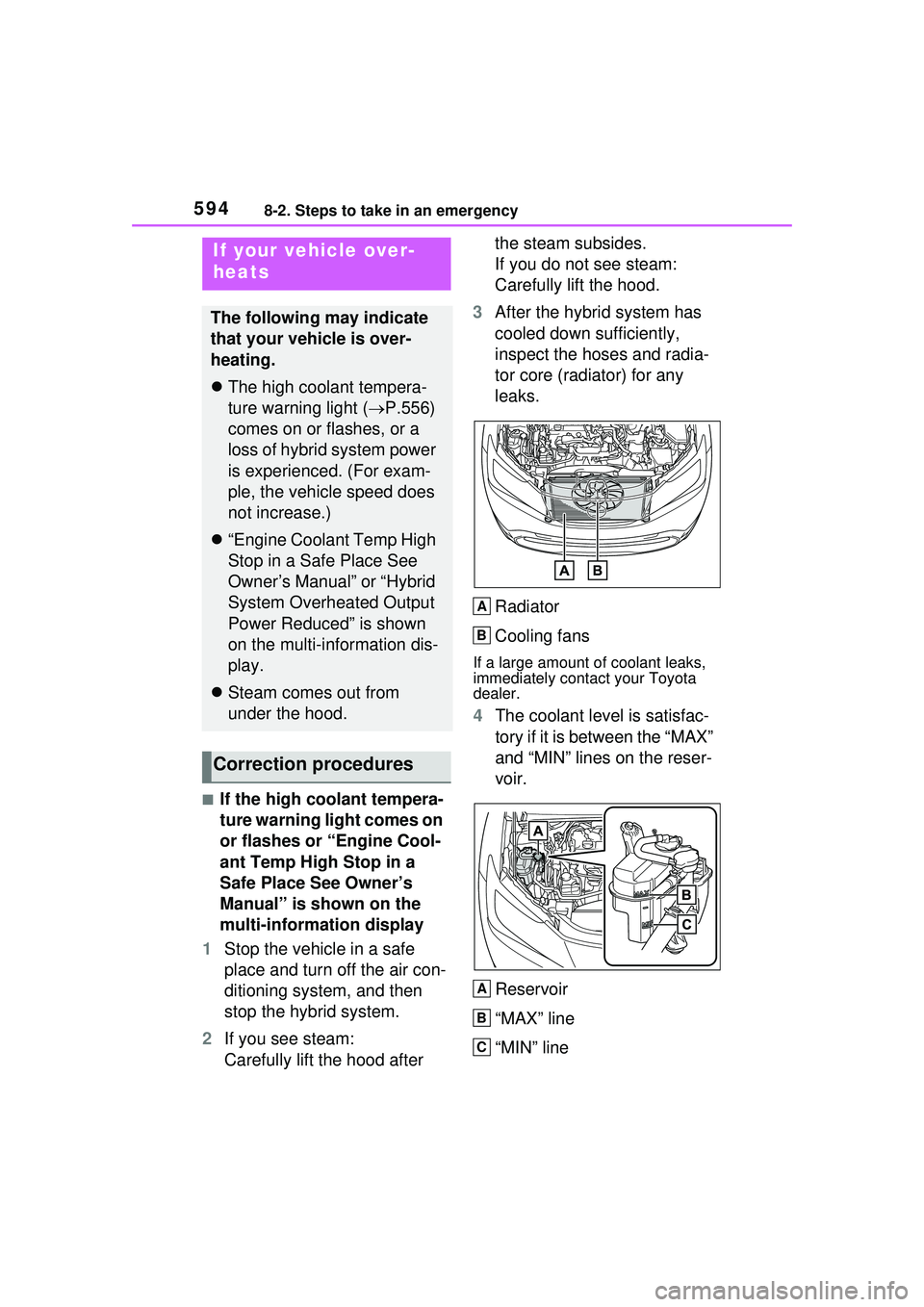
Radiator
Cooling fans
If a large amount of coolant leaks,
immediately contact your Toyota
dealer.
4The coolant level is satisfac-
tory if it is between the “MAX”
and “MIN” lines on the reser-
voir.
Reservoir
“MAX” line
“MIN” line
If your vehicle over-
heats
The following may indicate
that your vehicle is over-
heating.
The high coolant tempera-
ture warning light ( P.556)
comes on or flashes, or a
loss of hybrid system power
is experienced. (For exam-
ple, the vehicle speed does
not increase.)
“Engine Coolant Temp High
Stop in a Safe Place See
Owner’s Manual” or “Hybrid
System Overheated Output
Power Reduced” is shown
on the multi-information dis-
play.
Steam comes out from
under the hood.
Correction procedures
A
B
A
B
C
Page 595 of 680
5958-2. Steps to take in an emergency
8
When trouble arises
5Add coolant if necessary.
Water can be used in an emer-
gency if engine coolant is unavail-
able.
If water was added in an emer-
gency, have the vehicle inspected
at your Toyota dealer as soon as
possible.
6Start the hybrid system and
turn the air conditioning sys-
tem on to check that the radi-
ator cooling fan operates and
to check for coolant leaks
from the radiator or hoses.
The fan operates when the air con-
ditioning system is turned on imme-
diately after a cold start. Confirm
that the fan is operating by check-
ing the fan sound and air flow. If it is
difficult to check these, turn the air
conditioning system on and off
repeatedly. (The fan may not oper-
ate in freezing temperatures.)
7If the fan is not operating:
Stop the hybrid system
immediately and contact your
Toyota dealer.
If the fan is operating:
Have the vehicle inspected at
the nearest Toyota dealer.
8 Check if “Engine Coolant
Temp High Stop in a Safe
Place See Owner’s Manual” is shown on the multi-infor-
mation display.
If the message does not disappear:
Stop the hybrid system and contact
your Toyota dealer.
If the message is not displayed:
Have the vehicle inspected at the
nearest Toyota dealer.
■If “Hybrid System Over-
heated Output Power
Reduced” is shown on the
multi-information display
1 Stop the vehicle in a safe
place.
2 Stop the hybrid system and
carefully lift the hood.
3 After the hybrid system has
cooled down, inspect the
hoses and radiator core (radi-
ator) for any leaks.
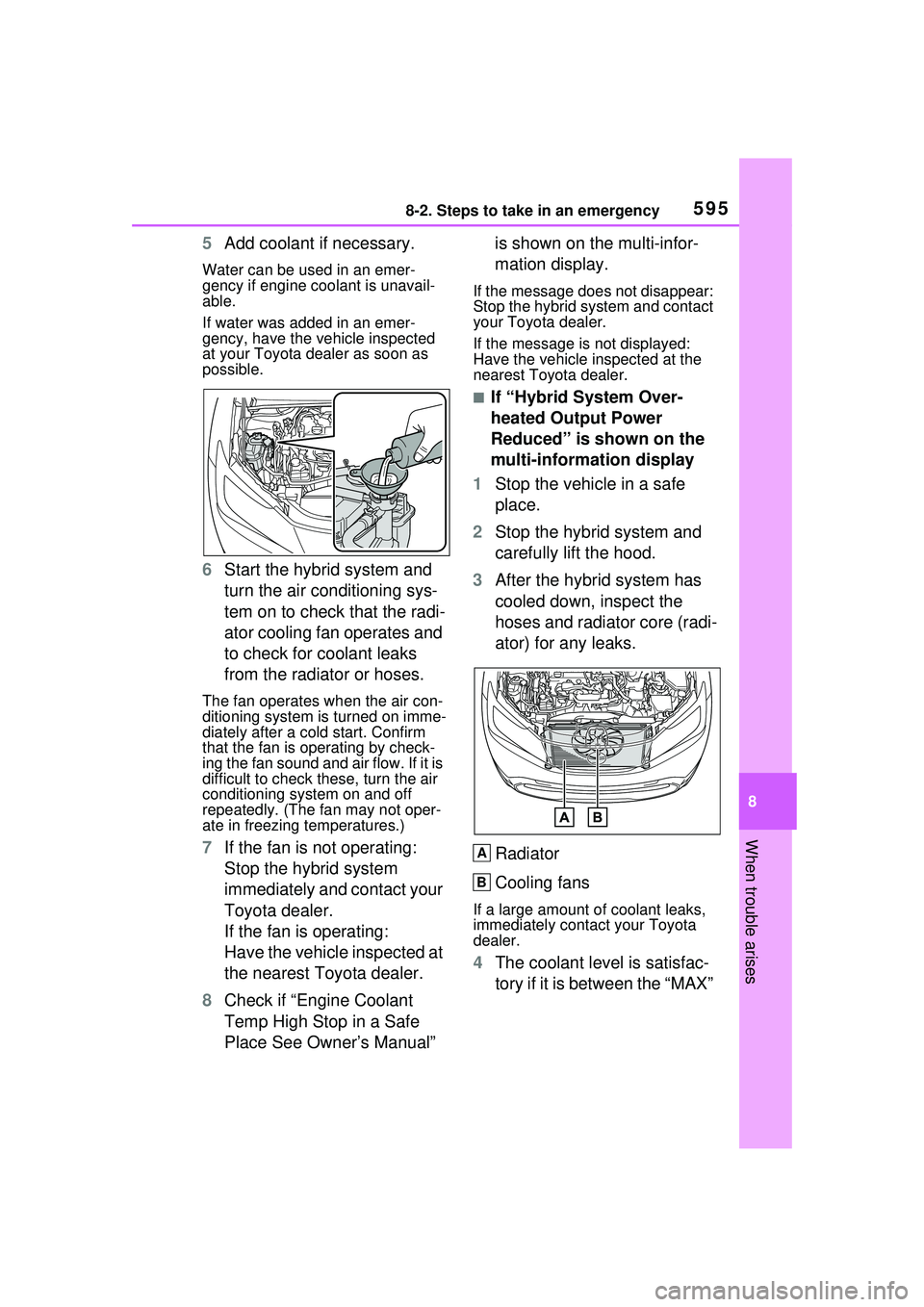
Radiator
Cooling fans
If a large amount of coolant leaks,
immediately contact your Toyota
dealer.
4The coolant level is satisfac-
tory if it is between the “MAX”
A
B