weight TOYOTA PRIUS PRIME 2023 Owners Manual
[x] Cancel search | Manufacturer: TOYOTA, Model Year: 2023, Model line: PRIUS PRIME, Model: TOYOTA PRIUS PRIME 2023Pages: 680, PDF Size: 14.97 MB
Page 34 of 680

341-1. For safe use
Move the height adjuster up and
down as needed until you hear a
click.
When the vehicle is subjected to
a severe frontal or side impact
or rollover, the pretensioners
retract the seat belts of the front
seats and rear outer seats to
securely restrain the occupants.
The pretensioners will not operate
in minor frontal or side impacts, or
rear impacts.
■Replacing the belt after the pre-
tensioner has been activated
If the vehicle is in volved in multiple collisions, the pretensioner will acti-
vate for the first collision, but will not
activate for the second or subse-
quent collisions.
■PCS-linked control
If the PCS (Pre-Collision System)
determines that th e possibility of a
collision with a vehicle is high, the
seat belt pretensioners will be pre-
pared to operate.WARNING
■Adjustable shoulder anchor
Always make sure the shoulder
belt is positioned across the cen-
ter of your shoulder. The belt
should be kept away from your
neck, but not falling off your
shoulder. Failure to do so could
reduce the amount of protection in
an accident and cause death or
serious injuries in the event of a
sudden stop, sudden swerve or
accident.
Seat belt pretensioners
(front seats and outboard
rear seats)
WARNING
■Seat belt pretensioners
Observe the following precautions
to reduce the risk of injury in the
event of sudden braking or an
accident.
Failure to do so may result in
death or serious injury.
●Do not place anything, such as
a cushion, on the front passen-
ger’s seat. Doing so will
disperse the passenger’s
weight, which prevents the sen-
sor from detecting the passen-
ger’s weight properly. As a
result, the seat belt pretensioner
for the front passenger’s seat
may not operate in the event of
a collision.
●If a pretensioner has operated,
the SRS warning light will illumi-
nate. In this situation, the seat
belt cannot be used and must
be replaced by your Toyota
dealer.
Page 42 of 680
421-1. For safe use
WARNING
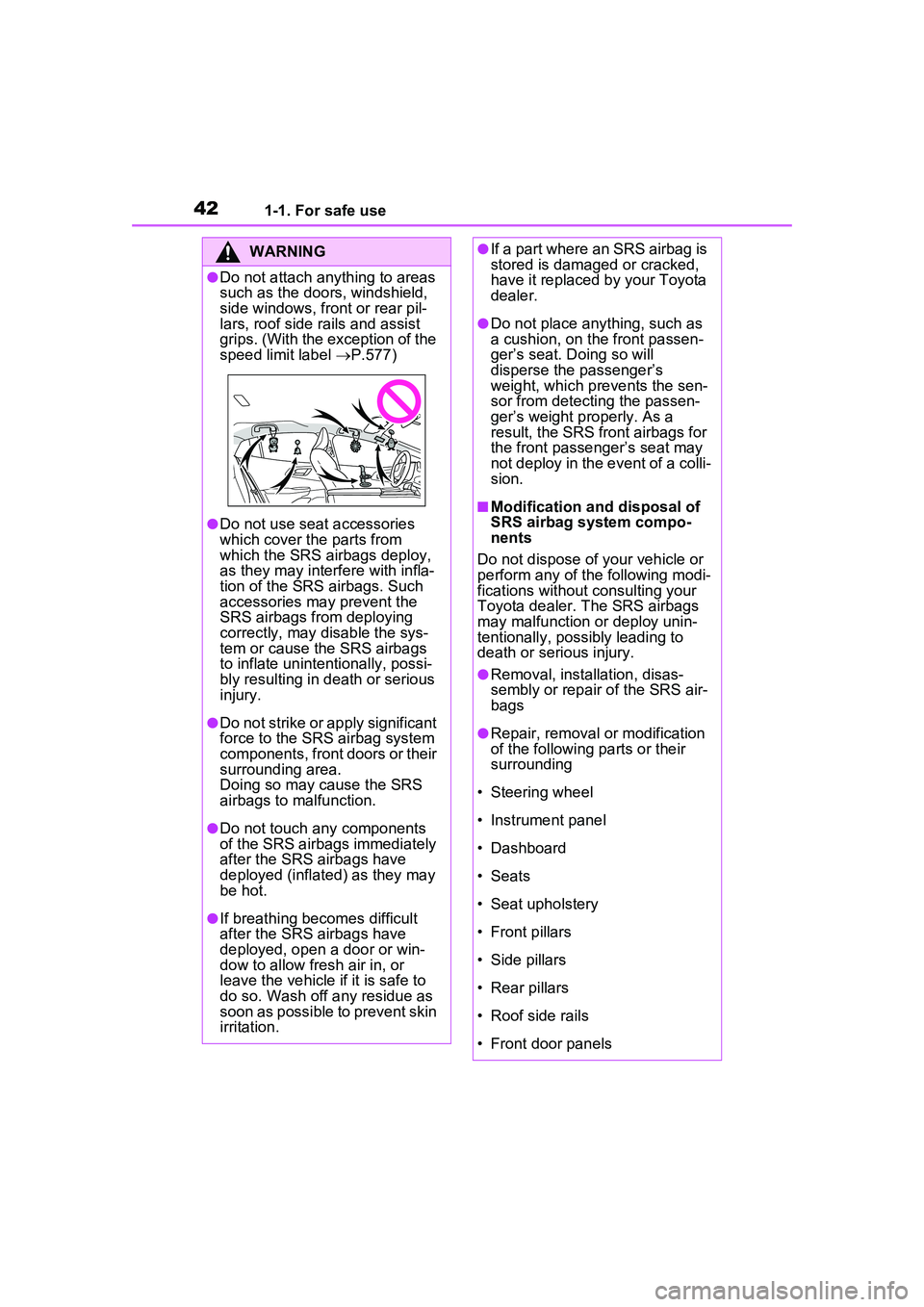
●Do not attach anything to areas
such as the doors, windshield,
side windows, front or rear pil-
lars, roof side rails and assist
grips. (With the exception of the
speed limit label P.577)
●Do not use seat accessories
which cover the parts from
which the SRS airbags deploy,
as they may inte rfere with infla-
tion of the SRS airbags. Such
accessories may prevent the
SRS airbags from deploying
correctly, may disable the sys-
tem or cause the SRS airbags
to inflate unintentionally, possi-
bly resulting in death or serious
injury.
●Do not strike or apply significant
force to the SRS airbag system
components, front doors or their
surrounding area.
Doing so may cause the SRS
airbags to malfunction.
●Do not touch any components
of the SRS airbags immediately
after the SRS airbags have
deployed (inflated) as they may
be hot.
●If breathing becomes difficult
after the SRS airbags have
deployed, open a door or win-
dow to allow fresh air in, or
leave the vehicle if it is safe to
do so. Wash off any residue as
soon as possible to prevent skin
irritation.
●If a part where an SRS airbag is
stored is damaged or cracked,
have it replaced by your Toyota
dealer.
●Do not place anything, such as
a cushion, on the front passen-
ger’s seat. Doing so will
disperse the passenger’s
weight, which prevents the sen-
sor from detecting the passen-
ger’s weight properly. As a
result, the SRS front airbags for
the front passenger’s seat may
not deploy in the event of a colli-
sion.
■Modification and disposal of
SRS airbag system compo-
nents
Do not dispose of your vehicle or
perform any of the following modi-
fications without consulting your
Toyota dealer. The SRS airbags
may malfunction or deploy unin-
tentionally, possibly leading to
death or serious injury.
●Removal, installation, disas-
sembly or repair of the SRS air-
bags
●Repair, removal or modification
of the following parts or their
surrounding
• Steering wheel
• Instrument panel
• Dashboard
• Seats
• Seat upholstery
• Front pillars
• Side pillars
• Rear pillars
• Roof side rails
• Front door panels
Page 45 of 680
451-1. For safe use
1
For safety and security
WARNING
●Make sure the “PASSENGER
AIR BAG OFF” indicator light is
not illuminated when using the
seat belt extender for the front
passenger seat. If the “PAS-
SENGER AIR BAG OFF” indi-
cator light is illuminated,
disconnect the extender tongue
from the seat belt buckle, and
reconnect the seat belt. Recon-
nect the seat belt extender after
making sure the “PASSENGER
AIR BAG ON” indicator light is
illuminated. If you use the seat
belt extender while the “PAS-
SENGER AIR BAG OFF” indi-
cator light is illuminated, the
SRS airbags for the front pas-
senger will not activate, which
could cause death or serious
injury in the event of a collision.
●Do not apply a heavy load to the
front passenger seat or equip-
ment (e.g. se atback pocket).
●Do not put weight on the front
passenger seat by putting your
hands or feet on the front pas-
senger seat seatback from the
rear passenger seat.
●Do not let a rear passenger lift
the front passenger seat with
their feet or press on the seat-
back with their legs.
●Do not put objects under the
front passenger seat.
●Do not recline the front passen-
ger seatback so far that it
touches a rear seat. This may
cause the “PASSENGER AIR
BAG OFF” indicator light to be
illuminated, which indicates that
the SRS airbags for the front
passenger will not activate in
the event of a severe accident.
If the seatback touches the rear
seat, return th e seatback to a
position where it does not touch
the rear seat. Keep the front
passenger seatback as upright
as possible when the vehicle is
moving. Reclining the seatback
excessively may lessen the
effectiveness of the seat belt
system.
●If an adult sits in the front pas-
senger seat, the “PASSENGER
AIR BAG ON” indicator light is
illuminated. If the “PASSEN-
GER AIR BAG OFF” indicator is
illuminated, ask the passenger
to sit up straight, well back in
the seat, feet on the floor, and
with the seat belt worn correctly.
If the “PASSENGER AIR BAG
OFF” indicator still remains illu-
minated, either ask the passen-
ger to move to the rear seat, or
if that is not possible, move the
front passenger seat fully rear-
ward.
●When it is unavoidable to install
a forward-facing child restraint
system on the front passenger
seat, install the child restraint
system on the front passenger
seat in the proper order.
( P.53)
●Do not modify or remove the
front seats.
Page 52 of 680
521-2. Child safety
WARNING
●Toyota strongly urges the use of
a proper child restraint system
that conforms to the weight and
size of the child, installed on the
rear seat. According to accident
statistics, the child is safer when
properly restrained in the rear
seat than in the front seat.
●Holding a child in your or some-
one else’s arms is not a substi-
tute for a child restraint system.
In an accident, the child can be
crushed against the windshield
or between the holder and the
interior of the vehicle.
■Handling the child restraint
system
If the child restrain t system is not
properly fixed in place, the child or
other passengers may be seri-
ously injured or even killed in the
event of sudden braking, sudden
swerving, or an accident.
●If the vehicle were to receive a
strong impact from an accident,
etc., it is possible that the child
restraint system has damage
that is not readily visible. In
such cases, do not reuse the
restraint system.
●Make sure you have complied
with all installation instructions
provided with the child restraint
system manufacturer and that
the system is properly secured.
●Keep the child restraint system
properly secured on the seat
even if it is not in use. Do not
store the child restraint system
unsecured in the passenger
compartment.
●If it is necessary to detach the
child restraint system, remove it
from the vehicle or store it
securely in the luggage com-
partment.
Page 247 of 680
2475-1. Before driving
5
Driving
Cargo capacity depends on the
total weight of the occupants.
(Cargo capacity) = (Total load
capacity) - (Total weight of occu-
pants)
Steps for Determining Correct
Load Limit
(1) Locate the statement “The
combined weight of occupants
and cargo should never exceed
XXX kg or XXX lbs.” on your
vehicle’s placard.
(2) Determine the combined
weight of the driver and passen-
gers that will be riding in your
vehicle.
(3) Subtract the combined
weight of the driver and passen-
gers from XXX kg or XXX lbs.
(4) The resulting figure equals
the available amount of cargo
and luggage load capacity.
For example, if the “XXX”
amount equals 1400 lbs. and
there will be five 150 lb passen-
gers in your vehicle, the amount
of available cargo and luggage
load capacity is 650 lbs. (1400 -
750 (5 150) = 650 lbs.)
(5) Determine the combined
weight of luggage and cargo
being loaded on the vehicle.
That weight may not safely
exceed the available cargo and
luggage load capacity calcu-
lated in Step 4.
WARNING
●Do not place cargo or luggage
in or on the following locations.
• At the feet of the driver
• On the front passenger or rear seats (when stacking items)
• On the luggage cover
• On the instrument panel
• On the dashboard
●Secure all items in the occupant
compartment.
NOTICE
■If luggage is loaded on the
roof (vehicles with solar
charging system)
Observe the following precau-
tions. Failure to observe them
could lead to the solar roof being
damaged, or the roof rack falling
off.
●Do not install a roof rack which
interferes with the solar roof.
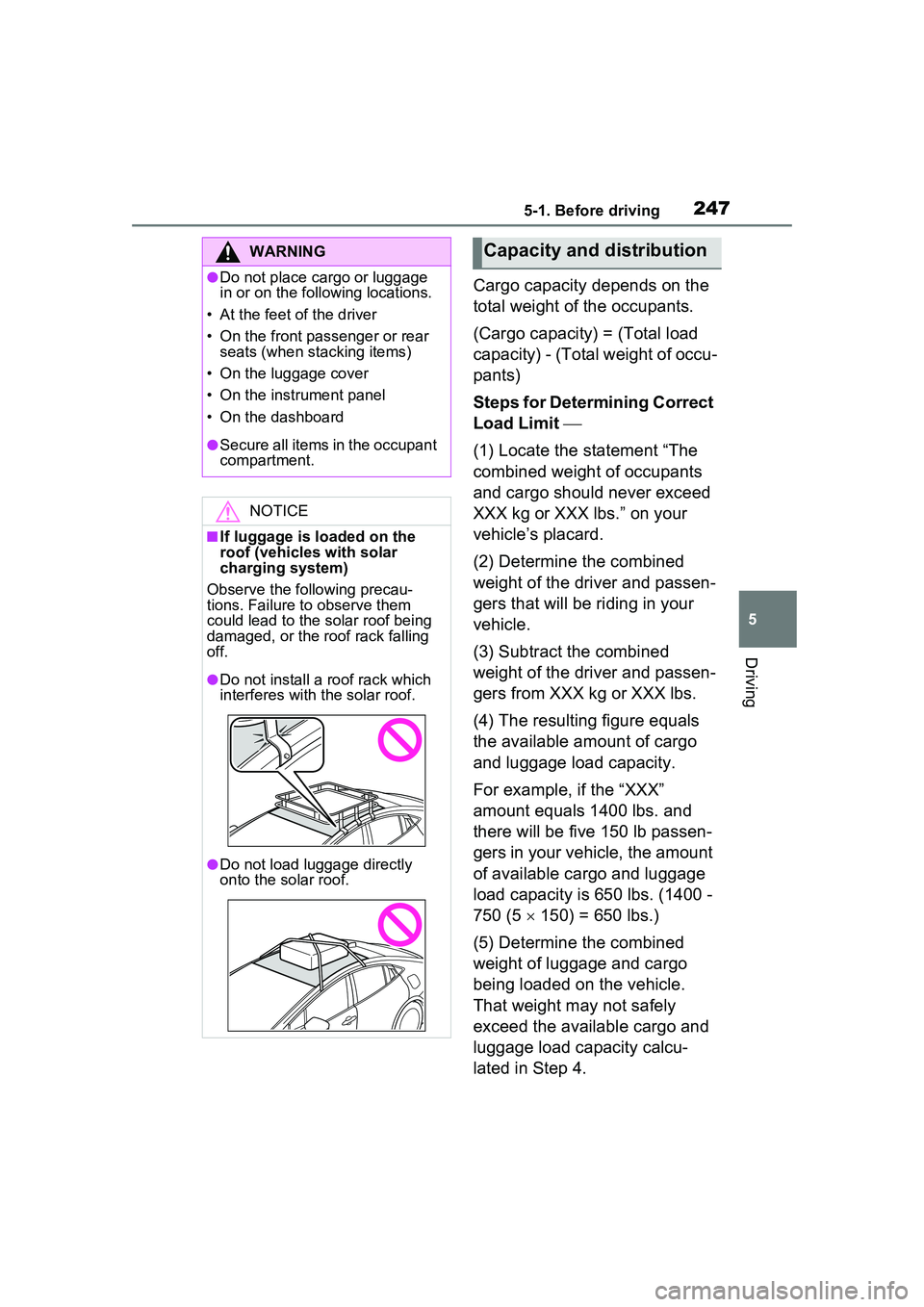
●Do not load luggage directly
onto the solar roof.
Capacity and distribution
Page 248 of 680
2485-1. Before driving
(6) If your vehicle will be towing
a trailer, load from your trailer
will be transferred to your vehi-
cle. Consult this manual to
determine how this reduces the
available cargo and luggage
load capacity of your vehicle.
(P.249)
Toyota does not recommend
towing a trailer with your vehicle.
Your vehicle is not designed for
trailer towing.
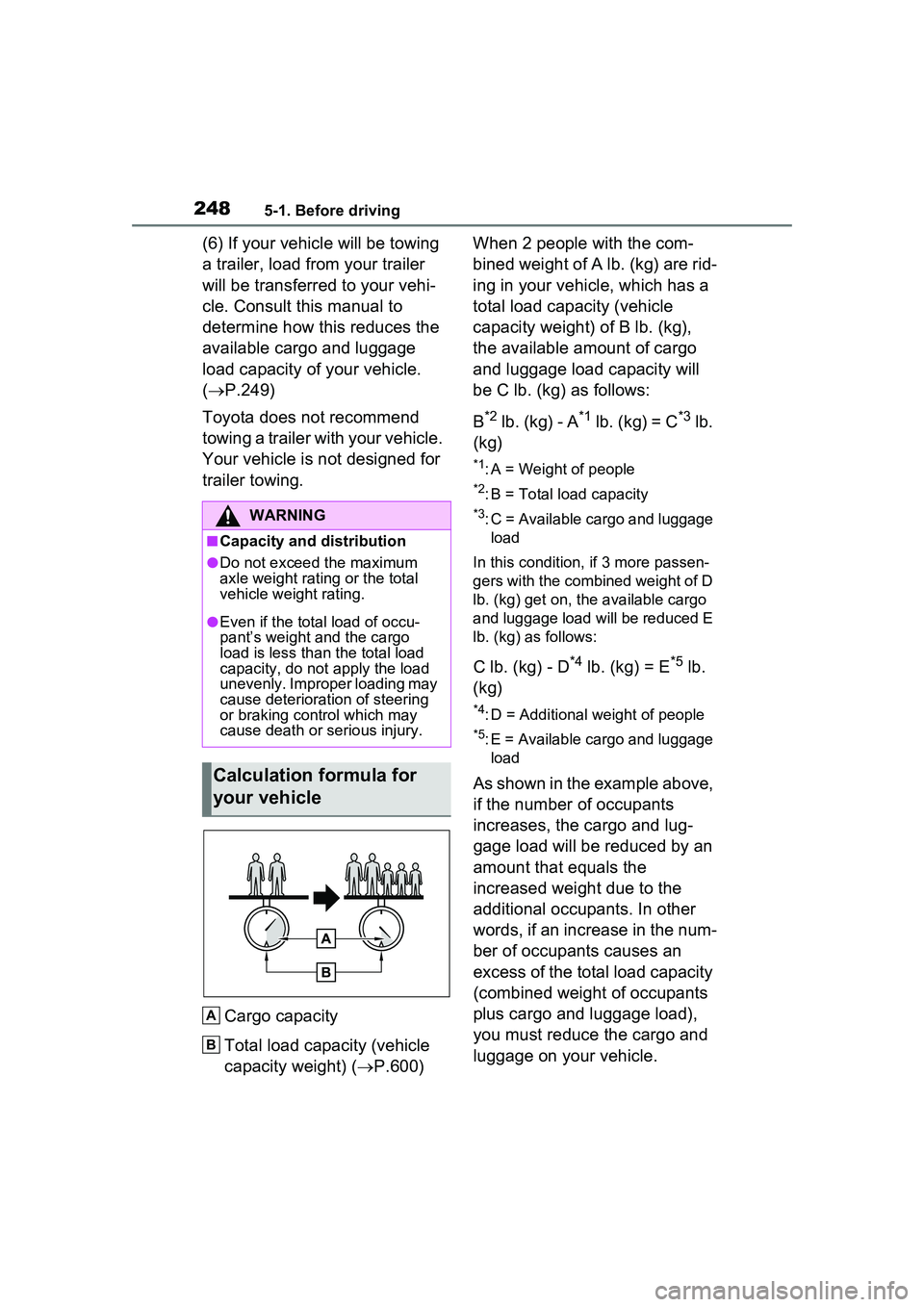
Cargo capacity
Total load capacity (vehicle
capacity weight) ( P.600) When 2 people with the com-
bined weight of A lb. (kg) are rid-
ing in your vehicle, which has a
total load capacity (vehicle
capacity weight) of B lb. (kg),
the available amount of cargo
and luggage load capacity will
be C lb. (kg) as follows:
B
*2 lb. (kg) - A*1 lb. (kg) = C*3 lb.
(kg)
*1: A = Weight of people
*2: B = Total load capacity
*3: C = Available cargo and luggage load
In this condition, if 3 more passen-
gers with the combined weight of D
lb. (kg) get on, the available cargo
and luggage load will be reduced E
lb. (kg) as follows:
C lb. (kg) - D*4 lb. (kg) = E*5 lb.
(kg)
*4: D = Additional weight of people
*5: E = Available cargo and luggage load
As shown in the example above,
if the number of occupants
increases, the cargo and lug-
gage load will be reduced by an
amount that equals the
increased weight due to the
additional occupants. In other
words, if an increase in the num-
ber of occupants causes an
excess of the total load capacity
(combined weight of occupants
plus cargo and luggage load),
you must reduce the cargo and
luggage on your vehicle.
WARNING
■Capacity and distribution
●Do not exceed the maximum
axle weight rating or the total
vehicle weight rating.
●Even if the total load of occu-
pant’s weight and the cargo
load is less than the total load
capacity, do not apply the load
unevenly. Improper loading may
cause deterioration of steering
or braking control which may
cause death or serious injury.
Calculation formula for
your vehicle
A
B
Page 249 of 680
2495-1. Before driving
5
Driving
■Total load capacity and seating
capacity
These details are also described on
the tire and loading information
label. ( P.532)
Vehicle load limits
Vehicle load limits include
total load capacity, seating
capacity, towing capacity
and cargo capacity.
Total load capacity (vehicle
capacity weight): P.600
Total load capacity means the
combined weight of occu-
pants, cargo and luggage.
Seating capacity: P.600
Seating capacity means the
maximum number of occu-
pants whose estimated aver-
age weight is 150 lb. (68 kg)
per person.
Towing capacity
Toyota does not recommend
towing a trailer with your vehi-
cle.
Cargo capacity
Cargo capacity may increase
or decrease depending on the
weight and the number of
occupants.
WARNING
■Overloading the vehicle
Do not overload the vehicle. It
may not only cause damage to
the tires, but also degrade steer-
ing and braking ability, resulting in
an accident.
Page 514 of 680
5147-3. Do-it-yourself maintenance
indicators are showing on a tire.
■When to replace your vehicle’s
tires
Tires should be replaced if:
●The treadwear indicators are
showing on a tire.
●You have tire damage such as
cuts, splits, cracks deep enough
to expose the fabric, and bulges
indicating internal damage
●A tire goes flat repeatedly or can-
not be properly repaired due to
the size or location of a cut or
other damage
If you are not sure, consult your
Toyota dealer.
■Tire life
Any tire over 6 years old must be
checked by a qualified technician
even if it has seldom or never been
used or damage is not obvious.
■Low profile tires (vehicles with
195/50R19 tires)
Generally, low profile tires will wear
more rapidly and tire grip perfor-
mance will be reduced on snowy
and/or icy roads when compared to
standard tires. Be sure to use snow
tires on snowy and/or icy roads and
drive carefully at a speed appropri-
ate for road and weather conditions.
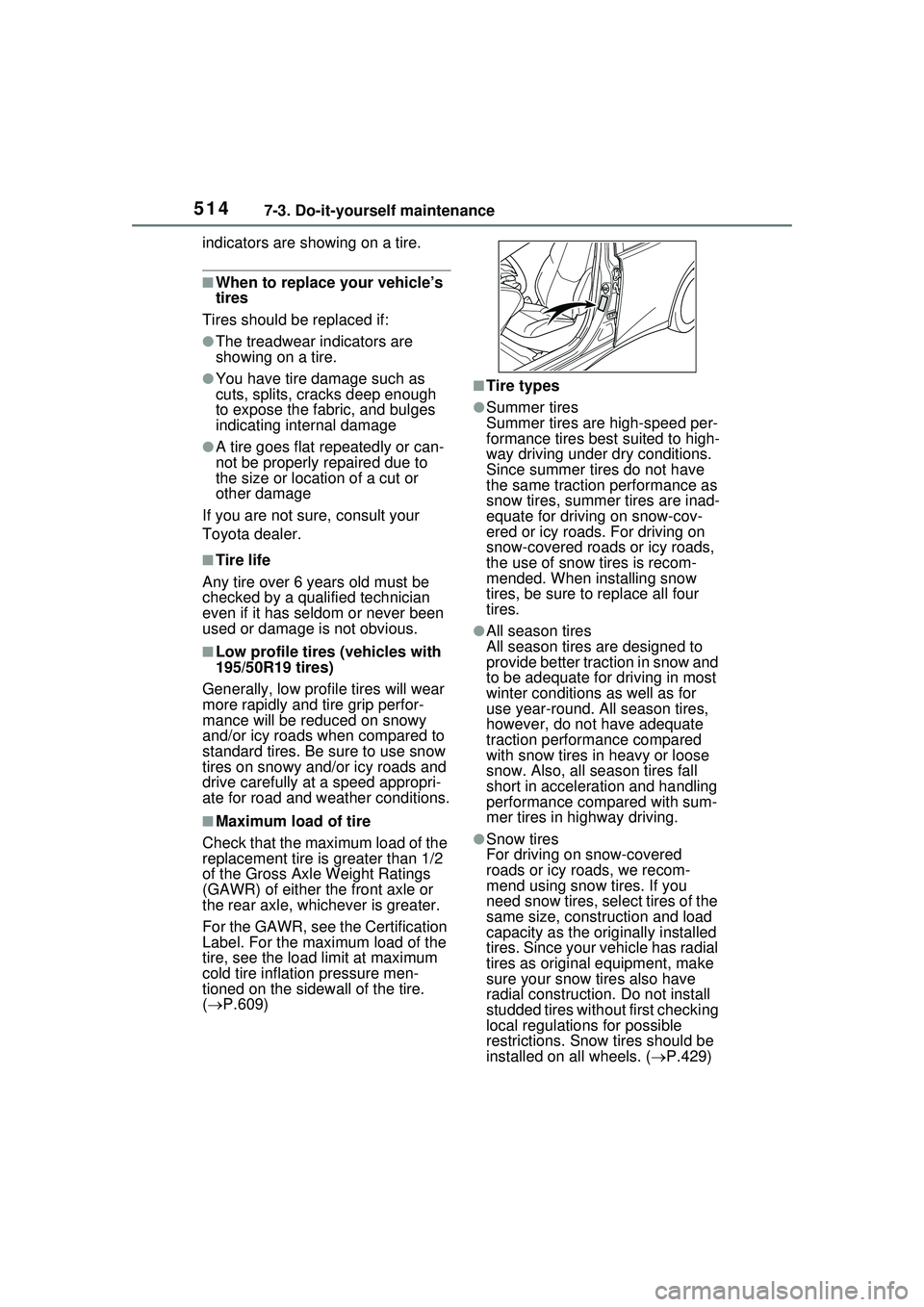
■Maximum load of tire
Check that the maximum load of the
replacement tire is greater than 1/2
of the Gross Axle Weight Ratings
(GAWR) of either the front axle or
the rear axle, whic hever is greater.
For the GAWR, see the Certification
Label. For the maximum load of the
tire, see the load limit at maximum
cold tire inflation pressure men-
tioned on the sidewall of the tire.
( P.609)
■Tire types
●Summer tires
Summer tires are high-speed per-
formance tires best suited to high-
way driving under dry conditions.
Since summer tires do not have
the same traction performance as
snow tires, summer tires are inad-
equate for driving on snow-cov-
ered or icy roads. For driving on
snow-covered roads or icy roads,
the use of snow tires is recom-
mended. When installing snow
tires, be sure to replace all four
tires.
●All season tires
All season tires are designed to
provide better traction in snow and
to be adequate for driving in most
winter conditions as well as for
use year-round. All season tires,
however, do not have adequate
traction performance compared
with snow tires in heavy or loose
snow. Also, all season tires fall
short in acceleration and handling
performance compared with sum-
mer tires in highway driving.
●Snow tires
For driving on snow-covered
roads or icy roads, we recom-
mend using snow tires. If you
need snow tires, select tires of the
same size, construction and load
capacity as the originally installed
tires. Since your vehicle has radial
tires as original equipment, make
sure your snow tires also have
radial construction. Do not install
studded tires without first checking
local regulation s for possible
restrictions. Snow tires should be
installed on all wheels. ( P.429)
Page 533 of 680
5337-3. Do-it-yourself maintenance
7
Maintenance and care
Do not forget to check the spare.
■Effects of incorrect tire inflation
pressure
Driving with incorrec t tire inflation
pressure may result in the following:
●Reduced fuel economy
●Reduced driving comfort and poor
handling
●Reduced tire life due to wear
●Reduced safety
●Damage to the drive train
If a tire needs frequent inflating,
have it checked by your Toyota
dealer.
■Instructions for checking tire
inflation pressure
When checking tire inflation pres-
sure, observe the following:
●Check only when the tires are
cold.
If your vehicle has been parked
for at least 3 hours or has not
been driven for more than 1 mile
or 1.5 km, you will get an accurate
cold tire inflation pressure reading.
●Always use a tire pressure gauge.
It is difficult to judge if a tire is
properly inflated based only on its
appearance.
●It is normal for the tire inflation
pressure to be higher after driving
as heat is generated in the tire. Do
not reduce tire inflation pressure
after driving.
●Never exceed the vehicle capacity
weight. Passengers and luggage
weight should be placed so that
the vehicle is balanced.
WARNING
■Proper inflation is critical to
save tire performance
Keep your tires properly inflated.
If the tires are not properly
inflated, the following conditions
may occur which could lead to an
accident resulting in death or seri-
ous injury:
●Excessive wear
●Uneven wear
●Poor handling
●Possibility of blow outs resulting
from overheated tires
●Air leaking from between tire
and wheel
●Wheel deformation and/or tire
damage
●Greater possibility of tire dam-
age while driving (due to road
hazards, expansion joints,
sharp edges in the road, etc.)
NOTICE
■When inspecting and adjust-
ing tire inflation pressure
Be sure to put the tire valve caps
back on.
If a valve cap is not installed, dirt
or moisture may get into the valve
and cause an air leak, resulting in
decreased tire inflation pressure.
Page 535 of 680
5357-3. Do-it-yourself maintenance
7
Maintenance and care
Use only Toyota wheel nuts
and wrenches designed for
use with your aluminum
wheels.
When rotating, repairing or
changing your tires, check
that the wheel nuts are still
tight after driving 1000 miles
(1600 km).
Be careful not to damage the
aluminum wheels when using
tire chains.
Use only Toyota genuine bal-
ance weights or equivalent
and a plastic or rubber ham-
mer when balancing your
wheels. 1
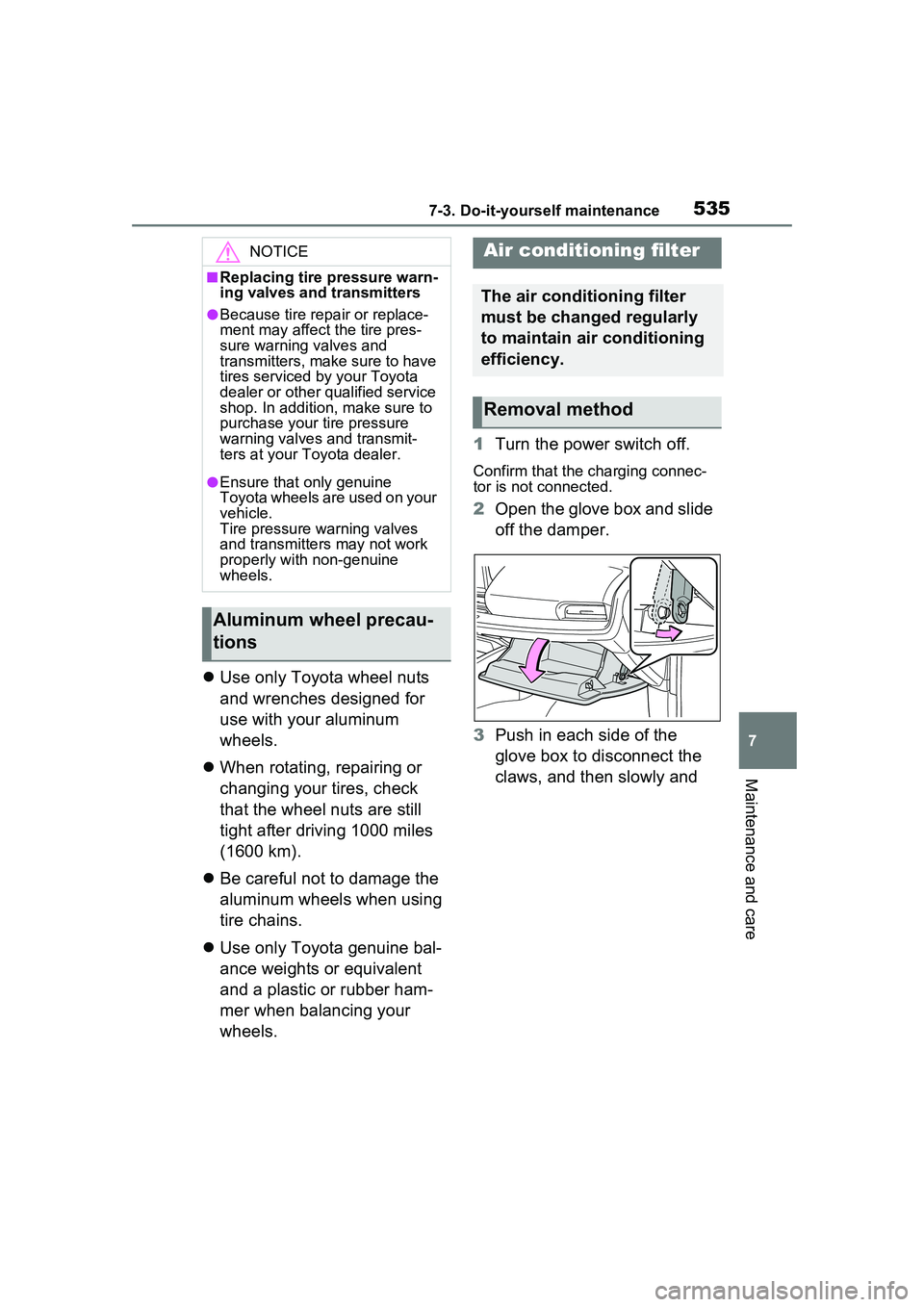
Turn the power switch off.
Confirm that the charging connec-
tor is not connected.
2Open the glove box and slide
off the damper.
3 Push in each side of the
glove box to disconnect the
claws, and then slowly and
NOTICE
■Replacing tire pressure warn-
ing valves and transmitters
●Because tire repair or replace-
ment may affect the tire pres-
sure warning valves and
transmitters, make sure to have
tires serviced by your Toyota
dealer or other qualified service
shop. In addition, make sure to
purchase your tire pressure
warning valves and transmit-
ters at your Toyota dealer.
●Ensure that only genuine
Toyota wheels are used on your
vehicle.
Tire pressure warning valves
and transmitters may not work
properly with non-genuine
wheels.
Aluminum wheel precau-
tions
Air conditioning filter
The air conditioning filter
must be changed regularly
to maintain air conditioning
efficiency.
Removal method