ECU TOYOTA PRIUS V 2013 (in English) Owner's Manual
[x] Cancel search | Manufacturer: TOYOTA, Model Year: 2013, Model line: PRIUS V, Model: TOYOTA PRIUS V 2013Pages: 568, PDF Size: 10.58 MB
Page 160 of 568
160 1-8. Safety information
PRIUS v_OM_OM47820U_(U)
CAUTION
■When installing a child restraint system
Follow the directions given in the child restraint system installation manual
and fix the child restraint system securely in place.
If the child restraint system is not correctly fixed in place, the child or other
passengers may be seriously injured or even killed in the event of sudden
braking, sudden swerving or an accident.
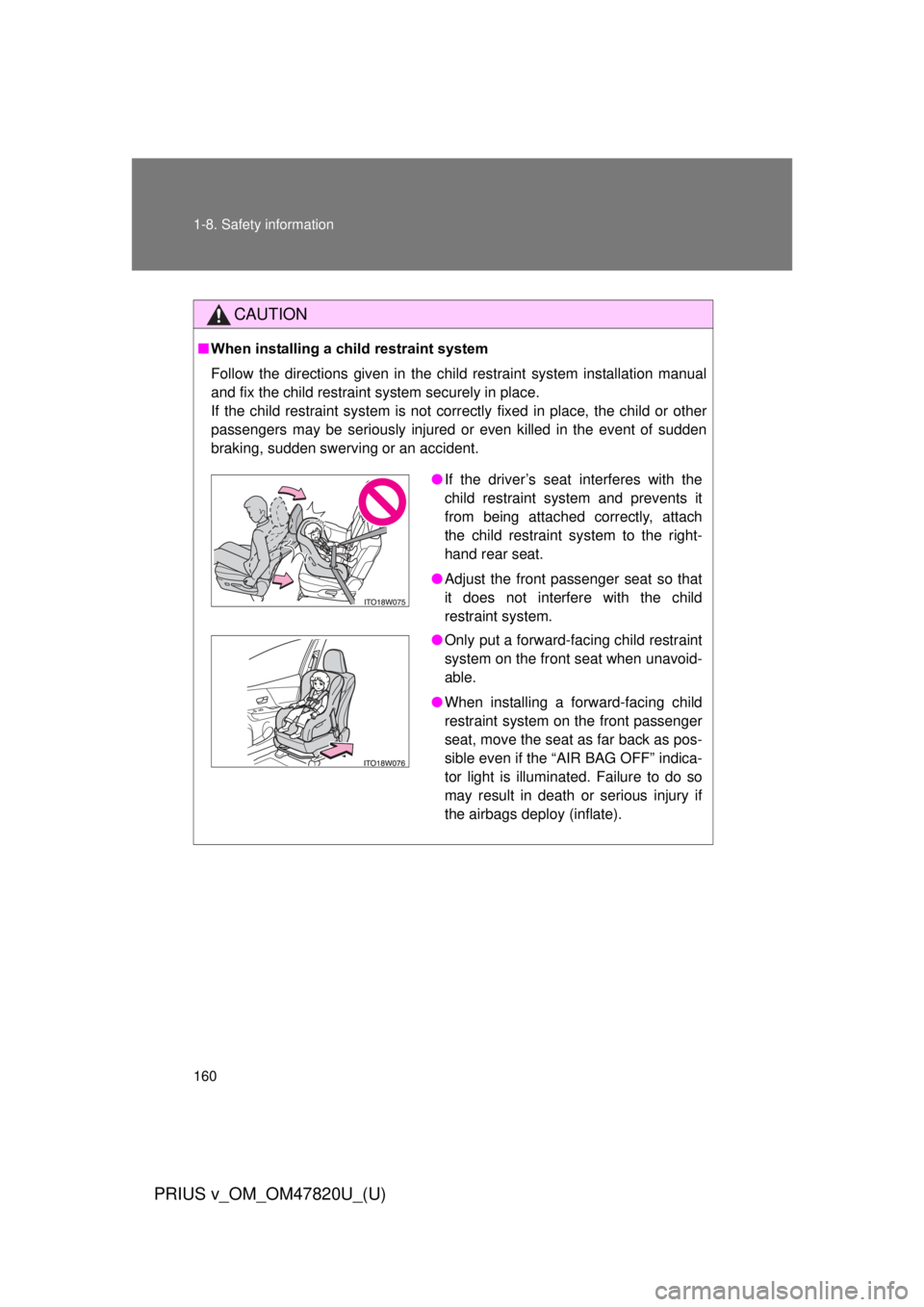
● If the driver’s seat interferes with the
child restraint system and prevents it
from being attached correctly, attach
the child restraint system to the right-
hand rear seat.
● Adjust the front passenger seat so that
it does not interfere with the child
restraint system.
● Only put a forward-facing child restraint
system on the front seat when unavoid-
able.
● When installing a forward-facing child
restraint system on the front passenger
seat, move the seat as far back as pos-
sible even if the “AIR BAG OFF” indica-
tor light is illuminated. Failure to do so
may result in death or serious injury if
the airbags deploy (inflate).
Page 161 of 568
161
1-8. Safety information
1
Before driving
PRIUS v_OM_OM47820U_(U)
CAUTION
■
When installing a child restraint system
● When installing a child restraint system in the rear center seat, adjust both
seat cushions to the same position and align both seatbacks at the same
angle. The seatbacks must be adjusted to the same angle. Otherwise, the
child restraint system cannot be securely restrained and this may cause
death or serious injuries in the event of sudden braking, sudden swerving
or an accident.
● When using the LATCH system, move the seat as far back as possible
and adjust the seatback as upright as possible.
● When a booster seat is installed, always ensure that the shoulder belt is
positioned across the center of the child’s shoulder. The belt should be
kept away from the child’s neck, but not so that it could fall off the child’s
shoulder. Failing to do so may result in death or serious injury in the event
of sudden braking, sudden swerving or an accident.
● Ensure that the belt and plate are securely locked and the seat belt is not
twisted.
● Push and pull the child restraint system from side to side and forward to be
sure it is secure.
● After securing a child restraint system, never adjust the seat.
● Follow all installation instructions provided by the child restraint system
manufacturer.
Page 162 of 568

162 1-8. Safety information
PRIUS v_OM_OM47820U_(U)
CAUTION
■Do not use a seat belt extender
If a seat belt extender is used when installing a child restraint system, the
seat belt will not securely hold the child restraint system, which could cause
death or serious injury to the child or other passengers in the event of sud-
den braking, sudden swerving or an accident.
■ To correctly attach a child r estraint system to the anchors
When using the LATCH anchors, be sure that there are no foreign objects
around the anchors and that the seat belt is not caught behind the child
restraint system. Make sure the child restraint system is securely attached,
or it may cause death or serious injury to the child or other passengers in the
event of a sudden stop, sudden swerve or accident.
Page 170 of 568
170 2-1. Driving procedures
PRIUS v_OM_OM47820U_(U)
CAUTION
■When the vehicle is stopped
● Do not depress the accelerator pedal unnecessarily.
If the vehicle is in any shift position other than P or N, the vehicle may
accelerate suddenly and unexpectedly, causing an accident.
● Do not leave the vehicle with the hybrid system on for a long time.
If such a situation cannot be avoided, park the vehicle in an open space
and check that exhaust fumes do not enter the vehicle interior.
● In order to prevent accidents due to the vehicle rolling away, always keep
depressing the brake pedal while the “READY” indicator is on. Apply the
parking brake as necessary.
● If the vehicle is stopped on an incline, in order to prevent accidents caused
by the vehicle rolling forward or backward, always depress the brake pedal
and securely apply the parking brake as needed.
● Avoid revving or racing the engine.
Running the engine at high speed while the vehicle is stopped may cause
the exhaust system to overheat, which could result in a fire if combustible
material is nearby.
■ When the vehicle is parked
● Make sure to firmly apply the parking brake and shift the shift position to P.
Failure to do so may cause the vehicle to move, or the vehicle to acceler-
ate suddenly if the accelerator pedal is accidentally depressed. Also, when
leaving the vehicle, make sure to turn off the hybrid system and lock the
vehicle.
Sound or shuddering may not be noticed even when the hybrid vehicle is
ready to drive (when the “READY” indicator is illuminated).
Page 172 of 568
172 2-1. Driving procedures
PRIUS v_OM_OM47820U_(U)
CAUTION
■Exhaust gases
Exhaust gases include harmful carbon monoxide (CO), which is colorless
and odorless. Inhaling exhaust gases may lead to death or a serious health
hazard.
● If the vehicle is in a poorly ventilated area, stop the hybrid system. In a
closed area, such as a garage, exhaust gases may collect and enter the
vehicle. This may lead to death or a serious health hazard.
● The exhaust system should be checked occasionally. If there is a hole or
crack caused by corrosion, damage to a joint or abnormal exhaust noise,
be sure to have the vehicle inspected and repaired by your Toyota dealer.
Failure to do so may allow exhaust gases to enter the vehicle, resulting in
death or a serious health hazard.
■ When taking a nap in the vehicle
Always turn the hybrid system off. Otherwise, if you accidentally move the
shift lever or depress the accelerator pedal, this could cause an accident or
fire due to hybrid system overheating. Additionally, if the vehicle is parked in
a poorly ventilated area, exhaust gases may collect and enter the vehicle,
leading to death or a serious health hazard.
■ When braking
● When the brakes are wet, drive more cautiously.
Braking distance increases when the brakes are wet, and this may cause
one side of the vehicle to brake differently than the other side. Also, the
parking brake may not securely hold the vehicle.
● If the electronically controlled assist function does not operate, do not fol-
low other vehicles closely and avoid downhill or sharp turns that require
braking.
In this case, braking is still possible, but the brake pedal should be
depressed more firmly than usual. Also, the braking distance will increase.
● The brake system consists of 2 individual hydraulic systems; if one of the
systems fails, the others will still operate. In this case, the brake pedal
should be depressed more firmly than usual and the braking distance will
increase. If this happens, do not continue to drive the vehicle. If the brake
system warning light (red indicator) comes on while driving, immediately
stop the vehicle in a safe place and contact your Toyota dealer.
Page 193 of 568
193
2-1. Driving procedures
PRIUS v_OM_OM47820U_(U)
2
When driving
NOTICE
■
Hybrid battery (tract ion battery) charge
If the shift position is in N, the hybrid battery (traction battery) will not be
charged. To help prevent the battery from discharging, avoid leaving the N
position selected for an extended period of time.
■ Situations where P position contro l system malfunctions are possible
If any of the following situations occurs, P position control system malfunc-
tions are possible.
Immediately stop the vehicle in a safe place on level ground, apply the park-
ing brake, and then contact your Toyota dealer.
● When the “P LOCK MALFUNCTION WHEN PARKING, PARK IN FLAT
PLACE AND APPLY PARKING BRAKE SECURELY” warning message
appears on the instrument cluster. ( P. 450)
● When the parking lock system warning light is illuminated.
● When everything except the shift position indicator selection frame is illu-
minated.
● When the shift position indicator remains off.
■ Notes regarding shift lever an d P position switch operation
Avoid repeatedly operating the shift lever and P position switch in quick suc-
cession.
The system protection function may activate and it will not be temporarily
possible to shift the shift position other than P. If this happens, please wait
for a while before attempting to change the shift position again.
Page 196 of 568
196
2-1. Driving procedures
PRIUS v_OM_OM47820U_(U)
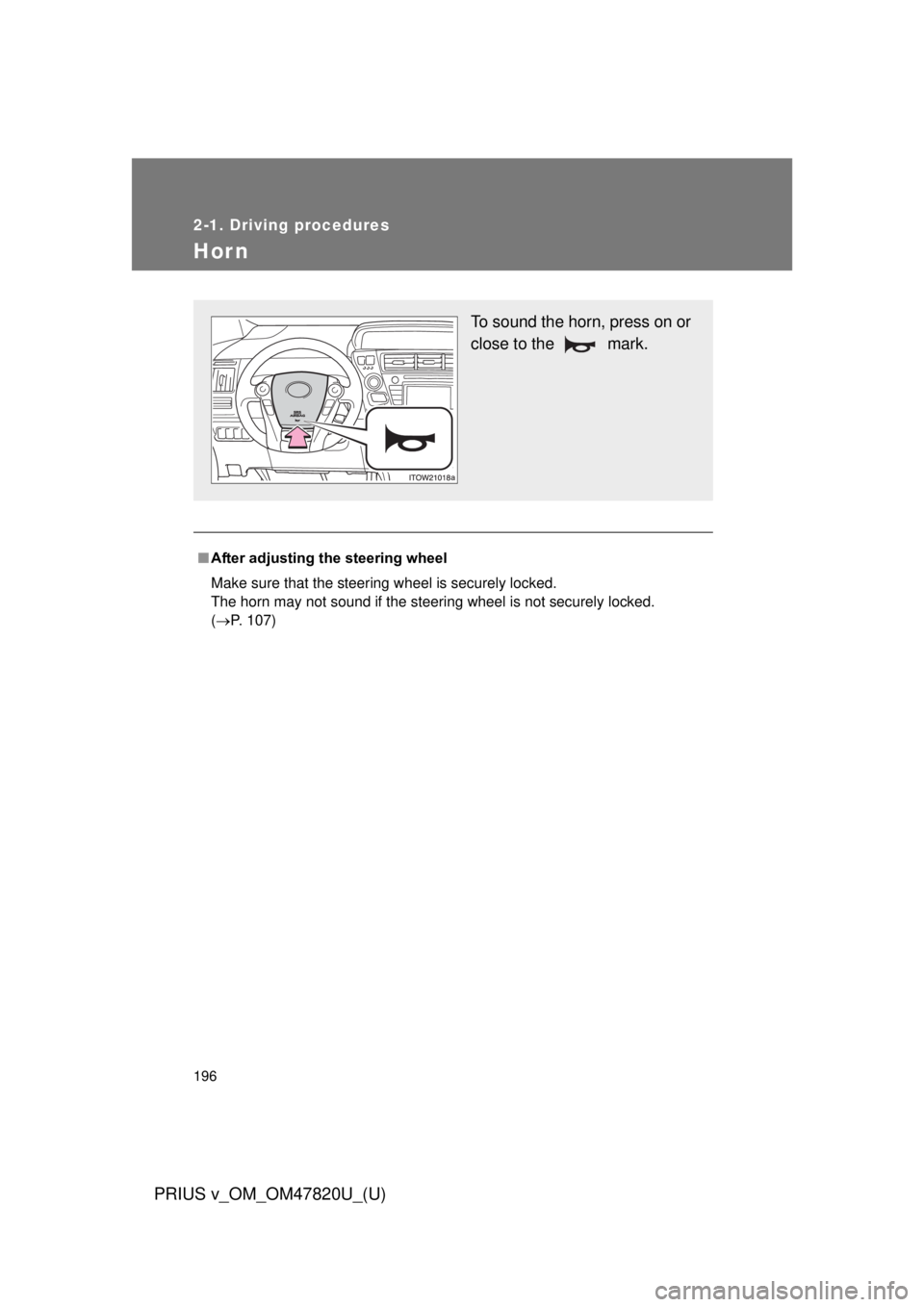
Hor n
■After adjusting the steering wheel
Make sure that the steering wheel is securely locked.
The horn may not sound if the steering wheel is not securely locked.
(P. 107)
To sound the horn, press on or
close to the mark.
Page 209 of 568
209
2-2. Instrument cluster
PRIUS v_OM_OM47820U_(U)
2
When driving
■
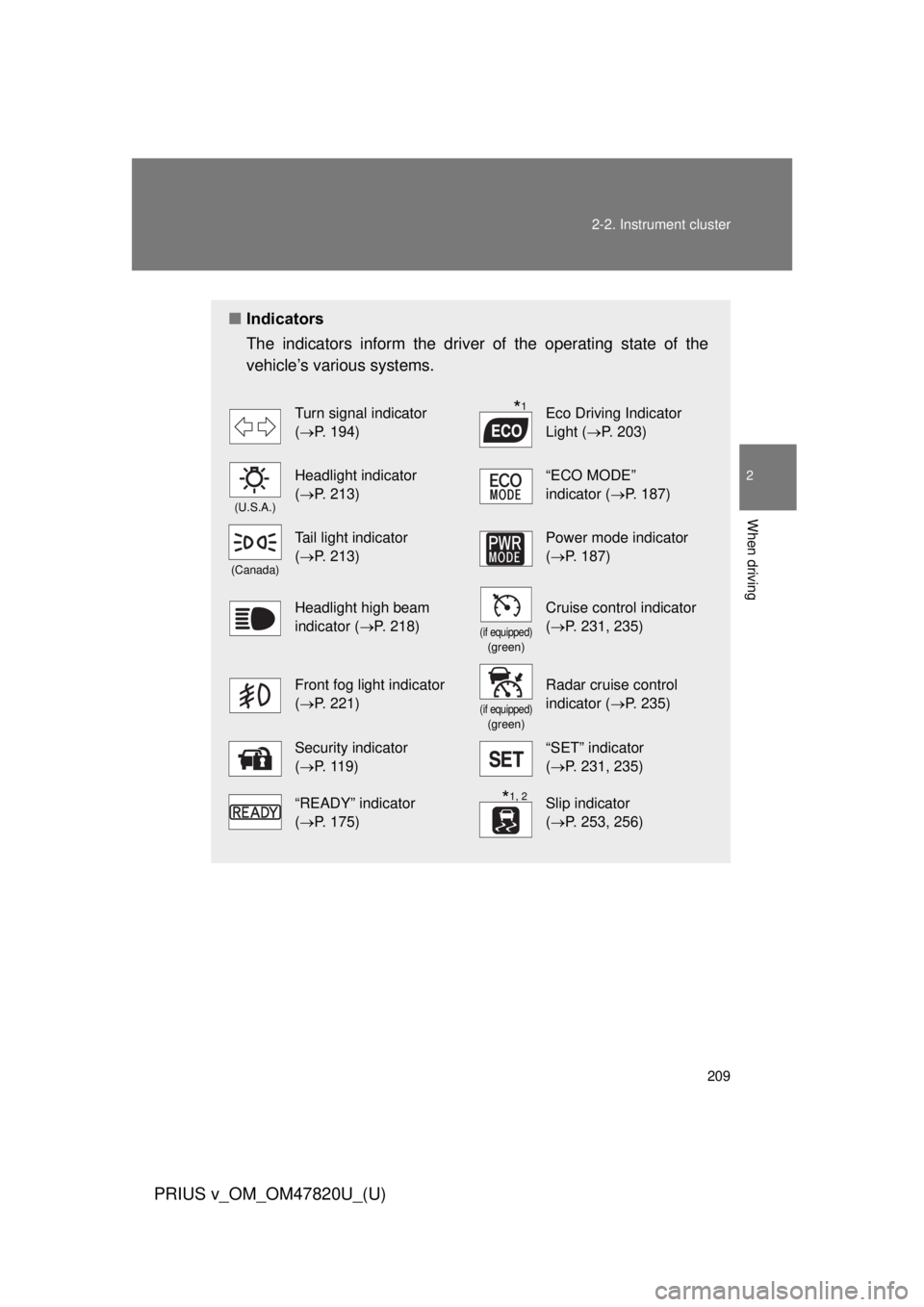
Indicators
The indicators inform the driver of the operating state of the
vehicle’s various systems.
Turn signal indicator
(P. 194)Eco Driving Indicator
Light ( P. 203)
(U.S.A.)
Headlight indicator
(P. 213)“ECO MODE”
indicator ( P. 187)
(Canada)
Tail light indicator
(P. 213)Power mode indicator
(P. 187)
Headlight high beam
indicator ( P. 218)
(if equipped)(green)
Cruise control indicator
(P. 231, 235)
Front fog light indicator
(P. 221)
(if equipped)(green)
Radar cruise control
indicator ( P. 235)
Security indicator
(P. 1 1 9 )“SET” indicator
(P. 231, 235)
“READY” indicator
(P. 175)Slip indicator
(P. 253, 256)
*1
*1, 2
Page 221 of 568
221
2-3. Operating the lights and windshield wipers
PRIUS v_OM_OM47820U_(U)
2
When driving
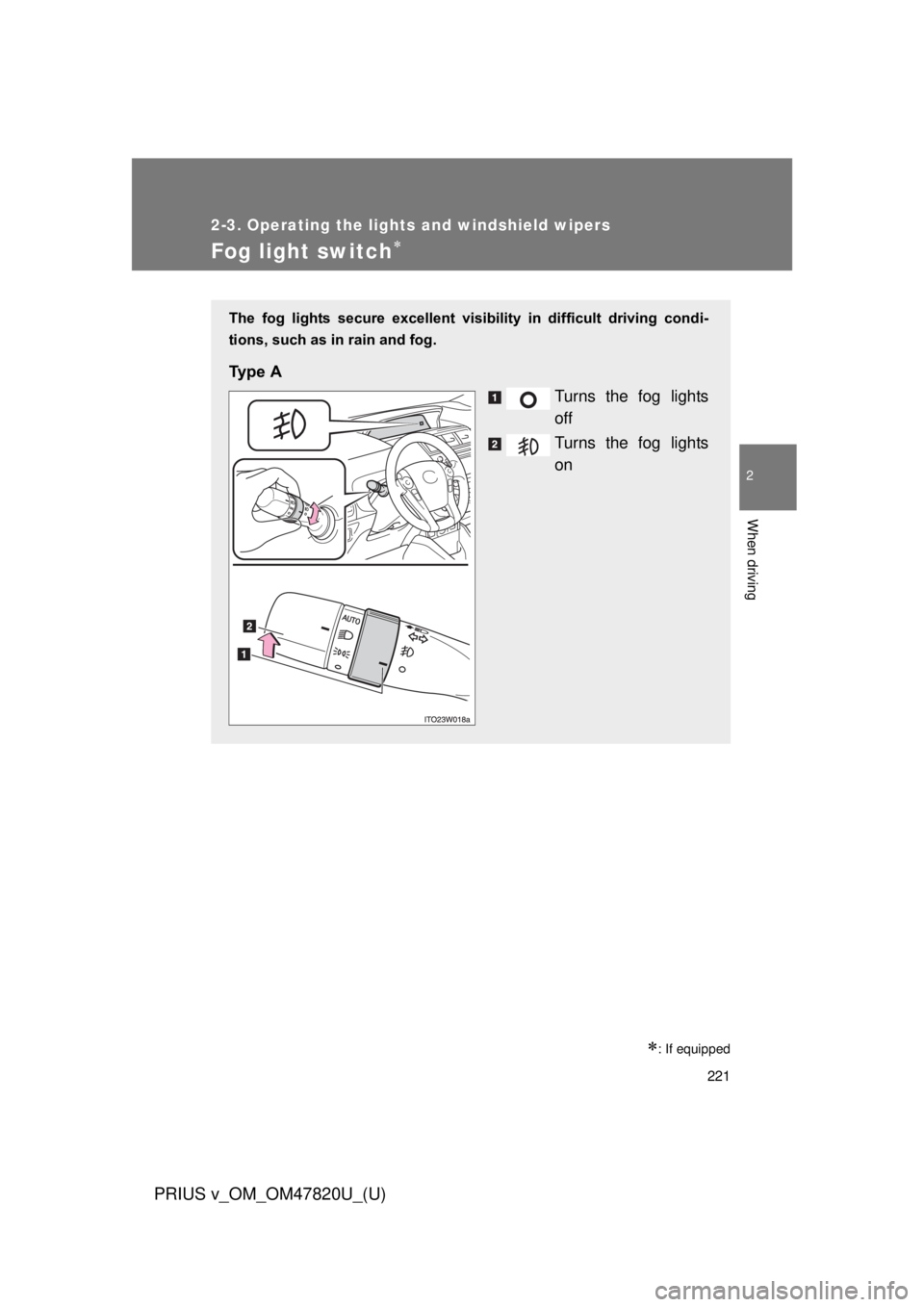
Fog light switch
: If equipped
The fog lights secure excellent visibility in difficult driving condi-
tions, such as in rain and fog.
Ty p e A
Turns the fog lights
off
Turns the fog lights
on
Page 266 of 568
266
PRIUS v_OM_OM47820U_(U)
2-5. Driving information
Cargo and luggage
Take notice of the following information about storage precau-
tions, cargo capacity and load:
●Stow cargo and luggage in the luggage compartment whenever
possible.
● Be sure all items are secured in place.
● To maintain vehicle balance while driving, position luggage
evenly within the luggage compartment.
● For better fuel economy, do no t carry unnecessary weight.