belt TOYOTA PROACE CITY VERSO 2020 Owners Manual
[x] Cancel search | Manufacturer: TOYOTA, Model Year: 2020, Model line: PROACE CITY VERSO, Model: TOYOTA PROACE CITY VERSO 2020Pages: 272, PDF Size: 58.6 MB
Page 2 of 272
2
■Overview
Labels 4
■Eco-driving
Eco-coaching 8
1Instruments
Instrument Panel 9Warning and indicator lamps 11Indicators 16Trip computer 21Setting the date and time 22
2Access
Electronic key with remote control function and built-in key, 23Back-up procedures 28Central locking / unlocking 31Doors 32General recommendations for the sliding side
doors 32Alarm 34Electric windows 36Tilting rear door windows 37
3Ease of use and comfort
General recommendations for the seats 38Front seats 38Steering wheel adjustment 41
Mirrors 41
Rear bench seat (row 2) 42Rear seats (row 2) 43Rear seats (row 3) 44Interior fittings 47Two-position luggage cover shelf (removable) 52Luggage cover (7-seat) 52Warning triangle 53Heating and Ventilation 54Heating 54Manual air conditioning 54Dual-zone automatic air conditioning 55Front demisting - defrosting 57Rear screen demisting - defrosting 58Rear heating and air conditioning 59Additional heating/ventilation system 59
4Lighting and visibility
Lighting control lever 63Direction indicators 64Automatic illumination of headlamps 64Daytime running lamps / Sidelamps 65Parking lamps 65
Automatic headlamp dipping 66Headlamp beam height adjustment 67Wiper control lever 67Changing a wiper blade 69Automatic wiping 70
5Safety
General safety recommendations 71Emergency or assistance call 71
Hazard warning lamps 74Horn 74Electronic stability control (ESC) 74Advanced Grip Control 76Hill Assist Descent Control 78Seat belts 79Airbags 81Child seats 84Deactivating the front passenger airbag 87ISOFIX child seats 90i-Size child seats 93Manual child lock 94Electric child lock 94
6Driving
Driving recommendations 95Starting/switching off the engine 97Manual parking brake 100Electric parking brake 101Hill start assist 1045-speed manual gearbox 1046-speed manual gearbox 105
Automatic gearbox 105Gear efficiency indicator 109Stop & Start 109Under-inflation detection 111Head-up display 11 3Driving and manoeuvring aids - General recommendations 11 4Speed Limit Recognition and Recommendation 11 6
Speed limiter 11 9
Page 5 of 272
5
Overview
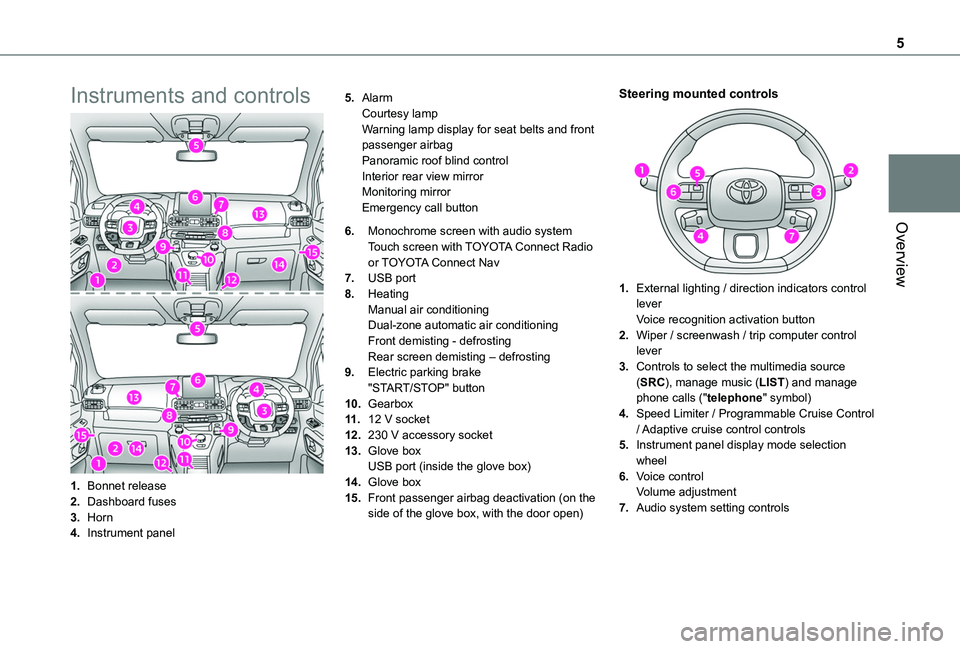
Instruments and controls
1.Bonnet release
2.Dashboard fuses
3.Horn
4.Instrument panel
5.AlarmCourtesy lampWarning lamp display for seat belts and front passenger airbagPanoramic roof blind controlInterior rear view mirrorMonitoring mirrorEmergency call button
6.Monochrome screen with audio system
Touch screen with TOYOTA Connect Radio or TOYOTA Connect Nav
7.USB port
8.HeatingManual air conditioningDual-zone automatic air conditioningFront demisting - defrostingRear screen demisting – defrosting
9.Electric parking brake"START/STOP" button
10.Gearbox
11 .12 V socket
12.230 V accessory socket
13.Glove boxUSB port (inside the glove box)
14.Glove box
15.Front passenger airbag deactivation (on the side of the glove box, with the door open)
Steering mounted controls
1.External lighting / direction indicators control leverVoice recognition activation button
2.Wiper / screenwash / trip computer control lever
3.Controls to select the multimedia source (SRC), manage music (LIST) and manage phone calls ("telephone" symbol)
4.Speed Limiter / Programmable Cruise Control / Adaptive cruise control controls
5.Instrument panel display mode selection wheel
6.Voice controlVolume adjustment
7.Audio system setting controls
Page 12 of 272
12
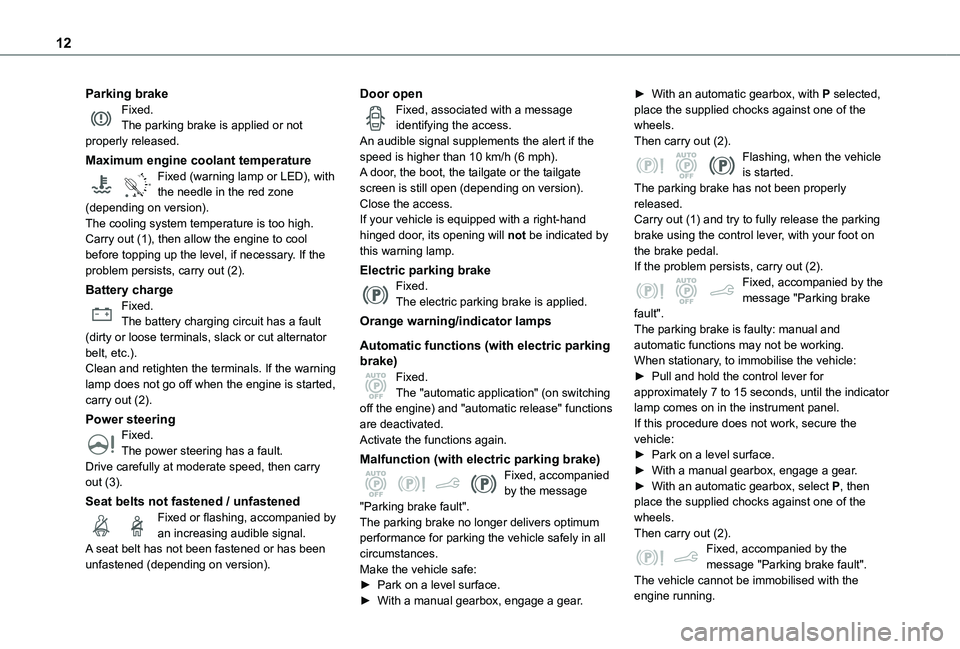
Parking brakeFixed.The parking brake is applied or not properly released.
Maximum engine coolant temperature
90°CFixed (warning lamp or LED), with the needle in the red zone (depending on version).The cooling system temperature is too high.Carry out (1), then allow the engine to cool before topping up the level, if necessary. If the problem persists, carry out (2).
Battery chargeFixed.The battery charging circuit has a fault (dirty or loose terminals, slack or cut alternator belt, etc.).Clean and retighten the terminals. If the warning lamp does not go off when the engine is started, carry out (2).
Power steeringFixed.
The power steering has a fault.Drive carefully at moderate speed, then carry out (3).
Seat belts not fastened / unfastenedFixed or flashing, accompanied by an increasing audible signal.A seat belt has not been fastened or has been unfastened (depending on version).
Door openFixed, associated with a message identifying the access.An audible signal supplements the alert if the speed is higher than 10 km/h (6 mph).A door, the boot, the tailgate or the tailgate screen is still open (depending on version).Close the access.If your vehicle is equipped with a right-hand hinged door, its opening will not be indicated by this warning lamp.
Electric parking brakeFixed.The electric parking brake is applied.
Orange warning/indicator lamps
Automatic functions (with electric parking brake)Fixed.The "automatic application" (on switching off the engine) and "automatic release" functions are deactivated.Activate the functions again.
Malfunction (with electric parking brake)Fixed, accompanied by the message "Parking brake fault".The parking brake no longer delivers optimum performance for parking the vehicle safely in all circumstances.Make the vehicle safe:► Park on a level surface.
► With a manual gearbox, engage a gear.
► With an automatic gearbox, with P selected, place the supplied chocks against one of the wheels.Then carry out (2).Flashing, when the vehicle is started.The parking brake has not been properly released.Carry out (1) and try to fully release the parking brake using the control lever, with your foot on the brake pedal.If the problem persists, carry out (2).Fixed, accompanied by the message "Parking brake fault".The parking brake is faulty: manual and automatic functions may not be working.When stationary, to immobilise the vehicle:► Pull and hold the control lever for approximately 7 to 15 seconds, until the indicator lamp comes on in the instrument panel.If this procedure does not work, secure the vehicle:
► Park on a level surface.► With a manual gearbox, engage a gear.► With an automatic gearbox, select P, then place the supplied chocks against one of the wheels.Then carry out (2).Fixed, accompanied by the message "Parking brake fault".The vehicle cannot be immobilised with the
engine running.
Page 14 of 272
14
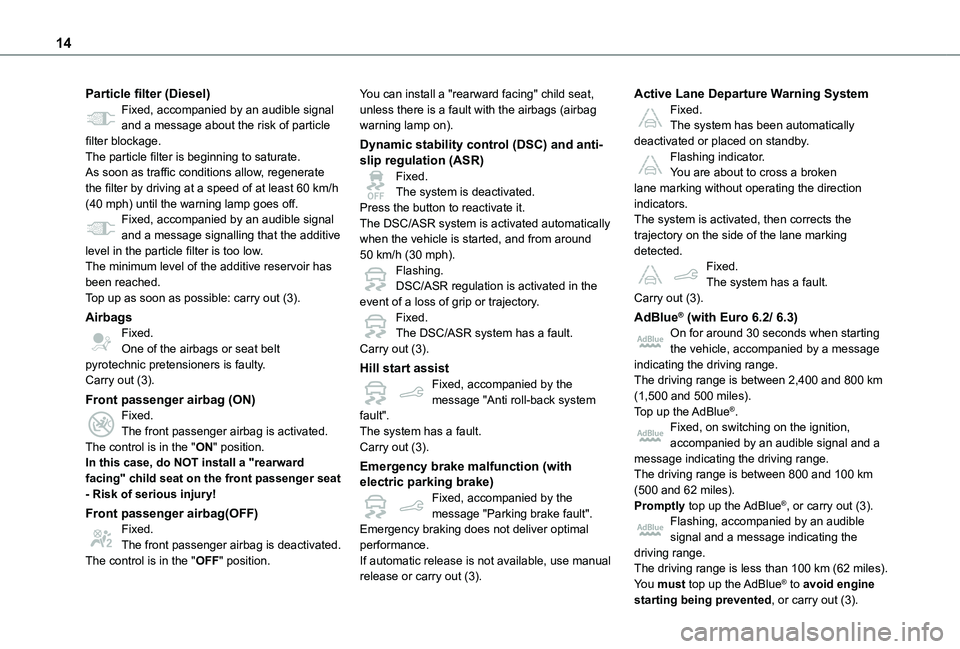
Particle filter (Diesel)Fixed, accompanied by an audible signal and a message about the risk of particle filter blockage.The particle filter is beginning to saturate.As soon as traffic conditions allow, regenerate the filter by driving at a speed of at least 60 km/h (40 mph) until the warning lamp goes off.Fixed, accompanied by an audible signal and a message signalling that the additive level in the particle filter is too low.The minimum level of the additive reservoir has been reached.Top up as soon as possible: carry out (3).
AirbagsFixed.One of the airbags or seat belt pyrotechnic pretensioners is faulty.Carry out (3).
Front passenger airbag (ON)Fixed.The front passenger airbag is activated.
The control is in the "ON" position.In this case, do NOT install a "rearward facing" child seat on the front passenger seat - Risk of serious injury!
Front passenger airbag(OFF)Fixed.The front passenger airbag is deactivated.The control is in the "OFF" position.
You can install a "rearward facing" child seat, unless there is a fault with the airbags (airbag warning lamp on).
Dynamic stability control (DSC) and anti-slip regulation (ASR)Fixed.The system is deactivated.Press the button to reactivate it.The DSC/ASR system is activated automatically when the vehicle is started, and from around 50 km/h (30 mph).Flashing.DSC/ASR regulation is activated in the event of a loss of grip or trajectory.Fixed.The DSC/ASR system has a fault.Carry out (3).
Hill start assistFixed, accompanied by the message "Anti roll-back system fault".The system has a fault.
Carry out (3).
Emergency brake malfunction (with electric parking brake)Fixed, accompanied by the message "Parking brake fault".Emergency braking does not deliver optimal performance.If automatic release is not available, use manual release or carry out (3).
Active Lane Departure Warning SystemFixed.The system has been automatically deactivated or placed on standby.Flashing indicator.You are about to cross a broken lane marking without operating the direction indicators.The system is activated, then corrects the trajectory on the side of the lane marking detected.Fixed.The system has a fault.Carry out (3).
AdBlue® (with Euro 6.2/ 6.3)On for around 30 seconds when starting the vehicle, accompanied by a message indicating the driving range.The driving range is between 2,400 and 800 km (1,500 and 500 miles).Top up the AdBlue®.Fixed, on switching on the ignition, accompanied by an audible signal and a
message indicating the driving range.The driving range is between 800 and 100 km (500 and 62 miles).Promptly top up the AdBlue®, or carry out (3).Flashing, accompanied by an audible signal and a message indicating the driving range.The driving range is less than 100 km (62 miles).You must top up the AdBlue® to avoid engine
starting being prevented, or carry out (3).
Page 38 of 272
38
General
recommendations for the
seats
WARNI NG
For safety reasons, seat adjustments must only be made when the vehicle is stationary.
WARNI NG
Folding or unfolding the seat backrests must only be done with the vehicle stationary.
WARNI NG
Before moving the seat backwards, ensure that there is no person or object that might prevent the full travel of the seat.There is a risk of trapping or pinching
passengers if present in the rear seats or of jamming the seat if large objects are placed on the floor behind the seat.
WARNI NG
Do not place hard or heavy objects on the backrests forming a table. They could become
dangerous projectiles in the event of sudden braking or a collision.– Do not remove a head restraint without stowing it; secure it to a support inside the vehicle.– Check that the seat belts remain accessible to the passenger and easy to fasten.– Passengers must never take their seat without adjusting and fastening their seat belt.– In row 3, be careful not to leave your feet under the row 2 seat while it is being tilted.– When a row 3 seat is in the fully folded position, ensure that the strap is correctly hooked to the Top Tether fixing of the row 2 backrest: risk of unexpected tipping of the seat.
WARNI NG
Before carrying out the manoeuvres, check that nothing and no one is obstructing the moving elements and their locking.
To avoid sudden folding, take care to hold the backrest and support it until it is horizontal.Never put your hand underneath the seat cushion to guide the seat downwards or upwards, you could get your fingers trapped. Place your hand on the grip/strap (depending on equipment) at the top of the seat cushion.
WARNI NG
Please note: an incorrectly latched backrest compromises the safety of passengers in the event of sudden braking or an impact.The contents of the boot may be thrown forward - risk of severe injury!
Front seats
Correct driving position
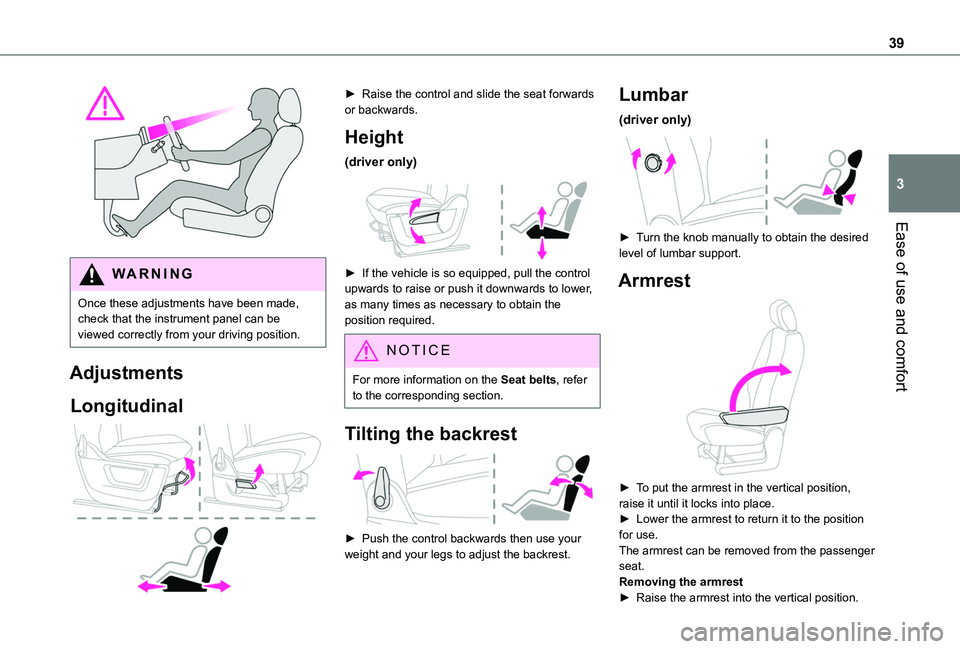
Before taking to the road and to make the most of the ergonomic layout of the instruments and controls, carry out these adjustments in the following order:– head restraint height.– seat backrest angle.– seat cushion height.– longitudinal seat position.– steering wheel height and reach.– rear view mirror and door mirrors.
Page 39 of 272
39
Ease of use and comfort
3
WARNI NG
Once these adjustments have been made, check that the instrument panel can be viewed correctly from your driving position.
Adjustments
Longitudinal
► Raise the control and slide the seat forwards or backwards.
Height
(driver only)
► If the vehicle is so equipped, pull the control upwards to raise or push it downwards to lower, as many times as necessary to obtain the position required.
NOTIC E
For more information on the Seat belts, refer to the corresponding section.
Tilting the backrest
► Push the control backwards then use your weight and your legs to adjust the backrest.
Lumbar
(driver only)
► Turn the knob manually to obtain the desired level of lumbar support.
Armrest
► To put the armrest in the vertical position, raise it until it locks into place.► Lower the armrest to return it to the position for use.The armrest can be removed from the passenger seat.Removing the armrest
► Raise the armrest into the vertical position.
Page 43 of 272
43
Ease of use and comfort
3
► check that nothing or no person might interfere with the folding of the backrests (clothing, luggage, etc.),► check that the outer seat belts are lying flat on the backrests.
NOTIC E
The folding of the backrest is accompanied by a slight lowering of the corresponding seat
cushion.When the backrest is released, the red indicator is visible in the release grips on the outer seats.
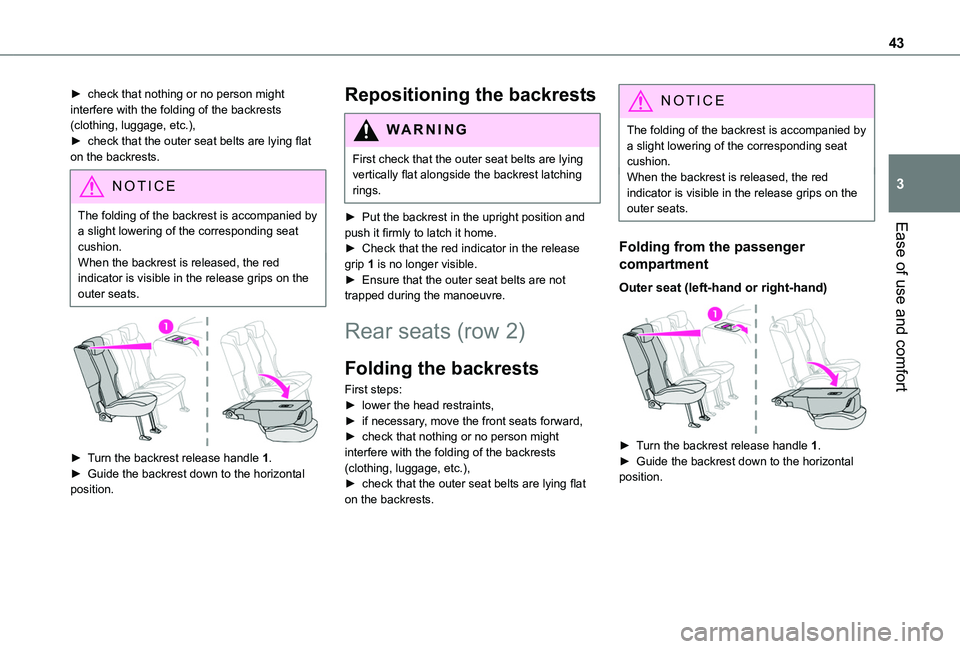
► Turn the backrest release handle 1.► Guide the backrest down to the horizontal
position.
Repositioning the backrests
WARNI NG
First check that the outer seat belts are lying vertically flat alongside the backrest latching rings.
► Put the backrest in the upright position and push it firmly to latch it home.
► Check that the red indicator in the release grip 1 is no longer visible.► Ensure that the outer seat belts are not trapped during the manoeuvre.
Rear seats (row 2)
Folding the backrests
First steps:► lower the head restraints,► if necessary, move the front seats forward,► check that nothing or no person might interfere with the folding of the backrests (clothing, luggage, etc.),► check that the outer seat belts are lying flat on the backrests.
NOTIC E
The folding of the backrest is accompanied by a slight lowering of the corresponding seat cushion.When the backrest is released, the red indicator is visible in the release grips on the outer seats.
Folding from the passenger
compartment
Outer seat (left-hand or right-hand)
► Turn the backrest release handle 1.► Guide the backrest down to the horizontal position.
Page 44 of 272
44
Central seat
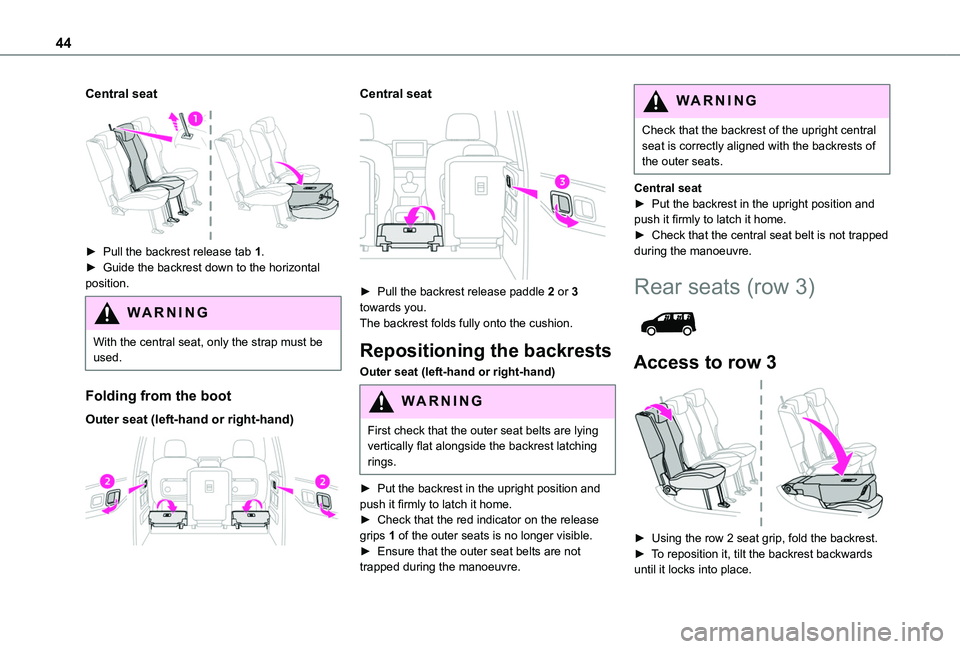
► Pull the backrest release tab 1.► Guide the backrest down to the horizontal position.
WARNI NG
With the central seat, only the strap must be used.
Folding from the boot
Outer seat (left-hand or right-hand)
Central seat
► Pull the backrest release paddle 2 or 3 towards you.The backrest folds fully onto the cushion.
Repositioning the backrests
Outer seat (left-hand or right-hand)
WARNI NG
First check that the outer seat belts are lying vertically flat alongside the backrest latching rings.
► Put the backrest in the upright position and push it firmly to latch it home.► Check that the red indicator on the release grips 1 of the outer seats is no longer visible.
► Ensure that the outer seat belts are not trapped during the manoeuvre.
WARNI NG
Check that the backrest of the upright central seat is correctly aligned with the backrests of the outer seats.
Central seat► Put the backrest in the upright position and push it firmly to latch it home.► Check that the central seat belt is not trapped during the manoeuvre.
Rear seats (row 3)
Access to row 3
► Using the row 2 seat grip, fold the backrest.
► To reposition it, tilt the backrest backwards until it locks into place.
Page 46 of 272
46
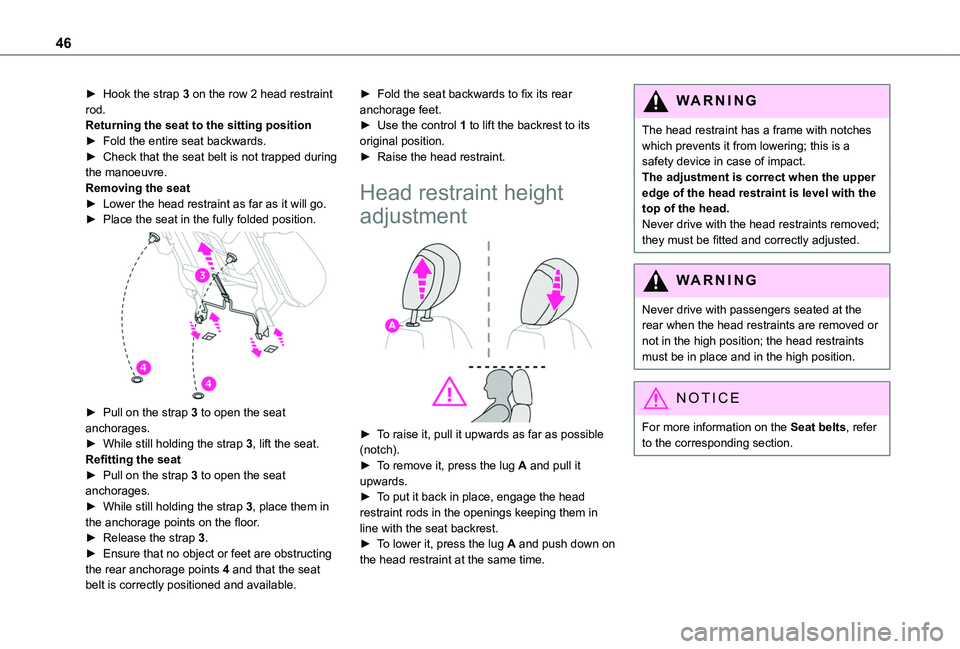
► Hook the strap 3 on the row 2 head restraint rod.Returning the seat to the sitting position► Fold the entire seat backwards.► Check that the seat belt is not trapped during the manoeuvre.Removing the seat► Lower the head restraint as far as it will go.► Place the seat in the fully folded position.
► Pull on the strap 3 to open the seat anchorages.► While still holding the strap 3, lift the seat.
Refitting the seat► Pull on the strap 3 to open the seat anchorages.► While still holding the strap 3, place them in the anchorage points on the floor.► Release the strap 3.► Ensure that no object or feet are obstructing the rear anchorage points 4 and that the seat belt is correctly positioned and available.
► Fold the seat backwards to fix its rear anchorage feet.► Use the control 1 to lift the backrest to its original position.► Raise the head restraint.
Head restraint height
adjustment
► To raise it, pull it upwards as far as possible (notch).► To remove it, press the lug A and pull it upwards.► To put it back in place, engage the head restraint rods in the openings keeping them in line with the seat backrest.► To lower it, press the lug A and push down on
the head restraint at the same time.
WARNI NG
The head restraint has a frame with notches which prevents it from lowering; this is a safety device in case of impact.The adjustment is correct when the upper edge of the head restraint is level with the top of the head.Never drive with the head restraints removed; they must be fitted and correctly adjusted.
WARNI NG
Never drive with passengers seated at the rear when the head restraints are removed or not in the high position; the head restraints must be in place and in the high position.
NOTIC E
For more information on the Seat belts, refer to the corresponding section.
Page 79 of 272
79
Safety
5
At speeds above 70 km/h (43 mph), the system is automatically deactivated; the indicator lamp in the button goes off.
Malfunction
In the event of a system malfunction, this warning lamp comes on on the instrument panel, accompanied by an onscreen message.Have the system checked by a TOYOTA dealer or a qualified workshop.
Seat belts
Front seat belts
The front seat belts are fitted with a single pyrotechnic pretensioning system (or double on the driver’s side, depending on equipment) and a force limiter (or progressive force limiter on the driver’s side, depending on equipment options).This system improves safety in the front seats in the event of a front or side impact.Depending on the severity of the impact, the
single pyrotechnic pretensioning system instantly tightens the seat belts against the body of the occupants.The double pyrotechnic pretensionsining system operates the same way, except that it uses two anchor points rather than one, for enhanced effectiveness.The pyrotechnic pretensioning seat belts are enabled when the ignition is on.
The force limiter reduces the pressure of the seat belt on the chest of the occupant, thus improving their protection.The progressive force limiter operates in the same way, except that it takes the driver’s stature into consideration, thus optimising the reduction in the pressure exerted by the seat belt on the occupant’s chest in the event of an impact.
Fastening
► Pull the strap, then insert the tongue in the
buckle.► Check that the seat belt is fastened correctly by pulling the strap.
Unlocking
► Press the red button on the buckle.► Guide the seat belt as it is reeled in.
Rear seat belts (row 2)
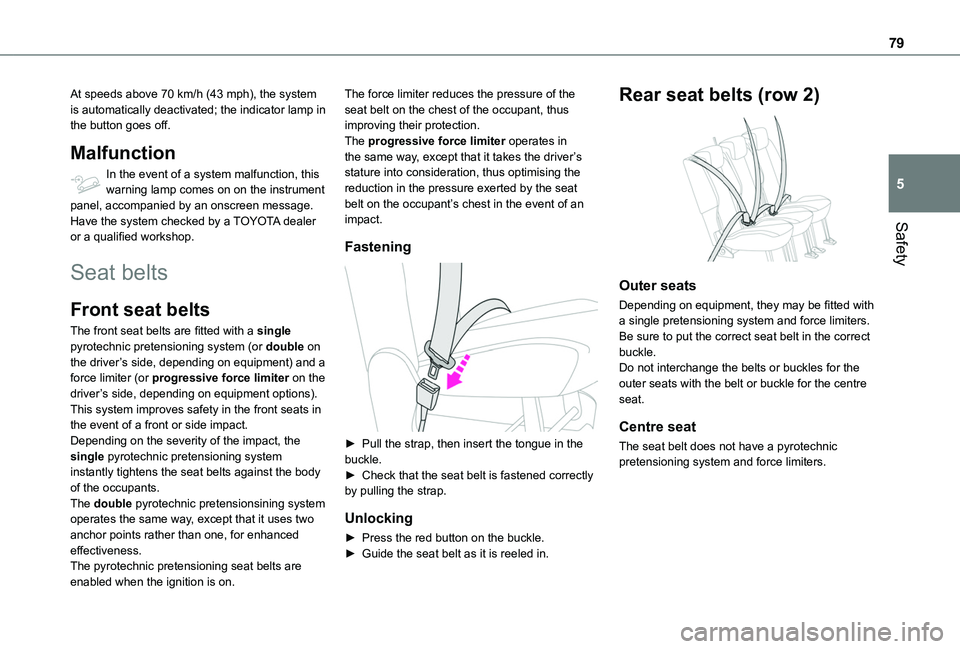
Outer seats
Depending on equipment, they may be fitted with a single pretensioning system and force limiters.Be sure to put the correct seat belt in the correct buckle.Do not interchange the belts or buckles for the outer seats with the belt or buckle for the centre seat.
Centre seat
The seat belt does not have a pyrotechnic pretensioning system and force limiters.