ESP TOYOTA RAV4 1996 Service Repair Manual
[x] Cancel search | Manufacturer: TOYOTA, Model Year: 1996, Model line: RAV4, Model: TOYOTA RAV4 1996Pages: 1632, PDF Size: 41.64 MB
Page 37 of 1632
The air bag sensor, which deploys air bags, contains a back-up power supply, safing sensor and diagnostic code
memory. Spiral cable (clockspring) maintains a complete circuit to the steering wheel pad.
SYSTEM OPERATION CHECK
Turn ignition switch to ACC or ON position. Air bag warning light in instrument cluster should come on for
about 6 seconds and then go out. If light does not respond as specified, SRS is malfunctioning and needs repair.
See DIAGNOSIS
.
SERVICE PRECAUTIONS
Observe the following precautions when working on SRS:
Before servicing any SRS or steering column component, disable SRS. See DISABLING &
ACTIVATING AIR BAG SYSTEM . Failure to disable system could result in accidental air bag
deployment and personal injury.
When diagnosing SRS, always check for diagnostic codes before disconnecting battery.
After ignition switch is turned to LOCK position and negative battery cable is disconnected, wait at least
90 seconds before working on SRS. SRS is equipped with a back-up power source that may allow air bag
to deploy within 90 seconds of disconnecting negative battery cable.
In a minor collision in which air bags do not deploy, steering wheel pad must be inspected.
NEVER use air bag parts from another vehicle. Replace air bag parts with new parts.
Air bag sensor assembly contains mercury. After replacement, DO NOT destroy the old part. When
scrapping vehicle or replacing air bag sensor assembly, remove air bag sensor assembly and dispose of as
toxic waste.
Never disassemble or repair system components. Replace cracked, dented or otherwise damaged system
components.
Remove air bag sensor if shocks are likely to be applied to the sensor during repairs.
When diagnosing electrical circuits, use a Digital Volt/Ohmmeter (DVOM) with high impedance (10,000
ohms minimum).
Information labels are attached to air bag components. Follow all notices on labels.
After servicing SRS, check air bag warning light to ensure system is functioning properly. See SYSTEM
OPERATION CHECK .
Always wear safety glasses when servicing or handling an air bag.
When placing a live air bag on a bench or other surface, always face air bag and trim cover up, away from
surface. This will reduce motion of module if accidentally deployed.
After deployment, air bag surface may contain deposits of sodium hydroxide which irritates skin. During
clean-up, always wear safety glasses, rubber gloves and long-sleeved shirt. After clean-up, wash hands
using mild soap and water.
When carrying a live air bag module, trim cover must be pointed away from your body to minimize
injury in case of accidental deployment.
If SRS is not fully functional for any reason, vehicle should not be driven until system is repaired and
a
gain becomes operational. DO NOTremove bulbs, modules, sensors or other components or in any way
1996 Toyota 4Runner
AIR BAG RESTRAINT SYSTEM 1996 ACCESSORIES/SAFETY EQUIPMENT Toyota Air Bag Restraint System
Microsoft
Tuesday, August 18, 2009 7:33:32 PMPage 3 © 2005 Mitchell Repair Information Company, LLC.
Page 49 of 1632
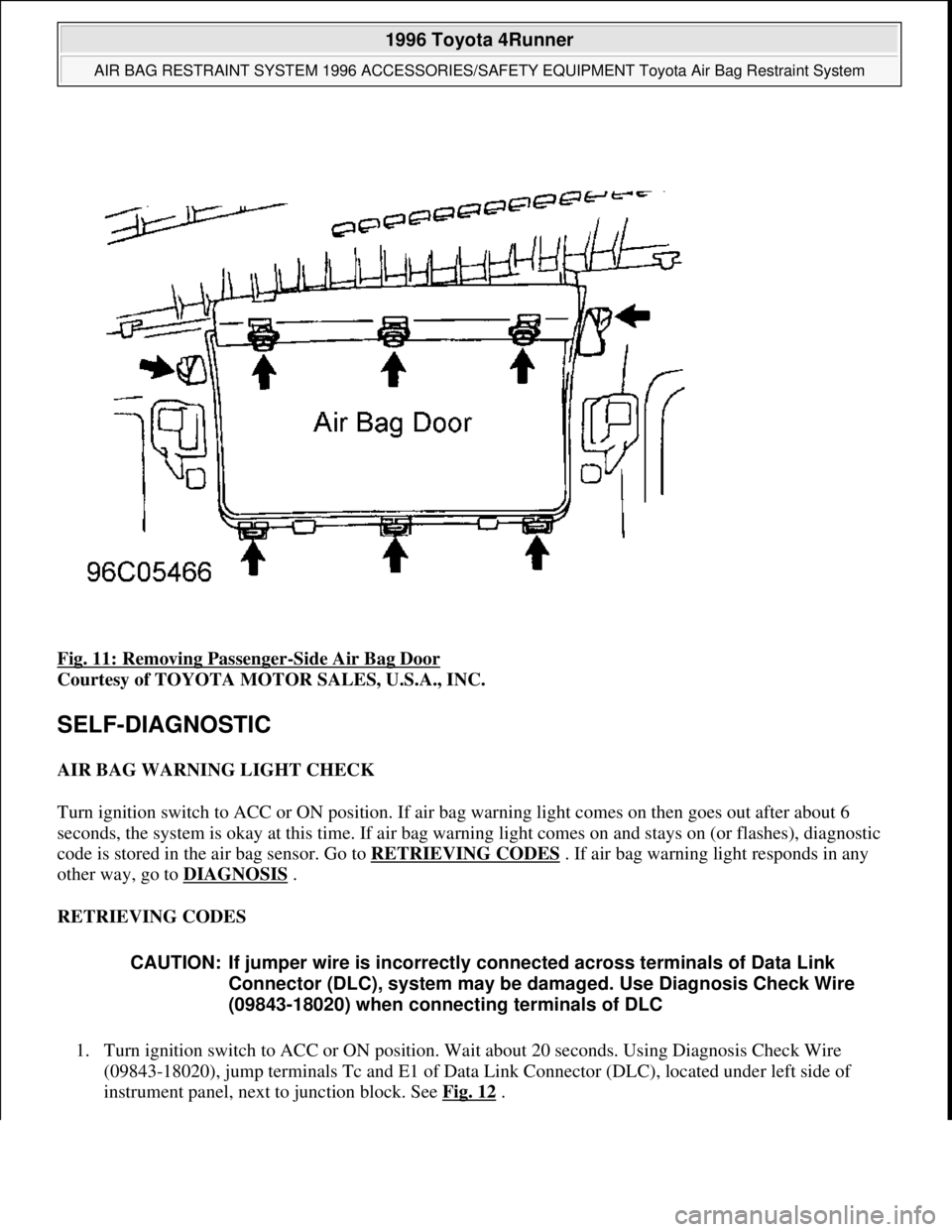
Fig. 11: Removing Passenger-Side Air Bag Door
Courtesy of TOYOTA MOTOR SALES, U.S.A., INC.
SELF-DIAGNOSTIC
AIR BAG WARNING LIGHT CHECK
Turn ignition switch to ACC or ON position. If air bag warning light comes on then goes out after about 6
seconds, the system is okay at this time. If air bag warning light comes on and stays on (or flashes), diagnostic
code is stored in the air bag sensor. Go to RETRIEVING CODES
. If air bag warning light responds in any
other way, go to DIAGNOSIS
.
RETRIEVING CODES
1. Turn ignition switch to ACC or ON position. Wait about 20 seconds. Using Diagnosis Check Wire
(09843-18020), jump terminals Tc and E1 of Data Link Connector (DLC), located under left side of
instrument panel, next to junction block. See Fig. 12
.
CAUTION: If jumper wire is incorrectly connected across terminals of Data Link
Connector (DLC), system may be damaged. Use Diagnosis Check Wire
(09843-18020) when connecting terminals of DLC
1996 Toyota 4Runner
AIR BAG RESTRAINT SYSTEM 1996 ACCESSORIES/SAFETY EQUIPMENT Toyota Air Bag Restraint System
Microsoft
Tuesday, August 18, 2009 7:33:32 PMPage 15 © 2005 Mitchell Repair Information Company, LLC.
Page 83 of 1632
1. Before proceeding, see SERVICE PRECAUTIONS . Ensure front wheels are in straight-ahead position.
Turn ignition switch to LOCK position. Disconnect negative battery cable. Wait at least 90 seconds.
Remove steering wheel. See STEERING WHEEL
.
2. Remove lower finish panel and instrument panel lower insert. Remove upper and lower steering column
covers. Disconnect and remove combination switch with spiral cable attached. Remove heater-to-register
duct. Match mark steering shaft and steering gear shaft for reassembly performance. Remove steering
column.
3. To install, reverse removal procedure. Tighten fasteners to specification. See TORQUE
SPECIFICATIONS . Check AIR BAG warning light to ensure system is functioning properly. See
SYSTEM OPERATION CHECK
.
STEERING WHEEL
Removal & Installation
1. Before proceeding, see SERVICE PRECAUTIONS . Ensure front wheels are in straight-ahead position.
Turn ignition switch to LOCK position. Disconnect negative battery cable. Wait at least 90 seconds.
Remove driver-side air bag module. See DRIVER
-SIDE AIR BAG MODULE .
2. Remove steering wheel nut. Match mark steering wheel and steering column for reassembly reference.
Using appropriate puller, remove steering wheel.
3. To install, reverse removal procedure. Ensure front wheels are in straight-ahead position and spiral cable
is properly aligned. See SPIRAL CABLE under ADJUSTMENTS
. Tighten steering wheel nut and
driver-side air bag module screws to specification. See TORQUE SPECIFICATIONS
. Check AIR
BAG warning light to ensure system is functioning properly. See SYSTEM OPERATION CHECK
.
SYSTEM OPERATION CHECK
Turn ignition switch to ACC or ON position. AIR BAG warning light should come on for about 6 seconds and
then go out. If AIR BAG warning light does not operate as specified, see DIAGNOSIS & TESTING
.
DIAGNOSIS & TESTING
AIR BAG WARNING LIGHT CHECK
Turn ignition switch to ACC or ON position. If air bag warning light comes on for about 6 seconds and then
goes off, system is functioning properly. If AIR BAG warning light comes on and stays on (or flashes),
Diagnostic Trouble Code (DTC) is stored in air bag sensor assembly. Go to RETRIEVING CODES
. If AIR
BAG warning light responds in any other way, go to DIAGNOSTIC TESTS
.
RETRIEVING CODES
CAUTION: System may be damaged if jumper wire is incorrectly connected across
terminals of Data Link Connector (DLC1). Use Diagnosis Check Wire
(09843-18020) when connecting terminals of DLC1.
1999 Toyota RAV4
AIR BAG RESTRAINT SYSTEM 1999 Toyota
Microsoft
Sunday, November 22, 2009 10:33:22 AMPage 20 © 2005 Mitchell Repair Information Company, LLC.
Page 203 of 1632
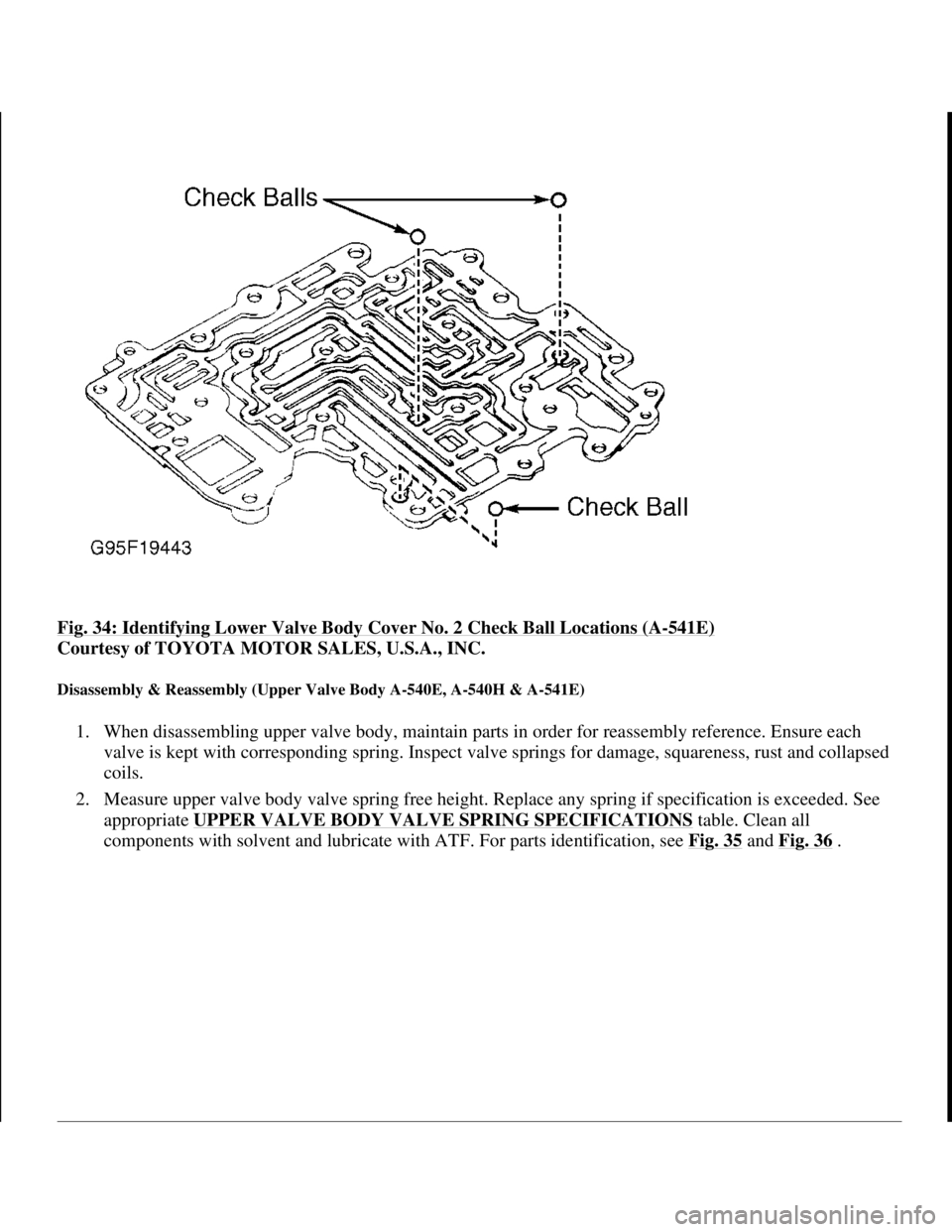
Fig. 34: Identifying Lower Valve Body Cover No. 2 Check Ball Locations (A-541E)
Courtesy of TOYOTA MOTOR SALES, U.S.A., INC.
Disassembly & Reassembly (Upper Valve Body A-540E, A-540H & A-541E)
1. When disassembling upper valve body, maintain parts in order for reassembly reference. Ensure each
valve is kept with corresponding spring. Inspect valve springs for damage, squareness, rust and collapsed
coils.
2. Measure upper valve body valve spring free height. Replace any spring if specification is exceeded. See
appropriate UPPER VALVE BODY VALVE SPRING SPECIFICATIONS
table. Clean all
components with solvent and lubricate with ATF. For parts identification, see Fig. 35
and Fig. 36.
1998 Toyota Avalon XLS
1997-99 AUTOMATIC TRANSMISSIONS Toyota A-540E, A-540H & A-541E Overhaul
Helpmelearn
November-03-08 10:28:18 AMPage 49 © 2005 Mitchell Repair Information Company, LLC.
Page 206 of 1632
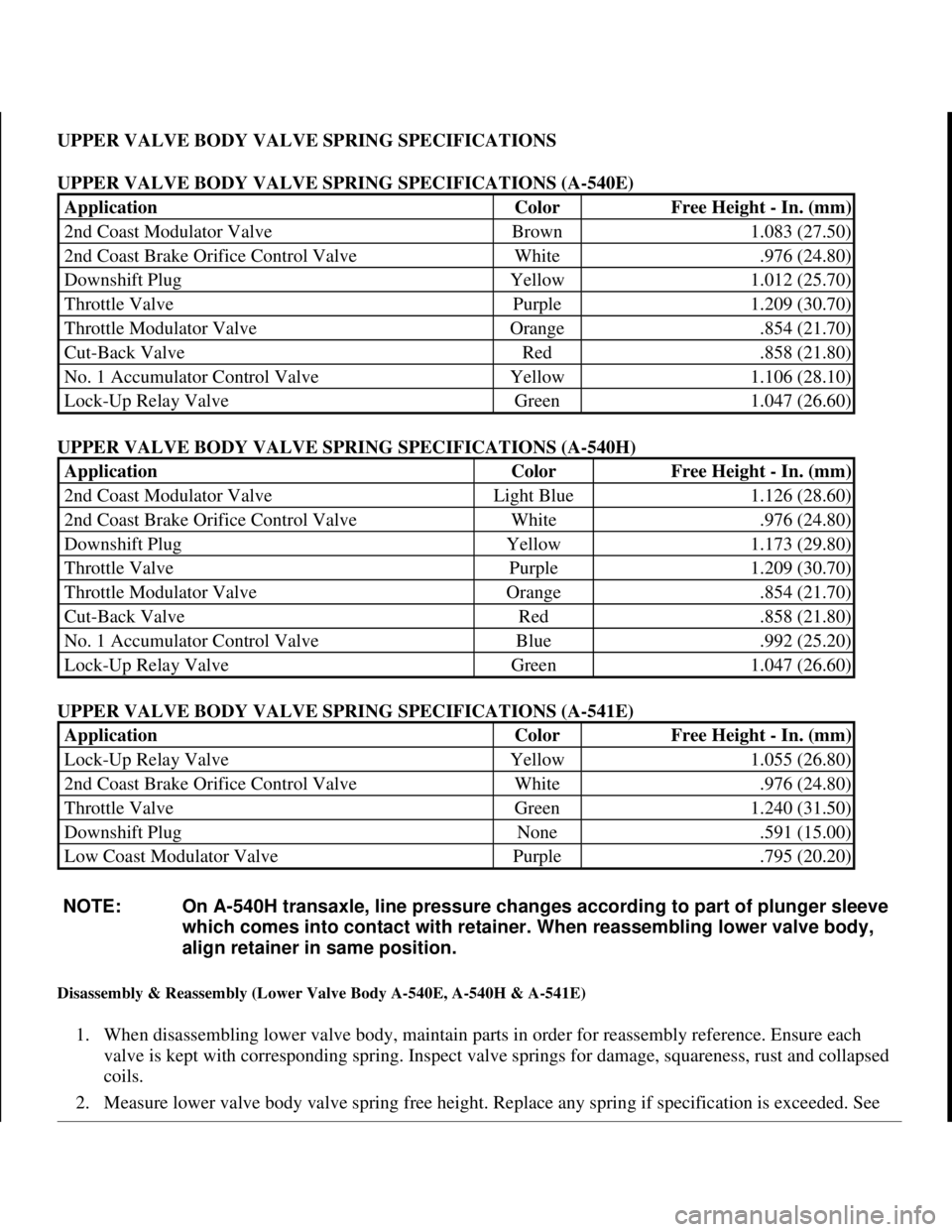
UPPER VALVE BODY VALVE SPRING SPECIFICATIONS
UPPER VALVE BODY VALVE SPRING SPECIFICATIONS (A-540E)
UPPER VALVE BODY VALVE SPRING SPECIFICATIONS (A-540H)
UPPER VALVE BODY VALVE SPRING SPECIFICATIONS (A-541E)
Disassembly & Reassembly (Lower Valve Body A-540E, A-540H & A-541E)
1. When disassembling lower valve body, maintain parts in order for reassembly reference. Ensure each
valve is kept with corresponding spring. Inspect valve springs for damage, squareness, rust and collapsed
coils.
2. Measure lower valve bod
y valve spring free height. Replace any spring if specification is exceeded. See
ApplicationColorFree Height - In. (mm)
2nd Coast Modulator ValveBrown1.083 (27.50)
2nd Coast Brake Orifice Control ValveWhite.976 (24.80)
Downshift PlugYellow1.012 (25.70)
Throttle ValvePurple1.209 (30.70)
Throttle Modulator ValveOrange.854 (21.70)
Cut-Back ValveRed.858 (21.80)
No. 1 Accumulator Control ValveYellow1.106 (28.10)
Lock-Up Relay ValveGreen1.047 (26.60)
ApplicationColorFree Height - In. (mm)
2nd Coast Modulator ValveLight Blue1.126 (28.60)
2nd Coast Brake Orifice Control ValveWhite.976 (24.80)
Downshift PlugYellow1.173 (29.80)
Throttle ValvePurple1.209 (30.70)
Throttle Modulator ValveOrange.854 (21.70)
Cut-Back ValveRed.858 (21.80)
No. 1 Accumulator Control ValveBlue.992 (25.20)
Lock-Up Relay ValveGreen1.047 (26.60)
ApplicationColorFree Height - In. (mm)
Lock-Up Relay ValveYellow1.055 (26.80)
2nd Coast Brake Orifice Control ValveWhite.976 (24.80)
Throttle ValveGreen1.240 (31.50)
Downshift PlugNone.591 (15.00)
Low Coast Modulator ValvePurple.795 (20.20)
NOTE: On A-540H transaxle, line pressure changes according to part of plunger sleeve
which comes into contact with retainer. When reassembling lower valve body,
align retainer in same position.
1998 Toyota Avalon XLS
1997-99 AUTOMATIC TRANSMISSIONS Toyota A-540E, A-540H & A-541E Overhaul
Helpmelearn
November-03-08 10:28:18 AMPage 52 © 2005 Mitchell Repair Information Company, LLC.
Page 235 of 1632
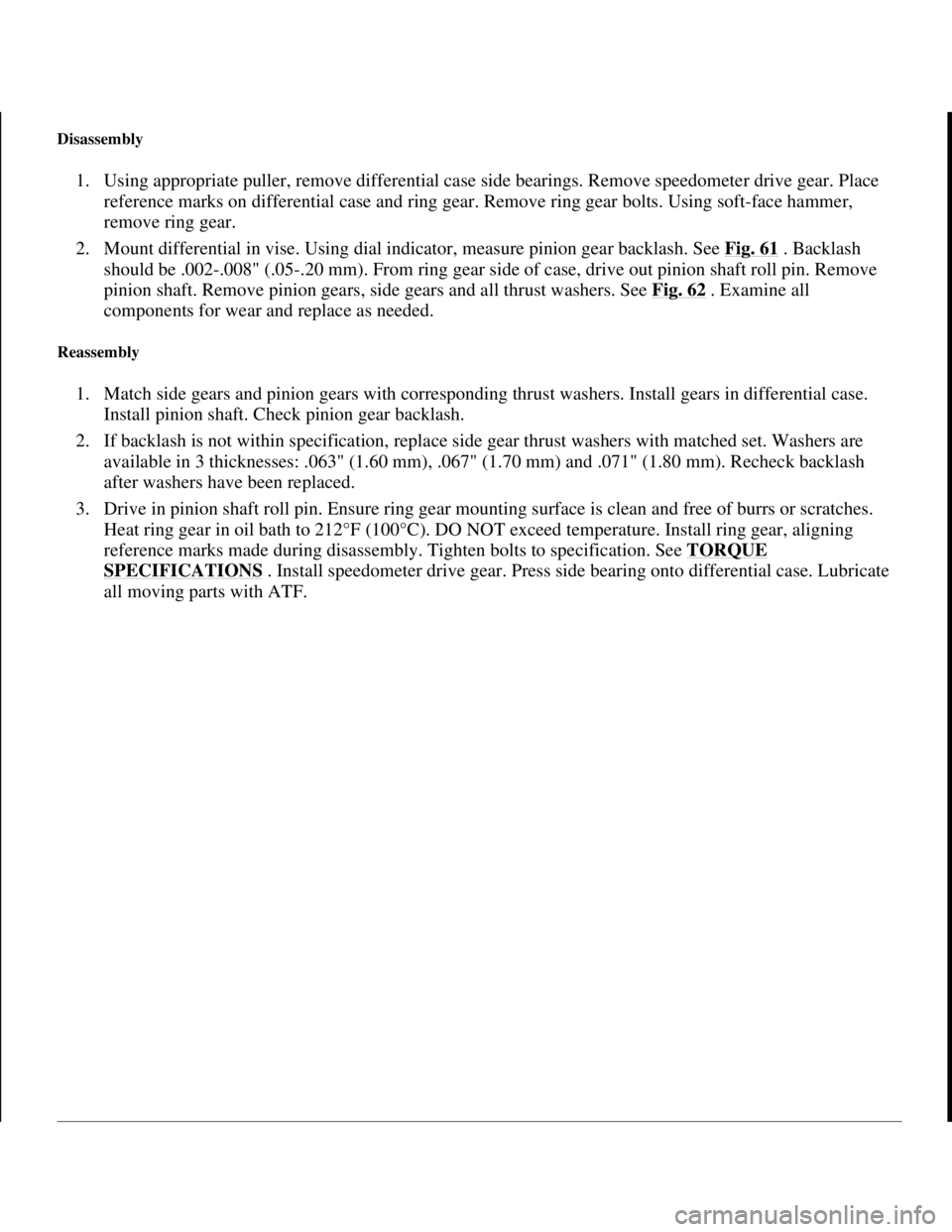
Disassembly
1. Using appropriate puller, remove differential case side bearings. Remove speedometer drive gear. Place
reference marks on differential case and ring gear. Remove ring gear bolts. Using soft-face hammer,
remove ring gear.
2. Mount differential in vise. Using dial indicator, measure pinion gear backlash. See Fig. 61
. Backlash
should be .002-.008" (.05-.20 mm). From ring gear side of case, drive out pinion shaft roll pin. Remove
pinion shaft. Remove pinion gears, side gears and all thrust washers. See Fig. 62
. Examine all
components for wear and replace as needed.
Reassembly
1. Match side gears and pinion gears with corresponding thrust washers. Install gears in differential case.
Install pinion shaft. Check pinion gear backlash.
2. If backlash is not within specification, replace side gear thrust washers with matched set. Washers are
available in 3 thicknesses: .063" (1.60 mm), .067" (1.70 mm) and .071" (1.80 mm). Recheck backlash
after washers have been replaced.
3. Drive in pinion shaft roll pin. Ensure ring gear mounting surface is clean and free of burrs or scratches.
Heat ring gear in oil bath to 212°F (100°C). DO NOT exceed temperature. Install ring gear, aligning
reference marks made during disassembly. Tighten bolts to specification. See TORQUE
SPECIFICATIONS . Install speedometer drive gear. Press side bearing onto differential case. Lubricate
all moving parts with ATF.
1998 Toyota Avalon XLS
1997-99 AUTOMATIC TRANSMISSIONS Toyota A-540E, A-540H & A-541E Overhaul
Helpmelearn
November-03-08 10:28:19 AMPage 81 © 2005 Mitchell Repair Information Company, LLC.
Page 528 of 1632
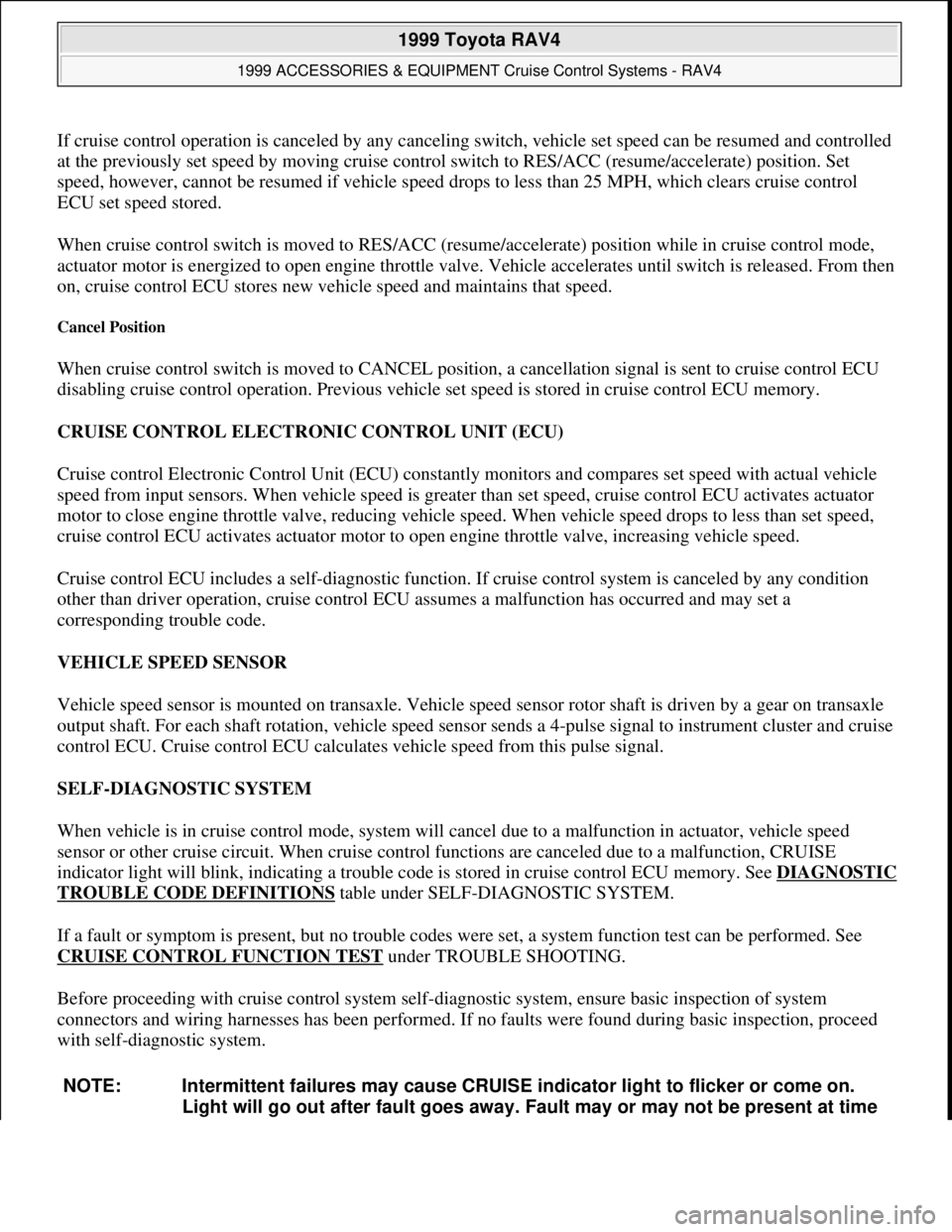
If cruise control operation is canceled by any canceling switch, vehicle set speed can be resumed and controlled
at the previously set speed by moving cruise control switch to RES/ACC (resume/accelerate) position. Set
speed, however, cannot be resumed if vehicle speed drops to less than 25 MPH, which clears cruise control
ECU set speed stored.
When cruise control switch is moved to RES/ACC (resume/accelerate) position while in cruise control mode,
actuator motor is energized to open engine throttle valve. Vehicle accelerates until switch is released. From then
on, cruise control ECU stores new vehicle speed and maintains that speed.
Cancel Position
When cruise control switch is moved to CANCEL position, a cancellation signal is sent to cruise control ECU
disabling cruise control operation. Previous vehicle set speed is stored in cruise control ECU memory.
CRUISE CONTROL ELECTRONIC CONTROL UNIT (ECU)
Cruise control Electronic Control Unit (ECU) constantly monitors and compares set speed with actual vehicle
speed from input sensors. When vehicle speed is greater than set speed, cruise control ECU activates actuator
motor to close engine throttle valve, reducing vehicle speed. When vehicle speed drops to less than set speed,
cruise control ECU activates actuator motor to open engine throttle valve, increasing vehicle speed.
Cruise control ECU includes a self-diagnostic function. If cruise control system is canceled by any condition
other than driver operation, cruise control ECU assumes a malfunction has occurred and may set a
corresponding trouble code.
VEHICLE SPEED SENSOR
Vehicle speed sensor is mounted on transaxle. Vehicle speed sensor rotor shaft is driven by a gear on transaxle
output shaft. For each shaft rotation, vehicle speed sensor sends a 4-pulse signal to instrument cluster and cruise
control ECU. Cruise control ECU calculates vehicle speed from this pulse signal.
SELF-DIAGNOSTIC SYSTEM
When vehicle is in cruise control mode, system will cancel due to a malfunction in actuator, vehicle speed
sensor or other cruise circuit. When cruise control functions are canceled due to a malfunction, CRUISE
indicator light will blink, indicating a trouble code is stored in cruise control ECU memory. See DIAGNOSTIC
TROUBLE CODE DEFINITIONS table under SELF-DIAGNOSTIC SYSTEM.
If a fault or symptom is present, but no trouble codes were set, a system function test can be performed. See
CRUISE CONTROL FUNCTION TEST
under TROUBLE SHOOTING.
Before proceeding with cruise control system self-diagnostic system, ensure basic inspection of system
connectors and wiring harnesses has been performed. If no faults were found during basic inspection, proceed
with self-diagnostic system.
NOTE: Intermittent failures may cause CRUISE indicator light to flicker or come on.
Light will go out after fault goes away. Fault may or may not be present at time
1999 Toyota RAV4
1999 ACCESSORIES & EQUIPMENT Cruise Control Systems - RAV4
Microsoft
Sunday, November 22, 2009 10:52:01 AMPage 4 © 2005 Mitchell Repair Information Company, LLC.
Page 529 of 1632
ADJUSTMENTS
ACTUATOR CONTROL CABLE
Ensure actuator, control cable and throttle linkage are installed properly. Ensure actuator and bell crank operate
smoothly. Ensure cable is not too loose or tight. Cable free play should be less than .39" (10 mm). If control
cable is too loose, vehicle will lose speed while driving uphill. If control cable is too tight, idle RPM will
increase.
TROUBLE SHOOTING
CRUISE CONTROL FUNCTION TEST
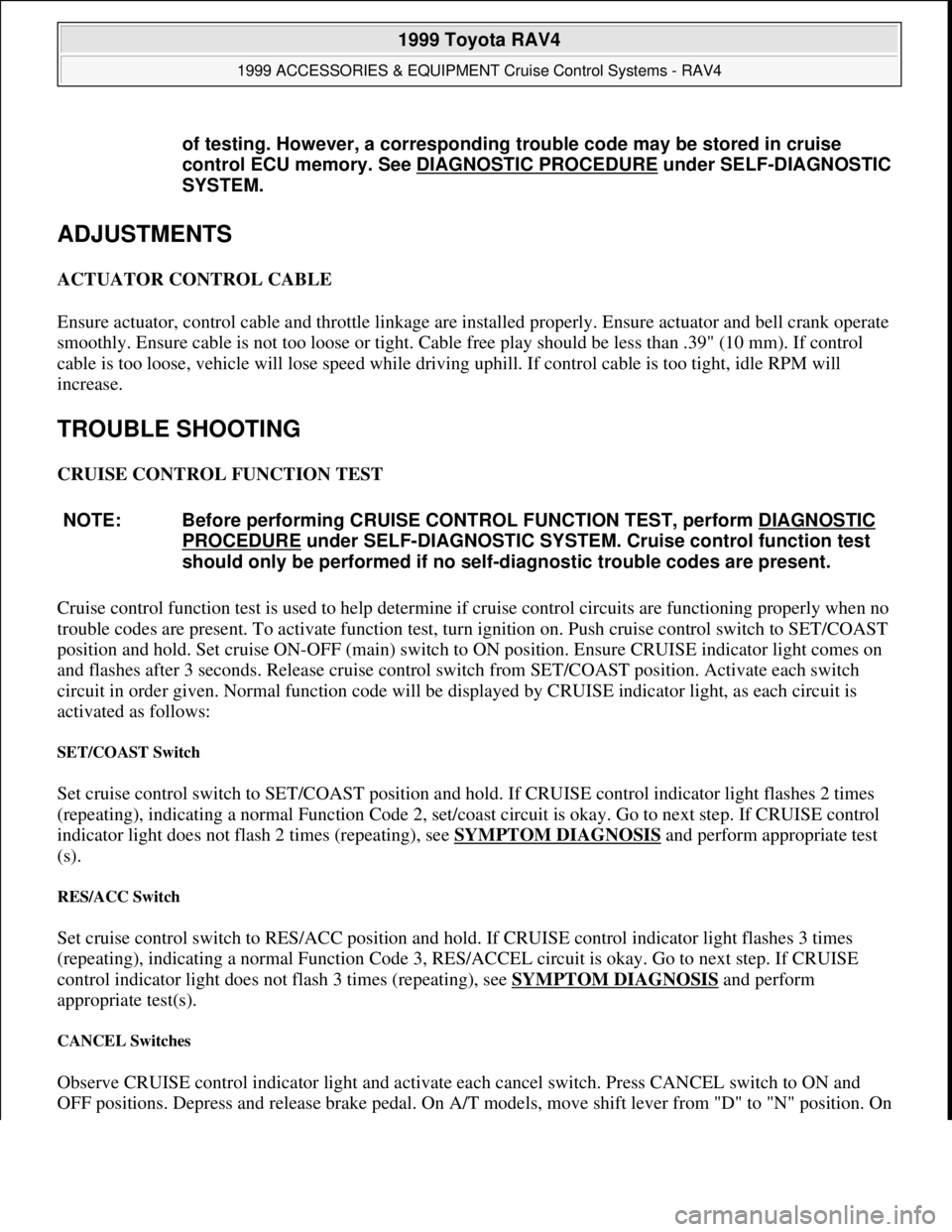
Cruise control function test is used to help determine if cruise control circuits are functioning properly when no
trouble codes are present. To activate function test, turn ignition on. Push cruise control switch to SET/COAST
position and hold. Set cruise ON-OFF (main) switch to ON position. Ensure CRUISE indicator light comes on
and flashes after 3 seconds. Release cruise control switch from SET/COAST position. Activate each switch
circuit in order given. Normal function code will be displayed by CRUISE indicator light, as each circuit is
activated as follows:
SET/COAST Switch
Set cruise control switch to SET/COAST position and hold. If CRUISE control indicator light flashes 2 times
(repeating), indicating a normal Function Code 2, set/coast circuit is okay. Go to next step. If CRUISE control
indicator light does not flash 2 times (repeating), see SYMPTOM DIAGNOSIS
and perform appropriate test
(s).
RES/ACC Switch
Set cruise control switch to RES/ACC position and hold. If CRUISE control indicator light flashes 3 times
(repeating), indicating a normal Function Code 3, RES/ACCEL circuit is okay. Go to next step. If CRUISE
control indicator light does not flash 3 times (repeating), see SYMPTOM DIAGNOSIS
and perform
appropriate test(s).
CANCEL Switches
Observe CRUISE control indicator light and activate each cancel switch. Press CANCEL switch to ON and
OFF positions. Depress and release brake pedal. On A/T models, move shift lever from "D" to "N" position. On of testing. However, a corresponding trouble code may be stored in cruise
control ECU memory. See DIAGNOSTIC PROCEDURE
under SELF-DIAGNOSTIC
SYSTEM.
NOTE: Before performing CRUISE CONTROL FUNCTION TEST, perform DIAGNOSTIC
PROCEDURE under SELF-DIAGNOSTIC SYSTEM. Cruise control function test
should only be performed if no self-diagnostic trouble codes are present.
1999 Toyota RAV4
1999 ACCESSORIES & EQUIPMENT Cruise Control Systems - RAV4
Microsoft
Sunday, November 22, 2009 10:52:01 AMPage 5 © 2005 Mitchell Repair Information Company, LLC.
Page 532 of 1632
Cruise Control Does Not Cancel Even With Clutch Pedal Depressed (M/T Only)
Check the following components and/or circuits:
Check actuator control cable adjustment. See ADJUSTMENTS .
Perform CLUTCH SWITCH CIRCUIT test under SYSTEM TESTS.
Perform DTC 11 OR DTC 15: ACTUATOR MOTOR CIRCUIT test under DIAGNOSTIC TESTS.
Replace cruise control ECU with a known-good ECU and retest. If symptom is no longer present, replace
ECU.
Cruise Control Switch Does Not Operate (SET/COAST, RES/ACC Or CANCEL Not Possible)
Check the following components and/or circuits:
Check actuator control cable adjustment. See ADJUSTMENTS .
Perform CRUISE CONTROL SWITCH CIRCUIT test under SYSTEM TESTS.
Perform DTC 11 OR DTC 15: ACTUATOR MOTOR CIRCUIT test under DIAGNOSTIC TESTS.
Replace cruise control ECU with a known-good ECU and retest. If symptom is no longer present, replace
ECU.
SET Possible at 25 MPH Or Less, Or CANCEL Does Not Operate At 25 MPH Or Less
Check the following components and/or circuits:
Check actuator control cable adjustment. See ADJUSTMENTS .
Perform DTC 23: VEHICLE SPEED SENSOR SIGNAL FAULT test under DIAGNOSTIC TESTS.
Perform DTC 11 OR DTC 15: ACTUATOR MOTOR CIRCUIT test under DIAGNOSTIC TESTS.
Replace cruise control ECU with a known-good ECU and retest. If symptom is no longer present, replace
ECU.
Poor Response In ACCEL & RESUME Modes
Check the following components and/or circuits:
Check actuator control cable adjustment. See ADJUSTMENTS .
Perform ELECTRONICALLY CONTROLLED TRANSMISSION (ECT) CIRCUIT test under
SYSTEM TESTS.
Perform DTC 11 OR DTC 15: ACTUATOR MOTOR CIRCUIT test under DIAGNOSTIC TESTS.
Replace cruise control ECU with a known-good ECU and retest. If symptom is no longer present, replace
ECU.
Overdrive Does Not Resume, Even Though Road Is Not Uphill
Check the following components and/or circuits:
1999 Toyota RAV4
1999 ACCESSORIES & EQUIPMENT Cruise Control Systems - RAV4
Microsoft
Sunday, November 22, 2009 10:52:01 AMPage 8 © 2005 Mitchell Repair Information Company, LLC.
Page 852 of 1632
Set control lever to correct position. See AIRFLOW MODE DAMPER CABLE ADJUSTMENTtable.
Remove cable retaining clip. Ensure airflow mode damper and cable are in their respective positions. Install
cable retaining clip.
AIRFLOW MODE DAMPER CABLE ADJUSTMENT
AIR MIX DAMPER CABLE
Set air door lever to cool position. Remove cable retaining clip. Ensure cable and damper are in full cool
position. Install cable retaining clip. Check air mix damper operation.
REAR HEAT DAMPER CABLE
4Runner
Set control lever to warm position. Remove cable retaining clip. Ensure cable and damper are in full warm
position. Install cable retaining clip.
WATER VALVE CONTROL CABLE
Set control lever to cool position. Remove cable retaining clip. Ensure water valve control cable is in full cool
position. Install cable retaining clip.
TROUBLE SHOOTING
BLOWER DOES NOT WORK
Inspect for blown heater fuse or faulty heater relay. Inspect heater blower switch, heater blower resistor, heater
blower motor, or wiring fault. See WIRING DIAGRAMS
.
INCORRECT TEMPERATURE OUTPUT
Inspect for broken or out of adjustment control cables, heater hoses leaking or clogged, or faulty water pump.
Inspect for broken air dampers, clogged air ducts, leaking or clogged heater core, or faulty heater control unit.
TESTING
ApplicationLever Position
Tacoma & 4RunnerFace
RAV4(1)
(1)Information is not available from manufacturer.
WARNING:To avoid injury from accidental air bag deployment, read and carefully
follow all SERVICE PRECAUTIONS and DISABLING & ACTIVATING AIR
BAG SYSTEM procedures in AIR BAG SYSTEM SAFETY article in
GENERAL SERVICING.
1999 Toyota RAV4
1999 HEATER SYSTEMS RAV4, Tacoma & 4Runner
Microsoft
Sunday, November 22, 2009 10:30:50 AMPage 2 © 2005 Mitchell Repair Information Company, LLC.