center console TOYOTA RAV4 1996 Service Repair Manual
[x] Cancel search | Manufacturer: TOYOTA, Model Year: 1996, Model line: RAV4, Model: TOYOTA RAV4 1996Pages: 1632, PDF Size: 41.64 MB
Page 38 of 1632
disable system from operating normally. If SRS is not functional, park vehicle until it is repaired and
functions properly.
DISABLING & ACTIVATING AIR BAG SYSTEM
DISABLING SYSTEM
Turn ignition switch to LOCK position. Disconnect and shield negative battery cable. Wait at least 90 seconds
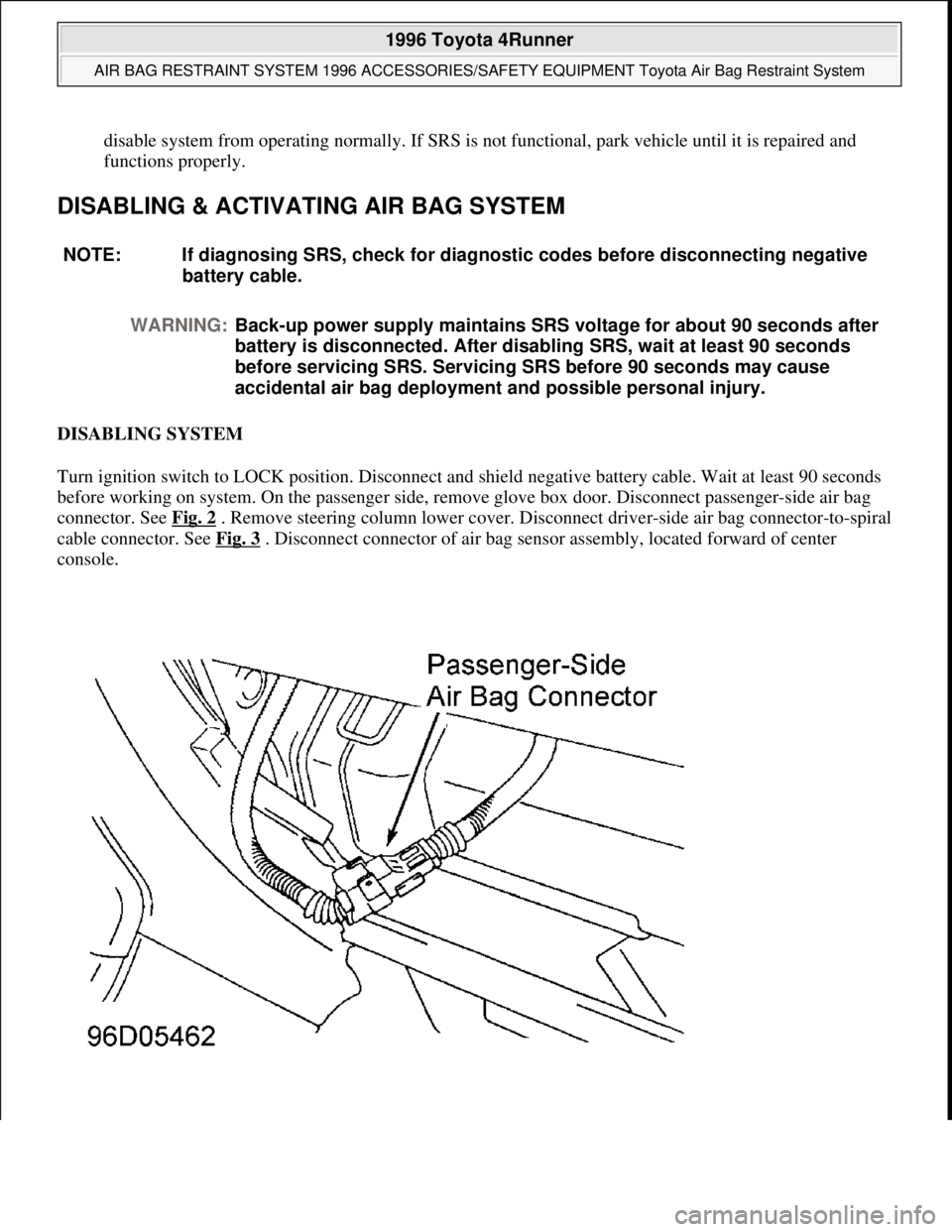
before working on system. On the passenger side, remove glove box door. Disconnect passenger-side air bag
connector. See Fig. 2
. Remove steering column lower cover. Disconnect driver-side air bag connector-to-spiral
cable connector. See Fig. 3
. Disconnect connector of air bag sensor assembly, located forward of center
console. NOTE: If diagnosing SRS, check for diagnostic codes before disconnecting negative
battery cable.
WARNING:Back-up power supply maintains SRS voltage for about 90 seconds after
battery is disconnected. After disabling SRS, wait at least 90 seconds
before servicing SRS. Servicing SRS before 90 seconds may cause
accidental air bag deployment and possible personal injury.
1996 Toyota 4Runner
AIR BAG RESTRAINT SYSTEM 1996 ACCESSORIES/SAFETY EQUIPMENT Toyota Air Bag Restraint System
Microsoft
Tuesday, August 18, 2009 7:33:32 PMPage 4 © 2005 Mitchell Repair Information Company, LLC.
Page 45 of 1632
1. Before proceeding, see SERVICE PRECAUTIONS . Disable SRS. See DISABLING &
ACTIVATING AIR BAG SYSTEM .
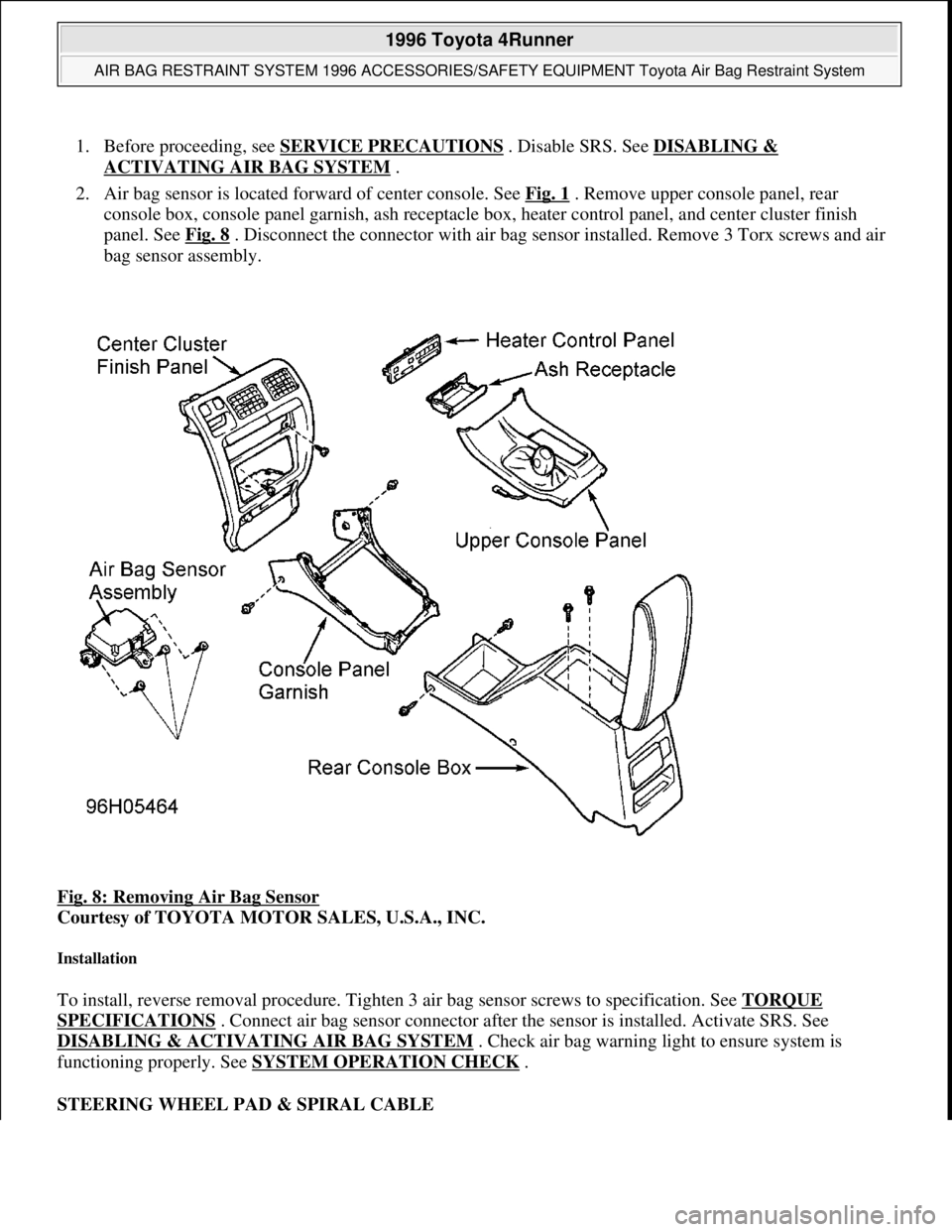
2. Air bag sensor is located forward of center console. See Fig. 1
. Remove upper console panel, rear
console box, console panel garnish, ash receptacle box, heater control panel, and center cluster finish
panel. See Fig. 8
. Disconnect the connector with air bag sensor installed. Remove 3 Torx screws and air
bag sensor assembly.
Fig. 8: Removing Air Bag Sensor
Courtesy of TOYOTA MOTOR SALES, U.S.A., INC.
Installation
To install, reverse removal procedure. Tighten 3 air bag sensor screws to specification. See TORQUE
SPECIFICATIONS . Connect air bag sensor connector after the sensor is installed. Activate SRS. See
DISABLING & ACTIVATING AIR BAG SYSTEM
. Check air bag warning light to ensure system is
functioning properly. See SYSTEM OPERATION CHECK
.
STEERING WHEEL PAD & SPIRAL CABLE
1996 Toyota 4Runner
AIR BAG RESTRAINT SYSTEM 1996 ACCESSORIES/SAFETY EQUIPMENT Toyota Air Bag Restraint System
Microsoft
Tuesday, August 18, 2009 7:33:32 PMPage 11 © 2005 Mitchell Repair Information Company, LLC.
Page 65 of 1632
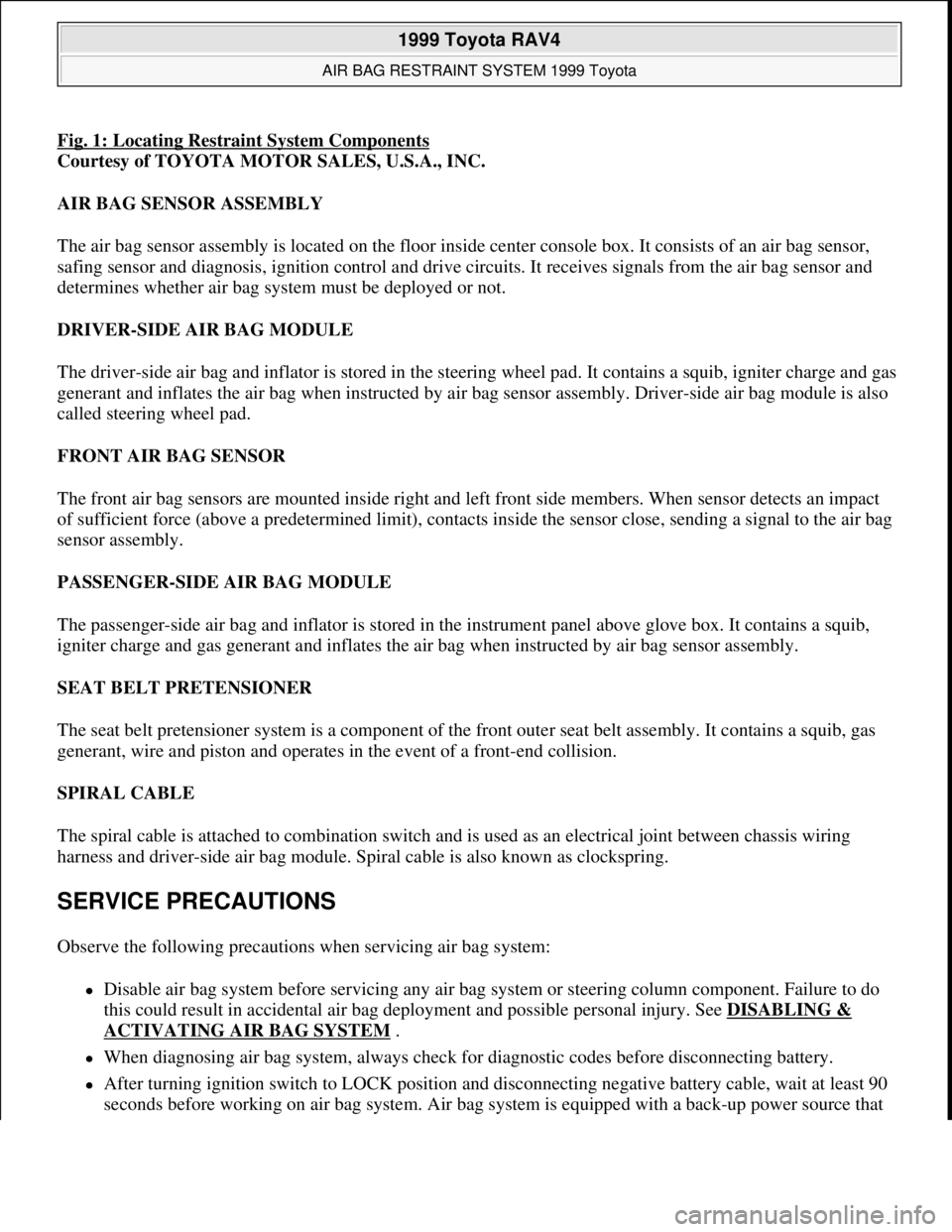
Fig. 1: Locating Restraint System Components
Courtesy of TOYOTA MOTOR SALES, U.S.A., INC.
AIR BAG SENSOR ASSEMBLY
The air bag sensor assembly is located on the floor inside center console box. It consists of an air bag sensor,
safing sensor and diagnosis, ignition control and drive circuits. It receives signals from the air bag sensor and
determines whether air bag system must be deployed or not.
DRIVER-SIDE AIR BAG MODULE
The driver-side air bag and inflator is stored in the steering wheel pad. It contains a squib, igniter charge and gas
generant and inflates the air bag when instructed by air bag sensor assembly. Driver-side air bag module is also
called steering wheel pad.
FRONT AIR BAG SENSOR
The front air bag sensors are mounted inside right and left front side members. When sensor detects an impact
of sufficient force (above a predetermined limit), contacts inside the sensor close, sending a signal to the air bag
sensor assembly.
PASSENGER-SIDE AIR BAG MODULE
The passenger-side air bag and inflator is stored in the instrument panel above glove box. It contains a squib,
igniter charge and gas generant and inflates the air bag when instructed by air bag sensor assembly.
SEAT BELT PRETENSIONER
The seat belt pretensioner system is a component of the front outer seat belt assembly. It contains a squib, gas
generant, wire and piston and operates in the event of a front-end collision.
SPIRAL CABLE
The spiral cable is attached to combination switch and is used as an electrical joint between chassis wiring
harness and driver-side air bag module. Spiral cable is also known as clockspring.
SERVICE PRECAUTIONS
Observe the following precautions when servicing air bag system:
Disable air bag system before servicing any air bag system or steering column component. Failure to do
this could result in accidental air bag deployment and possible personal injury. See DISABLING &
ACTIVATING AIR BAG SYSTEM .
When diagnosing air bag system, always check for diagnostic codes before disconnecting battery.
After turning ignition switch to LOCK position and disconnecting negative battery cable, wait at least 90
seconds before workin
g on air bag system. Air bag system is equipped with a back-up power source that
1999 Toyota RAV4
AIR BAG RESTRAINT SYSTEM 1999 Toyota
Microsoft
Sunday, November 22, 2009 10:33:22 AMPage 2 © 2005 Mitchell Repair Information Company, LLC.
Page 76 of 1632
REMOVAL & INSTALLATION
AIR BAG SENSOR ASSEMBLY
Removal & Installation
1. Before proceeding, see SERVICE PRECAUTIONS . Air bag sensor assembly is located on the floor
inside center console box. See Fig. 10
. Turn ignition switch to LOCK position. Disconnect negative
battery cable. Wait at least 90 seconds.
2. Remove shift lever and boot. Ash tray and console box hole cover. Remove console box. Remove 4 Torx
screws retaining air bag sensor assembly. Remove air bag sensor assembly.
3. To install, reverse removal procedure. Tighten air bag sensor assembly Torx screws to specification. See
TORQUE SPECIFICATIONS
. Check AIR BAG warning light to ensure system is functioning
properl
y. See SYSTEM OPERATION CHECK. WARNING:Failure to follow service precautions may result in air bag deployment and
personal injury. See SERVICE PRECAUTIONS
. After component
replacement, check system operation. See SYSTEM OPERATION CHECK
.
1999 Toyota RAV4
AIR BAG RESTRAINT SYSTEM 1999 Toyota
Microsoft
Sunday, November 22, 2009 10:33:22 AMPage 13 © 2005 Mitchell Repair Information Company, LLC.
Page 80 of 1632
INSTRUMENT PANEL
Removal & Installation
1. Before proceeding, see SERVICE PRECAUTIONS . Turn ignition switch to LOCK position.
Disconnect negative battery cable. Wait at least 90 seconds.
2. Access and disconnect right and left seat belt pretensioner connectors. See SEAT BELT
PRETENSIONERS . Remove front door scuff plates and cowl side trim boards. See Fig. 13 . Remove
steering wheel. See STEERING WHEEL
. Remove steering column covers and cluster finish panel.
Remove instrument cluster. Remove hood lock release lever.
3. Remove lower finish panel and instrument panel lower insert. Remove No. 2 heater-to-register duct.
Remove steering column assembly. See STEERING COLUMN
. Remove 2 screws and center cluster
finish panel. Pull off heater control knobs and pry off heater control name plate. Pry off cluster instrument
panel, then remove 3 screws from heater control assembly. Disconnect connectors and remove cluster
instrument panel.
4. Disconnect control cables and remove heater control assembly. Remove radio assembly. Remove console
box. Tape tip of screwdriver and remove lower center cluster finish panel. Disconnect connectors.
Remove stereo opening cover. Remove glove box assembly. Remove side trim cover. Disconnect
remaining connectors and remove bolts, then remove instrument panel.
5. To install, reverse removal procedure. Tighten fasteners to specification. See TORQUE
SPECIFICATIONS . Check AIR BAG warning light to ensure system is functioning properly. See
SYSTEM OPERATION CHECK
.
1999 Toyota RAV4
AIR BAG RESTRAINT SYSTEM 1999 Toyota
Microsoft
Sunday, November 22, 2009 10:33:22 AMPage 17 © 2005 Mitchell Repair Information Company, LLC.
Page 126 of 1632
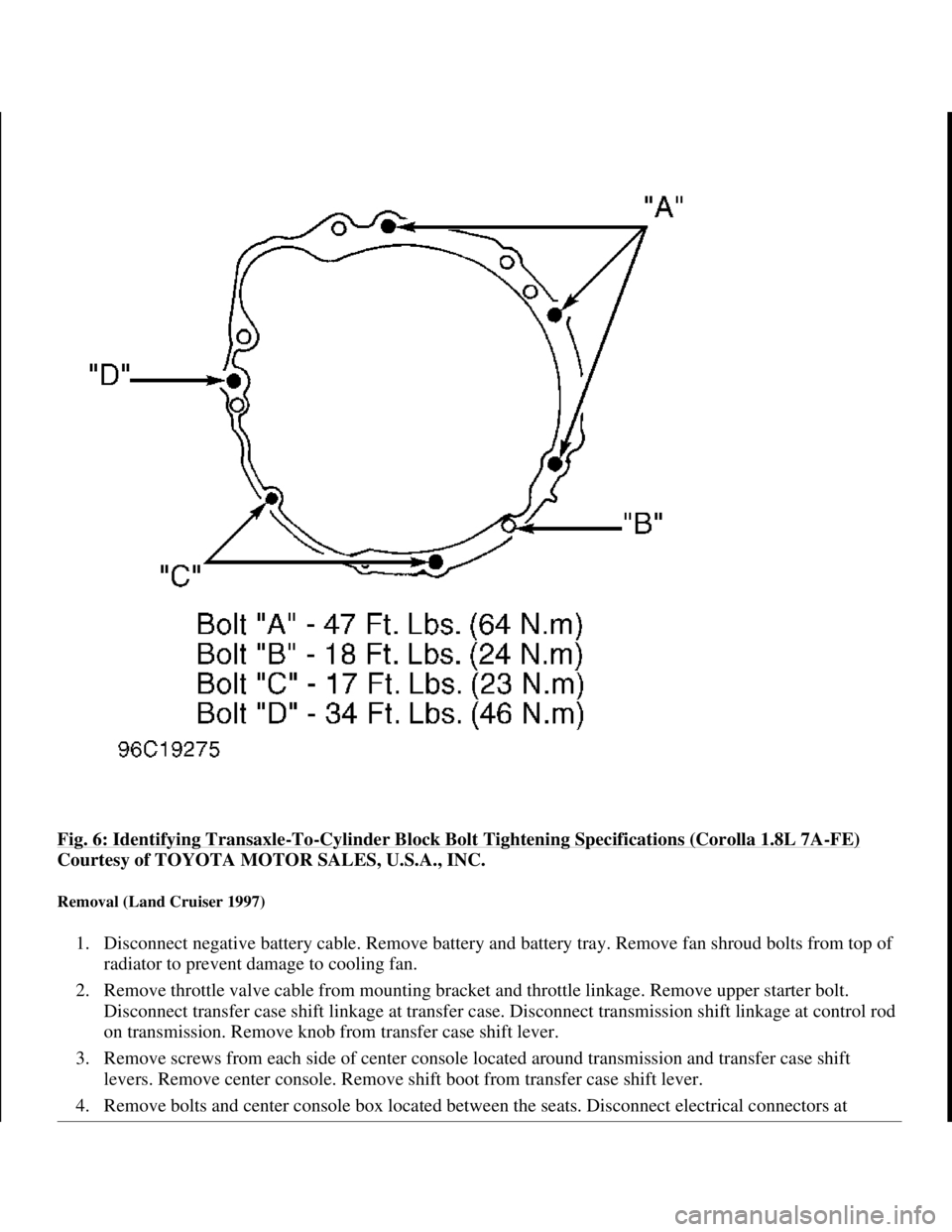
Fig. 6: Identifying Transaxle-To-Cylinder Block Bolt Tightening Specifications (Corolla 1.8L 7A-FE)
Courtesy of TOYOTA MOTOR SALES, U.S.A., INC.
Removal (Land Cruiser 1997)
1. Disconnect negative battery cable. Remove battery and battery tray. Remove fan shroud bolts from top of
radiator to prevent damage to cooling fan.
2. Remove throttle valve cable from mounting bracket and throttle linkage. Remove upper starter bolt.
Disconnect transfer case shift linkage at transfer case. Disconnect transmission shift linkage at control rod
on transmission. Remove knob from transfer case shift lever.
3. Remove screws from each side of center console located around transmission and transfer case shift
levers. Remove center console. Remove shift boot from transfer case shift lever.
4. Remove bolts and center console box located between the seats. Disconnect electrical connectors at
1998 Toyota Avalon XLS
TRANSMISSION SERVICING - A/T 1997-98 TRANSMISSION SERVICING Toyota - Transmission Removal &
Installation
Helpmelearn
November-03-08 10:30:28 AMPage 14 © 2005 Mitchell Repair Information Company, LLC.
Page 143 of 1632
installing the remaining torque converter bolts.
5. Use NEW gasket when installing front exhaust pipe. Adjust all cables, shift linkages and fill with ATF.
See appropriate TRANSMISSION SERVICING article.
Removal (4Runner 4WD)
1. Disconnect negative battery cable. Remove rear console upper panel and disconnect electrical connectors.
Rear console upper panel is located on the top of the console, near emergency brake lever.
2. Remove heater control knobs from instrument panel. Using screwdriver, pry heater control plate from
center finish panel on instrument panel. Center finish panel is the panel that fits around the radio and air
outlet ducts, located at center of instrument panel.
3. Remove screws and disconnect electrical connectors from center finish panel from instrument panel.
Remove center finish panel.
4. On models without 2-4 selector button on side of transfer case shift lever, unscrew knob from transfer
case shift lever. On models with2-4 selector button on side of transfer case shift lever, remove screw from
knob on transfer case shift lever. Remove knob from transfer case shift lever and lay aside with wire
attached.
5. On all models, remove upper console panel which contains boot for transfer case shift lever and is located
on center console. On models with 2-4 selector button on side of transfer case shift lever, disconnect
electrical connector for 2-4 selector button and remove knob on transfer case shift lever.
6. On all models, remove screws, clips and front console box, located around transmission shift lever
assembly and transfer case shift lever. Raise and support vehicle. Disconnect shift linkage at transmission
shift lever.
7. Disconnect electrical connectors for removal of transmission shift lever assembly. Remove transmission
shift lever assembly. Remove snap ring and transfer case shift lever.
8. Remove transmission oil dipstick, dipstick tube and "O" ring. Remove lower engine covers. Place
reference marks on drive shaft flanges for reassembly reference. Remove drive shafts.
9. Remove front exhaust pipe, located between exhaust manifold and catalytic converter on rear exhaust
pipe. Disconnect and necessary electrical connectors for transmission and transfer case removal. Separate
wiring harness from transmission and transfer case.
10. Remove starter. Remove transmission oil cooler pipes and brackets as necessary. On 3.4L V6, it may be
necessary to remove stabilizer bar.
11. On all models, support transmission with floor jack. Remove rear transmission mount-to-transmission
crossmember bolts. Remove transmission crossmember, located below transmission and transfer case.
12. Remove torque converter cover from front of transmission. On 3.4L, note location of Green torque
converter bolt for re-installation reference. Remove torque converter bolts. Remove transmission-to-
cylinder block bolts. Lower transmission with transfer case from vehicle.
Installation
1. Before installing transmission, use dial indicator to check drive plate runout. Drive plate runout should be
checked right next to the starter ring gear on the drive plate. Replace drive plate if runout
exceeds .0079" (.200 mm).
2. Install torque converter on transmission. To ensure torque converter is fully seated, torque converter
1998 Toyota Avalon XLS
TRANSMISSION SERVICING - A/T 1997-98 TRANSMISSION SERVICING Toyota - Transmission Removal &
Installation
Helpmelearn
November-03-08 10:30:29 AMPage 31 © 2005 Mitchell Repair Information Company, LLC.
Page 155 of 1632
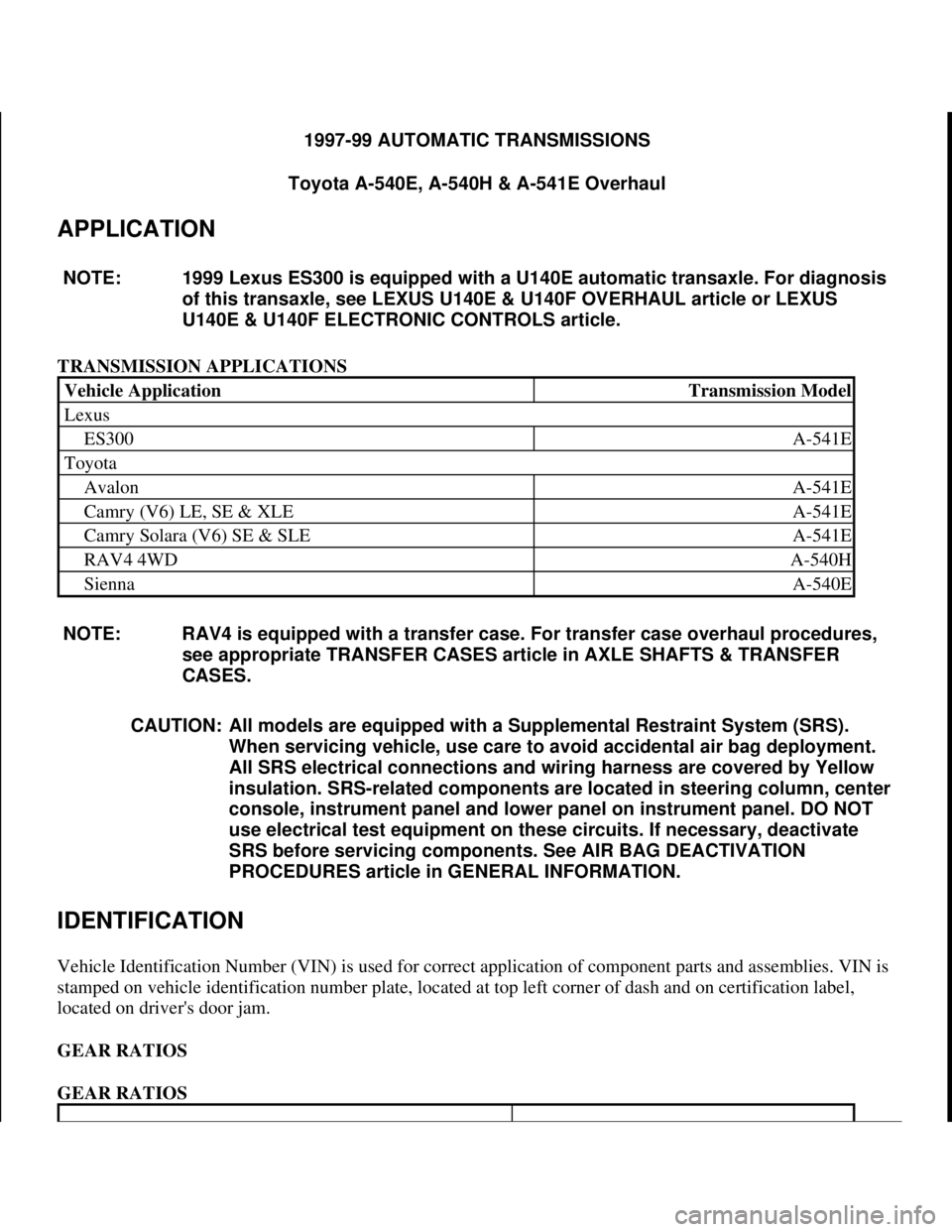
1997-99 AUTOMATIC TRANSMISSIONS
Toyota A-540E, A-540H & A-541E Overhaul
APPLICATION
TRANSMISSION APPLICATIONS
IDENTIFICATION
Vehicle Identification Number (VIN) is used for correct application of component parts and assemblies. VIN is
stamped on vehicle identification number plate, located at top left corner of dash and on certification label,
located on driver's door jam.
GEAR RATIOS
GEAR RATIOS NOTE: 1999 Lexus ES300 is equipped with a U140E automatic transaxle. For diagnosis
of this transaxle, see LEXUS U140E & U140F OVERHAUL article or LEXUS
U140E & U140F ELECTRONIC CONTROLS article.
Vehicle ApplicationTransmission Model
Lexus
ES300A-541E
Toyota
AvalonA-541E
Camry (V6) LE, SE & XLEA-541E
Camry Solara (V6) SE & SLEA-541E
RAV4 4WDA-540H
SiennaA-540E
NOTE: RAV4 is equipped with a transfer case. For transfer case overhaul procedures,
see appropriate TRANSFER CASES article in AXLE SHAFTS & TRANSFER
CASES.
CAUTION: All models are equipped with a Supplemental Restraint System (SRS).
When servicing vehicle, use care to avoid accidental air bag deployment.
All SRS electrical connections and wiring harness are covered by Yellow
insulation. SRS-related components are located in steering column, center
console, instrument panel and lower panel on instrument panel. DO NOT
use electrical test equipment on these circuits. If necessary, deactivate
SRS before servicing components. See AIR BAG DEACTIVATION
PROCEDURES article in GENERAL INFORMATION.
1998 Toyota Avalon XLS
1997-99 AUTOMATIC TRANSMISSIONS Toyota A-540E, A-540H & A-541E Overhaul
1998 Toyota Avalon XLS
1997-99 AUTOMATIC TRANSMISSIONS Toyota A-540E, A-540H & A-541E Overhaul
Helpmelearn
November-03-08 10:28:16 AMPage 1 © 2005 Mitchell Repair Information Company, LLC.
Helpmelearn
November-03-08 10:28:23 AMPage 1 © 2005 Mitchell Repair Information Company, LLC.
Page 280 of 1632
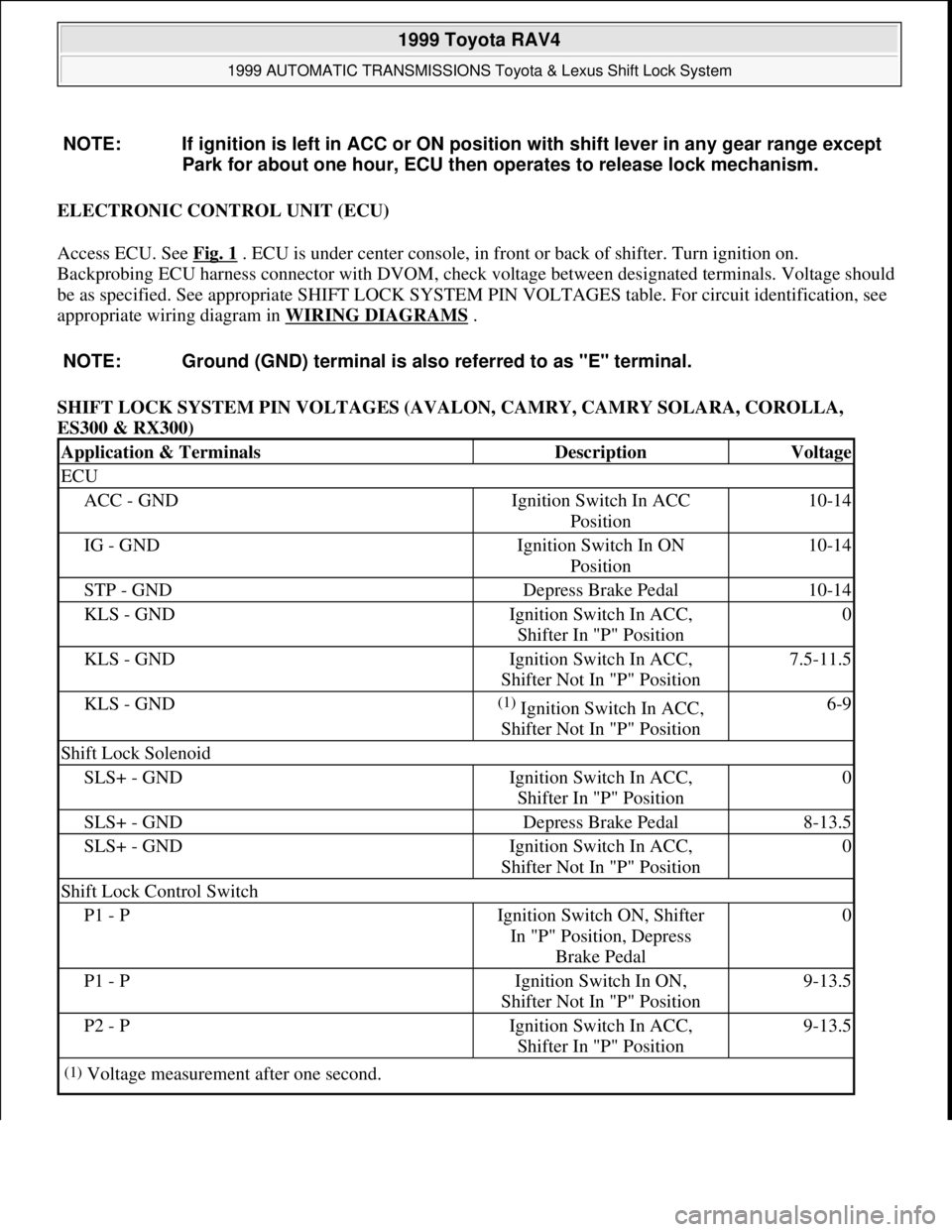
ELECTRONIC CONTROL UNIT (ECU)
Access ECU. See Fig. 1
. ECU is under center console, in front or back of shifter. Turn ignition on.
Backprobing ECU harness connector with DVOM, check voltage between designated terminals. Voltage should
be as specified. See appropriate SHIFT LOCK SYSTEM PIN VOLTAGES table. For circuit identification, see
appropriate wiring diagram in WIRING DIAGRAMS
.
SHIFT LOCK SYSTEM PIN VOLTAGES (AVALON, CAMRY, CAMRY SOLARA, COROLLA,
ES300 & RX300) NOTE: If ignition is left in ACC or ON position with shift lever in any gear range except
Park for about one hour, ECU then operates to release lock mechanism.
NOTE: Ground (GND) terminal is also referred to as "E" terminal.
Application & TerminalsDescriptionVoltage
ECU
ACC - GNDIgnition Switch In ACC
Position10-14
IG - GNDIgnition Switch In ON
Position10-14
STP - GNDDepress Brake Pedal10-14
KLS - GNDIgnition Switch In ACC,
Shifter In "P" Position0
KLS - GNDIgnition Switch In ACC,
Shifter Not In "P" Position7.5-11.5
KLS - GND(1) Ignition Switch In ACC,
Shifter Not In "P" Position6-9
Shift Lock Solenoid
SLS+ - GNDIgnition Switch In ACC,
Shifter In "P" Position0
SLS+ - GNDDepress Brake Pedal8-13.5
SLS+ - GNDIgnition Switch In ACC,
Shifter Not In "P" Position0
Shift Lock Control Switch
P1 - PIgnition Switch ON, Shifter
In "P" Position, Depress
Brake Pedal0
P1 - PIgnition Switch In ON,
Shifter Not In "P" Position9-13.5
P2 - PIgnition Switch In ACC,
Shifter In "P" Position9-13.5
(1)Voltage measurement after one second.
1999 Toyota RAV4
1999 AUTOMATIC TRANSMISSIONS Toyota & Lexus Shift Lock System
Microsoft
Sunday, November 22, 2009 10:46:00 AMPage 3 © 2005 Mitchell Repair Information Company, LLC.
Page 535 of 1632
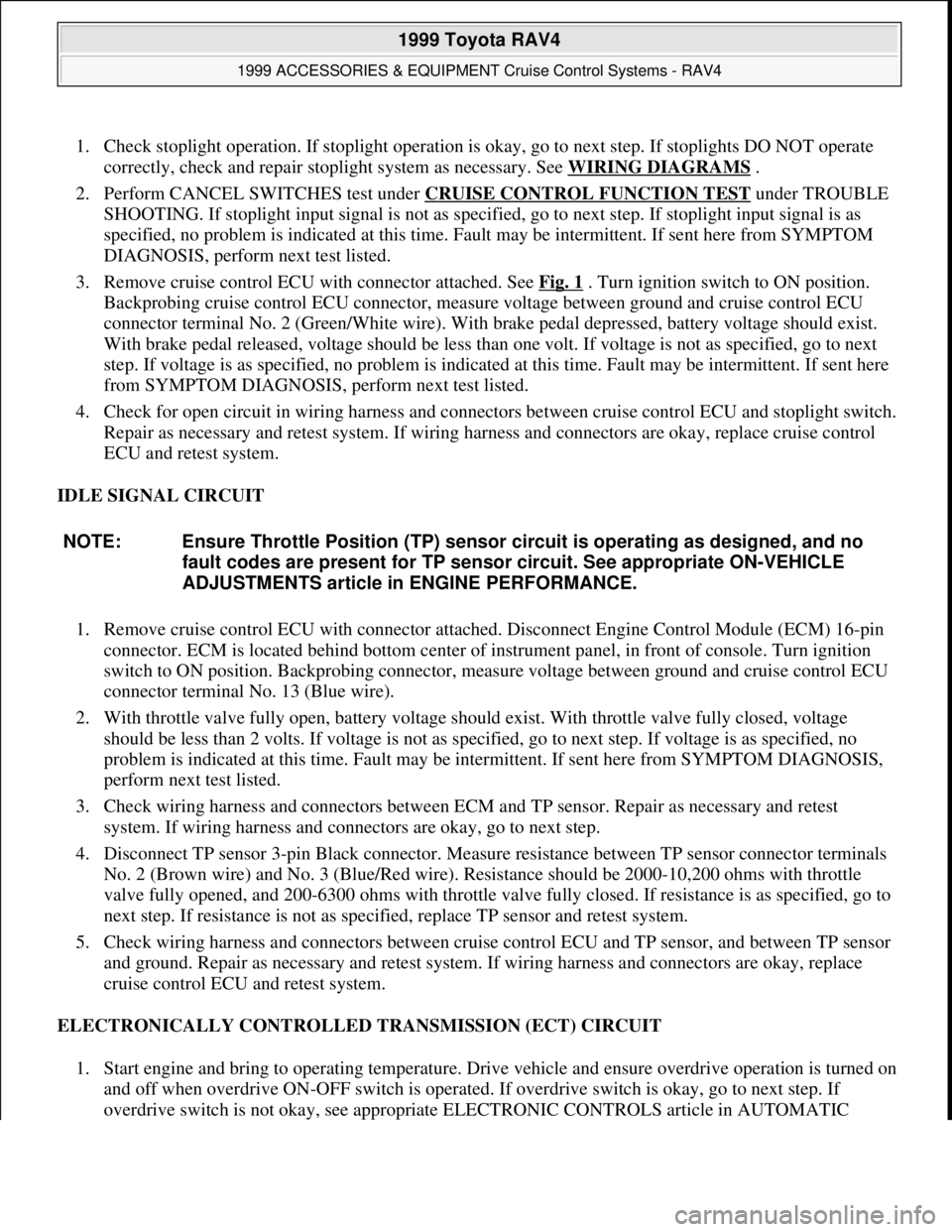
1. Check stoplight operation. If stoplight operation is okay, go to next step. If stoplights DO NOT operate
correctly, check and repair stoplight system as necessary. See WIRING DIAGRAMS
.
2. Perform CANCEL SWITCHES test under CRUISE CONTROL FUNCTION TEST
under TROUBLE
SHOOTING. If stoplight input signal is not as specified, go to next step. If stoplight input signal is as
specified, no problem is indicated at this time. Fault may be intermittent. If sent here from SYMPTOM
DIAGNOSIS, perform next test listed.
3. Remove cruise control ECU with connector attached. See Fig. 1
. Turn ignition switch to ON position.
Backprobing cruise control ECU connector, measure voltage between ground and cruise control ECU
connector terminal No. 2 (Green/White wire). With brake pedal depressed, battery voltage should exist.
With brake pedal released, voltage should be less than one volt. If voltage is not as specified, go to next
step. If voltage is as specified, no problem is indicated at this time. Fault may be intermittent. If sent here
from SYMPTOM DIAGNOSIS, perform next test listed.
4. Check for open circuit in wiring harness and connectors between cruise control ECU and stoplight switch.
Repair as necessary and retest system. If wiring harness and connectors are okay, replace cruise control
ECU and retest system.
IDLE SIGNAL CIRCUIT
1. Remove cruise control ECU with connector attached. Disconnect Engine Control Module (ECM) 16-pin
connector. ECM is located behind bottom center of instrument panel, in front of console. Turn ignition
switch to ON position. Backprobing connector, measure voltage between ground and cruise control ECU
connector terminal No. 13 (Blue wire).
2. With throttle valve fully open, battery voltage should exist. With throttle valve fully closed, voltage
should be less than 2 volts. If voltage is not as specified, go to next step. If voltage is as specified, no
problem is indicated at this time. Fault may be intermittent. If sent here from SYMPTOM DIAGNOSIS,
perform next test listed.
3. Check wiring harness and connectors between ECM and TP sensor. Repair as necessary and retest
system. If wiring harness and connectors are okay, go to next step.
4. Disconnect TP sensor 3-pin Black connector. Measure resistance between TP sensor connector terminals
No. 2 (Brown wire) and No. 3 (Blue/Red wire). Resistance should be 2000-10,200 ohms with throttle
valve fully opened, and 200-6300 ohms with throttle valve fully closed. If resistance is as specified, go to
next step. If resistance is not as specified, replace TP sensor and retest system.
5. Check wiring harness and connectors between cruise control ECU and TP sensor, and between TP sensor
and ground. Repair as necessary and retest system. If wiring harness and connectors are okay, replace
cruise control ECU and retest system.
ELECTRONICALLY CONTROLLED TRANSMISSION (ECT) CIRCUIT
1. Start engine and bring to operating temperature. Drive vehicle and ensure overdrive operation is turned on
and off when overdrive ON-OFF switch is operated. If overdrive switch is okay, go to next step. If
overdrive switch is not okay, see appropriate ELECTRONIC CONTROLS article in AUTOMATIC NOTE: Ensure Throttle Position (TP) sensor circuit is operating as designed, and no
fault codes are present for TP sensor circuit. See appropriate ON-VEHICLE
ADJUSTMENTS article in ENGINE PERFORMANCE.
1999 Toyota RAV4
1999 ACCESSORIES & EQUIPMENT Cruise Control Systems - RAV4
Microsoft
Sunday, November 22, 2009 10:52:01 AMPage 11 © 2005 Mitchell Repair Information Company, LLC.