display TOYOTA RAV4 2006 Service Manual PDF
[x] Cancel search | Manufacturer: TOYOTA, Model Year: 2006, Model line: RAV4, Model: TOYOTA RAV4 2006Pages: 2000, PDF Size: 45.84 MB
Page 1507 of 2000
TIRE AND WHEEL – TIRE PRESSURE WARNING SYSTEMTW–35
TW
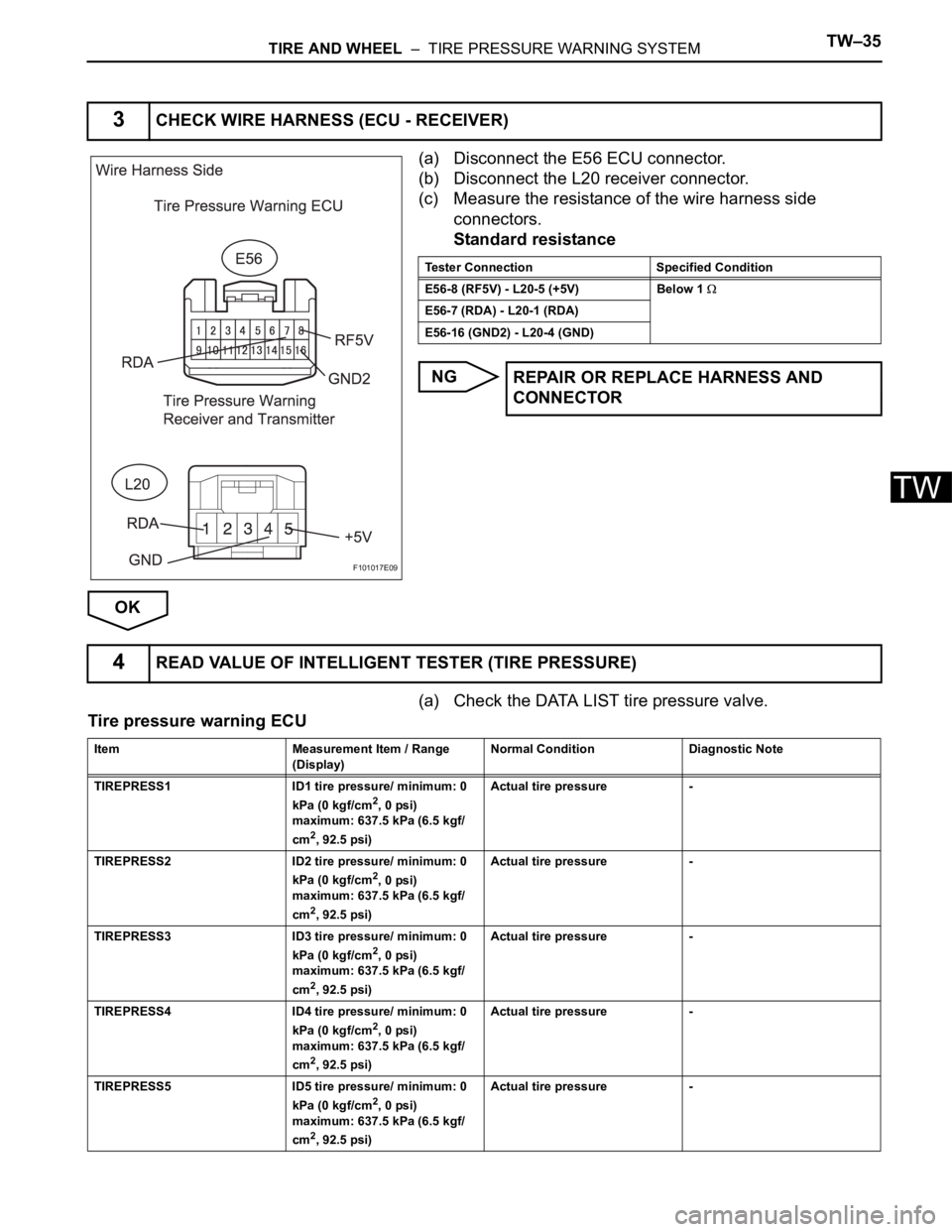
(a) Disconnect the E56 ECU connector.
(b) Disconnect the L20 receiver connector.
(c) Measure the resistance of the wire harness side
connectors.
Standard resistance
NG
OK
(a) Check the DATA LIST tire pressure valve.
Tire pressure warning ECU
3CHECK WIRE HARNESS (ECU - RECEIVER)
F101017E09
Tester Connection Specified Condition
E56-8 (RF5V) - L20-5 (+5V) Below 1
E56-7 (RDA) - L20-1 (RDA)
E56-16 (GND2) - L20-4 (GND)
REPAIR OR REPLACE HARNESS AND
CONNECTOR
4READ VALUE OF INTELLIGENT TESTER (TIRE PRESSURE)
Item Measurement Item / Range
(Display)Normal Condition Diagnostic Note
TIREPRESS1 ID1 tire pressure/ minimum: 0
kPa (0 kgf/cm
2, 0 psi)
maximum: 637.5 kPa (6.5 kgf/
cm
2, 92.5 psi)Actual tire pressure -
TIREPRESS2 ID2 tire pressure/ minimum: 0
kPa (0 kgf/cm
2, 0 psi)
maximum: 637.5 kPa (6.5 kgf/
cm
2, 92.5 psi)Actual tire pressure -
TIREPRESS3 ID3 tire pressure/ minimum: 0
kPa (0 kgf/cm
2, 0 psi)
maximum: 637.5 kPa (6.5 kgf/
cm
2, 92.5 psi)Actual tire pressure -
TIREPRESS4 ID4 tire pressure/ minimum: 0
kPa (0 kgf/cm
2, 0 psi)
maximum: 637.5 kPa (6.5 kgf/
cm
2, 92.5 psi)Actual tire pressure -
TIREPRESS5 ID5 tire pressure/ minimum: 0
kPa (0 kgf/cm
2, 0 psi)
maximum: 637.5 kPa (6.5 kgf/
cm
2, 92.5 psi)Actual tire pressure -
Page 1508 of 2000
TW–36TIRE AND WHEEL – TIRE PRESSURE WARNING SYSTEM
TW
OK:
All tire pressure readings are equal to the actual
tire pressure.
NOTICE:
It may take up to 1 minute to display the updated tire
pressure data.
OK
NG
(a) Select REGIT ID CODE by following the prompts
displayed on the intelligent tester.
Tire pressure warning ECU
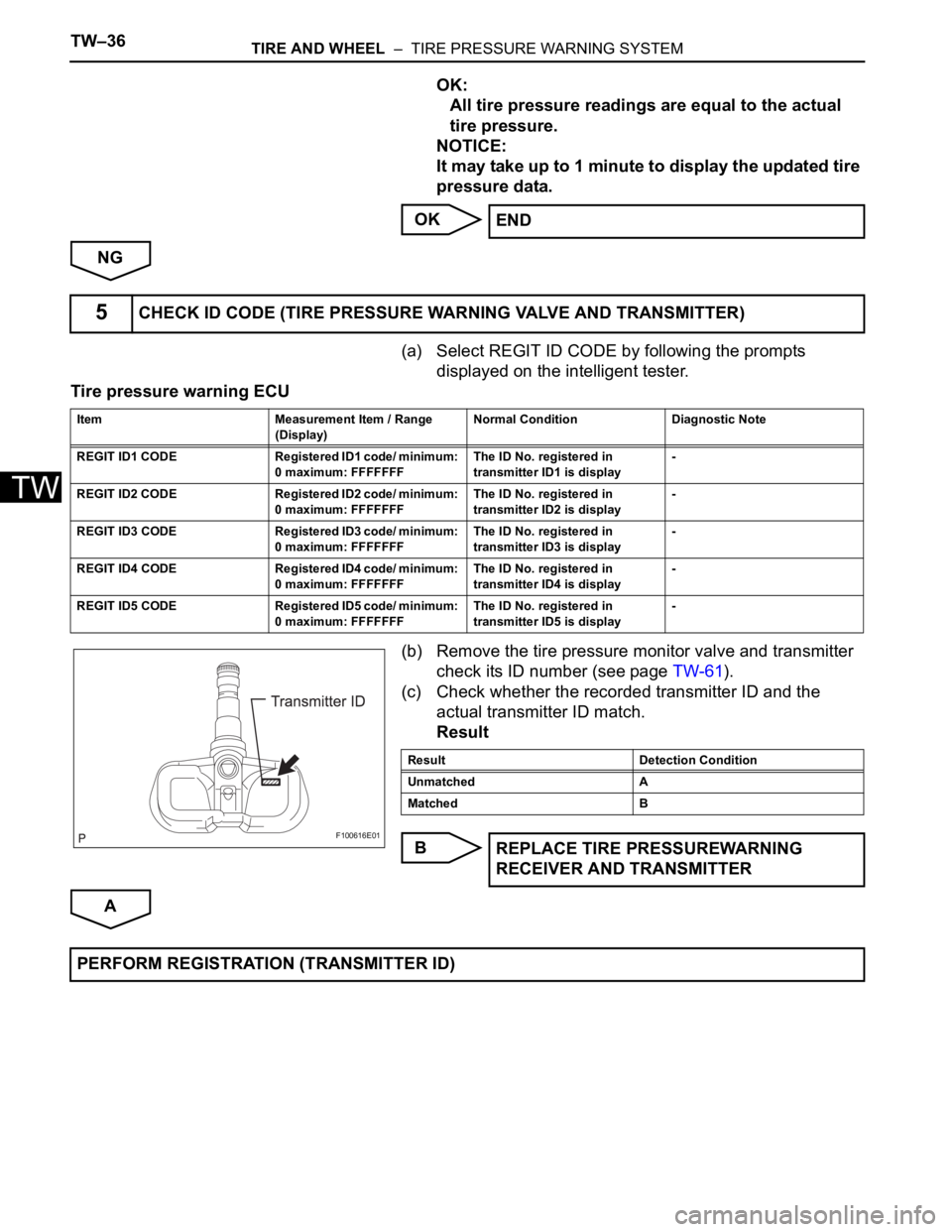
(b) Remove the tire pressure monitor valve and transmitter
check its ID number (see page TW-61).
(c) Check whether the recorded transmitter ID and the
actual transmitter ID match.
Result
B
AEND
5CHECK ID CODE (TIRE PRESSURE WARNING VALVE AND TRANSMITTER)
Item Measurement Item / Range
(Display)Normal Condition Diagnostic Note
REGIT ID1 CODE Registered ID1 code/ minimum:
0 maximum: FFFFFFFThe ID No. registered in
transmitter ID1 is display-
REGIT ID2 CODE Registered ID2 code/ minimum:
0 maximum: FFFFFFFThe ID No. registered in
transmitter ID2 is display-
REGIT ID3 CODE Registered ID3 code/ minimum:
0 maximum: FFFFFFFThe ID No. registered in
transmitter ID3 is display-
REGIT ID4 CODE Registered ID4 code/ minimum:
0 maximum: FFFFFFFThe ID No. registered in
transmitter ID4 is display-
REGIT ID5 CODE Registered ID5 code/ minimum:
0 maximum: FFFFFFFThe ID No. registered in
transmitter ID5 is display-
F100616E01
Result Detection Condition
Unmatched A
Matched B
REPLACE TIRE PRESSUREWARNING
RECEIVER AND TRANSMITTER
PERFORM REGISTRATION (TRANSMITTER ID)
Page 1521 of 2000

BC–18BRAKE CONTROL – VEHICLE STABILITY CONTROL SYSTEM
BC
(3) Front Wheel Skid Tendency
When the skid control ECU determines that
there is a front wheel skid tendency, it controls
the VSC to dampen the front wheel skid. At the
same time, it effects cooperative control with the
EPS to provide steering torque assist, which
facilitates the driver's steering maneuvers to
stabilize the vehicle posture. To prevent
excessive steering maneuvers, it provides a
steering torque assist. This assist increases the
resistance to counter the driver's steering effort,
if the driver turns the steering wheel excessively.
(4) Rear Wheel Skid Tendency
When the skid control ECU determines that
there is a rear wheel skid tendency, it controls
the VSC to dampen the rear wheel skid. At the
same time, it effects cooperative control with the
EPS to provide steering torque assist, which
facilitates the driver's steering maneuvers in the
direction to correct the rear wheel skid.
(5) Acceleration During Cornering
A sudden acceleration of the vehicle during
cornering may cause a drive wheel to freewheel,
which could cause the front wheels or rear
wheels to skid. If the skid control ECU
determines that there is freewheeling of a drive
wheel, a front wheel skid tendency, or a rear
wheel skid tendency, it effects cooperative
control with the 4WD system to optimally control
the drive torque distribution to the front and rear
wheels. Furthermore, it controls the TRC and
the VSC as needed to ensure driving stability
and acceleration performance.
(b) Operation
The operation of the solenoid valves under the
cooperative control is the same as the TRC or VSC
operation.
3. ABS WITH EBD, BA, TRC AND VSC OPERATION
(a) The skid control ECU calculates vehicle stability
tendency based on the signals from the 4 wheel
speed sensors, the yaw rate and deceleration
sensor and the steering sensor. In addition, it
evaluates the results of the calculations to
determine whether any control actions (control of
the engine output torque by electronic throttle
control and of the brake fluid pressure by the ABS
and TRACTION actuator) should be implemented.
(b) The slip indicator blinks and the skid control buzzer
sounds to inform the driver that the VSC system is
operating. The slip indicator also blinks when
traction control is operating, and the operation being
performed is displayed.
Page 1527 of 2000
BC–24BRAKE CONTROL – VEHICLE STABILITY CONTROL SYSTEM
BC
CHECK FOR INTERMITTENT
PROBLEMS
1. CHECK FOR INTERMITTENT PROBLEMS
HINT:
A momentary interruption (open circuit) in the connectors
and/or wire harness between the sensors and ECUs can
be detected by using the ECU DATA LIST function of an
intelligent tester.
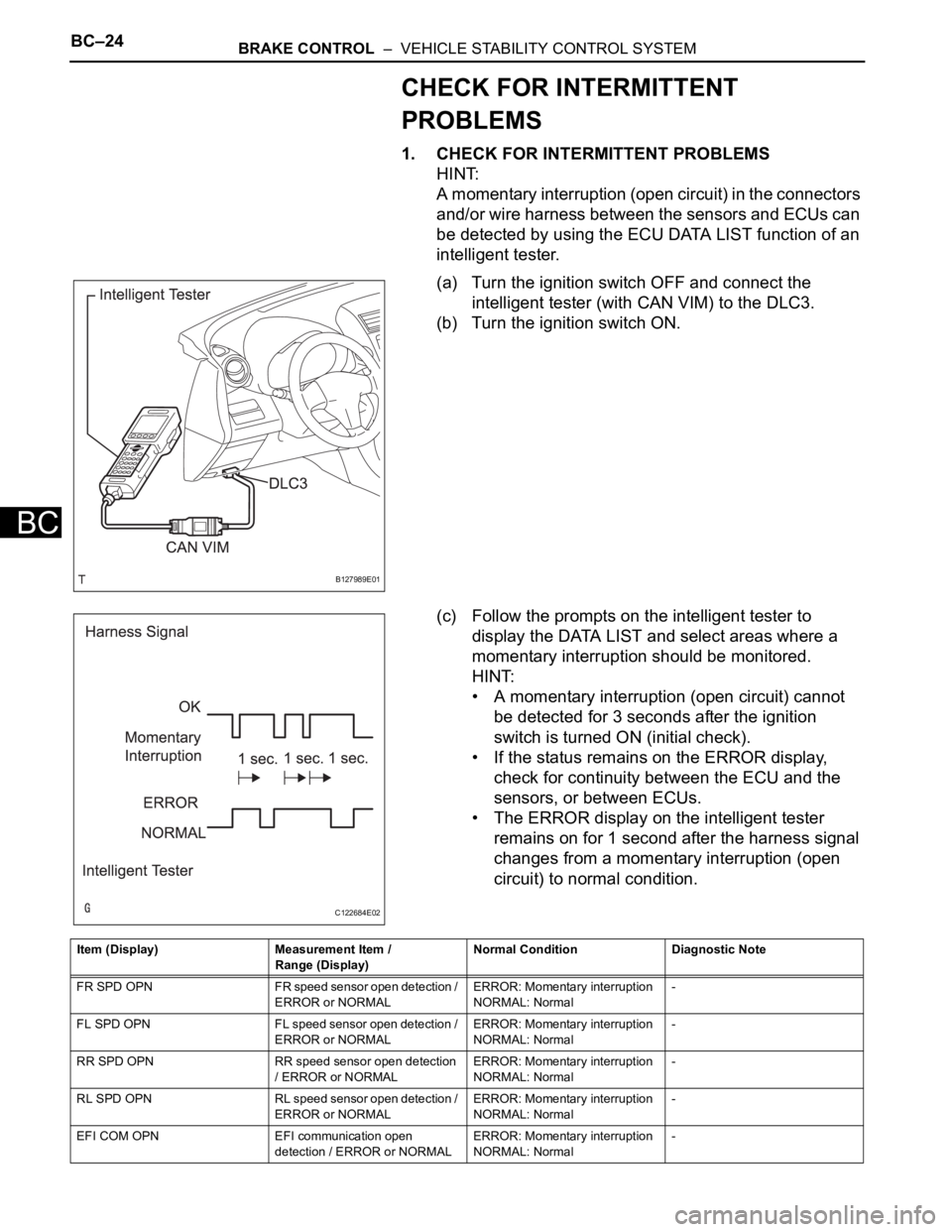
(a) Turn the ignition switch OFF and connect the
intelligent tester (with CAN VIM) to the DLC3.
(b) Turn the ignition switch ON.
(c) Follow the prompts on the intelligent tester to
display the DATA LIST and select areas where a
momentary interruption should be monitored.
HINT:
• A momentary interruption (open circuit) cannot
be detected for 3 seconds after the ignition
switch is turned ON (initial check).
• If the status remains on the ERROR display,
check for continuity between the ECU and the
sensors, or between ECUs.
• The ERROR display on the intelligent tester
remains on for 1 second after the harness signal
changes from a momentary interruption (open
circuit) to normal condition.
B127989E01
C122684E02
Item (Display) Measurement Item /
Range (Display)Normal Condition Diagnostic Note
FR SPD OPN FR speed sensor open detection /
ERROR or NORMALERROR: Momentary interruption
NORMAL: Normal-
FL SPD OPN FL speed sensor open detection /
ERROR or NORMALERROR: Momentary interruption
NORMAL: Normal-
RR SPD OPN RR speed sensor open detection
/ ERROR or NORMALERROR: Momentary interruption
NORMAL: Normal-
RL SPD OPN RL speed sensor open detection /
ERROR or NORMALERROR: Momentary interruption
NORMAL: Normal-
EFI COM OPN EFI communication open
detection / ERROR or NORMALERROR: Momentary interruption
NORMAL: Normal-
Page 1528 of 2000
BRAKE CONTROL – VEHICLE STABILITY CONTROL SYSTEMBC–25
BC
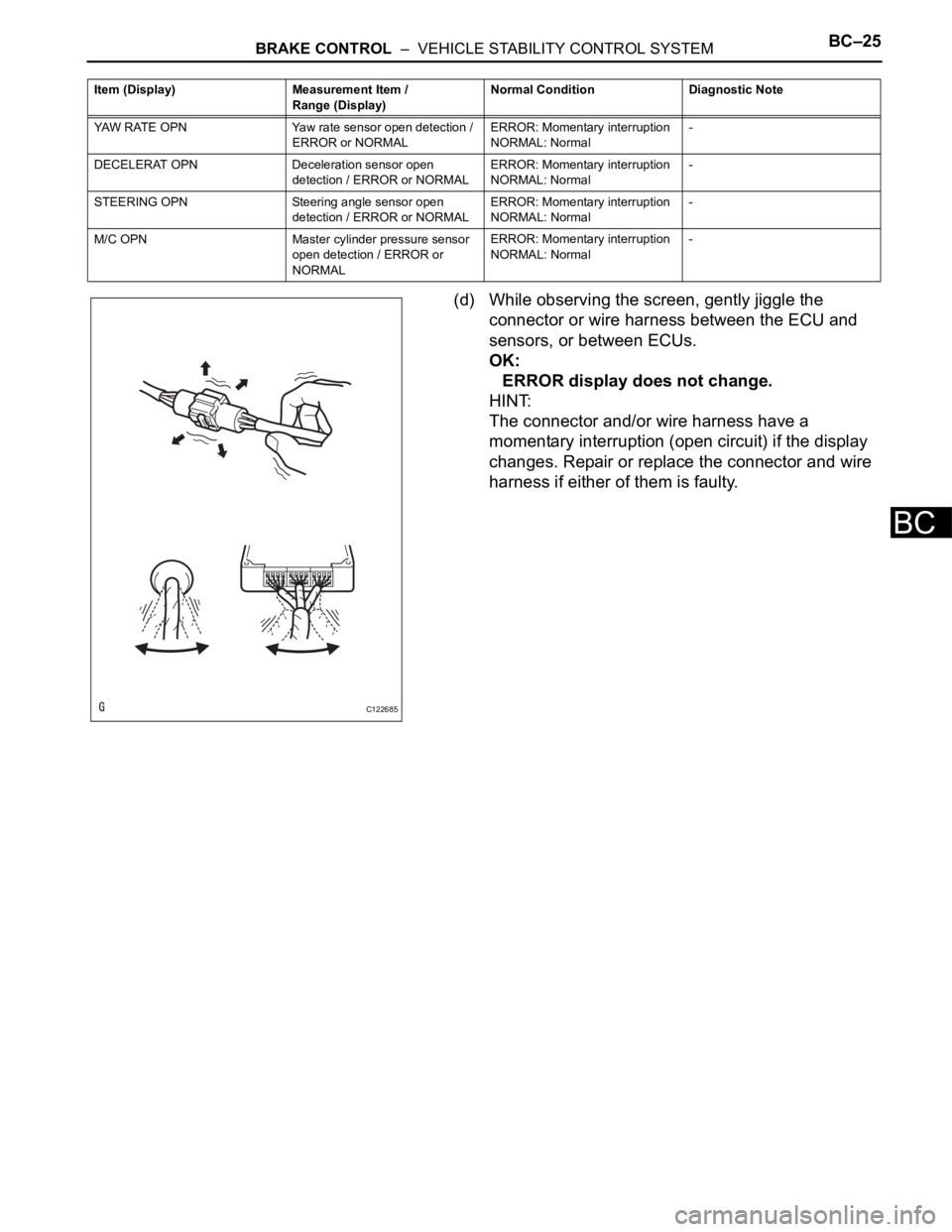
(d) While observing the screen, gently jiggle the
connector or wire harness between the ECU and
sensors, or between ECUs.
OK:
ERROR display does not change.
HINT:
The connector and/or wire harness have a
momentary interruption (open circuit) if the display
changes. Repair or replace the connector and wire
harness if either of them is faulty.
YAW RATE OPN Yaw rate sensor open detection /
ERROR or NORMALERROR: Momentary interruption
NORMAL: Normal-
DECELERAT OPN Deceleration sensor open
detection / ERROR or NORMALERROR: Momentary interruption
NORMAL: Normal-
STEERING OPN Steering angle sensor open
detection / ERROR or NORMALERROR: Momentary interruption
NORMAL: Normal-
M/C OPN Master cylinder pressure sensor
open detection / ERROR or
NORMALERROR: Momentary interruption
NORMAL: Normal- Item (Display) Measurement Item /
Range (Display)Normal Condition Diagnostic Note
C122685
Page 1537 of 2000
BC–34BRAKE CONTROL – VEHICLE STABILITY CONTROL SYSTEM
BC
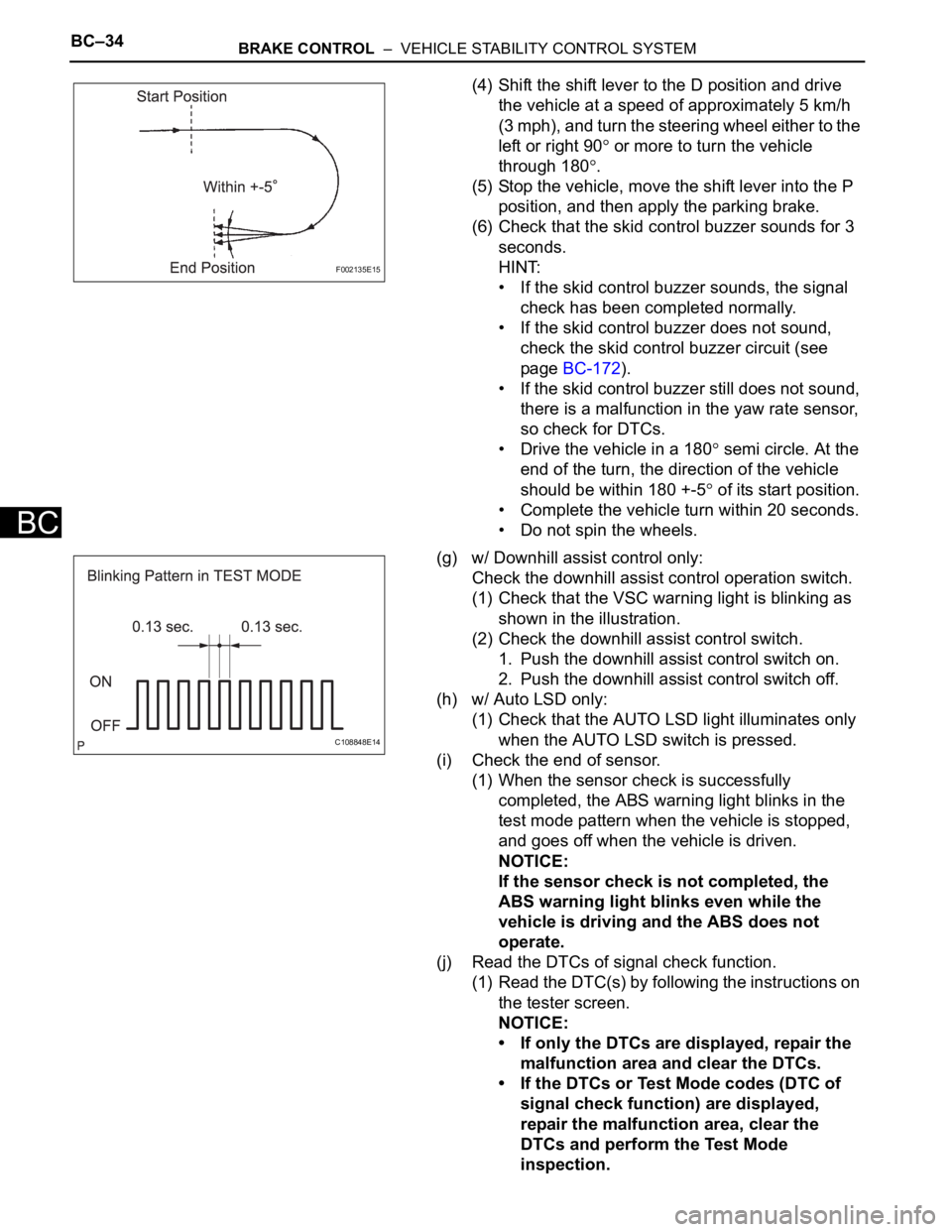
(4) Shift the shift lever to the D position and drive
the vehicle at a speed of approximately 5 km/h
(3 mph), and turn the steering wheel either to the
left or right 90
or more to turn the vehicle
through 180
.
(5) Stop the vehicle, move the shift lever into the P
position, and then apply the parking brake.
(6) Check that the skid control buzzer sounds for 3
seconds.
HINT:
• If the skid control buzzer sounds, the signal
check has been completed normally.
• If the skid control buzzer does not sound,
check the skid control buzzer circuit (see
page BC-172).
• If the skid control buzzer still does not sound,
there is a malfunction in the yaw rate sensor,
so check for DTCs.
• Drive the vehicle in a 180
semi circle. At the
end of the turn, the direction of the vehicle
should be within 180 +-5
of its start position.
• Complete the vehicle turn within 20 seconds.
• Do not spin the wheels.
(g) w/ Downhill assist control only:
Check the downhill assist control operation switch.
(1) Check that the VSC warning light is blinking as
shown in the illustration.
(2) Check the downhill assist control switch.
1. Push the downhill assist control switch on.
2. Push the downhill assist control switch off.
(h) w/ Auto LSD only:
(1) Check that the AUTO LSD light illuminates only
when the AUTO LSD switch is pressed.
(i) Check the end of sensor.
(1) When the sensor check is successfully
completed, the ABS warning light blinks in the
test mode pattern when the vehicle is stopped,
and goes off when the vehicle is driven.
NOTICE:
If the sensor check is not completed, the
ABS warning light blinks even while the
vehicle is driving and the ABS does not
operate.
(j) Read the DTCs of signal check function.
(1) Read the DTC(s) by following the instructions on
the tester screen.
NOTICE:
• If only the DTCs are displayed, repair the
malfunction area and clear the DTCs.
• If the DTCs or Test Mode codes (DTC of
signal check function) are displayed,
repair the malfunction area, clear the
DTCs and perform the Test Mode
inspection.
F002135E15
C108848E14
Page 1538 of 2000
BRAKE CONTROL – VEHICLE STABILITY CONTROL SYSTEMBC–35
BC
HINT:
See the list of the DTCs (refer to "DTC OF TEST
MODE FUNCTION (SIGNAL CHECK)" below).
2. CHECK SENSOR SIGNAL BY TEST MODE (When not
Using Intelligent Tester)
(a) Procedures for test mode:
(1) Turn the ignition switch OFF.
(2) Check that the steering wheel is in the centered
position.
(3) Check that the shift lever is in the P position and
apply the parking brake.
(4) Using SST, connect terminals 12 (TS) and 4
(CG) of the DLC3.
SST 09843-18040
(5) Turn the ignition switch ON.
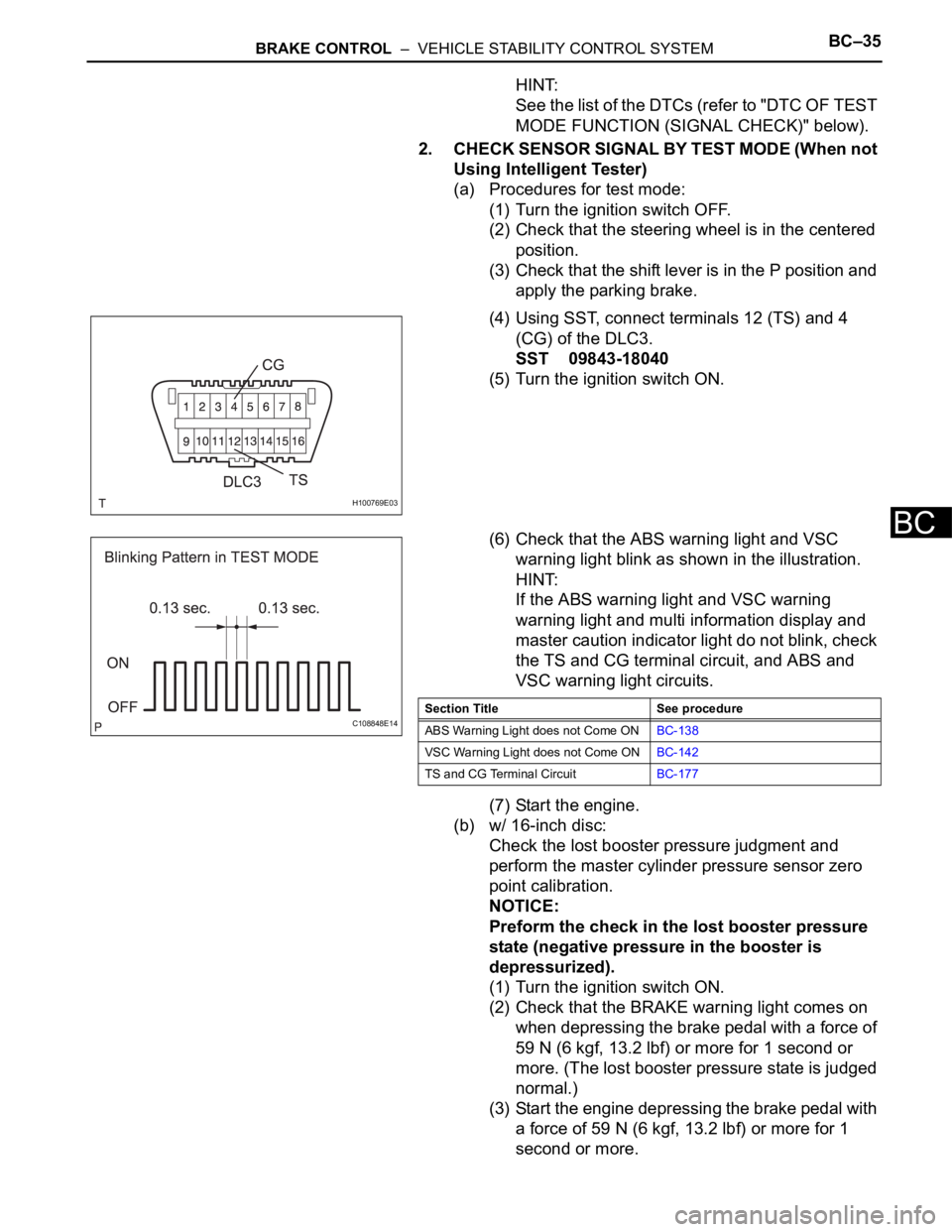
(6) Check that the ABS warning light and VSC
warning light blink as shown in the illustration.
HINT:
If the ABS warning light and VSC warning
warning light and multi information display and
master caution indicator light do not blink, check
the TS and CG terminal circuit, and ABS and
VSC warning light circuits.
(7) Start the engine.
(b) w/ 16-inch disc:
Check the lost booster pressure judgment and
perform the master cylinder pressure sensor zero
point calibration.
NOTICE:
Preform the check in the lost booster pressure
state (negative pressure in the booster is
depressurized).
(1) Turn the ignition switch ON.
(2) Check that the BRAKE warning light comes on
when depressing the brake pedal with a force of
59 N (6 kgf, 13.2 lbf) or more for 1 second or
more. (The lost booster pressure state is judged
normal.)
(3) Start the engine depressing the brake pedal with
a force of 59 N (6 kgf, 13.2 lbf) or more for 1
second or more.
H100769E03
C108848E14Section Title See procedure
ABS Warning Light does not Come ONBC-138
VSC Warning Light does not Come ONBC-142
TS and CG Terminal CircuitBC-177
Page 1542 of 2000
BRAKE CONTROL – VEHICLE STABILITY CONTROL SYSTEMBC–39
BC
(h) w/ Auto LSD only:
Check the end of the sensor.
(1) When the sensor check is successfully
completed, the ABS warning light blinks in the
test mode pattern when the vehicle is stopped,
and goes off when the vehicle is driven.
NOTICE:
If the sensor check is not completed, the
ABS warning light blinks even while the
vehicle is driving and the ABS does not
operate.
(i) Read the DTCs of the signal check function.
(1) Using SST, connect terminals 13 (TC) and 4
(CG) of the DLC3.
SST 09843-18040
(2) Turn the ignition switch ON.
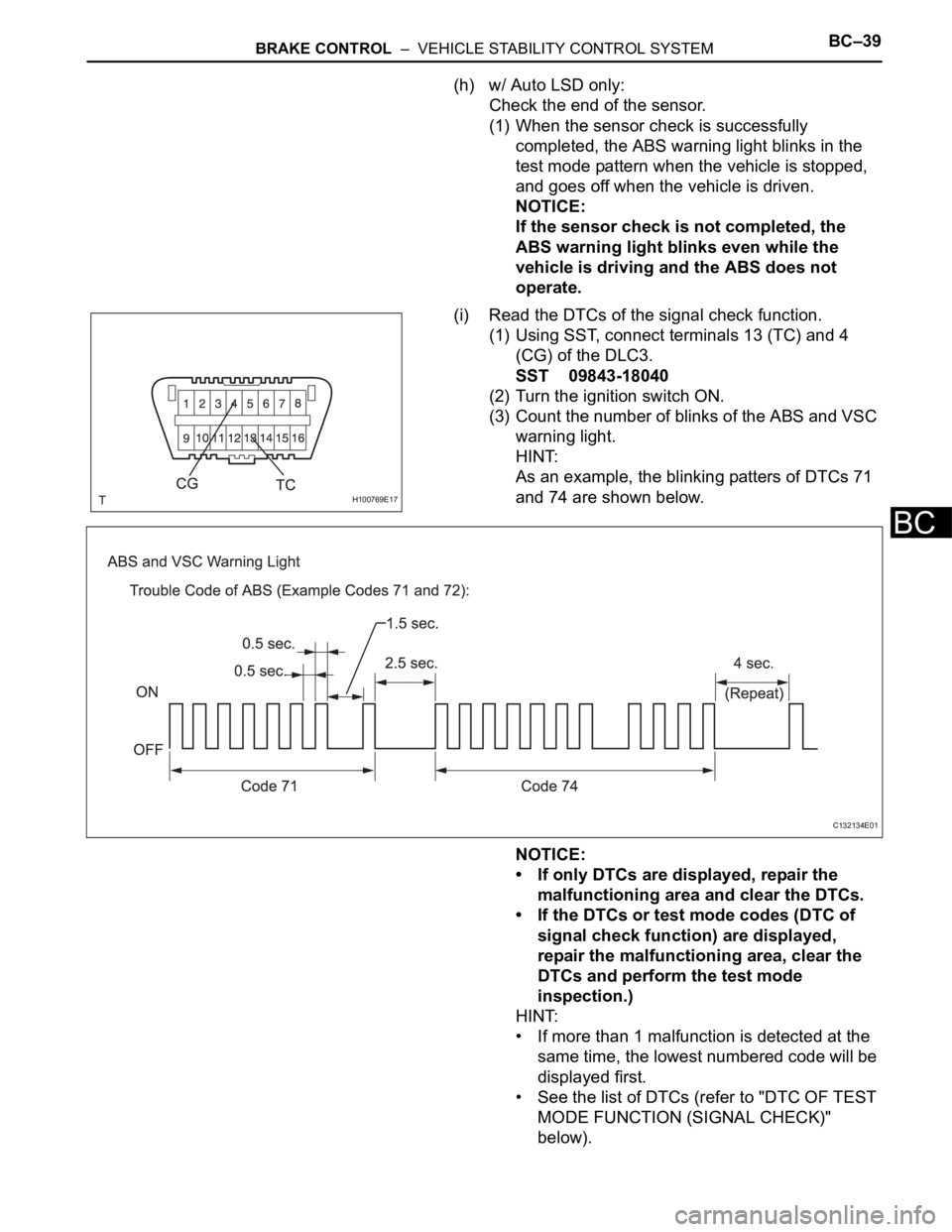
(3) Count the number of blinks of the ABS and VSC
warning light.
HINT:
As an example, the blinking patters of DTCs 71
and 74 are shown below.
NOTICE:
• If only DTCs are displayed, repair the
malfunctioning area and clear the DTCs.
• If the DTCs or test mode codes (DTC of
signal check function) are displayed,
repair the malfunctioning area, clear the
DTCs and perform the test mode
inspection.)
HINT:
• If more than 1 malfunction is detected at the
same time, the lowest numbered code will be
displayed first.
• See the list of DTCs (refer to "DTC OF TEST
MODE FUNCTION (SIGNAL CHECK)"
below).
H100769E17
C132134E01
Page 1545 of 2000
BC–42BRAKE CONTROL – VEHICLE STABILITY CONTROL SYSTEM
BC
PROBLEM SYMPTOMS TABLE
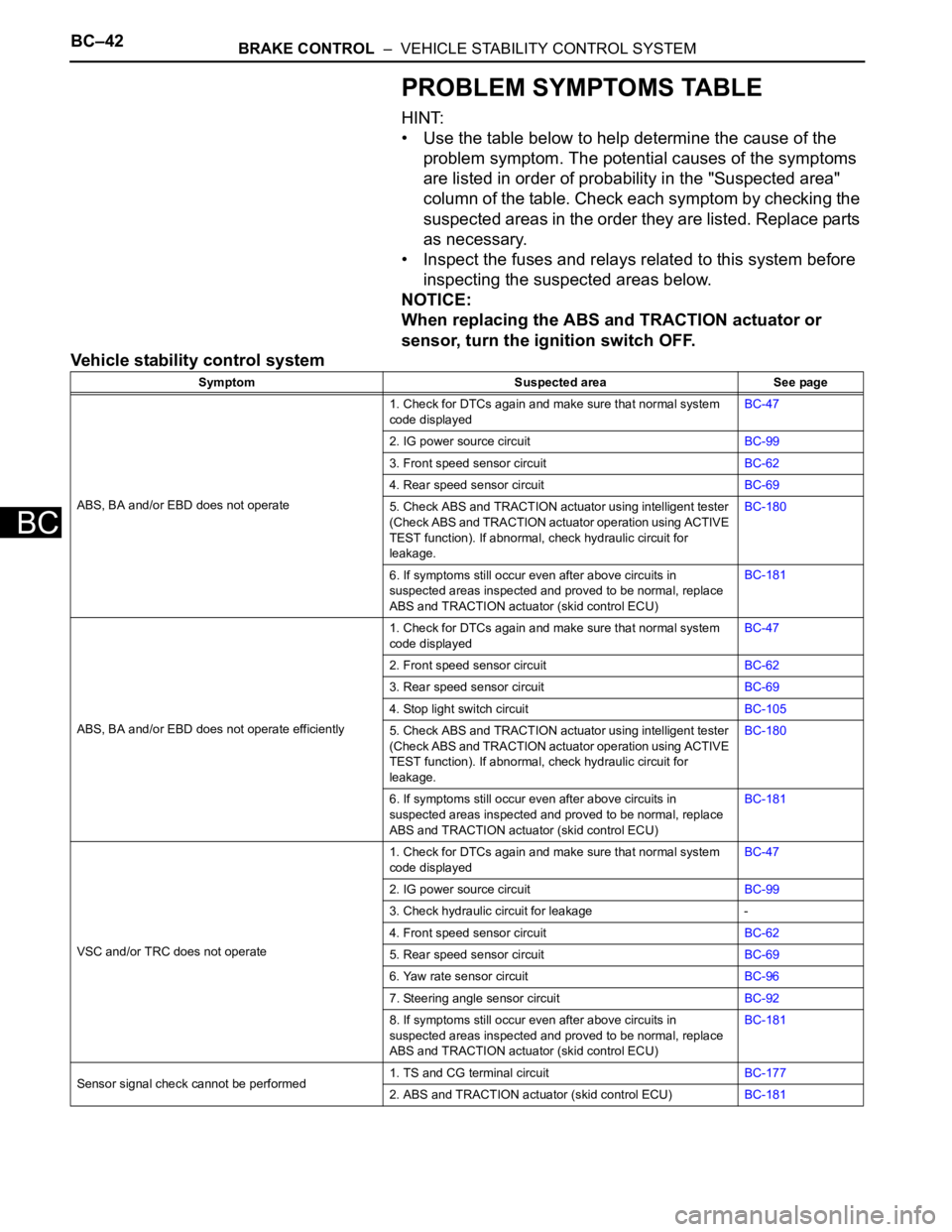
HINT:
• Use the table below to help determine the cause of the
problem symptom. The potential causes of the symptoms
are listed in order of probability in the "Suspected area"
column of the table. Check each symptom by checking the
suspected areas in the order they are listed. Replace parts
as necessary.
• Inspect the fuses and relays related to this system before
inspecting the suspected areas below.
NOTICE:
When replacing the ABS and TRACTION actuator or
sensor, turn the ignition switch OFF.
Vehicle stability control system
Symptom Suspected area See page
ABS, BA and/or EBD does not operate1. Check for DTCs again and make sure that normal system
code displayedBC-47
2. IG power source circuitBC-99
3. Front speed sensor circuitBC-62
4. Rear speed sensor circuitBC-69
5. Check ABS and TRACTION actuator using intelligent tester
(Check ABS and TRACTION actuator operation using ACTIVE
TEST function). If abnormal, check hydraulic circuit for
leakage.BC-180
6. If symptoms still occur even after above circuits in
suspected areas inspected and proved to be normal, replace
ABS and TRACTION actuator (skid control ECU)BC-181
ABS, BA and/or EBD does not operate efficiently1. Check for DTCs again and make sure that normal system
code displayedBC-47
2. Front speed sensor circuitBC-62
3. Rear speed sensor circuitBC-69
4. Stop light switch circuitBC-105
5. Check ABS and TRACTION actuator using intelligent tester
(Check ABS and TRACTION actuator operation using ACTIVE
TEST function). If abnormal, check hydraulic circuit for
leakage.BC-180
6. If symptoms still occur even after above circuits in
suspected areas inspected and proved to be normal, replace
ABS and TRACTION actuator (skid control ECU)BC-181
VSC and/or TRC does not operate1. Check for DTCs again and make sure that normal system
code displayedBC-47
2. IG power source circuitBC-99
3. Check hydraulic circuit for leakage -
4. Front speed sensor circuitBC-62
5. Rear speed sensor circuitBC-69
6. Yaw rate sensor circuitBC-96
7. Steering angle sensor circuitBC-92
8. If symptoms still occur even after above circuits in
suspected areas inspected and proved to be normal, replace
ABS and TRACTION actuator (skid control ECU)BC-181
Sensor signal check cannot be performed1. TS and CG terminal circuitBC-177
2. ABS and TRACTION actuator (skid control ECU)BC-181
Page 1546 of 2000
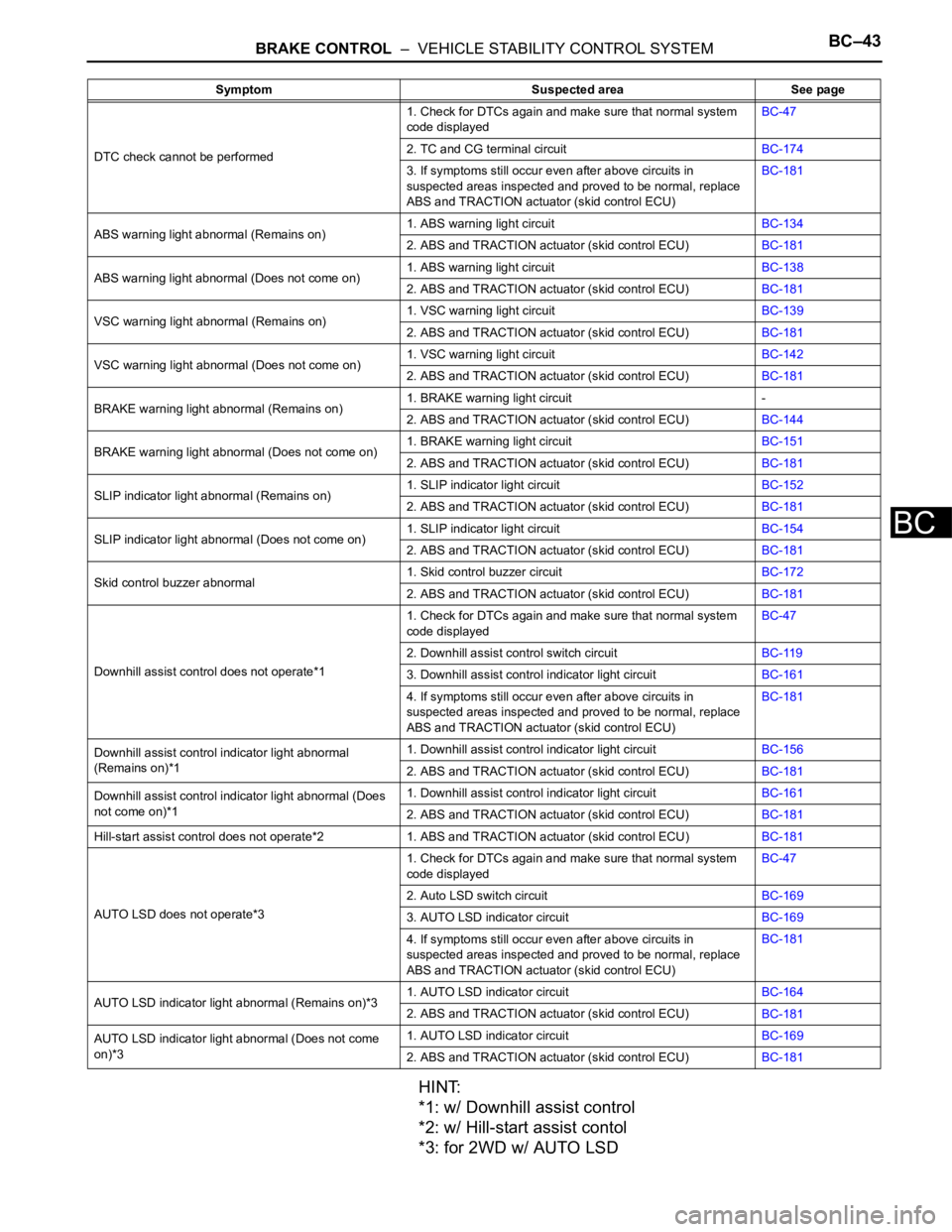
BRAKE CONTROL – VEHICLE STABILITY CONTROL SYSTEMBC–43
BC
HINT:
*1: w/ Downhill assist control
*2: w/ Hill-start assist contol
*3: for 2WD w/ AUTO LSD
DTC check cannot be performed1. Check for DTCs again and make sure that normal system
code displayedBC-47
2. TC and CG terminal circuitBC-174
3. If symptoms still occur even after above circuits in
suspected areas inspected and proved to be normal, replace
ABS and TRACTION actuator (skid control ECU)BC-181
ABS warning light abnormal (Remains on)1. ABS warning light circuitBC-134
2. ABS and TRACTION actuator (skid control ECU)BC-181
ABS warning light abnormal (Does not come on)1. ABS warning light circuitBC-138
2. ABS and TRACTION actuator (skid control ECU)BC-181
VSC warning light abnormal (Remains on)1. VSC warning light circuitBC-139
2. ABS and TRACTION actuator (skid control ECU)BC-181
VSC warning light abnormal (Does not come on)1. VSC warning light circuitBC-142
2. ABS and TRACTION actuator (skid control ECU)BC-181
BRAKE warning light abnormal (Remains on)1. BRAKE warning light circuit -
2. ABS and TRACTION actuator (skid control ECU)BC-144
BRAKE warning light abnormal (Does not come on)1. BRAKE warning light circuitBC-151
2. ABS and TRACTION actuator (skid control ECU)BC-181
SLIP indicator light abnormal (Remains on)1. SLIP indicator light circuitBC-152
2. ABS and TRACTION actuator (skid control ECU)BC-181
SLIP indicator light abnormal (Does not come on)1. SLIP indicator light circuitBC-154
2. ABS and TRACTION actuator (skid control ECU)BC-181
Skid control buzzer abnormal1. Skid control buzzer circuitBC-172
2. ABS and TRACTION actuator (skid control ECU)BC-181
Downhill assist control does not operate*11. Check for DTCs again and make sure that normal system
code displayedBC-47
2. Downhill assist control switch circuitBC-119
3. Downhill assist control indicator light circuitBC-161
4. If symptoms still occur even after above circuits in
suspected areas inspected and proved to be normal, replace
ABS and TRACTION actuator (skid control ECU)BC-181
Downhill assist control indicator light abnormal
(Remains on)*11. Downhill assist control indicator light circuitBC-156
2. ABS and TRACTION actuator (skid control ECU)BC-181
Downhill assist control indicator light abnormal (Does
not come on)*11. Downhill assist control indicator light circuitBC-161
2. ABS and TRACTION actuator (skid control ECU)BC-181
Hill-start assist control does not operate*2 1. ABS and TRACTION actuator (skid control ECU)BC-181
AUTO LSD does not operate*31. Check for DTCs again and make sure that normal system
code displayedBC-47
2. Auto LSD switch circuitBC-169
3. AUTO LSD indicator circuitBC-169
4. If symptoms still occur even after above circuits in
suspected areas inspected and proved to be normal, replace
ABS and TRACTION actuator (skid control ECU)BC-181
AUTO LSD indicator light abnormal (Remains on)*31. AUTO LSD indicator circuitBC-164
2. ABS and TRACTION actuator (skid control ECU)
BC-181
AUTO LSD indicator light abnormal (Does not come
on)*31. AUTO LSD indicator circuitBC-169
2. ABS and TRACTION actuator (skid control ECU)BC-181 Symptom Suspected area See page