Fuel line TOYOTA RAV4 2006 Service Repair Manual
[x] Cancel search | Manufacturer: TOYOTA, Model Year: 2006, Model line: RAV4, Model: TOYOTA RAV4 2006Pages: 2000, PDF Size: 45.84 MB
Page 27 of 2000

ENGINE - 2AZ-FE ENGINE EG-30
ENGINE CONTROL SYSTEM
1. General
The engine control system for the 2AZ-FE engine has the following systems.
System
Outline
SFI
Sequential Multiport
Fuel InjectionAn L-type SFI system directly detects the intake air volume with a hot-wire
type mass air flow meter.
The fuel injection system is a sequential multiport fuel injection system.
ESA
Electronic Spark
AdvanceIgnition timing is determined by the ECM based on signals from various sensors.
The ECM corrects ignition timing in response to engine knocking.
ETCS-i
Electronic
Optimally controls the throttle valve opening in accordance with the amount of
accelerator pedal effort and the condition of the engine and the vehicle.
Electronic
Throttle Control
System-intelligent
(See page-43)A linkless-type is used, without an accelerator cable.
An accelerator pedal position sensor is provided on the accelerator pedal.
A non-contact type throttle position sensor and accelerator pedal position
sensor are used.
VVT-i
Va r i a b l e Va l v e
Timing-intelligent
(See page EG-48)
Controls the intake camshaft to an optimal valve timing in accordance with the
engine condition.
Air-fuel Ratio
Sensor, Oxygen
Sensor Heater
ControlMaintains the temperature of the air-fuel ratio sensor or oxygen sensor at an
appropriate level to realize accuracy of detection of the oxygen concentration in
the exhaust gas.
Air Conditioning
Cut-off ControlBy turning the air conditioning compressor ON or OFF in accordance with the
engine condition, drivability is maintained.
Cooling Fan Control
(See page EG-52)Radiator cooling fan operation is controlled by signals from ECM based on the
engine coolant temperature sensor signal and the condition of the air
conditioning operation.
Fuel Pump Control
(See page EG-53)Fuel pump operation is controlled by signal from the ECM.
The fuel pump is stopped when the SRS driver’s and front passenger’s airbags
are deployed.
Evapotative Emission
The ECM controls the purge flow of evaporative emissions (HC) in the canister
in accordance with engine conditions.
Evapotative Emission
Control
(See page EG-54)Approximately five hours after the ignition switch has been turned OFF, the
ECM operates the canister pump module to detect any evaporative emission
leakage occurring in the EVAP (evaporative emission) control system through
changes in the 0.02 in. leak pressure.
Charging Control
(See page EG-65)The ECM regulates the charging voltage of the generator in accordance with the
driving conditions and the charging state of the battery.
(Continued)
Page 28 of 2000

ENGINE - 2AZ-FE ENGINEEG-31
System
Outline
Engine
Immobilizer*
2
Prohibits fuel delivery and ignition if an attempt is made to start the engine with
an invalid ignition key.
Diagnosis
(See page EG-67)When the ECM detects a malfunction, the ECM diagnoses and memorizes the
failed section.
Fail-safe
(See page EG-67)When the ECM detects a malfunction, the ECM stops or controls the engine
according to the data already stored in memory.
*2: Models with Engine Immobilizer System
Page 33 of 2000

ENGINE - 2AZ-FE ENGINE EG-36
5. Main Components of Engine Control System
General
The main components of the 2AZ-FE engine control system are as follows:
Component
OutlineQuantity
ECM32-bit CPU1
Mass Air Flow MeterHot-wire Type1
Crankshaft Position Sensor (Rotor Teeth)Pick-up Coil Type (36-2)1
Camshaft Position Sensor (Rotor Teeth)Pick-up Coil Type (3)1
Throttle Position SensorNon-contact Type1
Accelerator Pedal Position SensorNon-contact Type1
Knock SensorBuilt-in Piezoelectric Element Type
(Flat Type)1
Air-fuel Ratio Sensor
(Bank 1, Sensor 1)Type with Heater
(Planar Type)1
Heated Oxygen Sensor
(Bank 1, Sensor 2)Type with Heater
(Cup Type)1
Injector12-hole Type4
ECM
The 32-bit CPU of the ECM is used to increase the speed for processing the signals.
Page 34 of 2000

ENGINE - 2AZ-FE ENGINE
00REG21Y
D13N11
Air-fuel
Ratio
SensorA1A+
(3.3V)
A1A -
(2.9V)ECMHeated
Oxygen
SensorOX1B
EX1BECM
Air-fuel Ratio Sensor Circuit Heated Oxygen Sensor
: Air-fuel Ratio Sensor
: Heated Oxygen Sensor
Air-fuel Ratio Sensor Data
Displayed on Hand-held
Te s t e r4.2
2.2
11 (Rich) 14.7 19 (Lean)0.11
Heated Oxygen
Sensor Output (V)
Air-fuel RatioEG-37
Air-fuel Ratio Sensor and Heated Oxygen Sensor
1) General
The air-fuel ratio sensor and heated oxygen sensor differ in output characteristics.
Approximately 0.4V is constantly applied to the air-fuel ratio sensor, which outputs an amperage that
varies in accordance with the oxygen concentration in the exhaust emission. The ECM converts the
changes in the output amperage into voltage in order to linearly detect the present air-fuel ratio. The
air-fuel ratio sensor data is read out by the hand-held tester.
The output voltage of the heated oxygen sensor changes in accordance with the oxygen concentration
in the exhaust emission. The ECM uses this output voltage to determine whether the present air-fuel
ratio is richer or leaner than the stoichiometric air-fuel ratio.
Page 51 of 2000

ENGINE - 2AZ-FE ENGINE
Service Tip
The canister pump module performs the EVAP leak check. This check is done approximately five
hours after the engine is turned off. So you may hear sound coming from underneath the luggage
compartment for several minutes. It does not indicate a malfunction.
The pinpoint pressure test procedure is carried out by pressurizing the fresh air line that runs from
the pump module to the air filler neck. For details, refer to the 2006 RAV4 Repair Manual (Pub.
No. RM01M1U).
EG-54
10. EVAP (evaporative Emission) Control System
General
The EVAP (evaporative emission) control system prevents the vapor gas that is created in the fuel tank from
being released directly into the atmosphere.
The canister stores the vapor gas that has been created in the fuel tank.
The ECM controls the purge VSV in accordance with the driving conditions in order to direct the vapor
gas into the engine, where it is burned.
In this system, the ECM checks the evaporative emission leak and outputs DTC (Diagnostic Trouble
Code) in the event of a malfunction. An EVAP (evaporative emission) leak check consists of an
application of a vacuum pressure to the system and monitoring the changes in the system pressure in order
to detect a leakage.
This system consists of the purge VSV, canister, refueling valve, canister pump module, and ECM.
The ORVR (Onboard Refueling Vapor Recovery) function is provided in the refueling valve.
The canister pressure sensor has been included to the canister pump module.
The canister filter has been provided on the fresh air line. This canister filter is maintenance-free.
The followings are the typical conditions for enabling an EVAP leak check:
Typical Enabling
Condition
Five hours have elapsed after the engine has been turned OFF*.
Altitude: Below 2400 m (8000 feet)
Battery voltage: 10.5 V or more
Ignition switch: OFF
Engine coolant temperature: 4.4 to 35C (40 to 95F)
Intake air temperature: 4.4 to 35C (40 to 95F)
*: If engine coolant temperature does not drop below 35C (95F), this time should be extended to 7hours.
Even after that, if the temperature is not less than 35
C (95F), the time should be extended to 9.5 hours.
Page 52 of 2000

ENGINE - 2AZ-FE ENGINE
00REG22Y
To Intake Manifold
Purge VSV
Purge Air
Line
ECMFuel Tank
Canister Filter
Fresh Air LineRefueling Valve
Canister Pump Module
Ve n t
Va l v e
Leak Detection Pump
& Pump Motor
Canister
Pressure SensorCanisterP M
EG-55
System Diagram
Function of Main Components
ComponentFunction
CanisterContains activated charcoal to absorb the vapor gas that is created in the
fuel tank.
Refueling
Controls the flow rate of the vapor gas from the fuel tank to the canister
when the system is purging or during refueling.
Refueling
Va l v eRestrictor PassagePrevents a large amount of vacuum during purge operation or system
monitoring operation from affecting the pressure in the fuel tank.
Fresh Air LineFresh air goes into the canister and the cleaned drain air goes out into
the atmosphere.
Vent ValveOpens and closes the fresh air line in accordance with the signals from
the ECM.
Canister
Pump ModuleLeak Detection
PumpApplies vacuum pressure to the EVAP control system in accordance
with the signals from the ECM.
p
Canister
Pressure SensorDetects the pressure in the EVAP control system and sends the signals
to the ECM.
Purge VSV
Opens in accordance with the signals from the ECM when the system
is purging, in order to send the vapor gas that was absorbed by the
canister into the intake manifold. In system monitoring mode, this valve
controls the introduction of the vacuum into the fuel tank.
Canister FilterPrevents dust and debris in the fresh air from entering the system.
ECM
Controls the canister pump module and purge VSV in accordance with
the signals from various sensors, in order to achieve a purge volume that
suits the driving conditions. In addition, the ECM monitors the system
for any leakage and outputs a DTC if a malfunction is found.
Page 53 of 2000

ENGINE - 2AZ-FE ENGINE
D13N07 285EG76
Chamber A
Fresh Air Line
Refueling
Valve (Open)
Chamber B
From Fuel
Ta n k
Internal PressureCanister
To F u e l
Ta n k
Positive Pressure
(Fuel Tank Pressure)
Restrictor PassageNegative Pressure
(Intake Manifold Pressure)
During Refueling During Purge Operation or
System Monitoring Operation
228TU119
Fuel Tank Cap
Fresh Air
Fuel Inlet PipeTo Canister
Cleaned Drain Air EG-56
Construction and Operation
1) Refueling Valve
The refueling valve consists of the chamber A, chamber B, and restrictor passage. A constant
atmospheric pressure is applied to the chamber A.
During refueling, the internal pressure of the fuel tank increases. This pressure causes the refueling
valve to lift up, allowing the vapor gas to enter the canister.
The restrictor passage prevents the large amount of vacuum that is created during purge operation or
system monitoring operation from entering the fuel tank, and limits the flow of the vapor gas from the
fuel tank to the canister. If a large volume of vapor gas recirculates into the intake manifold, it will
affect the air-fuel ratio control of the engine. Therefore, the role of the restrictor passage is to help
prevent this from occurring.
2) Fuel Inlet (Fresh Air Line)
In accordance with the change of structure of the EVAP control system, the location of a fresh air line
inlet has been changed from the air cleaner section to the near fuel inlet. The flesh air from the atmosphere
and drain air cleaned by the canister will go in and out of the system through the passage shown below.
Page 55 of 2000

ENGINE - 2AZ-FE ENGINE
00REG23Y
To Intake Manifold
Atmosphere
Purge VSV
(Open)
ECM
00REG24Y
CloseOpen EG-58
System Operation
1) Purge Flow Control
When the engine has satisfied the predetermined conditions (closed loop, engine coolant temperature
above 74
C (165F), etc.), the stored vapor gas are purged from the canister whenever the purge VSV
is opened by the ECM.
The ECM will change the duty ratio cycle of the purge VSV, thus controlling purge flow volume. Purge
flow volume is determined by intake manifold pressure and the duty ratio cycle of the purge VSV.
Atmospheric pressure is allowed into the canister to ensure that purge flow is constantly maintained
whenever purge vacuum is applied to the canister.
2) ORVR (On-board Refueling Vapor Recovery)
When the internal pressure of the fuel tank increases during refueling, this pressure causes the diaphragm
in the refueling valve to lift up, allowing the vapor gas to enter the canister. Because the vent valve is
always open (even when the engine is stopped) when the system is in a mode other than the monitoring
mode, the air that has been cleaned through the canister is discharged outside the vehicle via the fresh
air line. If the vehicle is refueled in the monitoring mode, the ECM will recognize the refueling by way
of the canister pressure sensor, which detects the sudden pressure increase in the fuel tank, and will open
the vent valve.
Page 65 of 2000
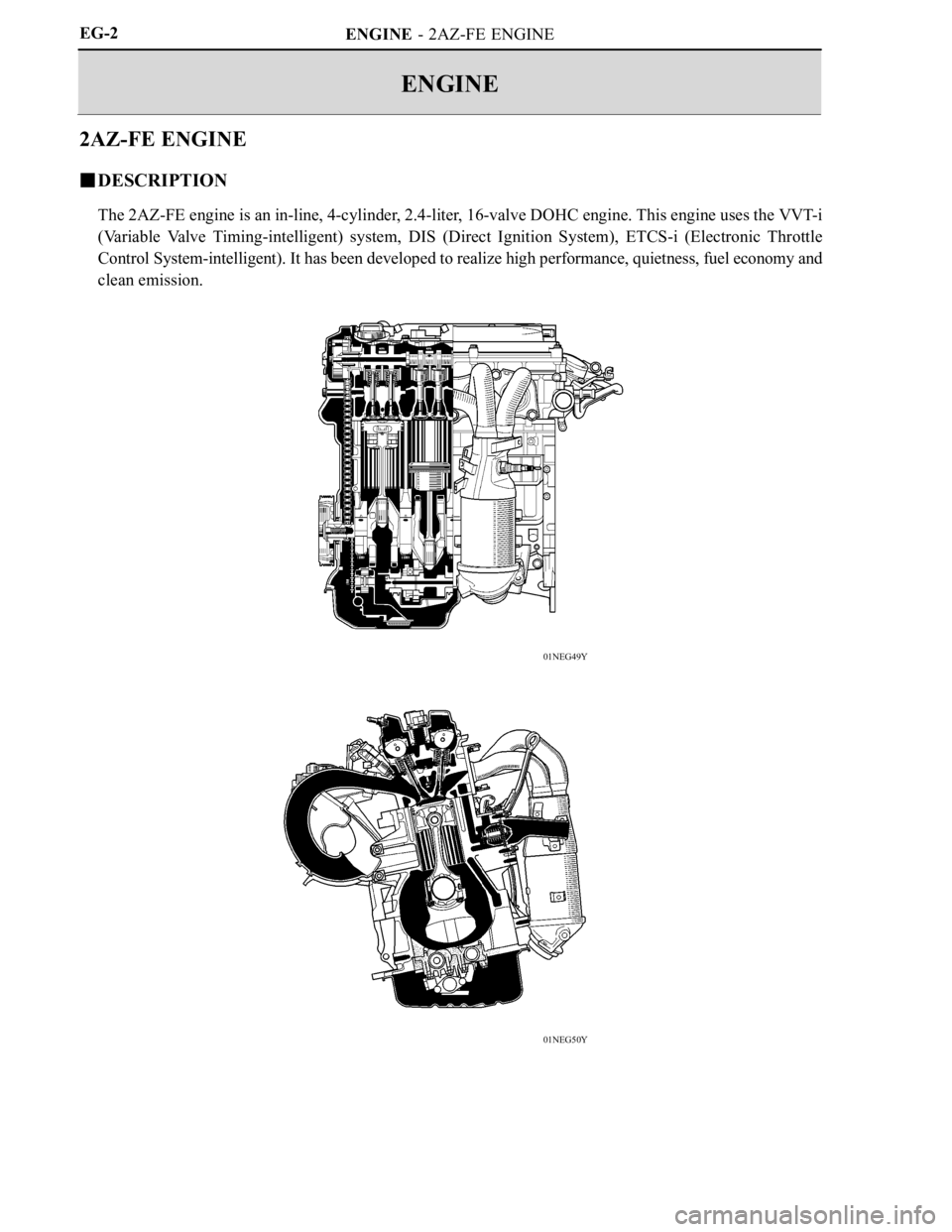
ENGINE
ENGINE - 2AZ-FE ENGINE
01NEG49Y
01NEG50Y
EG-2
2AZ-FE ENGINE
DESCRIPTION
The 2AZ-FE engine is an in-line, 4-cylinder, 2.4-liter, 16-valve DOHC engine. This engine uses the VVT-i
(Variable Valve Timing-intelligent) system, DIS (Direct Ignition System), ETCS-i (Electronic Throttle
Control System-intelligent). It has been developed to realize high performance, quietness, fuel economy and
clean emission.
Page 66 of 2000

ENGINE - 2AZ-FE ENGINE
01MEG02Y
Valve Timing : Intake Valve Opening Angle
: Exhaust Valve Opening Angle
VVT-i Operation
Range
VVT-i Operation
RangeTDC
3
3
43
65
25
45
BDCEG-3
Engine Specifications
No. of Cyls. & Arrangement4-cylinder, In-line
Valve Mechanism16-valve DOHC, Chain Drive (with VVT-i)
Combustion ChamberPentroof Type
ManifoldsCross-flow
Fuel SystemSFI
Ignition SystemDIS
Displacement cm3 (cu. in.)2362 (144.1)
Bore x Stroke mm (in.)88.5 x 96.0 (3.48 x 3.78)
Compression Ratio9.8 : 1
Max. Output*1(SAE-NET)124 kW @ 6000 rpm (166 HP @ 6000 rpm)
Max. Torque*1(SAE-NET)224 N.m @ 4000 rpm (165 ft-lbf @ 4000 rpm)
IntakeOpen3 - 43 BTDC
Valve Timing
IntakeClose65 - 25 ABDCVa l v e T i m i n g
ExhaustOpen45 BBDCExhaustClose3 ATDC
Firing Order1 - 3 - 4 - 2
Research Octane Number91 or higher
Octane Rating87 or higher
Oil GradeILSAC
Tailpipe Emission RegulationULEV-II, SFTP
Evaporative Emission RegulationLEV-II, ORVR
Engine Service Mass*2 (Reference) kg (lb)138 (304.2)
*1: Maximum output and torque rating is determined by revised SAE J1349 standard.
*
2: Weight shows the figure with oil and water fully filled.