chain TOYOTA RAV4 2006 Service Repair Manual
[x] Cancel search | Manufacturer: TOYOTA, Model Year: 2006, Model line: RAV4, Model: TOYOTA RAV4 2006Pages: 2000, PDF Size: 45.84 MB
Page 1 of 2000

ENGINE - 2AZ-FE ENGINE EG-4
FEATURES OF 2AZ-FE ENGINE
The 2AZ-FE engine has achieved the following performance through the use of the items listed below.
(1) High performance and reliability
(2) Low noise and vibration
(3) Lightweight and compact design
(4) Good serviceability
(5) Clean emission and fuel economy
Section
Item(1)(2)(3)(4)(5)
Engine
A cylinder block made of aluminum alloy along with a
magnesium alloy die-cast cylinder head cover is used.
Engine
ProperA taper squish shape is used for the combustion chamber.p
A resin gear balance shaft is used.
Vl
A timing chain and chain tensioner are used.
Va l v e
MechanismThe shim-less type valve lifters are used.MechanismThe VVT-i system is used.
A chacoal filter is used in the air cleaner cap.
Intake andIntake manifold made of plastic is used.Intake and
ExhaustThe linkless-type throttle body is used.
SystemA thin-wall ceramic TWC (Three-Way Catalytic converter)
is used.
The fuel returnless system is used.
Fuel
System
Quick connectors are used to connect the fuel hose with the
fuel pipe.
System12-hole type fuel injectors with high atomizing performance
are used.
Ignition
SystemIridium-tipped spark plugs are used.
Charging
SystemThe segment conductor type generator is used.
Starting
SystemPS (Planetary reduction-Segment conductor motor) type
starter is used.
The ETCS-i is used.
Engine
Control
The DIS (Direct Ignition System) makes ignition timing
adjustment unnecessary.
Control
SystemThe non-contact type sensor is used in the throttle position
sensor.
The planar type air-fuel ratio sensor is used.
Page 9 of 2000
ENGINE - 2AZ-FE ENGINE
240EG46 181EG10
VVT-i ControllerIntake CamshaftExhaust
Camshaft
Chain
Te n s i o n e r
Chain Damper
Chain SlipperCamshaft
Va l v e
Lifter
Service Tip
The adjustment of the valve clearance is accomplished by selecting and replacing the appropriate
valve lifters.
A total of 35 valve lifters are available in 0.02 mm (0.008 in.) increments, from 5.06 mm (0.199 in.)
to 5.74 mm (0.226 in.). For details, refer to 2006 RAV4 Repair Manual (Pub. No. RM01M1U).
EG-12
VA LV E M E C H A N I S M
1. General
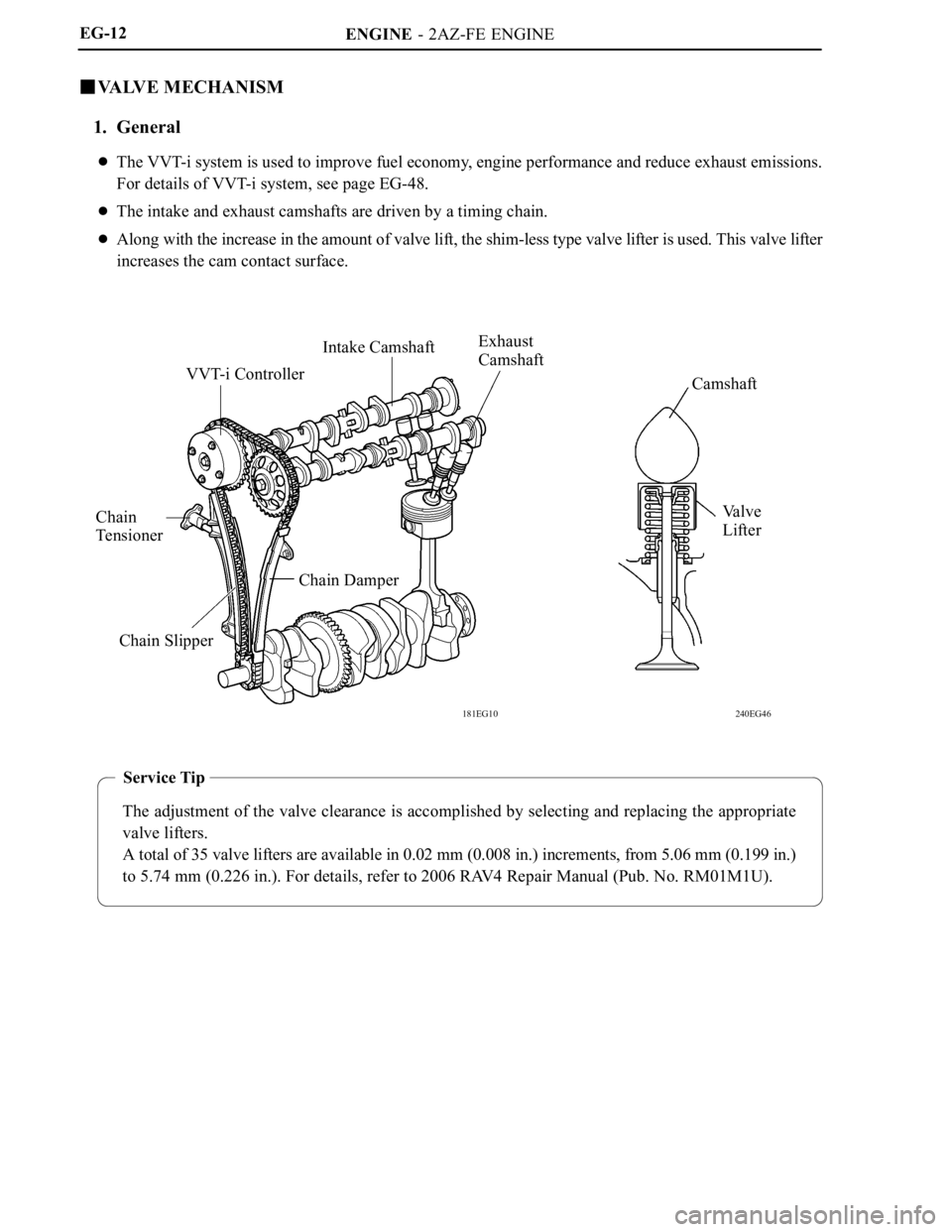
The VVT-i system is used to improve fuel economy, engine performance and reduce exhaust emissions.
For details of VVT-i system, see page EG-48.
The intake and exhaust camshafts are driven by a timing chain.
Along with the increase in the amount of valve lift, the shim-less type valve lifter is used. This valve lifter
increases the cam contact surface.
Page 10 of 2000

ENGINE - 2AZ-FE ENGINE
181EG11
VVT-i ControllerIntake CamshaftTiming Rotor
Exhaust Camshaft
Timing Sprocket
185EG25 181EG14
Cam Spring
Cam
Plunger
SpringChain
Te n s i o n e r
Chain Damper
Oil Jet
Chain TensionerChain SlipperEG-13
2. Camshaft
The intake camshaft is provided with timing rotor to trigger the camshaft position sensor.
In conjunction with the adoption of the VVT-i system, an oil passage is provided in the intake camshaft
in order to supply engine oil pressure to the VVT-i system.
A VVT-i controller has been installed on the front of the intake camshaft to vary the timing of the intake
valves.
3. Timing Chain
A roller chain with an 8 mm (0.315 in.) pitch is used to make the engine more compact.
The timing chain is lubricated by an oil jet.
The chain tensioner uses a spring and oil pressure to maintain proper chain tension at all times.
The chain tensioner suppresses noise generated by the timing chain.
A ratchet type non-return mechanism is used.
To achieve excellent serviceability, the chain tensioner is constructed so that it can be removed and
installed from the outside of the timing chain cover.
Page 11 of 2000

ENGINE - 2AZ-FE ENGINE
208EG07
VVT-i Controller
Camshaft Timing
Oil Control Valve
Oil Return
Hole
Oil PumpOil Filter Chain
Te n s i o n e r
01NEG33Y
Bypass
Va l v e
Relief
Va l v eMain Oil Hole
Oil Filter
Oil Pump
Oil StrainerChain
Te n s i o n e rCylinder Head
Exhaust
Camshaft
Journal
Oil Control
Va l v e
VVT-i Controller
Oil Pan
Intake
Camshaft
Journal
Crankshaft
Journal
Crankshaft
Pin
Oil Jet
Piston
Cylinder
Block
Barance
Shaft
Timing
Chain EG-14
LUBRICATION SYSTEM
1. General
The lubrication circuit is fully pressurized and oil passes through an oil filter.
The trochoid gear type oil pump is chain-driven by the crankshaft.
The oil filter is attached downward from the crankcase to improve serviceability.
Along with the adoption of the VVT-i system, the cylinder head is provided with a VVT-i controller and
a camshaft timing oil control valve. This system is operated by the engine oil.
Oil Circuit
Page 47 of 2000

ENGINE - 2AZ-FE ENGINE
169EG36
HousingLock Pin
Intake Camshaft
Vane (Fixed on Intake Camshaft)
Oil Pressure
At a Stop In Operation
Lock Pin
221EG17
To VVT-i Controller
(Advance Side)To V V T- i C o n t r o l l e r
(Retard Side)
Sleeve
Spring
Drain
Oil PressureDrain
Spool ValveCoil
Plunger EG-50
Construction
1) VVT-i Controller
This controller consists of the housing driven by the timing chain and the vane fixed on the intake
camshaft.
The oil pressure sent from the advance or retard side path at the intake camshaft causes rotation in the
VVT-i controller vane circumferential direction to vary the intake valve timing continuously.
When the engine is stopped, the intake camshaft will be in the most retarded state to ensure startability.
When hydraulic pressure is not applied to the VVT-i controller immediately after the engine has been
started, the lock pin locks the movement of the VVT-i controller to prevent a knocking noise.
2) Camshaft Timing Oil Control Valve
This camshaft timing oil control valve controls the spool valve position in accordance with the duty-cycle
control from the ECM. This allows hydraulic pressure to be applied to the VVT-i controller advance or
retard sides. When the engine is stopped, the camshaft timing oil control valve is in the most retarded
state.
Page 66 of 2000

ENGINE - 2AZ-FE ENGINE
01MEG02Y
Valve Timing : Intake Valve Opening Angle
: Exhaust Valve Opening Angle
VVT-i Operation
Range
VVT-i Operation
RangeTDC
3
3
43
65
25
45
BDCEG-3
Engine Specifications
No. of Cyls. & Arrangement4-cylinder, In-line
Valve Mechanism16-valve DOHC, Chain Drive (with VVT-i)
Combustion ChamberPentroof Type
ManifoldsCross-flow
Fuel SystemSFI
Ignition SystemDIS
Displacement cm3 (cu. in.)2362 (144.1)
Bore x Stroke mm (in.)88.5 x 96.0 (3.48 x 3.78)
Compression Ratio9.8 : 1
Max. Output*1(SAE-NET)124 kW @ 6000 rpm (166 HP @ 6000 rpm)
Max. Torque*1(SAE-NET)224 N.m @ 4000 rpm (165 ft-lbf @ 4000 rpm)
IntakeOpen3 - 43 BTDC
Valve Timing
IntakeClose65 - 25 ABDCVa l v e T i m i n g
ExhaustOpen45 BBDCExhaustClose3 ATDC
Firing Order1 - 3 - 4 - 2
Research Octane Number91 or higher
Octane Rating87 or higher
Oil GradeILSAC
Tailpipe Emission RegulationULEV-II, SFTP
Evaporative Emission RegulationLEV-II, ORVR
Engine Service Mass*2 (Reference) kg (lb)138 (304.2)
*1: Maximum output and torque rating is determined by revised SAE J1349 standard.
*
2: Weight shows the figure with oil and water fully filled.
Page 67 of 2000

ENGINE - 2GR-FE ENGINEEG-71
FEATURES OF 2GR-FE ENGINE
The 2GR-FE engine has achieved the following performance through the use of the items listed below.
(1) High performance and reliability
(2) Low noise and vibration
(3) Lightweight and compact design
(4) Good serviceability
(5) Clean emission and fuel economy
Item
(1)(2)(3)(4)(5)
A steel laminate type cylinder head gasket is used.
An upright intake port is used.
EngineA taper squish shape is used for combustion chamber.Engine
ProperA cylinder block made of aluminum alloy is used.Proper
The skirt portion of the piston is applied with resin to
reduce friction.
An oil pan No. 1 made of aluminum alloy is used.
The Dual VVT-i (Variable Valve Timing-intelligent)
system is used.
Va l v e
Mh i
Hydraulic lash adjusters are used.
MechanismTiming chains and chain tensioners are used.
Roller rocker arms are used.
Lubrication
SystemAn oil filter with a replaceable element is used.
Cooling SystemThe TOYOTA Genuine SLLC (Super Long Life Coolant)Cooling SystemThe TOYOTA Genuine SLLC (Super Long Life Coolant)
is used for the engine coolant.
The linkless-type throttle body is used.
Intake andThe intake air chamber made of plastic is used.Intake and
Exhaust
S
A stainless steel exhaust manifold is used.
SystemAn ultra thin-wall, high-cell density ceramic type TWC
(Three-Way Catalytic converter) is used.
The fuel delivery pipe made of plastic is used.
Fuel SystemA compact 12-hole type injector is used.Fuel SystemQuick connectors are used to connect the fuel hose with
the fuel pipe.
Ignition System
The DIS (Direct Ignition System) makes ignition timing
adjustment unnecessary.
Ignition System
The long-reach type spark plugs are used.
(Continued)
Page 76 of 2000

ENGINE - 2GR-FE ENGINE
285EG18
Secondary
Timing
ChainExhaust Camshaft Intake CamshaftsExhaust Camshaft
Roller Rocker Arm
Va l v e S p r i n g
Retainer
Va l v e S p r i n g
Hydraulic
Lash Adjuster
Va l v e G u i d e
Bush Va l v e S p r i n g
Sheet
Va l v e
Secondary Timing
Chain Primary
Timing
Chain EG-80
VA LV E M E C H A N I S M
1. General
Each cylinder of this engine has 2 intake valves and 2 exhaust valves. Intake and exhaust efficiency is
increased due to the larger total port areas.
This engine uses roller rocker arms with built-in needle bearings. This reduces the friction that occurs
between the cams and the areas (roller rocker arms) that push the valves down, thus improving fuel
economy.
A hydraulic lash adjuster, which maintains a constant zero valve clearance through the use of oil pressure
and spring force, is used.
The intake camshafts are driven by the crankshaft via the primary timing chain. The exhaust camshafts
are driven by the intake camshaft of the respective bank via the secondary timing chain.
This engine uses a Dual VVT-i (Variable Valve Timing-intelligent) system which controls the intake and
exhaust camshafts to provide optimal valve timing according to driving conditions. With this adoption,
lower fuel consumption, higher engine performance, and fewer exhaust emissions have been achieved.
For details of Dual VVT-i control, see page EG-120.
Page 78 of 2000

ENGINE - 2GR-FE ENGINE
285EG20
Secondary Chain Tensioner
Primary Chain TensionerSecondary
Timing Chain
Idle Sprocket Secondary Chain
Te n s i o n e r
Secondary
Timing Chain Secondary Chain
Te n s i o n e r
Chain Damper
Timing Chain Oil Jet
Primary Timing Chain Chain
Slipper Ball
Ball
SpringMain Spring
Plunger
SpringPlunger
Cam
Cam Spring EG-82
3. Timing Chain and Chain Tensioner
Both the primary and secondary timing chains use roller chains with a pitch of 9.525 mm (0.375 in.).
The timing chain is lubricated by an oil jet.
The primary timing chain uses one chain tensioner, and each of the secondary timing chains for the right
and left banks uses one chain tensioner.
Both the primary and secondary chain tensioners use a spring and oil pressure to maintain proper chain
tension at all times. They suppress noise generated by the timing chains.
The primary chain tensioner is the ratchet type with a non-return mechanism.
Page 79 of 2000

ENGINE - 2GR-FE ENGINE
285EG21
Timing Chain Cover
Wa t e r P u m p G a s k e t
Wa t e r P u m pWater Pump Swirl
Chamber
Oil Pump
Housing
Oil Pump RotorsTiming Chain
Cover
Oil Pump Chamber
View from Front Side View from Back Side
285EG22
Oil
Passage
Check Ball
Check Ball
Spring
Plunger SpringPlunger
Roller Rocker ArmCam
Oil
Passage
Hydraulic
Lash Adjuster
Service Tip
Valve clearance adjustment is not necessary because a hydraulic lash adjuster is used in this model.
EG-83
4. Timing Chain Cover
The timing chain cover has an integrated construction consisting of the cooling system (water pump and
water passage) and the lubrication system (oil pump and oil passage). Thus, the number of parts has been
reduced to reduce weight.
5. Hydraulic Lash Adjuster
The hydraulic lash adjuster, which is located at the fulcrum of the roller rocker arm, consists primarily of
a plunger, plunger spring, check ball, and check ball spring.
The engine oil that is supplied by the cylinder head and the built-in spring actuates the hydraulic lash
adjuster. The oil pressure and the spring force that act on the plunger push the roller rocker arm against
the cam, in order to adjust the valve clearance that is created during the opening and closing of the valve.
As a result, engine noise is reduced.