fuel cap TOYOTA RAV4 2006 Service Repair Manual
[x] Cancel search | Manufacturer: TOYOTA, Model Year: 2006, Model line: RAV4, Model: TOYOTA RAV4 2006Pages: 2000, PDF Size: 45.84 MB
Page 1 of 2000

ENGINE - 2AZ-FE ENGINE EG-4
FEATURES OF 2AZ-FE ENGINE
The 2AZ-FE engine has achieved the following performance through the use of the items listed below.
(1) High performance and reliability
(2) Low noise and vibration
(3) Lightweight and compact design
(4) Good serviceability
(5) Clean emission and fuel economy
Section
Item(1)(2)(3)(4)(5)
Engine
A cylinder block made of aluminum alloy along with a
magnesium alloy die-cast cylinder head cover is used.
Engine
ProperA taper squish shape is used for the combustion chamber.p
A resin gear balance shaft is used.
Vl
A timing chain and chain tensioner are used.
Va l v e
MechanismThe shim-less type valve lifters are used.MechanismThe VVT-i system is used.
A chacoal filter is used in the air cleaner cap.
Intake andIntake manifold made of plastic is used.Intake and
ExhaustThe linkless-type throttle body is used.
SystemA thin-wall ceramic TWC (Three-Way Catalytic converter)
is used.
The fuel returnless system is used.
Fuel
System
Quick connectors are used to connect the fuel hose with the
fuel pipe.
System12-hole type fuel injectors with high atomizing performance
are used.
Ignition
SystemIridium-tipped spark plugs are used.
Charging
SystemThe segment conductor type generator is used.
Starting
SystemPS (Planetary reduction-Segment conductor motor) type
starter is used.
The ETCS-i is used.
Engine
Control
The DIS (Direct Ignition System) makes ignition timing
adjustment unnecessary.
Control
SystemThe non-contact type sensor is used in the throttle position
sensor.
The planar type air-fuel ratio sensor is used.
Page 6 of 2000

ENGINE - 2AZ-FE ENGINE
01MEG01Y
Taper Squish Shape : Resin Coating
240EG45
Plastic Region Tightening BoltsEG-9
5. Piston
The piston is made of aluminum alloy and skirt area is made compact and lightweight.
The piston head portion uses a taper squish shape to improve the fuel combustion efficiency.
The piston skirt has been coated with resin to reduce the friction loss.
6. Connecting Rod
The connecting rods and caps are made of
high-strength steel for weight reduction.
Nut-less type plastic region tightening bolts are
used on the connecting rod for a lighter design.
The connecting rod bearings are reduced in
width to reduce friction.
Page 53 of 2000

ENGINE - 2AZ-FE ENGINE
D13N07 285EG76
Chamber A
Fresh Air Line
Refueling
Valve (Open)
Chamber B
From Fuel
Ta n k
Internal PressureCanister
To F u e l
Ta n k
Positive Pressure
(Fuel Tank Pressure)
Restrictor PassageNegative Pressure
(Intake Manifold Pressure)
During Refueling During Purge Operation or
System Monitoring Operation
228TU119
Fuel Tank Cap
Fresh Air
Fuel Inlet PipeTo Canister
Cleaned Drain Air EG-56
Construction and Operation
1) Refueling Valve
The refueling valve consists of the chamber A, chamber B, and restrictor passage. A constant
atmospheric pressure is applied to the chamber A.
During refueling, the internal pressure of the fuel tank increases. This pressure causes the refueling
valve to lift up, allowing the vapor gas to enter the canister.
The restrictor passage prevents the large amount of vacuum that is created during purge operation or
system monitoring operation from entering the fuel tank, and limits the flow of the vapor gas from the
fuel tank to the canister. If a large volume of vapor gas recirculates into the intake manifold, it will
affect the air-fuel ratio control of the engine. Therefore, the role of the restrictor passage is to help
prevent this from occurring.
2) Fuel Inlet (Fresh Air Line)
In accordance with the change of structure of the EVAP control system, the location of a fresh air line
inlet has been changed from the air cleaner section to the near fuel inlet. The flesh air from the atmosphere
and drain air cleaned by the canister will go in and out of the system through the passage shown below.
Page 62 of 2000

ENGINE - 2AZ-FE ENGINE
01NEG13Y
Generator
RegulatorB
DF
RLOECM
Various Electrical
Loads
Battery Current Sensor
Battery Temperature Sensor
Battery Voltage
Battery
Various Sensors and Switches
Throttle Position Sensor
Crankshaft Position Sensor
Accelerator Pedal Position
SensorEG-65
11. Charging Control
General
This system lowers the generated voltage when the vehicle is idling or is being driven at a constant speed,
and raises the generated voltage when the vehicle is decelerating. This reduces the load on the engine as
a result of the electric generation of the generator, thus contributing to the fuel economy of the engine.
During acceleration, this system regulates the generated voltage in order to place the amperage estimation
value close to the target value.
This control consists of the ECM, battery current sensor with a built-in battery temperature sensor,
generator, and various sensors and switches.
The ECM detects driving condition based on signals from various sensors and switches, and detects
charging condition based on signals from the generator, battery current sensor and battery temperature
sensor. Then the ECM outputs signals to the IC regulator to control the genetated voltage of the generator.
The ECM stops the charging control and the generator switches to normal power generation mode under
the following conditions:
Low battery capacity
Low or high battery temparature
Wipers operating or blower motor operating with tail lamp relay ON
System Diagram
Page 103 of 2000

ENGINE - 2GR-FE ENGINE
01MEG24Y
01MEG25Y
01MEG26Y
Heated Oxygen Sensor
(Bank 2, Sensor2)
Battery Current Sensor
(Built-in Battery Temperature Sensor)ECMHeated Oxygen Sensor
(Bank 1, Sensor 2)Canister Pump Module
Ve n t Va l v e
Leak Detection Pump
Canister Pressure SensorFuel Pump
VSV (for Air Intake Control)
Mass Air Flow Meter
Intake Air Temperature Sensor
Air Cleaner Cap
Vacuum Tank
Actuator (For Air Intake Control)
Combination Meter
Malfunction Indicator Lamp
DLC3
Accelerator Pedal
Position SensorEG-107
4. Layout of Main Components
Page 198 of 2000
2GR-FE ENGINE MECHANICAL – ENGINE ASSEMBLYEM–23
EM
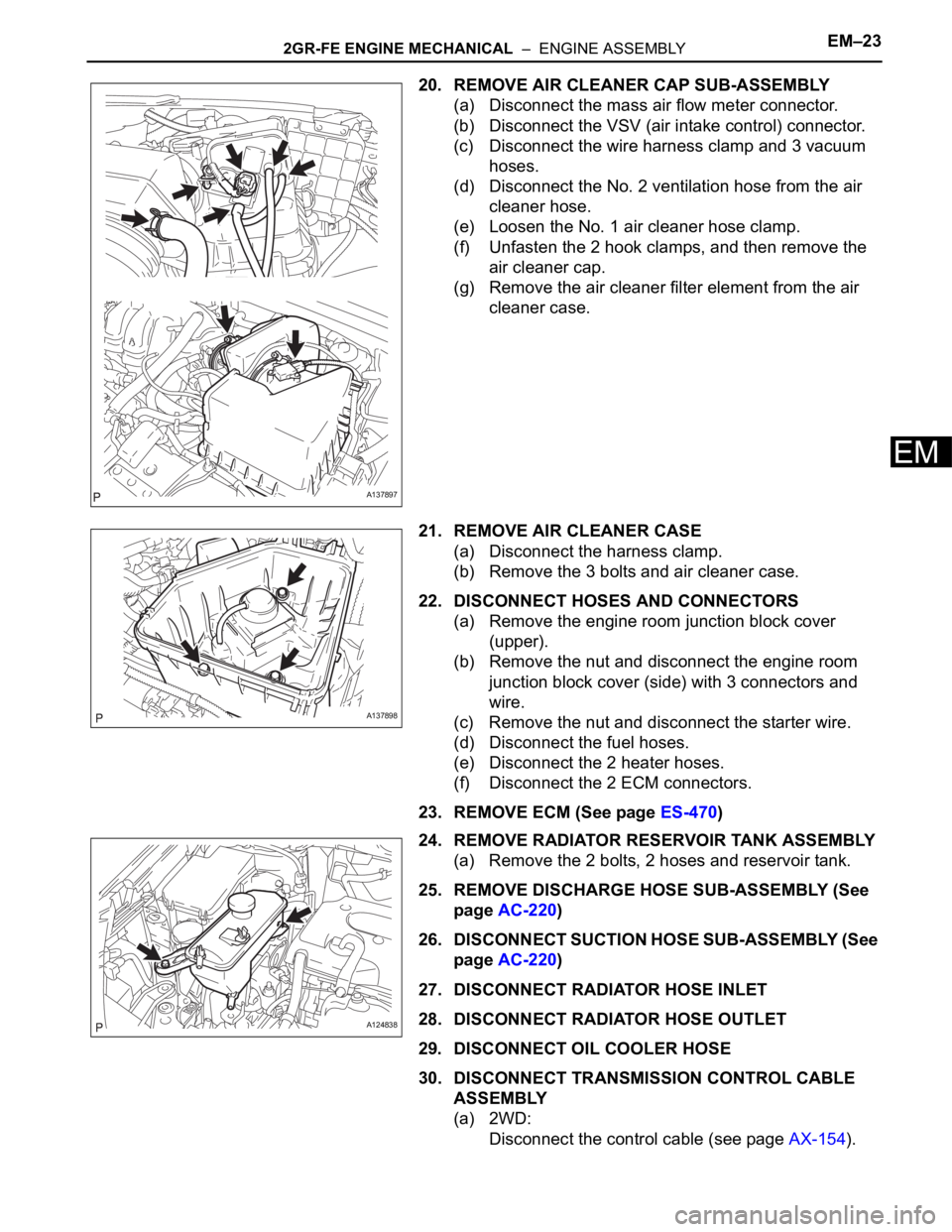
20. REMOVE AIR CLEANER CAP SUB-ASSEMBLY
(a) Disconnect the mass air flow meter connector.
(b) Disconnect the VSV (air intake control) connector.
(c) Disconnect the wire harness clamp and 3 vacuum
hoses.
(d) Disconnect the No. 2 ventilation hose from the air
cleaner hose.
(e) Loosen the No. 1 air cleaner hose clamp.
(f) Unfasten the 2 hook clamps, and then remove the
air cleaner cap.
(g) Remove the air cleaner filter element from the air
cleaner case.
21. REMOVE AIR CLEANER CASE
(a) Disconnect the harness clamp.
(b) Remove the 3 bolts and air cleaner case.
22. DISCONNECT HOSES AND CONNECTORS
(a) Remove the engine room junction block cover
(upper).
(b) Remove the nut and disconnect the engine room
junction block cover (side) with 3 connectors and
wire.
(c) Remove the nut and disconnect the starter wire.
(d) Disconnect the fuel hoses.
(e) Disconnect the 2 heater hoses.
(f) Disconnect the 2 ECM connectors.
23. REMOVE ECM (See page ES-470)
24. REMOVE RADIATOR RESERVOIR TANK ASSEMBLY
(a) Remove the 2 bolts, 2 hoses and reservoir tank.
25. REMOVE DISCHARGE HOSE SUB-ASSEMBLY (See
page AC-220)
26. DISCONNECT SUCTION HOSE SUB-ASSEMBLY (See
page AC-220)
27. DISCONNECT RADIATOR HOSE INLET
28. DISCONNECT RADIATOR HOSE OUTLET
29. DISCONNECT OIL COOLER HOSE
30. DISCONNECT TRANSMISSION CONTROL CABLE
ASSEMBLY
(a) 2WD:
Disconnect the control cable (see page AX-154).
A137897
A137898
A124838
Page 227 of 2000
2AZ-FE EMISSION CONTROL – EMISSION CONTROL SYSTEMEC–7
EC
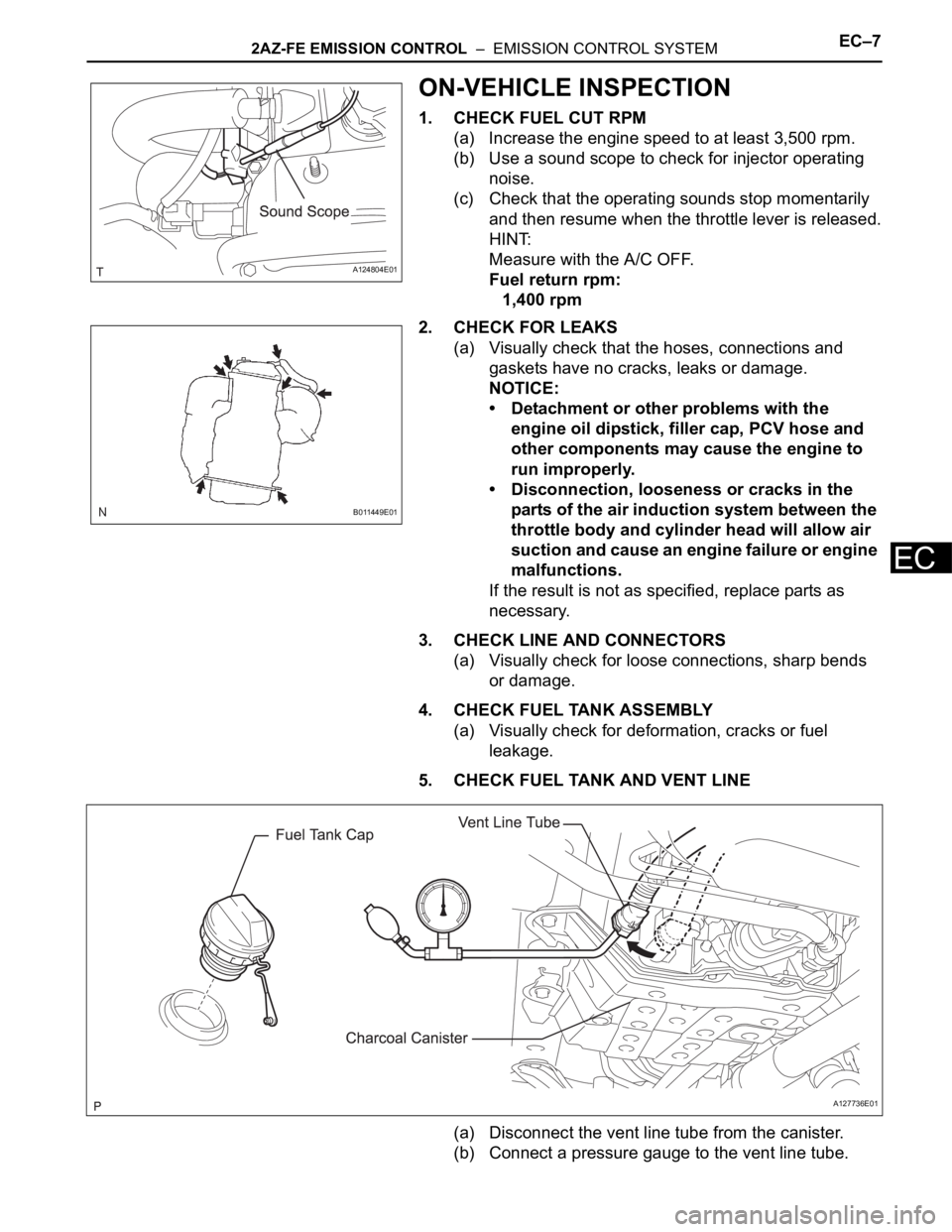
ON-VEHICLE INSPECTION
1. CHECK FUEL CUT RPM
(a) Increase the engine speed to at least 3,500 rpm.
(b) Use a sound scope to check for injector operating
noise.
(c) Check that the operating sounds stop momentarily
and then resume when the throttle lever is released.
HINT:
Measure with the A/C OFF.
Fuel return rpm:
1,400 rpm
2. CHECK FOR LEAKS
(a) Visually check that the hoses, connections and
gaskets have no cracks, leaks or damage.
NOTICE:
• Detachment or other problems with the
engine oil dipstick, filler cap, PCV hose and
other components may cause the engine to
run improperly.
• Disconnection, looseness or cracks in the
parts of the air induction system between the
throttle body and cylinder head will allow air
suction and cause an engine failure or engine
malfunctions.
If the result is not as specified, replace parts as
necessary.
3. CHECK LINE AND CONNECTORS
(a) Visually check for loose connections, sharp bends
or damage.
4. CHECK FUEL TANK ASSEMBLY
(a) Visually check for deformation, cracks or fuel
leakage.
5. CHECK FUEL TANK AND VENT LINE
(a) Disconnect the vent line tube from the canister.
(b) Connect a pressure gauge to the vent line tube.
A124804E01
B011449E01
A127736E01
Page 228 of 2000

EC–82AZ-FE EMISSION CONTROL – EMISSION CONTROL SYSTEM
EC
(c) Apply 4 kPa (41 kgf/cm2, 30 mmHg) of pressure to
the vent line of the fuel tank.
HINT:
Perform this inspection with the fuel tank less than
90% full. When the fuel tank is full, the fuel cutoff
valve closes and pressure is released through the
1.5 mm orifice. As a result, when the fuel tank cap is
removed, the pressure does not decrease smoothly.
(d) Check that the fuel tank pressure is maintained for
some time, and does not decrease immediately.
HINT:
If the pressure decreases immediately, one of the
following may be the cause:
• The fuel tank cap is not completely tightened.
• The fuel tank cap is damaged.
• Air is leaking from the vent line.
• The fuel tank is damaged.
(e) When the fuel tank cap is removed, check that
pressure is released smoothly.
HINT:
If the pressure does not drop, replace the fuel tank
assembly.
(f) Reconnect the vent line tube to the canister.
6. CHECK AIR INLET LINE
(a) Disconnect the air inlet line hose from the charcoal
canister.
(b) Check that air flows freely into the air inlet line.
HINT:
If air does not flow freely into the air inlet line, repair
or replace it.
(c) Reconnect the air inlet line hose to the charcoal
canister.
Page 247 of 2000
LU–122GR-FE LUBRICATION – OIL PUMP
LU
REMOVAL
1. DISCHARGE FUEL SYSTEM PRESSURE (See page
FU-9)
2. DISCONNECT CABLE FROM NEGATIVE BATTERY
TERMINAL
CAUTION:
Wait at least 90 seconds after disconnecting the
cable from the negative (-) battery terminal to
prevent airbag and seat belt pretensioner activation.
3. REMOVE ENGINE ASSEMBLY
(a) Remove the engine from the vehicle (see page EM-
21).
4. INSTALL ENGINE TO STAND
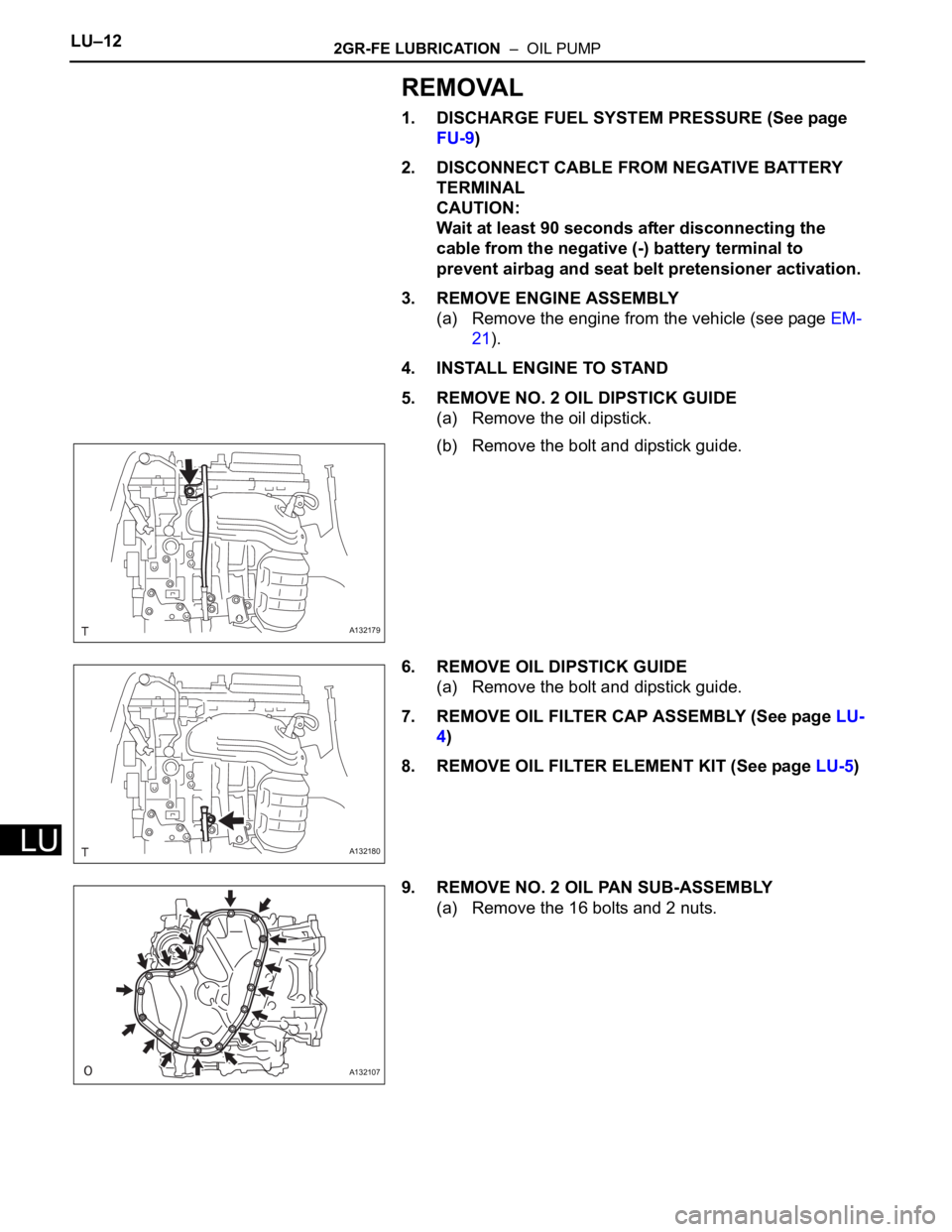
5. REMOVE NO. 2 OIL DIPSTICK GUIDE
(a) Remove the oil dipstick.
(b) Remove the bolt and dipstick guide.
6. REMOVE OIL DIPSTICK GUIDE
(a) Remove the bolt and dipstick guide.
7. REMOVE OIL FILTER CAP ASSEMBLY (See page LU-
4)
8. REMOVE OIL FILTER ELEMENT KIT (See page LU-5)
9. REMOVE NO. 2 OIL PAN SUB-ASSEMBLY
(a) Remove the 16 bolts and 2 nuts.
A132179
A132180
A132107
Page 303 of 2000

PREPARATION – 2AZ-FE LUBRICATIONPP–25
PP
LUBRICANT
Item Condition Capacity Classification
Oil grade - - Use API grade SL "Energy-
Conserving" or ILSAC multigrade
engine oil. SAE 5W-20 and SAE
0W-20 engine oil may be used.
However, SAE0W-20 is the best
choice for good fuel economy and
good starting in cold weather.
Drain and refill with oil filter change 4.3 liters (4.5 US qts, 3.8 Imp.
qts)-
without oil filter change 4.1 liters (4.3 US qts, 3.6 Imp.
qts)-
Dry fill Dry fill 5.0 liters (5.3 US qts, 4.4 Imp.
qts)-