warning lights TOYOTA RAV4 2006 Service Repair Manual
[x] Cancel search | Manufacturer: TOYOTA, Model Year: 2006, Model line: RAV4, Model: TOYOTA RAV4 2006Pages: 2000, PDF Size: 45.84 MB
Page 209 of 2000

IN–26INTRODUCTION – REPAIR INSTRUCTION
IN
CUSTOMIZE PARAMETERS
NOTICE:
• When the customer requests a change in a function,
first make sure that the function can be customized.
• Make a note of the current settings before
customizing.
• When troubleshooting a function, first make sure that
the function is set to the default setting.
1. Combination meter
2. Air conditioning system
3. Power Door Lock Control System
4. Wireless Door Lock Control System
Display (Item) Default Function Setting
SEAT BELT WARN D/P ON Seat belt warning buzzer ON /
OFF settingD/P ON: Driver and passenger
buzzer ON
D ON: Driver buzzer ON
P ON: Passenger buzzer ON
D/P OFF: Driver and passenger
buzzer OFF
Display (Item) Default Contents Setting
SET TEMP SHIFT
(Set Temperature Shift)NORMALTo control with shifted temperature against
display temperature+2 C / +1 C / NORMAL / -1 C / -2
C
AIR INLET MODE
(Air Inlet Mode)AUTOIn case of turning A/C ON when you desire to
make compartment cool down quickly, this is
function to change mode automatically to
RECIRCULATION modeMANUAL / AUTO
COMPRESSOR MODE
(Compressor Mode)AUTOFunction to turn A/C ON automatically by
pressing AUTO button when blower is ON
and A/C is OFFMANUAL / AUTO
COMPRS / DEF OPER
(Compressor / Air Inlet DEF
Operation)LINKFunction to turn A/C ON automatically linked
with FRONT DEF button when A/C is OFFNORMAL / LINK
EVAP CTRL
(Evaporator Control)AUTOFunction to set evaporator control to
AUTOMATIC position (AUTO) to save power,
or to coldest position (MANUAL) to dehumidify
air and to prevent windows from fogging upMANUAL / AUTO
FOOT / DEF MODE
(Foot / DEF auto mode)ONFunction to turn airflow from FOOT / DEF ON
automatically when AUTO MODE is ONOFF / ON
AUTO BLOW UP
(Foot / DEF automatic blower up
function)ONFunction to change blower level automatically
when defroster is ONOFF / ON
Display (Item) Default Function Setting
UNLK/KEY TWICE ON Unlocks only driver side door
when driver side door key
cylinder turned to unlock once,
and unlocks all doors when
turned to unlock twice. For OFF
setting, turning it once unlocks all
doors.ON / OFF
Display (Item) Default Contents Setting
HAZARD ANS BACK ONWhen LOCK switch on
transmitter pressed, all hazard
warning lights illuminate once.
When UNLOCK switch pressed,
all hazard warning lights
illuminate twiceON / OFF
Page 1522 of 2000

BRAKE CONTROL – VEHICLE STABILITY CONTROL SYSTEMBC–19
BC
4. FAIL SAFE FUNCTION
(a) When a failure occurs in the ABS with BA, TRC and
VSC systems, the ABS and VSC warning lights
illuminate, the slip indicator light comes on*1 or
remains off*2, and the operations of those systems
are prohibited. In addition to this, when a failure
which disables the EBD operation occurs, the brake
warning light comes on and its operation is
prohibited.
HINT:
*1: for 2WD
*2: for 4WD
(b) If control is prohibited due to a malfunction during
operation, control is disabled gradually to avoid
sudden vehicle instability.
5. INITIAL CHECK
(a) When the vehicle speed first reaches approximately
6 km/h (4 mph) or more after the ignition switch is
turned ON, each solenoid valve and the motor of the
ABS and TRACTION actuator are sequentially
activated to perform electrical checks. During the
initial check, the operating sound of the solenoid
valve and motor can be heard from the engine
compartment, but this does not indicate a
malfunction.
6. SERVICE MODE
(a) VSC operation can be disabled by operating the
intelligent tester.
HINT:
Refer to the intelligent tester operator's manual for
further details.
7. FUNCTION OF COMPONENTS
Components Functions
Speed Sensor
(Semiconductor Type)Detects the wheel speed and sends the signal to skid
control ECU
Skid Control ECU
(Housed in ABS and TRACTION Actuator)• Processes the signals from each sensor to control the
ABS, BA, TRC, and VSC
• Sends and receives control signals to and from the
ECM, yaw rate and deceleration sensor, steering
sensor, etc. via CAN communication.
ABS and TRACTION Actuator • Consists of the master cylinder cut solenoid valve,
holding solenoid valve, pressure reduction solenoid
valve, pump motor, and reservoir, and adjusts the brake
fluid pressure applied to each wheel cylinder
• Houses the skid control ECU
Solenoid Relay • Supplies power to each solenoid
• Housed in the skid control ECU
Motor Relay (VSC MTR Relay) • Supplies power to the pump motor
• Installed in engine room No. 1 relay block
Fail-safe Relay (VSC FAIL Relay) • Cuts off power to the motor when the pump motor circuit
malfunctions
• Installed in engine room No. 1 relay block
Page 1523 of 2000

BC–20BRAKE CONTROL – VEHICLE STABILITY CONTROL SYSTEM
BC
HINT:
*1: w/ Downhill assist control
*2: for 2WD w/ AUTO LSD
Steering Sensor • Detects the steering extent and direction and sends
signals to the skid control ECU via CAN communication
• Has a magnetic resistance element which detects the
rotation of the magnet housed in the detection gear in
order to detect the changes in magnetic resistance and
the steering amount and direction
Yaw Rate and Deceleration Sensor • Yaw rate sensor detects the vehicle's angular velocity
(yaw rate) in the vertical direction based on the extent
and direction of the deflection of the piezoelectric
ceramics
• Deceleration sensor measures the capacity of the
condenser that changes the distance between the
electrodes depending on G force, which occurs when
the vehicle is accelerated, and converts the measured
value into electrical signals
• Sends signals to the skid control ECU via CAN
communication
Master Cylinder Pressure Sensor • Detects the brake fluid pressure in the master cylinder
• Housed in the ABS and TRACTION actuator
ECM• Controls the engine output when TRC and VSC are
operating with the skid control ECU via CAN
communication
Downhill Assist Control switch*1 Allows the driver to turn downhill assist control ON and OFF
AUTO LSD switch*2 Allows the driver to turn AUTO LSD ON and OFF
Combination Meter ABS Warning Light • Illuminates to inform the driver that a malfunction in the
ABS has occurred
• Blinks to indicate DTCs that relate to the ABS
VSC Warning Light • Illuminates to inform the driver that a malfunction in the
VSC system has occurred
• Blinks to indicate DTCs that relate to the VSC
Brake Warning light • Illuminates to inform the driver that the parking brake is
ON when the system is normal, and when the brake
fluid has decreased
• Illuminates to inform the driver that a malfunction in the
EBD has occurred
Slip Indicator Light • Blinks to inform the driver that TRC, VSC, downhill
assist control and hill-start assist control are operating
• Illuminates to inform the driver that a malfunction has
occurred in the TRC or VSC system
AUTO LSD Indicator Light*2 Lights up to inform the driver when AUTO LSD operation is
possible
Downhill Assist Control Indicator
Light*1Lights up to inform the driver when downhill assist control
operation is possible
Skid Control Buzzer • Intermittently sounds to inform the driver that the VSC is
operating
• Housed in the combination meter Components Functions
Page 1551 of 2000
BC–48BRAKE CONTROL – VEHICLE STABILITY CONTROL SYSTEM
BC
DIAGNOSIS SYSTEM
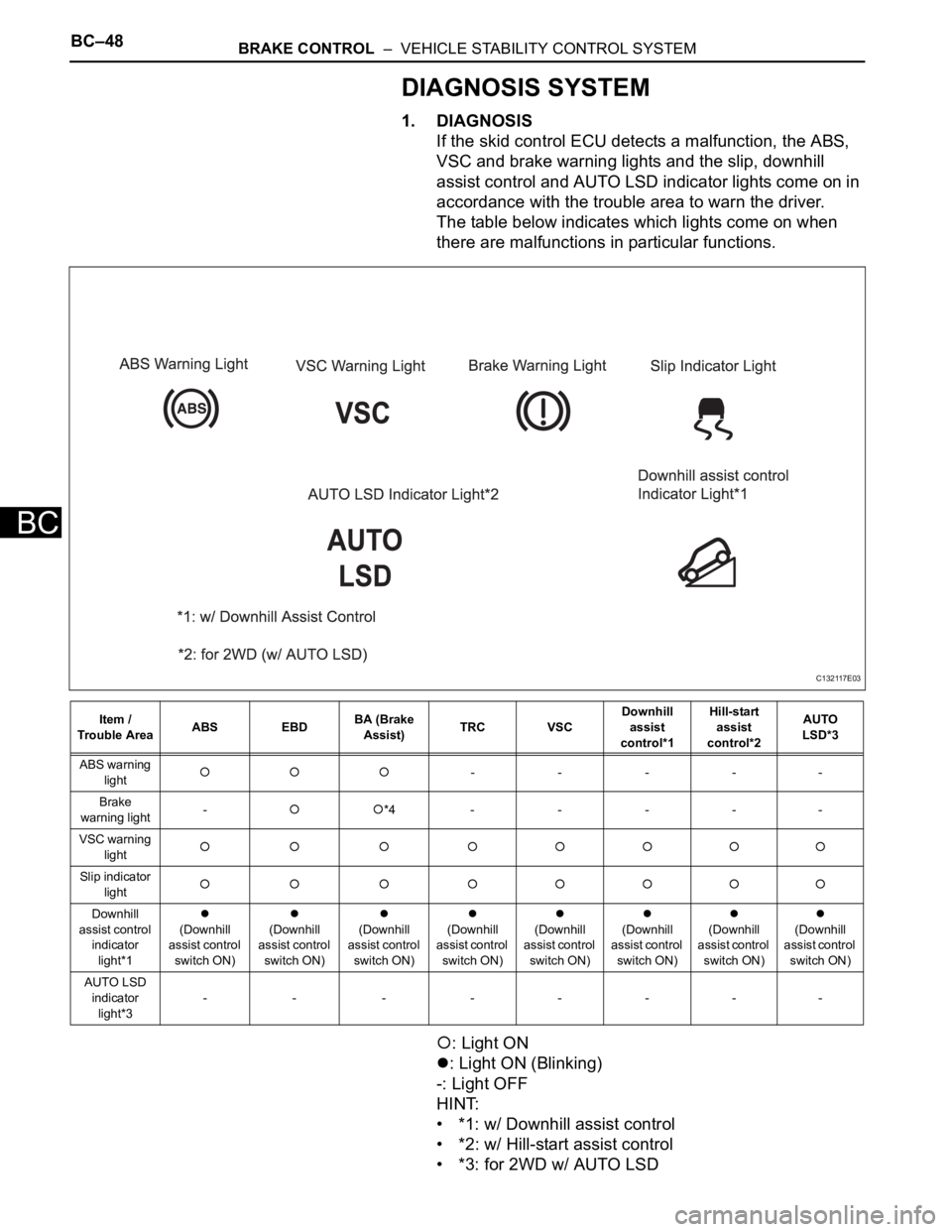
1. DIAGNOSIS
If the skid control ECU detects a malfunction, the ABS,
VSC and brake warning lights and the slip, downhill
assist control and AUTO LSD indicator lights come on in
accordance with the trouble area to warn the driver.
The table below indicates which lights come on when
there are malfunctions in particular functions.
: Light ON
: Light ON (Blinking)
-: Light OFF
HINT:
• *1: w/ Downhill assist control
• *2: w/ Hill-start assist control
• *3: for 2WD w/ AUTO LSD
Item /
Trouble AreaABS EBDBA (Brake
Assist)TRC VSCDownhill
assist
control*1Hill-start
assist
control*2AUTO
LSD*3
ABS warning
light
-----
Brake
warning light-
*4-----
VSC warning
light
Slip indicator
light
Downhill
assist control
indicator
light*1
(Downhill
assist control
switch ON)(Downhill
assist control
switch ON)(Downhill
assist control
switch ON)(Downhill
assist control
switch ON)(Downhill
assist control
switch ON)(Downhill
assist control
switch ON)(Downhill
assist control
switch ON)(Downhill
assist control
switch ON)
AUTO LSD
indicator
light*3--------
C132117E03
Page 1552 of 2000
BRAKE CONTROL – VEHICLE STABILITY CONTROL SYSTEMBC–49
BC
• *4: w/ 16-inch disc
• The DTCs can be read by connecting SST (09843-
18040) between the TC and CG terminals of the
DLC3 and observing the blinking pattern of the ABS
and VSC warning lights, or by using an intelligent
tester (see page BC-47).
• This system has a sensor signal check function (see
page BC-28).
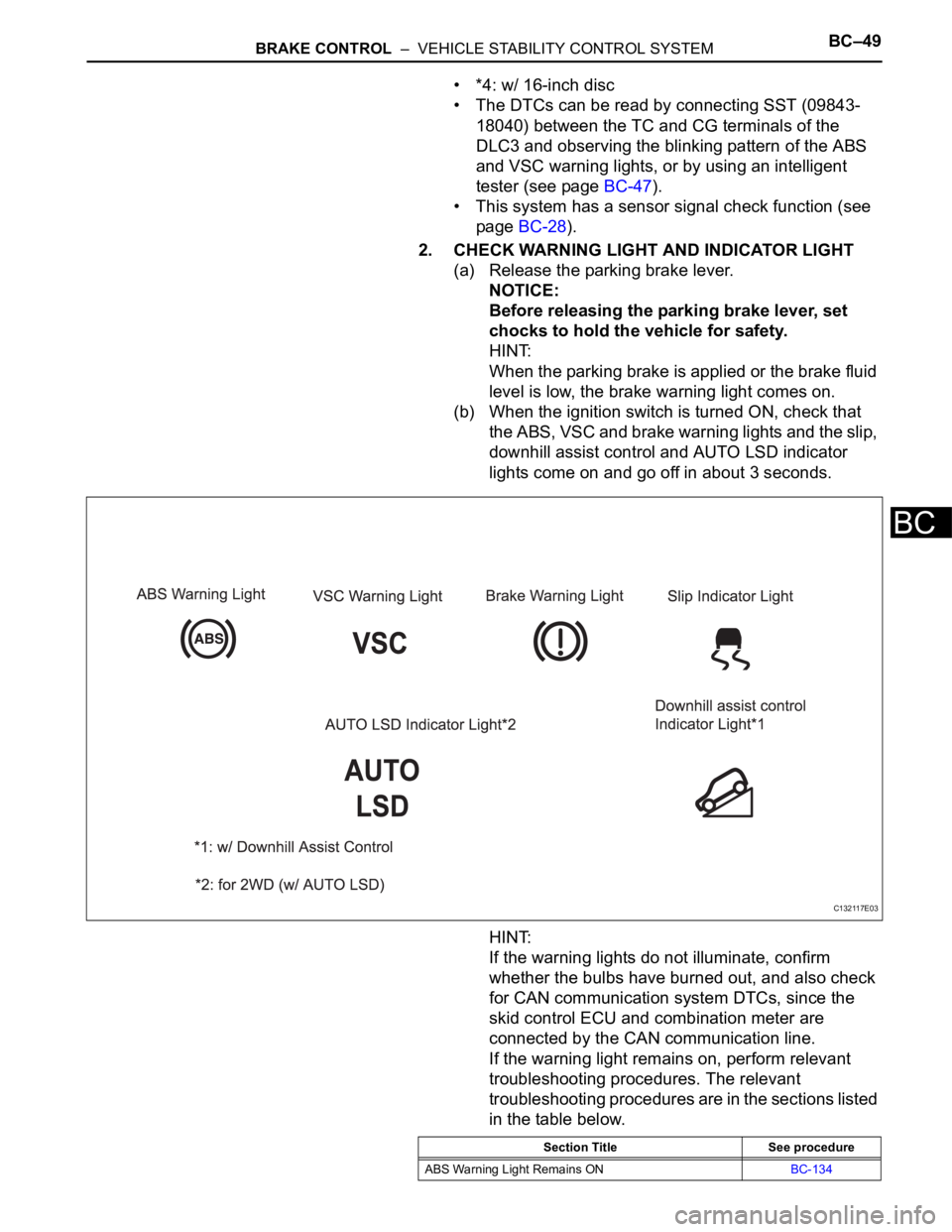
2. CHECK WARNING LIGHT AND INDICATOR LIGHT
(a) Release the parking brake lever.
NOTICE:
Before releasing the parking brake lever, set
chocks to hold the vehicle for safety.
HINT:
When the parking brake is applied or the brake fluid
level is low, the brake warning light comes on.
(b) When the ignition switch is turned ON, check that
the ABS, VSC and brake warning lights and the slip,
downhill assist control and AUTO LSD indicator
lights come on and go off in about 3 seconds.
HINT:
If the warning lights do not illuminate, confirm
whether the bulbs have burned out, and also check
for CAN communication system DTCs, since the
skid control ECU and combination meter are
connected by the CAN communication line.
If the warning light remains on, perform relevant
troubleshooting procedures. The relevant
troubleshooting procedures are in the sections listed
in the table below.
C132117E03
Section Title See procedure
ABS Warning Light Remains ONBC-134
Page 1555 of 2000
BC–52BRAKE CONTROL – VEHICLE STABILITY CONTROL SYSTEM
BC
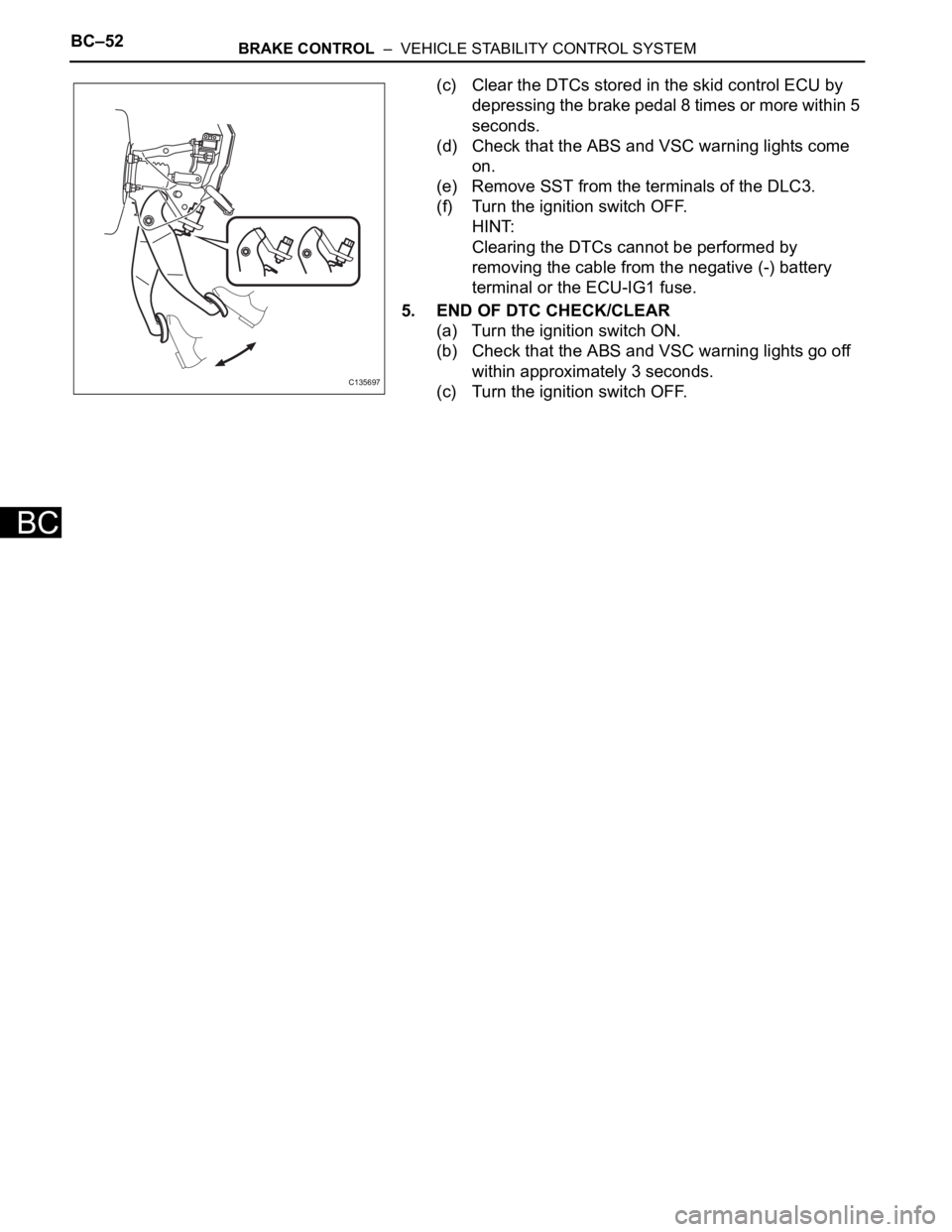
(c) Clear the DTCs stored in the skid control ECU by
depressing the brake pedal 8 times or more within 5
seconds.
(d) Check that the ABS and VSC warning lights come
on.
(e) Remove SST from the terminals of the DLC3.
(f) Turn the ignition switch OFF.
HINT:
Clearing the DTCs cannot be performed by
removing the cable from the negative (-) battery
terminal or the ECU-IG1 fuse.
5. END OF DTC CHECK/CLEAR
(a) Turn the ignition switch ON.
(b) Check that the ABS and VSC warning lights go off
within approximately 3 seconds.
(c) Turn the ignition switch OFF.
C135697
Page 1676 of 2000

SUPPLEMENTAL RESTRAINT SYSTEM – AIRBAG SYSTEMRS–27
RS
• The center airbag sensor receives signals
from the deceleration sensor and the
electronic safing sensor built into the center
airbag sensor and the rear airbag sensor, and
determines whether or not the side airbag
and curtain shield airbag should be activated,
and diagnoses system malfunctions.
• The center airbag sensor sends the airbag
deployment signal to ECM through the CAN
to operate the fuel pump control.
(2) Deceleration sensor and ignition control circuit
• The deceleration sensor is built into the
center airbag sensor.
• The ignition control circuit performs
calculations based on the signal output from
the deceleration sensors of the center airbag
sensor and front airbag sensor. If the
calculated values are greater than the
specified values, it activates the deployment
operation.
(3) Safing sensor
The safing sensor is built into the center airbag
sensor. During a frontal collision, the sensor
turns on and outputs an ON signal to the center
airbag sensor if a deceleration rate greater than
the specified value is applied to the safing
sensor.
(4) Electronic safing sensor
The electronic safing sensor is built into the
center airbag sensor. During a side collision, the
sensor turns on and outputs an ON signal to the
center airbag sensor if a deceleration rate
greater than the specified value is applied to the
electronic safing sensor.
(5) Back-up power source
The back-up power source consists of a power
supply capacitor and a DC-DC converter. When
the power system does not function during a
collision, the power supply capacitor discharges
and supplies electric power to the system. The
DC-DC converter operates as a boosting
transformer when the battery voltage falls below
a predetermined level.
(6) Diagnostic circuit
This circuit constantly diagnoses system
malfunctions. When a malfunction is detected, it
lights up the SRS warning light on the telltale
light to inform the driver.
(7) Memory circuit
When a malfunction is detected in the diagnostic
circuit, it is coded and stored in the memory
circuit.