oil TOYOTA RAV4 PHEV 2021 User Guide
[x] Cancel search | Manufacturer: TOYOTA, Model Year: 2021, Model line: RAV4 PHEV, Model: TOYOTA RAV4 PHEV 2021Pages: 666, PDF Size: 161.28 MB
Page 372 of 666
3705-5. Using the driving support systems
• Vehicle speed is approximately 50
km/h (32 mph) or more. • Width of traffic lane is approximately 3
m (9.8 ft.) or more.
• No system malfuncti ons are detected. ( →P.371)
●Lane centering function
This function operates when all of the
following conditions are met.
• LTA is turned on.
• Setting for “Steering Assist” and “Lane
Center” in the screen of the multi-
information display are set to “ON”. ( →P.179)
• This function recognizes white (yel -
low) lane lines or the position of a pre - ceding vehicle (except when the
preceding vehicle is small, such as a
motorcycle). • The dynamic radar cruise control with
full-speed range is operating in vehi-
cle-to-vehicle distance control mode. • Width of traffic lane is approximately 3
to 4 m (10 to 13 ft.).
• Turn signal lever is not operated. • Vehicle is not being driven around a
sharp curve.
• No system malfuncti ons are detected. ( →P.371)
• Vehicle does not accelerate or decel-
erate by a fixed amount or more. • Steering wheel is n ot operated with a
steering force level suitable for chang-
ing lanes. • ABS, VSC, TRC an d PCS are not
operating.
• TRC or VSC is not turned off. • Hands off steering wheel warning is
not displayed. ( →P.370)
• The vehicle is being driven in the cen- ter of a lane.
• Steering assist func tion is not operat-
ing.
■Temporary cancelation of functions
●When operation conditions are no lon -
ger met, a function may be temporar - ily canceled. However, when the
operation conditions are met again,
operation of the fu nction is automati- cally restored. ( →P.369)
●If the operation conditions (→P.369)
are no longer met while the lane cen- tering function is op erating, the steer-
ing wheel may vibrate and the buzzer
may sound to indicate that the func - tion has been temporarily canceled.
However, if the “Aler t” customization
setting is set to “Steering wheel vibra - tion”, the system will notify the driver
by vibrating the steering wheel instead
of sounding the buzzer.
■Steering assist function/lane cen - tering function
●Depending on the vehicle speed, lane departure situation, road conditions,
etc., the driver may not feel the func -
tion is operating or the function may not operate at all.
●The steering control of the function is overridden by the dr iver’s steering
wheel operation.
●Do not attempt to test the operation of
the steering assist function.
■Lane departure alert function
●The warning buzzer may be difficult to
hear due to external noise, audio play -
back, etc. Also, it may be difficult to feel steering wheel vibrations due to
the road conditions, etc.
●If the edge of the course* is not clear
or straight, the lane departure alert
function may not operate.
●Vehicles with BSM: It may not be pos-
sible for the syste m to determine if there is a danger of a collision with a
vehicle in an adjacent lane.
●Do not attempt to test the operation of
the lane departure alert function.*: Boundary between a sphalt and the
side of the road, such as grass, soil,
or a curb
■Hands off steering wheel warning
In the following situations, a warning message urging the driver to hold the
steering wheel and the symbol shown in
the illustration are displayed on the multi-information display to warn the
Page 447 of 666
445
5
5-6. Driving tips
Driving
5-6.Driving tips
Use fluids that are appropriate to
the prevailing outside tempera-
tures.
• Engine oil
• Engine coolant
• Power control unit coolant
• Washer fluid
Have a service technician
inspect the condition of the 12-
volt battery.
Have the vehicle fitted with four
snow tires or purchase a set of
tire chains for the front tires.
Ensure that all tires are the same size
and brand, and that chains match the
size of the tires.*
*: Tire chains cannot be mounted on
vehicles with 235/55R19 tires.
Winter driving tips
Carry out the necessary prepa -
rations and inspections before
driving the vehicle in winter.
Always drive the vehicle in a
manner appropriate to the pre -
vailing weather conditions.
Pre-winter preparations
WARNING
■Driving with snow tires
Observe the following precautions to reduce the risk of accidents.
Failure to do so may result in a loss of
vehicle control and cause death or serious injury.
●Use tires of the specified size.
●Maintain the recommended level of air pressure.
●Do not drive at speeds in excess of the speed limit or the speed limit
specified for the snow tires being
used.
●Use snow tires on all, not just some
wheels.
■Driving with tire chains (except
235/55R19 tires)
Observe the following precautions to
reduce the risk of accidents.
Failure to do so may result in the vehi - cle being unable to be driven safely,
and may cause death or serious
injury.
●Do not drive in excess of the speed
limit specified for the tire chains being used, or 50 km/h (30 mph),
whichever is lower.
●Avoid driving on bumpy road sur -
faces or over potholes.
●Avoid sudden acceleration, abrupt
steering, sudden br aking and shift-
ing operations that cause sudden engine braking.
●Slow down sufficiently before enter - ing a curve to ensure that vehicle
control is maintained.
●Do not use LTA (Lane Tracing
Assist) system (if equipped).
NOTICE
■Repairing or replacing snow tires
Request repairs or replacement of snow tires from any authorized
Toyota retailer or Toyota authorized
repairer, or any reliable repairer or legitimate tire retailers.
This is because the removal and
attachment of snow tires affects the operation of the tire pressure warning
valves and transmitters.
Page 451 of 666
449
5
5-6. Driving tips
Driving
cautions to ensure your driving
enjoyment and to help prevent the
closure of areas to off-road vehi -
cles:
Drive your vehicle only in areas
where off-road vehicles are per -
mitted to travel.
Respect private property. Get
owner’s permission before enter -
ing private property.
Do not enter areas that are
closed. Honor gates, barriers
and signs that restrict travel.
Stay on established roads. When
conditions are wet, driving tech -
niques should be changed or
travel delayed to prevent dam -
age to roads.
WARNING
■Off-road drivin g precautions
Always observe the following precau -
tions to minimize the risk of death, serious injury or damage to your vehi -
cle:
●Drive carefully when off the road. Do not take unnecessary risks by
driving in dangerous places.
●Do not grip the steering wheel
spokes when driving off-road. A
bad bump could jerk the wheel and injure your hands. Keep both hands
and especially your thumbs on the
outside of the rim.
●Always check your b rakes for effec-
tiveness immediately after driving in sand, mud, water or snow.
●After driving through tall grass, mud, rock, sand, ri vers, etc., check
that there is no g rass, bush, paper,
rags, stone, sand, etc. adhering or trapped on the underbody. Clear off
any such matter from the under -
body. If the vehi cle is used with these materials trapped or adhering
to the underbody, a breakdown or
fire could occur.
●When driving off-road or in rugged
terrain, do not drive at excessive speeds, jump, make sharp turns,
strike objects, etc. This may cause
loss of control or vehicle rollover causing death or serious injury. You
are also risking expensive damage
to your vehicle’s suspension and chassis.
NOTICE
■To prevent the water damage
Take all necessary safety measures
to ensure that wat er damage to the hybrid battery (tr action battery),
hybrid system or other components
does not occur.
●Water entering the engine compart -
ment may cause severe damage to
the hybrid system.
●Water entering the hybrid transmis -
sion will cause deterioration in transmission quality. The malfunc -
tion indicator may come on, and the
vehicle may no t be drivable.
●Water can wash the grease from
wheel bearings, causing rusting and premature fa ilure, and may
also enter the h ybrid transaxle
case, reducing the gear oil’s lubri - cating qualities.
Page 485 of 666
483
6
6-4. Using the other interior features
Interior features
WARNING
■Caution while driving
When charging a portable device, for
safety reasons, the driver should not operate the main pa rt of the portable
device while driving.
■Caution regarding interference
with electro nic devices
People with implantable cardiac pace -
makers, cardiac resynchronization therapy-pacemakers or implantable
cardioverter defibrillators, as well as
any other electrica l medical device, should consult thei r physician about
the usage of the wireless charger.
The operations of the wireless char - ger may have an affect on medical
devices.
■To prevent damage or burns
Observe the following precautions.
Failure to do so may result in a possi - bility of equipment failure and dam -
age, catch fire, burns due to overheat.
●Do not insert any metallic objects between the charging area and the
portable device while charging
●Do not place cont ainers with liquid
such as wate r on the wireless char-
ger.
●Do not attach sti ckers, metallic
objects, etc., to the charger area or portable device
●Do not cover with cloth, etc., and charge
●Do not charge po rtable devices other than designated
●Do not attempt to dismantle for dis - assembly or modifications
●Do not hit or appl y a strong force
NOTICE
■Conditions in which the function
may not operate correctly
In the following cond itions, it may not operate correctly
●The portable device is fully charged
●There is foreign matter between the
charge area and portable device
●The temperature of the portable device gets higher from charging
●The charging surf ace of the porta- ble device is facing up
●The placement of the portable device is out of alignment with the
charge area
●Near a TV tower, electric power
plant, gas station, radio station,
large display, airport or other facility that generates strong radio waves
or electrical noise
●When the electronic key is in con -
tact with, or is covered by the fol -
lowing metallic objects
• Cards to which aluminum foil is
attached
• Cigarette boxes that have alumi - num foil inside
• Metallic wallets or bags
• Coins
• Hand warmers made of metal
• Media such as CDs and DVDs
●When other wireless keys (that emit
radio waves) are being used nearby
In addition, excluding the above-men -
tioned, when the charger does not
perform normally or the operation dis -
play lamp is flashing continuously, it is
considered that the wireless charger
is malfunctioning. C ontact authorized
Toyota dealer.
Page 490 of 666
4887-1. Maintenance and care
7-1.Maintenance and care
Working from top to bottom, lib-
erally apply water to the vehicle
body, wheel wells and underside
of the vehicle to remove any dirt
and dust.
Wash the vehicle body using a
sponge or soft cloth, such as a
chamois.
For hard-to-remove marks, use
car wash soap and rinse thor -
oughly with water.
Wipe away any water.
Wax the vehicle when the water-
proof coating deteriorates.
If water does not bead on a clean sur -
face, apply wax when the vehicle body
is cool.
■Before car washes
Check that the fuel filler door and charging port lid on your vehicle are
closed properly.
■Automatic car washes
●Before washing the vehicle:
• Fold the mirrors
• Turn off the power back door (if equipped)
Start washing from t he front of the vehi-
cle. Make sure to extend the mirrors
before driving.
●Brushes used in automatic car
washes may scratch the vehicle sur - face, parts (wheel, etc.) and harm
your vehicle’s paint.
●Rear spoiler may not be washable in
some automatic c ar washes. There
may also be an increased risk of dam - age to vehicle.
■High pressure car washes
As water may enter the cabin, do not
bring the nozzle tip near the gaps around the doors or perimeter of the
windows, or spray th ese areas continu-
ously.
■Note for a smart e ntry & start sys- tem
If the door handle becomes wet while
the electronic key is within the effective range, the door may lock and unlock
repeatedly. In that c ase, follow the fol-
lowing correction procedures to wash the vehicle:
●Place the key in a position 2 m (6 ft.) or more separate from the vehicle
while the vehicle is being washed.
(Take care to ensur e that the key is not stolen.)
●Set the electronic key to battery-sav - ing mode to disable the smart entry &
start system. ( →P.224)
■Wheels and wheel ornaments
●Remove any dirt immediately by using
a neutral detergent.
●Wash detergent of f with water imme-
diately after use.
●To protect the paint from damage,
make sure to observe the following
precautions. • Do not use acidic, alkaline or abrasive
detergent.
• Do not use hard brushes.
• Do not use deterg ent on the wheels when they are hot, such as after driv -
ing or parking in hot weather.
Cleaning and protecting
the vehicle exterior
Perform the following to pro -
tect the vehicle and maintain it
in prime condition:
Cleaning instructions
Page 491 of 666
489
7
7-1. Maintenance and care
Maintenance and care
■Front side windows water-repel -
lent coating (except quarter win - dow)
●The following precautions can extend the effectiveness of the water-repel -
lent coating.
• Remove any dirt, etc., from the front side windows regularly.
• Do not allow dirt and dust to accumu -
late on the windows for a long period. Clean the windows wit h a soft, damp
cloth as soon as possible.
• Do not use wax or glass cleaners that contain abrasives when cleaning the
windows.
• Do not use any metallic objects to remove condensation build up.
■Bumpers
Do not scrub with abrasive cleaners.
■Plated portions
If dirt cannot be removed, clean the parts as follows:
●Use a soft cloth dampened with an approximately 5% sol ution of neutral
detergent and water to clean the dirt
off.
●Wipe the surface with a dry, soft cloth
to remove any remaining moisture.
●To remove oily deposits, use alcohol
wet wipes or a similar product.
WARNING
■When washing the vehicle
Do not apply water to the inside of the
engine compartment. Doing so may
cause the electrical components, etc. to catch fire.
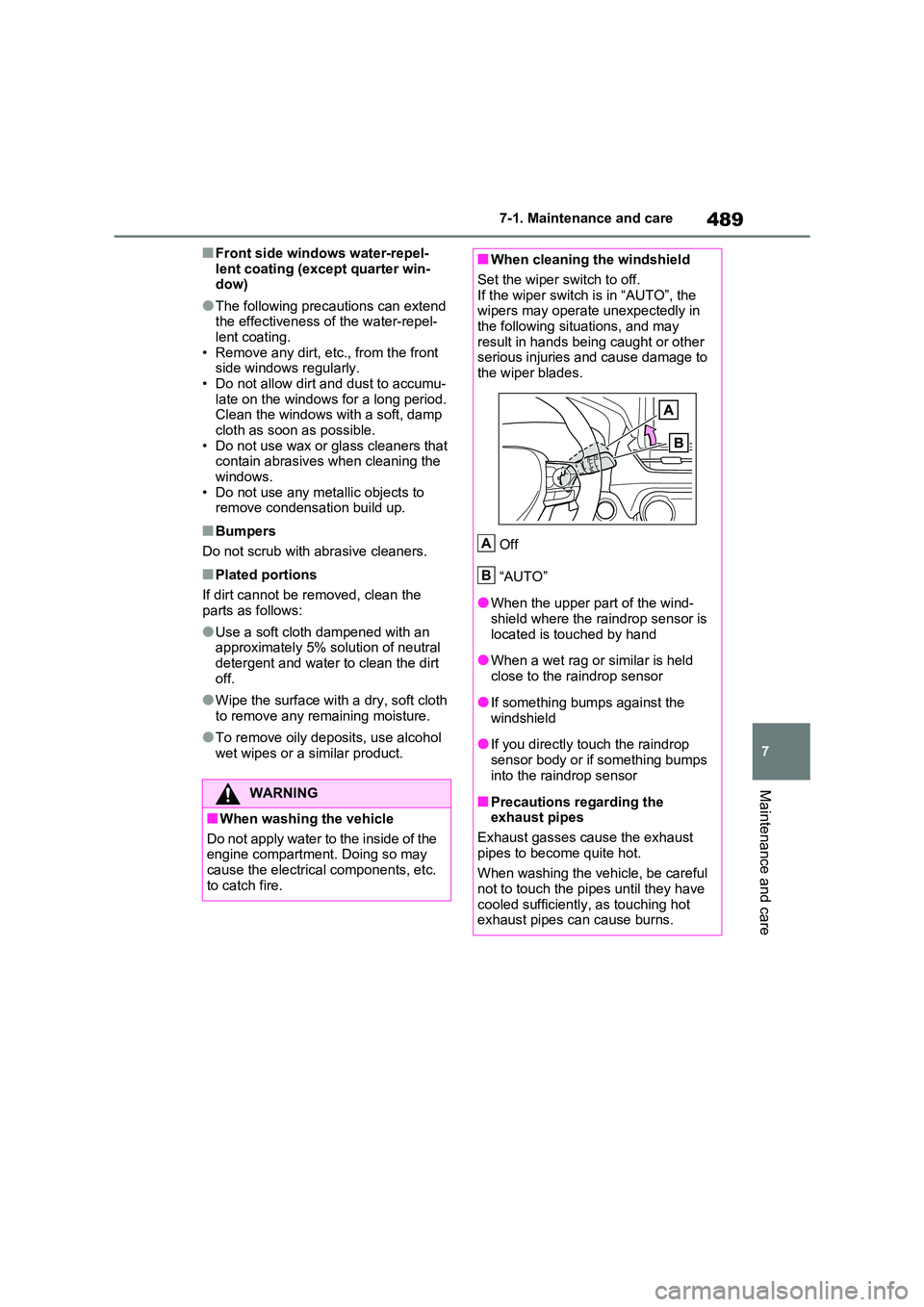
■When cleaning the windshield
Set the wiper switch to off.
If the wiper switch is in “AUTO”, the
wipers may operate unexpectedly in the following situations, and may
result in hands being caught or other
serious injuries and cause damage to the wiper blades.
Off
“AUTO”
●When the upper part of the wind -
shield where the raindrop sensor is
located is tou ched by hand
●When a wet rag or similar is held
close to the raindrop sensor
●If something bum ps against the
windshield
●If you directly touch the raindrop
sensor body or if something bumps
into the raindrop sensor
■Precautions regarding the
exhaust pipes
Exhaust gasses cause the exhaust
pipes to become quite hot.
When washing the vehicle, be careful not to touch the pipes until they have
cooled sufficiently, as touching hot
exhaust pipes can cause burns.
A
B
Page 492 of 666
4907-1. Maintenance and care
WARNING
■Precaution regarding the rear
bumper with Blind Spot Monitor
(if equipped)
If the paint of the rear bumper is
chipped or scratched, the system may
malfunction. If this occurs, consult any authorized Toyo ta retailer or
Toyota authorized repairer, or any
reliable repairer.
NOTICE
■To prevent paint deterioration and corrosion on the body and
components (aluminum wheels,
etc.)
●Wash the vehicle immediately in
the following cases:
• After driving near the sea coast
• After driving on salted roads
• If coal tar or tree sap is present on
the paint surface
• If dead insects, insect droppings or
bird droppings are present on the
paint surface
• After driving in an area contami - nated with soot, o ily smoke, mine
dust, iron powder or chemical sub -
stances
• If the vehicle becomes heavily
soiled with dust or mud
• If liquids such as benzene and gas - oline are spilled on the paint sur-
face
●If the paint is chipped or scratched,
have it repaired immediately.
●To prevent the wh eels from corrod-
ing, remove any dirt and store in a
place with low humidity when stor - ing the wheels.
■Cleaning the exterior lights
●Wash carefully. Do not use organic
substances or scrub with a hard
brush. This may damage the surfaces of
the lights.
●Do not apply wax to the surfaces of
the lights.
Wax may cause damage to the lenses.
■When using an automatic car wash
Set the wiper switch to off position.
If the wiper switch is in “AUTO”, the wipers may operate and the wiper
blades may be damaged.
■When using a high pressure car
wash
●When washing the vehicle, do not let water from the high-pressure
washer directly hit the camera (if
equipped) or the area around the camera. Due to the shock from the
high pressure water, it is possible
that the device may not operate normally.
●Do not bring the no zzle tip close to boots (rubber o r resin manufac-
tured cover), or co nnectors or the
following parts. The parts may be damaged if they
come into contact with high-pres -
sure water.
• Traction battery
• Traction related parts
• Steering parts
• Suspension parts
• Brake parts
●Keep the cleaning nozzle at least 30 cm (11.9 in.) away from the vehi -
cle body. Otherwis e resin section,
such as moldings and bumpers, may be deformed and damaged.
Also, do not continuously hold the
nozzle in the same place.
Page 498 of 666
4967-3. Do-it-yourself maintenance
7-3.Do-it-yourself maintenance
Do-it-yourself service
precautions
If you perform maintenance by
yourself, be sure to follow the
correct procedure as given in
these sections.
Maintenance
ItemsParts and tools
12-volt battery
condition
( →P.506)
•Grease
• Conventional
wrench (for terminal
clamp bolts)
Engine/power
control unit
coolant level
( →P.503)
• “Toyota Super Long
Life Coolant” or a
similar high quality
ethylene glycol-
based non-silicate,
non-amine, non-
nitrite and non-
borate coolant with
long-life hybrid
organic acid technol -
ogy
“Toyota Super Long
Life Coolant” is pre -
mixed with 50%
coolant and 50%
deionized water.
• Funnel (used only
for adding coolant)
Engine oil level
( →P.501)
• “Toyota Genuine
Motor Oil” or equiva -
lent
• Rag or paper towel
• Funnel (used only
for adding engine
oil)
Fuses
( →P.545)
• Fuse with same
amperage rating as
original
DC/DC Con -
verter air
intake vent
( →P.536)
• Vacuum cleaner,
etc,
• Phillips screwdriver
Light bulbs
( →P.548)
• Bulb with same
number and watt -
age rating as origi -
nal
• Phillips-head screw -
driver
• Flathead screw -
driver
• Wrench
Radiator and
condenser
( →P.504)
⎯
Tire inflation
pressure
( →P.529)
• Tire pressure gauge
• Compressed air
source
Washer fluid
( →P.505)
• Water or washer
fluid containing anti -
freeze (for winter
use)
• Funnel (used only
for adding water or
washer fluid)
WARNING
The engine compartment contains
many mechanisms and fluids that may move suddenly, become hot, or
become electrically energized. To
avoid death or serious injury, observe the following precautions.
ItemsParts and tools
Page 499 of 666
497
7
7-3. Do-it-yours elf maintenance
Maintenance and care
WARNING
■When working on the engine
compartment
●Make sure that “IGNITION ON” on the multi-information display and
the “READY” indicat or are both off.
●Keep hands, clothing and tools
away from the moving fan.
●Be careful not to touch the engine, power control unit, radiator, exhaust
manifold, etc. right after driving as
they may be hot. Oil and other flu - ids may also be hot.
●Do not leave anyt hing that may burn easily, such as paper and
rags, in the engi ne compartment.
●Do not smoke, cause sparks or
expose an open flame to fuel or the
12-volt battery. Fu el and 12-volt battery fumes are flammable.
●Take care because brake fluid can harm your hands or eyes and dam -
age painted surfac es. If fluid gets
on your hands or in your eyes, flush the affected area with clean water
immediately. If you still experience
discomfort, consult a doctor.
■When working near the electric
cooling fan or radiator grille
Be sure the power switch is off.
With the power swi tch in ON, the
electric cooling fan may automatically start to run if the air conditioning is on
and/or the coolant temperature is
high. ( →P.504)
■Safety glasses
Wear safety glasses to prevent flying or falling material, fluid spray, etc.,
from getting in your eyes.
NOTICE
■If you remove th e air cleaner fil-
ter
Driving with the air cleaner filter removed may cause excessive
engine wear due to dirt in the air.
■If the fluid level is low or high
It is normal for the br ake fluid level to
go down slightly as the brake pads
wear or when the fluid level in the accumulator is high.
If the reservoir needs frequent refill -
ing, it may indicate a serious problem.
Page 503 of 666
501
7
7-3. Do-it-yours elf maintenance
Maintenance and care
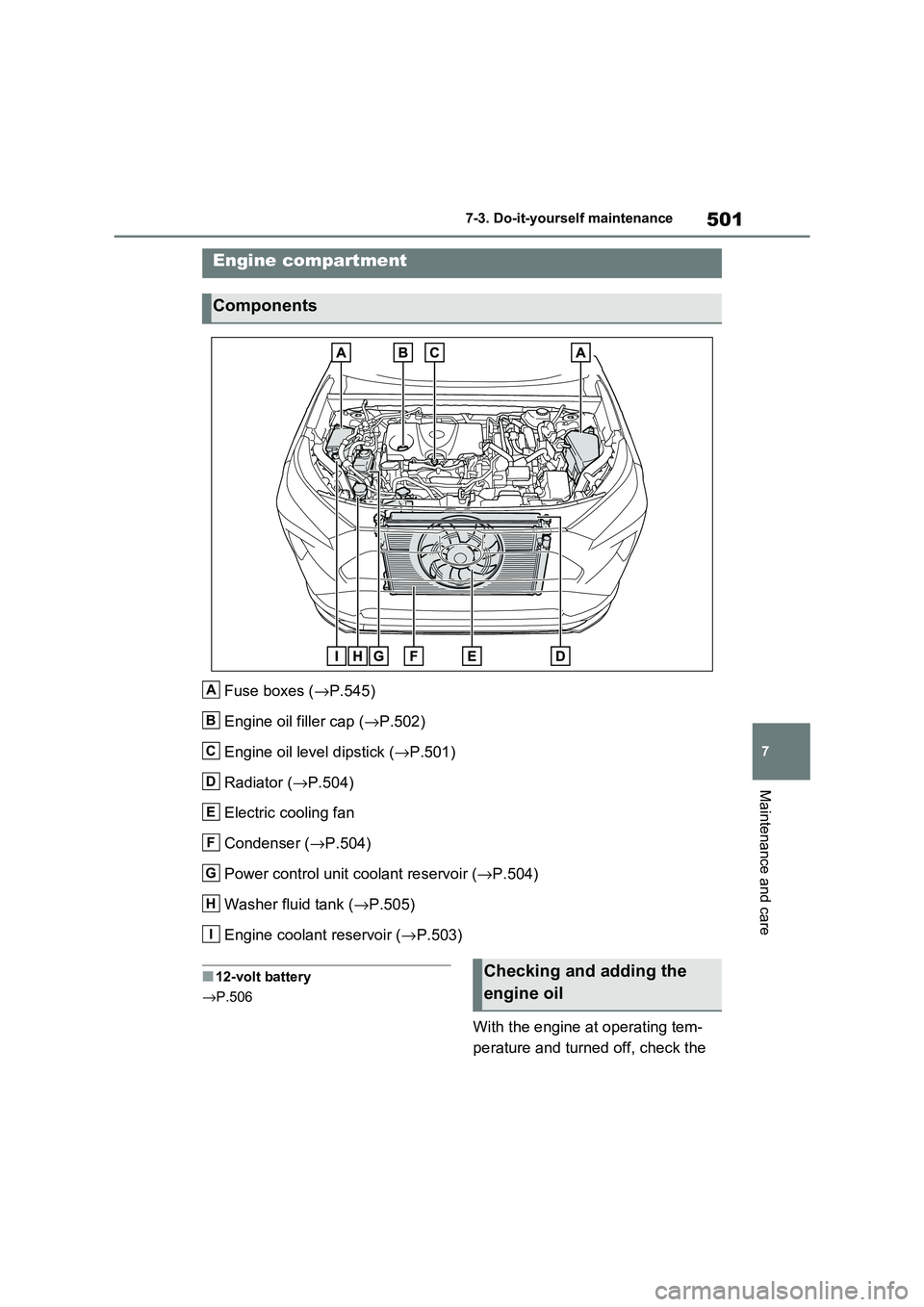
Fuse boxes (→P.545)
Engine oil filler cap ( →P.502)
Engine oil level dipstick ( →P.501)
Radiator ( →P.504)
Electric cooling fan
Condenser ( →P.504)
Power control unit coolant reservoir ( →P.504)
Washer fluid tank ( →P.505)
Engine coolant reservoir ( →P.503)
■12-volt battery
→ P.506
With the engine at operating tem-
perature and turned off, check the
Engine compartment
Components
A
B
C
D
E
F
G
H
I
Checking and adding the
engine oil