light TOYOTA RAV4 PHEV 2021 Manual PDF
[x] Cancel search | Manufacturer: TOYOTA, Model Year: 2021, Model line: RAV4 PHEV, Model: TOYOTA RAV4 PHEV 2021Pages: 666, PDF Size: 161.28 MB
Page 293 of 666
291
4
4-5. Opening, closing the windows and moon roof
Before driving
4-5.Opening, closing the windows and moon roof
The power windows can be opened
and closed using the switches.
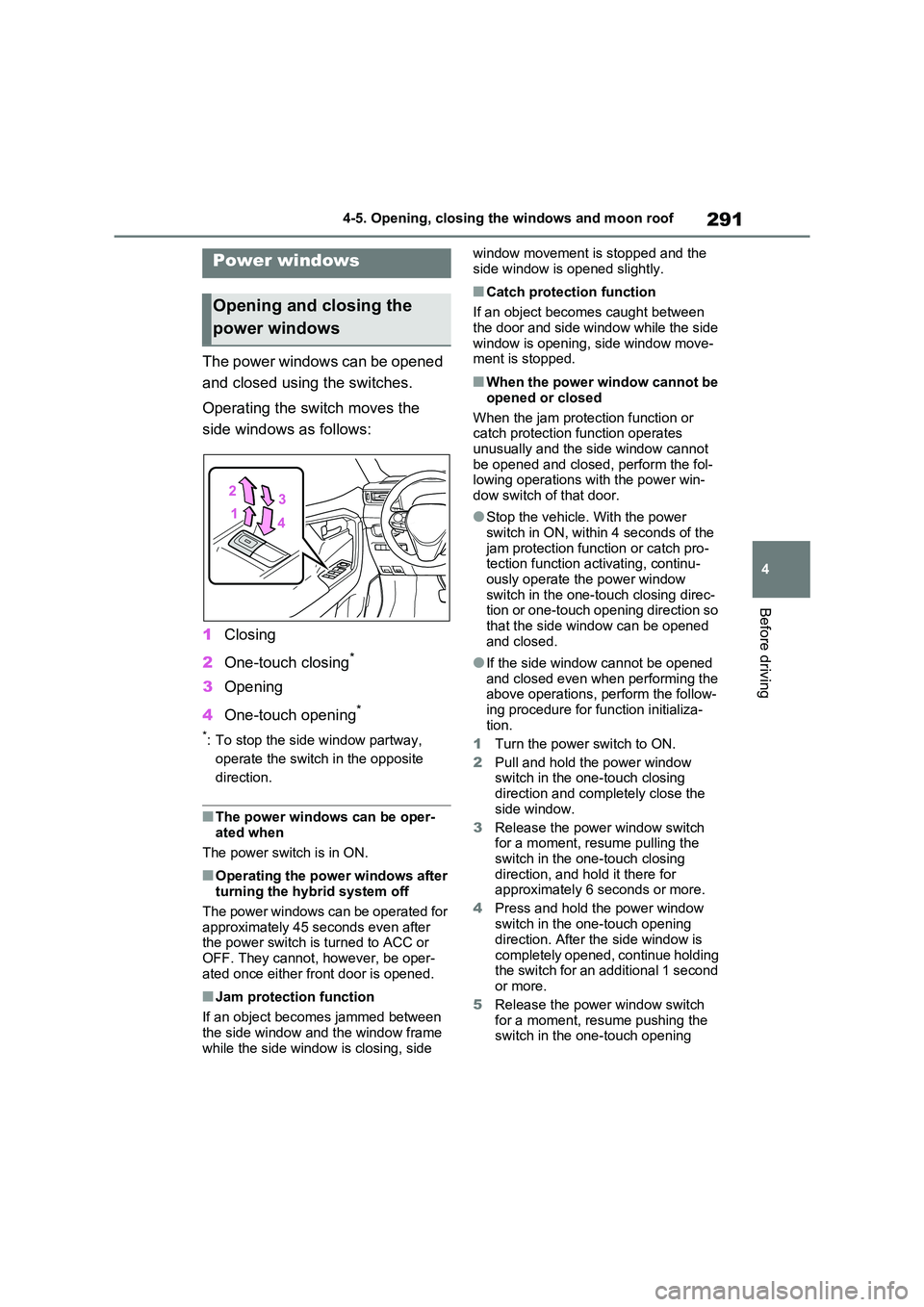
Operating the switch moves the
side windows as follows:
1 Closing
2 One-touch closing*
3Opening
4 One-touch opening*
*: To stop the side window partway,
operate the switch in the opposite
direction.
■The power windows can be oper -
ated when
The power switch is in ON.
■Operating the power windows after
turning the hybrid system off
The power windows can be operated for approximately 45 seconds even after
the power switch is turned to ACC or
OFF. They cannot, however, be oper- ated once either fr ont door is opened.
■Jam protection function
If an object becomes jammed between
the side window and the window frame while the side window is closing, side
window movement is stopped and the
side window is opened slightly.
■Catch protection function
If an object becomes caught between
the door and side window while the side
window is opening, side window move - ment is stopped.
■When the power window cannot be
opened or closed
When the jam protection function or catch protection function operates
unusually and the side window cannot
be opened and closed, perform the fol - lowing operations with the power win -
dow switch of that door.
●Stop the vehicle. With the power
switch in ON, within 4 seconds of the
jam protection func tion or catch pro- tection function activating, continu -
ously operate the power window
switch in the one-touch closing direc - tion or one-touch opening direction so
that the side windo w can be opened
and closed.
●If the side window cannot be opened
and closed even when performing the above operations, perform the follow -
ing procedure for function initializa -
tion.
1 Turn the power switch to ON.
2 Pull and hold the power window switch in the one-touch closing
direction and completely close the
side window.
3 Release the power window switch for a moment, resume pulling the
switch in the one-touch closing
direction, and hol d it there for approximately 6 seconds or more.
4 Press and hold the power window
switch in the one-touch opening
direction. After the side window is
completely opened, continue holding the switch for an additional 1 second
or more.
5 Release the power window switch
for a moment, resu me pushing the switch in the one-touch opening
Power windows
Opening and closing the
power windows
Page 296 of 666
2944-5. Opening, closing the windows and moon roof
*: If equipped
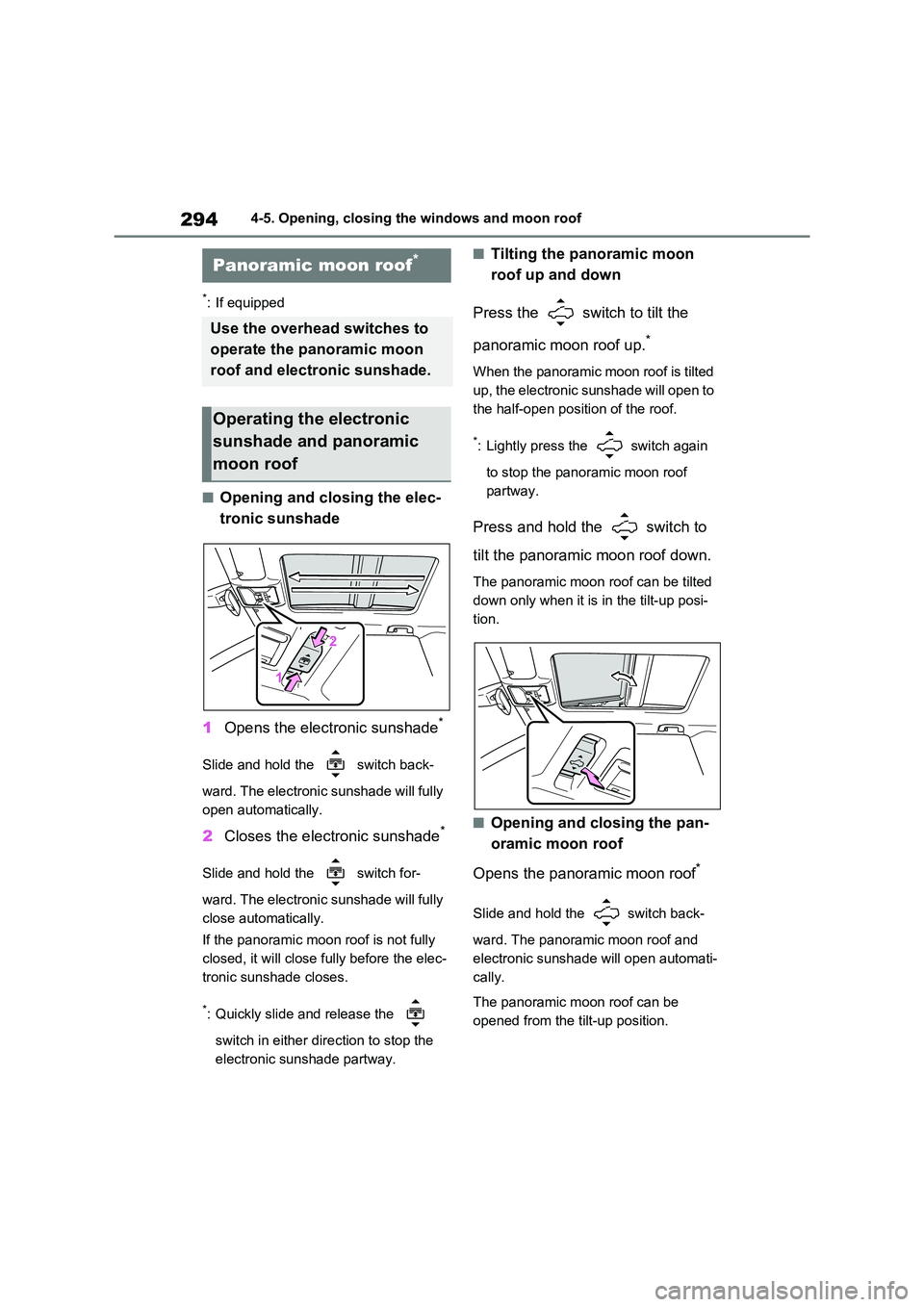
■Opening and closing the elec-
tronic sunshade
1 Opens the electronic sunshade*
Slide and hold the switch back-
ward. The electronic sunshade will fully
open automatically.
2 Closes the electronic sunshade*
Slide and hold the switch for-
ward. The electronic sunshade will fully
close automatically.
If the panoramic moon roof is not fully
closed, it will close fully before the elec -
tronic sunshade closes.
*: Quickly slide and release the
switch in either dir ection to stop the
electronic sunshade partway.
■Tilting the panoramic moon
roof up and down
Press the switch to tilt the
panoramic moon roof up.*
When the panoramic moon roof is tilted
up, the electronic sunshade will open to
the half-open posit ion of the roof.
*: Lightly press the switch again
to stop the panor amic moon roof
partway.
Press and hold the switch to
tilt the panoramic moon roof down.
The panoramic moon roof can be tilted
down only when it is in the tilt-up posi-
tion.
■Opening and closing the pan -
oramic moon roof
Opens the panoramic moon roof*
Slide and hold the switch back -
ward. The panoramic moon roof and
electronic sunshad e will open automati-
cally.
The panoramic moon roof can be
opened from the tilt-up position.
Panoramic moon roof*
Use the overhead switches to
operate the panoramic moon
roof and electronic sunshade.
Operating the electronic
sunshade and panoramic
moon roof
Page 297 of 666
295
4
4-5. Opening, closing the windows and moon roof
Before driving
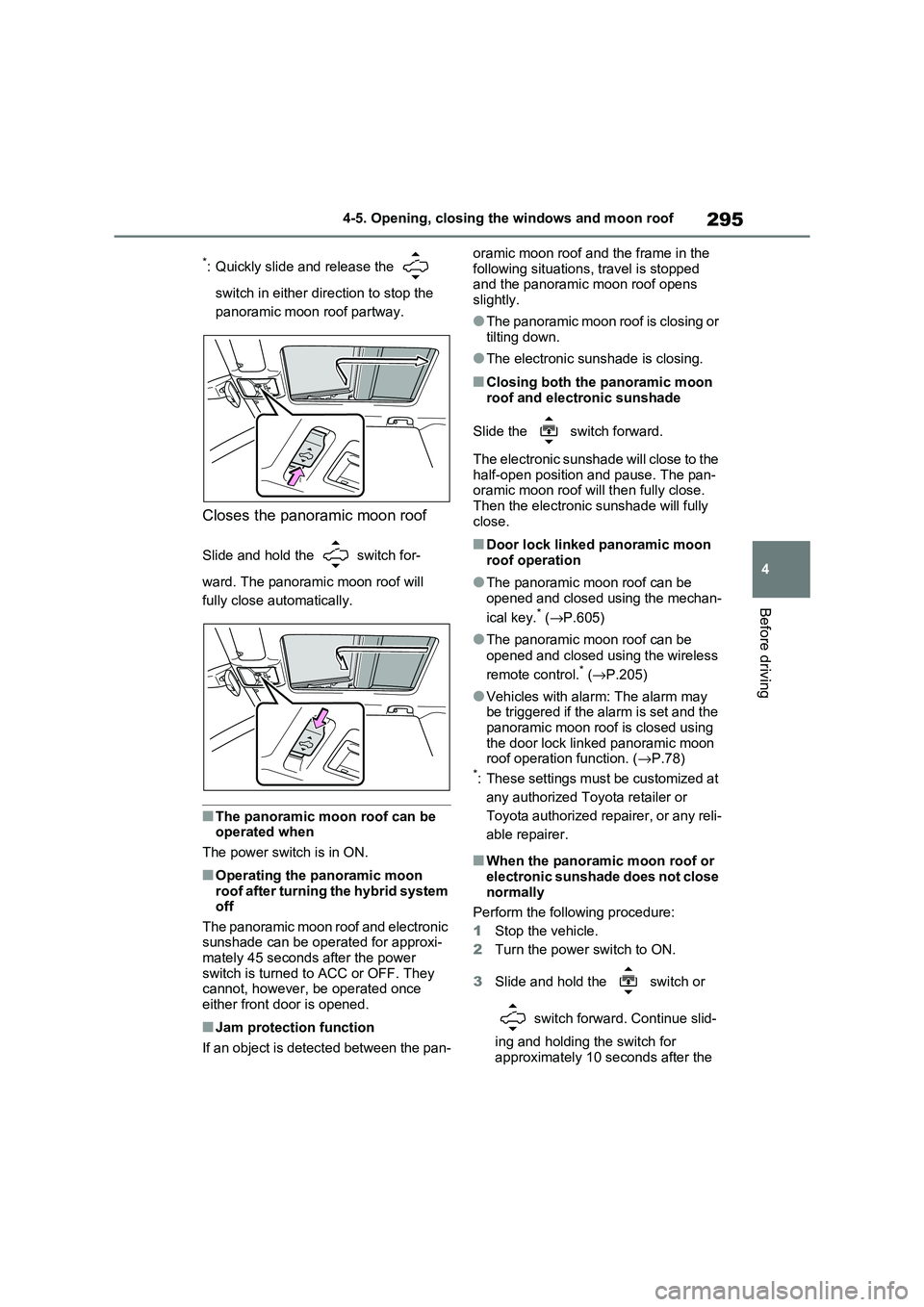
*: Quickly slide and release the
switch in either dir ection to stop the
panoramic moon roof partway.
Closes the panoramic moon roof
Slide and hold the switch for -
ward. The panoramic moon roof will
fully close automatically.
■The panoramic moon roof can be operated when
The power switch is in ON.
■Operating the panoramic moon
r o o f a f t e r t u r n i n g t h e h y b r i d s y s t e m off
The panoramic moon roof and electronic
sunshade can be oper ated for approxi- mately 45 seconds after the power
switch is turned to ACC or OFF. They
cannot, however, be operated once either front door is opened.
■Jam protection function
If an object is detected between the pan -
oramic moon roof an d the frame in the
following situations, travel is stopped and the panoramic moon roof opens
slightly.
●The panoramic moon roof is closing or
tilting down.
●The electronic sunshade is closing.
■Closing both the panoramic moon
roof and electronic sunshade
Slide the switch forward.
The electronic sunshade will close to the
half-open position and pause. The pan -
oramic moon roof will then fully close. Then the electronic sunshade will fully
close.
■Door lock linked panoramic moon
roof operation
●The panoramic moon roof can be
opened and closed using the mechan -
ical key.* ( →P.605)
●The panoramic moon roof can be
opened and closed using the wireless
remote control.* ( →P.205)
●Vehicles with alarm: The alarm may
be triggered if the alarm is set and the panoramic moon roof is closed using
the door lock lin ked panoramic moon
roof operation function. ( →P.78)*: These settings must be customized at
any authorized Toyota retailer or
Toyota authorized repairer, or any reli -
able repairer.
■When the panoramic moon roof or electronic sunshade does not close
normally
Perform the following procedure:
1 Stop the vehicle.
2 Turn the power switch to ON.
3 Slide and hold the switch or
switch forward. Continue slid -
ing and holding t he switch for
approximately 10 seconds after the
Page 299 of 666
297
4
4-5. Opening, closing the windows and moon roof
Before driving
WARNING
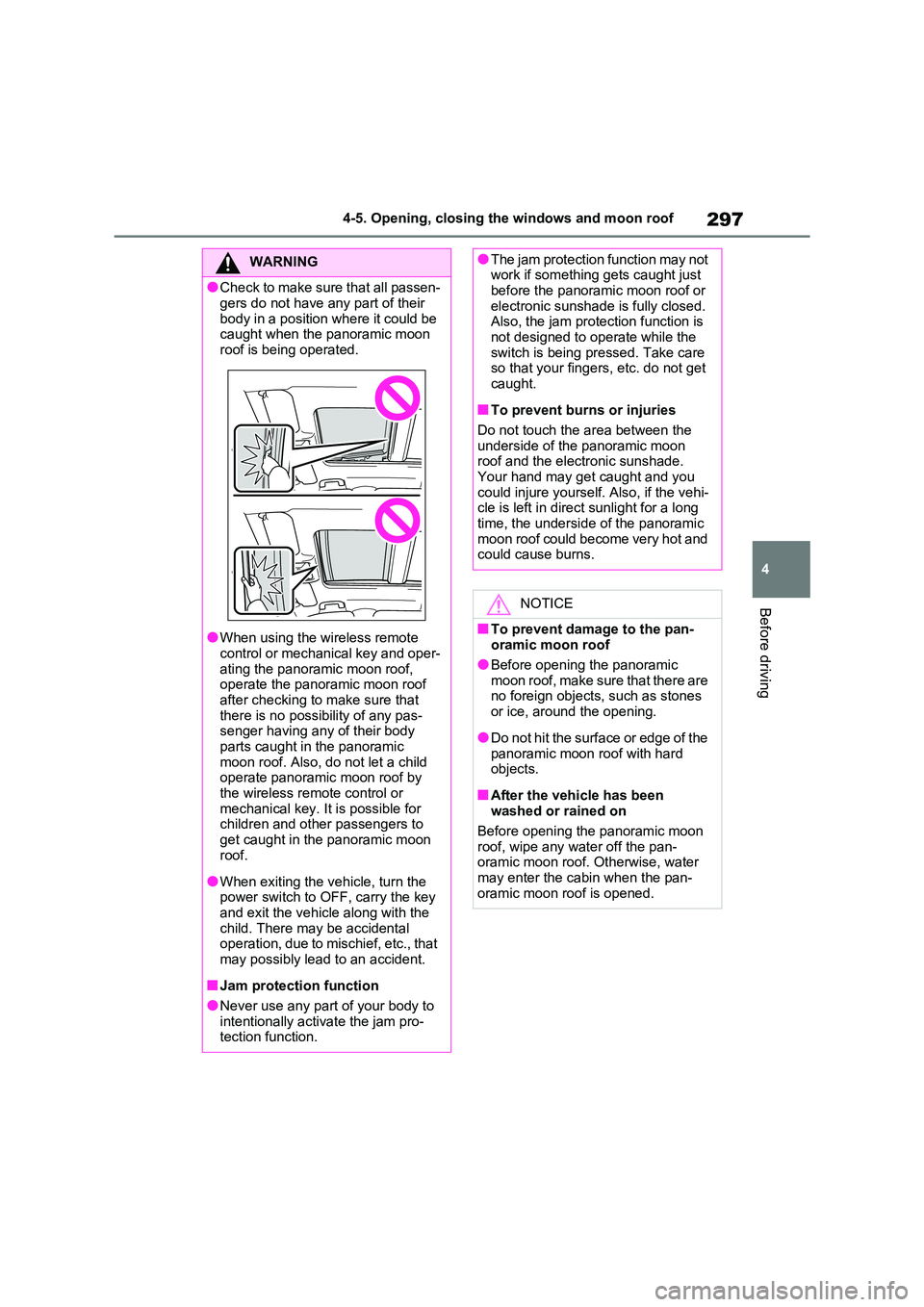
●Check to make sure that all passen -
gers do not have any part of their
body in a position where it could be caught when the panoramic moon
roof is being operated.
●When using the wireless remote
control or mechanical key and oper -
ating the panoramic moon roof, operate the panoramic moon roof
after checking to make sure that
there is no possibility of any pas - senger having any of their body
parts caught in the panoramic
moon roof. Also, do not let a child operate panoramic moon roof by
the wireless remote control or
mechanical key. It is possible for children and other passengers to
get caught in the panoramic moon
roof.
●When exiting the v ehicle, turn the
power switch to OFF, carry the key and exit the vehicle along with the
child. There may be accidental
operation, due to mischief, etc., that may possibly lead to an accident.
■Jam protection function
●Never use any part of your body to
intentionally activ ate the jam pro-
tection function.
●The jam protection function may not work if something gets caught just
before the panoramic moon roof or
electronic sunshade is fully closed. Also, the jam prote ction function is
not designed to op erate while the
switch is being pre ssed. Take care so that your fingers, etc. do not get
caught.
■To prevent burns or injuries
Do not touch the a rea between the
underside of the panoramic moon roof and the electronic sunshade.
Your hand may get caught and you
could injure yourself. Also, if the vehi - cle is left in direc t sunlight for a long
time, the underside of the panoramic
moon roof could become very hot and could cause burns.
NOTICE
■To prevent damage to the pan -
oramic moon roof
●Before opening the panoramic moon roof, make sure that there are
no foreign objects, such as stones
or ice, around the opening.
●Do not hit the surface or edge of the
panoramic moon r oof with hard objects.
■After the vehicle has been washed or rained on
Before opening the panoramic moon
roof, wipe any water off the pan - oramic moon roof. Otherwise, water
may enter the cabin when the pan -
oramic moon roof is opened.
Page 301 of 666
5
299
5
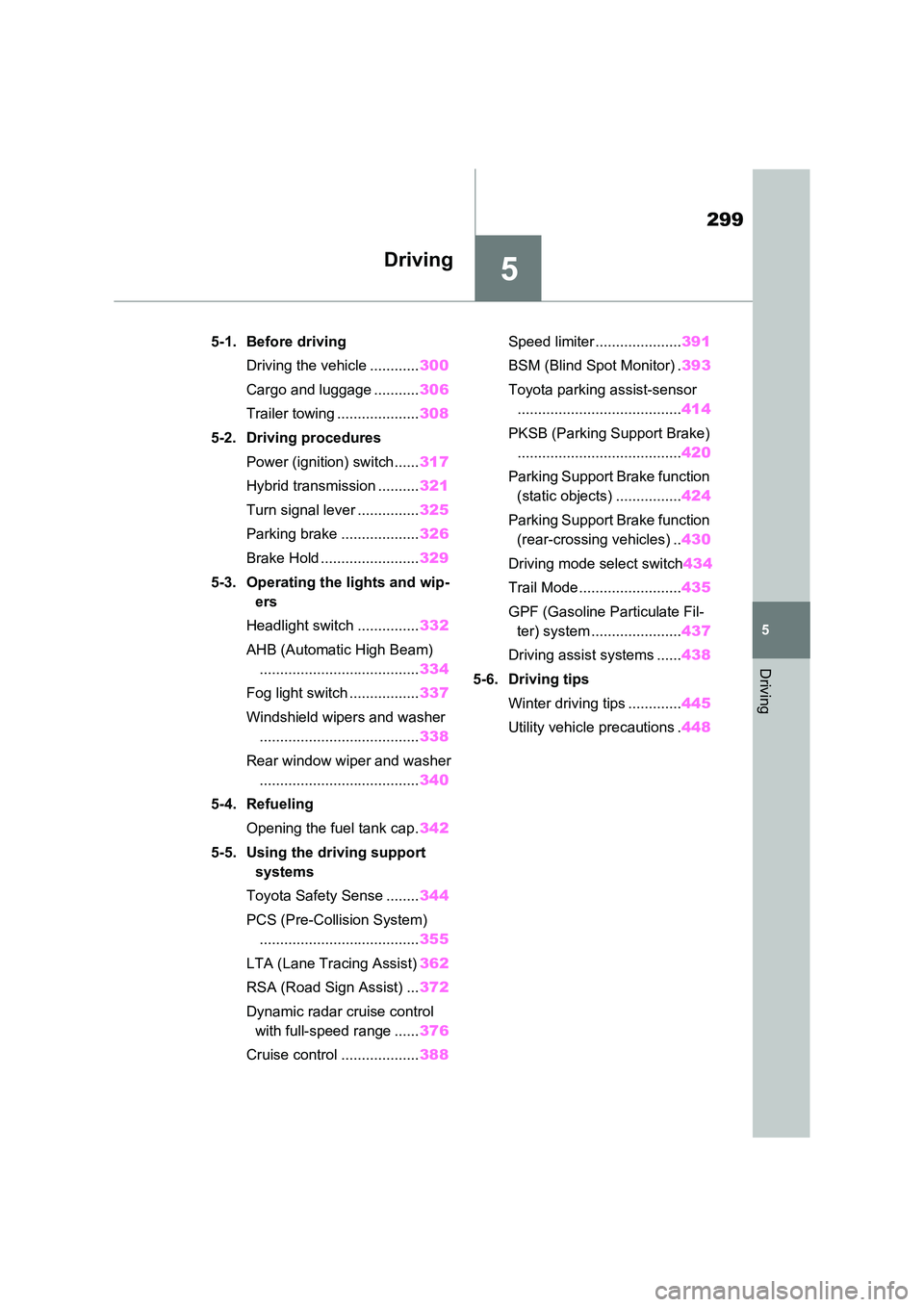
Driving
Driving
5-1. Before driving
Driving the vehicle ............ 300
Cargo and luggage ........... 306
Trailer towing .................... 308
5-2. Driving procedures
Power (ignition) switch ...... 317
Hybrid transmission .......... 321
Turn signal lever ............... 325
Parking brake ................... 326
Brake Hold ........................ 329
5-3. Operating the lights and wip -
ers
Headlight switch ............... 332
AHB (Automatic High Beam)
....................................... 334
Fog light switch ................. 337
Windshield wipers and washer
....................................... 338
Rear window wiper and washer
....................................... 340
5-4. Refueling
Opening the fuel tank cap. 342
5-5. Using the driving support
systems
Toyota Safety Sense ........ 344
PCS (Pre-Collision System)
....................................... 355
LTA (Lane Tracing Assist) 362
RSA (Road Sign Assist) ... 372
Dynamic radar cruise control
with full-speed range ...... 376
Cruise control ................... 388
Speed limiter ..................... 391
BSM (Blind Spot Monitor) . 393
Toyota parking assist-sensor
........................................ 414
PKSB (Parking Support Brake)
........................................ 420
Parking Support Brake function
(static objects) ................ 424
Parking Support Brake function
(rear-crossing vehicles) .. 430
Driving mode select switch 434
Trail Mode ......................... 435
GPF (Gasoline Particulate Fil -
ter) system ...................... 437
Driving assist systems ...... 438
5-6. Driving tips
Winter driving tips ............. 445
Utility vehicle precautions . 448
Page 304 of 666
3025-1. Before driving
■Operating your vehicle in a foreign
country
Comply with the rele vant vehicle regis-
tration laws and confi rm the availability
of the correct fuel. ( →P.620)
WARNING
Observe the following precautions.
Failure to do so may result in death or
serious injury.
■When starting the vehicle
Always keep your f oot on the brake
pedal while stopped with the “READY” indicator is illuminated. This
prevents the vehicle from creeping.
■When driving the vehicle
●Do not drive if you are unfamiliar
with the location of the brake and accelerator pe dals to avoid
depressing the wrong pedal.
• Accidentally depressing the accel - erator pedal instead of the brake
pedal will result in sudden accelera -
tion that may lead to an accident.
• When backing up, you may twist
your body around, leading to a diffi -
culty in operating the pedals. Make sure to operate th e pedals properly.
• Make sure to keep a correct driving
posture even when moving the vehicle only slightly. This allows
you to depress the brake and accel -
erator pedals properly.
• Depress the brake pedal using your
right foot. Depressing the brake
pedal using your left foot may delay response in an emergency, result -
ing in an accident.
●The driver should pay extra atten - tion to pedestrians when the vehicle
is powered only b y the electric
motor (traction motor). As there is no engine noise, the pedestrians
may misjudge the vehicle’s move-
ment. Even though the vehicle is equipped with the Acoustic Vehicle
Alerting System, drive with care as
pedestrians in the vicinity may still not notice the ve hicle if the sur-
rounding area is noisy.
●Do not drive the vehicle over or
stop the vehicle near flammable
materials such as leaves, paper or rags.
The exhaust system and exhaust
gases can be extremely hot. These hot parts may cause a fire if there is
any flammable material nearby.
●During normal driving, do not turn
off the hybrid system. Turning the
hybrid system off while driving will not cause loss of steering or brak -
ing control, however, power assist
to the steering will be lost. This will make it more difficult to steer
smoothly, so you should pull over
and stop the vehicle as soon as it is safe to do so.
In the event of an emergency, such
as if it becomes impossible to stop the vehicle in the normal way:
→ P.560
●Use engine braking (downshift) to
maintain a safe speed when driving
down a steep hill. Using the brakes continuously may
cause the brakes to overheat and
lose effectiveness. ( →P.321)
●Do not adjust the position of the
steering wheel, t he seat, or the
inside or outside rear view mirrors while driving.
Doing so may result in a loss of
vehicle control.
Page 305 of 666
303
5
5-1. Before driving
Driving
WARNING
●Always check that all passengers’
arms, head or other parts of their
body are not outside the vehicle.
■When driving on slippery road
surfaces
●Sudden braking, acceleration and
steering may cause tire slippage
and reduce your ability to control
the vehicle.
●Sudden acceleration, engine brak -
ing due to shifting, or changes in engine speed could cause the vehi -
cle to skid.
●After driving through a puddle,
lightly depress the brake pedal to
make sure that the brakes are func - tioning properly. Wet brake pads
may prevent the brakes from func -
tioning properly. If the brakes on only one side are wet and not func-
tioning properly, steering control
may be affected.
■When shifting the shift lever
●Do not let the vehi cle roll backward while a forward driving position is
selected, or roll forward while the
shift lever is in R. Doing so may result in an accident
or damage to the vehicle.
●Do not shift the shift lever to P while
the vehicle is moving.
Doing so can damage the transmis - sion and may result in a loss of
vehicle control.
●Do not shift the shift lever to R while
the vehicle is moving forward.
Doing so can damage the transmis - sion and may result in a loss of
vehicle control.
●Do not shift the sh ift lever to a driv- ing position while the vehicle is
moving backward.
Doing so can dama ge the transmis- sion and may resu lt in a loss of
vehicle control.
●Moving the shift lever to N while the
vehicle is moving will disengage the
hybrid system. Engine braking is not available with the hybrid system
disengaged.
●Be careful not to shift the shift lever
with the accelerator pedal
depressed. Shifting the shift lever to a gear
other than P or N may lead to unex -
pected rapid acceleration of the vehicle that may cause an accident
and result in death or serious injury.
Doing so can dama ge the transmis- sion and may resu lt in a loss of
vehicle control.
■If you hear a squealing or scrap -
ing noise (brake pad wear indica -
tors)
Have the brake pads checked and
replaced by any authorized Toyota
retailer or Toyota a uthorized repairer, or any reliable repairer as soon as
possible.
Rotor damage may result if the pads are not replaced when needed.
It is dangerous to drive the vehicle
when the wear limits of the brake pads and/or those of the brake discs
are exceeded.
■When the vehicle is stopped
●Do not depress the accelerator
pedal unnecessarily.
If the vehicle is i n any gear other than P or N, the vehicle may accel -
erate suddenly an d unexpectedly,
causing an accident.
Page 306 of 666
3045-1. Before driving
WARNING
●In order to prevent accidents due to
the vehicle rolling away, always
keep depressing the brake pedal while stopped with the “READY”
indicator is illuminated, and apply
the parking brake as necessary.
●If the vehicle is stopped on an
incline, in order to prevent acci -
dents caused by t he vehicle rolling forward or backward, always
depress the brake pedal and
securely apply the parking brake as needed.
●Avoid revving or racing the engine.Running the engine at high speed
while the vehicle is stopped may
cause the exhaust system to over- heat, which could result in a fire if
combustible material is nearby.
■When the vehicle is parked
●Do not leave glasses, cigarette
lighters, spray can s, or soft drink cans in the vehicle when it is in the
sun.
Doing so may result in the follow - ing:
• Gas may leak from a cigarette
lighter or spray c an, and may lead to a fire.
• The temperature inside the vehicle
may cause the plastic lenses and plastic material of glasses to
deform or crack.
• Soft drink cans may fracture, caus - ing the contents to spray over the
interior of the vehicle, and may also
cause a short circuit in the vehicle’s electrical components.
●Do not leave cigarette lighters in the vehicle. If a cigarette lighter is in a
place such as the glove box or on
the floor, it may be lit accidentally when luggage is loaded or the seat
is adjusted, causing a fire.
●Do not attach adhesive discs to the windshield or windows. Do not
place containers such as air fresh -
eners on the instrument panel or dashboard. Adhesive discs or con -
tainers may act as lenses, causing
a fire in the vehicle.
●Do not leave a door or window
open if the curved glass is coated with a metallized fi lm such as a sil-
ver-colored one. Reflected sunlight
may cause the gl ass to act as a lens, causing a fire.
●Always apply the parking brake, shift the shift lev er to P, stop the
hybrid system and lock the vehicle.
Do not leave the vehicle unat - tended while the “READY” indicator
is illuminated.
If the vehicle is parked with the shift lever in P but the parking brake is
not set, the vehicl e may start to
move, possibly leading to an acci - dent.
●Do not touch the exhaust pipes while the “READY” indicator is illu -
minated or immediately after turn -
ing the hybrid system off. Doing so may cause burns.
■When taking a nap in the vehicle
Always turn the hybrid system off.
Otherwise, if you accidentally move
the shift lever or depress the acceler - ator pedal, this could cause an acci -
dent or fire due to hybrid system
overheating. Additionally, if the vehi - cle is parked in a poorly ventilated
area, exhaust gases may collect and
enter the vehi cle, leading to death or a serious health hazard.
Page 311 of 666
309
5
5-1. Before driving
Driving
Check the allowable towing capac -
ity, GVM (Gross Vehicle Mass),
MPAC (Maximum Permissible Axle
Capacity), and permissible drawbar
load before towing. ( →P.618)
Toyota recommends the use of the
Toyota hitch/bracke t for your vehi-
cle. Other products of a suitable
nature and comparable quality may
also be used.
For vehicles where the towing
device blocks any of the lights or
license plate, the fo llowing shall be
observed:
Do not use towing device that
cannot be easily removed or
repositioned.
Towing devices must be
removed or repositioned when
not in use.
Please consult a ny authorized
Toyota retailer or Toyota authorized
repairer, or any reliable repairer
when installing tra iler lights, as
incorrect installa tion may cause
damage to the vehicle’s lights.
Please take care to comply with
your state’s laws when installing
trailer lights.
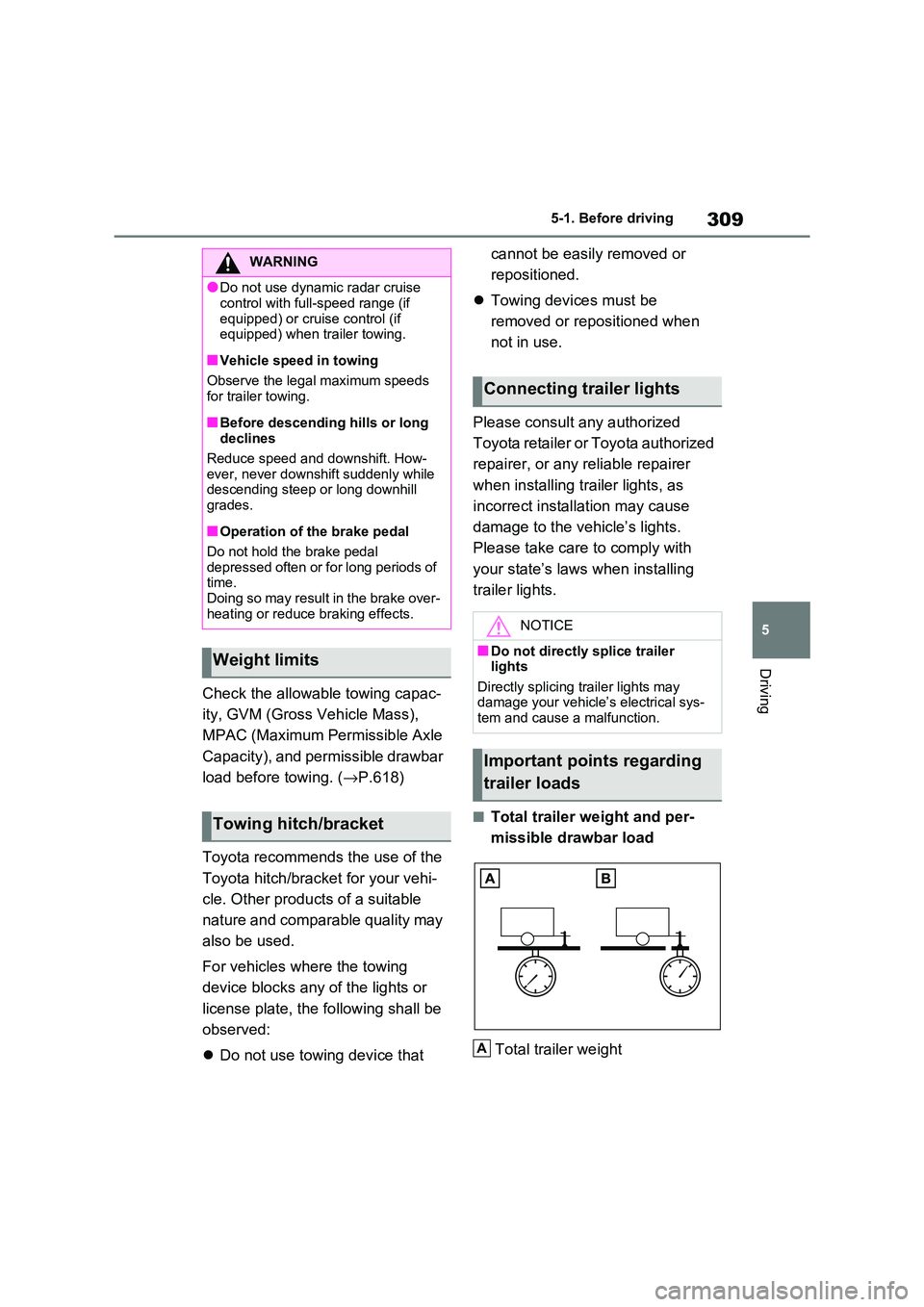
■Total trailer weight and per -
missible drawbar load
Total trailer weight
WARNING
●Do not use dynamic radar cruise
control with full- speed range (if
equipped) or cruise control (if equipped) when trailer towing.
■Vehicle speed in towing
Observe the legal maximum speeds
for trailer towing.
■Before descending hills or long declines
Reduce speed and downshift. How -
ever, never downshift suddenly while descending steep or long downhill
grades.
■Operation of the brake pedal
Do not hold the brake pedal
depressed often or for long periods of time.
Doing so may result in the brake over -
heating or reduce braking effects.
Weight limits
Towing hitch/bracket
Connecting trailer lights
NOTICE
■Do not directly splice trailer lights
Directly splicing trailer lights may
damage your vehicle’s electrical sys - tem and cause a malfunction.
Important points regarding
trailer loads
A
Page 316 of 666
3145-1. Before driving
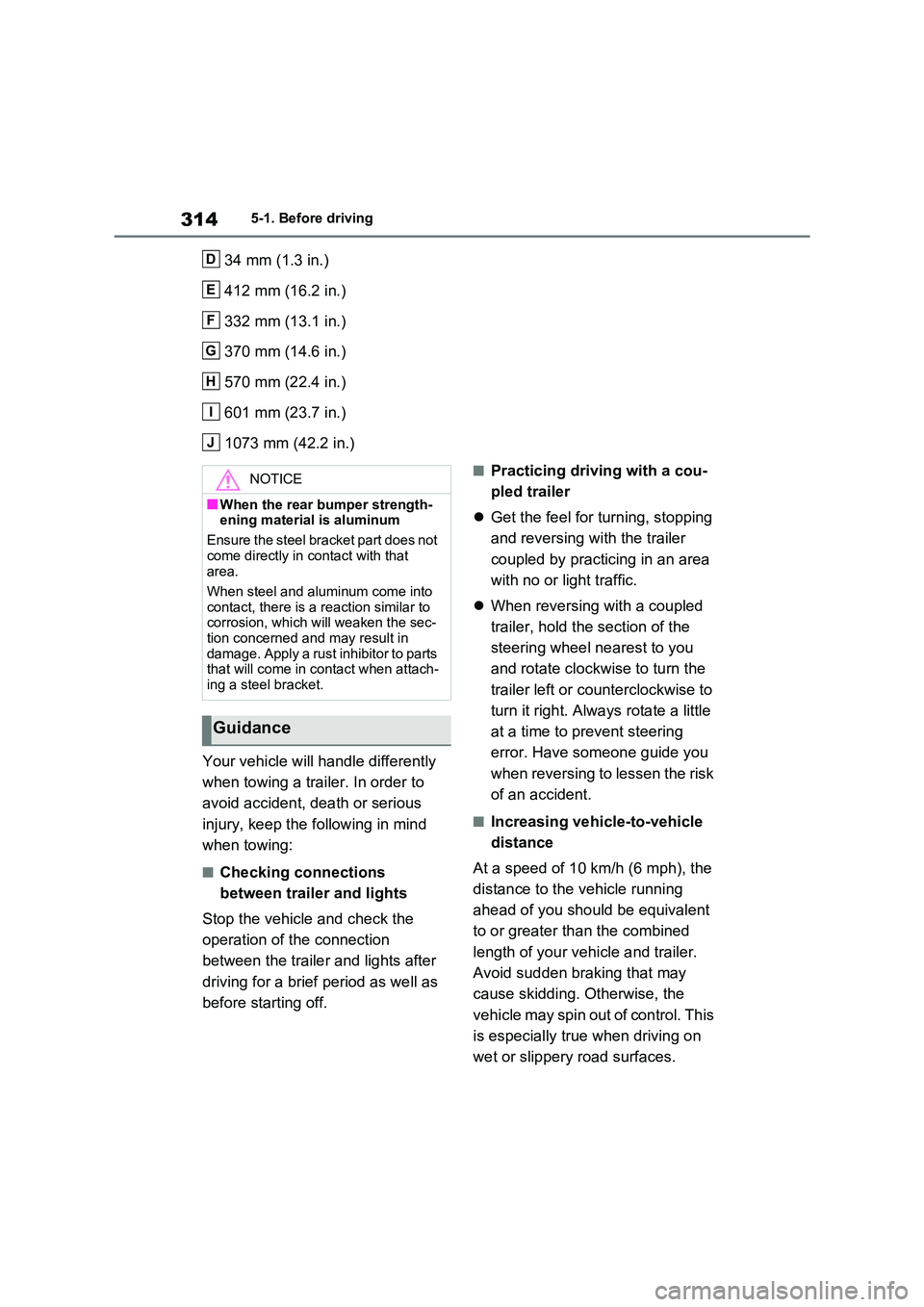
34 mm (1.3 in.)
412 mm (16.2 in.)
332 mm (13.1 in.)
370 mm (14.6 in.)
570 mm (22.4 in.)
601 mm (23.7 in.)
1073 mm (42.2 in.)
Your vehicle will handle differently
when towing a trailer. In order to
avoid accident, d eath or serious
injury, keep the following in mind
when towing:
■Checking connections
between trailer and lights
Stop the vehicle and check the
operation of the connection
between the trailer and lights after
driving for a brief period as well as
before starting off.
■Practicing driving with a cou -
pled trailer
Get the feel for turning, stopping
and reversing with the trailer
coupled by practicing in an area
with no or light traffic.
When reversing with a coupled
trailer, hold the section of the
steering wheel nearest to you
and rotate clockwise to turn the
trailer left or co unterclockwise to
turn it right. Always rotate a little
at a time to prevent steering
error. Have someone guide you
when reversing to lessen the risk
of an accident.
■Increasing vehicle-to-vehicle
distance
At a speed of 10 km/h (6 mph), the
distance to the vehicle running
ahead of you should be equivalent
to or greater th an the combined
length of you r vehicle and trailer.
Avoid sudden braking that may
cause skidding. Otherwise, the
vehicle may spin out of control. This
is especially true when driving on
wet or slippery road surfaces.
D
E
F
G
H
I
J
NOTICE
■When the rear bumper strength -
ening material is aluminum
Ensure the steel bracket part does not
come directly in contact with that
area.
When steel and aluminum come into
contact, there is a reaction similar to
corrosion, which will weaken the sec - tion concerned and may result in
damage. Apply a rust inhibitor to parts
that will come in contact when attach - ing a steel bracket.
Guidance