light TOYOTA RAV4 PHEV 2021 Owners Manual
[x] Cancel search | Manufacturer: TOYOTA, Model Year: 2021, Model line: RAV4 PHEV, Model: TOYOTA RAV4 PHEV 2021Pages: 666, PDF Size: 161.28 MB
Page 418 of 666
4165-5. Using the driving support systems
■The system can be operated when
●The power switch is in ON.
●Toyota parking assist-sensor function is on.
●The vehicle speed is less than about 10 km/h (6 mph).
●The shift lever is in other than P.
■If “Clean Parking Assist Sensor” is
displayed on the multi-information display
A sensor may be covered with ice,
snow, dirt, etc. Rem ove the ice, snow, dirt, etc., from the sensor to return the
system to normal.
Also, due to ice forming on a sensor at low temperatures, a warning message
may be displayed or the sensor may not
be able to detect an object. Once the ice melts, the system will return to normal.
If a warning message is displayed even
if the sensor is cle an, there may be a sensor malfunction. Have the vehicle
inspected by any a uthorized Toyota
retailer or Toyota authorized repairer, or any reliable repairer.
WARNING
●The area directly under the bum -
pers is not detected.
Thin posts or objects lower than the sensor may not be detected when
approached, even if they have been
detected once.
■When to disable the function
In the following situations, disable the
function as it may operate even though there is no possibility of a colli -
sion.
●The vehicle is equipped with a com - mercial fender pole, wireless
antenna or fog lights.
●The front or rear bumper or a sen -
sor receives a strong impact.
●A non-genuine Toyota suspension
(lowered suspension, etc.) is
installed.
●Towing eyelets are installed.
●A backlit license plate is installed.
●When using an automatic car wash
■When using the Toyota parking
assist-sensor
In the following situations, the system
may not function correctly due to a
sensor malfunction, etc. Have the vehicle checked by any authorized
Toyota retailer or Toyota authorized
repairer, or any reliable repairer.
●The Toyota parki ng assist-sensor
operation display flashes or shows continuously, a nd a beep sounds
when no objects are detected.
●If the area around a sensor collides
with something, or is subjected to
strong impact.
●If the bumper or grille collides with
something.
●If the display flashes or is displayed continuously and a buzzer does not
sound, except when the mute func -
tion has been turned on.
■Notes when washing the vehicle
Do not apply intensiv e bursts of water or steam to the sensor area.
Doing so may result in the sensor
malfunctioning.
●When using a high pressure
washer to wash the vehicle, do not spray the sensors directly, as doing
so may cause a sensor to malfunc -
tion.
●When using steam to clean the
vehicle, do not direct steam too close to the sensors as doing so
may cause a sensor to malfunction.
Page 430 of 666
4285-5. Using the driving support systems
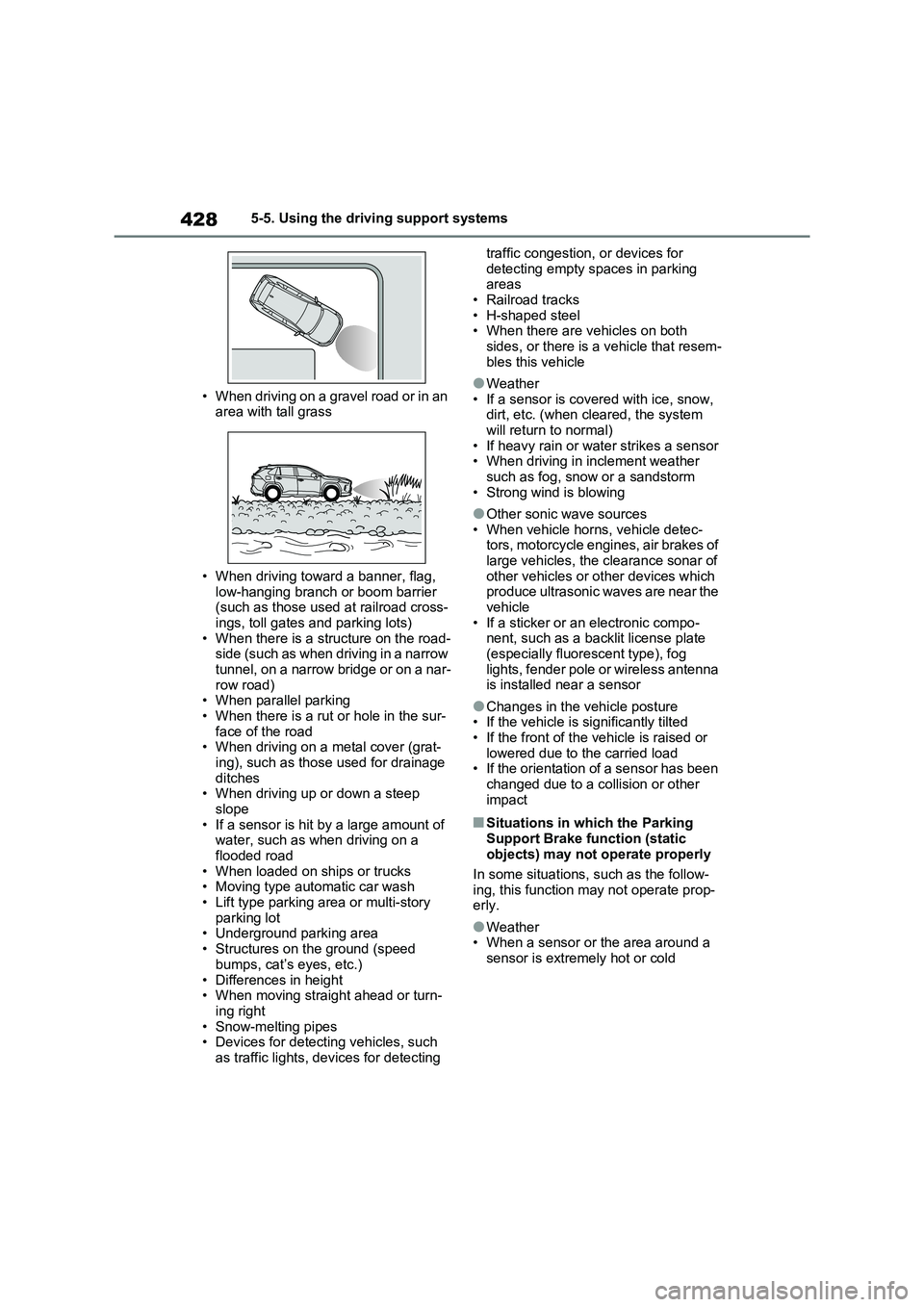
• When driving on a gravel road or in an
area with tall grass
• When driving toward a banner, flag,
low-hanging branch or boom barrier (such as those used at railroad cross-
ings, toll gates and parking lots)
• When there is a structure on the road - side (such as when driving in a narrow
tunnel, on a narrow bridge or on a nar -
row road) • When parallel parking
• When there is a rut o r hole in the sur-
face of the road • When driving on a metal cover (grat -
ing), such as those used for drainage
ditches • When driving up or down a steep
slope
• If a sensor is hit by a large amount of water, such as when driving on a
flooded road
• When loaded on ships or trucks • Moving type automatic car wash
• Lift type parking area or multi-story
parking lot • Underground parking area
• Structures on the ground (speed
bumps, cat’s eyes, etc.)
• Differences in height • When moving straight ahead or turn -
ing right
• Snow-melting pipes • Devices for detecting vehicles, such
as traffic lights, dev ices for detecting
traffic congestion, or devices for
detecting empty spaces in parking areas
• Railroad tracks
• H-shaped steel • When there are vehicles on both
sides, or there is a vehicle that resem -
bles this vehicle
●Weather
• If a sensor is covered with ice, snow, dirt, etc. (when c leared, the system
will return to normal)
• If heavy rain or water strikes a sensor • When driving in inclement weather
such as fog, snow or a sandstorm
• Strong wind is blowing
●Other sonic wave sources
• When vehicle horns, vehicle detec - tors, motorcycle engines, air brakes of
large vehicles, the clearance sonar of
other vehicles or other devices which produce ultrasonic waves are near the
vehicle
• If a sticker or an electronic compo - nent, such as a backlit license plate
(especially fluorescent type), fog
lights, fender pole or wireless antenna is installed near a sensor
●Changes in the vehicle posture• If the vehicle is significantly tilted
• If the front of the v ehicle is raised or
lowered due to the carried load • If the orientation of a sensor has been
changed due to a collision or other
impact
■Situations in which the Parking Support Brake function (static
objects) may not operate properly
In some situations, s uch as the follow- ing, this function m ay not operate prop-
erly.
●Weather • When a sensor or the area around a
sensor is extremely hot or cold
Page 431 of 666
429
5
5-5. Using the driving support systems
Driving
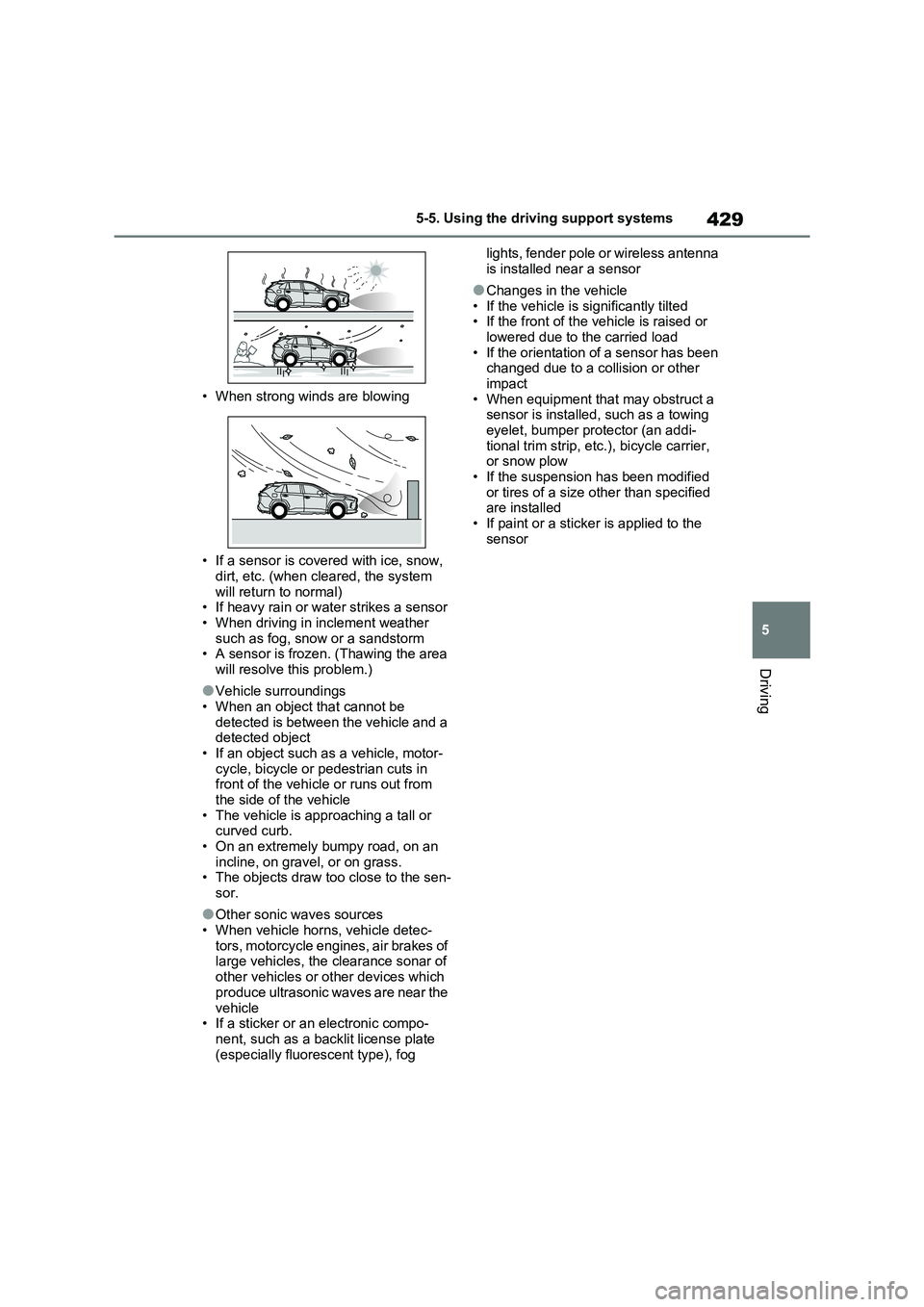
• When strong winds are blowing
• If a sensor is cove red with ice, snow,
dirt, etc. (when cleared, the system
will return t o normal) • If heavy rain or wa ter strikes a sensor
• When driving in inclement weather
such as fog, snow or a sandstorm • A sensor is frozen. (Thawing the area
will resolve this problem.)
●Vehicle surroundings
• When an object that cannot be
detected is between the vehicle and a detected object
• If an object such as a vehicle, motor-
cycle, bicycle or pedestrian cuts in front of the vehicl e or runs out from
the side of the vehicle
• The vehicle is approaching a tall or curved curb.
• On an extremely bumpy road, on an
incline, on gravel, or on grass. • The objects draw too close to the sen -
sor.
●Other sonic waves sources
• When vehicle horns , vehicle detec-
tors, motorcycle engines, air brakes of large vehicles, the clearance sonar of
other vehicles or other devices which
produce ultrasonic waves are near the
vehicle • If a sticker or an electronic compo -
nent, such as a backl it license plate
(especially fluorescent type), fog
lights, fender pole or wireless antenna
is installed near a sensor
●Changes in the vehicle
• If the vehicle is significantly tilted • If the front of the v ehicle is raised or
lowered due to the carried load
• If the orientation of a sensor has been changed due to a collision or other
impact
• When equipment that may obstruct a sensor is installed , such as a towing
eyelet, bumper protector (an addi -
tional trim str ip, etc.), bicycle carrier, or snow plow
• If the suspension has been modified
or tires of a size o ther than specified are installed
• If paint or a sticker is applied to the
sensor
Page 435 of 666
433
5
5-5. Using the driving support systems
Driving
nent, such as a backl it license plate
(especially fluorescent type), fog lights, fender pole or wireless antenna
is installed near a radar sensor
●If the orientation of a radar sensor has
been changed
●When multiple vehicles are approach -
ing with only a sm all gap between
each vehicle
●If a vehicle is appro aching the rear of
your vehicle rapidly
●Situations in which the radar sensor
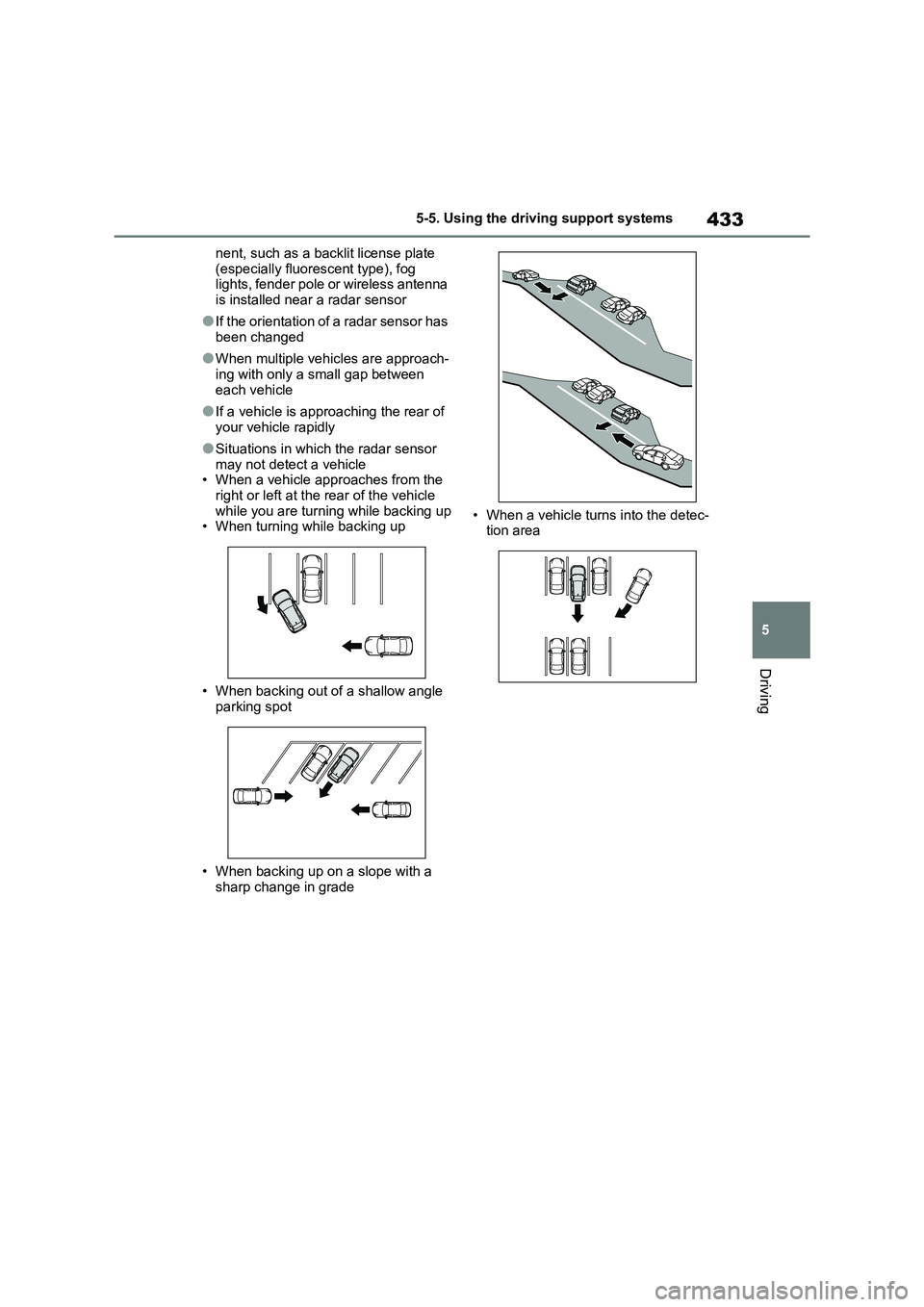
may not detect a vehicle • When a vehicle appr oaches from the
right or left at the rear of the vehicle
while you are turning while backing up • When turning while backing up
• When backing out of a shallow angle parking spot
• When backing up on a slope with a sharp change in grade
• When a vehicle turns into the detec - tion area
Page 438 of 666
4365-5. Using the driving support systems
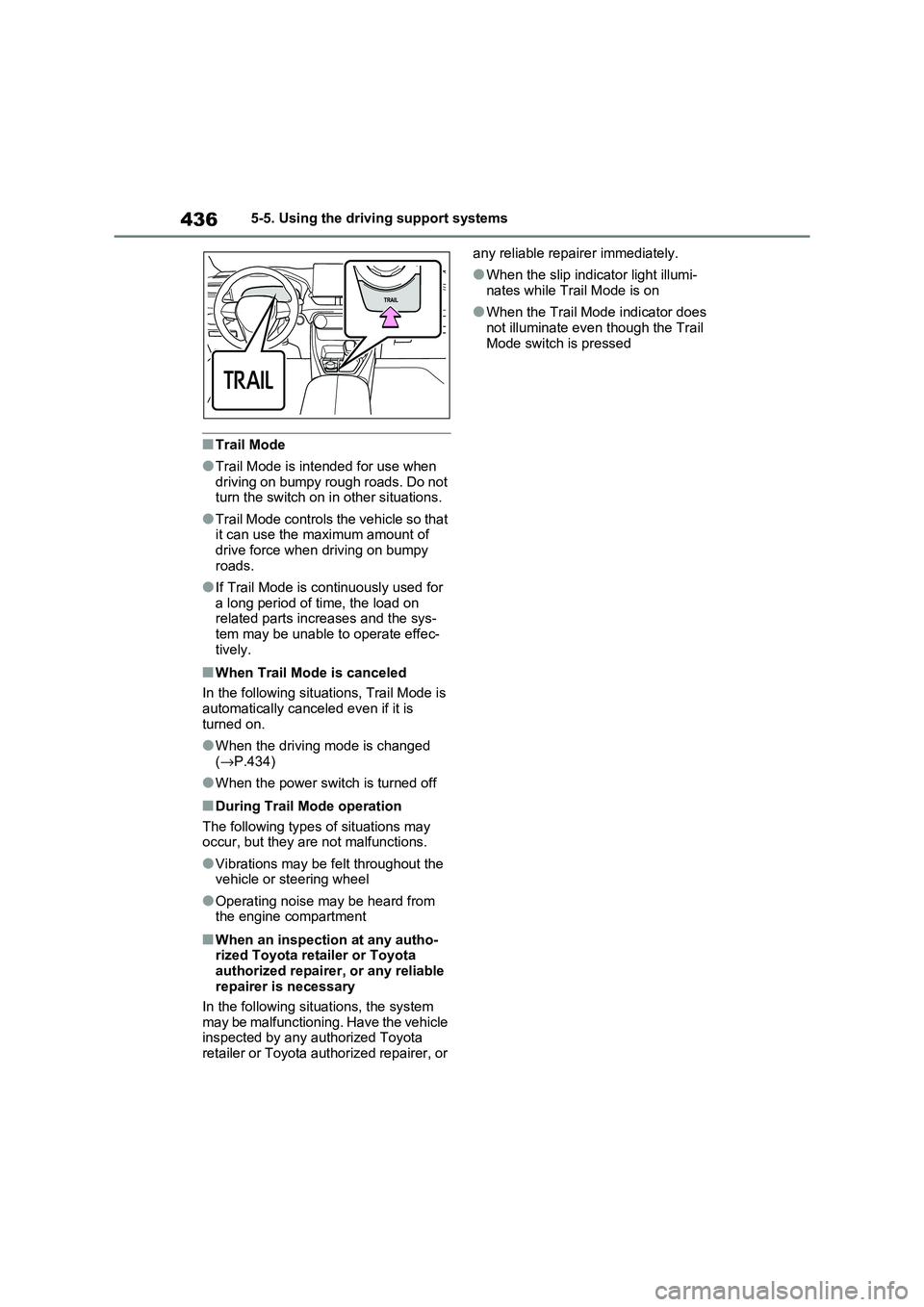
■Trail Mode
●Trail Mode is intended for use when
driving on bumpy rough roads. Do not turn the switch on in other situations.
●Trail Mode controls the vehicle so that it can use the maximum amount of
drive force when driving on bumpy
roads.
●If Trail Mode is continuously used for
a long period of t ime, the load on related parts increases and the sys -
tem may be unable t o operate effec-
tively.
■When Trail Mode is canceled
In the following situations, Trail Mode is
automatically canc eled even if it is
turned on.
●When the drivi ng mode is changed
( →P.434)
●When the power switch is turned off
■During Trail Mode operation
The following types of situations may occur, but they are not malfunctions.
●Vibrations may be felt throughout the vehicle or steering wheel
●Operating noise may be heard from
the engine compartment
■When an inspection at any autho - rized Toyota retailer or Toyota
authorized repairer, or any reliable
repairer is necessary
In the following situ ations, the system
may be malfunctioning. Have the vehicle
inspected by any authorized Toyota retailer or Toyota authorized repairer, or
any reliable repairer immediately.
●When the slip indicator light illumi -
nates while Trail Mode is on
●When the Trail Mode indicator does
not illuminate even though the Trail
Mode switch is pressed
Page 441 of 666
439
5
5-5. Using the driving support systems
Driving
■E-Four (Electronic On-Demand
AWD system)
Automatically switches from front
wheel drive to all-wheel drive
(AWD) according to the driving con -
ditions, helping to ensure reliable
handling and stability. Examples of
conditions where the system will
switch to AWD are when cornering,
going uphill, start ing off or acceler-
ating, and when the road surface is
slippery due to snow, rain, etc.
■Emergency brake signal
When the brakes are applied sud -
denly, the emergency flashers
automatically flash to alert the vehi -
cle behind.
■The Secondary Collision
Brake (if equipped)
When the SRS airbag sensor
detects a collision and the system
operates, the brakes and brake
lights are automatically controlled
to reduce the v ehicle speed and
help reduce the possibility of further
damage due to a secondary colli -
sion.
■When the TRC/VSC/ABS/Trailer Sway Control syst ems are operat-
ing
The slip indicator light will flash while the TRC/VSC/ABS/Traile r Sway Control
systems are operating.
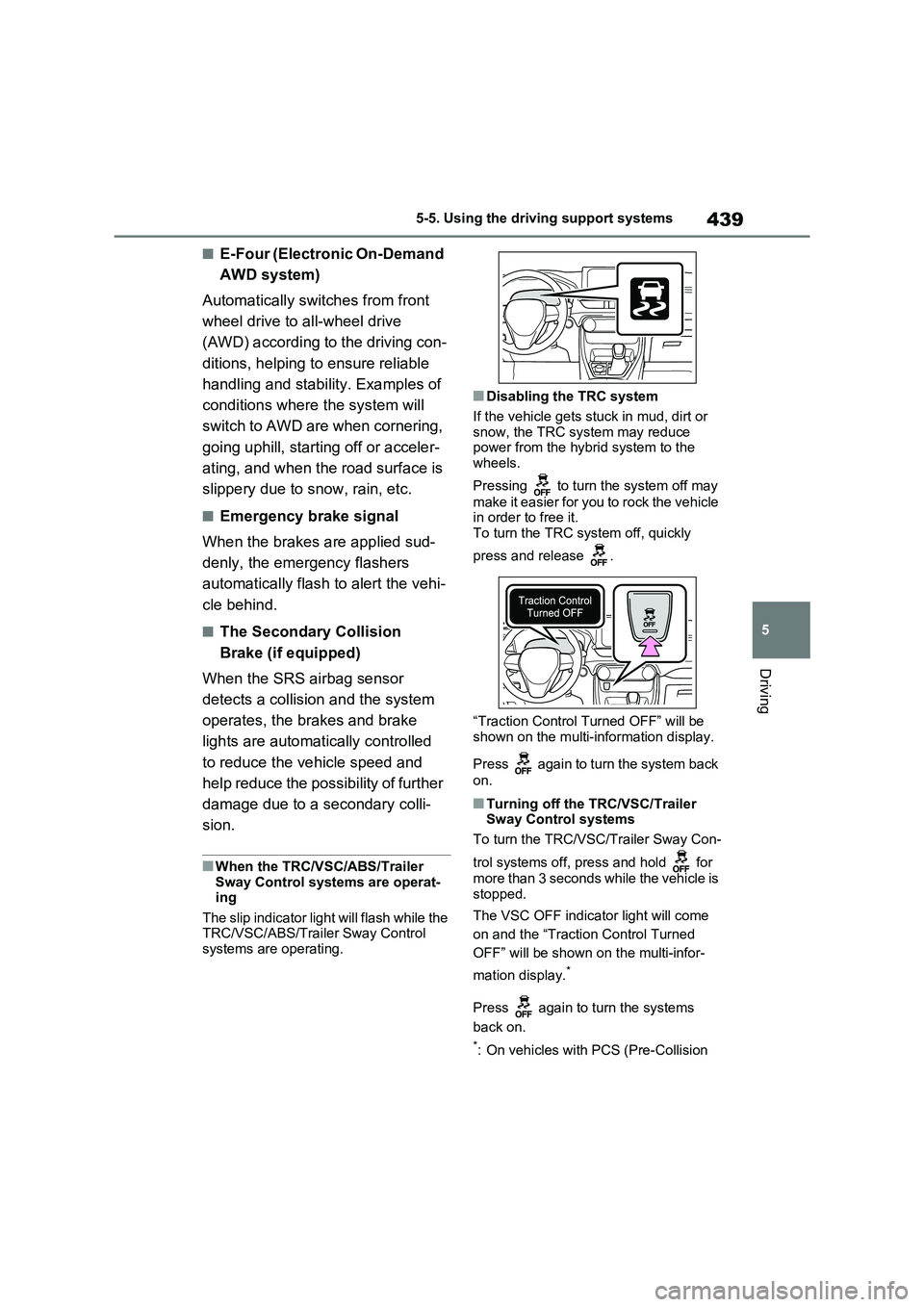
■Disabling the TRC system
If the vehicle gets stuck in mud, dirt or snow, the TRC system may reduce
power from the hyb rid system to the
wheels.
Pressing to turn t he system off may
make it easier for you to rock the vehicle
in order to free it.
To turn the TRC system off, quickly
press and release .
“Traction Control Tu rned OFF” will be
shown on the multi-information display.
Press again to turn the system back
on.
■Turning off the TRC/VSC/Trailer
Sway Control systems
To turn the TRC/VS C/Trailer Sway Con-
trol systems off, press and hold for
more than 3 seconds wh ile the vehicle is
stopped.
The VSC OFF indicator light will come
on and the “Tractio n Control Turned
OFF” will be shown on the multi-infor-
mation display.*
Press again to turn the systems
back on.
*: On vehicles with PCS (Pre-Collision
Page 442 of 666
4405-5. Using the driving support systems
System), PCS will also be disabled
(only Pre-Collision warning is avail -
able). The PCS warning light will
come on and a message will be dis -
played on the multi-information dis -
play. ( →P.361)
■When the message is displayed on
the multi-information display show -
ing that TRC has been disabled
even if has not been pressed
TRC is temporary deactivated. If the information continues to show, contact
any authorized Toyota retailer or Toyota
authorized repairer, or any reliable repairer.
■Operating conditions of hill-start
assist control
When the following four conditions are met, the hill-start as sist control will oper-
ate:
●The shift lever is in a position other
than P or N (when starting off for-
ward/backward on an upward incline).
●The vehicle is stopped.
●The accelerator pedal is not
depressed.
●The parking brake is not engaged.
■Automatic system cancelation of
hill-start assist control
The hill-start assist control will turn off in any of the following situations:
●The shift lever is shifted to P or N.
●The accelerator pedal is depressed.
●The parking brak e is engaged.
●No more than 2 seconds have elapsed after the brake pedal is
released.
■Sounds and vibrations caused by
the ABS, brake assist, VSC, Trailer Sway Control, TRC and hill-start
assist control systems
●A sound may be heard from the
engine compartment when the brake
pedal is depressed repeatedly, when
the hybrid system i s started or just
after the vehicle beg ins to move. This sound does not indicate that a mal -
function has occurred in any of these
systems.
●Any of the followin g conditions may
occur when the a bove systems are operating. None of these indicates
that a malfunction has occurred.
• Vibrations may be felt through the vehicle body and steering.
• A motor sound may be heard also
after the vehicle comes to a stop.
■ECB operating sound
ECB operating sound may be heard in
the following cases, but it does not indi-
cate that a malfun ction has occurred.
●Operating sound heard from the
engine compartment when the brake pedal is operated.
●Motor sound of the brake system heard from the front part of the vehicle
when the driver’ door is opened.
●Operating sound heard from the
engine compartment when one or two
minutes passed after the stop of the hybrid system.
■Active Cornering Assist operation
sounds and vibrations
When the Active Cornering Assist is operated, operation sounds and vibra -
tions may be generat ed from the brake
system, but thi s is not a malfunction.
■EPS operation sound
When the steering wheel is operated, a
motor sound (whirring sound) may be
heard. This does not indicate a malfunc - tion.
■Automatic reacti vation of TRC,
Trailer Sway Control and VSC sys -
tems
After turning the TRC, Trailer Sway Control and VSC systems off, the sys -
tems will be automati cally re-enabled in
the following situations:
●When the power switch is turned off.
●If only the TRC syst em is turned off,
Page 445 of 666
443
5
5-5. Using the driving support systems
Driving
WARNING
●When driving over roads with pot -
holes or uneven surfaces
■TRC/VSC may not operate effec -
tively when
Directional control and power may not be achievable while driving on slip -
pery road surfaces , even if the
TRC/VSC system is operating.
Drive the vehicle carefully in condi - tions where stabilit y and power may
be lost.
■Active Cornering Assist does not
operate effectively when
●Do not overly rely on Active Corner - ing Assist. Active Cornering Assist
may not operate effectively when
accelerating down slopes or driving on slippery road surfaces.
●When Active Cornering Assist fre - quently operates, Active Cornering
Assist may temporarily stop operat -
ing to ensure prop er operation of the brakes, TRC and VSC.
■Hill-start assist control does not operate effectively when
●Do not overly rely on hill-start assist
control. Hill-start assist control may not operate effectively on steep
inclines and roads covered with ice.
●Unlike the parking brake, hill-start
assist control is not intended to hold
the vehicle stationary for an extended period of time. Do not
attempt to use hill-start assist con -
trol to hold the vehicle on an incline, as doing so may lead to an acci-
dent.
■When the TRC/ABS/VSC/Trailer
Sway Control is activated
The slip indicator light flashes. Always drive carefully. Reckless driving may
cause an accident. Exercise particular
care when the indicat or light flashes.
■When the TRC/VSC/Trailer Sway Control systems are turned off
Be especially careful and drive at a
speed appropriate t o the road condi- tions. As these ar e the systems to
help ensure vehicl e stability and driv-
ing force, do not turn the TRC/VSC/Trailer Sway Control sys -
tems off unle ss necessary.
Trailer Sway Control is part of the VSC system and will not operate if
VSC is turned off or experiences a
malfunction.
■Replacing tires
Make sure that all tires are of the specified size, brand, tread pattern
and total load capac ity. In addition,
make sure that the tires are inflated to the recommended tire inflation pres -
sure level.
The ABS, TRC and VSC/Trailer Sway Control systems will not function cor -
rectly if different ti res are installed on
the vehicle. Contact any authorized Toyota
retailer or Toyota a uthorized repairer,
or any reliable repairer for further information when replacing tires or
wheels.
■Handling of tires and the suspen -
sion
Using tires with any kind of problem or modifying the suspension will affect
the driving assist systems, and may
cause a system to malfunction.
■Trailer Sway Control precaution
The Trailer Sway C ontrol system is not able to reduce tr ailer sway in all
situations. Depending on many fac -
tors such as the conditions of the
vehicle, trailer, road surface and driv - ing environment, the Trailer Sway
Control system may not be effective.
Refer to your traile r owner’s manual for information on how to tow your
trailer properly.
Page 448 of 666
4465-6. Driving tips
Perform the following according to
the driving conditions:
Do not try to forcibly open a win-
dow or move a wiper that is fro -
zen. Pour warm water over the
frozen area to melt the ice. Wipe
away the water immediately to
prevent it from freezing.
To ensure proper operation of
the climate control system fan,
remove any sno w that has accu-
mulated on the air inlet vents in
front of the windshield.
Check for and remove any
excess ice or snow that may
have accumulated on the exte -
rior lights, vehicle’s roof, chassis,
around the tires or on the brakes.
Remove any snow or mud from
the bottom of your shoes before
getting in the vehicle.
Accelerate the veh icle slowly, keep
a safe distance between you and
the vehicle ahead, and drive at a
reduced speed suitable to road
conditions.
Park the vehicle and move the
s hif t le ve r to P w itho u t se tt ing th e
parking brake. The parking brake
may freeze up, preventing it from
being released. If the vehicle is
parked without setting the park -
ing brake, make sure to block the
wheels.
Failure to do so may be danger -
ous because it may cause the
vehicle to move unexpectedly,
possibly leading to an accident.
When the parking brake is in automatic
mode, release the parking brake after
shifting the shift lever to P. ( →P.326)
If the vehicle is left parked with
the brakes damp in cold tem -
peratures, there is a possibility of
the brakes freezing.
If the vehicle is parked without
setting the parking brake, con -
firm that the shift lever cannot be
moved out of P*.
*: The shift lever will be locked if it is
attempted to be shifted from P to any
other position with out depressing the
brake pedal. If the shift lever can be
shifted from P, t here may be a prob-
lem with the shift lock system. Have
the vehicle inspected by any autho -
rized Toyota retailer or Toyota autho -
rized repairer, or any reliable repairer
immediately.
Before driving the vehicle
When driving the vehicle
When parking the vehicle
WARNING
■When parking the vehicle
When parking the vehicle without
applying the parki ng brake, make
sure to chock the wheels. If you do
not chock the wheels, the vehicle may move unexpectedly, possibly result-
ing in an accident.
Page 453 of 666
6
451
6
Interior features
Interior features
6-1. Using the air conditioning
system and defogger
Automatic air conditioning sys -
tem ................................. 452
Remote Air Conditioning Sys -
tem ................................. 460
Heated steering wheel/Front
seat heaters/Front seat heat -
ers and ventilators/Rear seat
heaters ........................... 462
6-2. Using the interior lights
Interior lights list................ 465
6-3. Using the storage features
List of storage features ..... 468
Luggage compartment features
....................................... 472
6-4. Using the other interior fea -
tures
Other interior features ....... 476