steering TOYOTA RAV4 PHEV 2021 Manual PDF
[x] Cancel search | Manufacturer: TOYOTA, Model Year: 2021, Model line: RAV4 PHEV, Model: TOYOTA RAV4 PHEV 2021Pages: 666, PDF Size: 161.28 MB
Page 492 of 666
4907-1. Maintenance and care
WARNING
■Precaution regarding the rear
bumper with Blind Spot Monitor
(if equipped)
If the paint of the rear bumper is
chipped or scratched, the system may
malfunction. If this occurs, consult any authorized Toyo ta retailer or
Toyota authorized repairer, or any
reliable repairer.
NOTICE
■To prevent paint deterioration and corrosion on the body and
components (aluminum wheels,
etc.)
●Wash the vehicle immediately in
the following cases:
• After driving near the sea coast
• After driving on salted roads
• If coal tar or tree sap is present on
the paint surface
• If dead insects, insect droppings or
bird droppings are present on the
paint surface
• After driving in an area contami - nated with soot, o ily smoke, mine
dust, iron powder or chemical sub -
stances
• If the vehicle becomes heavily
soiled with dust or mud
• If liquids such as benzene and gas - oline are spilled on the paint sur-
face
●If the paint is chipped or scratched,
have it repaired immediately.
●To prevent the wh eels from corrod-
ing, remove any dirt and store in a
place with low humidity when stor - ing the wheels.
■Cleaning the exterior lights
●Wash carefully. Do not use organic
substances or scrub with a hard
brush. This may damage the surfaces of
the lights.
●Do not apply wax to the surfaces of
the lights.
Wax may cause damage to the lenses.
■When using an automatic car wash
Set the wiper switch to off position.
If the wiper switch is in “AUTO”, the wipers may operate and the wiper
blades may be damaged.
■When using a high pressure car
wash
●When washing the vehicle, do not let water from the high-pressure
washer directly hit the camera (if
equipped) or the area around the camera. Due to the shock from the
high pressure water, it is possible
that the device may not operate normally.
●Do not bring the no zzle tip close to boots (rubber o r resin manufac-
tured cover), or co nnectors or the
following parts. The parts may be damaged if they
come into contact with high-pres -
sure water.
• Traction battery
• Traction related parts
• Steering parts
• Suspension parts
• Brake parts
●Keep the cleaning nozzle at least 30 cm (11.9 in.) away from the vehi -
cle body. Otherwis e resin section,
such as moldings and bumpers, may be deformed and damaged.
Also, do not continuously hold the
nozzle in the same place.
Page 514 of 666
5127-3. Do-it-yourself maintenance
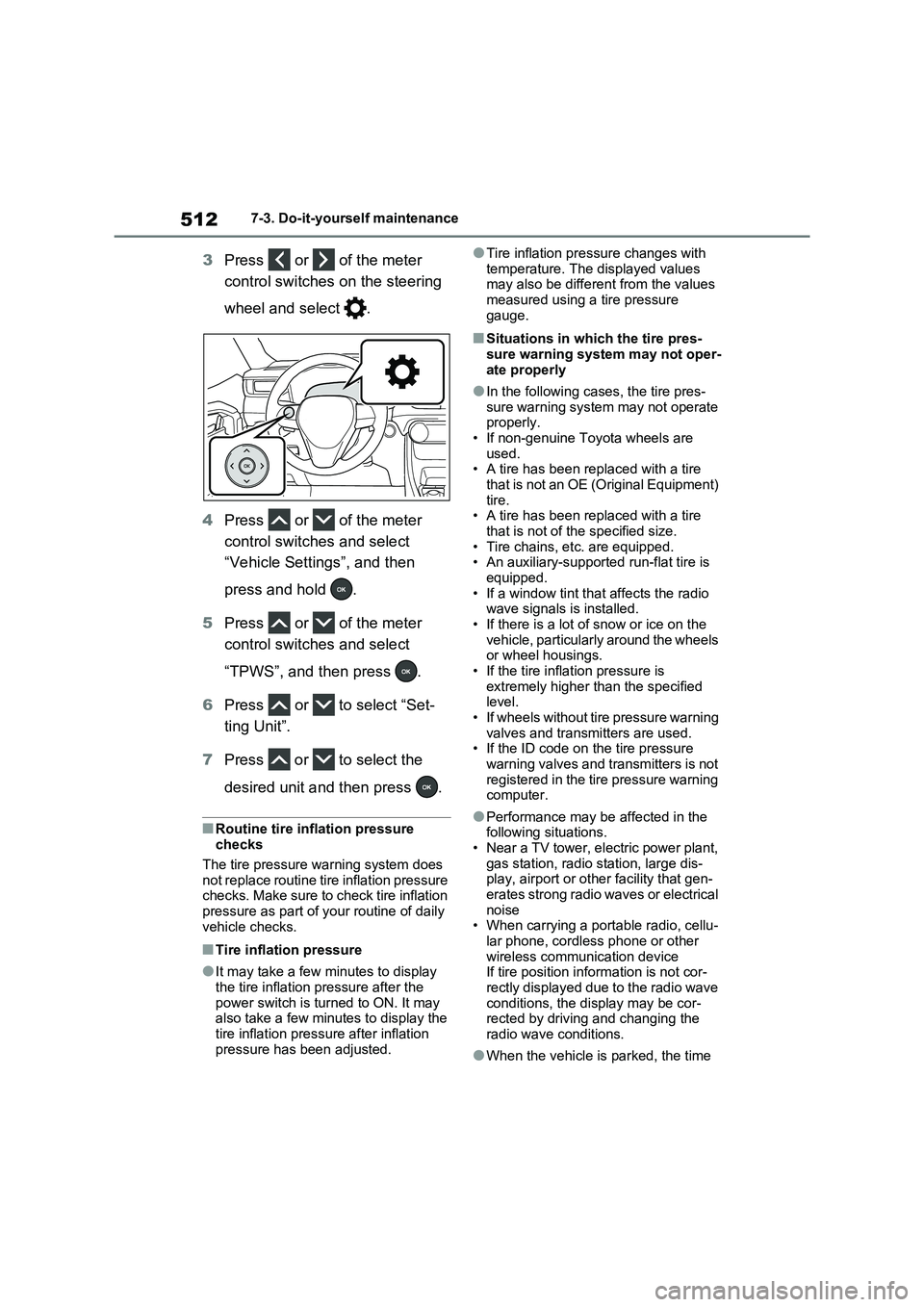
3Press or of the meter
control switches on the steering
wheel and select .
4 Press or of the meter
control switches and select
“Vehicle Settings”, and then
press and hold .
5 Press or of the meter
control switches and select
“TPWS”, and then press .
6 Press or to select “Set-
ting Unit”.
7 Press or to select the
desired unit and then press .
■Routine tire inflation pressure checks
The tire pressure w arning system does
not replace routine tire inflation pressure checks. Make sure to check tire inflation
pressure as part of your routine of daily
vehicle checks.
■Tire inflation pressure
●It may take a few minutes to display
the tire inflation pressure after the
power switch is turned to ON. It may also take a few minutes to display the
tire inflation pressu re after inflation
pressure has been adjusted.
●Tire inflation pre ssure changes with
temperature. The displayed values may also be different from the values
measured using a tire pressure
gauge.
■Situations in which the tire pres - sure warning system may not oper -
ate properly
●In the following cases, the tire pres -
sure warning system may not operate
properly. • If non-genuine Toyota wheels are
used.
• A tire has been r eplaced with a tire that is not an OE (Original Equipment)
tire.
• A tire has been r eplaced with a tire that is not of the specified size.
• Tire chains, etc. are equipped.
• An auxiliary-supporte d run-flat tire is equipped.
• If a window tint tha t affects the radio
wave signals is installed. • If there is a lot of snow or ice on the
vehicle, particularly around the wheels
or wheel housings. • If the tire inflation pressure is
extremely higher t han the specified
level. • If wheels without tire pressure warning
valves and transmitters are used.
• If the ID code on the tire pressure warning valves and transmitters is not
registered in the tire pressure warning
computer.
●Performance may be affected in the
following situations. • Near a TV tower, electric power plant,
gas station, radio station, large dis -
play, airport or ot her facility that gen- erates strong radio waves or electrical
noise
• When carrying a port able radio, cellu-
lar phone, cordless phone or other wireless communication device
If tire position information is not cor -
rectly displayed due to the radio wave conditions, the display may be cor -
rected by driving and changing the
radio wave conditions.
●When the vehicle is parked, the time
Page 526 of 666
5247-3. Do-it-yourself maintenance
2Adjust the tire inflation pressure
to the specified cold tire inflation
pressure level. ( →P.624)
Make sure to adjust the tire pressure to
the specified cold tire inflation pressure level. The tire pressure warning system
will operate based o n this pressure
level.
3 Start the hybrid system.
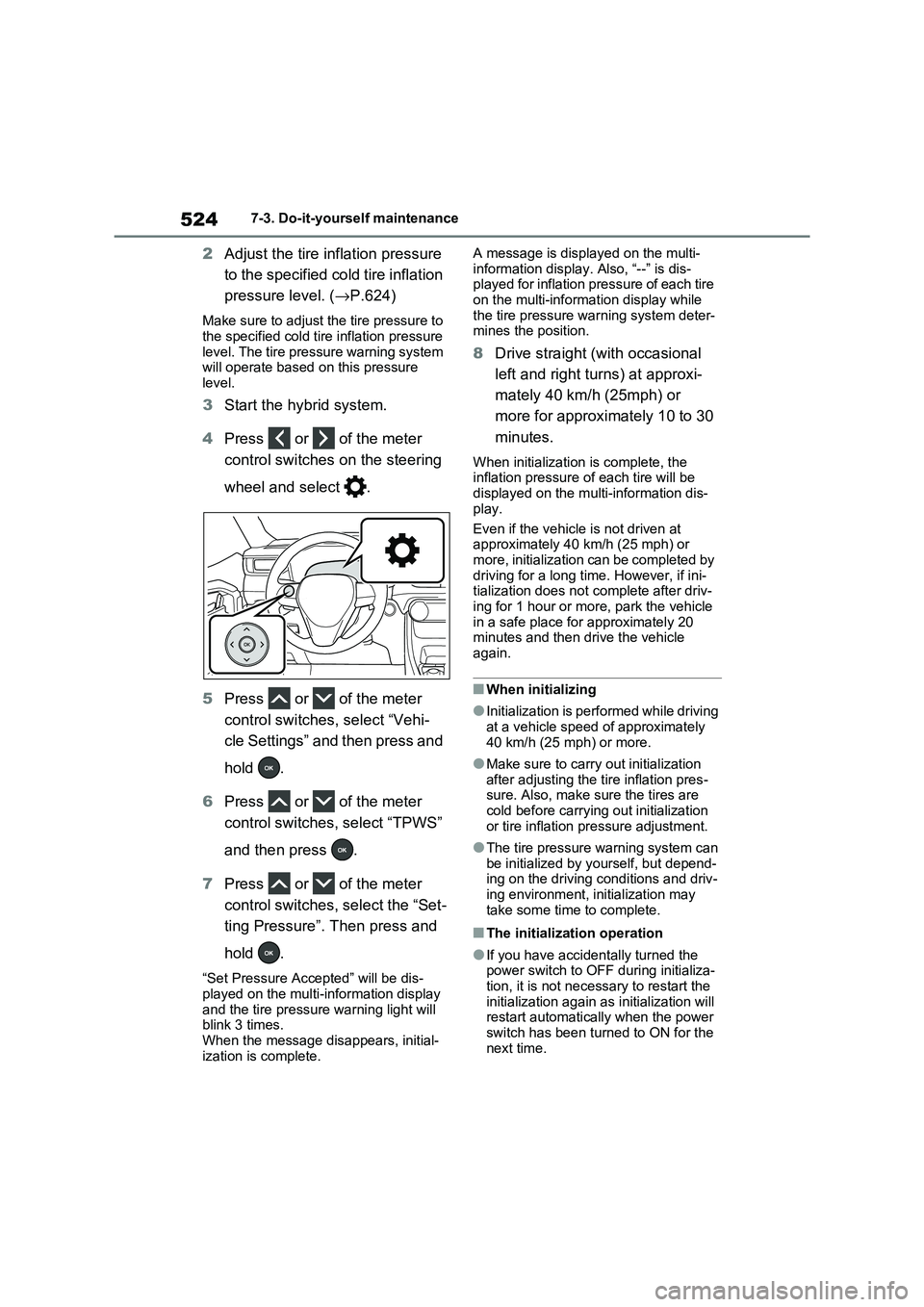
4 Press or of the meter
control switches on the steering
wheel and select .
5 Press or of the meter
control switches, select “Vehi -
cle Settings” and then press and
hold .
6 Press or of the meter
control switches, select “TPWS”
and then press .
7 Press or of the meter
control switches, select the “Set -
ting Pressure”. Then press and
hold .
“Set Pressure Accepted” will be dis -
played on the multi-information display
and the tire pressure warning light will blink 3 times.
When the message disappears, initial -
ization is complete.
A message is displayed on the multi-
information display. Also, “--” is dis - played for inflation pressure of each tire
on the multi-informat ion display while
the tire pressure w arning system deter- mines the position.
8 Drive straight (with occasional
left and right turns) at approxi -
mately 40 km/h (25mph) or
more for approximately 10 to 30
minutes.
When initialization is complete, the inflation pressure of each tire will be
displayed on the multi-information dis -
play.
Even if the vehicle is not driven at
approximately 40 k m/h (25 mph) or
more, initialization can be completed by driving for a long time. However, if ini -
tialization does not complete after driv-
ing for 1 hour or mor e, park the vehicle in a safe place for approximately 20
minutes and then drive the vehicle
again.
■When initializing
●Initialization is performed while driving at a vehicle speed of approximately
40 km/h (25 mph) or more.
●Make sure to carry out initialization
after adjusting the tire inflation pres -
sure. Also, make s ure the tires are
cold before carrying out initialization or tire inflation pressure adjustment.
●The tire pressure warning system can be initialized by yourself, but depend -
ing on the driving conditions and driv -
ing environment, initialization may take some time to complete.
■The initialization operation
●If you have accident ally turned the power switch to OFF during initializa -
tion, it is not necessary to restart the
initialization again as initialization will restart automatically when the power
switch has been tu rned to ON for the
next time.
Page 528 of 666
5267-3. Do-it-yourself maintenance
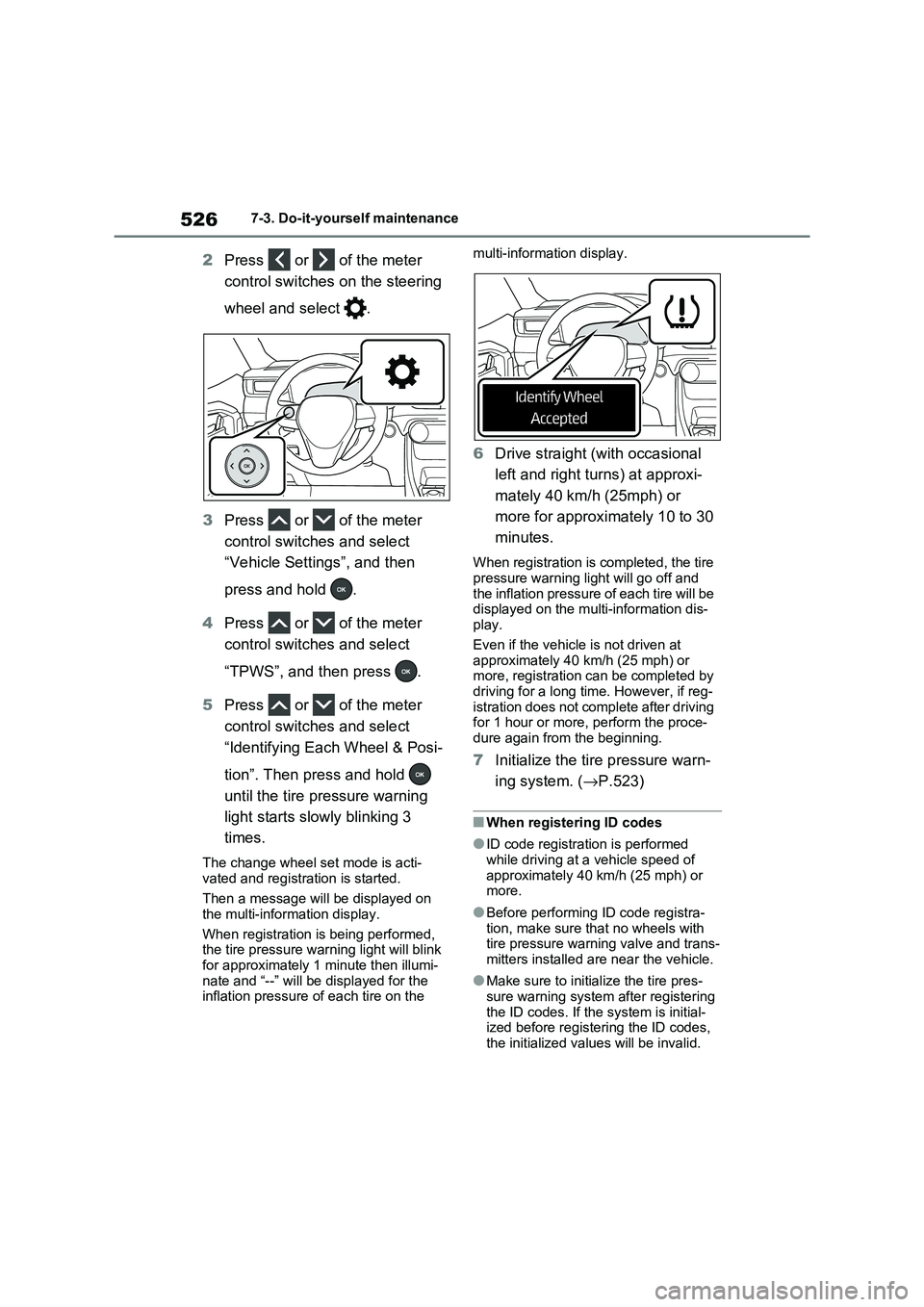
2Press or of the meter
control switches on the steering
wheel and select .
3 Press or of the meter
control switches and select
“Vehicle Settings”, and then
press and hold .
4 Press or of the meter
control switches and select
“TPWS”, and then press .
5 Press or of the meter
control switches and select
“Identifying Each Wheel & Posi -
tion”. Then press and hold
until the tire pressure warning
light starts slowly blinking 3
times.
The change wheel set mode is acti - vated and registration is started.
Then a message will be displayed on
the multi-information display.
When registration is being performed,
the tire pressure warning light will blink
for approximately 1 minute then illumi - nate and “--” will be displayed for the
inflation pressure o f each tire on the
multi-information display.
6 Drive straight (with occasional
left and right turns) at approxi -
mately 40 km/h (25mph) or
more for approximately 10 to 30
minutes.
When registration is completed, the tire
pressure warning light will go off and
the inflation pressure of each tire will be displayed on the multi-information dis -
play.
Even if the vehicle is not driven at approximately 40 k m/h (25 mph) or
more, registration c an be completed by
driving for a long ti me. However, if reg- istration does not complete after driving
for 1 hour or more, perform the proce-
dure again from the beginning.
7 Initialize the tire pressure warn-
ing system. ( →P.523)
■When registering ID codes
●ID code registration is performed
while driving at a vehicle speed of
approximately 40 km/h (25 mph) or more.
●Before performing ID code registra -
tion, make sure that no wheels with tire pressure warning valve and trans -
mitters installed ar e near the vehicle.
●Make sure to initialize the tire pres-
sure warning system a fter registering
the ID codes. If t he system is initial- ized before registering the ID codes,
the initialized val ues will be invalid.
Page 530 of 666
5287-3. Do-it-yourself maintenance
After registration of a second wheel
set, either of these two wheel sets
can be selected for usage with the
tire pressure warning system.
■Operating conditions for the
function
This function will perform the
change of wheel set only if a sec -
ond wheel set h as been regis-
tered. If no second wheel set has
been registered, no change will
be made when selecting this
function in the menu.
Only a change between both
registered wheel set is possible,
mixing between these wheel sets
is not supported.
■How to change between wheel
sets
1 Have the vehicle fitted with the
preferred wheel set.
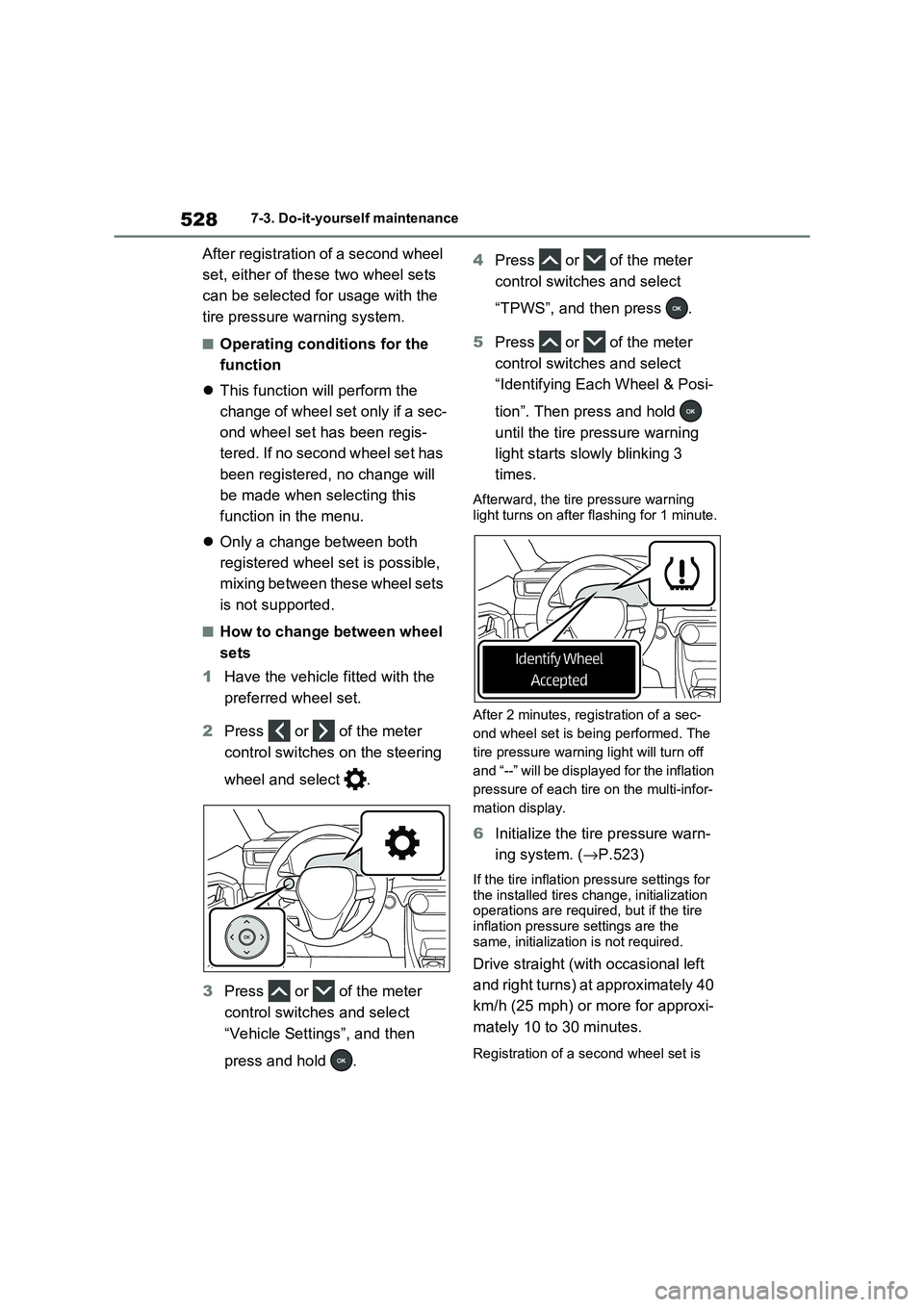
2 Press or of the meter
control switches on the steering
wheel and select .
3 Press or of the meter
control switches and select
“Vehicle Settings”, and then
press and hold .
4 Press or of the meter
control switch es and select
“TPWS”, and then press .
5 Press or of the meter
control switch es and select
“Identifying Each Wheel & Posi -
tion”. Then press and hold
until the tire pressure warning
light starts slowly blinking 3
times.
Afterward, the tire pressure warning
light turns on after flashing for 1 minute.
After 2 minutes, regi stration of a sec-
ond wheel set is being performed. The
tire pressure warning light will turn off
and “--” will be displayed for the inflation
pressure of each tir e on the multi-infor-
mation display.
6 Initialize the tire pressure warn-
ing system. ( →P.523)
If the tire inflation pressure settings for the installed tires c hange, initialization
operations are require d, but if the tire
inflation pressure settings are the same, initialization is not required.
Drive straight (with occasional left
and right turns) at approximately 40
km/h (25 mph) or more for approxi -
mately 10 to 30 minutes.
Registration of a sec ond wheel set is
Page 551 of 666
549
7
7-3. Do-it-yours elf maintenance
Maintenance and care
●Back-up lights
●Outer foot lights (if equipped)
■Condensation build-up on the
inside of the lens
Temporary condensation build-up on the inside of the lig ht lens does not indi-
cate a malfunction. Contact any autho -
rized Toyota ret ailer or Toyota authorized repairer, or any reliable
repairer for more inf ormation in the fol-
lowing situations:
●Large drops of wat er have built up on
the inside of the lens.
●Water has built up inside the light.
■When replacing an electronic com -
ponent, such as a lights, etc.
→ P.547
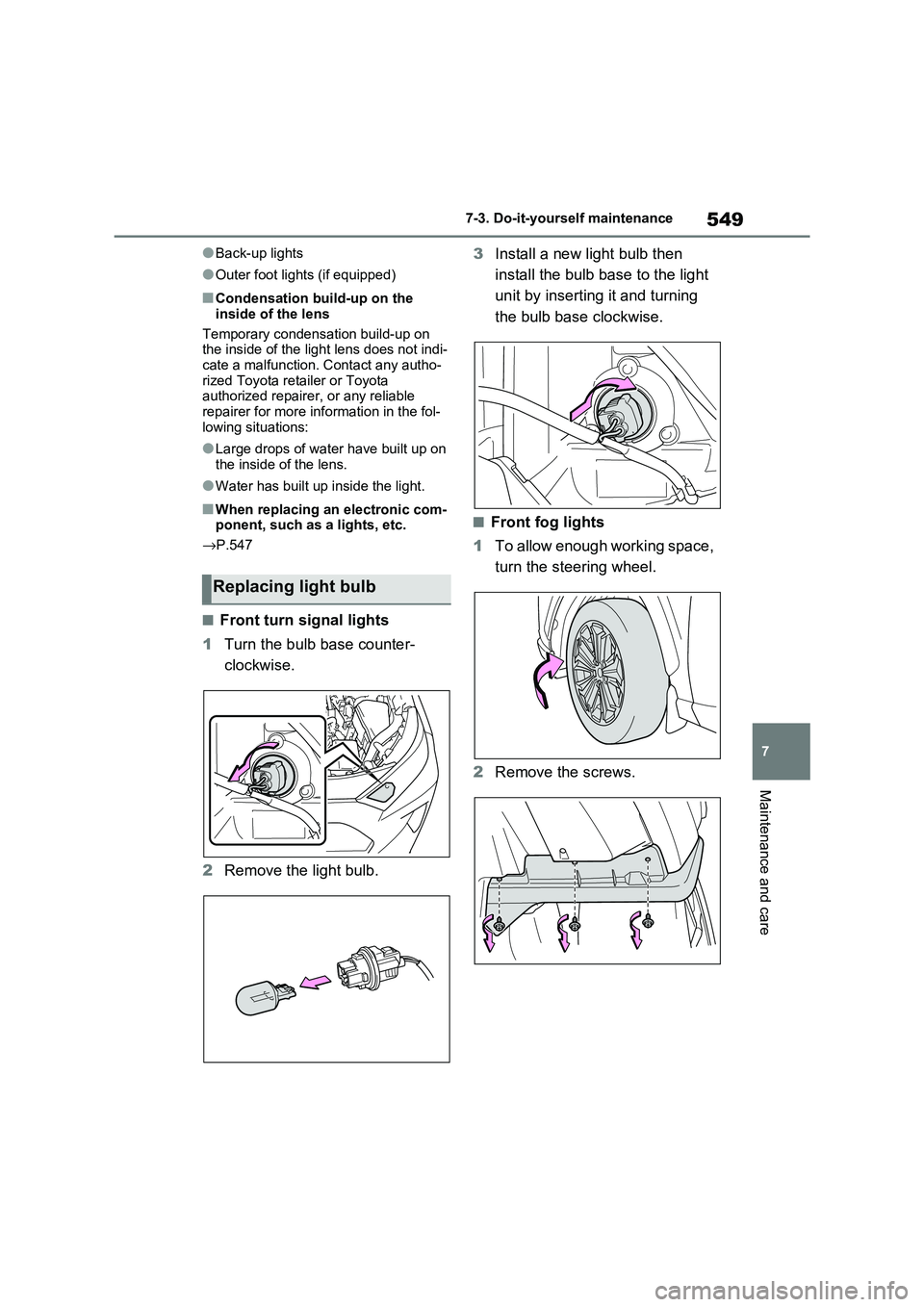
■Front turn signal lights
1 Turn the bulb base counter-
clockwise.
2 Remove the light bulb.
3 Install a new light bulb then
install the bulb base to the light
unit by inserting it and turning
the bulb base clockwise.
■Front fog lights
1 To allow enough working space,
turn the steering wheel.
2 Remove the screws.
Replacing light bulb
Page 563 of 666
561
8
8-1. Essential information
When trouble arises
it briefly 3 times or more in succession.
5Stop the vehicle in a safe place
by the road.
■If emergency stopped
The functions of the air conditioning, etc.
may be partially limited in order to reduce the power consumption of the
12-volt battery.
Remove the seat belt first.
If the door can be opened, open
the door and exit the vehicle.
If the door can not be opened,
open the window using the
power window s witch and exit
the vehicle through the window.
If the window can not be opened
using the power window switch,
remain calm, wait until the water
level inside the vehicle rises to
the point that the water pressure
inside of the vehicle equals the
water pressure o utside of the
vehicle, and then open the door
and exit the vehicle.
WARNING
■If the hybrid system has to be
turned off while driving
Turning the hybrid system off while
driving will not c ause a loss of steer-
ing or braking control. However, power assist for the steering wheel
may be lost making it difficult to steer
smoothly before st opping the vehicle depending on the remaining charge in
the 12-volt battery or usage condi-
tions. Decelerate as much as possible before turning off the hybrid system.
If the vehicle is trapped
in rising water
In the event the vehicle is sub-
merged in wate r, remain calm
and perform the following.
WARNING
■Using an emergency hammer* f o r
emergency escape
The rear side windows and rear win - dow of this vehicl e can be shattered
by an emergency hammer* used for
emergency escape, however, since the windshield and front side windows
are laminated glass they can not be
shattered by an emergency hammer*.*: Contact any authorized Toyota
retailer or Toyota authorized
repairer, or any reliable repairer, or
aftermarket accessory manufac -
turer for further information about
an emergency hammer.
Page 566 of 666
5648-2. Steps to take in an emergency
The following may indicate a prob-
lem with your transmission. Contact
any authorized Toyota retailer or
Toyota authorized repairer, or any
reliable repairer or commercial tow -
ing service before towing.
The hybrid system warning mes-
sage is shown on the multi-infor -
mation display and the vehicle
does not move.
The vehicle makes an abnormal
sound.
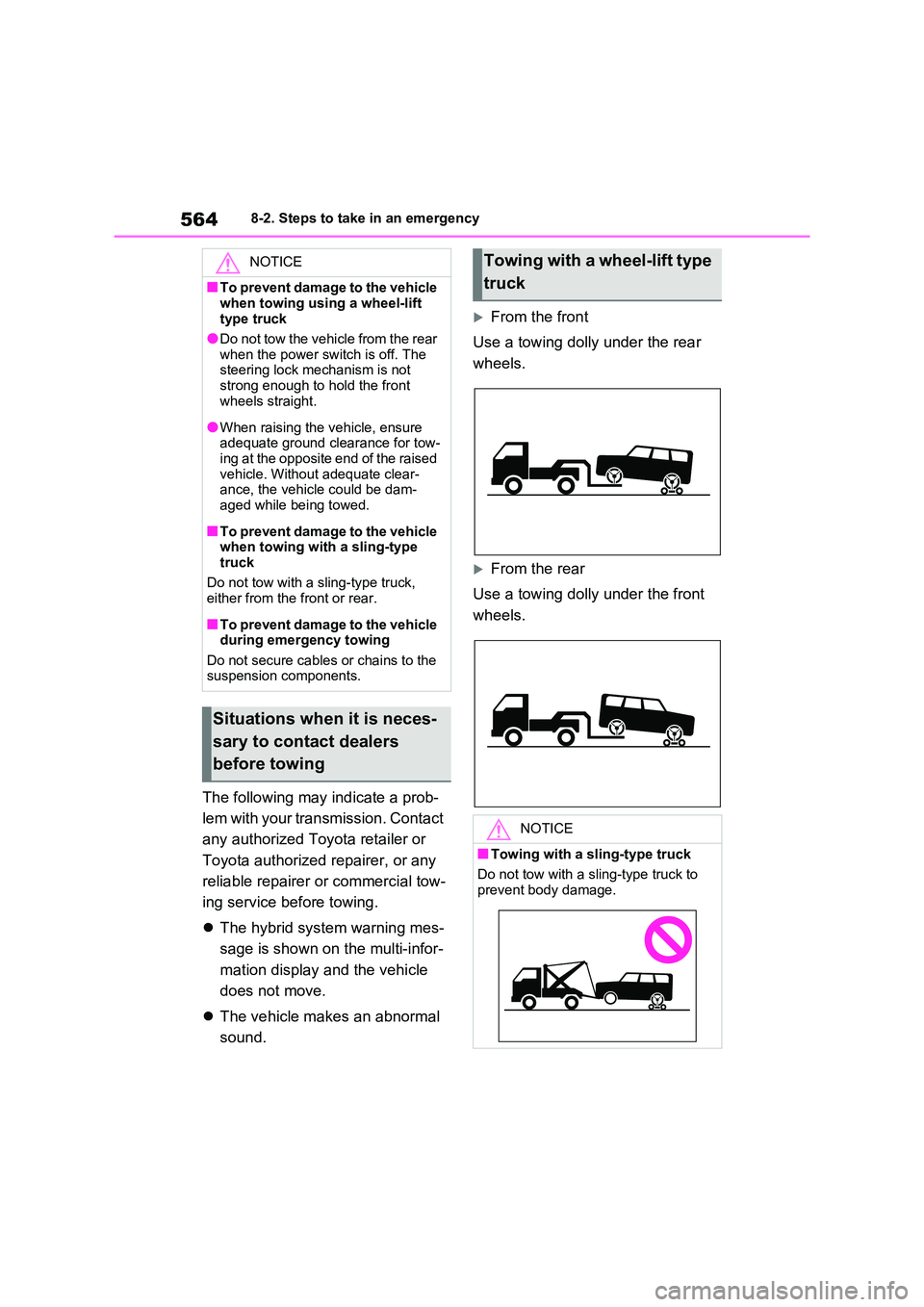
From the front
Use a towing dolly under the rear
wheels.
From the rear
Use a towing dolly under the front
wheels.
NOTICE
■To prevent damage to the vehicle
when towing using a wheel-lift
type truck
●Do not tow the vehicle from the rear
when the power switch is off. The
steering lock mechanism is not strong enough to hold the front
wheels straight.
●When raising the vehicle, ensure adequate ground clearance for tow -
ing at the opposite end of the raised
vehicle. Without adequate clear - ance, the vehicle could be dam -
aged while being towed.
■To prevent damage to the vehicle
when towing with a sling-type
truck
Do not tow with a sling-type truck,
either from the front or rear.
■To prevent damage to the vehicle
during emergency towing
Do not secure cables or chains to the suspension components.
Situations when it is neces -
sary to contact dealers
before towing
Towing with a wheel-lift type
truck
NOTICE
■Towing with a sling-type truck
Do not tow with a s ling-type truck to prevent body damage.
Page 567 of 666
565
8
8-2. Steps to take in an emergency
When trouble arises
When using a flat-bed truck to
transport the vehicle, use tire strap -
ping belts. Refer to the owner’s
manual of the flat-bed truck for the
tire strapping method.
In order to supp ress vehicle move-
ment during transportation, set the
parking brake and turn the power
switch off.
If a tow truck is not available in an
emergency, your vehicle may be
temporarily towed using cables or
chains secured to the emergency
towing eyelets. This should only be
attempted on hard surfaced roads
for short distances at under 30
km/h (18 mph).
A driver must be i n the vehicle to
steer and operate the brakes. The
vehicle’s wheels, drive train, axles,
steering and brakes must be in
good condition.
To have your vehicle towed by
another vehicle, the towing eyelet
must be installed to your vehicle.
Install the towing eyelet using the
following procedure.
1 Take out the wheel nut wrench
and towing eyelet. ( →P.583,
594)
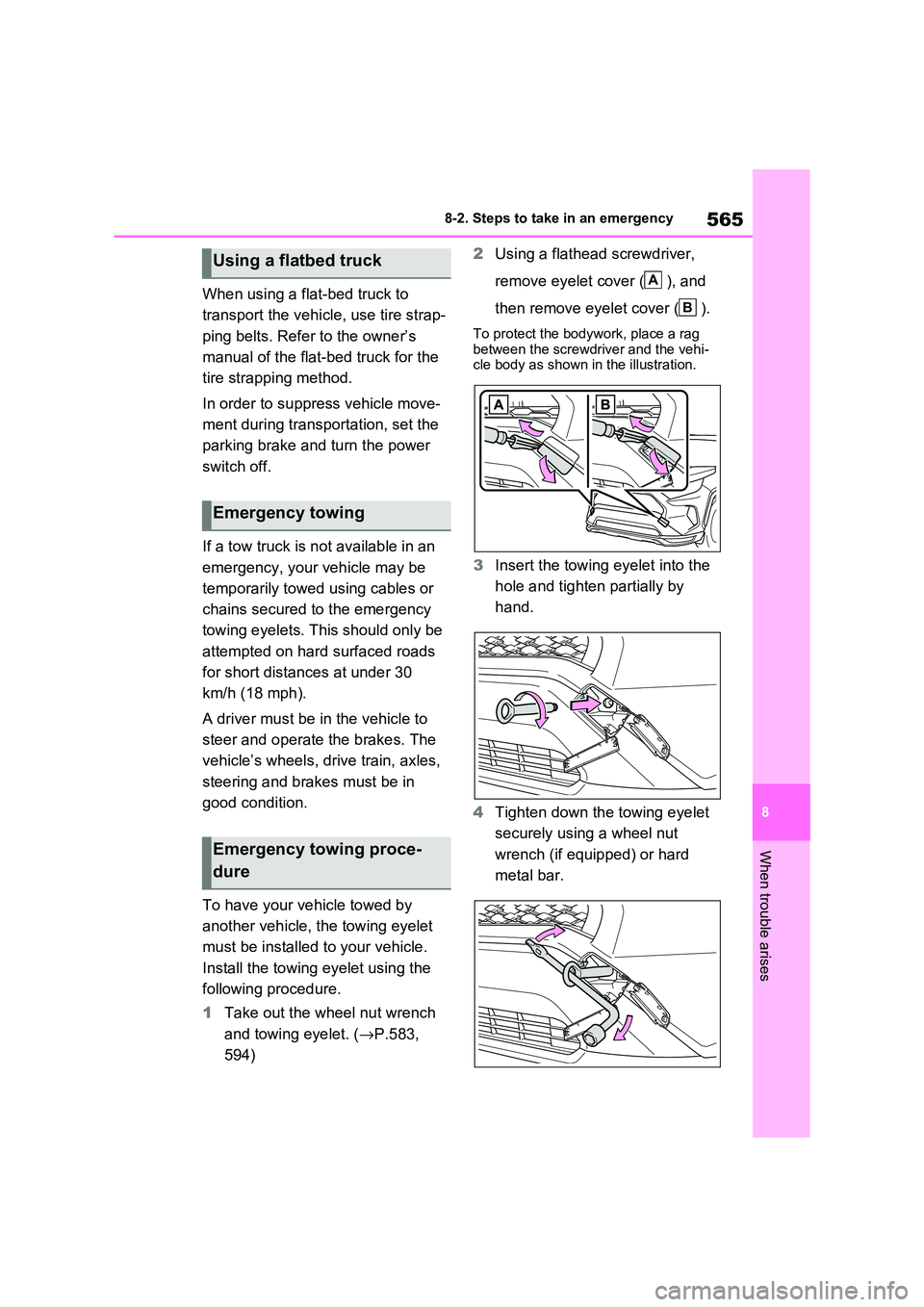
2 Using a flathead screwdriver,
remove eyelet cover ( ), and
then remove eyelet cover ( ).
To protect the bodywork, place a rag
between the screwdriver and the vehi - cle body as shown in the illustration.
3 Insert the towing eyelet into the
hole and tighten partially by
hand.
4 Tighten down the towing eyelet
securely using a wheel nut
wrench (if equipped) or hard
metal bar.
Using a flatbed truck
Emergency towing
Emergency towing proce -
dure
A
B
Page 568 of 666
5668-2. Steps to take in an emergency
5Securely attach cables or chains
to the towing eyelet.
Take care not to damage the vehicle
body.
6 Enter the vehicle being towed
and start the hybrid system.
Turn off the Parking Support Brake
function. (if equipped): →P.420
If the hybrid system d oes not start, turn
the power switch to ON.
7 Shift the shift lever to N and
release the parking brake.
Turn automatic mode off. ( →P.327)
When the shift lever cannot be shifted:
→ P.323
■While towing
If the hybrid system is not running, the
power assist for the brakes and steering will not function, making steering and
braking more difficult.
■Wheel nut wrench (if equipped)
Wheel nut wrench is installed in the deck under tray. ( →P.583, 594)
Fluid leaks under the vehicle
(Water dripping from the air con -
ditioning after use is normal.)
Flat-looking tires or uneven tire
wear
High coolant temperature warn-
ing light flashes or come on
Changes in exhaust sound
Excessive tire squeal when cor-
nering
Strange noises related to the
suspension system
Pinging or other noises related to
the hybrid system
Engine missing, stumbling or
running roughly
Appreciable loss of power
If you think something is
wrong
If you notice any of the follow -
ing symptoms, your vehicle
probably needs adjustment or
repair. Contact any authorized
Toyota retailer or Toyota
authorized repairer, or any reli -
able repairer as soon as possi -
ble.
Visible symptoms
Audible symptoms
Operational symptoms