ECO mode TOYOTA RAV4 PRIME 2021 Owners Manual
[x] Cancel search | Manufacturer: TOYOTA, Model Year: 2021, Model line: RAV4 PRIME, Model: TOYOTA RAV4 PRIME 2021Pages: 618, PDF Size: 24.18 MB
Page 26 of 618
261-1. For safe use
1-1.For safe use
Use only floor mats designed
specifically for vehicles of the
same model and model year as
your vehicle. Fix them securely
in place onto the carpet.
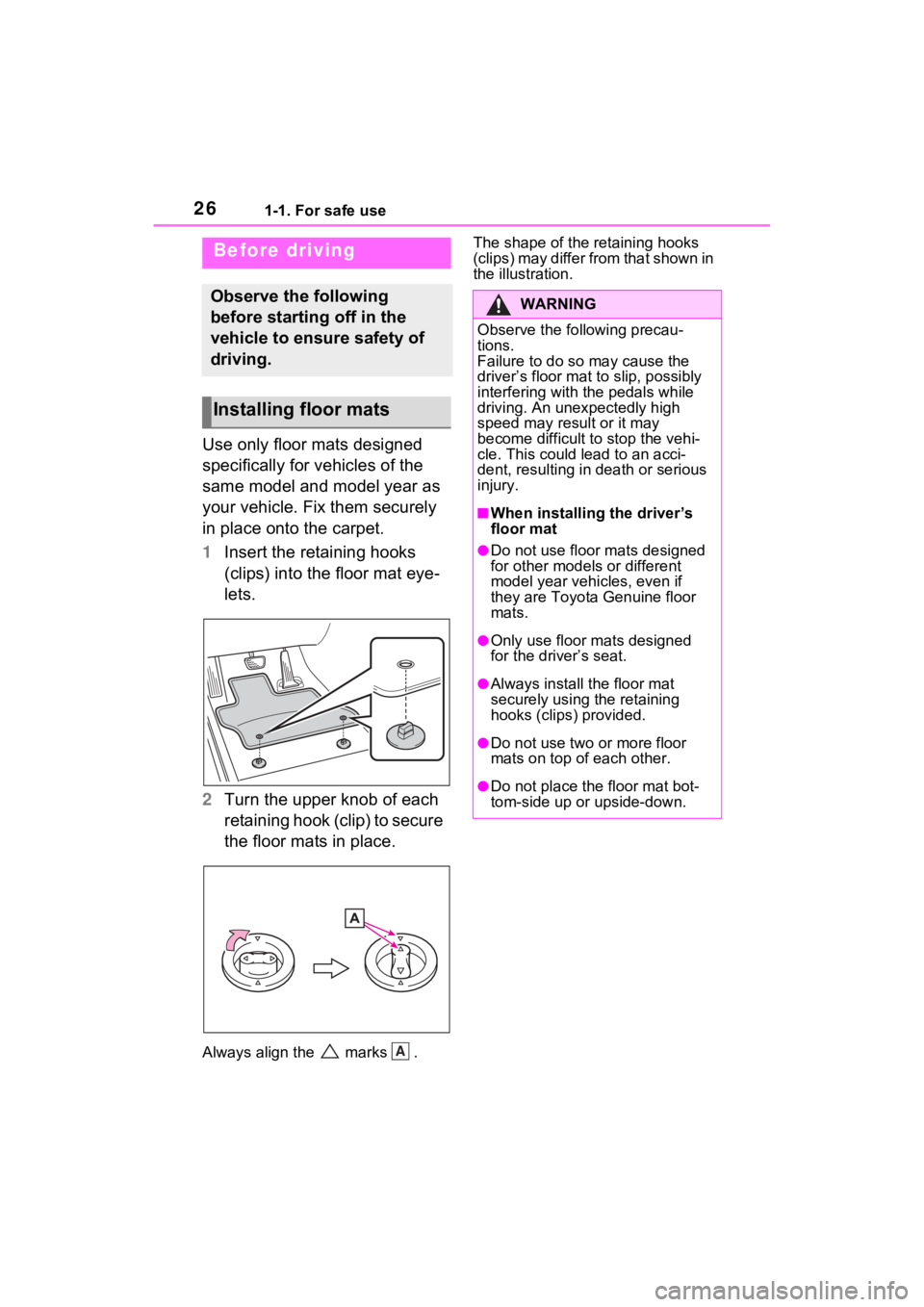
1 Insert the retaining hooks
(clips) into the floor mat eye-
lets.
2 Turn the upper knob of each
retaining hook (clip) to secure
the floor mats in place.
Always align the marks . The shape of the retaining hooks
(clips) may differ from that shown in
the illustration.
Before driving
Observe the following
before starting off in the
vehicle to ensure safety of
driving.
Installing floor mats
A
:$51,1*
Observe the following precau-
tions.
Failure to do so may cause the
driver’s floor mat to slip, possibly
interfering with t
he pedals while
driving. An unexpectedly high
speed may result or it may
become difficult to stop the vehi-
cle. This could lead to an acci-
dent, resulting in death or serious
injury.
■When installing the driver’s
floor mat
●Do not use floor mats designed
for other models or different
model year vehicles, even if
they are Toyota Genuine floor
mats.
●Only use floor mats designed
for the driver’s seat.
●Always install the floor mat
securely using the retaining
hooks (clips) provided.
●Do not use two or more floor
mats on top of each other.
●Do not place the floor mat bot-
tom-side up or upside-down.
Page 69 of 618
691-3. Emergency assistance
1
For safety and security
■Safety Connect Services Infor-
mation
●Phone calls using the vehicle’s
Bluetooth® technology will not be
possible when Safety Connect is
active and in use.
●Safety Connect is available begin-
ning Fall 2009 on select Toyota
models (in the contiguous United
States only). Contact with the
Safety Connect response center
is dependent upon the telematics
device being in operative condi-
tion, cellular connection availabil-
ity, and GPS satellite signal
reception, which can limit the abil-
ity to reach the response center or
receive emergency service sup-
port. Enrollment and Telematics
Subscription Service Agreement
are required. A variety of subscrip-
tion terms are available; charges
vary by subscription term selected
and location.
●Automatic Collision Notification,
Emergency Assistance and Stolen
Vehicle Location are available in
the United States, including
Hawaii and Alaska, Puerto Rico
and Canada, and Enhanced
Roadside Assistance are avail-
able in the United States, Puerto
Rico and Canada.
●Automatic Collision Notification,
Emergency Assist ance, Stolen
Vehicle and Enhanced Road
Assistance are not available in the
U.S. Virgin Islands.
For vehicles first sold in the U.S.
Virgin Islands, no Safety Connect
services will function in or outside
the U.S. Virgin Islands.
●Safety Connect ser vices are not
subject to section 255 of the Tele-
communications Act and the
device is not TTY compatible.
■Languages
The Safety Connect response cen-
ter will offer support in multiple lan-
guages. The Safety Connect system will offer voice prompts in English,
Spanish, and French. Please indi-
cate your language of choice when
enrolling.
■When contacting the response
center
You may be unable to contact the
response center if the network is
busy.
When the power switch is turned
to ON, the red indicator light
comes on for 2 seconds then
turns off. Afterward, the green
indicator light comes on, indicat-
ing that the service is active.
The following indicator light pat-
terns indicate specific system
usage conditions:
Green indicator light on =
Active service
Green indicator light flashing
= Safety Connect call in pro-
cess
Red indicator light (except at
vehicle start-up) = System
malfunction (contact your
Toyota dealer)
No indicator light (off) =
Safety Connect service not
active
■Automatic Collision Notifi-
cation
In case of either airbag deploy-
Safety Connect LED light
Indicators
Safety Connect services
Page 78 of 618
782-1. Plug-in hybrid system
engine and electric motor.
(P.81)
• If electricity needed for EV driving in EV mode or AUTO
EV/HV mode is not remaining,
the operation mode will be
automatically switched to HV
mode.
• The operation mode can be switched to HV mode at any
timing by operating the switch
to keep electricity for EV driv-
ing etc.
* ( P.78). Switching
to HV mode when driving on a
highway or when driving uphill
is recommended in order to
conserve battery power.
When in HV mode, the HV drive
mode indicator illuminates.
*: The EV driving range may reduce even after switching to HV mode.
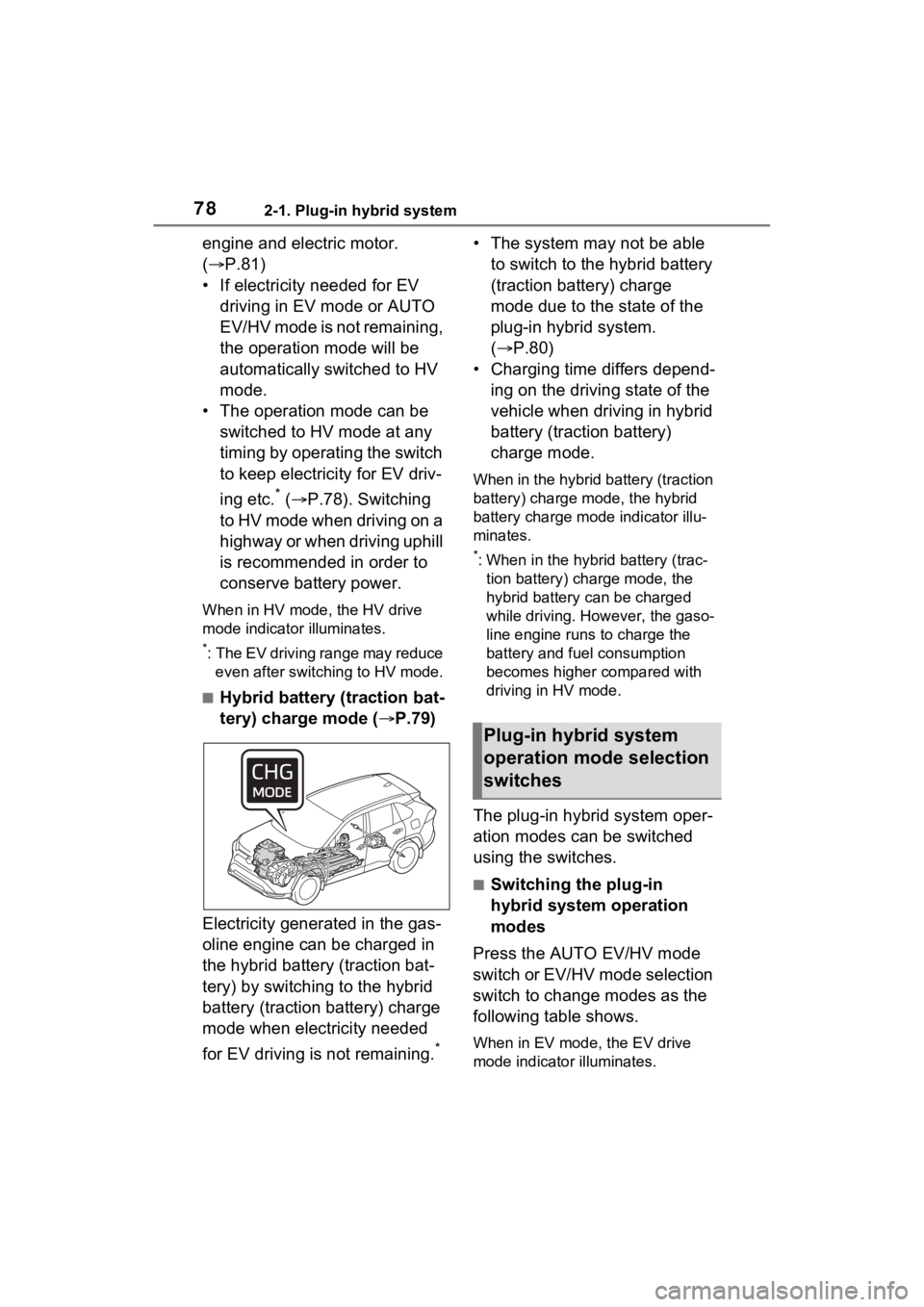
■Hybrid battery (traction bat-
tery) charge mode ( P.79)
Electricity generated in the gas-
oline engine can be charged in
the hybrid battery (traction bat-
tery) by switching to the hybrid
battery (traction battery) charge
mode when electricity needed
for EV driving is not remaining.
*
• The system may not be able to switch to the hybrid battery
(traction battery) charge
mode due to the state of the
plug-in hybrid system.
( P.80)
• Charging time differs depend- ing on the driving state of the
vehicle when driving in hybrid
battery (traction battery)
charge mode.
When in the hybrid battery (traction
battery) charge mode, the hybrid
battery charge mod e indicator illu-
minates.
*: When in the hybrid battery (trac- tion battery) charge mode, the
hybrid battery can be charged
while driving. Ho wever, the gaso-
line engine runs to charge the
battery and fuel consumption
becomes higher compared with
driving in HV mode.
The plug-in hybrid system oper-
ation modes can be switched
using the switches.
■Switching the plug-in
hybrid system operation
modes
Press the AUTO EV/HV mode
switch or EV/HV mode selection
switch to change modes as the
following table shows.
When in EV mode, the EV drive
mode indicator illuminates.
Plug-in hybrid system
operation mode selection
switches
Page 81 of 618

812-1. Plug-in hybrid system
2
Plug-in hybrid system
using only the electric motor)* is
possible. However, depending
on the situation, EV driving may
be canceled and both gasoline
engine and electric motor are
used ( P.82). Also, if a little
electricity is remaining in the
hybrid battery (traction battery),
HV mode is automatically
selected. To drive in EV mode
long, observe the followings.
Avoid sudden acceleration
and sudden deceleration, and
be sure to drive smoothly. If
you repeatedly accelerate,
the hybrid battery (traction
battery) charge will deplete
quickly. Also, EV driving may
be canceled by rapid acceler-
ation or vehicle speed.
Restrain your speed as much
as possible. The distance that
can be driven in EV mode will
reduce considerably at high
speeds.
*: The EV driving range can be
checked using the multi-informa-
tion display. ( P.172)
■When in AUTO EV/HV mode
Only the electric motor is used
for EV driving
* during normal
driving, but when the accelera-
tor pedal is strongly depressed,
the gasoline engine starts.
( P.82)
Also, when the hybrid battery
(traction battery) level is low, the
mode switches to HV mode automatically the same as in EV
mode.
AUTO EV/HV mode is suitable
for driving conditions when more
power is required, such as for
driving uphill or accelerating
suddenly. However, because
the gasoline engine will start
more easily, it is recommended
to drive in EV mode usually.
*: The EV driving range can be
checked using th e multi-informa-
tion display. ( P.172)
■When in HV mode
The vehicle can be used in the
same way as a standard hybrid
vehicle.
In HV mode, controls are pri-
marily carried out as follows in
accordance with the driving con-
ditions.
The gasoline engine stops
*
when the vehicle is stopped.
During start off, the electric
motor (traction motor) drives
the vehicle.
During normal driving, the
gasoline engine and electric
motor (traction motor) are
controlled effectively, and the
vehicle is driven with optimum
fuel efficiency. Also, when
necessary, the electric motor
(traction motor) operates as
an electrical generator to
charge the hybrid battery
(traction battery).
Page 83 of 618

832-1. Plug-in hybrid system
2
Plug-in hybrid system
driving range (P.172) is being dis-
played on the multi-information dis-
play, EV driving (driving using only
the electric motor) may be canceled
and both gasoline engine and elec-
tric motor are used depending on
the situation (EV driving will be
returned to automatically after EV
driving becomes possible again).
EV driving may be canceled auto-
matically in the following circum-
stances
*1:
●When vehicle speed is more than
approximately 84 mph (135 km/h).
●When power is needed temporar-
ily, for example when the acceler-
ator pedal is depressed firmly or
when accelerating suddenly.
*2
●When the temperature of the
hybrid system is high.
The vehicle has been left in the
sun, driven on a hill, driven at high
speeds, etc.
●When the temperature of the
hybrid system is low.
●When the heater is switched on
when the outside temperature is
below about 14°F (-10°C).
●When the windshield defogger
switch is pressed. ( P.398)
●When the system determines that
the gasoline engine needs to be
started.
*1: The gasoline engine may also
operate in circumstances other
than those listed above, depend-
ing on conditions.
*2: When driving in AUTO EV/HV mode. Even in EV mode, the gas-
oline engine may start, depend-
ing on the condition of the hybrid
battery (traction battery).
■If “Engine Started to Protect
System EV driving unavailable”
is displayed on the multi-infor-
mation display
EV driving may be canceled in order to protect the hybrid system, etc.
In this case, perform driving with the
gasoline engine until EV driving will
be returned to automatically.
■Conditions in which the gaso-
line engine may not stop
The gasoline engine starts and
stops automatically. However, it
may not stop automatically in the
following conditions
*:
●During gasoline engine warm-up
●During hybrid battery (traction bat-
tery) charging
●When the temperature of the
hybrid battery (traction battery) is
high or low
●When the windshield defogger
switch is pressed. ( P.398)
*: Depending on the circumstances,
the gasoline engine may also not
stop automatically in situations
other than those above.
■Sounds and vibrations specific
to a hybrid vehicle
There may be no e ngine sound or
vibration even thoug h the vehicle is
able to move with the “READY” indi-
cator is illuminated. For safety,
apply the parking brake and make
sure to shift the shift lever to P when
parked.
The following sounds or vibrations
may occur when the hybrid system
is operating and are not a malfunc-
tion.
●Motor sounds may be heard from
the engine compartment.
●Sounds may be heard from the
hybrid battery (traction battery)
when the hybrid sy stem starts or
stops.
●Relay operating sounds such as a
snap or soft clank will be emitted
from the hybrid ba ttery (traction
battery), behind the rear seats,
when the hybrid system is started
or stopped.
Page 84 of 618
842-1. Plug-in hybrid system
●Sounds from the hybrid system
may be heard when the back door
is open.
●Sounds may be heard from the
transmission when the gasoline
engine starts or stops, when driv-
ing at low speeds, or during idling.
●Engine sounds may be heard
when accelerating sharply.
●Sounds may be heard due to
regenerative braking when the
brake pedal is dep ressed or as
the accelerator pedal is released.
●Vibration may be felt when the
gasoline engine starts or stops.
●Cooling fan sounds may be heard
from the air intake vent under the
rear seat. ( P.91)
●Sounds may be heard from near
the hybrid battery (traction battery)
in accordance with the operation
of the air conditioning system or
“Battery Cooler” ( P.116).
■Maintenance, repair, recycling,
and disposal
Contact your Toyota dealer regard-
ing maintenance, repair, recycling
and disposal. Do not dispose of the
vehicle yourself.
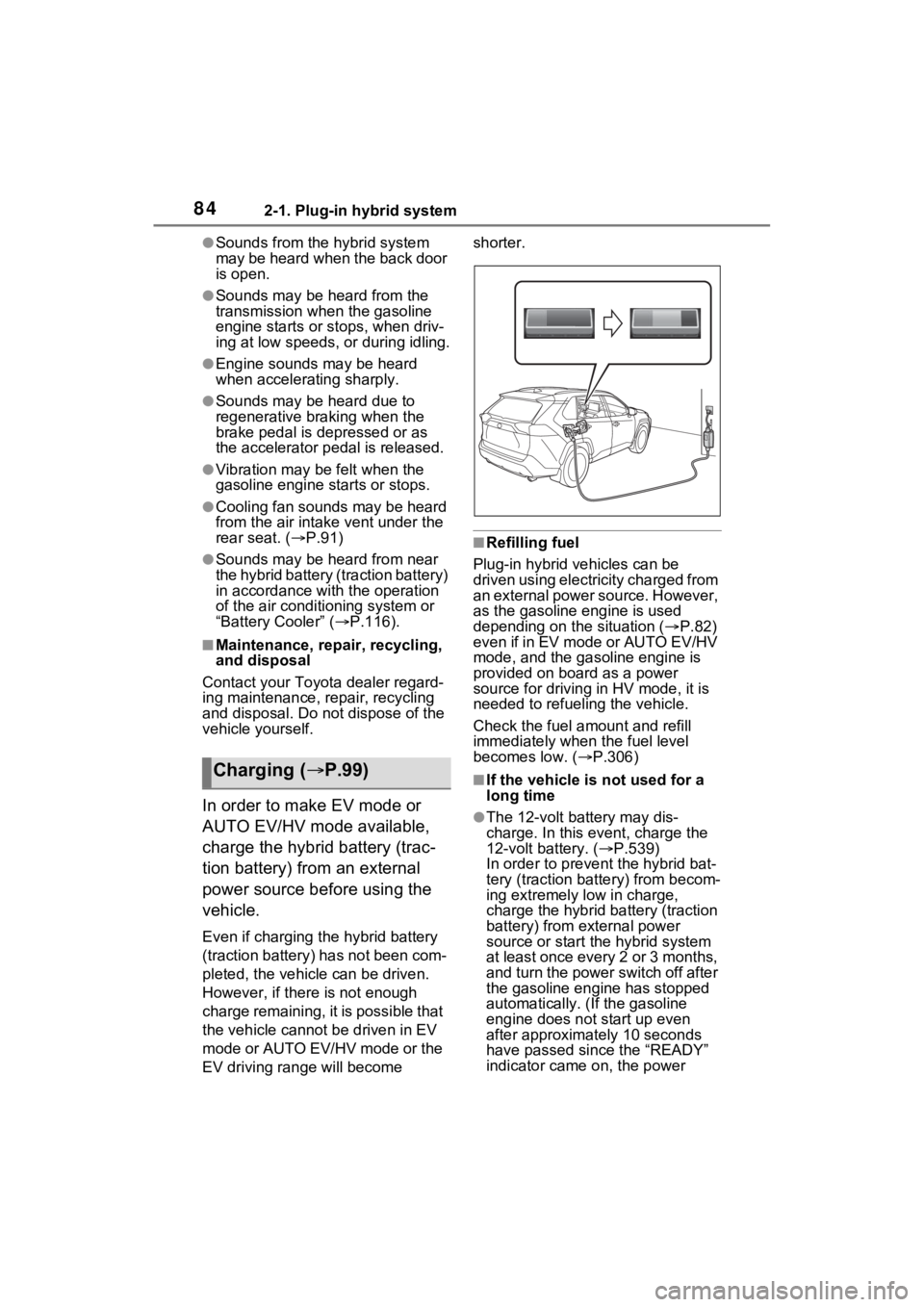
In order to make EV mode or
AUTO EV/HV mode available,
charge the hybrid battery (trac-
tion battery) from an external
power source before using the
vehicle.
Even if charging t he hybrid battery
(traction battery) has not been com-
pleted, the vehicle can be driven.
However, if there is not enough
charge remaining, it is possible that
the vehicle canno t be driven in EV
mode or AUTO EV/HV mode or the
EV driving range will become shorter.
■Refilling fuel
Plug-in hybrid vehicles can be
driven using electricity charged from
an external power source. However,
as the gasoline engine is used
depending on the situation ( P.82)
even if in EV mode or AUTO EV/HV
mode, and the gasoline engine is
provided on board as a power
source for driving in HV mode, it is
needed to refueling the vehicle.
Check the fuel a mount and refill
immediately when the fuel level
becomes low. ( P.306)
■If the vehicle is not used for a
long time
●The 12-volt battery may dis-
charge. In this e vent, charge the
12-volt battery. ( P.539)
In order to prevent the hybrid bat-
tery (traction batt ery) from becom-
ing extremely low in charge,
charge the hybrid battery (traction
battery) from external power
source or start th e hybrid system
at least once every 2 or 3 months,
and turn the power switch off after
the gasoline engine has stopped
automatically. ( If the gasoline
engine does not start up even
after approximately 10 seconds
have passed since the “READY”
indicator came on, the power
Charging ( P.99)
Page 92 of 618
922-1. Plug-in hybrid system
detected by the impact sensor,
the emergency shut off system
blocks off the high voltage cur-
rent and stops the fuel pump to
minimize the risk of electrocu-
tion and fuel leakage.
If the emergency shut off system
activates, your vehicle will not
restart. To restart the hybrid sys-
tem, contact your Toyota dealer.
A message is automatically dis-
played when a malfunction
occurs in the hybrid system or
an improper operation is
attempted.
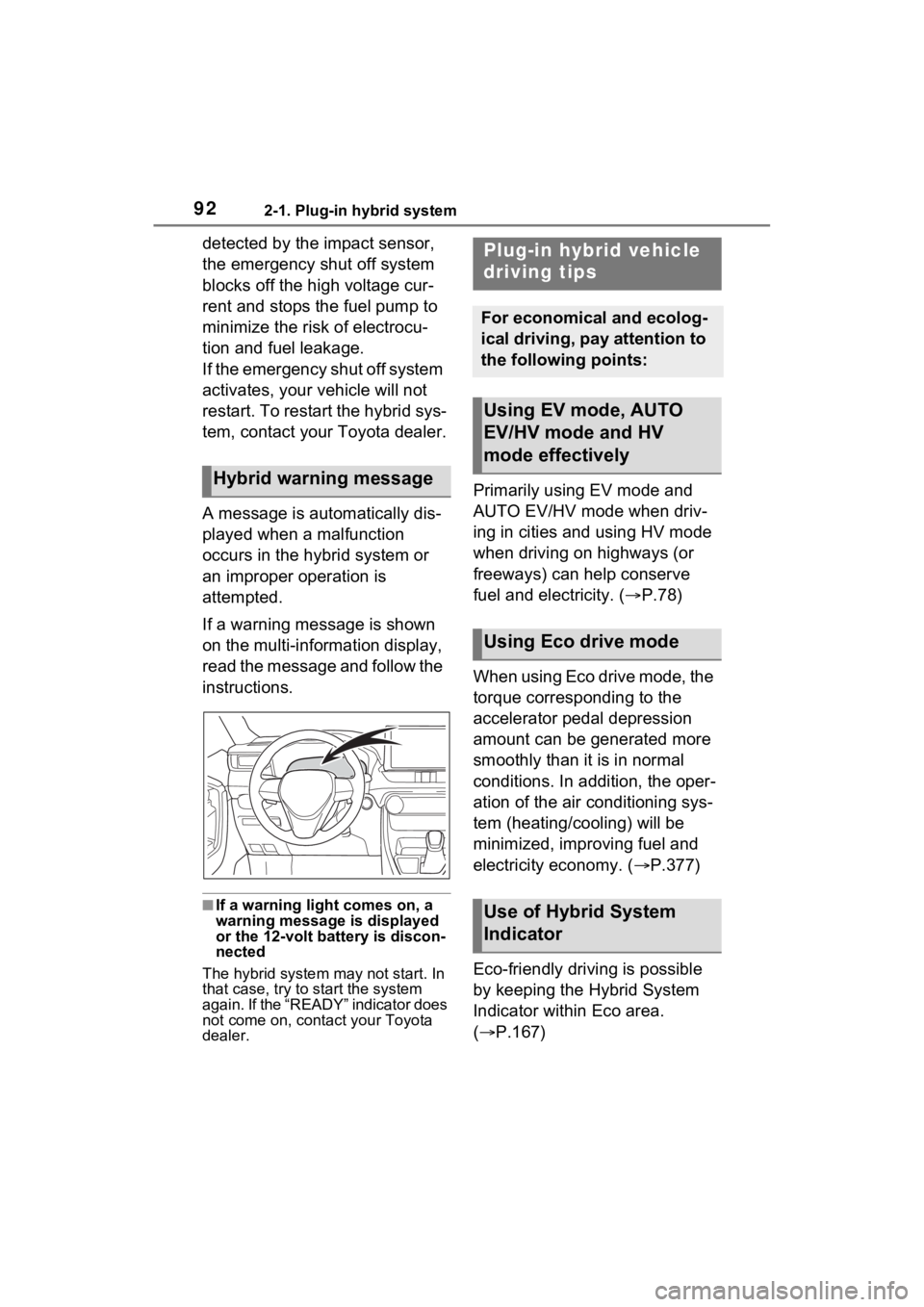
If a warning message is shown
on the multi-information display,
read the message and follow the
instructions.
■If a warning light comes on, a
warning message is displayed
or the 12-volt battery is discon-
nected
The hybrid system may not start. In
that case, try to start the system
again. If the “READY” indicator does
not come on, contact your Toyota
dealer.
Primarily using EV mode and
AUTO EV/HV mode when driv-
ing in cities and using HV mode
when driving on highways (or
freeways) can help conserve
fuel and electricity. ( P.78)
When using Eco drive mode, the
torque corresponding to the
accelerator pedal depression
amount can be generated more
smoothly than it is in normal
conditions. In addition, the oper-
ation of the air conditioning sys-
tem (heating/cooling) will be
minimized, improving fuel and
electricity economy. ( P.377)
Eco-friendly driving is possible
by keeping the Hybrid System
Indicator within Eco area.
( P.167)Hybrid warning message
Plug-in hybrid vehicle
driving tips
For economical and ecolog-
ical driving, pay attention to
the following points:
Using EV mode, AUTO
EV/HV mode and HV
mode effectively
Using Eco drive mode
Use of Hybrid System
Indicator
Page 93 of 618
932-1. Plug-in hybrid system
2
Plug-in hybrid system
Shift the shift lever to D when
stopped at a traffic light, or driv-
ing in heavy traffic etc. Shift the
shift lever to P when parking.
When using the N, there is no
positive effect on fuel consump-
tion. In the N, the gasoline
engine operates but electricity
cannot be generated. Also,
when using the air conditioning
system, etc., the hybrid battery
(traction battery) power is con-
sumed.
Drive your vehicle smoothly.
Avoid abrupt acceleration and
deceleration. Gradual accel-
eration and deceleration will
make more effective use of
the electric motor (traction
motor) without having to use
gasoline engine power.
Avoid repeated acceleration.
Repeated acceleration con-
sumes hybrid battery (trac-
tion battery) power, resulting
in poor fuel consumption. Bat-
tery power can be restored by
driving with the accelerator
pedal slightly released.
Make sure to operate the brakes
gently and a timely manner. A greater amount of electrical
energy can be regenerated
when slowing down.
Repeated acceleration and
deceleration, as well as long
waits at traffic lights, will lead to
high fuel and electricity con-
sumption. Check traffic reports
before leaving and avoid delays
as much as possible. When driv-
ing in a traffic jam, gently
release the brake pedal to allow
the vehicle to move forward
slightly while avoiding overuse
of the accelerator pedal. Doing
so can help control excessive
electricity and fuel consumption.
Control and maintain the vehi-
cle at a constant speed.
Before stopping at a toll booth
or similar, allow plenty of time
to release the accelerator and
gently apply the brakes. A
greater amount of electrical
energy can be regenerated
when slowing down.
Electricity consumption will
increase significantly when
driving at high speeds in EV
mode or AUTO EV/HV mode.
If there will be a long distance
to the next external charging
point after leaving a freeway,
it is recommended to drive in
Shift lever operation
Accelerator pedal/brake
pedal operation
When braking
Delays
Highway driving
Page 94 of 618
942-1. Plug-in hybrid system
HV mode while on the free-
way and change to EV mode
or AUTO EV/HV mode after
leaving the freeway. (P.78)
Turn the “A/C” switch off
when it is not needed. Doing
so can help reduce excessive
electricity and fuel consump-
tion.
In summer: When the ambient tem-
perature is high, use the recircu-
lated air mode. Doing so will help to
reduce the burden on the air condi-
tioning system and reduce electric-
ity and fuel consumption as well.
In winter: Avoid excessive and
unnecessary use o f the heater.
Usage of the heated steering wheel
(if equipped) ( P.407) and seat
heaters ( P.408) are effective.
Using the Remote Air Condi-
tioning System ( P.405)
while the AC charging cable is
connected to the vehicle can
reduce electricity consump-
tion immediately after starting
off by operating air condition-
ing mainly using electricity
from an external power
source.
When setting the charging
schedule, setting the charging
mode to “Departure” and “Cli-
mate Prep” to on can reduce
electricity consumption imme-
diately after starting off by
operating air conditioning before charging is completed.
(
P.130)
Make sure to check the tire infla-
tion pressure frequently. If there
is improper tire inflation pres-
sure in the tires, the EV driving
range will become shorter, and
fuel consumption when in HV
mode will increase.
Also, as snow tires can cause
large amounts of friction, their
use on dry roads can lead to
increased fuel and electricity
consumption.
Carrying heavy luggage will lead
to poor fuel economy. Avoid car-
rying unnecessary luggage.
Installing a large roof rack will
also cause poor fuel economy.
Since the gasoline engine starts
up and cuts out automatically,
warming up is not necessary.
Air conditioning
Checking tire inflation
pressure
Luggage
Warming up before driv-
ing
Page 96 of 618

962-1. Plug-in hybrid system
of occupants.
The distance that EV driving is
possible can be extended if the
following is performed:
■When starting off, depress
the accelerator pedal
smoothly to accelerate
As a guide, accelerate up to
approximately 12mph (20 km/h)
in the first 5 seconds.
Electrical and fuel efficiency can
be improved just by using the
ECO Accelerator Guidance dis-
played on the multi-information
display and taking care to start
off gently. ( P.173)
When the driving mode is set to
Eco drive mode, depressing the
accelerator pedal generates
smooth torque that makes it easier
to operate the accelerator gently.
At the same time, the air condition-
ing control is switched to eco air
conditioning mode ( P.397) to
reduce the strength of the air condi-
tioning operation.
■Maintain sufficient vehicle-
to-vehicle distance and do
not accelerate or decelerate
unnecessarily
Try to maintain a fixed speed
while driving. Driving at a short
vehicle-to-vehicle distance will
result in repeating wasteful
acceleration and deceleration,
which will worsen the electrical
and fuel efficiency.
■Release the accelerator
pedal early before stopping
the vehicle, such as at a
traffic light
The regenerative brake will
operate to convert the kinetic
energy of the vehicle into electri-
cal energy, which will charge the
hybrid battery (traction battery).
The regeneration status can be
checked from the Hybrid Sys-
tem Indicator. ( P.167)
When the brake pedal is
depressed lightly during decel-
eration, the regeneration
amount increases, enabling
more electrical energy to be
recovered.
If the brake pedal is depressed too
strongly, the recovered amount
indicator will reac h the maximum
level and the upper limit of the
recoverable energy will be
exceeded. Theref ore, be sure to
operate the brak e pedal early.
■Use the air conditioning
system appropriately, and
also utilize the heated steer-
ing wheel (if equipped) and
seat heaters
In EV mode, the vehicle is
cooled and heated by electrical
energy. (Except in extremely
cold temperatures of approxi-
mately 14°F (-10°C) or less.)
Preventing excessive cooling or
heating of the vehicle will reduce
power consumption and
improve electrical efficiency.